Best Off-the-Shoulder Tops for a Large Bust
A construction-led buying guide to necklines that stay placed, bodices that make room for projection, sleeves that move independently, and support solutions that preserve the clean shoulder line.
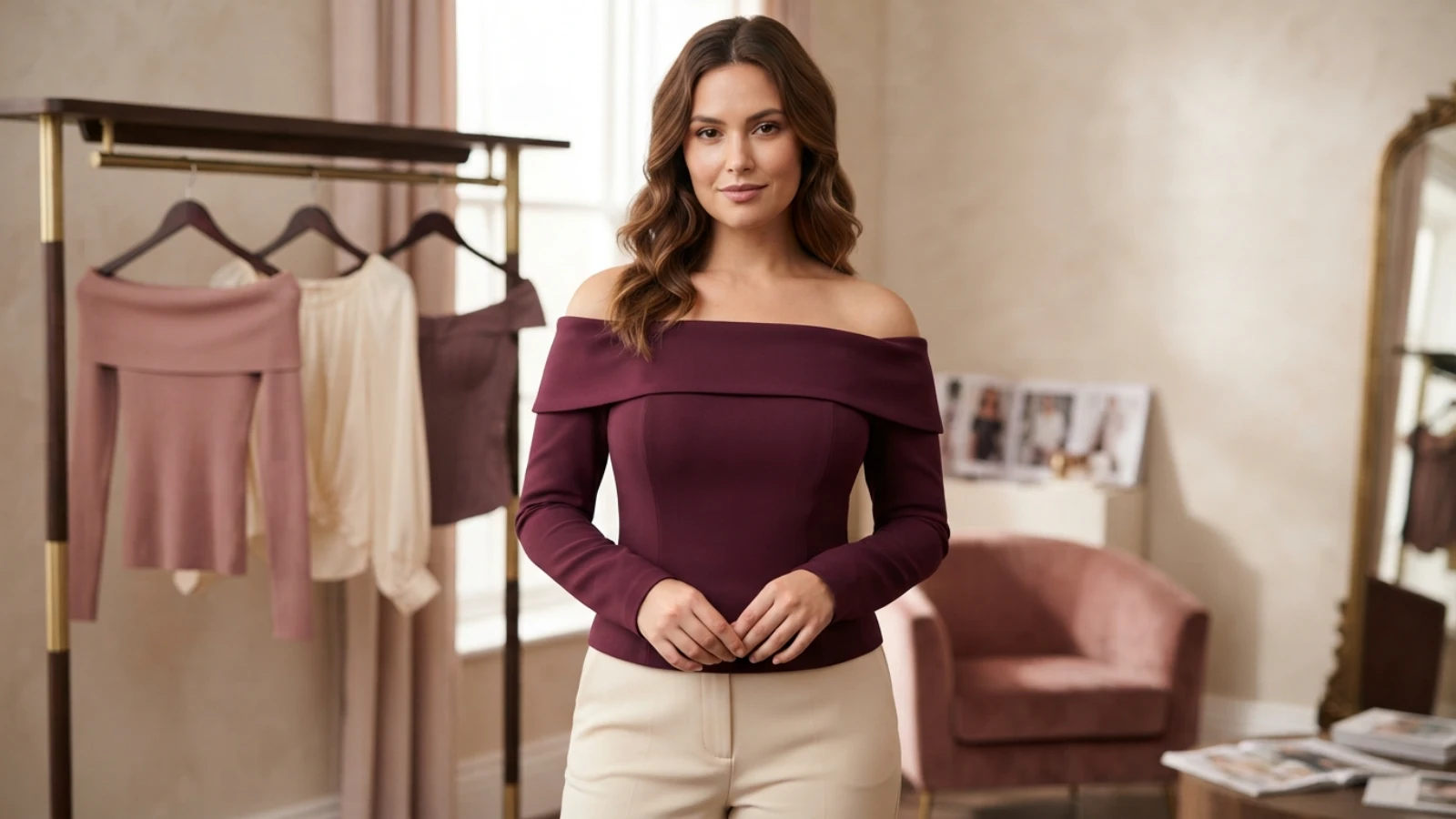
The best off-the-shoulder tops for a large bust do more than expose the collarbones. They hold a wide neckline in the intended position while giving the bust enough forward depth, keeping the sides contained, and allowing the arms to move without dragging the entire garment upward. That is a demanding pattern problem. A tight strip of elastic can create a secure product photograph, yet feel restrictive after twenty minutes. A loose romantic neckline can feel comfortable, yet reveal a strapless bra or slide down when you lean. This guide translates appearance into practical checks: relaxed and stretched neckline circumference, elastic recovery, silicone or internal grip, bodice anchoring, strapless-bra compatibility, cup or dart shaping, sleeve attachment, upper-arm ease, side height, front length, opacity, and return terms. The aim is to help you shortlist verified products later without invented ratings, false support claims, or a static model pose standing in for real fit evidence.
The eight-point off-shoulder fit check
Use this screen before color, ruffles, price, or an event deadline persuades you to keep a difficult fit.
- The neckline sits where intended without painful grooves, rolling, or repeated pulling.
- The bust has shaped room, so the upper edge does not rise and the front hem does not shorten dramatically.
- The intended strapless bra is concealed at the front, sides, and back during movement.
- The bodice feels secure around the torso instead of depending entirely on upper-edge elastic.
- The sleeves allow reaching, sitting, and driving without lifting the whole neckline.
- The side seams remain close to vertical and the side edge contains breast tissue and the bra cup.
- The fabric stays opaque, smooth, and resilient when stretched over projection.
- You can wear the complete outfit for the required hours without restriction or constant adjustment.
Best off-the-shoulder tops for a large bust by type and purpose
The best off-the-shoulder tops are not one universal shape. A firm Bardot knit for dinner, a woven blouse for a summer event, and a bra-sized bodice for formal wear solve different problems. Start with where the garment anchors, what support layer it expects, how the sleeves connect to the neckline, and how long you need to wear it. The following six archetypes provide a more useful shopping filter than “flattering” or “supportive” alone.
Structured Bardot top
Best for: polished dinners, work-adjacent events, and tailored outfits.
A structured Bardot top uses seams, lining, interfacing, or a firm knit to hold a defined upper edge. Look for bust darts or princess seams, a back closure, and enough torso stability that the top does not rely on aggressive elastic. This type often creates the cleanest neckline under a blazer or with tailored trousers. It is less forgiving when the bust shaping is shallow, so garment measurements and side-view photographs matter.
Wide fold-over knit
Best for: knit comfort, adjustable shoulder exposure, and easy styling.
A broad fold-over band spreads pressure and can be positioned slightly higher or lower. Medium-weight rib, ponte, or substantial jersey usually behaves better than thin single jersey because it recovers after stretching and does not immediately reveal every bra edge. Confirm that the folded panel remains flat over a fuller bust instead of rolling upward or creating a bulky horizontal ridge.
Softly gathered off-shoulder blouse
Best for: warm weather, romantic styling, and easier bust accommodation.
Gathering can provide valuable volume, but it should release from a stable neckline into a shaped body. Choose controlled gathers rather than excessive ruffles concentrated at the fullest part of the bust. A separate elastic channel, lined upper edge, side seams with enough height, and a fluid but opaque fabric make the silhouette easier to wear. Compare more general woven options in the best blouses for a large bust guide.
Corset-seamed off-shoulder top
Best for: formal outfits and defined torso support.
Princess seams, a firm underbust area, boning, and a secure back can reduce the job assigned to the neckline. The crucial question is whether the cups or bust panels are genuinely deep enough. A decorative corset look with shallow cups may cut across breast tissue and push the neckline upward. Prefer bra-sized construction or clearly published garment measurements, and never assume boning automatically equals support.
One-shoulder convertible neckline
Best for: asymmetric styling and a little more upper-body anchoring.
Some stretch necklines can be worn fully off both shoulders or raised onto one shoulder. The one-shoulder position adds an anchor and may improve mobility while preserving an open neckline. Check that the construction is genuinely designed for both arrangements; simply pushing one side upward can twist the bust, sleeve, or side seam. If you prefer a centered neck strap, compare the best halter tops for a large bust.
Bra-sized support-integrated top
Best for: fuller support needs and low or difficult back lines.
When properly engineered, a bra-sized top uses cups, an underband, a secure back, and sometimes boning to support independently of the shoulder edge. Verify that the size uses both band and cup information, not only small-to-large labels. Read how the back closes, whether the underband adjusts, and whether the cup shape matches your projection. Integrated support should feel like a stable foundation garment, not a thin shelf panel sewn into a fashion top.
| Type | Primary advantage | Main fit risk | Support plan to verify |
|---|---|---|---|
| Structured Bardot | Defined, polished upper line | Shallow bust shaping | Strapless bra or stable lined bodice |
| Wide fold-over knit | Comfort and position flexibility | Band rolling upward | Smooth strapless or longline bra |
| Gathered blouse | Soft volume for projection | Elastic riding up | Concealed strapless bra with adequate sides |
| Corset-seamed | Torso anchoring | Cups cutting across tissue | Bra-sized or genuinely deep integrated cups |
| Convertible one-shoulder | Extra upper anchor | Twisted seams | Convertible or strapless bra |
| Bra-sized integrated | Support built into structure | Incorrect band or cup proportion | Published band-and-cup sizing |
How the best off-the-shoulder tops stay in place
An off-shoulder neckline has to resist several forces at once. The bust pushes the front forward; the arms and sleeves pull laterally and upward; gravity encourages a loose edge to fall; and a short front length can drag the entire garment higher. The best off-the-shoulder tops manage those forces through a coordinated system rather than one very tight elastic band.
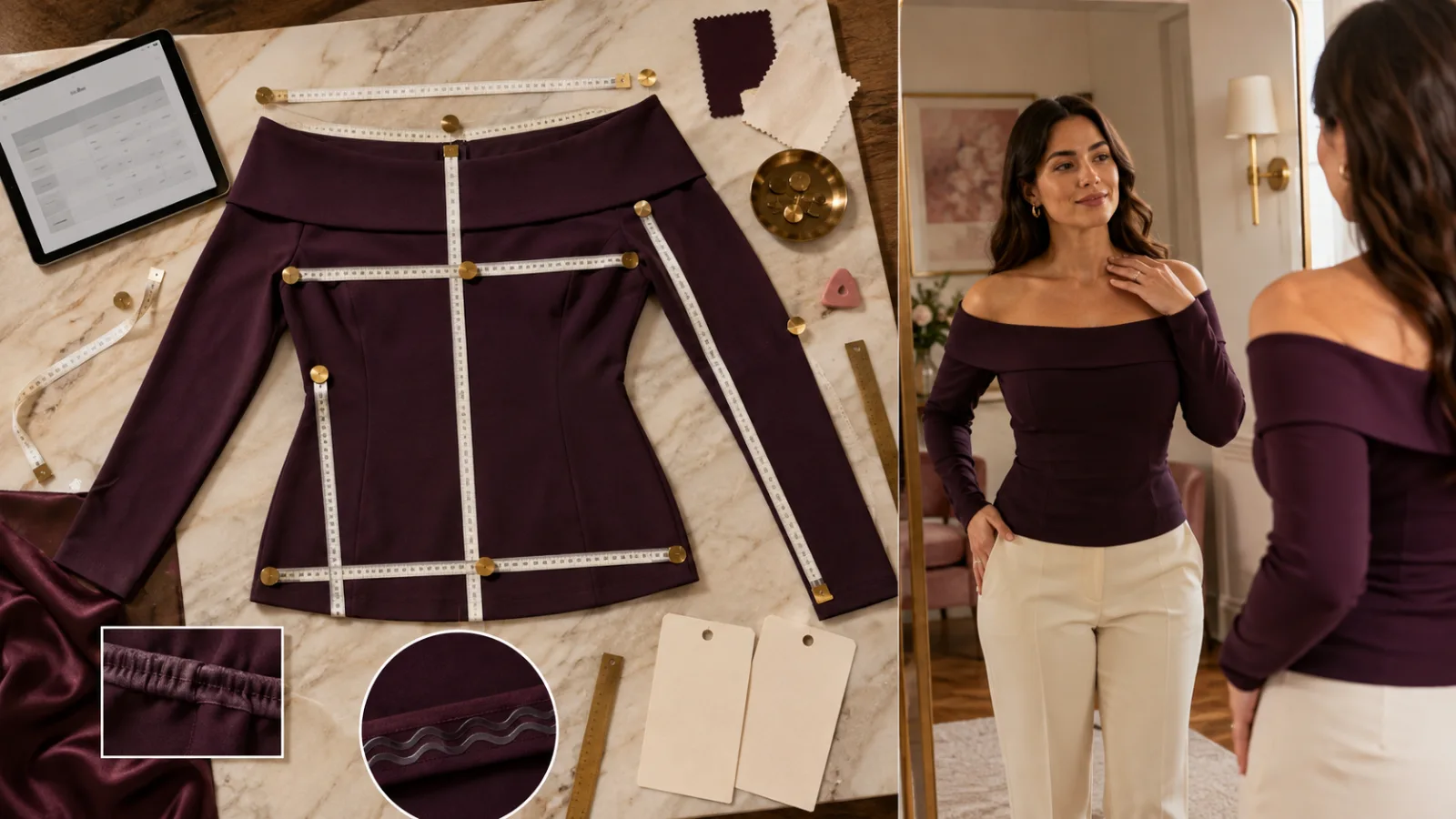
First, the neckline circumference must suit the intended wearing position. If it is cut for the high shoulder but styled lower in the photograph, it may spring upward whenever you move. If it is far larger than the shoulder line, the edge may depend on a narrow elastic channel or repeated adjustment. Product pages rarely publish neckline circumference, so compare the top with a similar item laid flat and ask customer service for the relaxed and safely stretched measurement when possible.
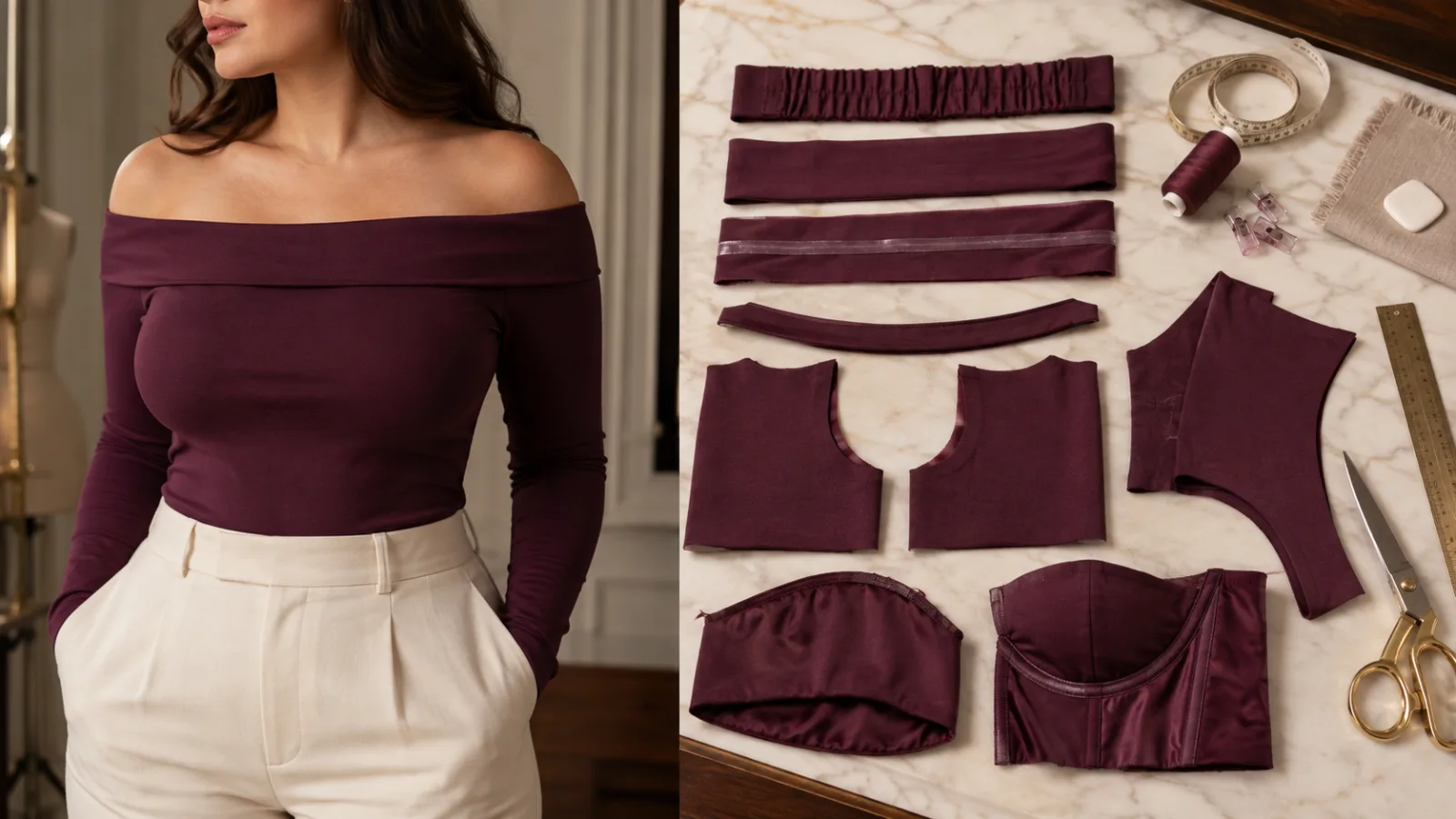
Second, the bodice needs enough bust depth. Missing projection is often misdiagnosed as bad elastic. When the bust takes more horizontal and vertical fabric than the pattern allows, the neckline gets pulled forward and upward, the sleeves rotate, and the front hem rises. Darts, princess seams, gathering placed below a stable edge, cup seaming, or stretch with strong recovery can create the required three-dimensional room.
Third, the sleeves should not control the whole neckline. A raglan-like off-shoulder sleeve attached continuously to the upper channel often rises when the arms lift. Separate elastic at the sleeve, a gusset, a dropped sleeve cap with enough mobility, or a convertible neckline can reduce that tug. No fully off-shoulder top will behave exactly like a conventional set-in sleeve, but it should recover to position without a full outfit reset after ordinary movement.
Elastic, silicone grip, and pressure in the best off-the-shoulder tops
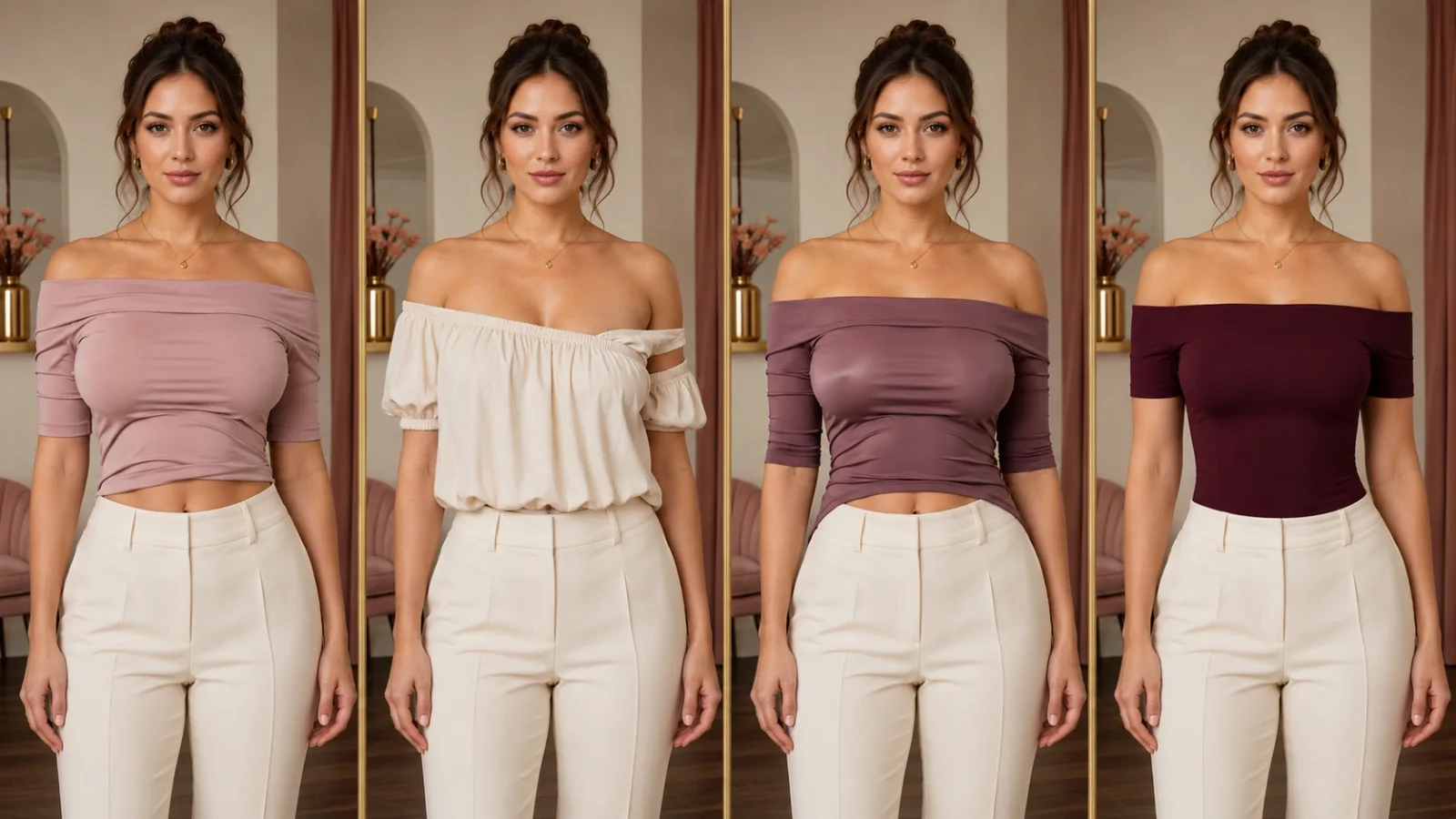
The best off-the-shoulder tops hold their line without punishing the skin. Elastic quality matters more than maximum tightness. A broad, soft channel spreads pressure; a narrow cord concentrates it. Recovery matters too: the edge should return after stretching, yet not snap into the upper arms. Fold-over bands can distribute pressure well, provided the inner seam remains flat and the knit has enough body to resist rolling.
Silicone grip can reduce sliding in structured formal tops, but it is not automatically more comfortable. The strip should be smooth, cleanly applied, and wide enough to avoid a sharp pressure line. Heat, perspiration, skincare products, and individual skin sensitivity can change how it feels. Try the complete outfit at home with tags protected. If the grip causes itching, redness, or pinching, the theoretical security does not make it a good purchase for you.
Run a timed comfort test. Wear the top with the intended bra for twenty to thirty minutes while sitting, standing, turning, and reaching. Look for growing pressure rather than only immediate pain. An upper edge can feel acceptable in the fitting room and become distracting over dinner. The best off-the-shoulder tops remain stable because the whole body of the garment participates; loosening the neckline slightly should not cause the top to collapse.
The two-finger test is only a clue
Being able to slide two fingers under an elastic edge can reveal extreme tightness, but it cannot guarantee comfort or security. Elastic width, stretch ratio, skin sensitivity, shoulder shape, garment weight, and wearing time all matter. Treat numbness, tingling, breathing restriction, persistent grooves, or skin irritation as clear reasons to remove the top.
Bra compatibility and torso support for a fuller bust
Choose the support garment before judging the fashion top. A correctly fitted strapless bra usually provides the cleanest reusable foundation because the band—not removable straps—does most of the support work. A longline style can add torso stability for formal wear, while a convertible bra may work when the manufacturer explicitly allows strap removal or a low-back configuration. A light bandeau may supply coverage but should not be assumed to supply fuller-bust support.
Put the bra on first, confirm that its band is level and secure, then assess the top from the front, side, and back. The neckline should cover the cup edge without needing to be pulled unnaturally high. The side seam and underarm area should conceal the outer cup or make any exposure clearly intentional. The back neckline should not sit so low that it reveals the strapless band every time you bend.
Integrated support is meaningful only when the garment contains an actual load path: defined cups or bust panels, an underbust seam or band, stable side wings, and a secure back. A loose shelf lining can smooth but may not lift or separate. When the listing uses ordinary clothing sizes and gives no cup-depth information, assume the internal panel is light shaping until evidence shows otherwise.
If a conventional bra is non-negotiable, an off-shoulder look may not be the most practical daily choice. A wide scoop or square neck can create an open upper line while covering straps; compare the best necklines for a large bust and the best tank tops for a large bust before buying a special support solution for one garment.
Fabric and shaping that make the best off-the-shoulder tops work
Fabric determines how the top responds when the bust projects forward and the sleeves move. Pattern shaping determines whether there is room to begin with. The best off-the-shoulder tops use both. A highly stretchy fabric can accommodate circumference but still flatten the bust, reveal the bra, or lose recovery. A rigid woven can look crisp but needs darts, seams, gathering, or cup shaping to create depth.
Stable knits
Ponte, double knit, compact rib, and substantial jersey can support a fold-over neckline and smooth over the bra. Look for stretch recovery: gently extend an inconspicuous area and watch whether it returns without rippling. The fabric should remain opaque over the fullest point. Thin rib may expand dramatically, turn shiny, or let the neckline band roll because the body cannot counter its weight.
Woven fabrics with controlled drape
Crepe, cotton poplin, linen blends, and lined chiffon can create beautiful off-shoulder silhouettes, but each needs appropriate shaping. Crisp cotton benefits from darts or panels; fluid crepe needs a stable neckline and enough torso control; linen needs ease for sitting and reaching; sheer fabrics need a lining that shares the same bust depth. The fabric guide for a large bust explains how weight, drape, opacity, and recovery affect fit.
Ruffles and surface volume
A ruffle can soften the neckline edge and provide coverage, but its scale and placement change the visual line. A shallow, fluid flounce that travels cleanly across the shoulders often behaves better than several stiff layers ending at the fullest part of the bust. Surface decoration cannot replace projection room. If the base bodice is tight, the ruffle may tilt upward in front and advertise the imbalance.
Seam and dart placement
A bust dart should aim toward the fullest point without ending directly on it. Princess seams should travel smoothly over projection rather than cutting across it. An underbust seam should sit beneath the breast tissue, not climb onto it. When these landmarks are consistently too high or too shallow across sizes, the pattern proportion—not merely the labeled size—is the problem.
Sleeves, upper arms, side coverage, and front length
The sleeves are often the hidden reason an off-shoulder top rides up. When the sleeve cap is short, the upper arm is tight, or the elastic channel connects the sleeves and neckline as one unbroken loop, raising the arms pulls everything upward. The best off-the-shoulder tops give the arms enough independent room for the movements required by the occasion.
Test four motions: reach forward as if driving, lift a glass, place both hands on the back of the head, and put on the jacket or coat you intend to wear. The neckline may shift slightly—this is a low, wide cut—but it should return without exposing the bra or trapping the arms. If every reach requires pulling both sides down, the garment will become work rather than clothing.
Check the upper-arm circumference against a sleeve you already tolerate. Elastic cuffs should stretch without digging, and puff sleeves need enough bicep room beneath their volume. A dramatic sleeve can look generous while the actual elastic opening is small. Sleeve weight also matters: heavy gathered fabric can drag a loose neckline downward, whereas stiff fabric can push it upward.
Side height and front length reveal missing bust room. If the side seam angles forward, the underarm opens, or the front hem is much shorter than the back, the bust is borrowing fabric from neighboring areas. Measure front length from the neckline or shoulder reference used by the retailer to the hem, then compare it with a successful top. A high-low hem can be intentional, but the side seams should still hang predictably.
| Movement | What should remain stable | Failure signal | Likely cause |
|---|---|---|---|
| Reach forward | Back edge and sleeves | Neckline jumps above shoulders | Sleeve mobility or neckline circumference too small |
| Lift one arm | Opposite side and bra coverage | Whole bodice twists | Connected elastic channel or tight upper arm |
| Sit and lean | Front coverage and back band | Bra edge appears | Loose neckline or insufficient bust depth |
| Add a jacket | Sleeve position and upper edge | Fabric bunches under layer | Excess sleeve volume or incompatible layer |
| Wear for 30 minutes | Comfort and recovery | Grooves, rolling, or constant adjustment | Aggressive elastic or weak recovery |
Choosing the best off-the-shoulder tops for work, events, travel, and weekends
The best off-the-shoulder tops are the ones that remain functional for the real occasion. A low neckline that succeeds during a two-hour dinner may be frustrating for a full workday or long drive. Decide how much arm movement, sitting, layering, temperature change, and support the outfit must handle before choosing the most dramatic silhouette.
For work or polished daytime settings
First confirm that the neckline suits the dress code. A higher Bardot line that rests near the shoulder tips, firm fabric, modest sleeve volume, and tailored trousers creates a controlled result. Keep a blazer or cardigan that can be put on without forcing the neckline upward. If you will spend hours typing, test the forward reach carefully. A wide scoop blouse may preserve the open line with less adjustment when full shoulder exposure is impractical.
For weddings and evening events
A structured woven, corset-seamed top, or bra-sized bodice can balance formal polish with security. Build the outfit from the strapless or longline bra outward, then test sitting, dining, photographs, dancing, and the coat-check layer. Avoid relying on fashion tape as the only stabilizer; it may help an edge, but it does not create bust depth, replace a supportive band, or fix sleeves that drag the neckline.
For travel
Driving, lifting luggage, and repeated layering demand more mobility than a mirror fitting. A wide fold-over knit or convertible one-shoulder design is usually easier than a rigid upper edge. Choose wrinkle-resistant fabric, a bra you can tolerate for the full journey, and a layer that slips over the sleeves. If you need to reset the neckline after every reach, save the top for the destination rather than the transit day.
For weekends and warm weather
A gathered cotton or linen-blend blouse can feel airy, but check the lining, elastic, and underarm coverage. Pair a visually active neckline with a simple lower half when you want the shoulder line to be the focus. Comfort is not the same as looseness: a very wide neckline can be more distracting than a gently secured one. The best off-the-shoulder tops let you move through the day without planning every gesture.
Diagnose fit problems before returning the best off-the-shoulder tops
A symptom often appears far from its cause. An upper edge that rises may be blamed on elastic when the front is too short for the bust. A gaping neckline may come from sizing up to gain bust room. Use the table to identify whether a reversible setup change, a simple alteration, or a different pattern is the honest solution.
| Symptom | Likely cause | Try first | Keep, alter, or return? |
|---|---|---|---|
| Neckline rides above shoulders | Small circumference, tight sleeve cap, or short bust length | Test the next size and a different sleeve construction | Return if movement still controls the whole edge |
| Upper edge falls or reveals bra | Large neckline or weak elastic recovery | Confirm correct wearing position and bra height | Elastic replacement may help; major mismatch should return |
| Elastic leaves painful grooves | Excess tension or narrow channel | Stop the trial and compare a broader band | Return unless a tailor can safely replace accessible elastic |
| Front hem rises sharply | Insufficient projection room or front length | Compare a size up and shaped-front design | Return if the larger size destabilizes neckline and sides |
| Side bra cup shows | Low side edge or front panel too narrow | Try intended strapless bra and check next size | Return when coverage is a garment-cut issue |
| Fold-over band rolls | Thin knit, excessive tension, or bust pulling | Reposition once and test a firmer fabric | Return if rolling repeats during normal wear |
| Sleeves dig into upper arms | Small opening or aggressive cuff elastic | Measure bicep and compare garment opening | Elastic alteration may work if seam allowance permits |
| Fabric becomes shiny or sheer | Too much stretch over bust | Try larger size in daylight | Return if opacity requires an unstable oversized fit |
Temporary styling tools should never conceal a structural failure. Fashion tape may steady a small clean edge on dry skin when used according to its instructions, but it cannot add bust capacity or redistribute sleeve tension. Safety pins, clips, and improvised elastic changes can damage fabric and create pressure points. When the problem is fundamental, a return is cheaper and more comfortable than a collection of fixes.
How to shop for the best off-the-shoulder tops online
Online shopping becomes safer when a romantic silhouette is converted into specifications. “Stretchy,” “supportive,” and “stays put” are marketing terms unless the listing explains the fabric, elastic, lining, closure, and construction. The best off-the-shoulder tops for a large bust can be shortlisted by comparing a known garment, reading every view of the product, and protecting a realistic return path.
- Start with your support setup. Put on the strapless or longline bra you expect to wear and record its cup-edge, side-wing, and back-band height.
- Measure a comparable top. Lay it flat without stretching. Record bust width, front length, side height, hem width, upper-arm opening, and relaxed neckline width.
- Ask how the neckline is measured. A straight flat width, curved seam length, and full circumference are not interchangeable. Request relaxed and maximum recommended stretch values.
- Separate body and garment charts. A body-bust range tells who the brand targets; a garment bust tells how much physical space the item provides. You need to know which one is shown.
- Read fiber content with construction. Elastane percentage alone does not reveal weight, opacity, lining, rib structure, or recovery. Use composition as one clue, not the decision.
- Inspect front, side, and back images. Look for rotated seams, raised front hems, visible bra edges, upper-edge rolling, and whether every model keeps the arms down.
- Read fit notes by symptom. Prioritize comments about riding up, elastic pressure, sleeve openings, bust compression, transparency, and front length from shoppers describing relevant proportions.
- Confirm the return clock. Check final-sale status, hygiene restrictions, return shipping, restocking fees, and whether a careful indoor movement test is allowed.
Garment measurements worth requesting
Ask for relaxed neckline circumference, safely stretched neckline circumference, bust or underarm width, front length, side-seam height, upper-arm opening, sleeve length, back height, hem width, and underbust measurement when the top is structured. Also ask whether lining and outer fabric stretch equally.
Fiber content does not guarantee fit, but it helps compare similar listings. The U.S. Federal Trade Commission explains the information generally required on covered textile labels in its textile labeling guidance. Elasticated, lined, structured, and embellished necklines may require specific care, so review the FTC’s care-label guidance and the garment’s actual care label before purchase.
What a tailor can realistically fix
Tailoring can refine a promising off-shoulder top, but it cannot cheaply redraft every relationship between neckline, bust, sleeves, and torso. A tailor may shorten accessible elastic, replace a poor-quality elastic channel, reduce a loose side seam, add discreet internal stays, adjust a cuff, or refine hem balance when adequate seam allowance exists. Some structured tops can accept a silicone strip or waist stay, but the method must suit the fabric and wearer.
Alterations become less predictable when the bust needs substantial extra depth, shaped cups sit on breast tissue, the neckline curve is fundamentally wrong, or sleeve mobility is built into an undersized pattern. Adding fabric invisibly to a prominent upper edge is difficult. Recutting a lined, boned, or embellished bodice may cost more than choosing a better design. Read the tailoring guide for a large bust before assuming a sale purchase is an easy project.
Take the intended bra and event underlayer to the fitting. Show the tailor the exact neckline position you want and perform the same movement test you used at home. Ask what changes when you sit, raise the arms, or add a jacket. A technically possible alteration is not automatically worthwhile; compare the complete cost, timeline, and risk with returning the garment.
How to style, care for, and value the best off-the-shoulder tops
The best off-the-shoulder tops earn their place by working with your support wardrobe, bottoms, layers, climate, and care habits. The neckline already creates a strong horizontal or curved line, so the rest of the outfit can be deliberately quiet or equally expressive. The goal is not to hide a fuller bust; it is to control where the eye travels and keep the clothing functioning.
Keep the vertical line clean
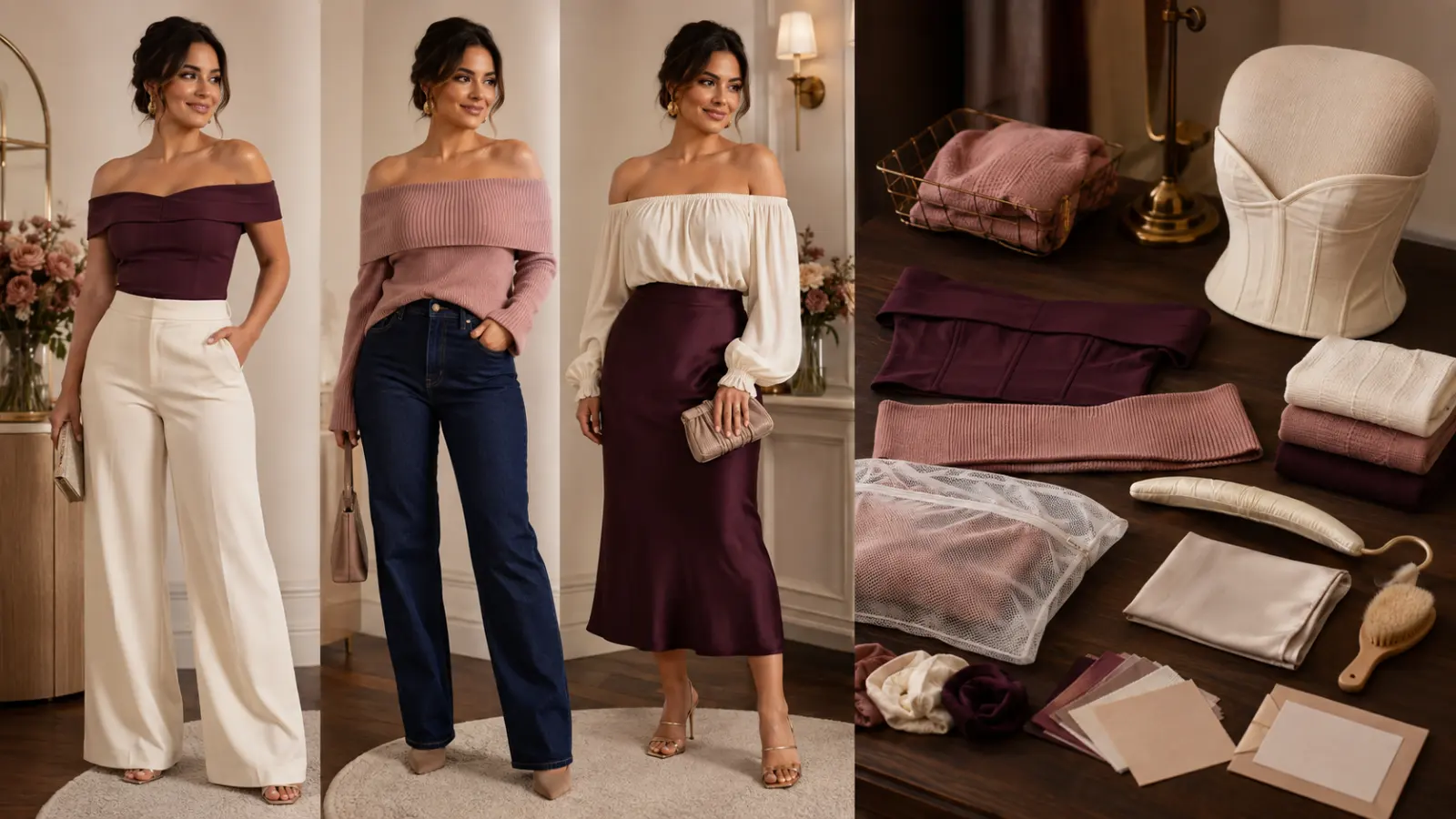
A high-rise straight trouser, fluid wide-leg pant, bias-cut midi skirt, or simple dark jean can provide a long lower line beneath an open neckline. A front tuck works only when the top has enough front length; forcing a short hem into the waistband can pull the neckline upward. For broader outfit principles, use the complete guide to dressing a large bust.
Layer without crushing the sleeves
A coat, cape, soft blazer, or open cardigan needs enough armhole and sleeve room for the chosen top. Very full puff sleeves can bunch under narrow tailoring and push the neckline out of place. Try the exact layer before the return window closes. The layering tips for a large bust help coordinate depth, fabric, and opening lines.
Choose accessories around the neckline
Collarbones and shoulders already create a focal area. Small earrings, a short necklace above the neckline, or a longer pendant ending clearly below the bust can preserve separation. Avoid a necklace that lands directly on a ruffle edge and repeatedly catches it. A belt can define the waist when the top has enough length and the neckline remains stable after blousing.
Protect elastic and grip
Follow the garment label. Heat can degrade elastic and silicone; hanging a heavy wet knit can stretch the neckline; rough storage can crease boning or crush structured cups. Fasten hooks before washing, use a laundry bag when directed, reshape fold-over bands, and store structured tops so the upper edge is not bearing the garment’s full weight. Never apply heat or adhesive to grip strips unless the care instructions permit it.
Calculate complete cost per successful wear
Add the price of a required strapless bra, tailoring, return shipping, and special cleaning to the garment price. Then count realistic outfits and occasions. The best off-the-shoulder tops justify the complete wardrobe cost. A moderately priced top that works with your existing bra and jacket may deliver better value than a dramatic bargain that needs a new foundation, alterations, and constant adjustment.
Buy the neckline as a system
The best off-the-shoulder tops for a large bust combine comfortable upper-edge stability, real projection room, a secure torso, independent sleeve mobility, adequate side height, resilient fabric, and a support layer chosen in advance. Test reaching, sitting, leaning, and layering before the return window closes. Keep the top only when it preserves both the clean shoulder line and your freedom to move.
FAQs about the best off-the-shoulder tops for a large bust
Are off-the-shoulder tops good for a large bust?
They can be excellent when the neckline is stable, the bust has enough three-dimensional room, the side seams are high enough, and the support plan works with the exposed shoulder line. A good off-shoulder top should stay in place without painfully tight elastic, crushing the bust, or needing constant pulling.
What type of off-the-shoulder top is best for a large bust?
A structured Bardot top, a wide fold-over knit, a softly gathered blouse with a shaped body, or an off-shoulder top designed around a stable strapless-bra line are dependable starting points. The best type depends on your required support, shoulder mobility, torso length, dress code, and how long you need to wear it.
What bra should I wear with an off-the-shoulder top?
A correctly fitted strapless bra is the most versatile option when conventional straps would show. Depending on the cut, you may also use a longline strapless bra, a convertible bra with straps removed as designed, a supportive bandeau for lighter needs, or a garment with genuinely bra-sized integrated support. Choose the bra before judging the top.
How do I stop an off-the-shoulder top from riding up?
Look for a neckline circumference that matches your shoulder line, elastic or silicone grip with controlled recovery, sleeves anchored independently from the upper edge, and enough bust and front-length room. If raising your arms drags the whole neckline upward, a different pattern is usually more effective than tightening the elastic.
Should I size up in an off-the-shoulder top for a fuller bust?
Size up when the current size compresses the bust, turns the fabric sheer, pulls the neckline upward, rotates the side seams, or lifts the front hem. Do not size up automatically if the larger size becomes loose across the shoulder line or exposes the bra. Compare garment measurements and try another cut when adjacent sizes trade one problem for another.
Can off-the-shoulder tops be supportive without straps?
The top itself can contribute support when it has a firm torso, shaped cups, an underbust seam, boning, a secure back, or bra-sized construction. A decorative elastic neckline alone is not a reliable support system for a fuller bust. Most everyday designs work best over a correctly fitted strapless or longline bra.
How tight should the neckline elastic feel?
It should hold the upper edge in the intended position without leaving painful grooves, restricting breathing, causing numbness, or forcing the shoulders inward. Test it for at least twenty minutes while sitting, reaching, and turning. Persistent pressure or skin irritation means the edge is too aggressive, even if it looks secure.
What measurements matter when buying an off-the-shoulder top online?
Compare the relaxed and stretched neckline circumference, bust or underarm width, front length, side-seam height, upper-arm width, sleeve length, hem width, and any underbust or torso measurement with a similar top you own. Confirm whether the chart gives body or garment measurements and read the fabric, elastic, lining, closure, and return details together.