Best Blouses for a Large Bust
The best blouses create room through cut, seams, and drape—not by becoming oversized everywhere. This guide shows which details keep the neckline settled, the shoulders neat, and the front hem balanced.
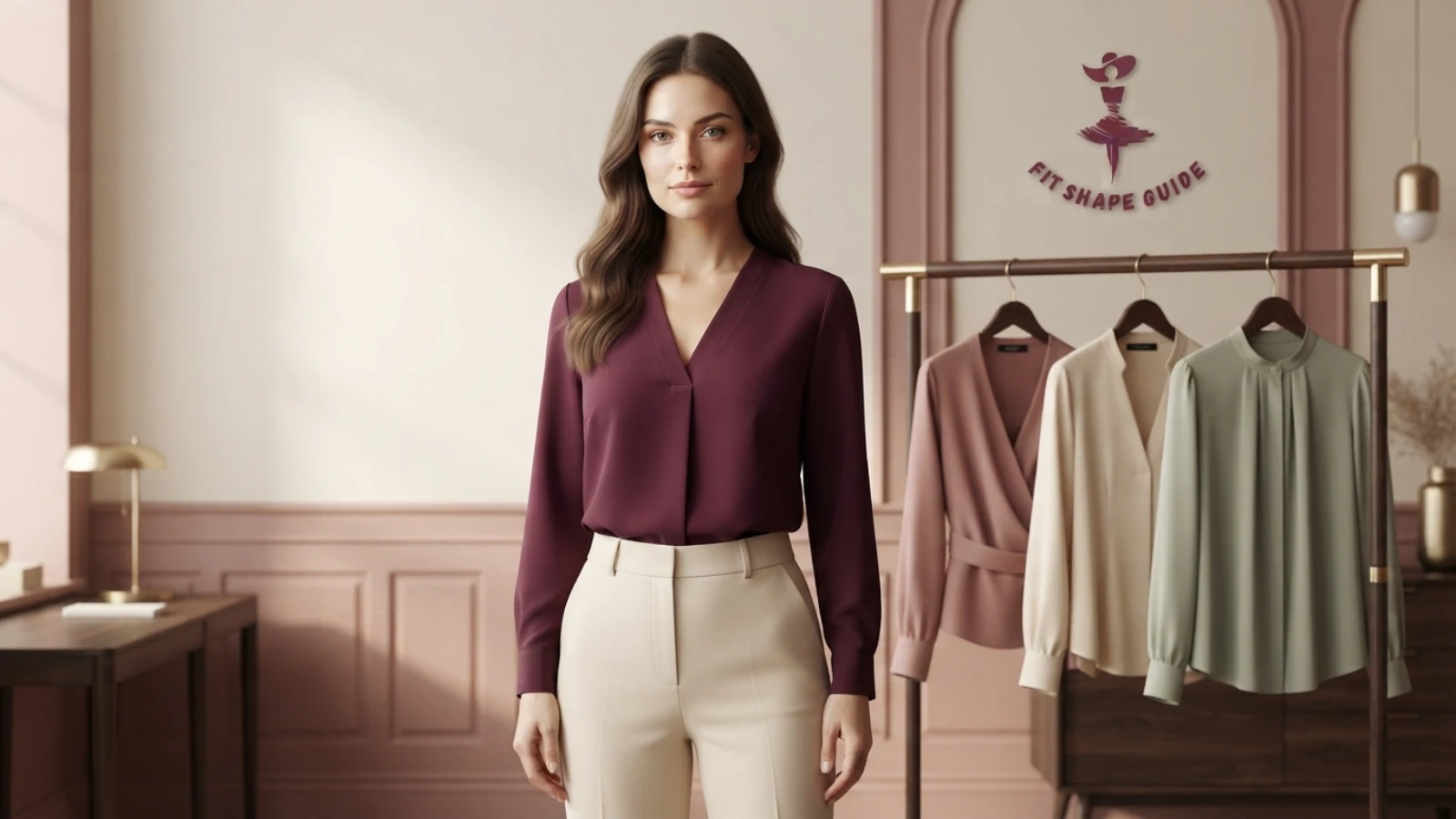
A blouse can have no buttons to gape and still fit badly. The neckline may slide backward, a shoulder pleat may open over the bust, the front hem may climb, or soft fabric may cling to every line beneath it. These problems are often blamed on the person wearing the blouse, but they begin in the pattern. The best blouses for a large bust distribute enough fabric through the front, control it with darts, curved seams, pleats, or a wrap, and use a neckline that remains stable once the garment moves. A useful blouse also has the right degree of drape for its purpose: polished enough for work, resilient enough for travel, and opaque enough to wear without constant checking.
Quick answer
The best blouses for a large bust are usually semi-fitted V-neck, scoop-neck, wrap, princess-seam, or softly draped styles with deliberate bust shaping and enough front length. Look for bust darts or curved seams, a neckline facing that lies flat, shoulder seams that end correctly, and opaque crepe, viscose twill, stretch woven, or substantial jersey with good recovery. Choose the blouse by finished garment measurements when possible, then test it while sitting, reaching, and raising the arms. A blouse that only looks smooth while standing still is not a reliable fit.
The six-point check for the best blouses
- The neckline should stay in place without falling open, pulling backward, or requiring repeated adjustment.
- Room should be added over the bust through darts, seams, gathers, or wrap overlap—not through excess shoulder width.
- The front hem should sit close to level with the back, unless an intentional high-low cut is clearly built into the pattern.
- Soft fabric should skim rather than cling; structured fabric should hold shape without forming sharp horizontal strain lines.
- Armholes and sleeves must allow forward reach without dragging the entire blouse upward.
- Decorative detail should be placed intentionally. Ruffles, pockets, ties, and pleats are not automatically wrong, but their scale and location change the visual and physical fit.
Best blouses for a large bust by type and fit need
“Blouse” covers garments with very different architecture, so the best blouses cannot be judged by one silhouette rule. A woven shell hangs from the shoulders. A wrap blouse controls fit through overlap and ties. A princess-seam blouse builds depth through curved panels. A gathered yoke releases fabric below a seam, while a substantial knit relies on stretch and recovery.
The most useful first question is what you need the blouse to do. The best blouses for waist definition use vertical shaping rather than a wide belt fighting against a boxy top. For reliable office coverage, prioritize a stable neckline and opaque fabric over dramatic drape. If comfort while travelling matters most, controlled stretch and crease resistance may be worth more than a sharply tailored outline.
A medium V creates breathing room around the neckline, while darts or princess seams prevent the body from becoming boxy. Matte crepe drapes cleanly and usually transitions well between work and dinner. The trade-off is that lightweight crepe may need a camisole if it becomes sheer under bright light.
A true wrap can adapt through the waist and create front depth without extra width at the back. Choose generous overlap, an anchored neckline, and a tie that sits at the waist rather than directly beneath the bust. The trade-off is that a shallow overlap can open while sitting.
Curved vertical seams add room over the bust and remove excess below it, producing definition without tight stretch. The trade-off is exact placement: a seam curve drafted too high or too narrow is difficult to disguise and more involved to alter.
Jersey allows movement and can work especially well in crossover or softly draped necklines. Choose matte fabric with enough weight to skim and recover. The trade-off is that thin jersey may cling, grow longer over the front, or reveal every line underneath.
A sleeveless or short-sleeve shell slips neatly under blazers when its armholes, neckline, and darts are controlled. The trade-off is that many shells are cut too straight, forcing a size-up that leaves the armholes open and the shoulder line wide.
A back or front yoke can release deliberate volume and make ease look designed rather than accidental. The trade-off is placement: gathers beginning directly over the fullest area may create bulk, while a pleat that cannot open may restrict movement.
| Blouse construction | Best for | Why it can work | Inspect before buying |
|---|---|---|---|
| Darted V-neck woven | Work and smart casual | Open neckline plus targeted front depth | Dart height, neckline facing, opacity, and front hem level |
| True wrap blouse | Adjustable waist definition | Overlap creates flexible front room | Overlap while seated, tie position, and neckline anchoring |
| Princess-seam blouse | A tailored silhouette | Vertical curved panels distribute volume precisely | Curve alignment and whether the seams twist toward the sides |
| Draped-neck jersey | Movement and travel | Resilient knit moves without sharp pulling | Neckline stability, recovery, cling, and bra coverage |
| Darted shell | Layering under jackets | Low-bulk construction keeps layers clean | Armhole gap, shoulder width, and neckline depth |
| Yoke with controlled pleats | An intentionally relaxed fit | Adds movement without sizing up every dimension | Where pleats open and whether the front balloons when tucked |
How the best blouses keep the neckline stable
The best blouses often use an open neckline because it breaks up one large field of fabric and gives the upper torso a clearer frame. That does not mean the deepest neckline is automatically the best. A neckline succeeds when its shape, depth, width, facing, and closure remain stable during movement.
Medium V-necks are versatile, but the V must be anchored
A medium V can lengthen the visual line and reduce fabric crowding near the neck. Check the point of the V: it should lie flat rather than curling outward, and the two neckline edges should have enough reinforcement to resist stretching. A stitched facing, binding, or clean crossover edge provides more control than a raw-looking fold. If the neckline moves wider each time the blouse is pulled over the head, it may become difficult to wear after a few washes.
Scoop and split necklines offer a calmer alternative
A moderate scoop can work beautifully when the curve is broad enough to look intentional but not so wide that bra straps appear. A split neck provides a vertical opening while retaining more coverage than a V. For both, examine the shoulder span. A neckline that is attractive from the front can still be too wide at the shoulder, causing the blouse to migrate outward and expose the underlayer.
Wrap and surplice necklines need overlap, not wishful styling
A wrap effect can be useful because diagonal edges shape the front, yet there is a difference between a true wrap and a fixed surplice. A true wrap adjusts through ties. A fixed surplice is stitched in place and must fit correctly as drafted. Sit down and lean slightly forward: if the overlap opens, the issue is not solved by standing straighter. Look for an internal snap, a modesty panel, or deeper fabric overlap. A camisole is a valid styling choice, but it should be intentional rather than emergency coverage for a neckline that never stays put.
After putting on a blouse, move the neckline into place once and leave it alone for five minutes. Sit, turn, and reach. If you must keep pulling the blouse forward or closing the neckline with your hand, the pattern is migrating and will demand attention all day.
High necklines are not forbidden. A mock neck, jewel neck, or tied neck can look polished when the fabric has drape and the shoulder line remains clean. The trade-off is visual concentration: a large unbroken front panel makes cling, tension, shine, and print placement more noticeable. If you prefer more guidance on how different openings change the frame, the best necklines for a large bust guide explains the construction and styling trade-offs in depth.
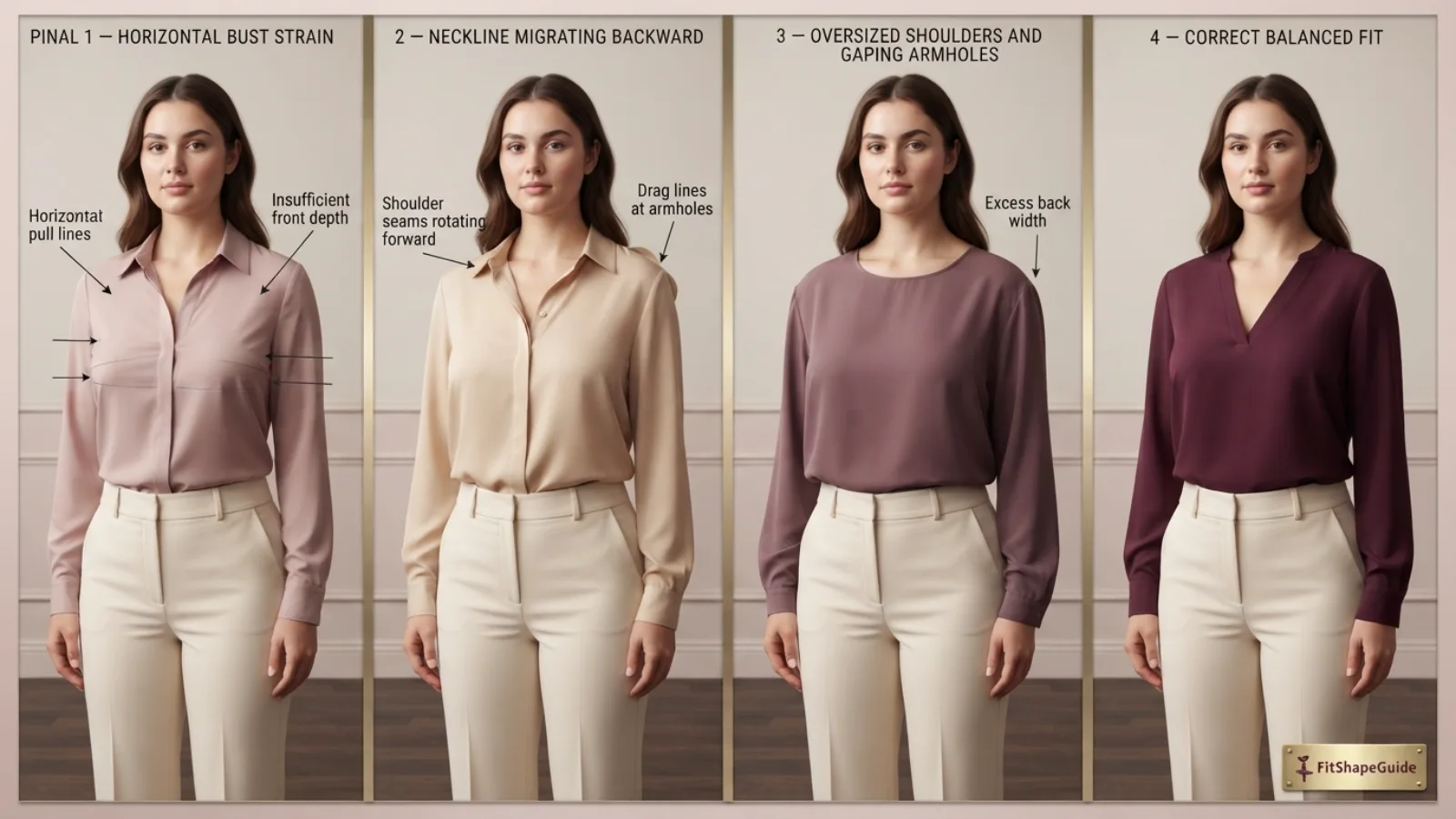
Why the best blouses build three-dimensional bust room
The best blouses distribute fabric forward instead of borrowing room from the shoulders. A blouse can match a bust circumference on a size chart and still fail because the fabric is distributed incorrectly. A straight front panel offers width but little projection, so it may pull upward, push the neckline backward, or stand away from the waist. Three-dimensional shaping directs fabric where it is needed and removes it where it is not.
Bust darts should point toward fullness without reaching it
A side bust dart is a stitched wedge that turns flat cloth into a shaped front. Its tip should aim toward the fullest area and stop before it. If the dart ends too high, loose fabric may collect above while the lower front strains. If it sits too low, the blouse can look dragged down. Dart placement is more valuable than the mere presence of a dart.
Look from the side as well as the front. A correctly placed dart creates a smooth route from side seam to front. A dart that forms a bubble at its tip may be too long or pressed poorly. A small bubble can sometimes be corrected; an entire dart positioned in the wrong vertical zone usually signals a pattern mismatch.
Princess seams spread shaping across a longer line
Princess seams run vertically and curve through the front. Because shaping is distributed along the seam, they can create more bust room and stronger waist definition than a single dart. They also create a useful visual line. The curve must align with the garment’s actual point of fullness. If the seam drifts outward, flattens too early, or twists toward the side, the blouse may have been drafted for a different proportion.
Gathers and pleats are useful only when their release point makes sense
Soft gathers at a shoulder yoke can create front room, but very dense gathering directly above the bust may produce unwanted volume. A center-front pleat can provide movement yet may open dramatically while sitting. The most controlled versions release fabric from a stable yoke and distribute it across the front rather than concentrating it at one point.
Front length is the detail many size charts omit
A blouse needs enough length to travel over the bust and still reach the intended hem position. If front length is inadequate, the hem rises, side seams angle forward, and a tuck pulls out. Buying a longer overall size may make the back too long while leaving the front balance unchanged. Look for a level side seam, a hem that stays where designed, and enough front length to raise the arms without exposing the waistband.
One practical comparison is to measure a blouse that already behaves well. Lay it flat without stretching and record the half-bust width, shoulder width, front length from the high shoulder point, armhole depth, and width at the hem. If it has darts, measure from the shoulder to the dart tip. These numbers create a personal garment benchmark that is often more informative than a retailer’s body chart.
Best blouse fabrics: compare drape, recovery, opacity, and surface
The best blouses use fabric that supports the pattern rather than merely feeling soft on a hanger. Retailers often use words such as “flowy,” “silky,” or “stretchy,” but none explains how the fabric will behave after two hours of sitting, under office lighting, or against a support layer. Four properties matter more.
Drape determines whether fabric falls or tents
Viscose twill, matte crepe, and many Tencel or lyocell blends have enough weight to fall downward after passing over the bust. That can create a clean, fluid line without tightness. Very crisp cotton, organza-like cloth, and stiff polyester may project outward from the fullest area unless the pattern includes precise shaping. Structure is not bad, but it demands more accurate fit.
Recovery determines whether stretch remains controlled
Stretch describes expansion; recovery describes return. A fabric can stretch comfortably and still grow longer across the front, loosen at the neckline, or develop a wavy hem. Gently stretch a discreet section of the blouse and release it. The surface should return quickly without rippling or turning shiny. Substantial jersey and stretch woven fabrics can be excellent when recovery is firm.
Opacity must be checked in motion and light
Hold the fabric toward a light source, then check it again while it is lightly tensioned. Some fabrics look opaque on a hanger and become transparent over the bust or shoulder blades. A camisole can solve sheerness, but it adds heat, seams, and another neckline to coordinate. If the blouse is meant for work or travel, built-in opacity may be worth prioritizing.
Surface finish changes how fit lines appear
High shine reflects from every fold and makes local tension more visible. Matte crepe, sandwashed fabric, and softly textured weaves are generally quieter. Satin can still work beautifully, especially for evening, when the cut has adequate ease and the bias does not twist. Its trade-off is demanding care and more visible wrinkling, snagging, and underlayer lines.
| Fabric | Typical behavior | Strong use | Main trade-off |
|---|---|---|---|
| Matte crepe | Fluid with a lightly textured surface | Office, dinner, travel | Light versions may be sheer or snag easily |
| Viscose twill | Soft, weighted drape | Relaxed blouses and tucked looks | Can shrink or crease if care instructions are ignored |
| Stretch woven | Structured with controlled movement | Tailored shells and princess seams | Poor recovery can create shine and rippling |
| Substantial jersey | Flexible and softly skimming | Travel and comfort-first dressing | Thin jersey can cling or grow |
| Silk or satin | Fluid with reflective highlights | Evening and polished occasions | Shows tension, wrinkles, snags, and moisture more readily |
| Crisp cotton | Holds a defined silhouette | Architectural or tailored styles | Needs accurate darts and more ease to avoid tenting |
For a deeper comparison of weave, weight, cling, and recovery, use the fabric guide for a large bust. It is especially useful when two blouses share a similar cut but behave differently because of material.
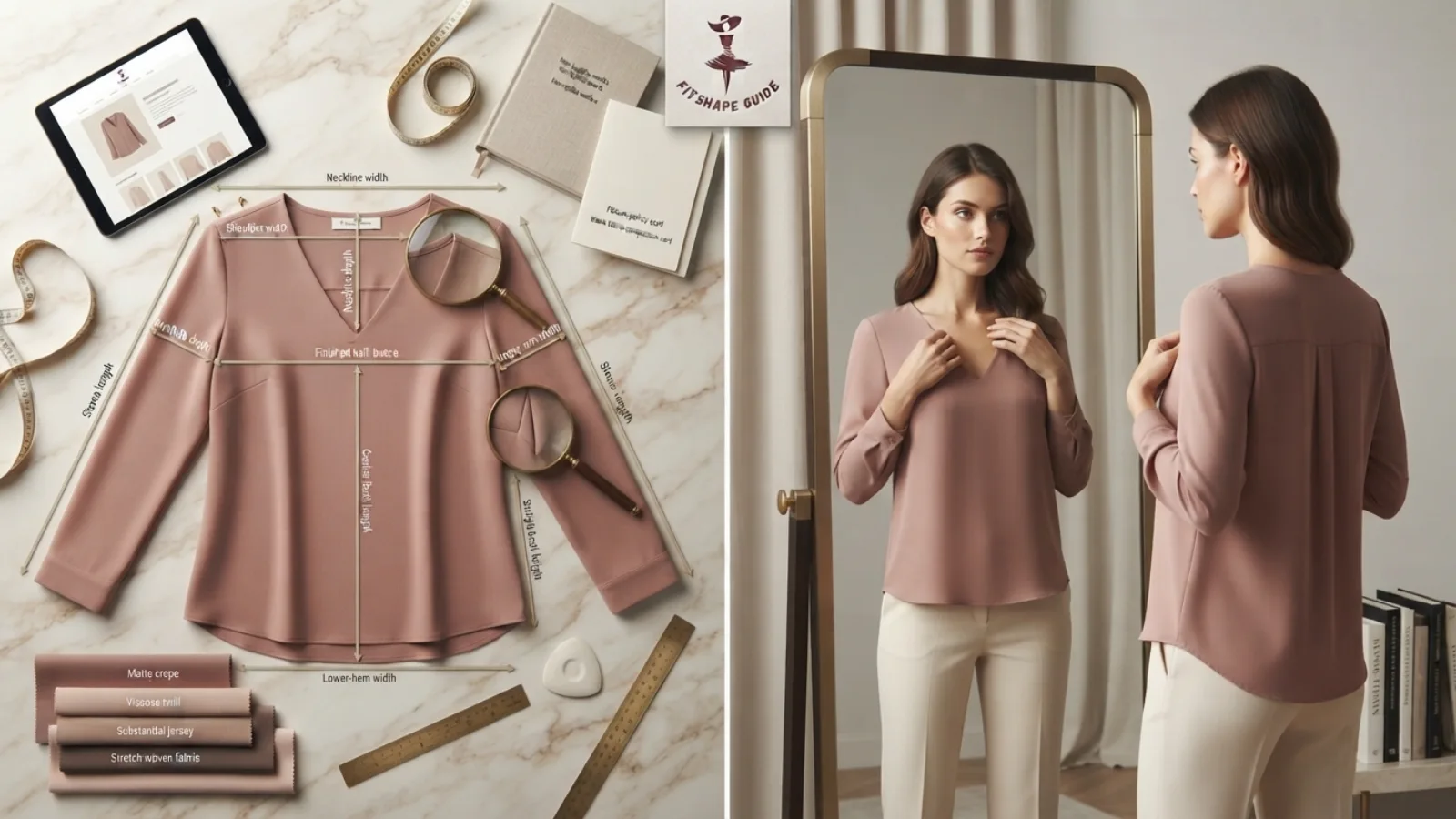
How the best blouses balance shoulders, sleeves, and armholes
The best blouses preserve movement without letting the neckline or hem migrate. Front fit gets most of the attention, yet many blouse problems begin at the shoulder and armhole. A low, wide armhole can look relaxed on a product image but drag the entire blouse upward when the arms lift. A narrow back can pull the neckline toward the throat. A dropped shoulder can be intentional; a shoulder seam that simply falls in the wrong place makes sleeve volume and front drape harder to control.
Set-in sleeves give the clearest fit information
With a standard set-in sleeve, the shoulder seam should finish near the shoulder edge unless the design is deliberately extended. Reach both arms forward. If the back tightens sharply or the blouse travels several centimeters upward, check upper-back width and armhole shape rather than immediately blaming bust ease.
Raglan and dolman sleeves trade precision for freedom
Raglan seams run toward the neckline and can provide comfortable shoulder movement. Dolman sleeves merge sleeve and body into a wider shape. Both can feel easy, but they add fabric around the upper torso. Choose fluid cloth and a defined hem or cuff so the volume looks intentional. The trade-off is layering: generous underarm fabric can bunch inside a fitted jacket.
Puff and ruffle sleeves change balance through scale
Volume at the shoulder can balance the upper silhouette or make it feel crowded depending on sleeve height, fabric stiffness, and neckline. A soft puff beginning slightly below the shoulder is quieter than a rigid gathered cap. Ruffles placed along a vertical placket or cuff behave differently from dense horizontal tiers across the chest. The right question is not whether decorative volume is allowed; it is where the volume begins and whether the fabric can fall.
Stand naturally, sit against a chair back, reach forward as if typing, raise both arms halfway, and bend to pick up a bag. After each move, check whether the neckline opens, the shoulder seams rotate, the front hem climbs, or the blouse must be pulled back into place.
Best blouses for a large bust by occasion
The best blouses change with context. A dramatic satin wrap may be excellent for dinner and irritating under an office blazer. A crisp darted shell may look authoritative in a meeting and feel restrictive during a long flight. Use occasion as a performance requirement, not just a dress-code label.
Choose a medium V, split neck, or stable scoop with opaque matte crepe, controlled darts, and sleeves that fit beneath a blazer. Confirm that the neckline remains closed while seated. Avoid high-maintenance ties or cuffs if you spend most of the day typing.
Choose resilient jersey, viscose twill, or textured crepe with enough back movement and a hem that works untucked. A print can disguise minor creasing, but check placement across seams. The trade-off is that very soft fabric may need steaming on arrival.
A relaxed yoke blouse, soft popover, or uncomplicated wrap works with straight denim and flat shoes. Keep one point of definition—a neat shoulder, a shaped cuff, or a short front tuck—so ease reads as intentional rather than simply large.
Use satin, silk, a draped neckline, or a controlled statement sleeve when the cut supports it. Matte trousers or a simple skirt can let the blouse carry the detail. Check flash photography and bright light for transparency before leaving home.
Diagnose the best blouses by reading fit wrinkles
The best blouses remain calm through ordinary movement, while persistent wrinkles reveal where fabric is being pulled, pushed, or asked to travel farther than the pattern allows. One crease is not a diagnosis, but repeated lines in the same place reveal the likely cause.
| What you see | Likely construction cause | Better response |
|---|---|---|
| Horizontal lines across the bust | Insufficient front width or depth | Try more bust ease, better darts, princess seams, or a more flexible fabric |
| Neckline slides backward | Front length shortage, bust pulling, or incorrect shoulder balance | Check front length and shaping rather than repeatedly pulling the blouse forward |
| Front hem rises sharply | Not enough front projection or length | Choose extra front length, curved shaping, or a deliberately shorter hem |
| Armholes gape | Size-up added width at the upper chest or the armhole is too long | Try a bust-shaped cut with narrower shoulders; alter only if the armhole can be raised cleanly |
| Diagonal lines from armhole to bust | Bust point or dart placement does not match the pattern | Try a different cut; adding overall width may not correct the direction of pull |
| Side seams swing toward the front | Front panel is borrowing fabric from the back | Look for more front depth rather than more total circumference alone |
| Fabric collapses above the bust | Dart sits too low, neckline is stretched, or shoulder-to-bust length is mismatched | Check vertical placement and neckline stability |
Also check the support layer you intend to wear. A different bra can alter projection, neckline coverage, and where the blouse’s fullest point sits. This does not mean the blouse should require one exact undergarment to function, but fitting it over the real layer prevents surprises. Keep the support layer smooth and correctly adjusted before diagnosing the garment.
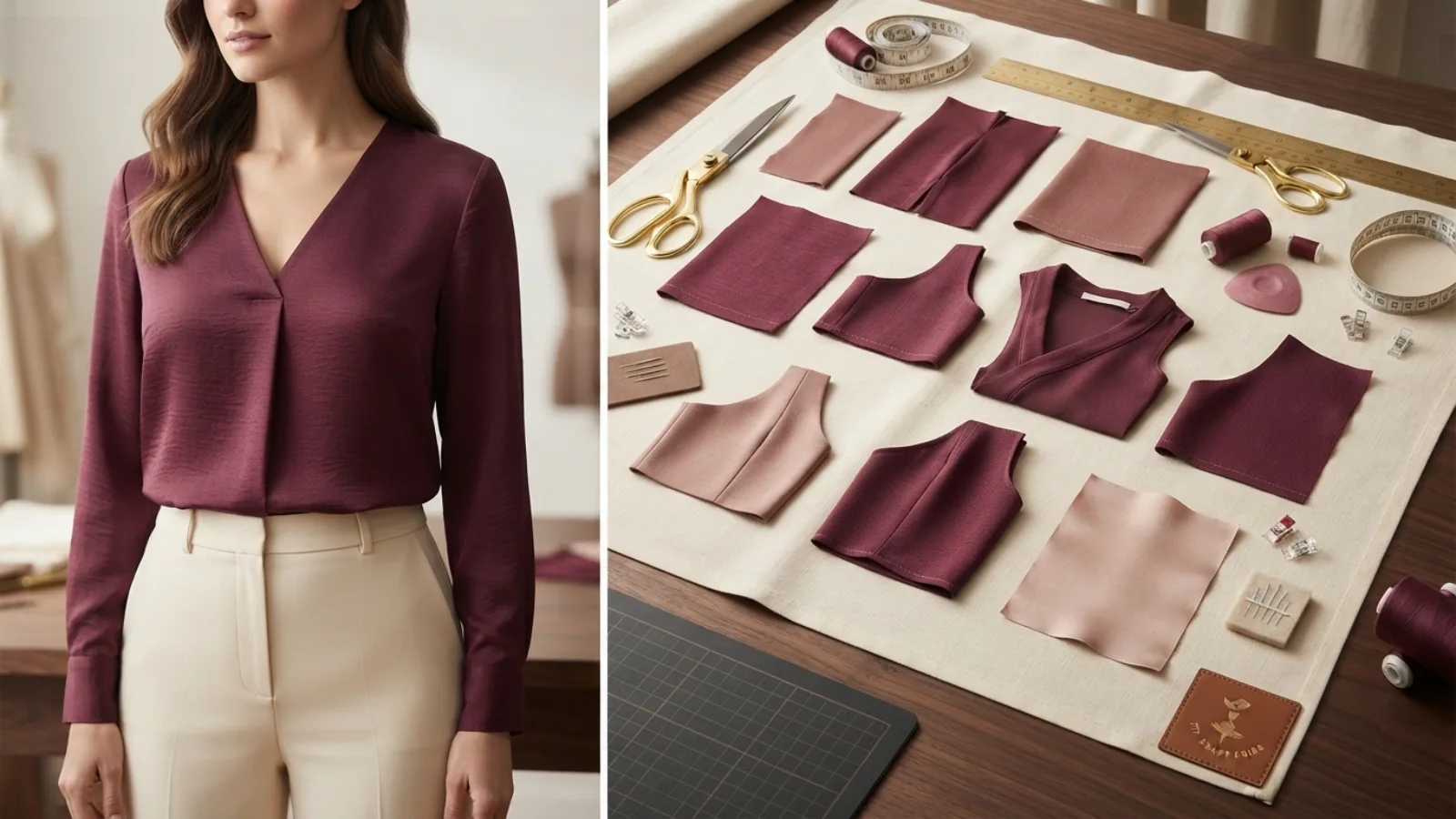
How to shop online for the best blouses for a large bust
The best blouses should be selected through garment evidence, not one front-facing product photograph. A styled image can hide the most useful information: the model may be wearing the blouse open, half-tucked, clipped at the back, or photographed only with arms down. Product copy may call the fit “relaxed” without publishing garment measurements. Build a short evidence checklist before ordering.
A chart labelled “bust” may describe the body size the garment is intended to fit, not the blouse’s finished circumference. Look for “garment measurement,” “item measurement,” or a technical size guide. When only body measurements are available, the amount and placement of ease remain uncertain.
Use side and back images to check hem balance, dart position, shoulder width, and whether the blouse is clipped. In video, watch the neckline and front hem as the model turns. A blouse that shifts during a few steps is unlikely to become calmer during a full day.
A small elastane percentage can improve movement in a woven, but it does not guarantee recovery. “Dry clean only” changes the true cost of a blouse. Fabric composition, lining, weave, and care requirements should support how often you intend to wear it. For U.S. purchases, the FTC’s official textile-label guidance explains the fiber-content, country-of-origin, and responsible-company information generally required on covered textile products.
Look for an internal snap on wraps, a back keyhole on high necks, side zips on fitted woven shells, or a lined front panel. Confirm whether the pictured camisole is included. A blouse that needs a separate layer is not automatically poor value, but the layer should be part of the decision.
Finished half-bust, shoulder width, front length, and armhole depth provide a practical baseline. If the new blouse is narrower at the bust and made from a less flexible fabric, the attractive product photograph does not override that evidence.
Try the blouse with its intended bra, bottom, and layer before removing tags. Photograph the fit from front and side, perform the movement test, and keep packaging until the decision is complete. Do not plan an alteration until you are certain the base size is workable.
FitShapeGuide may earn a commission from qualifying purchases when verified retailer links are added. Recommendations on this page are based on construction features and fit logic, not invented product testing, ratings, prices, or availability claims.
Tailoring the best blouses: fix only manageable excess
The best blouses are strong alteration candidates only when the bust, shoulders, neckline, and armholes already fit. A tailor can remove extra fabric more reliably than create substantial missing fabric. This distinction can prevent spending money on a blouse that never had a workable base.
Alterations that are often reasonable
Taking in side seams below the bust, adding back darts, shortening a straight hem, narrowing a simple sleeve, or adding a discreet snap to a wrap neckline can be practical. A tie position may sometimes be adjusted, and a dart may be shortened when its direction is correct but its point is too long. The garment’s seam allowance, lining, print, and finish determine what is possible.
Alterations that deserve caution
Adding significant bust width, moving an entire princess seam, raising a very low armhole, narrowing shoulders on a complex sleeve, or rebuilding a heavily faced neckline can cost more than the blouse is worth. Prints must still match, linings need parallel work, and delicate satin can retain needle marks. A tailor should inspect the garment before you depend on a specific fix.
If the blouse closes and hangs correctly through the upper body but looks loose at the waist, that is a much stronger alteration candidate than a blouse that is tight at the bust and perfect everywhere else. The large-bust tailoring guide explains which ready-to-wear problems are usually worth correcting and which are better solved by choosing another pattern.
Style the best blouses so their construction remains visible
The best blouses should not need camouflage. Styling can reinforce their line, however, especially when the outfit repeats one clear direction: an open layer, a vertical necklace, a defined waistband, or a controlled tuck.
Office formula: shaped blouse + high-rise trouser + open blazer
Use a darted V-neck or split-neck blouse in matte crepe. Tuck it fully when the front and back lengths allow, then wear a blazer open so the blouse’s vertical center remains visible. The trouser waistband gives the hem a destination. The trade-off is heat and bulk, so a low-bulk shell may be better under a fitted jacket.
Weekend formula: soft blouse + straight denim + partial tuck
A relaxed yoke blouse or fluid popover works with straight denim. A short front tuck can reveal the waistband without pulling the entire blouse tightly across the bust. If the fabric is slippery, leave it untucked and choose a hem that ends intentionally rather than fighting it all day.
Travel formula: resilient jersey + open cardigan + tonal bottom
A stable crossover or scoop blouse in substantial jersey handles sitting and movement. An open cardigan provides temperature control and repeats a vertical line. Keep the palette tonal if you want a quiet silhouette, but prioritize fabric recovery over color theory because a stretched neckline will be more noticeable than the shade.
Evening formula: controlled satin + simple bottom + one focal detail
Let a draped neckline, sculpted cuff, or soft wrap be the blouse’s focal point. Pair it with a simple skirt or trouser and keep necklaces away from the neckline if they compete with the drape. A longer pendant can work with a simple V, while a short necklace may sit better above a scoop. The accessorizing guide for a large bust gives practical placement rules for necklaces, scarves, belts, and bags.
Layering works best when the under-blouse and outer layer do not fight for the same space. A puff sleeve under a narrow blazer will crush and bunch; a cowl neck under a high-closing cardigan may become crowded. Use the large-bust layering guide when you are building combinations for changing temperatures or workwear.
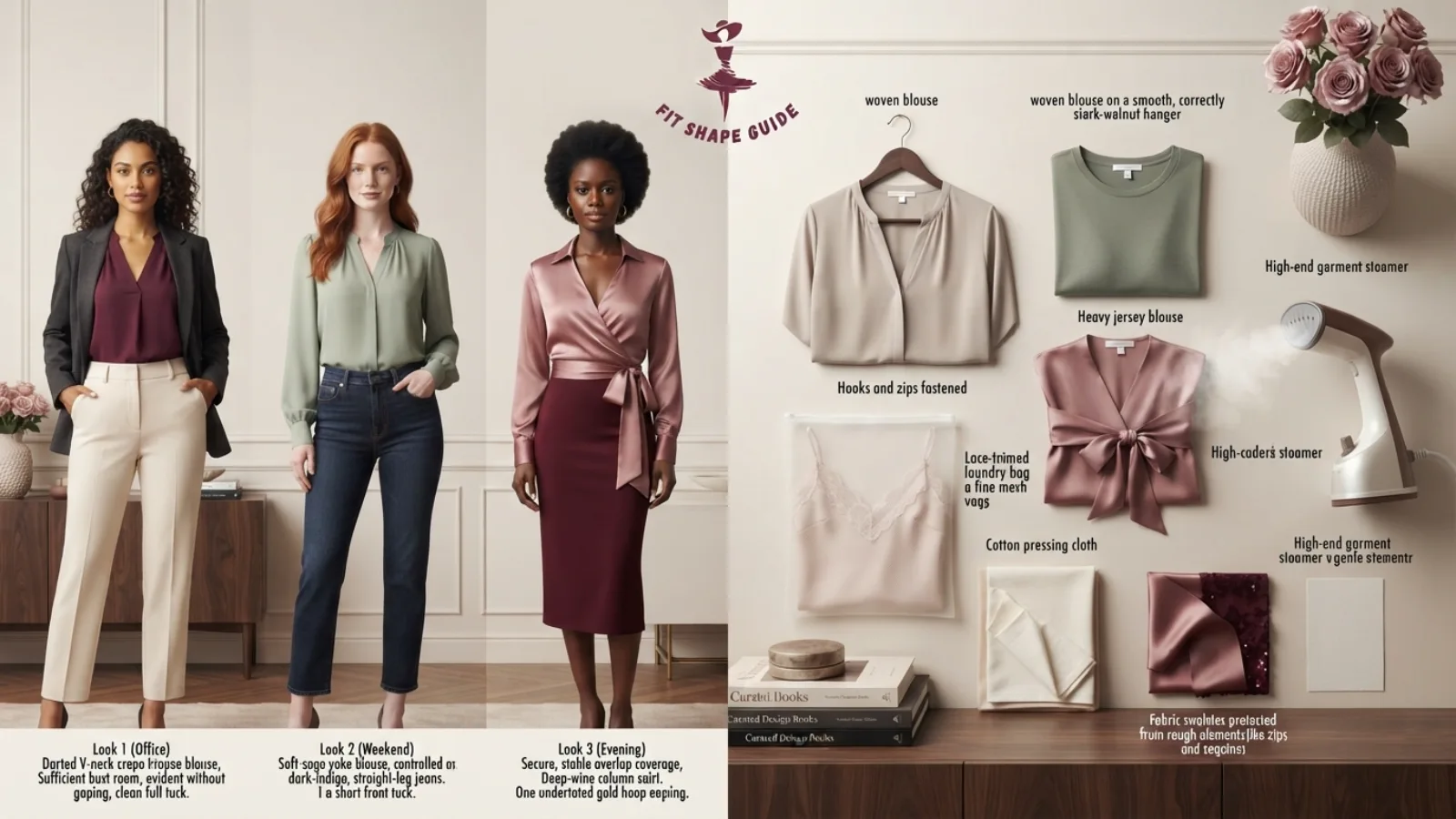
Judge the best blouses by cost per calm wear
The best blouses earn repeat wear because they behave predictably. A blouse that requires fashion tape, constant neckline adjustment, a special bra, and dry cleaning after every wear may be poor value even if the purchase price is low. Evaluate fabric, seams, closures, and care before treating a discount as savings.
Inspect construction while the blouse is new
Turn it inside out. Look for even seam allowances, secure bar tacks at openings, smooth facing edges, and stitching that does not pucker. On a wrap, check the tie attachment. On a side-zip shell, move the zip through its full length without forcing it. On delicate fabric, inspect for pulls around labels, hooks, and buttons.
Wash in a way that protects shape
Follow the care label. Close hooks and zips, use a mesh bag for delicate machine-washable items, and avoid overloading the washer. Air drying often protects elastic recovery and reduces abrasion, but some woven fabrics need gentle reshaping while damp. Steam from the inside or use a pressing cloth when shine is a risk. Never assume all “silky” fabrics tolerate the same heat. The FTC’s Care Labeling Rule guide explains why covered garments carry regular care instructions and what those instructions are intended to communicate.
Store according to fabric weight
Hang woven blouses on smooth, correctly sized hangers so the shoulders do not form points. Fold heavy jersey that may stretch under its own weight. Fasten one closure on wraps or tie the belt loosely so it does not tangle. Give delicate surfaces space from rough zips and sequins.
Before buying, imagine three complete outfits and two real occasions for the blouse. If you cannot, the design may be attractive but too specialized. The wider complete large-bust styling guide can help connect one blouse decision with proportions, layers, bottoms, and accessories across the wardrobe.
Best blouses for a large bust: editor’s final verdict
The best blouses for a large bust are not defined by one neckline or one fabric. They are the designs whose patterns create enough front depth while keeping the shoulders, neckline, and armholes controlled. For the broadest use, begin with a semi-fitted V-neck or split-neck blouse in opaque matte crepe or viscose twill, with darts or princess seams and enough front length to keep the hem balanced. Choose a true wrap when you want adjustable waist definition, a substantial jersey crossover when movement matters most, and a darted shell when you need a clean layer under jackets. Skip any blouse that requires repeated adjustment during a five-minute fitting-room test. A calm garment is the strongest recommendation.
FAQs about the best blouses for a large bust
What blouse style is most flattering for a large bust?
A semi-fitted V-neck, split-neck, wrap, or princess-seam blouse is a strong starting point because it combines visual openness with intentional front shaping. The best option is the one that keeps its neckline stable, gives enough bust ease, and maintains clean shoulders and a balanced hem. Fit and construction matter more than a universally “flattering” label.
Are wrap blouses good for a large bust?
Wrap blouses can work very well when they have generous overlap, a secure neckline, and a tie positioned at the natural waist. Test the overlap while sitting and leaning forward. A shallow wrap may open or require constant adjustment, while a fixed surplice cannot be tightened like a true wrap.
What fabric is best for blouses for a fuller bust?
Matte crepe, viscose twill, stretch woven, and substantial jersey are useful options because they can combine drape, opacity, and movement. The best fabric depends on the cut: crisp cloth needs precise shaping and more ease, while soft cloth needs enough weight and recovery to avoid cling, growth, or neckline stretching.
Should I size up in a blouse to fit the bust?
Size up only when the larger size improves bust and upper-back room without making the shoulders, neckline, armholes, and sleeves noticeably too large. If sizing up creates several new problems, look for a blouse with darts, princess seams, wrap overlap, or extra front depth instead. Excess waist room is often easier to alter than a major shoulder mismatch.
How can I tell if a blouse has enough bust room?
Check for smooth fabric without persistent horizontal pulling, side seams that stay vertical, a front hem that remains near its intended level, and a neckline that does not migrate backward. Sit, reach, and raise the arms halfway. The blouse should return to place without needing to be pulled down or closed by hand.
Why does my blouse ride up in the front?
The blouse may lack front length or three-dimensional depth over the bust, so fabric travels upward to find room. Look for well-positioned darts, princess seams, added front length, a true wrap, or a shaped hem. Choosing a longer overall size may lengthen the back without correcting the front balance.
Can a tailor make a loose blouse fit the waist?
Often, yes—especially when the blouse already fits the bust, shoulders, neckline, and armholes. A tailor may take in side seams below the bust, add back darts, or refine a simple hem. Results depend on seam allowance, lining, print placement, and fabric. Adding significant missing bust room is usually much harder.
How do I stop a wrap or V-neck blouse from opening?
First check that the blouse has enough bust room and that the neckline is not being pulled wider by a short front or tight back. On an otherwise good fit, a discreet internal snap, modesty panel, or planned camisole can add coverage. Fashion tape is a temporary aid, not a correction for insufficient overlap or an unstable neckline.