Best Halter Tops for a Large Bust
A construction-led buying guide to neck straps that distribute pressure, bodices that make room for projection, side edges that contain securely, and bra solutions that work beyond a posed product photo.
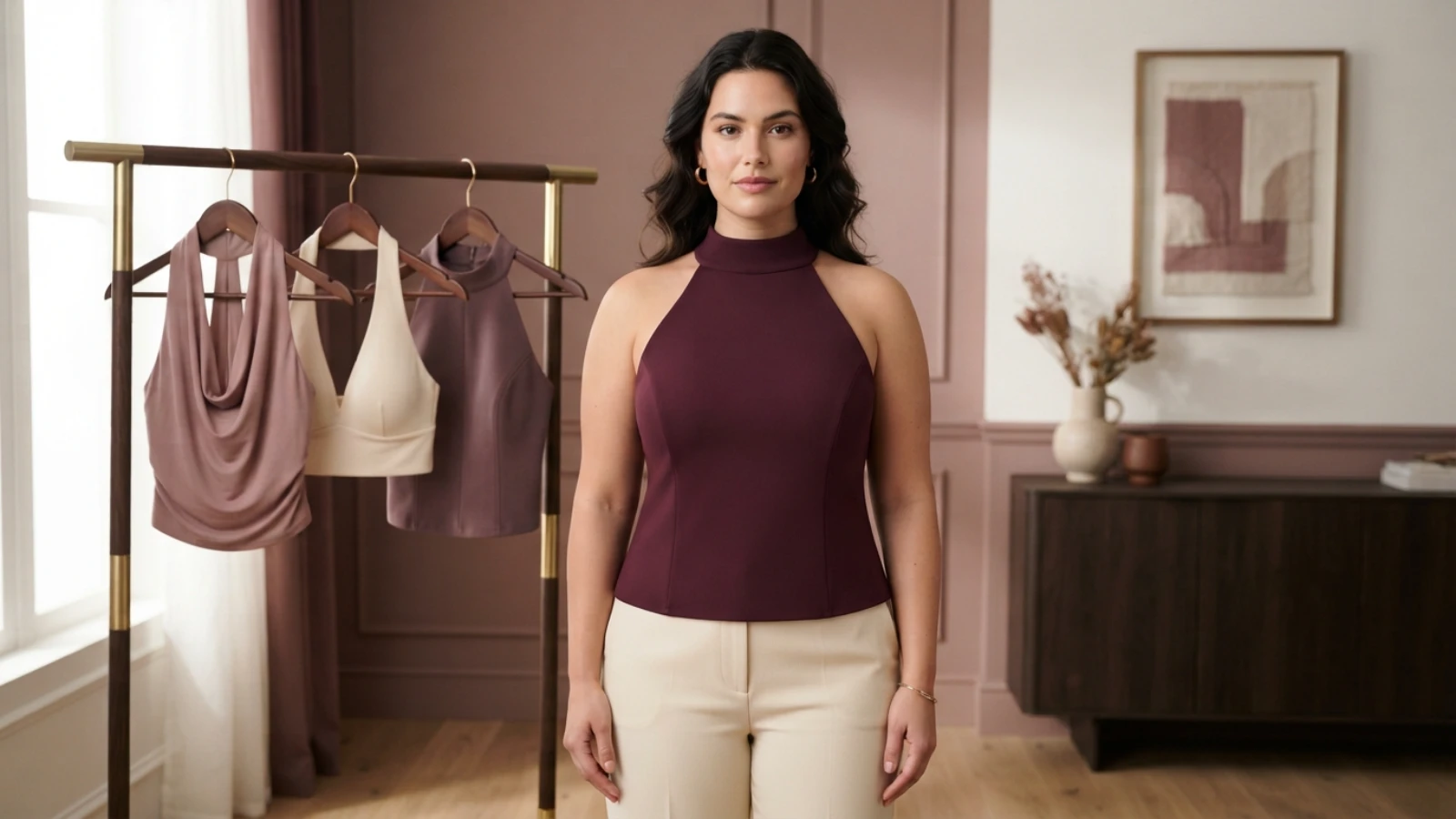
The best halter tops for a large bust should create a clean neckline without asking the back of your neck to carry the bust. That distinction matters because “halter” describes where the upper strap travels, not how the garment supports, contains, or shapes a fuller chest. One design may use a broad neck band, secure back, shaped front, and resilient fabric; another may be a thin tie attached to a shallow triangle of cloth. Both appear under the same shopping filter, but they deliver entirely different comfort and coverage. This guide turns the difference into visible checks: neck-band width, torso anchoring, bust depth, side-seam height, armhole cutaway, back coverage, compatible bras, fabric recovery, front length, and movement stability. It helps you compare verified products later without relying on invented ratings, vague “supportive” labels, or a model pose that conceals the garment’s real load path.
The eight-point halter fit check
Use this screen to compare the best halter tops before color, price, or occasion styling persuades you to keep a difficult fit.
- The neck band lies flat and broad enough to spread pressure rather than act like a cord.
- The bodice stays up because the torso, back, or underbust is stable—not because the neck tie is painfully tight.
- The bust has depth without crushing, center pulling, or fabric becoming sheer.
- The side edge contains the intended bra and breast tissue through normal movement.
- The back height and closure work with a support option you already own or deliberately plan to buy.
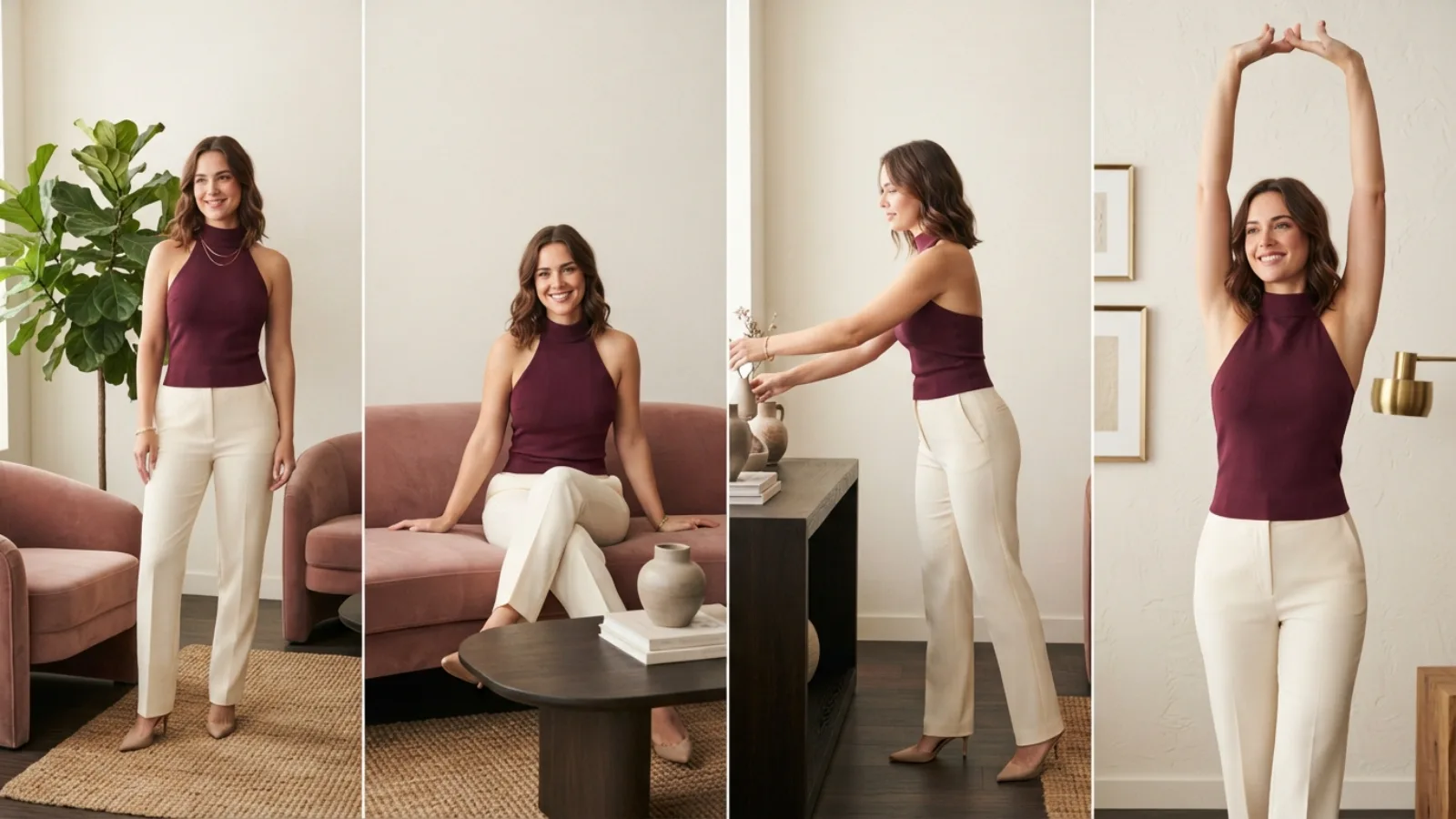
- The neckline remains controlled while sitting, leaning, and reaching.
- The front hem has enough length to remain balanced after the bust takes up fabric.
- You can wear the complete outfit for the required hours without neck strain or repeated adjustment.
Best halter tops for a large bust by type and purpose
The best halter tops are not defined by one universally “flattering” neckline. They are defined by whether their construction matches the job. A high-neck knit worn with a convertible bra needs different engineering from a structured event top with integrated cups. Start by identifying where the top is meant to anchor, what support layer it expects, how much side and back exposure it creates, and how long you need to wear it.
1. Wide-band high-neck halter: the most stable starting point
A broad band that travels from the upper front toward the back of the neck spreads pressure over more surface area than a narrow tie. A high or medium-high neckline can also reduce reliance on a fragile center plunge. Look for a band that lies flat, a neckline edge that does not collapse, and a torso that fits firmly enough to resist upward pull. “High neck” does not guarantee containment: a very cutaway armhole can still expose the bra cup or side tissue, so inspect the profile view as carefully as the front.
2. Softly draped halter with a stable lower body: the elegant option
Drape can create vertical movement and accommodate projection, but it needs an anchor. The useful version has a controlled underbust, waistband, back panel, or lined torso below the fluid neckline. Without that stability, the fabric may swing open when you lean or pull backward on the neck. Choose enough drape to fall rather than cling, yet not so much that the neckline becomes a shifting cowl. A lightweight woven may need lining; a matte jersey needs enough weight and recovery to keep the folds intentional.
3. Faux-halter with bra-friendly shoulder coverage: the everyday bridge
A faux-halter creates the inward visual line of a halter while retaining more fabric over the shoulders or upper back. It may conceal conventional bra straps, use a keyhole front, or shape the neckline toward the neck without becoming backless. This is often the practical choice when you like halter proportions but do not want a strapless or convertible support setup. Verify the back view because some designs look bra-friendly from the front and then cut inward sharply behind the shoulder.
4. Structured woven halter with bust shaping: the tailored event choice
Woven fabric does not rely on stretch to create depth, so it needs darts, princess seams, curved panels, gathers, or a shaped cup area. When those features align, a woven halter can produce clean containment and a polished waist. When they do not, it may gape above the bust, cut across the fullest point, or pull the back closure. Check where the dart ends, whether the seam follows rather than bisects the bust, and whether the front length remains balanced. A lined bodice can improve opacity and edge control, but lining does not correct shallow shaping.
5. Bra-sized support-integrated halter: the specialist solution
Integrated support becomes more credible when the garment uses band-and-cup sizing, a secure underband, sufficient cup depth, adjustable neck length, side wings, and clear support guidance. A basic shelf layer or removable foam pad is not the same as a bra-sized system. This category can be valuable for swim-inspired tops, bodysuits, and occasion pieces, but confirm whether the neck strap is stabilizing or actually bearing most of the load. Even a correctly sized cup can become uncomfortable if the torso anchor is weak.
6. Adjustable crossover halter: the flexible but test-dependent choice
Cross-front panels can adapt to different projection and create a controlled V, especially when each side has enough width. Adjustment is useful only within the pattern’s intended range. If you must pull the panels excessively tight to prevent gaping, the neckline may distort and neck pressure will rise. Look for a fixed lower edge, broad crossover coverage, secure attachment at the side seam, and enough overlap when seated. Treat multiway tops carefully: versatility often creates more possible failure points than a dedicated halter.
| Halter type | Best use | Construction to prioritize | Main risk |
|---|---|---|---|
| Wide-band high neck | Longer wear and modern outfits | Broad flat band, stable torso, controlled cutaway | Side exposure despite a high front |
| Softly draped | Dinner and occasion styling | Anchored underbust or waistband, lined edge | Neckline shifting when leaning |
| Faux-halter | Everyday and bra-friendly outfits | Shoulder coverage and a compatible back | Bra exposure behind the shoulder |
| Structured woven | Tailored events and defined waists | Darts, panels, lining, secure back closure | Shallow bust shaping |
| Bra-sized integrated | Specialist support and swim-inspired looks | Cup-and-band sizing, underband, side wings | Neck bearing too much load |
| Adjustable crossover | Flexible neckline depth | Broad overlap and fixed lower anchor | Over-tightening to stop gaping |
Where the best halter tops get support
The best halter tops distribute forces through several points: a support bra or integrated cups shape the bust; the underband or torso holds the garment around the body; the back keeps the front from falling forward; and the neck strap stabilizes the neckline. Problems appear when one component is expected to do everything. If tightening the neck is the only way to lift the front, the garment is transferring load to a sensitive area rather than solving fit.
Think of the neck strap as a stabilizer, not a crane
A neck band can stop the upper edge from falling outward and can fine-tune neckline height. It should not need to hoist the bust. The distinction is easy to test: support the front with your hands and loosen the neck slightly. If the whole bodice collapses because the lower body has no grip, the pattern lacks an anchor. A broader band may reduce pressure, but width cannot compensate fully for poor structure below.
The torso anchor should resist downward and forward pull
Useful anchors include a fitted back, a secure zipper, a wide elastic underbust, a shaped waistband, firm side panels, or the band of a separate bra. The top should feel stable around the ribcage without restricting breathing. Elastic that rolls, a back that rides upward, or a waistband that sits on the bust rather than below it will make the neck work harder. Assess the anchor after sitting because a fitted waist may travel upward when the torso compresses.
Integrated cups need depth, not merely padding
Removable pads can conceal nipples or smooth a surface, but they do not create the projection required by a fuller bust. A cup that is too shallow pushes tissue outward or downward, increasing side exposure and neck tension. Look for defined cup depth, a stable underband, and sizing that acknowledges both torso and bust volume. If the garment comes in only small, medium, and large, read its measurements and support claims cautiously.
Long-wear comfort is part of fit evidence
A top can pass a two-minute mirror check and still fail after dinner, dancing, driving, or desk work. Wear it at home with tags protected for the length of a realistic trial. Sit, stand, turn the head, lift the arms, and add any jacket you plan to use. If pressure grows steadily, the band twists, or the neckline needs frequent retightening, the design is not one of your best halter tops even if the front photograph looks excellent.
How the best halter tops adjust without neck strain
Halter discomfort is not a required tradeoff for a cleaner shoulder line. The best halter tops reduce concentrated pressure by using an appropriate strap width, smooth edge construction, sensible adjustment, and a stable lower body. Your neck shape, posture, bust support, and wearing time all change the threshold, so no single strap measurement guarantees comfort.
Wider and flatter usually beats narrow and cord-like
A broad fabric band spreads pressure and is less likely to dig. Check whether it remains flat at the back of the neck or folds into a narrow rope under tension. Thick piping, hard beads, large knots, rough sequins, and bulky sliders can become pressure points. A softly padded or lined band may feel better, but only if it does not trap excessive heat or twist.
Ties offer range, but they invite over-tightening
A tie can accommodate different torso lengths and neckline preferences. The temptation is to keep pulling until the bust appears higher. Instead, support the bust with the intended bra or lower structure, then tie the halter only firmly enough to position the edge. Make a bow or secure knot that will not creep, and ensure the ends do not rub or tangle with hair and jewelry. A knot that must be extremely tight to remain secure is poor adjustment design.
Fixed bands require exact vertical proportion
A buttoned, clasped, or continuous neck loop may look cleaner than a bow, but it leaves less tolerance for torso length and bust position. Too short, and it pulls the front upward and back against the neck; too long, and the neckline may gape. Multiple button positions or a short concealed adjuster increase usability. Product listings should provide the neck-loop length or at least clear closure photos; if not, a return option matters more.
Pressure should not build into headache, tingling, numbness, skin pain, or a feeling that you cannot relax your shoulders. Loosen or remove the garment if those signs appear. Styling advice is not a reason to tolerate pain.
Neckline stability should survive head and shoulder movement
Turn the head fully, shrug, reach forward, and look down. The band should not saw across the neck or pull the front sideways. A centered neckline after movement indicates balanced strap lengths and torso anchoring. If the top twists toward one shoulder, inspect whether the strap attachments are symmetrical and whether the bra or bust is pulling one side differently. For a broader comparison of opening shapes, use the best necklines for a large bust guide.
How the best halter tops handle bras, sides, and backs
The best halter tops make their expected support setup clear. A dramatic cutaway may be designed for a strapless or backless solution; a faux-halter may conceal a standard bra; a bra-sized bodice may supply its own structure. None is inherently wrong, but buying the top first and discovering its support demands later can turn an affordable garment into an expensive, uncomfortable project.
Conventional bras work only when the shoulder and back are truly covered
From the front, a wide upper panel may appear to hide straight bra straps. Follow that panel over the shoulder and across the back. If it narrows sharply toward the neck, the bra will show behind you. A deliberate visible strap can be styled, but accidental exposure is different. Wear your intended bra in the try-on and photograph all angles rather than assuming a product model is wearing standard support.
Convertible halter bras change the strap path, not the band’s job
A convertible bra can route one or both straps around the neck while the band provides most support. This can align with a classic halter, but the added neck strap may still create pressure, especially if the band is loose or the cups are shallow. Check the bra’s instructions, ensure the band remains level, and adjust the halter strap only enough to stabilize. Stacking a tight bra neck strap under a tight top neck strap can double the discomfort.
Strapless support needs a secure band and compatible top
A correctly fitted strapless bra relies on its band, frame, cup shape, and often silicone or grip details rather than shoulder straps. The halter top must cover its upper cup edge, wings, and back. Very low sides or backs can expose the structure that makes the bra supportive. Before committing to an exposed design, decide which matters more: the exact cut of the top or the support level you require for the occasion.
Adhesive and low-back solutions have limits
Adhesive cups may offer coverage, shaping, or limited lift, but performance varies with skin, heat, movement, product design, and bust weight. They should not be treated as a universal replacement for band support. Follow the product’s skin and reuse directions, patch-test where appropriate, and never use a top whose security depends on a support method you have not tested before the event.
Side-bust coverage is the hidden variable
Halter armholes often cut inward to emphasize the shoulders. On a fuller bust, that can reveal the side of the bra cup or tissue even when the front is high. Raise both arms, reach forward, and view the side at normal standing distance. A side seam with adequate height, a front panel that extends far enough toward the underarm, and a stable edge produce more dependable containment. Compare sleeveless alternatives in the best tank tops for a large bust guide when bra concealment is the priority.
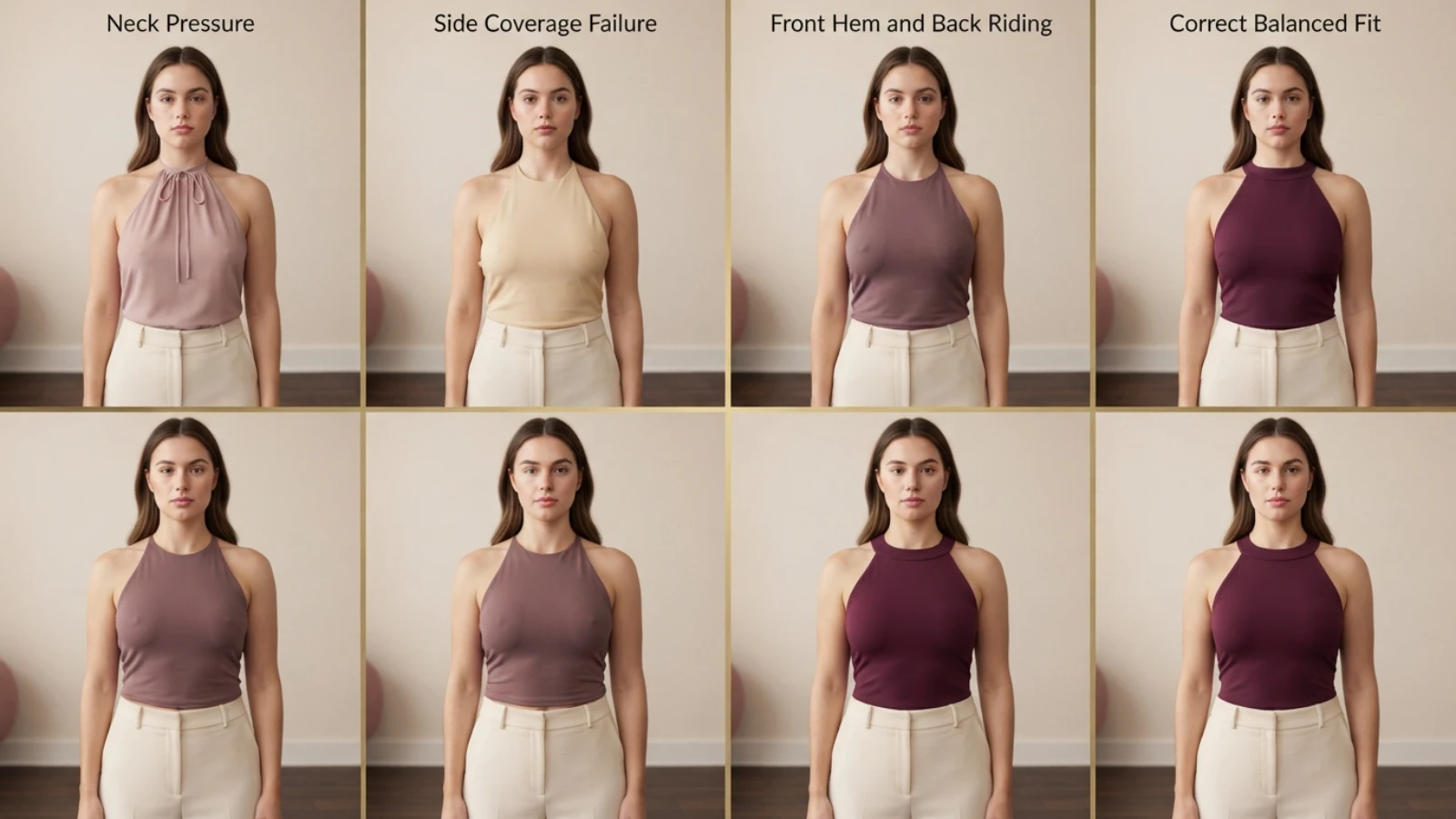
Fabric and shaping that make the best halter tops work
Fabric determines how a halter responds when the bust pulls the front forward and down. Pattern shaping determines whether the garment provides actual depth. The best halter tops use the two together. Stretch without recovery can sag; a rigid woven without darts can compress; fluid drape without an anchor can open. Read fiber content as a clue, then confirm weight, construction, lining, and seam placement.
Resilient jersey suits controlled drape and adjustable designs
Medium-weight jersey can follow projection and create soft folds, particularly in crossover and gathered halters. Stretch it gently across the direction the bust will load, then release. It should return promptly without whitening, becoming transparent, or leaving a wavy edge. A small amount of elastane can improve recovery, but percentages alone do not reveal knit density or finishing. The site’s best fabrics for a large bust guide explains why weight and structure matter alongside fiber names.
Wovens need darts, seams, gathers, or shaped panels
Look for a dart pointing toward—not ending on—the fullest point, princess seams that create depth, or gathers distributed where projection is required. Random fullness at the neckline can create drape without enough lower-bust room. Side seams should remain close to vertical. If they sweep forward, the front is borrowing fabric from the back. Sizing up may add circumference but can also enlarge the neckline and back.
Lining should support edges without fighting the shell
A lining can improve opacity, reduce friction, and stabilize the neckline. It must have compatible stretch and enough depth. A non-stretch lining under a stretchy shell can become the true limiting layer, while a loose lining may roll out at the armhole. Check the inside when possible: understitching, clean seam allowances, and anchored lining at closures are signs of more deliberate construction.
Texture changes both visibility and friction
Dense matte textures can disguise minor tension better than shine, but heavy ribbing may grip a bra or bunch under layers. Satin highlights every diagonal pull and often needs careful bias or dart engineering. Sequins, beading, and embellishment add weight that can increase neck load. Choose decoration attached to a stable body, not suspended from a delicate neck edge.
Opacity must be tested over the fullest point
Fabric may appear opaque while flat and become sheer when stretched across projection. Check in daylight with the intended bra color. Printed fabric can also distort or fade over the bust even when skin is not visible. The best halter tops preserve color density and surface appearance in the size that provides adequate ease.
How the best halter tops balance ease, edges, and length
Fit problems often appear at an edge even when the missing room is at the bust. A shallow front pushes forward, so the neckline pulls backward, the armholes open, the side seams rotate, and the front hem rises. The best halter tops for a large bust give projection its own space instead of forcing every boundary to compensate.
Bust ease should allow breathing without erasing the anchor
For stretch garments, the correct amount depends on knit recovery and the intended silhouette; some use controlled negative ease, while draped styles need positive ease. Judge the result rather than demanding one number. You should breathe fully, move the arms, and sit without compression lines, spill, or transparency. At the same time, the lower torso should remain stable enough that the neckline does not fall.
Armhole depth controls side security
A deep armhole can be intentional, but it needs planned support and enough front coverage. If the edge gaps only near the front of the underarm, the pattern may lack bust shaping rather than being globally too large. A smaller size can close the gap while worsening bust compression. Curved side panels, a dart, a higher side seam, or firmer recovery addresses the geometry more directly.
Neckline height changes after the bust takes up length
A V or scoop that appears moderate on a hanger may deepen when worn because projection consumes fabric vertically. Adjustable bands can raise it, but over-shortening shifts load to the neck and lifts the hem. Check the neckline while seated and leaning forward. If coverage depends on perfect posture, it is not stable enough for a real day.
Front length should be measured separately from back length
Many listings provide one center-back length that says little about how the front will cover a fuller bust. Compare shoulder or neck-edge to front hem on a garment you own. A shaped hem, extra front length, or bust-specific pattern can help. Once the halter settles, the hem should not require constant downward pulling or make a waistband visible only at the front.
The back should stay level and resist climbing
A back that rises is donating length to the front or responding to a tight bust. Mark its position, sit and stand several times, then check again. If it climbs toward the shoulder blades, tightening the neck will usually worsen the system. More front room or a different cut is the better solution.
Choosing the best halter tops for work, events, travel, and weekends
A halter that succeeds for a two-hour dinner may be wrong for an eight-hour workday. Match construction to wearing time, movement, temperature, layering, support needs, and dress code. The best halter tops are the ones that remain functional for the actual occasion, not the ones that look most dramatic in a static fitting-room image.
For work: choose a faux-halter or high-neck style with a layer plan
A faux-halter that conceals a conventional bra is usually easier for long wear. Pair it with an open blazer or cardigan that does not press the neck band. Ensure the armholes remain covered when reaching across a desk and that the neckline stays stable while seated. If a workplace requires covered shoulders, treat the halter as a shell rather than the complete outfit. The layering guide for a large bust helps preserve vertical lines without building bulk.
For weddings and evening events: rehearse the complete support system
Wear the exact bra, shapewear if any, necklace, hairstyle, and outer layer during a home trial. Dance, sit for a meal, bend to pick something up, and photograph with flash. Embellished necklines should not catch hair; long ties should remain secure; adhesive products should be tested according to their directions. Do not debut an unfamiliar support method on the event day.
For travel: prioritize adjustable comfort and easy layering
Long sitting changes how a fitted underbust, waistband, and neck loop feel. Choose a broad band, breathable stable fabric, and a back you can lean against comfortably. Bulky knots, hard clasps, and beads at the neck can become irritating against a seat. An open shirt adds coverage and temperature control while allowing the neckline to remain visible.
For weekends: let bra compatibility decide how effortless it really is
A casual halter is not effortless if it requires a special bra, tape, repeated adjustment, and careful posture. A faux-halter or supportive integrated style may earn more wears. If you prefer straightforward bra-friendly basics, compare the best T-shirts for a large bust and use the halter when its distinct shoulder line adds enough value.
For hot weather: balance exposure with friction and support
Exposed shoulders can feel cool, but a tight band and dense underbust may trap heat. Look for breathable fabric, smooth neck contact, stable edges, and enough side coverage to reduce rubbing. A wide neckline band should distribute pressure without acting like an insulating collar. Consider how sunscreen, perspiration, and washing frequency may affect light colors and delicate finishes.
Diagnose fit problems before returning the best halter tops
Do not begin with “my body is wrong for halters.” Identify the load path. A painful neck, open side, riding back, or low neckline usually points to a specific relationship between bust depth, strap length, torso anchor, edge shape, and bra. The table below separates symptoms from likely causes and useful next tests.
| Symptom | Likely cause | Next test | Better direction |
|---|---|---|---|
| Neck pressure builds | Weak torso anchor or narrow band | Support front and loosen neck slightly | Wider band plus secure underbust/back |
| Side bust or bra shows | Cutaway too deep or front too narrow | Reach forward and view profile | Higher side seam and broader front panel |
| Neckline falls open | Excess edge length or unstable anchor | Sit, lean, then release adjustment | Reinforced edge and shaped torso |
| Front becomes sheer | Insufficient ease or low-density fabric | Check in daylight at fullest point | Larger or better-shaped cut; denser fabric |
| Back rides upward | Front borrowing length from back | Mark back position before sitting | More front depth and length |
| Armhole edge gapes | Missing bust shaping | Pin a small dart temporarily | Darted, paneled, or higher-side design |
| Band rolls under bust | Band too narrow, soft, or misplaced | Check position while seated | Wider stable band at true underbust |
| Top twists sideways | Uneven straps, asymmetrical load, or closure | Compare attachment points and strap lengths | Balanced fixed construction |
When sizing up is the correct fix
Try the next size when fabric stretches visibly, the bust feels compressed, seams pull, side coverage disappears because the front is too narrow, or the hem climbs. Then inspect whether the larger size preserves the neck, armholes, back, and underbust. If it does, the first size was simply too small.
When sizing up creates a different failure
If the larger size gives bust room but makes the neckline fall, the side edges gape, and the lower body lose grip, the pattern’s bust-to-torso ratio is the issue. Choose shaping, an adjustable back, stretch with better recovery, or fuller-bust sizing. Do not accept an unstable upper edge merely to obtain circumference.
What a tailor can realistically improve
A tailor may shorten a neck band, add a discreet snap, refine a neckline edge, take in an accessible back or waist, add bra-strap keepers, or adjust a simple hem. Adding substantial bust depth, raising a deeply cut side, rebuilding integrated cups, or changing a low back can require reconstructing the garment and lining. Get an estimate before removing tags. The large-bust tailoring guide explains which ready-to-wear problems are usually worth correcting.
How to shop for the best halter tops online
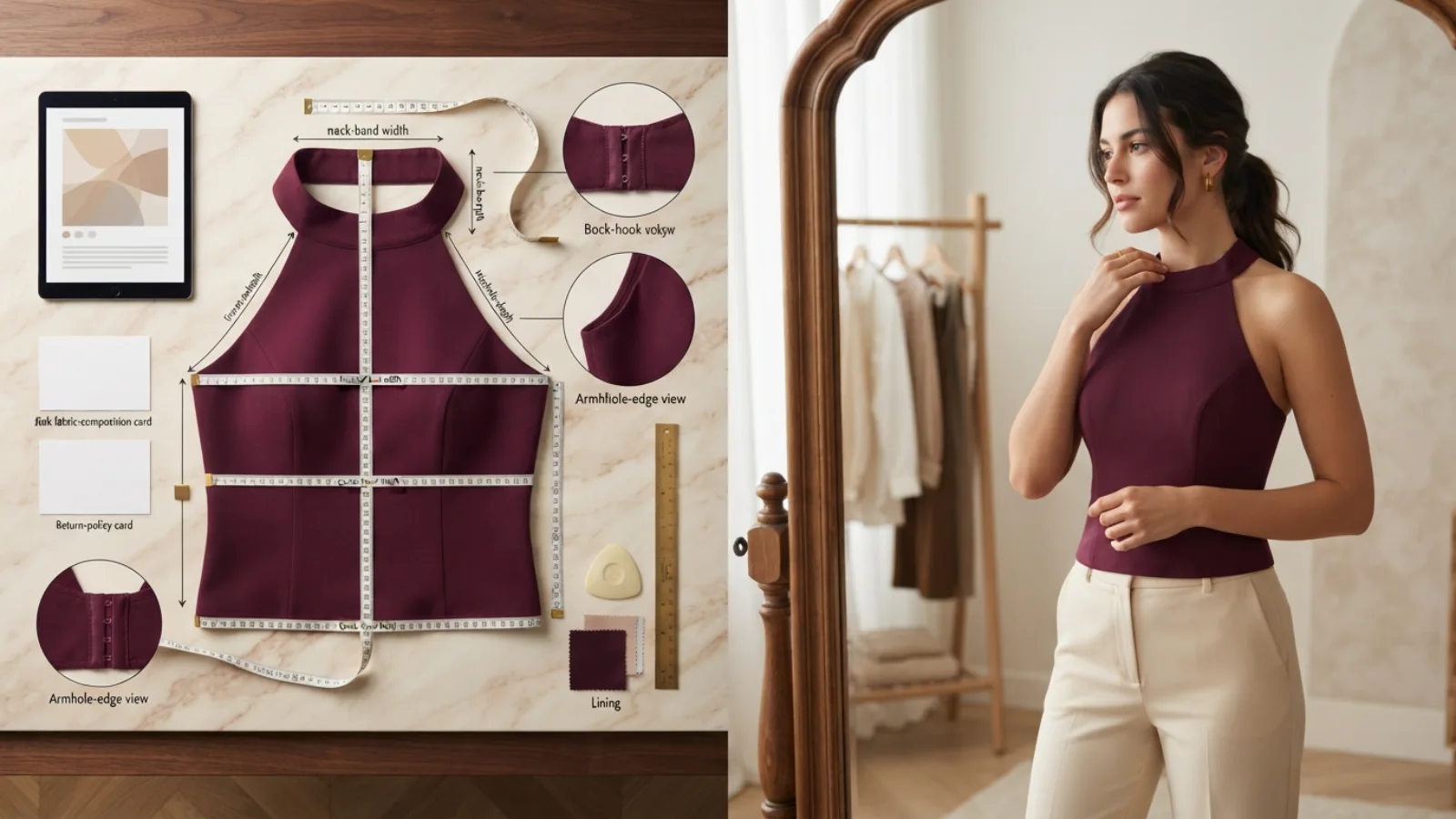
Online shopping becomes safer when you convert visual preferences into measurements and evidence. A title such as “supportive halter” is not a specification. The best halter tops for a large bust can be shortlisted by comparing the garment with a known item, reading the material and closure details, checking the front, side, and back images, and preserving a realistic return path.
Start with a garment that has a related fit
If you already own a successful halter, measure it flat without stretching. If not, use a shaped sleeveless top to establish bust width, side-seam height, and front length, then treat neck and back measurements as additional unknowns. Record the support garment worn with the reference; a measurement without its bra context can mislead.
| Measurement or detail | How to use it | Red flag |
|---|---|---|
| Bust or underarm width | Compare at the same point and note stretch | Only body chart with no garment ease clues |
| Front length | Measure neck edge or shoulder point to hem | Only center-back length listed |
| Neck-band width and length | Estimate pressure spread and adjustment range | No back-neck or closure photo |
| Armhole depth and side height | Predict bra and side-bust coverage | Front-only imagery |
| Back height and closure | Match the intended bra band and movement | Back described as low without dimensions |
| Underbust or waist | Check whether the torso can anchor the top | “Stretch fit” with no recovery information |
| Fiber and lining | Estimate drape, opacity, recovery, and care | Fiber percentages or lining omitted |
| Return terms | Confirm window, condition, fees, and final sale | Special-occasion item marked final sale |
Read the size chart as a system
Determine whether measurements describe the body or the garment. If they are body measurements, look for fit language such as close, relaxed, or compression and compare fabric stretch. If they are garment measurements, compare them directly with your reference top. A bust number alone is not enough for a halter because neck-loop length, side height, underbust, front length, and back closure govern comfort.
Use model information carefully
Model height and size can help with length, but bra size is often absent or inconsistent across sizing systems. Use images to inspect seam direction, neckline distortion, side coverage, and back height—not to predict your fit from appearance alone. Zoom into closures and lining. Video can reveal movement, but sponsored styling may use tape, clips, or a hidden support garment.
Separate review evidence from body commentary
Useful reviews describe measurements, fabric behavior, support setup, duration, movement, and whether the item changed after washing. Statements such as “not for big chests” are less useful unless the reviewer explains the actual failure. Look for repeated reports of neck pressure, side exposure, rolling bands, sheerness, or inconsistent sizing. Do not treat rating averages as a substitute for construction evidence.
Read fiber and care labels before buying
Fiber content does not guarantee performance, but it helps you compare two similar designs. The U.S. Federal Trade Commission explains the information generally required on covered textile labels in its textile labeling guidance. Care instructions affect long-term shape, especially for lined, embellished, elasticated, or bias-cut halters, so review the FTC’s care-label guidance and the garment’s actual label before purchase.
Use a two-size trial when the retailer permits it
Adjacent sizes reveal whether the problem is size or pattern. Try both with the same bra, adjust each once, and run the identical movement test. Keep the one that balances bust room, torso anchoring, side coverage, and neck comfort. Return both if neither works. A return is data, not a failure.
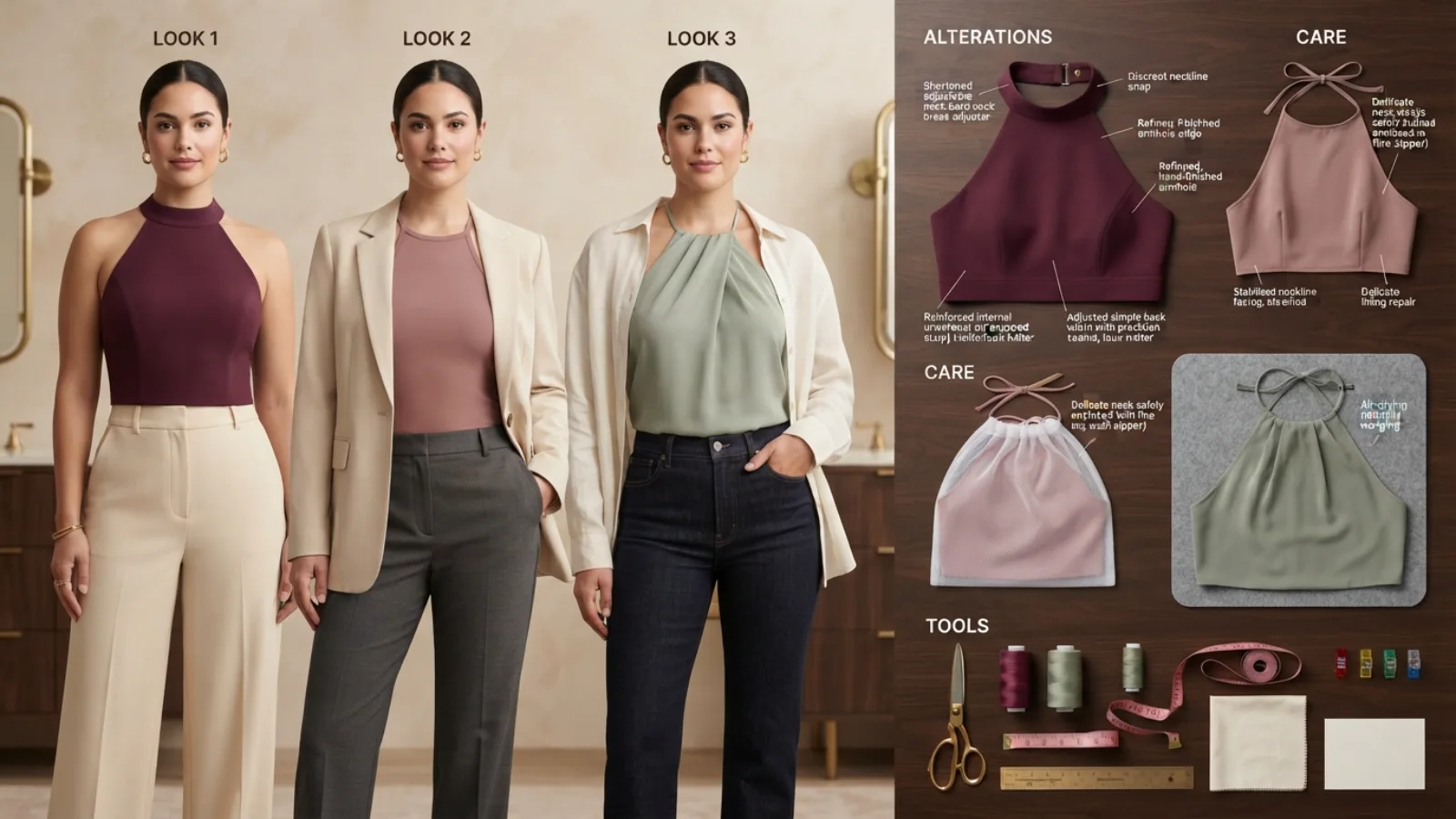
How to style, alter, and care for the best halter tops
The best halter tops earn their place by working with your support wardrobe, bottoms, layers, climate, and care habits. A beautiful special-occasion piece may justify limited wear; an everyday halter should combine easily and survive repeated cleaning. Judge value through cost per successful wear, not price alone.
Use the exposed shoulder line as the main design event
A halter already directs attention inward and upward, so the outfit rarely needs a complicated necklace. Studs, hoops, or a bracelet can add polish without competing at the neck. If you choose a necklace, ensure it does not tangle with ties or press under the band. An open neckline may suit a pendant; a high halter often works better with earrings.
Balance the lower half according to the top’s volume
A close, structured halter pairs easily with wide-leg trousers, an A-line skirt, or straight denim. A draped top may benefit from a defined waistband so the fabric has somewhere to finish. Tucking should not pull the front downward and increase neck tension. If the top is cropped, confirm that bust projection does not shorten it beyond your intended rise.
Layer without trapping the neck band
An open blazer, cardigan, or shirt preserves the halter line and adds side or back coverage. Test the layer over the knot or clasp: a high collar can press hardware into the neck. The outer garment should move independently rather than dragging the halter backward. For a softer sleeveless alternative under tailoring, compare the best blouses for a large bust guide.
Alter only after the support setup is final
Neck length, neckline depth, and side coverage can change when the bra changes. Settle the support garment first, then pin any alteration. Simple strap shortening or a discreet edge snap may be worthwhile; reconstruction of cups, sides, or a low back may exceed the top’s value. Ask the tailor to preserve enough adjustment for sitting and breathing.
Protect elastic, lining, ties, and embellishment
Follow the care label rather than assuming all halters need the same method. Fasten hooks, place delicate ties in a mesh bag where permitted, avoid hanging a wet heavy top from its neck band, and dry it in a way that does not stretch the loop. Store embellished pieces so their weight rests on the body, not the tie. Heat can damage elastane and grip details, while rough washing can twist linings.
Recheck fit after laundering
Measure the neck band, bust width, and front length before the first wash if the fit is exceptional. After cleaning, confirm that the band has not lengthened, the lining has not shrunk differently, and the neckline edge remains flat. A top that requires increasing neck tension after every wash is losing its structure.
Calculate value from successful outfits
Add the cost of a required special bra, tailoring, and delicate cleaning to the purchase price. Then count the outfits and occasions the top can realistically serve. The best halter tops justify their complete wardrobe cost. A slightly more expensive faux-halter that works with your existing bra and layers may cost less per wear than a dramatic low-back top that needs several additional solutions.
Final verdict
The best halter tops for a large bust share the load. Start with a broad, comfortable neck band; require a secure torso, back, or underbust anchor; make sure the bust has real depth; and confirm side, bra, and back coverage through movement. Choose the support system before the event, use garment measurements online, and keep only a top that remains comfortable without aggressive neck tightening.
If you remember one rule, use this: a halter should frame the shoulders while the bra and bodice manage the bust. When the neck must do the supporting, the construction—not your body—is the problem.
FAQs about the best halter tops for a large bust
Are halter tops good for a large bust?
They can be, provided the top creates bust room and torso stability instead of hanging the bust’s weight from the neck. Prioritize a broad neck strap, secure back or underbust structure, enough side coverage, stable fabric, and a bra plan you can wear comfortably for the full event.
What type of halter top is best for a large bust?
A wide-band high-neck halter, a softly draped halter with a stable lower body, or a bra-friendly faux-halter is usually the most dependable starting point. The best type depends on whether you need conventional-bra compatibility, a convertible bra, integrated cup-and-band support, or only light shaping.
Can I wear a normal bra with a halter top?
A normal straight-strap bra usually shows because halter straps angle toward the neck. Some faux-halter and wide-shoulder designs conceal a conventional bra, but classic halters generally need a convertible halter-strap bra, a correctly fitted strapless bra, a bra-sized integrated top, or a deliberate visible-layer solution.
How do I stop a halter top from hurting my neck?
Choose a wider, flatter neck band and a bodice with secure back or underbust tension so the neck is not carrying the garment’s entire load. Tie only firmly enough to stabilize the neckline. If you feel pressure, headache, tingling, numbness, or persistent pulling, loosen or remove the top rather than enduring it.
Should I size up in a halter top for a fuller bust?
Size up when the current size crushes the bust, opens the side armholes, turns opaque fabric sheer, or pulls the front hem upward. Do not size up automatically if the larger size makes the neckline, back, or underarms unstable. Compare garment measurements and try a different cut when adjacent sizes solve one problem by creating another.
What neckline is most secure in a halter top for a large bust?
A medium high-neck or controlled V halter with a reinforced edge is often more predictable than an extreme plunge or very narrow gathered front. Security still depends on strap width, bust shaping, back anchoring, torso length, and the support garment, so test the neckline while sitting, reaching, and leaning.
How much side coverage should a halter top have?
The side edge should cover the bra cup or breast tissue in the support setup you intend to use, without rubbing the underarm. Check from the front, side, and back while moving. A deep cutaway can look intentional, but it needs a planned bra and enough internal structure to prevent spill or exposure.
What measurements matter when buying a halter top online?
Compare bust or underarm width, front length, neck-band width and length, armhole depth, side-seam height, back height, hem width, and any underbust measurement with a similar top you already own. Confirm whether the chart lists body or garment measurements, then read fabric composition, closure details, model information, and return terms together.