Best Sweaters for a Large Bust
A construction-first guide to sweater necklines, knit gauge, bust ease, recovery, front length, warmth, and real-life layering.
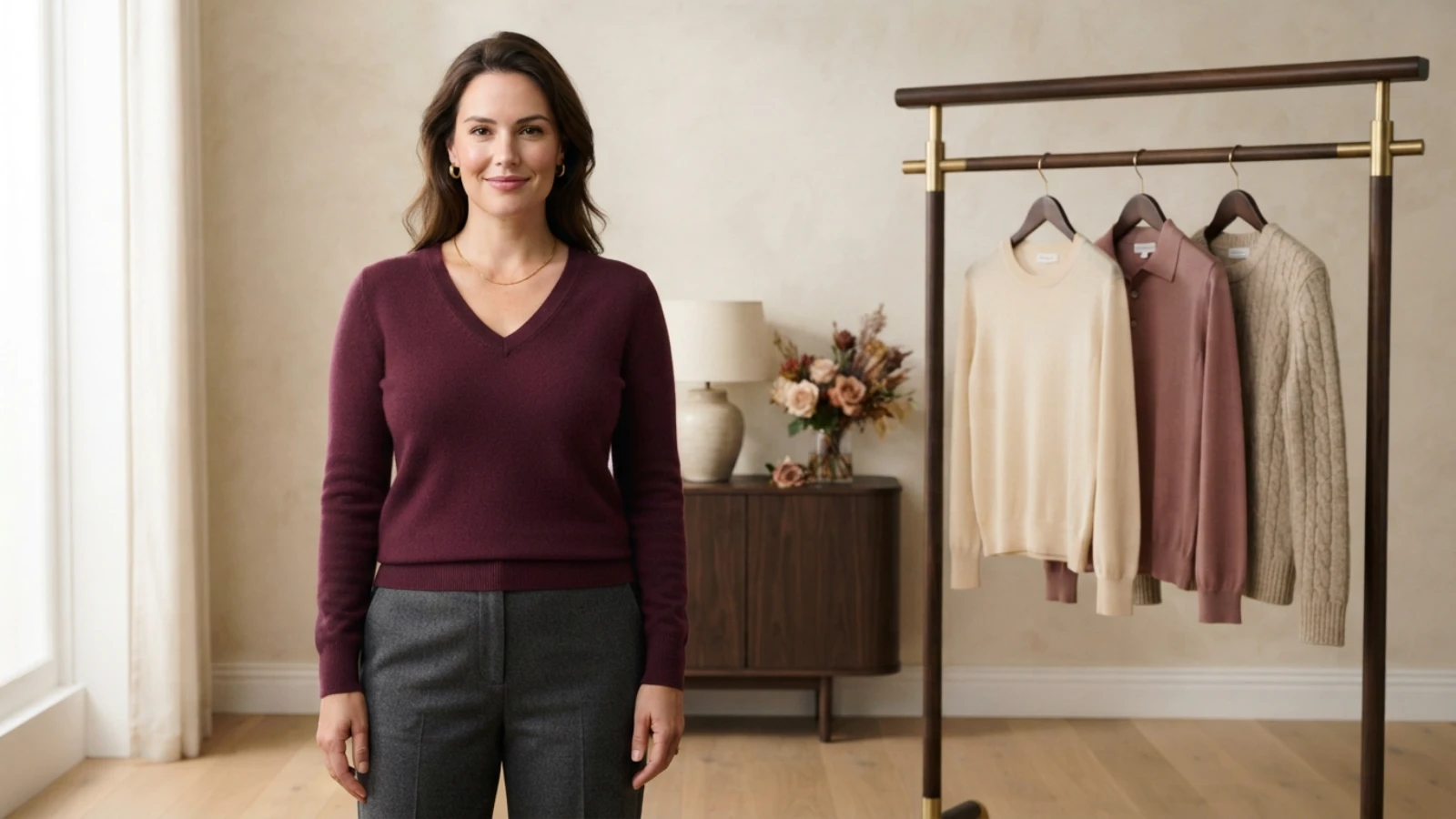
The best sweaters for a large bust are not defined by a single neckline, a dark color, or a rule to size up. They are defined by how the pattern and knit behave over projection. A sweater can have enough stretch to go on yet still be too small: the ribs widen and become sheer, the shoulder seam moves forward, the armholes pull, the hem rises, and the neckline changes shape. Another sweater may be technically roomy but so wide through the shoulder and back that it feels heavy rather than relaxed. Good fit balances front-body room with a deliberate shoulder, a neckline that stays put, a knit that recovers after movement, and enough center-front length to hang where the designer intended. This guide compares six useful sweater constructions, explains gauge and fiber trade-offs, gives an online measurement system, diagnoses common fit problems, and shows what can realistically be altered. Product modules remain private until current listings, finished garment measurements, materials, returns, and availability can be verified. That makes the buying advice useful without inventing an Amazon product, rating, price, or wear claim.
The 60-second sweater test
Put on the intended bra and base layer, then read the garment rather than the size label.
- The shoulder seam sits near the intended shoulder point and does not rotate toward the chest.
- The neckline keeps its designed shape without being pulled wider, higher, or asymmetrical.
- The knit stays opaque over the bust and its stitch pattern does not distort dramatically.
- The side seams remain near vertical rather than swinging forward toward the fullest point.
- The center-front hem is long enough; a deliberate crop stays balanced instead of lifting only in front.
- The armhole and upper sleeve permit reaching without dragging the whole sweater upward.
- The ribbed hem returns after sitting and does not grip so firmly that the body balloons above it.
- After five minutes, the collar, elbows, cuffs, and bust area have not remained stretched.
Best sweaters by type and wardrobe need
The best sweaters solve a defined wardrobe problem. A thin layer for an office is judged differently from a warm weekend knit, and a deliberate relaxed shape should not be forced through the same body measurements as a close-fitting rib. Start with what the sweater must do, then evaluate its construction. The best sweaters for a large bust create their shape through pattern, stitch structure, and proportion rather than asking extreme stretch to supply missing front room.
Fine-gauge V-neck sweater
Best for: office layers, jackets, and a clean neckline. Fine gauge reduces bulk, while a stable V opens the upper chest without requiring a low cut. Look for opacity at full stretch, a V edge that lies flat, and enough front length. The trade-off is that thin knits reveal bra seams and poor recovery more readily.
Open crew-neck sweater
Best for: everyday coverage with less neck pressure. An open crew sits farther from the base of the neck than a classic high crew and can feel visually lighter. It still needs a reinforced neckline and shoulders that do not slide outward. The trade-off is that a very wide opening may expose bra straps.
Shaped rib-knit sweater
Best for: close fit with flexible movement. Narrow, resilient ribs can follow projection and return, but ribs that spread into broad flat channels at the bust indicate stress. Choose a dense knit, thoughtful waist shaping, and a hem that does not grip. The trade-off is higher sensitivity to underlayers and static.
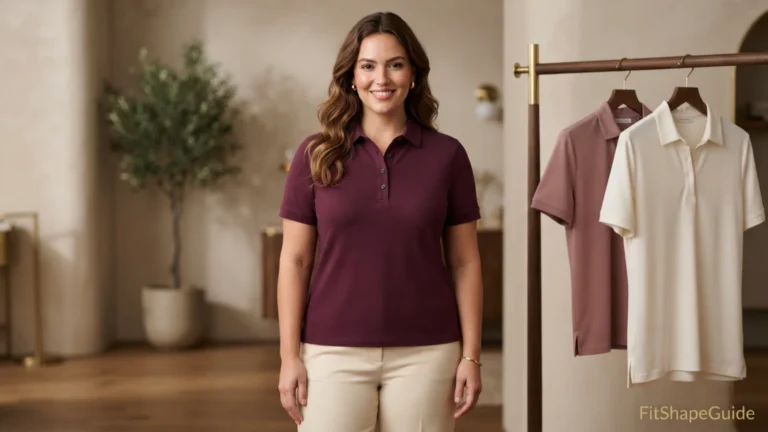
Refined polo or collared knit
Best for: smart-casual outfits and neckline structure. A short placket, open collar, or zip neck adds adjustability. The collar should not be dragged backward by the bust, and the placket must remain flat. The trade-off is that thick collars, patch pockets, and heavy zips can concentrate bulk near the upper torso.
Relaxed tunic sweater
Best for: leggings, travel, and easy coverage. Choose intentional shoulder placement, enough side-slit room, and a front hem that reaches its designed length. The trade-off is volume: excessive dropped shoulders, low armholes, and a tight lower rib can create a large fabric bubble instead of relaxed drape.
Controlled chunky sweater
Best for: warmth and visible texture. A moderate cable scale, simple neckline, stable shoulders, and adequate length make chunkiness look deliberate. The trade-off is real physical volume and coat clearance. Test it under outerwear before deciding that the sweater works alone.
| Wardrobe need | Strong starting point | Evidence to verify | Main trade-off |
|---|---|---|---|
| Under a blazer | Fine-gauge V-neck | Smooth sleeves, low bulk, opaque knit | Shows underlayer lines |
| Everyday casual | Open crew neck | Stable neckline and level hem | Strap coverage varies |
| Closer silhouette | Resilient shaped rib | Ribs recover after stretch | Can cling or turn sheer |
| Smart casual | Polo or collared knit | Flat placket and controlled collar | Hardware may add weight |
| Long coverage | Side-slit tunic | Front length and walking room | May overwhelm a shorter frame |
| Cold-weather texture | Controlled chunky knit | Moderate cable scale and coat fit | Adds volume and care needs |
How the best sweaters balance necklines and shoulders
A neckline is not an isolated styling detail. It is attached to the shoulders and upper front, so bust tension can change its width, height, and angle. The best sweaters keep the neckline recognizably shaped after the sweater settles over the bust. Compare the garment on the hanger with the garment on your body. If a neat curve becomes a stretched oval, a V turns much wider, or one side sits higher, the neckline may be revealing tension elsewhere.
V-necks need stability, not maximum depth
A moderate V often works because it reduces fabric near the upper chest and creates an open line. Depth should be chosen by coverage and use, not by a supposed flattering rule. Inspect the V point: it should lie flat and remain centered. A narrow binding that rolls, a point that lifts, or edges that flare can indicate weak finishing or insufficient front room. If you plan to wear a camisole, include its thickness and friction in the fitting.
Crew, mock, and turtleneck shapes are valid options
A high neckline does not automatically fail on a fuller bust. Smooth fine gauge, controlled shoulder width, a comfortable collar, and enough front length can create a polished line. If you prefer more detail on high-neck construction, use the turtleneck fit guide. The useful question is whether the extra upper-chest fabric feels balanced for your style and temperature, not whether a universal rule permits it.
Shoulder seams control apparent sweater size
A set-in shoulder should meet the intended shoulder point. When it sits too far inward, the upper sleeve may pull, the armhole may cut forward, and the bust may borrow width from the side. A deliberately dropped shoulder can sit lower, but its drop should look consistent and allow the sleeve to hang cleanly. The combination of dropped shoulder, deep armhole, wide sleeve, chunky yarn, and short body creates several sources of volume at once. That may be intentional, but it should be chosen knowingly.
Sleeve room must be tested with the whole torso
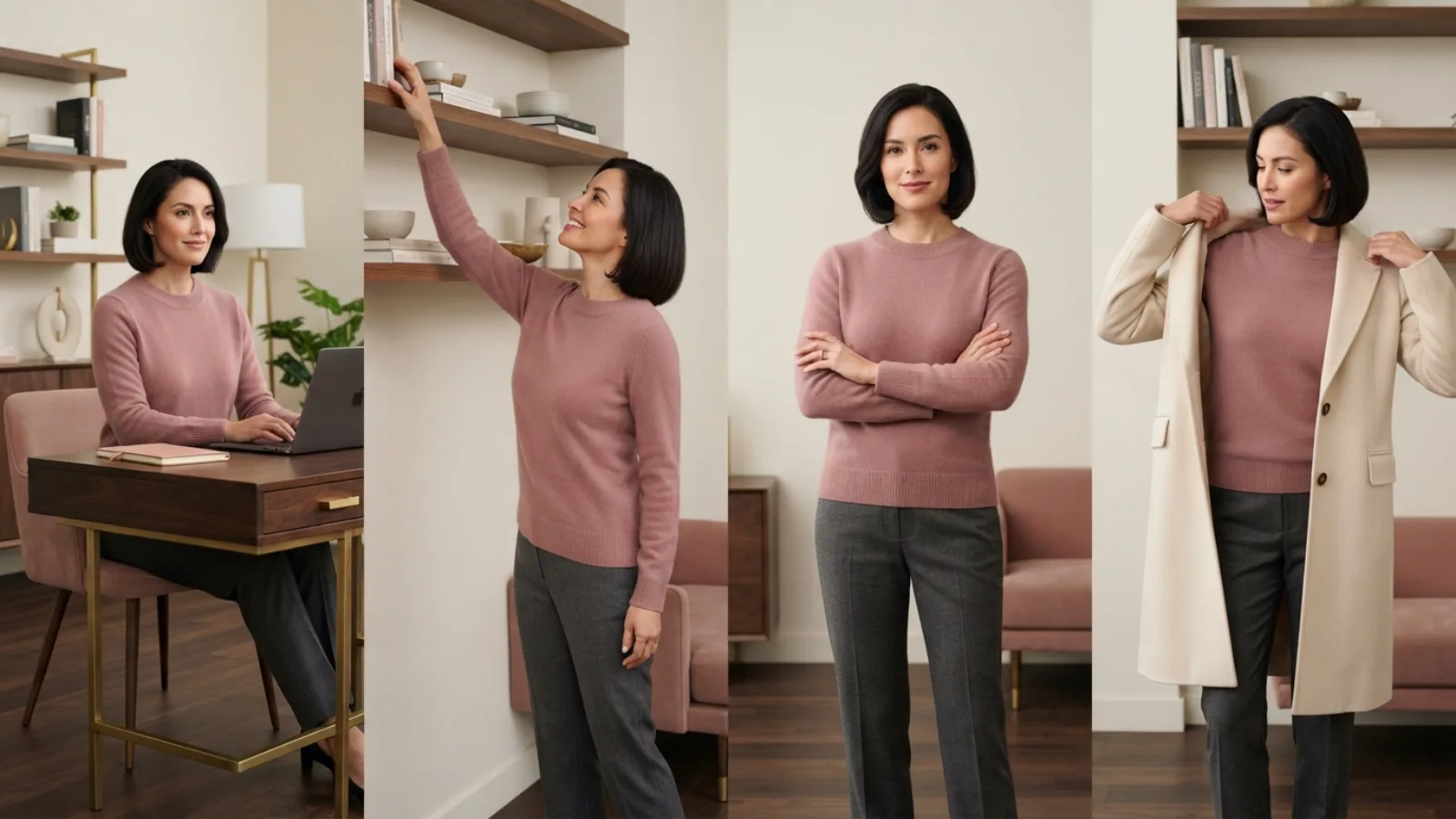
Cross your arms, reach forward, and lift both hands. If the sleeves feel restrictive, determine whether the problem is upper-arm width, armhole shape, back width, or bust tension. A sweater that pulls upward every time the arms move may not have enough independent room through the upper body. Very low armholes often feel roomy while standing yet lift the entire body during reach. The best sweaters permit ordinary movement without forcing constant hem adjustment.
How the best sweaters use gauge, recovery, and opacity
Fiber content identifies ingredients, not performance. Yarn twist, stitch structure, gauge, finishing, elastane, and garment pattern determine whether the knit feels resilient or unstable. The best sweaters combine enough give for movement with enough recovery to return. Recovery matters at the bust, elbows, cuffs, neckline, and hem. A garment that becomes longer, wider, or shinier after an hour may have generous stretch but poor memory.
Fine gauge reduces bulk but exposes weak recovery
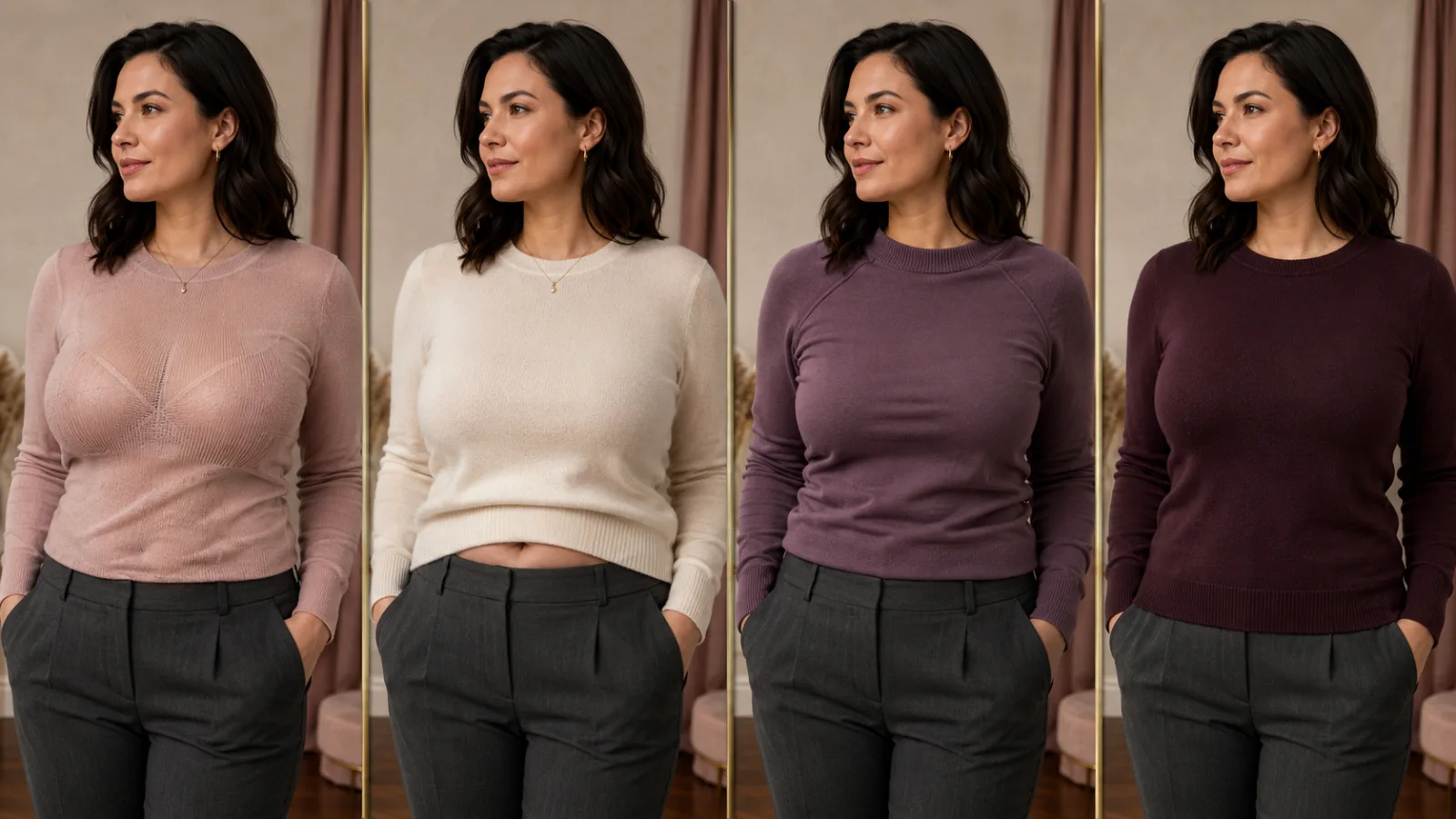
Fine-gauge stitches create a smooth surface and layer easily under jackets. They can also become transparent or reveal every underlayer when stretched beyond their intended range. Hold the sweater up to diffuse light, then repeat while gently stretching a hidden area. On the body, compare stitch density at the upper back with density over the bust. A small difference is normal; dramatic thinning, shine, or visible bra color means the garment needs more room or density.
Mid gauge is often the versatile middle
Mid-gauge knit offers visible texture without the physical scale of a chunky sweater. It can disguise minor underlayer lines and still fit beneath many coats. Look for a stitch pattern that remains readable over curves, edges that do not curl, and seams that lie flat. Weight matters: a heavy cotton mid-gauge sweater may grow vertically, while a resilient blended knit may retain shape better.
Chunky gauge magnifies construction choices
Large stitches, cables, bobbles, and thick yarn add real depth. The issue is not that texture is forbidden; it is that each element has a spatial effect. A large central cable can widen when stretched and appear different at the bust than below it. A high chunky collar adds warmth and volume close to the face. A thick hem may stand away from the body. If you enjoy the look, select one or two dominant features and keep shoulders, length, and sleeves controlled.
Ribbing should stretch and return evenly
Rib knits are common because they expand readily. Watch the distance between ribs. If narrow channels become broad, flat gaps only over the bust, the garment is relying heavily on stretch. Release a gently stretched hidden section and see whether the ribs close promptly. A ribbed hem also needs balance: too little recovery becomes wavy, while an aggressive hem grips the waist or hip and causes the torso to balloon above it.
Fiber trade-offs matter to comfort and care
Merino and other wool blends can deliver warmth at a relatively low thickness, but softness, pilling, moth protection, and washing needs vary. Cotton may feel breathable and substantial, though heavy cotton knits can grow. Viscose and modal blends often drape smoothly but may need added structure for recovery. Polyester, acrylic, and nylon blends can improve durability, drying speed, or shape retention, while heat and hand feel vary widely. Elastane may help recovery but does not rescue a poor pattern or loose knit. Check the actual sewn-in label. The FTC textile-label guidance explains U.S. fiber-content labeling requirements.
How the best sweaters balance bust ease and front length
Finished chest width is essential, but it cannot explain the entire fit. Sweaters may be designed with positive ease, zero ease, or negative ease. The intended amount depends on knit recovery and silhouette. Instead of using a universal ease number, compare a successful sweater from your wardrobe. Measure it flat, record how it behaves over your usual bra and base layer, and use those numbers as a personal reference. The best sweaters for a large bust reproduce the useful room without turning every other area oversized.
Chest width must be interpreted with stretch
Measure pit to pit without pulling, then double the number. A relaxed wool sweater and a close rib knit may have different unstretched measurements and both fit, because their intended ease differs. Ask how the seller measured and whether stretch information is descriptive or quantified. “Stretchy” is not enough evidence. If reviews consistently mention transparency, shrinkage, or loss of shape, treat those as questions to investigate rather than proof that every garment behaves identically.
Center-front length is a separate measurement
Bust projection uses vertical fabric. A retailer may publish “body length” measured at the center back, which does not tell you whether the front is long enough. Compare center-front and center-back length on your reference sweater. A small difference in hang may be expected; a dramatic front rise can expose a waistband, alter a motif, or make a standard-length sweater look accidentally cropped. A deliberately cropped design should still look intentional from the side.
Side seams reveal borrowed fabric
When a sweater lacks front width, the side seams can rotate forward as fabric is pulled from the back. This changes the sleeve and hem too. Stand naturally and check both sides in a mirror or photo. If the seam moves forward only near the bust and returns near the hem, a larger size may help, but a cut with more front room is often cleaner when sizing up damages the shoulders.
The lower rib controls where volume collects
A fitted ribbed band can anchor a sweater at the waist or hip, which may be useful. It can also stop the garment from falling, causing fabric to blouse above the band. Decide whether that is the designed silhouette. If the hem repeatedly climbs and collects beneath the bust, compare the relaxed and stretched hem widths. A straight or split hem may work better when you prefer a continuous line.
| Fit evidence | Likely meaning | First response | Do not assume |
|---|---|---|---|
| Stitches widen only at bust | High local stretch demand | Try more chest room or denser knit | That opacity is unchanged |
| Shoulder seam rotates forward | Front body borrowing width | Compare shoulder and chest together | That sleeves alone are the issue |
| Front hem rises sharply | Insufficient front length or width | Check center-front measurement | That a longer back fixes it |
| Body balloons above hem | Hem too gripping for torso volume | Try straighter or split hem | That more overall size is required |
| Neckline becomes wider | Upper front under tension | Assess chest, shoulder, and binding | That neckline was designed that way |
| Back looks very loose after sizing up | Size solved bust but lost proportion | Choose more front-shaped cut | That tailoring knit is simple |
How to buy the best sweaters online accurately
The best sweaters can be shortlisted online only when the listing provides enough evidence for the intended use. Begin with role: under a blazer, worn alone, layered over a shirt, or used as a heavy outer layer. Then identify the seller’s chart type. Body measurements are the measurements the brand intends a size to fit. Finished garment measurements describe the physical sweater. You need both when possible, because stretch language and a model photograph cannot replace dimensions.
- Choose a reference sweater. Use one with similar gauge and intended fit, then photograph it and record its measurements.
- Measure chest width flat. Measure straight from underarm to underarm without stretching and double it.
- Record shoulder and armhole. For set-in sleeves, measure shoulder seam to seam. Note armhole depth and upper-arm width.
- Separate front and back length. Measure from the appropriate shoulder or neckline point and record where the hem lands.
- Measure the hem relaxed. A fitted rib, straight hem, and split tunic hem behave differently at the same chest size.
- Check neckline dimensions. Width and depth affect bra coverage, collar comfort, and layering.
- Read materials and care. Note exact fiber percentages, knit description, washing method, and whether reshaping or flat drying is required.
- Verify returns. Confirm the return window, condition requirements, fees, and whether sale or marketplace items follow different terms.
Product reviews are useful for repeated observations about shrinkage, pilling, sheerness, sleeve length, or color transfer, but bodies, care, and expectations differ. Prioritize reviews that give measurements, selected size, and context. A statement that a sweater “runs small” is less useful than a report that a size has a particular pit-to-pit measurement and became shorter after a stated wash method.
| Listing evidence | Why it matters | Strong signal | Weak signal |
|---|---|---|---|
| Finished chest width | Shows physical room before stretch | Measurement method stated | Only S–XL body chart |
| Front and back length | Predicts hem balance | Both dimensions listed | One vague “length” |
| Fiber percentages | Supports care and behavior questions | Exact composition | “Luxury soft knit” |
| Gauge and opacity photos | Shows density and texture | Close-ups in neutral light | Only distant styled image |
| Care instructions | Affects realistic ownership | Specific wash and dry method | “Easy care” only |
| Return policy | Protects the fit trial | Window, fees, and exclusions clear | Policy difficult to find |
The ten-minute test for the best sweaters
The best sweaters for a large bust work beyond a still mirror pose. Wear the exact bra and underlayer planned for the garment. If the sweater must fit beneath a coat, put that coat on too. Sit, type, cross your arms, reach to a shelf, imitate driving, raise one arm, and carry a bag. These actions reveal whether the armholes transfer tension, the hem climbs, the neckline moves, or the knit catches on the base layer.
Test warmth as a system
A sweater’s comfort depends on fiber, gauge, base layer, room for air, indoor heating, and outerwear. A very warm chunky knit may be useful outdoors but uncomfortable in an office. A fine merino blend may provide warmth with less bulk, but care and skin sensitivity matter. The best sweaters match the actual temperature range rather than the visual idea of winter.
Check friction between layers
Rough interior stitches can grip a cotton shirt, and static can make synthetic layers cling. A smooth camisole may let a sweater fall better, but it should not be used to disguise severe tightness. If you regularly wear button-downs under knits, allow room for the collar, cuffs, placket, and shirt fabric. The large-bust layering guide explains how to manage combined volume without relying on compression.
Try the bra that matches the neckline
Bra shape can alter garment projection and neckline coverage. A seamed bra may show beneath fine gauge; a smooth cup may change the outline; strap placement matters for wide necklines. The sweater should still have sufficient room. Underwear is a foundation choice, not a structural repair for a garment that distorts, rides up, or turns sheer.
Keep / alter / return rule
Keep when the neckline, shoulders, opacity, movement, and front length already work. Alter only when the base fit is sound and the change is small, technically feasible, and worth the cost. Return when the knit distorts strongly, turns sheer, rides up repeatedly, restricts movement, or needs several structural fixes.
Fit problems even the best sweaters must avoid
The best sweaters make the relationship between neckline, shoulder, bust, sleeve, and hem look intentional. When something fails, name the visible behavior before changing sizes. A bigger size is one possible response, not the diagnosis.
The knit becomes shiny or transparent at the bust
The stitches are opening under local stretch. Try a larger size, more finished chest width, denser gauge, darker or more substantial knit, or a style intended for less negative ease. A camisole can add coverage but does not restore distorted stitch geometry.
The front hem rides up throughout the day
Possible causes include insufficient front length, tight chest, restrictive armholes, a gripping hem, or friction from the underlayer. Smooth the sweater down once, then move normally. If it climbs again, record where the tension begins. A longer sweater may still ride if its extra length is only at the back.
The neckline pulls backward toward the throat
The front body may need more length or room, causing the garment to rotate backward. Shoulder angle and posture can also matter. Look at the side seam and front hem together. If both move, neckline adjustment alone is unlikely to solve the underlying geometry.
The sweater fits the bust but looks oversized elsewhere
Sizing up may have solved one circumference while making the shoulders, back, sleeves, and neckline too large. Choose a cut with more front ease, shaping, stretch recovery, or a different shoulder construction. The goal is not a smaller visual body; it is a garment whose design remains coherent.
Cables or motifs distort across the front
Patterned knit stitches widen where the garment stretches. A moderate change may be expected, but severe distortion means the motif and size are not working together. Try a larger repeat, simpler front panel, more ease, or texture placed away from the highest-stress area.
The lower hem creates a bubble
A tight rib stops at the waist or hip while the upper body contains more fabric. This can be intentional blousing. If it is not desired, choose a straighter hem, split hem, less difference between body and band width, or a style designed to hang rather than anchor.
For a broader explanation of fiber drape and recovery, see the best fabrics for a large bust. That page supports the material decision; this guide remains focused on sweater construction and shopping.
What a tailor can change in the best sweaters
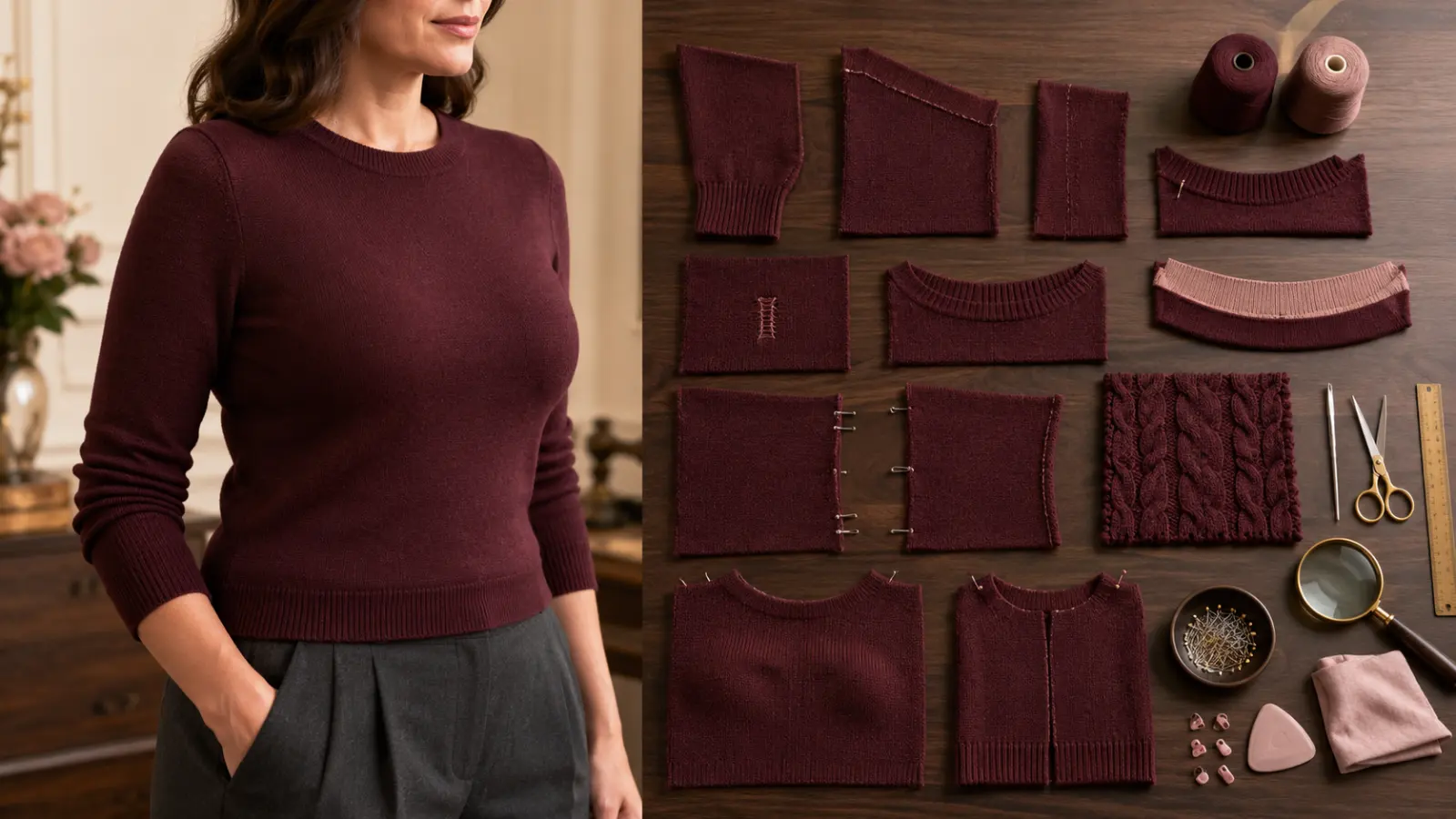
Knitwear alteration is specialized because cutting can unravel stitches and ribbed edges are constructed as part of the garment. A professional experienced with knits may be able to shorten sleeves, reduce some side width, repair a seam, replace a collar, reinforce a shoulder, or adjust a simple hem. Feasibility depends on whether the sweater is fully fashioned, cut-and-sew, linked, seamed, rib-finished, or hand-knit.
Adding substantial bust room, changing armhole shape, moving a complex shoulder, rebuilding a neckline, or creating missing center-front length is usually difficult and may cost more than the garment. Small repairs can be worthwhile for quality knitwear; major reconstruction is rarely a sensible plan for an unverified purchase. The tailoring guide helps distinguish local alterations from pattern-level fit problems.
| Possible change | Feasibility | Good candidate | Better buying response |
|---|---|---|---|
| Shorten simple sleeves | Sometimes | Plain cuff and accessible seam | Verify sleeve length first |
| Reduce side width | Sometimes | Stable side-seamed knit | Keep correct shoulders and bust |
| Reinforce shoulder seam | Often possible | Shoulder growing from weight | Choose lighter, resilient knit |
| Repair pulled seam | Often possible | Localized seam failure | Inspect seam quality before buying |
| Add substantial bust room | Rarely practical | Only with planned panels | Choose more front width |
| Create missing front length | Usually impractical | Limited specialty redesign | Buy correct center-front length |
How to style the best sweaters for real wardrobes
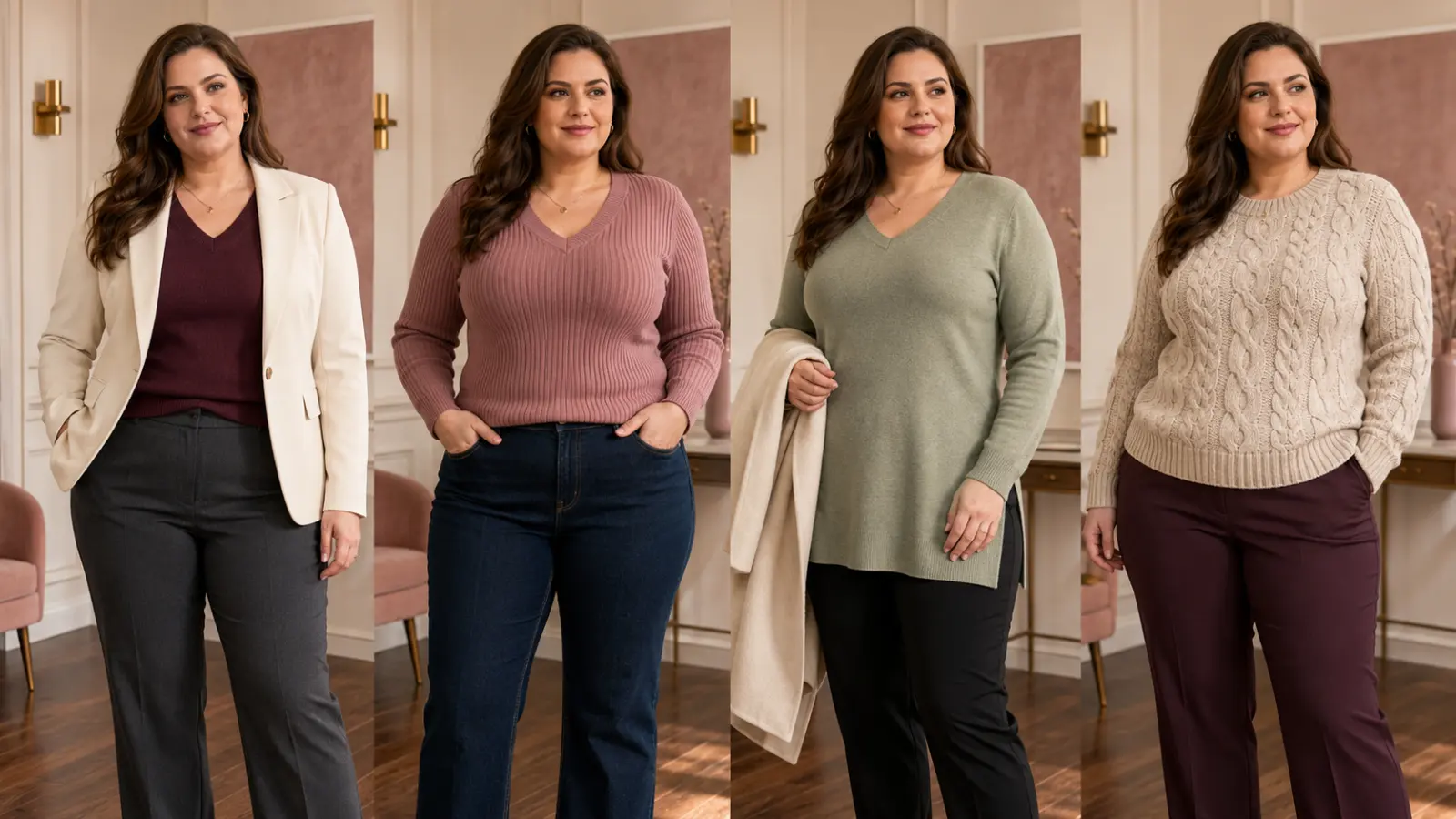
The best sweaters for a large bust should multiply outfit options rather than demand a special bottom or accessory to hide poor fit. Styling begins after the neckline, shoulder, bust room, and hem already work. Use proportion and texture to match the setting, not to correct a structural failure.
Work: fine gauge + tailored trouser + clean jacket
Choose a fine-gauge V or open crew with sleeves smooth enough for a blazer. Keep the sweater hem flat or use a controlled tuck only if the knit and waistband tolerate it. A simple necklace or small earring can finish the outfit without competing with the neckline. If the jacket closes, test it over the sweater rather than assuming a thin appearance equals low bulk.
Weekend: shaped rib + high-rise denim
A resilient rib sweater can create a clean close layer with straight or wide-leg denim. The high rise gives a clear relationship to the hem, whether tucked, cropped, or left out. Keep the rib opaque and let the garment skim rather than compress. If you prefer more ease, choose a semi-fitted cut with a straight hem.
Travel: tunic knit + straight base + practical coat
A side-slit tunic offers coverage and movement over leggings or straight trousers. Select pockets carefully; bulky patch pockets can change the line and catch beneath a coat. Sit for the length of a realistic journey, then check whether the front hem creeps, the collar becomes hot, or the seat stretches.
Cold weekend: controlled cable + simple lower half
Let the cable or texture be the outfit’s main visual element. Pair it with a quieter trouser or skirt and footwear substantial enough for the sweater’s weight. This is a preference, not a rule: texture can be combined with pattern when the wearer enjoys it. The construction test remains the same regardless of styling.
Layered shirt look: open-neck sweater + crisp collar
A shirt under a sweater needs extra torso and armhole room. Use a thin, smooth shirt and check that its placket does not add a ridge beneath the knit. The button-down guide helps select a base that remains closed before the sweater is added.
Soft set: sweater + matching cardigan
A twinset creates color continuity and adaptable warmth. The inner knit should have a neckline and sleeve that sit smoothly beneath the outer layer. Use the cardigan guide to assess button bands, open fronts, and extra layer clearance. Matching color does not compensate for two garments fighting at the shoulder or bust.
Care, pilling, and value in the best sweaters
The best sweaters earn value through useful wears, not through purchase price alone. Before buying, estimate how many outfits and temperature ranges the sweater serves, whether it works with existing coats, and whether its care instructions fit your routine. Inspect seams, shoulder reinforcement, neckline binding, cuff recovery, hem alignment, yarn consistency, and pattern matching. Turn the garment inside out when possible. Long floats, rough joins, or weak seam finishing can become pressure points.
Pilling is a friction question as well as a fiber question
Pills often form where fibers rub: underarms, bag contact, seat belts, coat interiors, and the bust where layers meet. Fiber length, yarn twist, surface fuzz, and care influence the rate. A very soft fuzzy finish may pill sooner than a compact smooth yarn, but no generic material label predicts the exact result. Reduce avoidable friction, wash as directed, and use a suitable fabric comb carefully only when the garment maker permits it.
Washing can change more than size
Heat, agitation, water, and hanging weight can alter length, width, softness, and recovery. Follow the sewn-in care label. The FTC care-label guidance explains U.S. care-instruction requirements for covered garments. When instructed, reshape the sweater without aggressive stretching and dry it flat on a suitable surface. Heavy wet knits can grow if hung.
Storage should support the garment’s weight
Fold heavy sweaters rather than hanging them from narrow shoulders. Keep knits clean and dry before long storage, follow appropriate moth-prevention practices for animal fibers, and avoid crushing collars or embellishment. A breathable storage method and a smooth shelf reduce snagging. Place the fold where it will not create a permanent ridge across a sensitive motif.
Final buying scorecard
- Purpose: the sweater has a defined outfit and temperature role.
- Upper fit: neckline, shoulders, armholes, and sleeves stay intentional.
- Bust behavior: stitches remain opaque and motifs do not distort severely.
- Balance: side seams and center-front hem remain close to their design position.
- Recovery: neckline, ribs, cuffs, elbows, and hem return after movement.
- Layering: planned base and outer layers fit without crowding.
- Evidence: measurements, composition, care, returns, and availability are verified.
- Value: care burden and likely outfit use justify the purchase.
Frequently asked questions
What sweater style is best for a large bust?
A V-neck, open crew neck, refined polo knit, or lightly shaped fine-to-mid-gauge sweater is often a useful starting point. The best style is the one with correct shoulders, enough bust room, stable recovery, comfortable neckline depth, and sufficient front length to remain balanced without relying on extreme oversizing.
Are V-neck sweaters good for a large bust?
V-neck sweaters can work well because the neckline creates visual openness and may reduce fabric near the upper chest. The V still needs a stable edge, bra-compatible depth, adequate bust ease, and shoulders that remain in place. A deep or stretched V is not automatically a better fit.
Should I size up in sweaters for a fuller bust?
Size up when the current size becomes sheer, pulls the armholes forward, distorts the knit, restricts movement, or rises substantially at the front. If a larger size makes the shoulders, sleeves, neckline, and back too loose, choose a sweater cut with more front room or a different knit structure instead.
Do chunky sweaters make a large bust look bigger?
Chunky knits add physical volume, but the result depends on yarn, stitch scale, neckline, shoulder line, length, and the rest of the outfit. A controlled chunky sweater can look intentional; an unstable oversized cable, dropped shoulder, bulky collar, and short front hem may create more volume than the wearer wants.
What sweater necklines work well for a fuller bust?
V-necks, open crew necks, modest scoop necks, split necks, and neat collars can all work. Choose by comfort, bra coverage, shoulder stability, and the amount of fabric you prefer above the bust. High necks are also valid when the knit is smooth, the collar is comfortable, and the overall fit is balanced.
Which sweater fabrics are best for a large bust?
Merino blends, compact cotton blends, resilient viscose or modal blends, and well-constructed synthetic blends can all perform well. Judge the finished knit rather than the fiber name alone: it should remain opaque, recover after stretching, resist edge curl, feel comfortable, and match your realistic care routine.
How do I stop a sweater from riding up over my bust?
Check for adequate garment bust width, center-front length, armhole room, hem recovery, and a base layer that does not create excess friction. A sweater that repeatedly climbs may be too short or too tight through the front body; sizing up helps only if the shoulders and neckline still fit.
What measurements should I check when buying a sweater online?
Check finished garment chest width, shoulder width, armhole depth, upper-arm width, center-front and center-back length, hem width, sleeve length, neckline dimensions, and stated stretch. Compare them with a sweater you already wear comfortably and confirm whether the retailer chart lists body or garment measurements.