Best Turtlenecks for a Large Bust
A fit-first guide to high-neck knits with comfortable collars, enough bust depth, reliable recovery, useful opacity, and the right length for smooth layering.
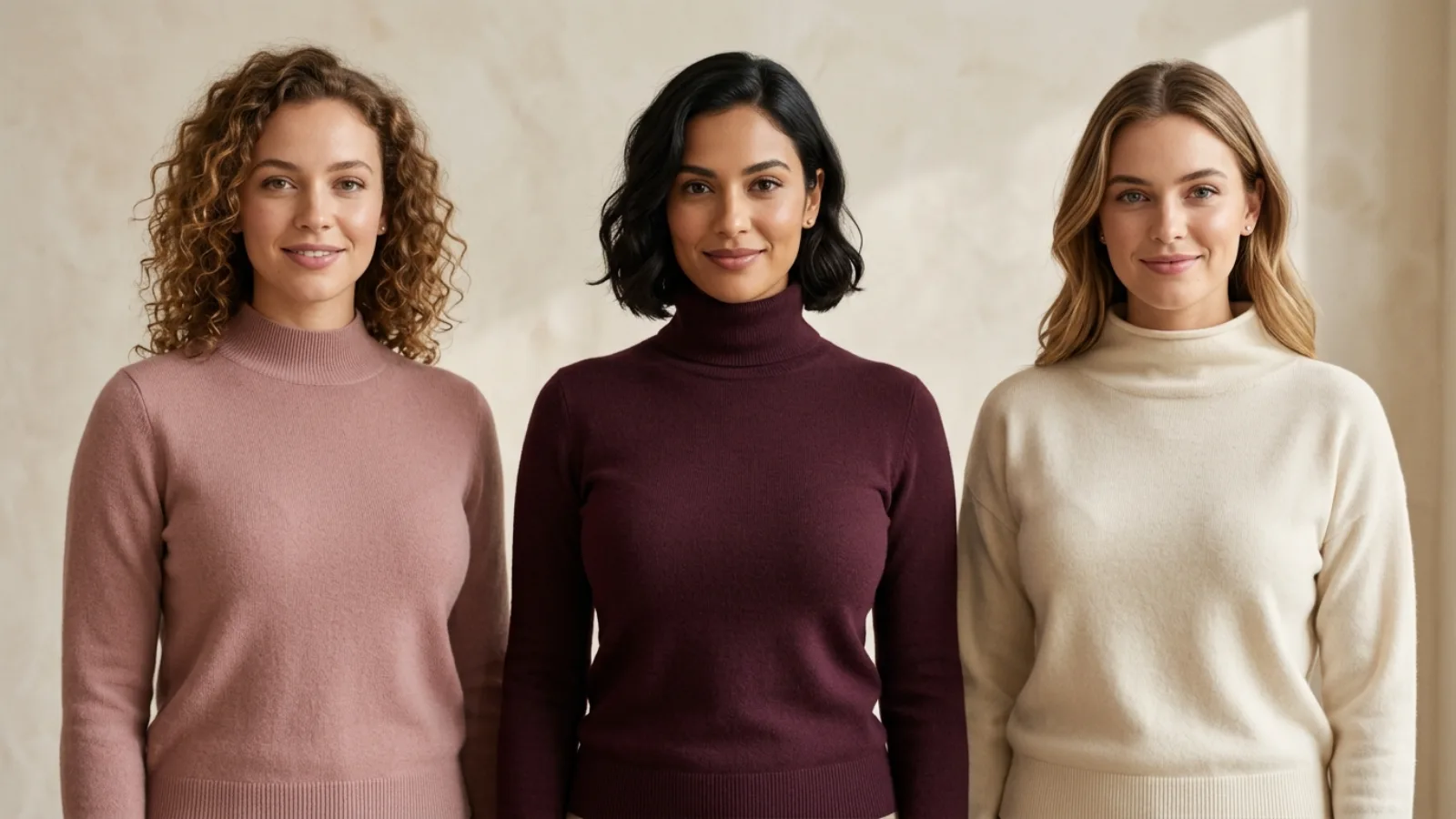
The best turtlenecks for a large bust are not selected by one visual rule about high necklines. They are selected by how the entire knitted garment responds to projection. A dependable style gives the bust enough width and forward room, keeps the shoulder seam close to the shoulder point, remains opaque when stretched, and supplies enough center-front length for the hem to stay calm. Its collar should feel secure without pressing the throat, rolling unpredictably, or pulling the upper body upward. When these engineering details are right, a turtleneck can be a polished base layer, a warm standalone knit, or the quiet foundation of an office, weekend, or travel outfit. When they are wrong, the fabric may turn shiny over the chest, every bra seam may show, the front may shorten, or the neckline may feel tighter because the body of the garment is being pulled downward. This guide compares construction rather than promising that a particular color or styling trick will change a body. It covers six useful silhouettes, collar design, knit density, rib scale, recovery, online measurements, movement, layering, alterations, care, and value. Product slots remain unpublished until a current listing can be checked, so an attractive photograph is never treated as proof of fuller-bust fit.
The 60-second turtleneck test
Put it on with the bra and outer layer you intend to wear, then check these eight points before deciding.
- The collar is comfortable when upright and folded, and it does not press the throat or trap the jaw.
- The shoulder seams sit close to the shoulder points rather than being dragged inward by the bust.
- The knit stays opaque across the fullest area without shiny strain or visibly opened ribs.
- The side seams remain close to vertical, and the armholes do not pull toward the chest.
- The front hem stays reasonably level with the back instead of climbing several centimeters.
- The sleeves and upper arms permit movement without transferring tension into the bust.
- The collar and body return after being stretched over the head and after ten minutes of sitting.
- A jacket, blazer, or coat closes smoothly over it without creating a bulky ridge at the neck or chest.
Best turtlenecks for a large bust by fit need
“Turtleneck” describes a neckline family, not one standardized fit. Collar height, yarn, rib structure, body ease, armhole, length, and hem all change the result. Start with the job the garment must do, then choose the construction most likely to perform that job. The best turtlenecks are therefore the styles whose construction matches a real wardrobe purpose, not simply the styles that look sleek on a product form.
Fine-gauge stretch turtleneck
Best for: sleek office layers, skirts, trousers, and wearing under a blazer. A dense fine gauge can follow curves without adding heavy bulk. Look for a matte surface, useful elastane or mechanical recovery, a body that is fitted rather than compressed, and enough length to stay tucked. A paper-thin knit is not automatically elegant; if it turns transparent across the bust or records every bra seam, it is too strained or too light for the intended use.
Medium-weight ribbed turtleneck
Best for: everyday warmth and a defined but forgiving silhouette. Ribbing can create expansion and recovery, but scale matters. Narrow, dense ribs usually distribute stretch more quietly than large, loose channels that spread dramatically over the bust. Check whether the rib returns after pulling over the head and whether the front ribs remain vertical rather than fanning outward. A slightly relaxed cut often performs better than an aggressively bodycon rib.
Soft mock-neck knit
Best for: indoor wear, shorter necks, collar sensitivity, and lighter layering. The shorter stand avoids a double fold and can reduce heat and bulk. It still needs a stable neck opening; an overstretched mock neck may wave or collapse. This is often one of the best turtlenecks in practical capsule wardrobes because it provides the visual continuity of a high neck without demanding a tall or tightly folded collar.
Relaxed funnel-neck sweater
Best for: soft winter outfits and anyone who dislikes close neck pressure. A funnel stands or drapes away from the neck instead of folding tightly. The body should contain deliberate ease, not random excess concentrated below the arms. Choose a shoulder line that remains intentional and a hem with enough width to fall past the bust. Heavy collars and dropped shoulders can add bulk, so test the garment under the coat you actually use.
Turtleneck bodysuit
Best for: a secure tucked line with high-rise trousers or skirts. The lower anchor can stop riding, but it can also pull the neckline and bust downward if the torso is too short. Check full torso length, snap comfort, leg opening, bust opacity, and bathroom practicality. A bodysuit is not a fit solution when the upper body is undersized; it simply makes the tension harder to escape.
Longline turtleneck tunic
Best for: leggings, narrow trousers, travel, and relaxed coverage. The best version has controlled shoulder width and enough hem circumference to clear the hips without catching. Bust projection may shorten the front, so compare center-front and center-back length. Side slits can improve movement, but they should begin below the area where you want coverage. Avoid using extreme oversizing as a substitute for bust depth.
| Need | Strong starting point | Evidence to check | Common risk |
|---|---|---|---|
| Smooth blazer layer | Fine-gauge fitted knit | Dense opacity, flat seams, adequate front length | Sheerness and bra texture |
| Everyday warmth | Medium dense rib | Recovery, vertical ribs, soft collar | Ribs opening over bust |
| Lower neck bulk | Mock neck | Stable short collar and comfortable opening | Wavy neckline |
| Relaxed winter shape | Funnel neck | Intentional ease and coat compatibility | Heavy collar and shoulder bulk |
| Reliable tuck | Bodysuit | Torso length, opacity, snap comfort | Downward pull |
| Longer coverage | Tunic | Front length, hip clearance, side slits | Front hem lift |
Collar height and comfort matter as much as bust fit
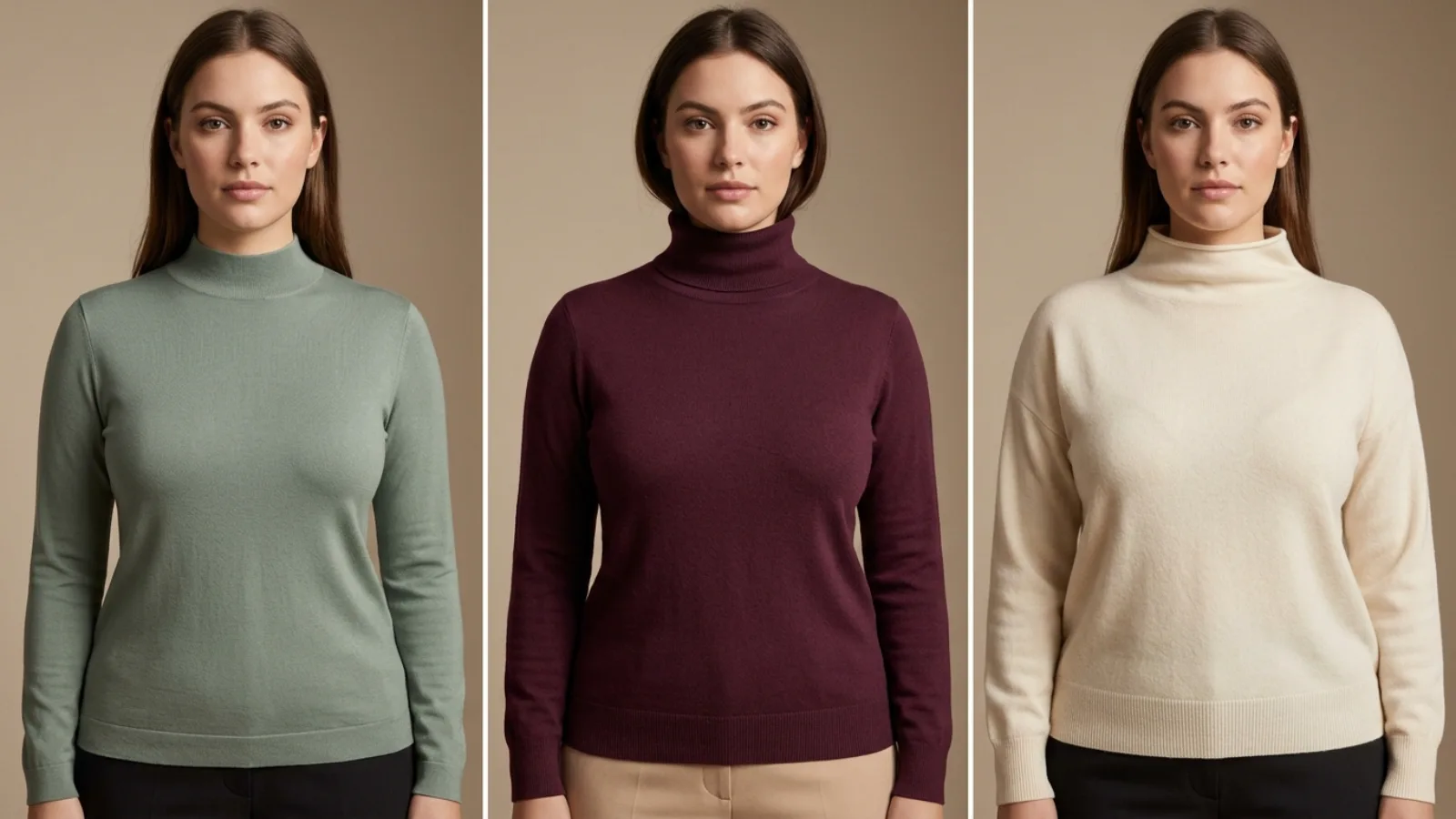
A turtleneck collar can be cut as a separate doubled band, an extension of the body, a high rib tube, a mock stand, or a loose funnel. Those constructions behave differently. A doubled collar is warm and stable but may feel thick. A single-layer fine knit is sleek but can curl. A rib tube expands over the head and should return without becoming loose. A funnel creates space but can interfere with a short necklace, jacket lapel, or coat closure. The best turtlenecks for a large bust balance this collar structure with enough room below it, so the body does not pull the neckline downward or make a comfortable opening feel tight.
Do not evaluate the collar only while standing still. Turn your head, lower your chin, sit for several minutes, and put on the outerwear you expect to use. Pressure at the front of the throat, scratchiness, heat, makeup transfer, and a collar that touches the jaw may turn a beautiful knit into an unworn purchase. Collar tolerance is personal; it is not a style failure. The best turtlenecks respect that limit rather than asking you to endure discomfort for a line in the mirror.
Neck opening circumference also matters. If the opening is too small, pulling the top over the head can stretch the collar, disturb hair and makeup, or make dressing unpleasant. If it is too wide, a mock neck may fall away or a fold-over collar may slump. Product descriptions rarely list this measurement, so customer photos, flat-lay images, fabric composition, and return terms become useful secondary evidence.
A useful collar rule
If you keep folding, tugging, or pulling the collar away from your throat during a five-minute try-on, that style is unlikely to become more comfortable during a full day. Choose a lower mock neck, softer yarn, wider opening, or relaxed funnel instead of treating repeated adjustment as normal.
Bust ease, shoulder position, and front length
Knits stretch, but stretch is not the same as fit. A garment can technically go around the bust while still being too small in the ways that matter. When the body is drafted with insufficient width or length, the knit borrows from the side seams, armholes, collar, and hem. That is why a top may feel tight at the neck even when the collar measurement seems reasonable: the body is pulling downward over the bust. It is also why the front hem can sit higher, the back can creep toward the shoulders, or sleeves can feel restricted. The best turtlenecks preserve the intended line from shoulder to hem instead of using maximum stretch as a substitute for three-dimensional room.
Start at the shoulder. In a set-in style, the seam should sit near the shoulder point unless the design intentionally drops it. If the seam is dragged inward, the bust may be consuming width. If it falls far beyond the shoulder in an otherwise fitted top, sizing up may have solved the chest but damaged the upper frame. Raglan and dolman sleeves redistribute this geometry, but they still need enough upper-body room; inspect whether fabric collapses into deep diagonal folds from neck to bust.
Next, check the fullest area. A close fit can be attractive and comfortable when the knit remains matte, opaque, and resilient. Compression is different: the bust appears flattened, rib channels spread widely, bra edges become unusually visible, and breathing or arm movement changes the neckline. The side seam should remain close to vertical. When it rotates toward the front, the garment is seeking extra circumference from the back.
Finally, compare front and back length. Some difference is normal because the front travels over more projection, but a pronounced raised front hem signals missing vertical room. For a tucked top, the front should remain securely inside the waistband after sitting and reaching. For an untucked knit, the hem should look intentional rather than curved upward only at center front. If you routinely need more length, a tall or longline option may work better than simply increasing the size.
Use a reference garment
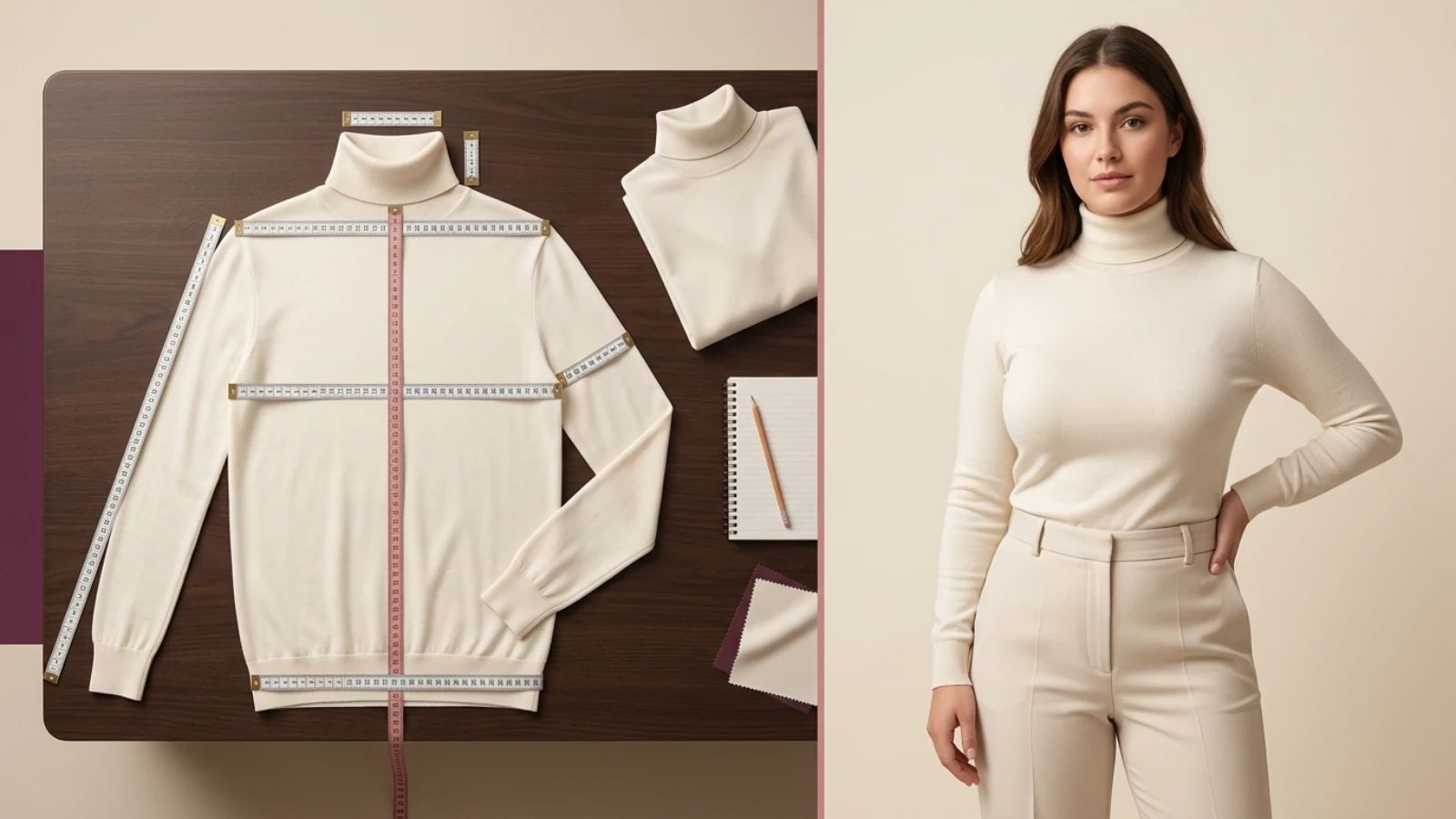
Lay a turtleneck you already like flat without stretching it. Record half-bust, shoulder width, center-front length, center-back length, upper-arm width, sleeve length, hem width, collar height, and neck opening. These garment measurements are more useful for online comparison than relying on a letter size across unrelated brands.
Fabric weight, rib scale, opacity, and recovery
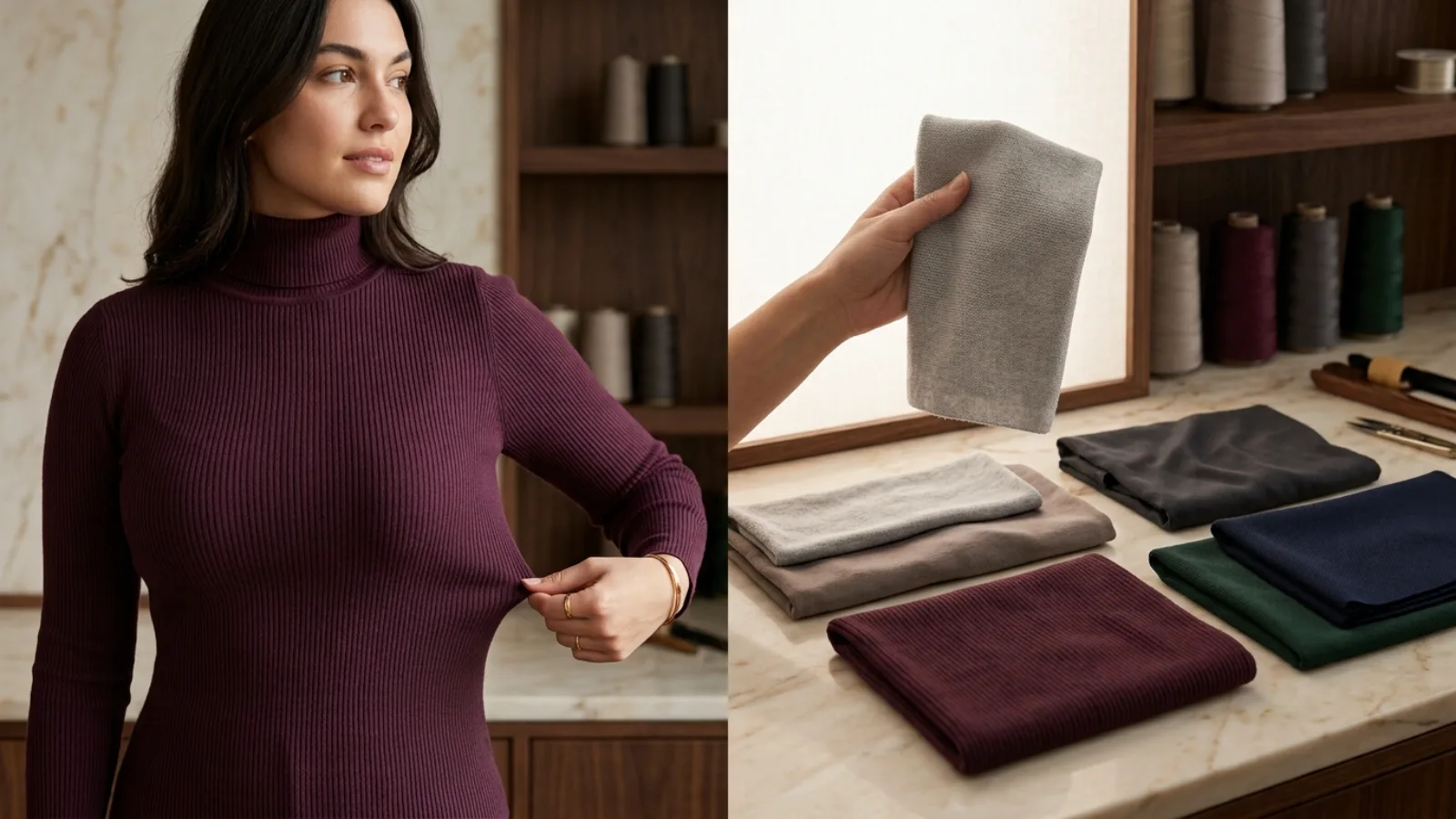
The best turtlenecks feel refined because their fabric does several jobs at once: it stretches over the head and bust, returns at the collar and elbows, stays opaque, handles warmth, and survives laundering. For shoppers comparing the best turtlenecks for a large bust, fabric behavior is often the difference between a close fit that looks deliberate and compression that becomes shiny or transparent. Fiber content helps, but it does not tell the whole story. Two tops labeled cotton and elastane can behave differently because of yarn quality, knit density, finishing, cut, and percentage. The United States Federal Trade Commission explains the role of fiber-content labeling in its textile and wool labeling guidance; use the label as evidence, then verify how the actual knit performs.
Fine-gauge merino and merino blends can provide warmth with less thickness, making them valuable under tailoring. Check softness against the neck, care requirements, and whether the body is opaque at full stretch. Cotton-modal or viscose blends often feel smooth and drape well, but very light versions may cling or grow. Elastane can improve recovery, although good structure also depends on knit construction. Dense rib blends offer expansion, but loose ribs may open over the bust and stay stretched at the collar. Polyester or nylon blends can improve durability and recovery, yet heat retention, static, pilling, and surface shine should be considered.
Perform a gentle recovery test. Stretch a hidden section sideways for several seconds, release it, and watch whether the edges return. Inspect the elbow and bust after sitting. Hold the fabric against a light source, then stretch it to the amount it will experience on the body. A knit that is opaque while relaxed may become noticeably sheer when expanded. Matte surfaces tend to show less strain than shiny finishes, but opacity and fit remain the important tests.
| Fabric family | Potential strength | Check before buying | Best use |
|---|---|---|---|
| Fine-gauge merino blend | Warmth without heavy bulk | Softness, opacity, care, pilling | Office and travel layers |
| Cotton-modal stretch knit | Smooth feel and easy drape | Recovery, cling, shrinkage | Indoor everyday wear |
| Dense rib blend | Expansion and shape | Rib opening, collar return | Standalone casual top |
| Viscose or rayon blend | Fluid line | Growth, care, wet handling | Soft fitted looks |
| Ponte-like knit | Opacity and smoothing structure | Heat and neckline bulk | Polished cold-weather wear |
| Performance synthetic blend | Recovery and easy care | Static, shine, breathability | Travel and high rotation |
How to identify the best turtlenecks online
Online shopping becomes more accurate when you separate body measurements, garment measurements, and stretch claims. The best turtlenecks for a large bust are easier to identify when the listing supplies garment dimensions, clear fabric composition, close construction photos, and a workable return policy. A body chart tells you the shopper range a brand associates with each size. It does not reveal the actual top width, length, collar, or intended ease. A garment chart is more useful, but only if you know whether measurements are taken relaxed, stretched, or around the full circumference.
- Confirm the chart type. Look for language such as body measurement, garment measurement, laid flat, relaxed, or maximum stretch. Do not treat a model’s size as a substitute for data.
- Compare bust and shoulder together. If you need the larger size for bust room but its shoulder is much wider than your reference knit, the cut may not suit your proportions. Search for a style with more stretch or a different body block.
- Check center-front length. Bust projection uses vertical fabric. A top that looks long on a flatter product form may become cropped or untuck on a fuller bust.
- Read collar evidence. Note collar height, whether it folds, neck opening construction, visible seam bulk, and reviewer comments about tightness, scratchiness, or stretching.
- Inspect rib and opacity. Zoom into product and customer images. Widely opened ribs, shine over the bust, or visible underlayers can indicate insufficient room or a light knit.
- Verify fabric and care. Record the full fiber percentages and read the care instructions before purchase. A high-rotation base layer should fit your realistic laundry routine.
- Check return conditions. Turtleneck comfort is difficult to predict from a screen. Confirm the return window, final-sale status, return shipping, and hygiene or tag requirements.
| Evidence | What it tells you | What it cannot prove |
|---|---|---|
| Garment measurements | Real dimensions and likely ease | Recovery, itch, or long-term shape |
| Fiber percentages | Material composition | Knit density or finished performance |
| Close product photos | Rib scale, seams, collar structure | Your exact fit |
| Customer photos | Behavior on varied bodies | Standardized lighting or sizing |
| Reviews with measurements | Useful context for fit and comfort | Universal conclusions |
| Return policy | Financial risk of trying | Garment quality |
A movement, temperature, and layering test
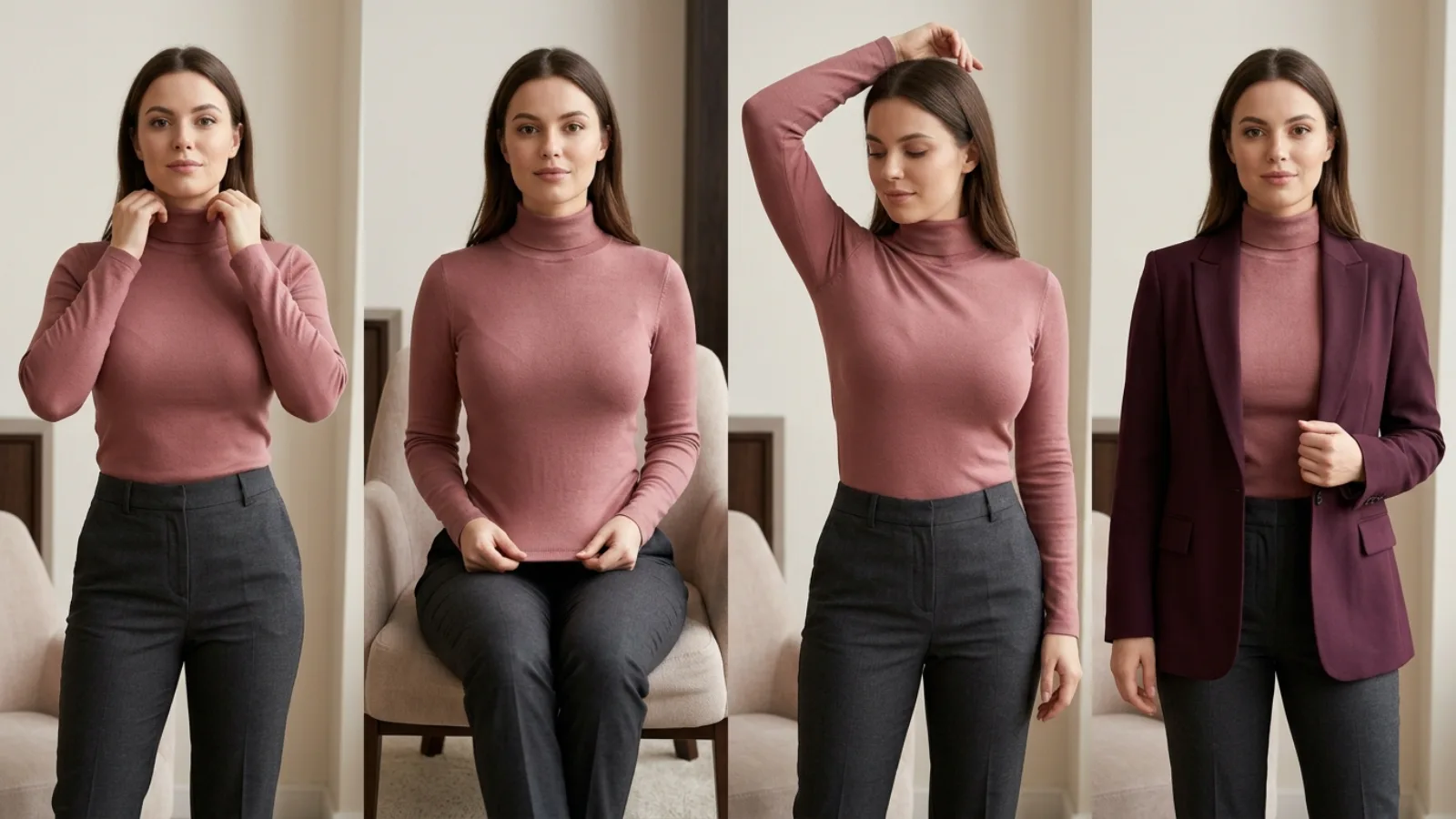
A mirror still can hide the exact problems that make knitwear frustrating. The best turtlenecks remain comfortable beyond the first pose, so wear the garment for at least ten minutes. Sit, stand, reach forward, raise both arms, cross them, turn your head, and put on your intended outer layer. Then check whether the collar tightened, the body rode upward, the shoulder seams moved, or the sleeves transferred tension into the chest.
Temperature matters because the same collar that feels cozy outdoors may become uncomfortable in a heated office. If the garment will be worn indoors, test it with realistic room temperature and the bra or camisole you use. A fine-gauge merino layer and a heavy acrylic rib can offer very different warmth even when both look similar online. Breathability, moisture handling, and static also affect whether the item is reached for repeatedly.
Next, test the outer layer. A blazer should slide over the shoulders without the turtleneck bunching in the armholes. A coat should close without crushing a bulky collar into the jaw. If the outfit creates too much volume, change one variable: use a mock neck instead of a folded collar, a fine gauge instead of a chunky rib, or an open jacket instead of another closed high neckline. The body is not the problem; the layers simply need compatible thickness and geometry.
Common turtleneck problems and the correct response
The best turtlenecks are selected by solving the actual failure point. Changing size may help one problem, but collar pressure, insufficient front length, unstable ribbing, and incompatible layer thickness require different responses.
The front hem rises. The top may lack center-front length, bust ease, or both. Compare a longer style, a fuller-bust-friendly cut, or a slightly more relaxed body. Sizing up is useful only when shoulder and sleeve fit remain acceptable.
The knit becomes shiny or transparent. This usually means too much stretch for the fabric’s density. Try a larger size, a denser knit, a darker or more matte construction, or a style with intentional ease. A camisole may reduce visibility but cannot repair severe compression.
The collar feels tighter during wear. First check whether the body is riding downward over the bust and pulling from the neck. Also assess the neck opening, collar seam, fiber softness, and heat. A mock or funnel neck may be a better design match than a full fold-over collar.
Ribs spread across the chest. Widely opened channels reveal strain and can change opacity. Look for denser, narrower ribbing, more body ease, better recovery, or a smooth knit. Do not assume all ribbed turtlenecks behave alike.
The side seams rotate forward. The bust is borrowing fabric from the back. Additional circumference may help, but if the shoulders become too broad, choose another cut instead of continuing to size up.
The bra shows in strong relief. Combine a smoother bra with a denser or slightly less fitted knit. If the top is otherwise too tight, fix garment fit first; changing the bra cannot supply missing room. Our guide to fabrics for a large bust explains why weight, recovery, opacity, and surface finish often matter more than the fiber name alone.
The top bunches under a jacket. The body or sleeves may be too loose for the outer layer, or the collar may be too bulky. Choose a fine-gauge base, smoother seams, and an outer layer with enough armhole and chest room. For a broader system, use the large-bust layering guide.
How to style a turtleneck without adding unwanted bulk
A high neckline creates a continuous field of fabric from chin to waist. The best turtlenecks make that field look intentional because their fabric stays calm and their layers have compatible thickness. You can keep the field clean, interrupt it with an open layer, or add a long vertical accessory. None of these strategies is mandatory. Choose the effect that supports your outfit and comfort rather than following a rule that fuller busts must always be minimized.
For work: pair a fine-gauge mock or turtleneck with high-rise trousers and an open single-breasted blazer. The open lapels create vertical structure while the thin knit prevents armhole bulk. Check that the blazer has enough chest room even if you plan to wear it open.
For weekends: combine a dense medium rib with straight jeans or a fluid midi skirt. A half tuck can work when the front length allows it and does not pull the rib. If the knit is bulky, leave it untucked at an intentional length rather than forcing excess fabric into a waistband.
For travel: choose a breathable, resilient mock neck with a long cardigan or soft jacket. Prioritize temperature control, non-scratch fibers, recovery at the elbows, and easy care. A repeatable neutral base is usually more useful than several near-duplicates that demand different underlayers.
For a dressier look: use a smooth fitted knit with a satin or tailored skirt, refined belt, and controlled jewelry. A pendant can create a vertical line, but necklace length should sit clearly above or below the fullest area rather than landing awkwardly on it.
For an all-knit outfit: vary texture or scale. A fine-gauge turtleneck with a heavier cardigan is usually easier to layer than heavy rib under heavy rib. Repeating identical bulky textures at the neck, bust, and outer layer can restrict movement even if the colors coordinate beautifully.
What can be altered—and what should be returned
Knit alterations are possible, but they are not always economical. The best turtlenecks should need only minor refinement, not structural reconstruction. A tailor may shorten sleeves, reduce side seams in a stable knit, adjust a hem, or sometimes reshape a loose body. Fine knits can require specialized equipment and careful finishing. Adding meaningful bust room, widening a tight collar, replacing lost recovery, or lengthening a short center front is usually difficult or impossible without visible panels and redesign.
A size-up-and-alter approach can work when the larger size gives comfortable bust room and length while the shoulder is only slightly wide or the waist and sleeves are too loose. It is less successful when the neck opening is wrong, the armhole sits far below the body, or the knit itself is sheer and unstable. Get a quote before removing tags when the purchase depends on alteration. Our detailed tailoring guide for a large bust explains which ready-to-wear problems are realistic to correct.
Return instead of repair when
The collar causes pressure, the chest is transparent, the ribs stay stretched, the front is much too short, the side seams rotate strongly, or the shoulders fail after sizing for the bust. These are structural mismatches, not small finishing issues.
Care, cost per wear, and the final verdict
The best turtlenecks keep their usefulness after repeated wear and care. Read the sewn-in care label before laundering. The FTC’s care-label guidance explains the role of care instructions for garments. Follow the garment’s specific method rather than assuming every knit can tolerate the same wash and dry cycle. Heat can shrink natural fibers, weaken elastane, set wrinkles, or change collar recovery. Heavy sweaters may stretch when hung wet, while delicate fine-gauge knits can snag in a mixed load.
Wash only as needed, close jewelry or zippers that could catch the knit, use a mesh bag when appropriate, and dry in the shape recommended by the label. Fold heavier turtlenecks instead of hanging them by the shoulders. Before storage, clean the garment and support the collar rather than leaving it crushed. Pilling does not always mean a garment is unusable, but rapid pilling in high-friction areas can reduce a polished base layer’s value.
Judge cost per wear by actual wardrobe use. A moderately priced turtleneck worn twice a week through a cold season may deliver more value than a sale knit that feels scratchy, rides up, or works with only one bra and jacket. Record the first wear, comfort after several hours, recovery after laundering, and outfit compatibility. This turns future purchases into comparison rather than memory.
Frequently asked questions
Can a woman with a large bust wear a turtleneck?
Yes. A turtleneck can work very well when the body has enough bust room, the shoulders fit, the collar feels comfortable, and the fabric keeps its opacity and recovery. The goal is not to hide the bust but to prevent compression, front-hem lift, shiny strain, and excess bulk.
What type of turtleneck is best for a large bust?
Fine-gauge stretch knits, stable medium-weight rib, soft mock necks, and smoothly fitted layering styles are dependable starting points. The best choice depends on collar tolerance, torso length, desired warmth, bra texture, layering plans, and whether you prefer a close or relaxed silhouette.
Do turtlenecks make a large bust look bigger?
A high neckline creates an uninterrupted area of fabric, so color, shine, rib scale, compression, and styling can influence visual emphasis. That does not mean every turtleneck enlarges the bust. Correct bust room, matte fabric, controlled ribbing, clean layering, and a fit that hangs level usually create a calmer line.
Should I size up in a turtleneck for a fuller bust?
Size up when the chest becomes transparent, the knit is overstretched, the front hem rises, the armholes pull, or the side seams rotate forward. Do not size up automatically if it makes the shoulders, neck opening, sleeves, and back too loose. A different cut or fabric may solve the problem more accurately.
Is a mock neck better than a full turtleneck for a large bust?
A mock neck can feel lighter and create less folded bulk at the neck, which many people prefer for indoor wear or shorter necks. A full fold-over turtleneck provides more warmth and styling options. Bust size alone does not decide between them; collar comfort, fabric weight, neck length, and outfit purpose matter.
Which fabrics work best for fuller-bust turtlenecks?
Look for opaque fine-gauge knits, resilient rib blends, merino blends, ponte-like knits, cotton-modal blends with elastane, or substantial jersey that stretches and returns. Evaluate the actual fabric rather than trusting the fiber name alone, because knit density, yarn quality, finish, and garment cut change performance.
How should a turtleneck fit across the bust?
It should follow or skim the bust without flattening it, turning shiny, showing the bra in unintended detail, or pulling the side seams forward. The shoulder seam should remain near the shoulder point, the armhole should feel calm, and the front hem should stay close to level with the back.
What measurements matter when buying a turtleneck online?
Compare garment bust width, shoulder width, armhole depth, center-front and center-back length, sleeve length, upper-arm width, hem width, neck opening, collar height, and fabric stretch information. Confirm whether the chart lists body or garment measurements and compare it with a similar knit you already wear.