Best One-Shoulder Tops for a Large Bust
A construction-first guide to secure asymmetric necklines, dependable bra compatibility, enough bust room, controlled side coverage, balanced sleeves, and evidence-led online shopping.
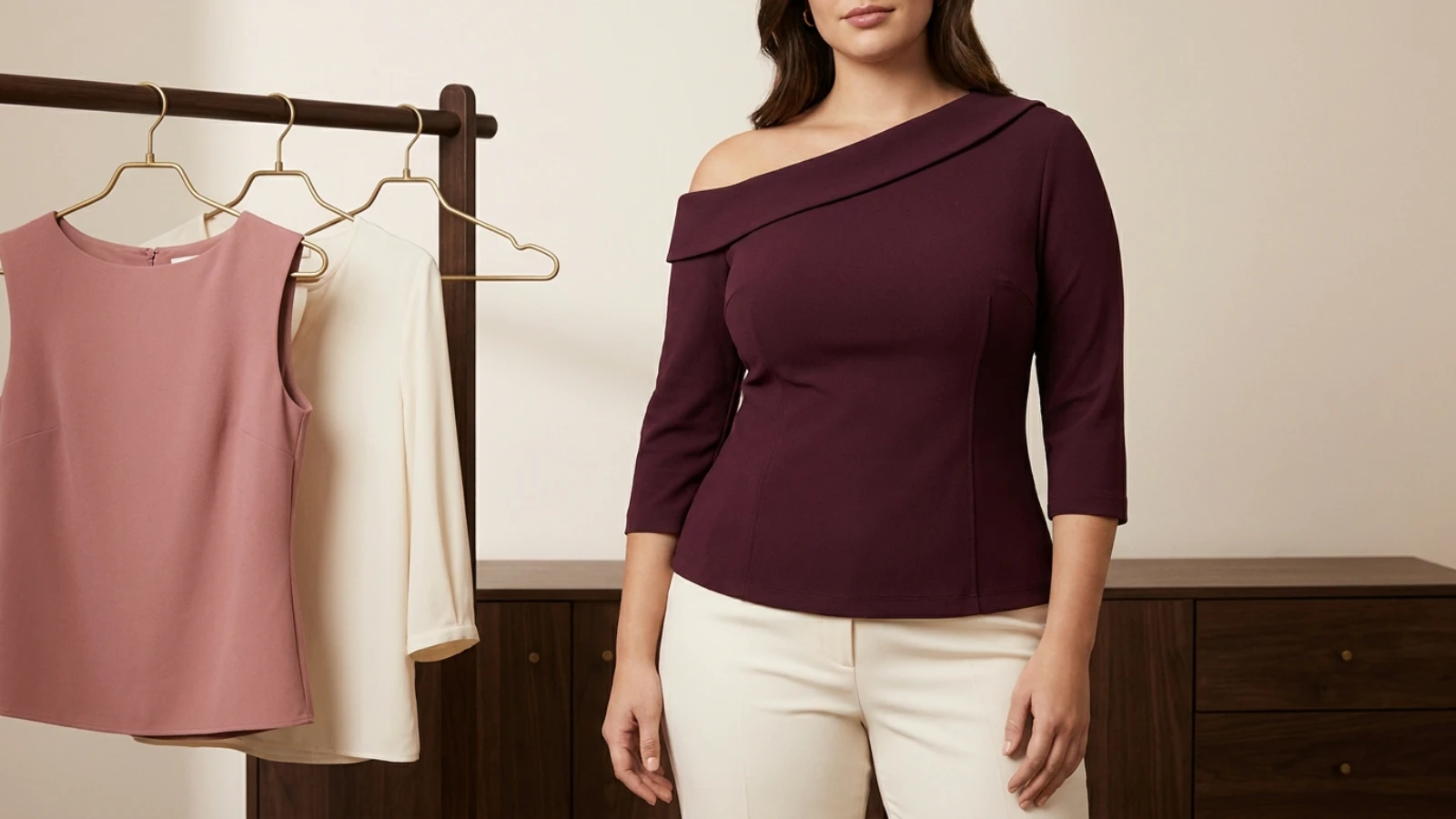
The best one-shoulder tops for a large bust must manage an intentionally uneven load. One side of the neckline is supported by a shoulder anchor; the other ends near the upper chest or underarm and must remain secure without a conventional shoulder seam. Bust projection can pull the diagonal neckline forward, rotate the anchored side toward the neck, lower the bare-side edge, reveal a bra cup or wing, and shorten the front hem. A heavy single sleeve can add another directional force, while a thin knit may stretch more on one side than the other. The result is not determined by whether asymmetry is supposedly slimming. It is determined by neckline engineering, finished bust room, side height, foundation compatibility, fabric recovery, sleeve weight, and center-front length. This guide compares six useful constructions, explains how to read the asymmetric load path, and gives a practical online-shopping and movement-testing system. Product modules remain private until the live item, measurements, materials, support features, return terms, availability, and affiliate disclosure are verified. No Amazon product name, ASIN, price, rating, review, or personal wear claim is invented.
The 60-second one-shoulder fit test
Put on the planned foundation, let the top settle without fashion tape, and check the asymmetric line from front, side, and back.
- The anchored shoulder lies flat and does not creep toward the neck or slide toward the arm.
- The diagonal neckline stays smooth without cutting across, collapsing between the breasts, or gaping.
- The bare-side edge covers the intended cup and wing while remaining comfortable against the skin.
- The fabric stays opaque and the bust has enough room without strong drag lines toward one shoulder.
- The side seams remain close to vertical and the front hem lands at the intended level.
- A single sleeve moves without rotating the entire neckline or pulling the bare side downward.
- Raising, reaching, sitting, and turning do not cause unexpected foundation exposure.
- After movement, the top returns close to its original position without constant adjustment.
Best one-shoulder tops by fit architecture
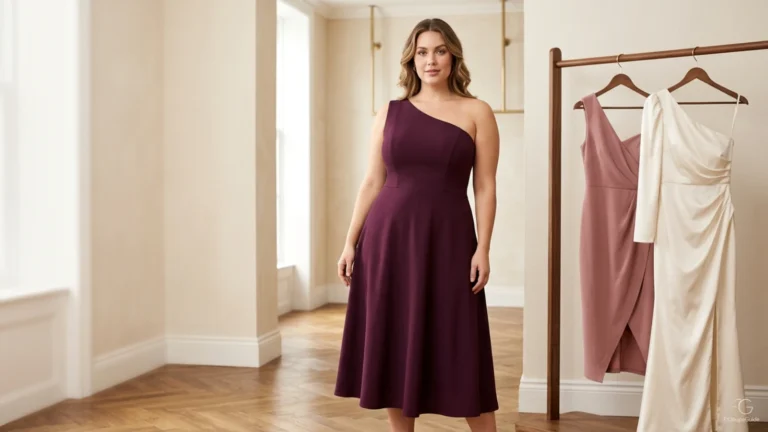
The best one-shoulder tops for a large bust coordinate the shoulder anchor, diagonal neckline, bare-side edge, bust shaping, and hem. Choose the architecture that matches the setting and foundation rather than assuming every asymmetric neckline behaves alike.
Stable asymmetric jersey top
Best for: casual outfits and forgiving movement. Look for compact medium-weight jersey, a broad shoulder section, reinforced upper edge, high bare-side coverage, and strong stretch recovery. The trade-off is cling: a thin or over-stretched knit may show bra texture, turn sheer, and grow unevenly during wear.
Shaped woven one-shoulder blouse
Best for: polished outfits and cleaner drape. Darts, princess seams, a facing, lining, and enough armhole room create controlled projection. The trade-off is precision. Rigid fabric cannot compensate for a misplaced bust point, tight side seam, or diagonal edge cut for a flatter front.
Wide-anchor sleeveless top
Best for: warm weather and minimal sleeve torque. The anchored side should cover a generous shoulder area, while the bare-side armhole remains high enough for the planned bra. The trade-off is exposure: strapless-foundation edges and underarm fit become more visible.
Single-sleeve one-shoulder top
Best for: dramatic visual balance and cooler events. Verify bicep ease, sleeve-cap mobility, cuff weight, and how the sleeve connects to the neckline. The trade-off is directional pull: a long, tight, embellished, or heavy sleeve can rotate the top toward the covered side.
Asymmetric peplum top
Best for: a shaped bodice and defined lower transition. The waist seam should sit below breast tissue and remain close to level before the flare begins. The trade-off is front lift: inadequate bodice length can pull the seam upward and make the peplum start across the bust.
Internally supported occasion top
Best for: formalwear with lining, grip tape, boning, a stay, or built-in shaping. Internal structure can reduce neckline movement, but it does not automatically provide bra-equivalent support. The trade-off is hidden restriction, so inspect the lining and inner layer rather than judging the decorative shell alone.
| Wardrobe need | Strong starting point | Evidence to verify | Main trade-off |
|---|---|---|---|
| Everyday flexibility | Stable asymmetric jersey | Recovery, opacity, broad anchor | May cling or relax |
| Office or polished event | Shaped woven blouse | Darts, facing, side height | Needs precise pattern fit |
| Warm-weather outfit | Wide-anchor sleeveless top | Bare-side coverage and grip | Foundation edges more visible |
| Dramatic sleeve | Single-sleeve construction | Bicep ease and sleeve weight | Can rotate the neckline |
| Defined lower silhouette | Asymmetric peplum | Bodice depth and seam position | Waist seam may lift |
| Formal stability | Lined supported top | Inner stay, grip, lining, closure | Hidden layer may restrict |
How the best one-shoulder tops control the neckline
The best one-shoulder tops for a large bust use the covered shoulder as an anchor without concentrating uncomfortable pressure there. The diagonal edge should cross the upper body smoothly, while the bare-side edge stays high enough for the chosen foundation. Width, angle, edge finish, back connection, and bust room determine whether the line remains intentional.
The shoulder anchor needs area, not just tension
A broad shoulder piece distributes load better than a narrow elastic strap. It should lie flat from front to back and meet the neckline without twisting. If it creeps toward the neck, the bare side may be too loose, the sleeve too heavy, or the bust too tight. If it slides toward the arm, the anchor may be too wide, too elastic, or cut at the wrong angle.
The bare-side edge must follow the upper chest
The exposed side behaves partly like a strapless neckline. Facing, binding, elastic, silicone grip, lining, or internal stays may help it follow the body. More grip is not always better: aggressive elastic can create pressure and visible indentation without correcting missing bust room. The best one-shoulder tops keep this edge secure during breathing and sitting, not only during a still photograph.
The diagonal line needs enough length over projection
A neckline drafted on a flatter front may shorten across a fuller bust, pull the covered shoulder inward, and lower the opposite edge. Shaped seams or extra front length allow the diagonal to cross projection without becoming the garment’s main source of tension. Compare this with the broader construction choices in the neckline guide.
The back neckline is part of the anchor
A secure front can still rotate when the back is too low, too stretchy, or disconnected from the covered shoulder. Inspect the full rear view. A higher back, diagonal back strap, internal stay, or stable facing may provide counter-tension. Decorative ties should not be assumed to carry structural load unless the listing explains their function.
How fabric, lining, and sleeves change one-shoulder fit
The best one-shoulder tops treat stretch direction, fabric weight, edge recovery, lining, and sleeve load as connected evidence. A fabric can feel soft and luxurious yet lack the recovery needed to hold an asymmetric edge. A structured shell can look secure while a rigid lining becomes the actual fit limit.
Medium-weight jersey needs strong recovery
A compact jersey can move over projection, but the neckline must return. Gently stretch a concealed edge sample and release it. Persistent widening suggests that the bare side or shoulder may relax during wear. Stretch the body fabric over a hand to inspect opacity; if it becomes shiny or sheer, the finished chest needs more ease.
Stretch crepe and ponte add controlled weight
Matte stretch crepe can drape without excessive cling, while ponte provides firmer support. Both still require correct shaping. Heavy ponte may feel warm and can pull downward; loose crepe may migrate if the edge lacks support. The large-bust fabric guide compares opacity, drape, recovery, and structure in more detail.
Woven fabric needs three-dimensional shaping
Darts, princess seams, gathers from a controlled shoulder, or a shaped lining create space that flat width alone cannot. Strong diagonal lines from the bare-side armhole to the fullest point signal missing room. The best one-shoulder tops use that shaping deliberately; a larger size is useful only if it improves the bust without making the anchored shoulder, upper edge, and back too loose.
A single sleeve creates torque
Sleeve weight acts on only one side. Check bicep width, sleeve-cap mobility, cuff weight, embellishment, and fabric density. Raise the covered arm and let it fall. If the sleeve remains bunched or pulls the neckline toward it, the load path is not balanced. A generous bell sleeve may still restrict at the upper arm.
Internal support must match the outer shell
Grip tape, clear elastic, boning, a waist stay, inner mesh, cups, or a corset-like lining can stabilize formal styles. These features vary widely and should not be inferred from a smooth model photograph. Confirm what is sewn in, whether it is adjustable, and whether the support is intended to replace or supplement a bra.
Bra compatibility, bust shaping, side height, and front length
A one-shoulder top and its foundation must be evaluated as one system. The top may fit its label size but fail when the bra cup edge appears, a convertible strap crosses the open side, or the upper edge sits below the bra wing. Select support for comfort and function first, then verify that the garment covers it during movement.
Strapless and convertible bras solve different problems
A strapless bra removes visible shoulder straps but relies more on the band and cup construction. A convertible bra configured with one strap may add upward support on the covered side, yet the strap position must align with the top. Follow the bra manufacturer’s configuration instructions and make sure the asymmetric tension does not distort the cups. No top should be used to compensate for a painfully tight or poorly fitting foundation.
Side-bust coverage is measured at the bare side
Check the vertical distance from the underarm seam or top edge to the lowest point of the bare-side neckline. A high side wing on the bra may require a higher garment edge. The best one-shoulder tops preserve planned coverage when the wearer turns sideways, lifts the arm, and reaches across the body; coverage that works only with the arm held away is not reliable for normal wear.
Bust shaping keeps the anchor centered
Darts, princess seams, curved panels, controlled gathers, or useful stretch create front volume. Without it, the garment borrows length and width from the neckline. Watch the side seam: forward sweep often indicates that the front lacks room. Watch the anchor: movement toward the neck can be a bust-fit symptom rather than a shoulder-size problem.
Center-front length protects the intended hem
Bust projection consumes vertical fabric. Record center-front length from the neckline’s chosen reference point to the hem, and compare with a garment that sits correctly. Asymmetric hems can be intentional, so judge whether the designed low and high points remain where the product image indicates instead of demanding a mathematically level edge.
How to buy the best one-shoulder tops online
Styled photography often hides asymmetric fit risks. A model may keep the bare arm away from the body, the top may be clipped at the back, or the neckline may be placed immediately before the shot. The best one-shoulder tops for a large bust are easier to shortlist when a listing shows front, side, back, and movement views plus finished garment measurements and internal construction.
- Choose the foundation first. Decide whether the outfit requires a strapless, convertible, or garment-integrated support solution.
- Measure a successful reference. Use an asymmetric top or secure strapless-neckline garment whose chest, side height, and length already work.
- Record the load path. Measure the anchored shoulder, diagonal neckline, bare-side height, back height, and any single sleeve.
- Separate body and garment charts. Body bust circumference does not reveal finished ease or shaped depth.
- Inspect shell and lining separately. Confirm stretch direction, opacity, facing, grip, elastic, stays, cups, and closures.
- Look beyond the front pose. Require a clear bare-side view, covered-side view, back, and preferably raised-arm or video evidence.
- Check size scaling. Ask whether anchor width, bare-side height, bicep, length, and internal support change across sizes.
- Confirm return terms. Neckline angle and foundation compatibility are difficult to predict, so fees, exclusions, and timing matter.
| Measurement or fact | Why it matters | How to compare | Warning sign |
|---|---|---|---|
| Finished chest width | Controls strain and opacity | Compare relaxed garment width | Only body chart supplied |
| Anchored-shoulder width | Distributes asymmetric load | Measure front-to-back coverage | Only diagonal front view |
| Bare-side edge height | Predicts cup and wing coverage | Compare with planned bra | Arm held away in every photo |
| Diagonal neckline length | Affects pull over projection | Use consistent endpoints | No garment measurements |
| Bicep and sleeve weight | Predicts covered-side torque | Measure a comfortable sleeve | Volume shown, upper arm hidden |
| Shell, lining, support | Controls grip and real ease | Read each layer separately | Generic built-in support claim |
| Center-front length | Predicts hem lift | Compare identical reference points | Only center-back length |
The U.S. FTC textile-label guidance explains fiber-content, origin, and responsible-business labeling requirements for covered textile products. Those facts can help verify a listing, but they do not prove diagonal-edge recovery, internal support, opacity, or fuller-bust fit.
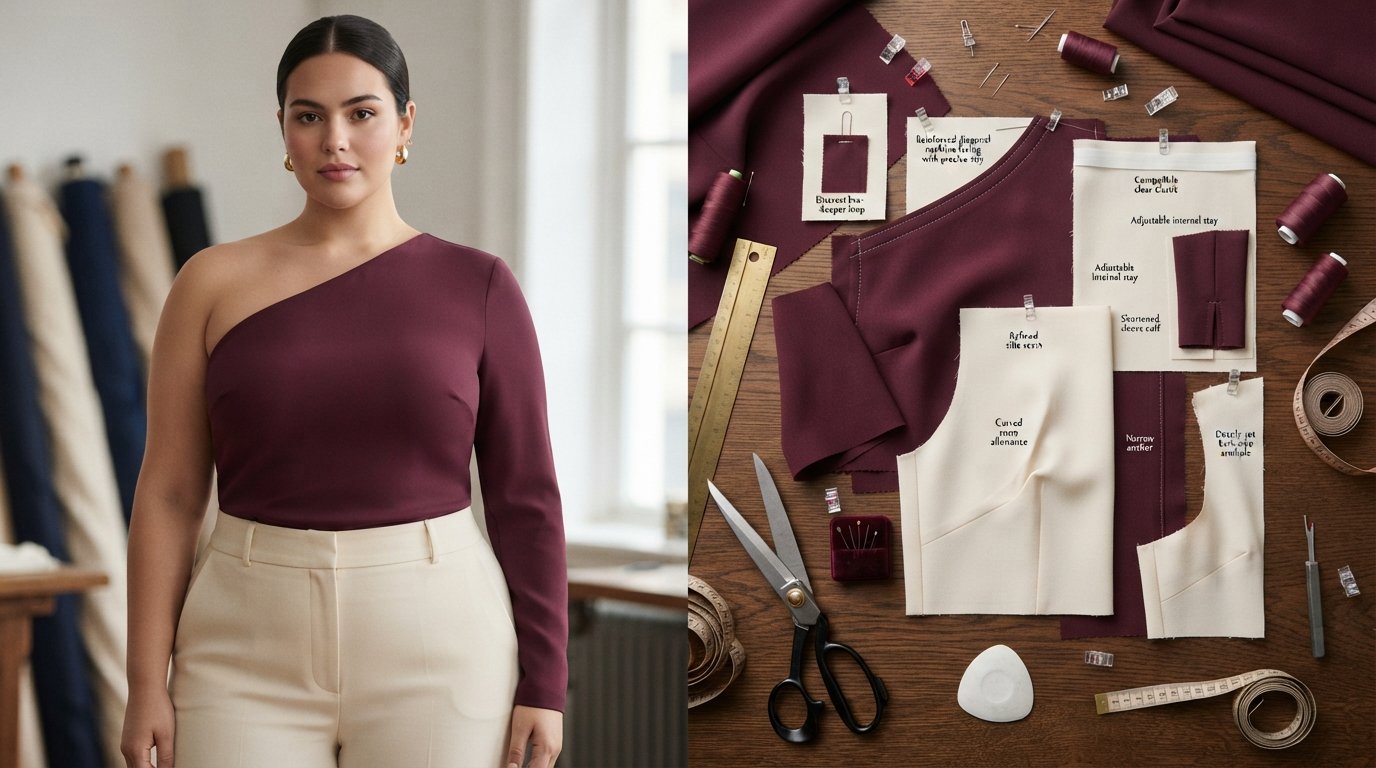
The movement test for the best one-shoulder tops
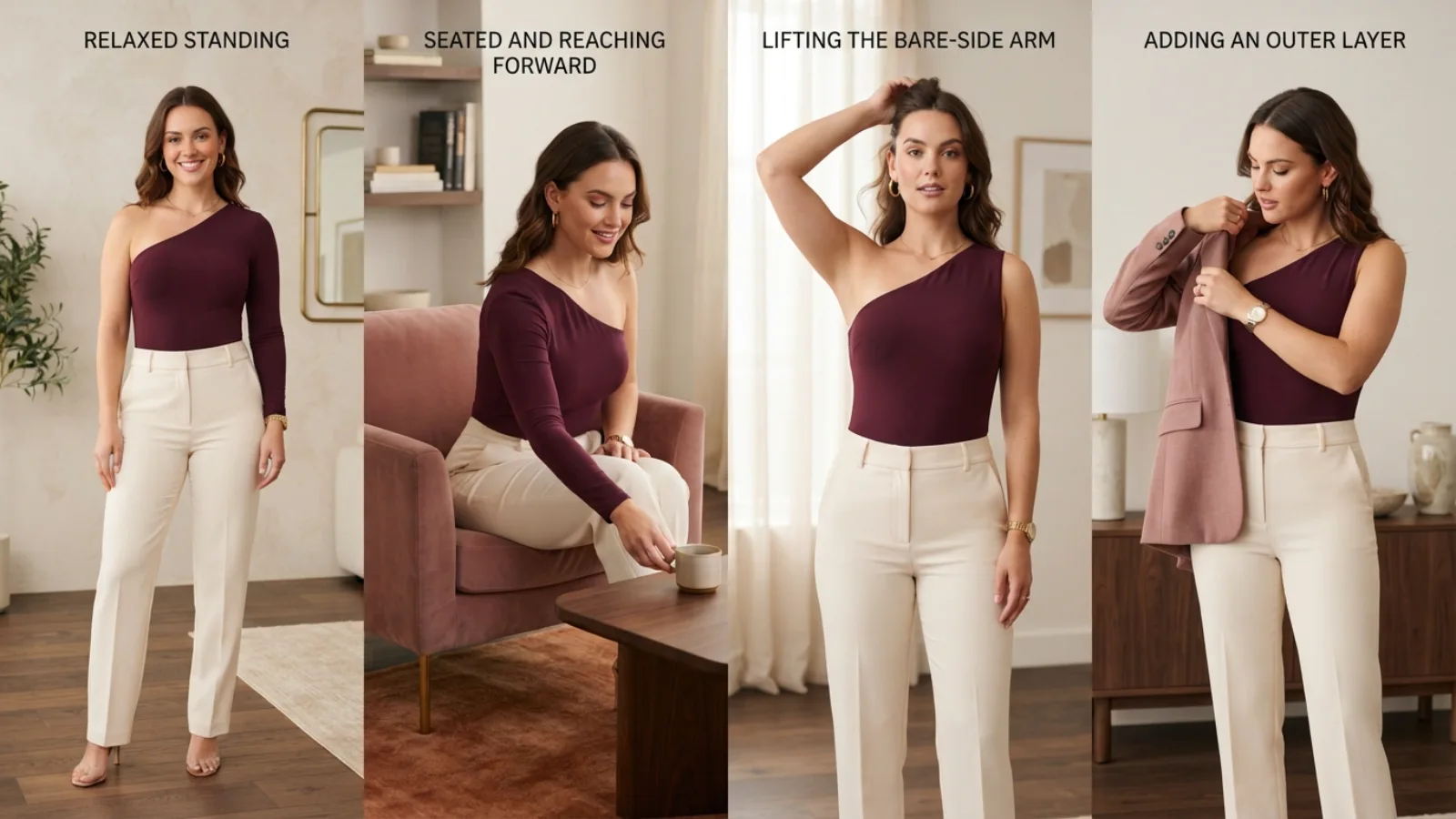
A one-shoulder top can appear secure while the body is still and rotate as soon as the arms move. The best one-shoulder tops return close to their intended position without the wearer repeatedly lifting the bare side or pulling down the hem. Test the outfit with its real foundation and accessories before removing tags.
Raise the bare arm and let it fall
Lift the exposed-side arm overhead, then lower it without touching the top. The upper edge should not fold into the armhole, reveal an unplanned foundation edge, or remain displaced. Slight fabric movement is normal; the useful question is whether coverage and comfort return.
Reach with the covered arm
A single sleeve and shoulder anchor are stressed most when that arm reaches forward or upward. Watch whether the anchor moves toward the neck, the diagonal edge tightens, or the front hem catches. If movement is restricted at the bicep or sleeve cap, a looser lower sleeve will not repair it.
Turn, sit, and breathe normally
Rotate the torso in both directions, sit for several minutes, and take comfortable full breaths. Check pressure at the bare-side edge and underarm. A style that feels secure only when held rigidly is not suited to a long meal, desk work, dancing, or travel.
Add the planned outer layer and bag
A jacket can compress the single sleeve or catch a draped shoulder detail. A shoulder bag placed on the anchored side may shift the fabric; one placed on the bare side may rub the neckline. Test the actual layer and bag rather than assuming the top will behave alone.
Keep / alter / return rule
Keep when the anchor, diagonal edge, bust room, foundation coverage, side height, sleeve, opacity, hem, and movement already work. Alter when the base fit is sound and a local change—such as shortening a plain sleeve, refining a hem, adding a compatible bra keeper, or stabilizing minor edge gaping—is feasible. Return when the entire top rotates, the bust is fundamentally tight, the bare side exposes the cup or wing, the sleeve controls the neckline, or the fabric becomes sheer.
Fit problems even the best one-shoulder tops must avoid
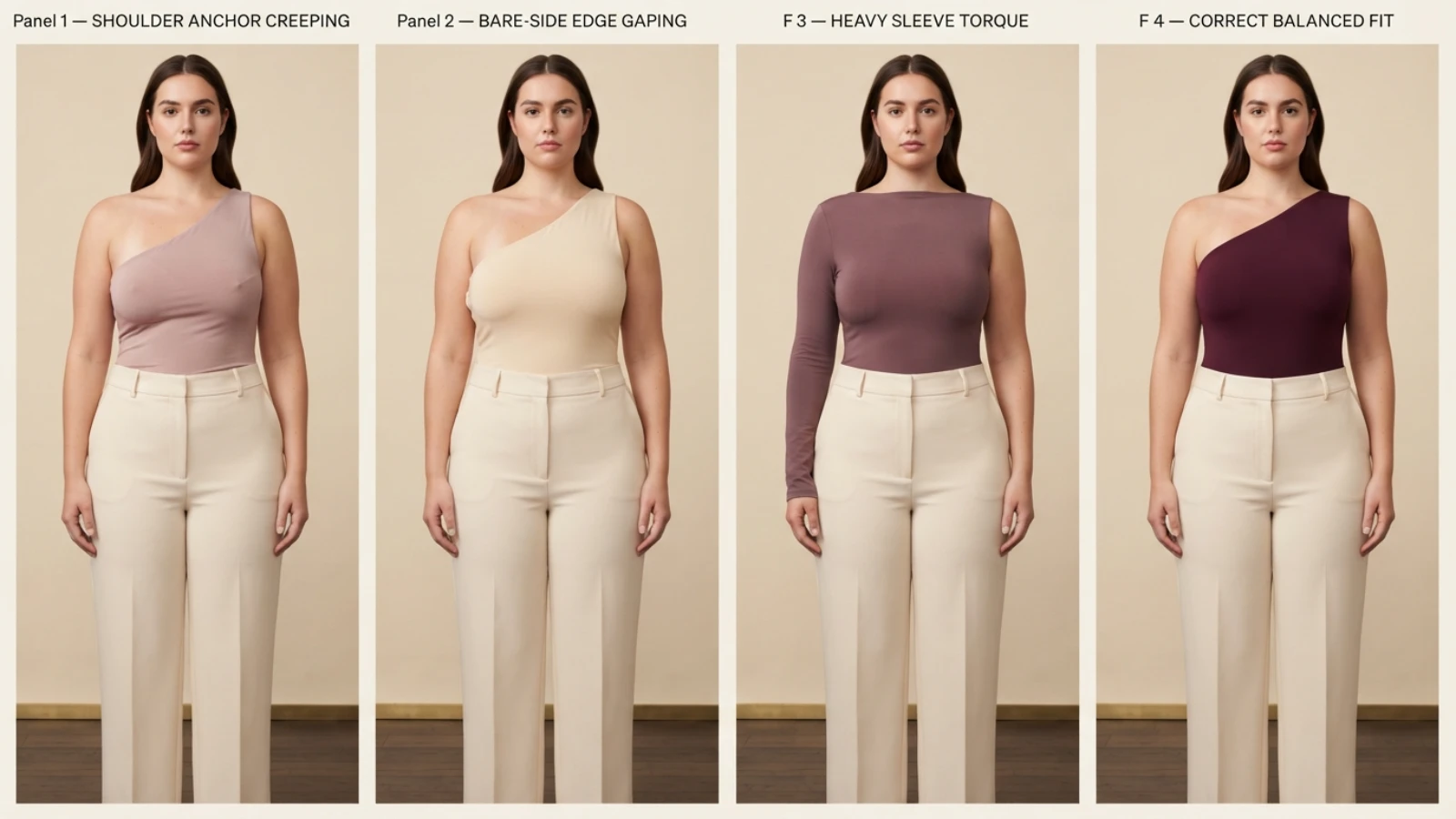
Several visible symptoms can share one cause. Missing bust room may pull the anchor inward and lower the opposite edge; sleeve restriction may rotate the neckline; a loose back may allow the entire garment to descend. Diagnose the load path before changing sizes or adding tape.
The anchored shoulder creeps toward the neck
The front may be tight, the sleeve may be pulling, or the bare side may lack counter-tension. Check bust drag lines, bicep room, and back position. If the problem returns after every movement, a wider anchor alone may not solve the underlying imbalance.
The bare-side edge gaps or rolls
The edge may be too long, stretched during construction, insufficiently supported, or positioned over a curve the pattern did not shape. Minor gaping may respond to local elastic or tailoring. A large mismatch combined with bust strain usually requires a different cut.
The bra cup or wing appears
The top may sit too low, the bare-side armhole may be too deep, or the foundation may be too high for the garment. Try the intended compatible bra only if it remains supportive and comfortable. Do not force coverage by pulling the top upward if that makes the hem or anchor unstable.
The diagonal neckline cuts or collapses
Cutting suggests insufficient neckline length, bust room, or edge flexibility. Collapsing suggests excess length, weak recovery, or missing support. The same size change will not necessarily solve opposite problems; inspect shaping, facing, and the front-to-back anchor.
The single sleeve twists the top
Likely causes include a tight bicep, shallow sleeve cap, heavy fabric, dense cuff, embellishment, or an anchor that cannot resist the load. If a larger size makes the bare side loose, choose a different sleeve architecture instead of accepting constant rotation.
The front hem rises while the back pools
The front needs more projection room or center-front length. A curved or intentionally asymmetric hem may accommodate this, but the side seam should still reveal whether the garment is being pulled forward. Look for shaped fronts rather than simply adding back width.
What a tailor can change in a one-shoulder top
A tailor may refine a simple hem, shorten an uncomplicated sleeve, reduce some back or waist width, add a discreet bra keeper beneath the covered shoulder, stabilize a small amount of upper-edge gaping, or adjust compatible straps and internal stays. Feasibility depends on seam allowance, lining, boning, grip tape, closures, embellishment, and whether the neckline edge is cut as one continuous piece.
Rebuilding the entire diagonal neckline, adding substantial bust projection, raising a deeply cut bare-side armhole, widening a narrow shoulder anchor invisibly, or correcting a restrictive sleeve cap is more involved. The tailoring guide helps separate local refinements from pattern-level reconstruction. If several structural areas fail together, returning the garment is often more rational than rebuilding it.
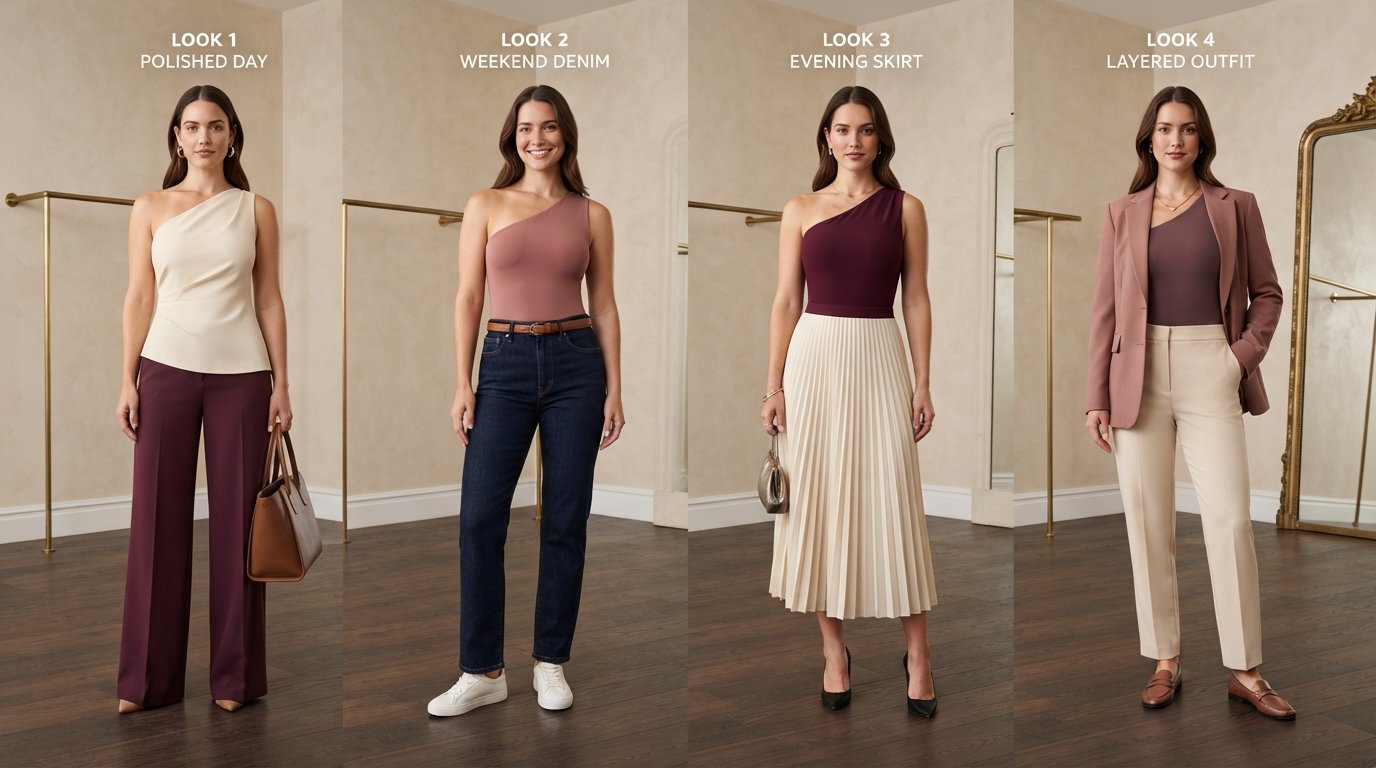
How to style the best one-shoulder tops
The best one-shoulder tops for a large bust work before styling begins. Once the fit is secure, asymmetry can be emphasized, repeated, or balanced according to personal taste. The top does not need to minimize the bust. It needs to deliver the chosen coverage, foundation support, movement, and dress-code fit.
Polished day: shaped blouse + tailored trouser
Choose matte stretch crepe or a shaped woven top with a broad anchor and a modest diagonal line. Pair it with a straight or wide-leg trouser and a clean shoe. Confirm the workplace dress code; one-shoulder exposure may suit creative or social settings but not every office.
Weekend: stable jersey + high-rise denim
A compact jersey top without a heavy sleeve is easier for walking and casual movement. High-rise denim can overlap a shorter hem, but verify sitting length rather than relying on the rise label. Keep the bag off the neckline if its strap causes friction.
Evening: lined top + fluid skirt
A lined crepe or internally supported top can create a clean formal line. Test sitting, dancing, and outerwear before the event. If the neckline and single sleeve already create visual detail, simple jewelry may keep the construction visible; statement jewelry is equally valid when maximal styling is the goal.
Compare related shoulder constructions
A one-shoulder top creates one continuous diagonal line. A secure off-the-shoulder top opens both shoulders and depends on a horizontal upper edge, while a cold-shoulder top retains two shoulder anchors and exposes controlled cutouts. A halter top redirects load toward the neck or upper back. Choose by comfort and support path, not by a universal flattering rule.
Care, durability, and value in the best one-shoulder tops
The best one-shoulder tops retain their anchor width, diagonal edge, bare-side grip, bust shape, sleeve balance, opacity, and front length after care. Inspect facing, elastic, grip tape, lining, boning channels, sleeve attachment, underarm stitching, darts, closures, and hem. An asymmetric garment may reveal small changes quickly because the left and right sides have different jobs.
Store the neckline without stretching it
Follow the sewn-in care label. Do not hang a heavy wet knit from its single shoulder, pull the garment on by the bare-side edge, or use the anchor as a handle. Fold knits that lengthen on hangers. Use any side zip, back closure, or fastening intended to reduce strain during dressing.
Check grip, elastic, and lining after care
The FTC care-label guidance explains U.S. care-instruction requirements for covered garments. A compliant instruction is useful evidence, but it does not guarantee that silicone grip, clear elastic, lining, or the diagonal edge will retain performance. Review the retailer policy before washing during a return window.
Value comes from complete outfit compatibility
The best one-shoulder tops earn wardrobe value through compatibility. A top that works with an existing comfortable foundation, two bottoms, suitable shoes, and practical outerwear may offer more realistic use than a dramatic style requiring new support garments and repeated adjustment. List actual events, temperatures, movements, care steps, and accessories before buying. Cost per wear is a planning estimate, not a promised result.
| Final checkpoint | Pass signal | Trade-off to accept knowingly |
|---|---|---|
| Shoulder anchor | Flat, broad, stable front to back | More coverage creates less exposure |
| Diagonal neckline | Smooth, reinforced, comfortable | More structure may feel firmer |
| Bare-side coverage | Foundation concealed in movement | Higher edge changes neckline drama |
| Bust and length | Shaped, opaque, balanced hem | Extra shaping may look curved flat |
| Sleeve and movement | No rotation after reaching | Dramatic sleeves complicate layers |
| Evidence | Measurements, care, returns verified | Extra checking takes more time |
Frequently asked questions
What one-shoulder top style is best for a large bust?
A one-shoulder top with a broad secure shoulder anchor, a reinforced diagonal neckline, enough shaped room over the bust, high coverage at the bare-side armhole, opaque fabric, and an upper edge that returns after movement is the most dependable starting point. A stable asymmetric jersey or a lined woven style with darts or princess seams is usually easier to control than a very thin, loosely draped, or heavily embellished design.
Are one-shoulder tops flattering on a large bust?
They can be, but flattering is personal and should not be treated as a body-type rule. The diagonal neckline can create a strong visual line, yet the result depends on construction. A secure anchor, adequate bust room, balanced drape, and the wearer’s preferred coverage matter more than whether an article claims asymmetry makes the bust look smaller.
What bra should I wear with a one-shoulder top?
Choose the foundation around the actual neckline. Many one-shoulder tops work with a well-fitted strapless bra; some work with a convertible bra configured with one strap, while a few contain enough internal structure to follow their own instructions. Test the foundation under the exact top because strap position, cup edge, side wing height, grip, and neckline depth vary. A standard two-strap bra is practical only when both straps remain intentionally concealed.
Should I size up in a one-shoulder top for a fuller bust?
Size up when the fabric strains, turns sheer, pulls the neckline downward, rotates the shoulder anchor, distorts the bare-side armhole, or makes the front hem climb. If the larger size creates a loose upper edge, oversized armholes, a slipping shoulder, or excess back fabric, the pattern is the problem. Look for more bust shaping, a better upper-edge construction, or fuller-bust sizing instead.
How do I stop a one-shoulder top from slipping down?
Start with the correct size and a shoulder anchor that lies flat without stretching. The bare-side upper edge should use stable binding, facing, elastic, grip tape, lining, or internal support appropriate to the fabric. Check bust ease and sleeve weight because a tight front or heavy sleeve can rotate the top. Fashion tape may help a compatible edge for a short event, but it cannot repair an incorrect pattern or replace necessary support.
Can I wear a one-shoulder top with a regular bra?
Sometimes, but only when the garment is designed to cover both straps or when a coordinated visible strap is an intentional styling choice accepted by the wearer and setting. Most classic one-shoulder necklines expose one standard bra strap, so a strapless or convertible option is more predictable. Never assume one solution works for every bra size or comfort need; test support, edge visibility, and movement together.
Which fabric is best for a fuller-bust one-shoulder top?
Medium-weight jersey with strong recovery, matte stretch crepe, lined woven crepe, stable ponte, and structured stretch fabric can all work. The useful qualities are opacity under stretch, diagonal-edge recovery, enough drape or shaping over projection, comfortable grip, and resistance to sleeve torque. Fiber percentages alone cannot prove how the finished garment will fit.
What measurements should I check when buying a one-shoulder top online?
Check finished chest width, center-front length, anchored-shoulder width, diagonal neckline length, bare-side armhole height, back neckline height, bicep width and sleeve length where applicable, hem width, lining, stretch direction, and internal support. Compare them with a successful asymmetric top or a secure strapless-neckline garment worn with the planned bra, then verify the return conditions.