Accessorizing a Large Bust: Necklaces, Scarves and Belts
Most accessory advice treats every body the same. Here’s what actually changes when you’re layering jewelry, scarves, belts and bags over a fuller bust — and how to tell good advice from generic filler.
- The landing point of an accessory matters more than the accessory itself.
- Scale matters: bigger jewelry needs more open necklines to breathe.
- If you’re constantly adjusting it, it’s the wrong length or the wrong piece.
Why accessorizing feels harder with a fuller bust
Nobody warns you that the accessory advice written for straight-up-and-down mannequins just doesn’t transfer. A pendant that hangs perfectly on a flat chest form will swing, twist, or disappear into the fabric on a fuller bust — not because you’re doing it wrong, but because the landing surface is different. The chest isn’t flat, so anything you hang from your neck has to travel over a curve before it settles.
The same is true for scarves, belts and bag straps. Each one interacts with the widest part of your torso at some point, and that interaction is what decides whether the piece looks intentional or looks like it’s fighting you all day. This guide is built around that idea: not “flattering tricks,” but simple mechanical rules about where things land and how much room they need.
None of this is about hiding anything. It’s about choosing accessories that behave the same way at 9am as they do at 9pm — through sitting, reaching, taking a coat off, and getting back in the car.
Necklaces: it’s almost entirely about length
Of everything in this guide, necklace length makes the single biggest visual difference, and it’s the easiest thing to get wrong by accident. A chain that’s just slightly too short will land directly on the fullest point of the bust, which draws the eye to exactly the spot most women are trying to draw attention away from — not because that spot is a problem, but because a necklace sitting on a curve always looks like it’s about to slide off.
Go short or go long — skip the in-between
Chokers and collar-length necklaces (roughly 14–16 inches) sit above the bust entirely, right at the collarbone, so they never compete with anything below. On the other end, opera-length and lariat necklaces (28 inches and up) fall well past the bust and rest against the stomach or waist instead. It’s the middle lengths — princess and matinee, roughly 18–24 inches — that cause the most trouble, because that’s exactly where most fuller busts sit.
Pendants need a plan, not just a length
A pendant on a slightly longer chain will usually settle below the bust if the chain has enough drop — but “usually” isn’t good enough when you’re getting dressed for a specific outfit. Try it sitting down, not just standing at a mirror, since pendants shift position the moment you sit. If it lands mid-chest sitting down, size up the chain by two to three inches rather than switching pendants entirely.
Layering multiple necklaces
Layered necklace sets photograph beautifully on straight torsos because every strand is visible at a different height. On a fuller bust, the middle strand in a typical three-piece set often just vanishes into the neckline. The fix is asymmetric spacing: one choker-length piece up top, then skip straight to an opera-length piece that clears the bust completely, rather than three evenly spaced chains.
Scarves: drape beats stiffness every time
A structured silk square scarf, the kind that looks crisp and architectural in product photos, tends to sit like a small shelf across a fuller chest instead of draping. It’s not the scarf’s fault — it’s just doing exactly what stiff fabric does over a curved surface, which is bridge the gap rather than follow it.
Softer, lighter fabrics — modal, lightweight cotton voile, unstructured silk crepe rather than habotai — fall with the body instead of holding their own shape. A long, thin scarf worn loose and open down the front does more for a fuller bust than any elaborately knotted square ever will, simply because it has nothing rigid to hold a shelf shape.
Knot placement matters more than knot style
Any knot tied directly at the base of the neck sits right above the bust and adds visual width exactly where a lot of women don’t want it. Move the knot slightly off-center, or skip the knot altogether and let two ends hang loose and uneven — it reads as more intentional anyway, and it avoids the bulk pile-up.
Belts: proportion and placement over trend
Belts get complicated with a fuller bust because the natural waist is often shorter in visual distance from the bust than styling illustrations assume. A wide statement belt cinched high, directly under the bust, tends to look like it’s dividing the body into two blocks rather than defining a waist.
Medium-width belts (around 1.5–2 inches) worn at the natural waist — not pulled up under the bust — tend to create a cleaner line. If you want a wider belt, wear it looser and lower, resting on the hip bones instead of cinched tight, so it reads as a design detail rather than a compression point.
Belts over dresses vs. belts over separates
A wrap dress with a self-belt is usually already engineered with the right drop built into the pattern, so trust the original tie point before adding an external belt on top. Adding a second, wider belt over a wrap dress is one of the most common ways this specific combination goes wrong — you end up with two competing waistlines instead of one clear one.
Bags and straps: the detail nobody talks about
A flat, non-adjustable crossbody strap that sits perfectly straight across a flatter chest will often cut diagonally right across the fullest part of a larger bust, creating a visible line of compression in every photo taken from the side. It’s a small thing, but it’s one of the most common “I don’t know why this outfit looks off” culprits.
Adjustable straps you can lengthen slightly, or bags worn on a single shoulder rather than crossbody, avoid that compression line entirely. If crossbody is non-negotiable for practicality, look for straps with some width and padding rather than a thin cord — the wider surface distributes pressure instead of digging a line across one point.
The one rule that covers all four
Every accessory in this guide works the same way: it needs to either land clearly above the bust, clearly below it, or be soft enough to move with it. Anything rigid or short enough to land right at the fullest point is the thing that will need constant adjusting — that’s not you doing it wrong, that’s the accessory picking a fight with your shape.
Quick reference: what to choose and what to check
Use this as a shopping shortcut. It’s the same four rules from above, laid out so you can scan it while you’re actually standing in a fitting room or scrolling a product page.
| Accessory | What to look for | What to skip |
|---|---|---|
| Necklaces | Choker-length (14–16″) or opera-length (28″+) chains; pendants tested while seated | Princess-length chains (18–20″) that land mid-chest |
| Scarves | Soft modal, voile or crepe; worn long and loose or knotted off-center | Stiff structured silk squares tied in a tight center knot |
| Belts | Medium width (1.5–2″) at the natural waist, or wide and loose on the hip | Wide belts cinched tightly directly under the bust |
| Bags | Adjustable straps, single-shoulder carry, or wide padded crossbody straps | Thin, fixed-length crossbody cords with no adjustment |
Four outfit formulas that use these rules
Reading the rules is one thing — seeing them applied is what actually makes them stick. These four combinations lean on everything above.
The everyday V-neck
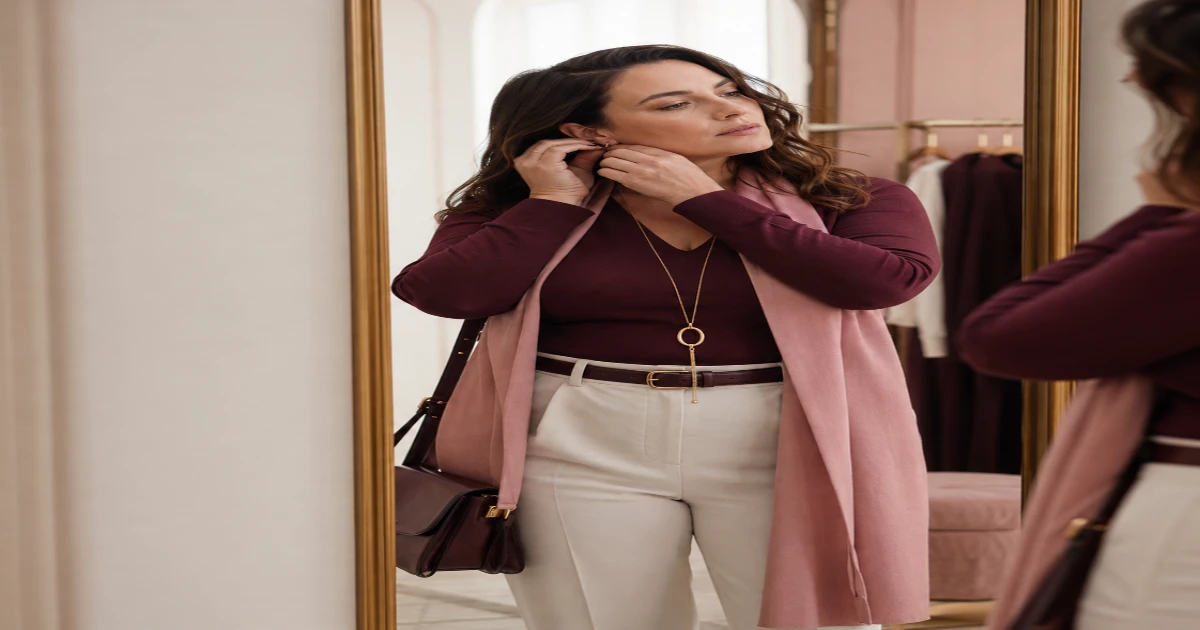
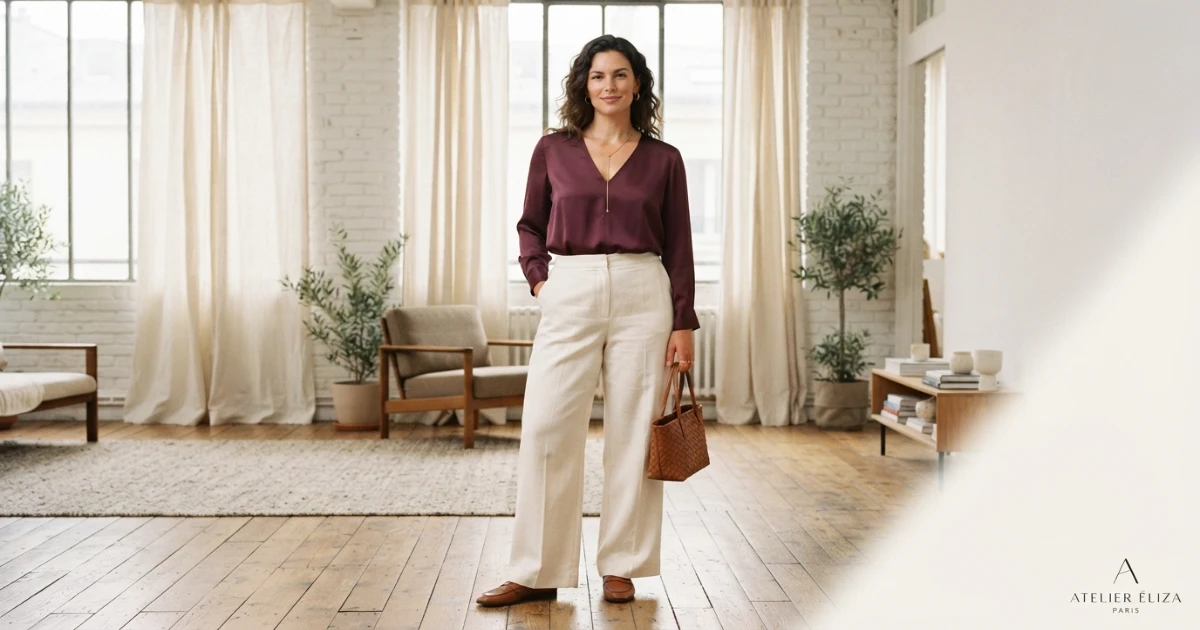
V-neck tee, opera-length pendant that clears the bust, medium belt at the natural waist over straight-leg trousers. The long pendant does the work a shorter one can’t.
The open blazer
Fine knit under an open blazer, choker sitting above where the blazer lapels start, no belt needed since the blazer already defines the waist. Two accessories instead of three keeps it clean.
The wrap dress
Wrap dress using its own built-in tie, drop earrings instead of a necklace entirely, single-shoulder bag rather than crossbody. Sometimes the best necklace choice is no necklace.
The scoop-neck layer
Scoop-neck top, long unstructured scarf left open and uneven rather than knotted, thin belt worn loose on the hip under an open cardigan. Nothing here is cinched tight.
The four mistakes that show up again and again
These aren’t hypothetical — they’re the specific combinations that come up over and over in fit questions, and each one has a slightly different cause.
Princess-length chains
The most common mistake simply because it’s the most common necklace length sold. It’s not a bad necklace — it’s just the wrong length for this specific body, and swapping to choker or opera length fixes it instantly.
Tight square scarf knots
The knot itself isn’t the problem — the fabric stiffness is. A silk square that would drape fine on a flatter chest holds its shape into a shelf here, so the fix is fabric weight, not knot technique.
Wide belts cinched under the bust
This one usually comes from following a “define your waist” tip that assumes the waist sits much closer to the bust than it visually does on a fuller figure. Moving the belt down half an inch changes everything.
Thin fixed crossbody straps
Almost never a styling choice — usually just the strap the bag came with. Swapping it for an adjustable or padded strap solves it without needing a different bag.
Test everything in motion, not standing still
A mirror only shows you one frozen position, and almost every accessory problem in this guide only shows up once you move. Before deciding something doesn’t work, run through this quickly.
Necklaces shift length the moment you sit — a pendant that cleared the bust standing may not once you’re seated.
Reach across your body the way you would grabbing a bag or a coffee cup. Scarves and loose necklaces shift the most here.
Bag straps and belts that look fine from the front often reveal a compression line only visible from the side.
This is where scarf knots come loose and necklaces get tangled in collars — worth testing before you’re out the door.
Long pendants and lariats swing when you walk. If it’s hitting a button or a zipper repeatedly, size the chain differently.
Support layers change chest projection slightly. Test with the bra you’ll actually wear with the outfit, not a different one.
A note on fabric and proportion
Fabric weight does more heavy lifting in this guide than most people expect. Anything structured — stiff cotton, heavy silk, wide leather — holds its own shape regardless of what’s underneath it, which is exactly why it bridges rather than drapes over a curve. Soft, fluid fabrics do the opposite: they follow the body’s shape instead of fighting it.
This is why the same style of scarf or belt can look completely different in two fabrics. A knit belt behaves nothing like a stiff leather one, even at the same width. When something isn’t working and you’ve already tried adjusting placement, check whether fabric weight is the actual variable before assuming the style itself is wrong. This is also why two people can buy the exact same scarf and have completely different experiences with it — one in a lightweight modal blend, one in a stiffer silk-cotton mix, even though the listing called both of them “silk scarves.”
Scale matters too, but it works in your favor here rather than against you: larger, bolder jewelry generally reads better on a fuller bust than delicate, tiny pieces, which can get visually lost. A statement pendant or chunky chain has enough visual weight to hold its own, where a fine delicate chain can disappear entirely. The same logic applies to belt buckles and bag hardware — a slightly larger buckle or clasp tends to read as intentional, while a tiny, delicate one can look like it was designed for a different body and just happens to be worn here.
Shopping for these pieces without the guesswork
Product photos are shot on models with a huge range of body types, so a necklace photographed sitting perfectly at the collarbone on one model might sit three inches lower on you — and that’s not a flaw in the product, it’s just proportion. When you’re shopping online, check the actual chain length listed in inches rather than trusting the photo alone.
For scarves, check the fabric content before the pattern. “100% silk” covers everything from stiff dupioni to fluid crepe de chine, and those two behave completely differently once tied. If a product description doesn’t specify weave or weight, look at customer photos rather than the studio shot — real bodies in real lighting tell you more about drape than a flat-lay product photo ever will.
For belts, buy based on where your natural waist actually sits, not your dress size. Two people in the same dress size can need different belt lengths depending on torso proportion, so if you’re between sizes, size up rather than down — a belt worn one notch looser always looks more natural than one straining at the tightest hole.
It’s worth keeping a short note on your phone of what’s worked before: chain lengths that sat right, scarf fabrics that draped instead of bunched, belt widths that didn’t dig in. It sounds like overkill for accessories, but it turns every future purchase into a five-second comparison instead of another guess.
Keep it, adjust it, or skip it?
Keep it as is when the piece passes the movement test above — sitting, reaching, walking — without you touching it more than once. That’s the real bar. If you’re not thinking about it, it’s working.
Adjust it when the concept is right but the length or placement is slightly off. Most necklace problems are solved with 2–3 extra inches of chain. Most belt problems are solved by moving it down half an inch. These are small, cheap fixes — an extender chain costs very little compared to buying an entirely new piece.
Skip it when a piece needs constant readjusting no matter what you try. Not every accessory works with every outfit, and that’s fine — the wrap dress formula above swaps out the necklace entirely for a reason. Sometimes the best accessory decision is one fewer accessory.
Bringing it together
None of this is really about rules for their own sake — it’s about noticing why something feels off and having a quick, specific fix instead of a vague sense that “accessories are hard.” Length, drape, placement and fabric weight explain almost every accessory frustration in this guide. Once you’ve tested a few pieces against these four things, you’ll start trusting your own eye over any generic style chart.
Frequently asked questions
The specific questions that come up most after the first try-on.
What necklace length works best with a large bust?+
Choker or collar-length necklaces (14–16 inches) that sit above the bust, or opera-length necklaces (28 inches and up) that fall below it, both work well. Lengths in between — roughly 18–24 inches — tend to land directly on the bust and look unstable.
Are statement necklaces a bad idea with a fuller bust?
No — larger, bolder pieces often work better than delicate ones, since they have enough visual weight to hold their own instead of disappearing. The length still matters more than the size of the piece.
Why does my scarf always look bulky instead of draped?
It’s almost always the fabric, not the way it’s tied. Stiff structured silk holds a shelf shape over a curved chest. Switching to a softer modal, voile or crepe fabric usually fixes it without changing the knot at all.
Where should a belt sit with a fuller bust?
At the natural waist, not cinched up under the bust. If you want a wider belt, wear it looser and lower on the hip rather than tight and high — that avoids the “two blocks” effect a tight, high belt can create.
Why does my crossbody bag strap leave a mark or look off in photos?
A flat, fixed-length strap often cuts diagonally across the fullest part of the chest. Switching to an adjustable strap, a wider padded strap, or carrying the bag on one shoulder instead usually resolves it.
How do I know if an accessory just needs adjusting versus not working at all?
Run it through a quick movement test — sit, reach, walk, take a coat on and off. If it only needs one small change, like a longer chain or a lower belt position, adjust it. If it needs constant readjusting no matter what, it’s the wrong piece for this outfit.
Related guides
Move to the next connected fit decision instead of starting from zero.
How to Dress a Large Bust
Fit first. Style always.
Keep the accessory that stays in place through a full day of actually moving — not just the one that looked right standing still in a mirror.