Best Off-the-Shoulder Dresses for a Large Bust
A construction-first buying guide to Bardot necklines, bust projection, bodice anchoring, strapless-bra compatibility, sleeve mobility, fabrics, sizing and event-ready comfort.
The 60-second off-shoulder dress fit check
- The upper edge touches evenly without pinching, rolling or leaving pressure marks.
- Princess seams, darts, panels or controlled stretch create room at the fullest bust.
- The bodice and waist stay positioned before the sleeves are asked to hold anything.
- The chosen bra’s cups, wings and back remain concealed from front, side and overhead views.
- The waist seam stays level and the front hem does not lift because center-front length is missing.
- The neckline returns after reaching forward, sitting and a gentle self-hug.
- Sleeves permit breathing, dining and normal event movement without cutting into the upper arms.
Best off-the-shoulder dresses for a large bust by design
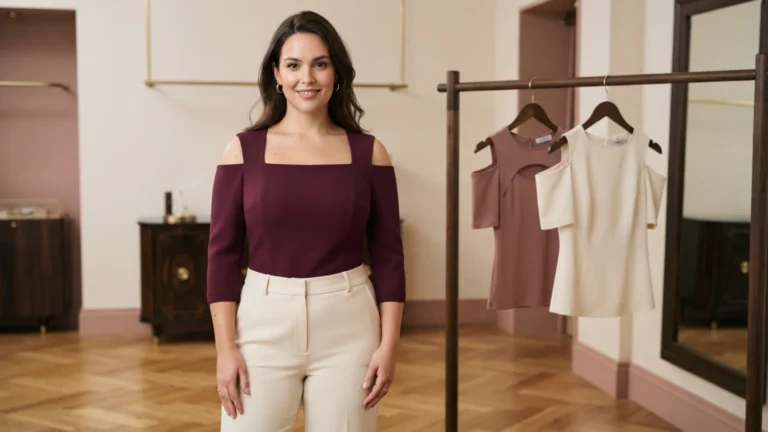
The off-shoulder label describes where the neckline sits, not how the dress fits or supports the bust. Two dresses can look almost identical from the front while one uses a shaped, lined bodice and waist stay and the other depends on a narrow elastic channel. The best off-the-shoulder dresses create front volume first, control the upper edge second and let the sleeves frame the shoulders without becoming load-bearing straps.
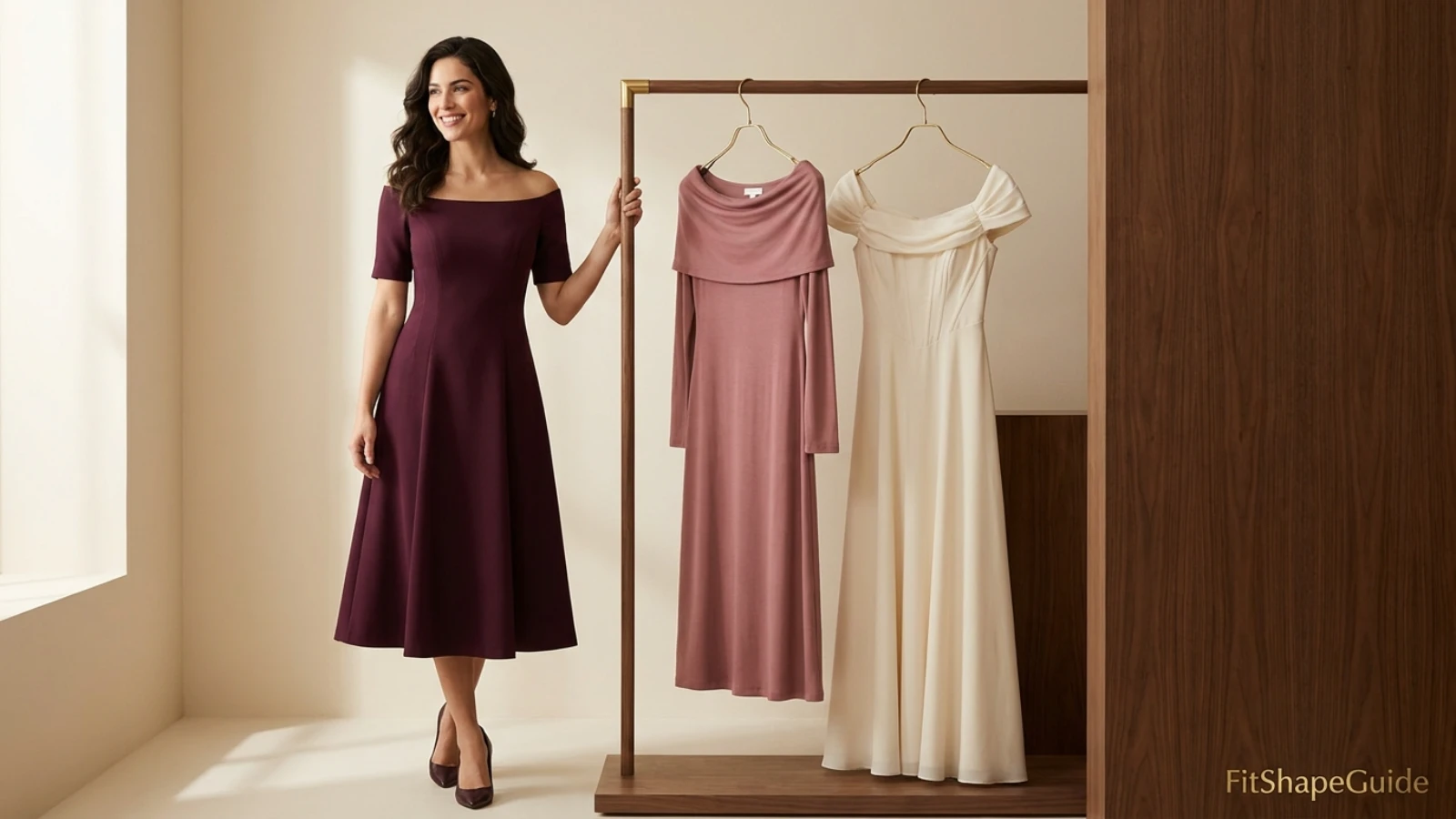
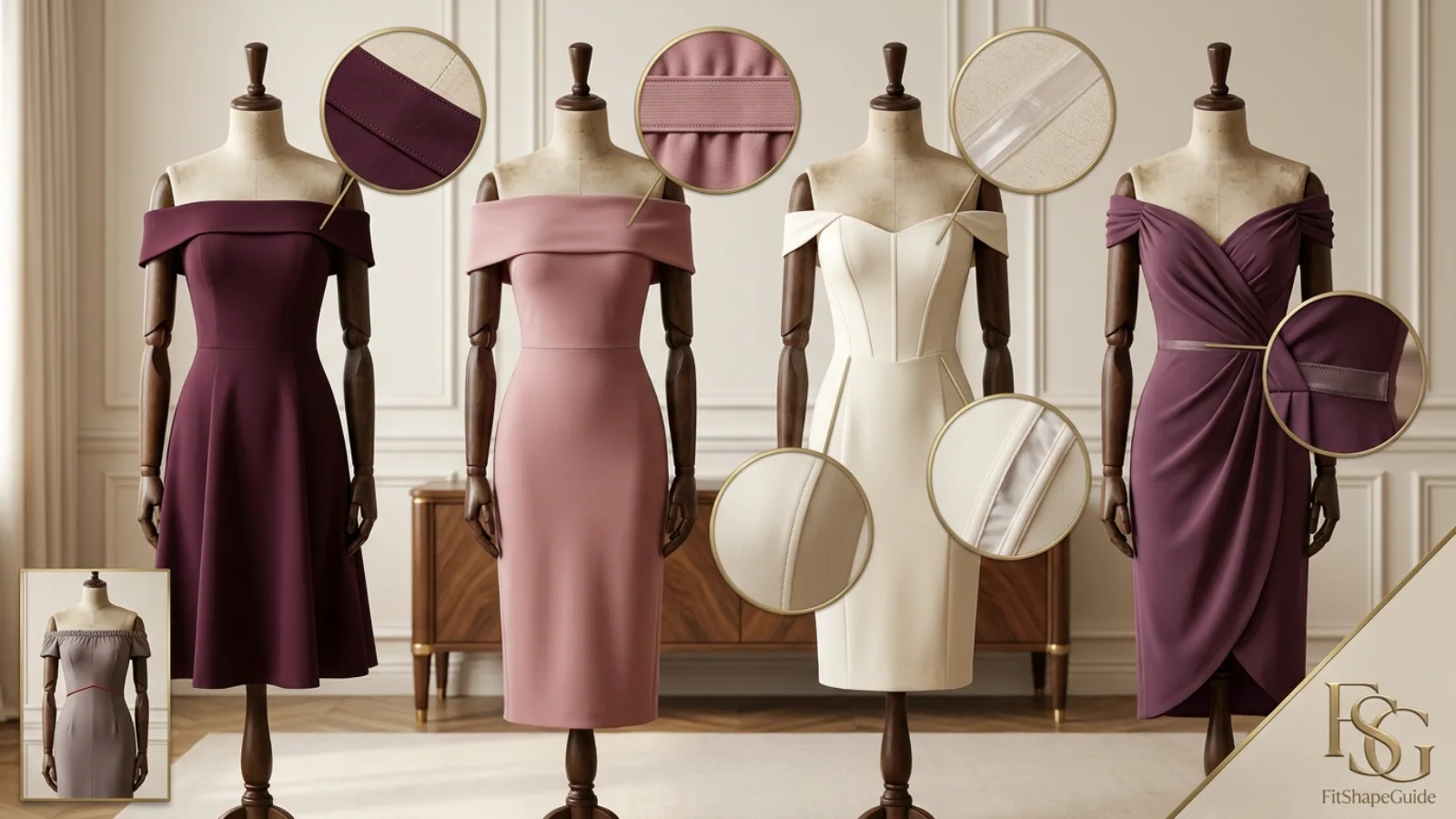
Structured Bardot A-line
Best for: cocktail parties, dinners and wedding-guest dressing when polished structure matters. Look for princess seams or curved panels, a faced Bardot edge, high enough sides, firm lining and a level natural waist. The shaped bodice supplies projection while the A-line skirt balances the silhouette. Trade-off: a fixed woven neckline offers less overhead reach than a knit style, and the dress may need a precisely fitted strapless or longline bra.
Wide fold-over knit dress
Best for: dinners, travel and occasions where softness and adjustable shoulder placement matter. A broad fold-over band distributes pressure better than a narrow elastic casing, while stable jersey or interlock can recover after movement. Trade-off: very soft rib or thin jersey may cling, reveal bra edges and stretch longer at the front; the fold should not be expected to create missing bust depth.
Corset-seamed off-shoulder midi
Best for: a defined evening bodice with stronger torso anchoring. Seek multi-panel construction, protected boning channels, adequate cup or panel depth, a waist stay or firm midriff and a flat back closure. Trade-off: “corset-style” may mean decorative seams or lacing only. Real structure can also feel restrictive when seated, so support claims and internal construction must be verified rather than inferred from the look.
Softly draped faux-wrap dress
Best for: shoppers who like a diagonal front and visual softness without a fully opening wrap skirt. A stitched overlap, stable neckline edge, side gathers releasing below the bust and a securely placed waist can provide useful shaping. Trade-off: drape can hide a shallow lining while standing; leaning and seated tests are essential, and a snap cannot replace insufficient overlap or center-front length.
Smocked or elasticated casual dress
Best for: relaxed warm-weather wear when the bodice has broad, soft elasticity and enough vertical depth. Dense smocking can distribute stretch through the torso, and a fuller skirt reduces lower-body tension. Trade-off: smocking may flatten rather than shape, become sheer when overextended or pull the neckline upward. Narrow sleeve elastics and very short bodices are common warning signs.
Supportive off-shoulder formal gown
Best for: black-tie events when the dress has a genuine internal foundation. Look for bust panels, stable lining, a high side bodice, gripper or stay tape, waist anchoring and a closure able to balance skirt weight. Trade-off: formal fabrics and long skirts add downward pull, alterations are more technical, and normal arm range may be intentionally limited even when the fit is correct.
Neckline security, bust projection and waist anchoring decide the fit
A stable neckline is the visible result of several parts working together. Neckline circumference controls how closely the edge follows the shoulders and upper chest. Grip, elastic, facing or stay tape controls growth. Bodice projection prevents the bust from forcing the neckline outward. Side height conceals the bra and contains the bust, while the waist or torso anchors the dress below. The best necklines for a large bust guide explains why depth, width and edge construction matter more than a neckline label.
The bodice should support the neckline—not the reverse
On a structured dress, princess seams, side darts, curved panels or shaped cups should create the three-dimensional room. The waist seam, firm midriff, boning or internal stay can resist downward pull. Sleeves can stabilize direction, but they should not be tightened until they leave marks or drag the neckline over the bust. If the dress immediately slides without sleeve tension, its circumference, front depth or torso anchor is probably wrong.
Center-front length protects the waist and hem
Full-bust fit requires length as well as circumference. The front bodice must travel from the neckline over the fullest point to the waist. When that distance is short, the waist climbs at center front, the neckline may rotate, the side seams swing forward and the front skirt appears shorter. Sizing up sometimes restores length, but a larger shallow pattern can remain short while becoming loose across the back.
Elastic pressure and grip are different tools
Elastic holds by tension; silicone or textured grip increases friction; facing or stay tape preserves shape. More tension is not automatically more secure. A narrow, aggressive elastic may bite into the upper arm yet still roll because the bodice pulls downward. A broad band with moderate recovery can feel steadier because pressure is distributed. Skin sensitivity, perspiration and laundering also change how grip performs, so the dress must remain wearable without relying on maximum friction.
The best off-the-shoulder dresses balance all three jobs: the pattern supplies projection, the torso supplies anchoring and the upper edge controls placement without painful compression.
| Construction | Why it can work | Evidence to confirm | Main trade-off |
|---|---|---|---|
| Faced woven Bardot edge | Maintains a clean fixed shape | Facing, stay tape, front projection and flat closure | Less overhead reach |
| Wide fold-over band | Distributes pressure and can adjust slightly | Band depth, recovery, opacity and stable base bodice | May roll in very soft fabric |
| Elastic casing | Accommodates different shoulder widths | Elastic width, recovery, replaceable channel and sleeve pressure | Narrow elastic can pinch |
| Internal gripper or stay tape | Reduces edge migration | Continuous placement, skin comfort and care instructions | Grip may irritate sensitive skin |
| Boned or panelled bodice | Anchors the dress through the torso | Protected channels, adequate depth, waist stay and sitting comfort | Technical fit and alterations |
| Smocked torso | Spreads stretch through a larger area | Dense recovery, sufficient vertical depth and non-sheer expansion | Can compress rather than shape |
Fabric, elastic, lining and skirt weight in the best off-the-shoulder dresses
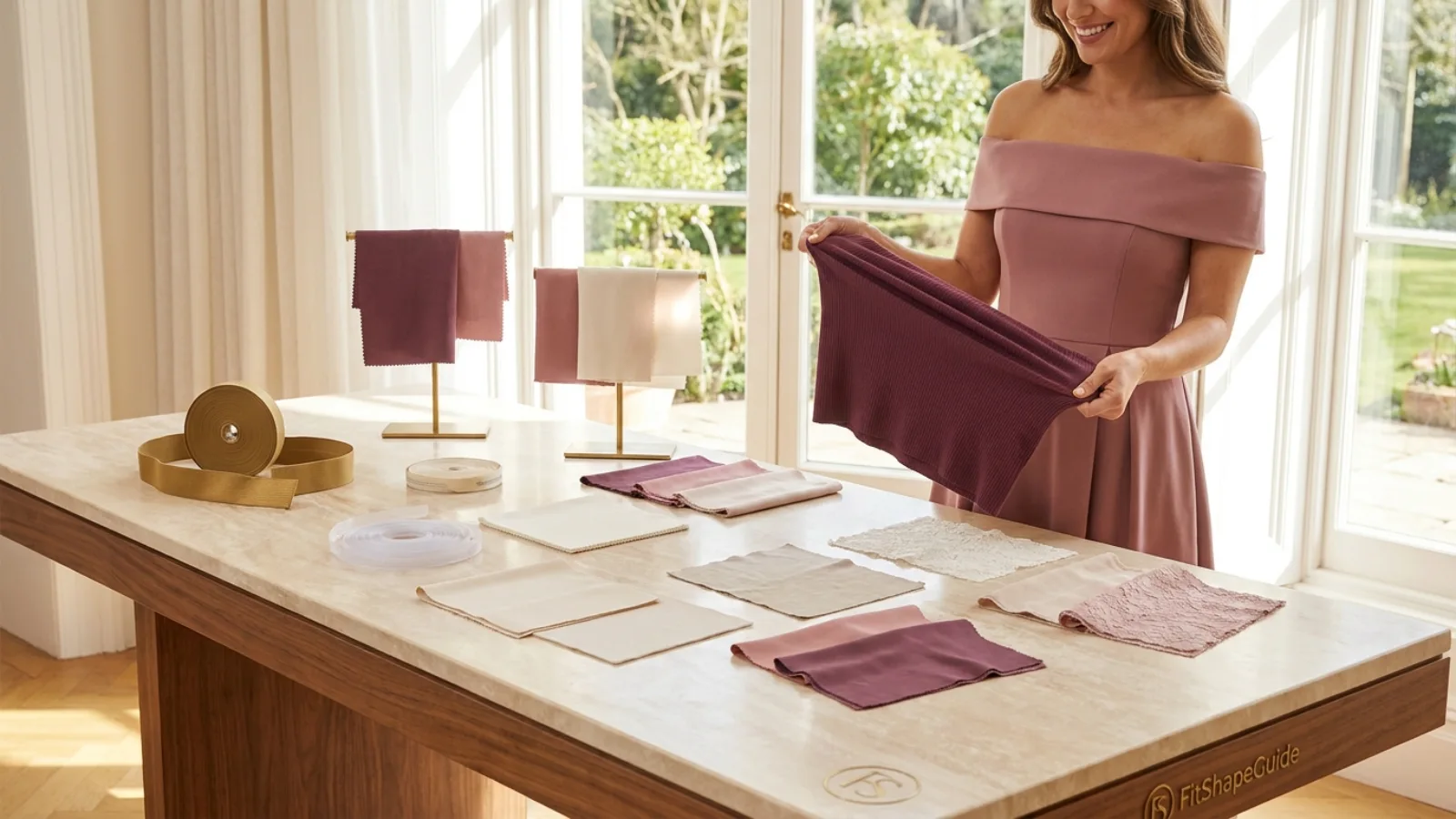
For the best off-the-shoulder dresses for a large bust, fabric determines whether the neckline holds its architecture or continually migrates. Stable jersey, interlock and ponte usually offer more predictable recovery than thin viscose jersey or loose rib. Matte crepe, satin, mikado and linen blends need shaping through seams because woven fabric cannot create projection simply by stretching. Chiffon, lace, tulle and ruffles are overlays; the hidden foundation still decides fit.
Stable knits need recovery and opacity
Stretch describes how far a fabric moves; recovery describes whether it returns. Pull a hidden area across both width and length, release it and observe whether it snaps back or remains rippled. Check opacity under strong light while the fabric is gently tensioned. A knit may feel comfortable yet grow heavier at the neckline through an evening, especially when a full skirt adds weight.
Wovens need explicit three-dimensional shaping
Crepe and cotton sateen can hold a crisp Bardot line when darts or panels supply enough front room. Satin and mikado show drag lines clearly, which makes accurate seams and pressing important. Linen blends may soften with wear and washing, while velvet has directional pile and weight. None should be forced smooth by an over-tight closure; the zipper, side seams and waist must remain calm.
Lining must agree with the shell
A stretchy shell over a rigid, shallow lining is not a stretch dress. Try the garment inside out if possible and compare the inner bust curve, side height, seam allowance and elastic attachment. Boning ends should be protected. A waist stay should sit around the torso rather than crossing breast tissue. Sewn-in pads can add coverage or contour, but they do not prove lift or size range.
Skirt weight changes neckline behavior
A mini or light midi places less downward load on the bodice than a velvet maxi, beaded dress or full formal gown. Hanger loops can protect storage but do nothing while worn. For heavier dresses, look for the skirt to connect to a secure waist seam, midriff panel or internal stay. If the garment pulls downward when the sleeves are gently lifted away, the neckline is compensating for poor anchoring.
Among the best off-the-shoulder dresses, fabric quality is therefore a system question: shell, lining, elastic, seam reinforcement and skirt weight must recover together. A luxurious surface cannot rescue a weak upper edge, and high stretch cannot replace adequate front length.
How to buy the best off-the-shoulder dresses online
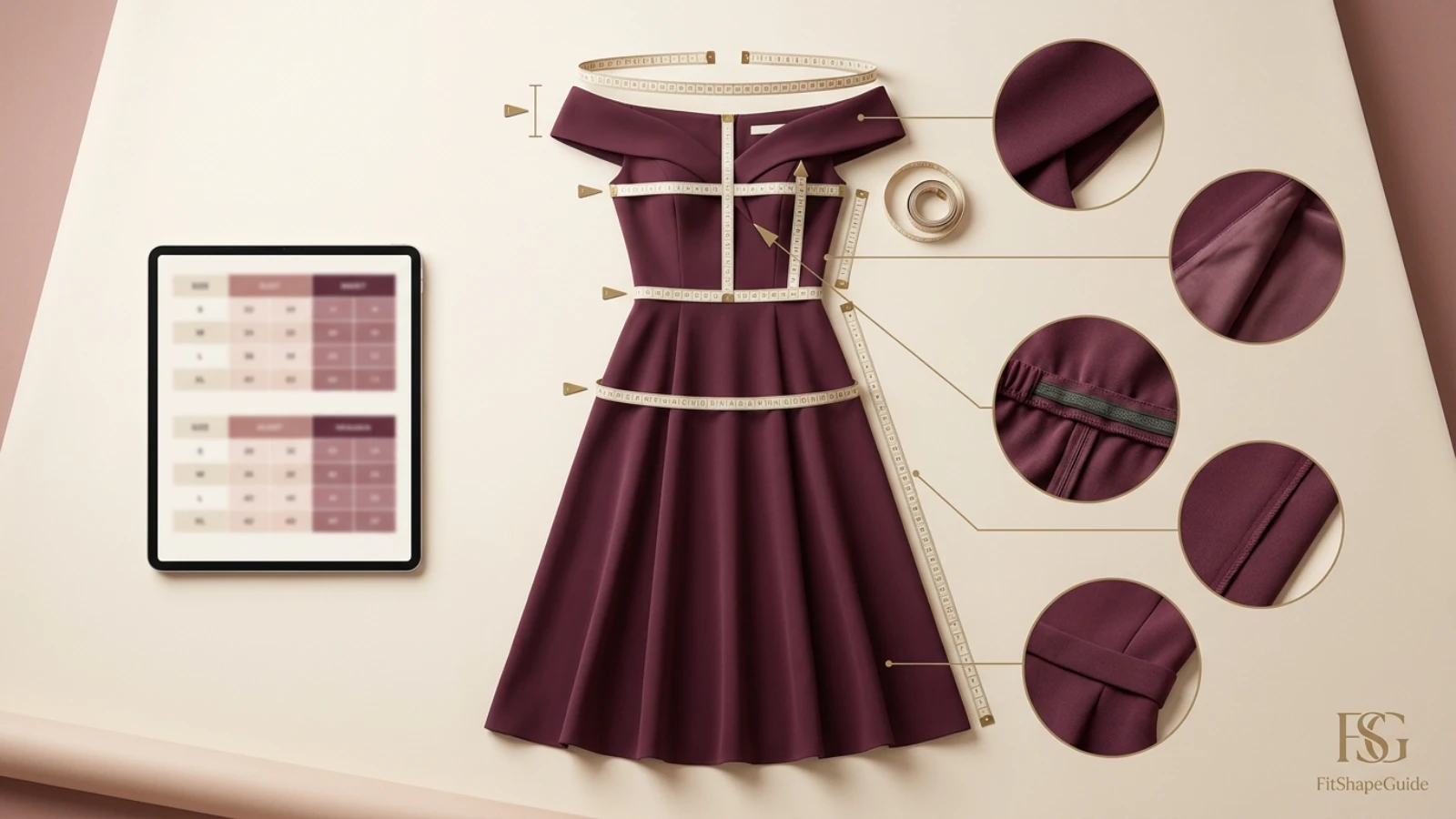
Measure over the exact bra intended for the dress. Record full bust, snug underbust, upper torso where the neckline will sit, natural waist, high and full hip, upper-arm circumference, shoulder-to-bust apex, neckline-to-waist at center front, side-waist length and intended dress length. The best off-the-shoulder dresses for a large bust make enough of this evidence visible to compare geometry. Do not pull the tape tight to imitate elastic; ask whether the chart gives body or finished garment dimensions.
| Listing evidence | Why it matters | Warning sign |
|---|---|---|
| Finished bust and front-bodice length | Protects projection, waist placement and front hem balance | Only a generic size label |
| Neckline circumference and band depth | Predicts contact, pressure distribution and placement | No rear or overhead view |
| Upper-arm and sleeve opening | Determines comfort and neckline pull during movement | Sleeves shown only in one pose |
| Side-bodice and back height | Determines strapless-bra concealment | Model’s bra area hidden by hair or arms |
| Shell, lining and stretch percentages | Predicts ease, recovery, opacity and alteration behavior | “Super stretchy” without composition |
| Closure, boning, gripper and waist stay | Shows how a structured dress stays positioned | Decorative seams described as support |
| Customer photos after sitting or dancing | Reveals rolling, rotation and front-waist lift | Only edited studio photographs |
| Return, care and alteration terms | Protects comparison fitting and realistic ownership cost | Final-sale terms unclear before checkout |
Use size charts as the starting evidence
If full bust points to a larger size than waist, choose the size or construction that restores bust room and center-front length without making the neckline uncontrollable. Waist and back refinement can be realistic after the bust fits. Buying a smaller size for “security” often increases downward drag, flattening and front-waist lift. Buying larger everywhere can create a loose upper edge while the front remains shallow, so compare geometry rather than assuming either direction is universal.
Read customer evidence carefully
Useful reviews mention neckline rolling, sleeve pressure, strapless-bra coverage, lining size, waist position, zipper behavior, front hem balance and how the dress felt after several hours. Photos from side and back can reveal forward-swinging seams or exposed bra wings. Another person’s stated cup size is not a garment measurement, and a successful fit on one torso does not establish support for yours.
Safe Amazon recommendation workflow
Before inserting any product, verify the live title, seller, size chart, shell and lining composition, neckline construction, closure, care, current return eligibility and recent customer-photo evidence. Use the affiliate tag bracalculator-20 only on a confirmed Amazon URL. Do not publish a permanent price, rating, coupon, stock claim or review count because those details change.
The best off-the-shoulder dresses earn a recommendation only when the live listing supports a construction-led conclusion. If neckline circumference, support details or lining information cannot be verified, state the missing evidence or omit the product rather than guessing.
Movement tests every off-the-shoulder dress should pass
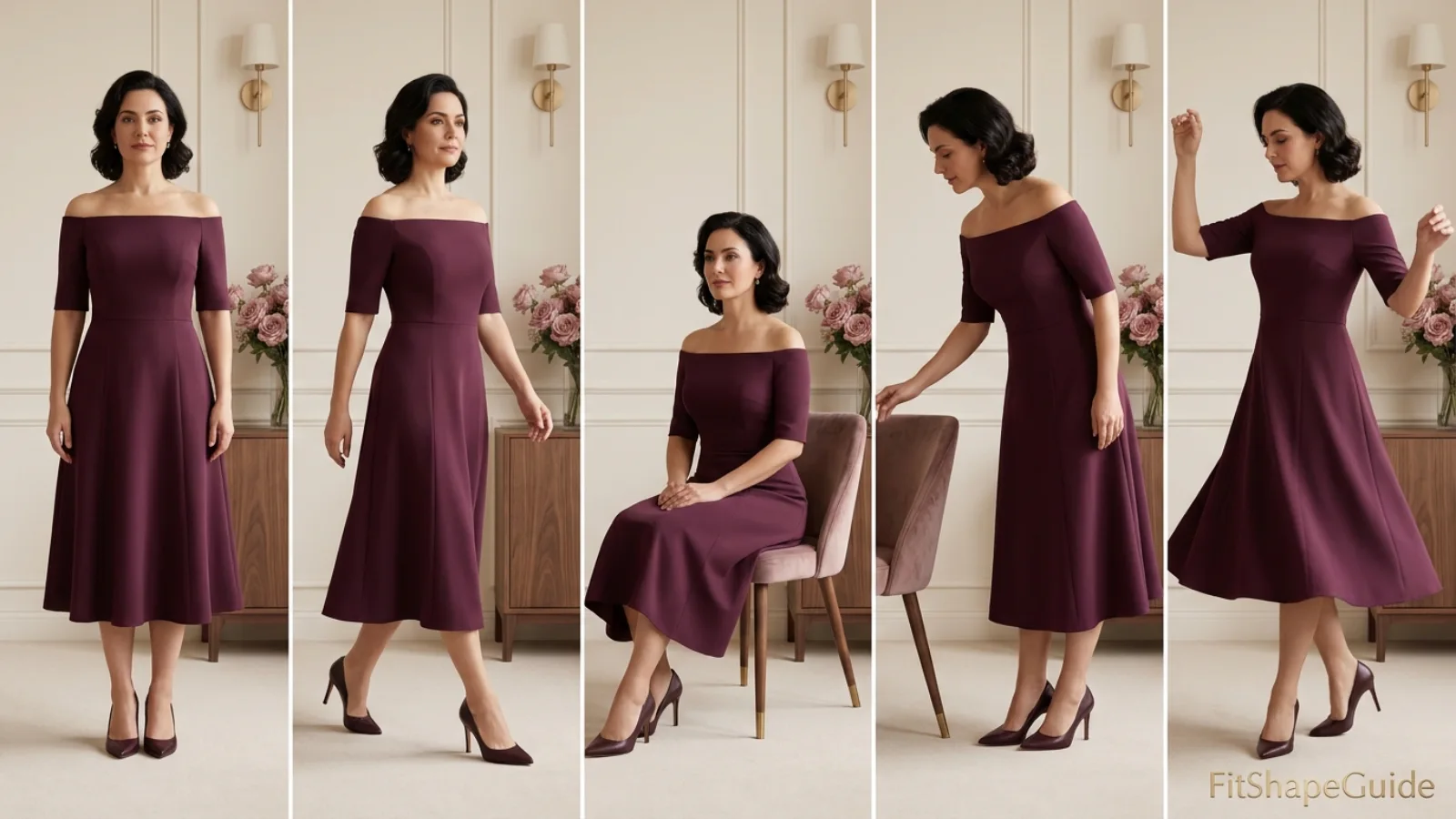
The best off-the-shoulder dresses for a large bust need a defined, realistic movement range. An off-shoulder sleeve sits below the shoulder joint, so full overhead reach may naturally lift it. The key question is whether the dress returns to its intended position without rolling, rotating or exposing the bra. Fasten every closure, wear the intended bra and shoes, and allow the fabric to settle between tests.
Neutral stand and slow-walk baseline
Stand normally without pulling the neckline down into a styled pose. Walk, turn and pause. The upper edge should maintain even contact, side seams should remain vertical and the waist should stay level. If the dress steadily descends, compare torso anchoring and skirt weight. If it climbs, inspect sleeve pressure, elastic contraction and insufficient bust depth.
Lean, dine and breathing test
Lean toward a table, look down, sit upright for ten minutes and take several deep breaths. Check cleavage coverage, bra cups and wings, boning ends, waist pressure and zipper ripples. A secure bodice may feel close, but it should not require rigid posture or shallow breathing. The neckline should not open because the bust is pushing a flat panel outward.
Forward reach and self-hug test
Reach for a glass, hold a steering-wheel position and gently hug the shoulders. This moves the shoulder blades and upper arms without forcing a full overhead lift. The sleeves should permit the motion, the back should not drag the neckline downward and the bodice should return when the arms relax. Repeated rotation toward one side suggests uneven sleeve tension or asymmetric fitting.
Controlled arm-lift and dance test
Lift one arm and then both only until the sleeve meets its designed limit. Lower slowly, then complete several gentle turns. A broad knit band may resettle by itself; a fitted woven Bardot edge may need a smaller range by design. Reject any style that causes pain, persistent rolling, bra exposure or the whole waist shifting. A dress can be beautiful without being suitable for an activity that requires frequent overhead reach.
Layer, bag and outerwear test
Add the exact shawl, coat, bag or crossbody strap. A close jacket can push sleeves upward; a heavy wrap can pull one side down; a shoulder bag may sit directly on the neckline. Walk and sit in the complete outfit. If outerwear is essential, an open coat with generous armholes may preserve the dress better than a tight cropped layer.
Common off-shoulder dress fit problems and what they mean
The best off-the-shoulder dresses for a large bust reveal the source of a problem through direction. A neckline rolling upward points toward excessive contraction or sleeve pull. A neckline sliding down points toward insufficient anchoring, excessive circumference or skirt weight. Drag lines from bust to side seam indicate missing front space. Diagnose the full system before tightening elastic, adding tape or selecting a different bra.
| Visible symptom | Likely cause | Best next step |
|---|---|---|
| Neckline rolls upward | Narrow elastic, upper-arm pull or insufficient front depth | Try a broader band or better-shaped bodice |
| Dress slides downward | Loose torso, weak grip, heavy skirt or shallow internal cups | Choose stronger waist anchoring and correct bust depth |
| Upper edge pinches or leaves marks | Excessive elastic tension or narrow pressure area | Increase circumference or choose a wider softer edge |
| Waist rises at center front | Insufficient neckline-to-waist length over the bust | Seek longer front shaping rather than only more width |
| Side seams swing forward | Front is borrowing fabric from the back | Increase front projection and finished bust room |
| Bra wings or cup edges show | Low side bodice, wide upper edge or incompatible bra | Change dress geometry or bra after checking both together |
| One side rotates downward | Uneven sleeve tension, posture response or asymmetric alteration | Compare sleeve openings and side lengths independently |
| Fabric stays rippled after movement | Poor recovery or overextension | Choose a more stable fabric or a size with usable ease |
When sizing up works
Size up when the next size restores bust room, front length, sleeve comfort and opacity while the torso and upper edge remain controllable. It is less useful when the larger dress immediately slides, leaves a loose back and still raises at center front. That combination indicates a shallow pattern, not simply insufficient circumference.
When alterations are realistic
A tailor may refine a loose back or waist after the bust fits, shorten elastic through an accessible casing, replace degraded elastic, add stay tape to an adequately sized edge, adjust sleeve openings or hem the skirt. The tailoring guide for a large bust explains why fitting the bust before the waist is usually safer. Major front-width additions, lowering a fixed waist, rebuilding molded cups, moving boning or changing an entire Bardot curve can be costly or impossible without matching fabric.
Fashion tape can reduce small edge movement on clean, dry skin when the dress already fits. It should not carry skirt weight, close a shallow bodice or protect against painful elastic. Test any adhesive in advance, follow its instructions and avoid placing it over irritated skin. A temporary fix is not evidence that the dress construction works.
Bra compatibility, occasions and styling
The best off-the-shoulder dresses do not require the bust to look smaller; they require the dress and support system to occupy compatible space. Try the bra and dress together before removing tags or approving tailoring. Cup edges, center gore, wings and back band must remain concealed while the bra stays level and supportive. Sewn-in pads can improve coverage but are not automatically a substitute for a bra.
Choose the bra from the exact neckline and back
A well-fitted strapless bra is the most conventional pairing. A longline style may spread anchoring lower on the torso, but its back and bottom edge must suit the dress. Convertible low-back options trade some stability for concealment and should be tested through the full event. Transparent straps remain visible and can reflect light; they are not visually invisible. If the dress contains verified internal cups, boning and a waist stay, test it with and without the planned bra before deciding.
Match construction to the occasion
For a wedding guest or cocktail event, a structured A-line, corset-seamed midi or stable draped dress provides a polished starting point; compare the wedding guest dress guide. For black tie, skirt weight, lining and internal foundation matter more; the formal gown guide covers those trade-offs. For daytime or travel, a wide fold-over knit or dense smocked dress may be easier to wear, provided recovery and opacity are proven.
Use vertical and waist details intentionally
Long princess seams, a level waist, a clean skirt line and monochrome styling can create visual continuity, but none is a compulsory “slimming” rule. Necklaces may sit above the dress edge or be omitted; earrings can add emphasis without competing with the Bardot line. A belt can highlight a correctly placed waist but cannot lower a seam that is riding over the bust.
Layer without forcing the neckline
Shawls and wraps can suit the open neckline, but secure them without pinning through delicate fabric or pulling one side down. Jackets need enough sleeve and armhole room to sit over off-shoulder sleeves. Test the complete layer while seated and reaching. If a coat will stay on throughout the event, consider whether a different neckline would provide more reliable comfort.
The best off-the-shoulder dresses make styling easier because the neckline remains intentional after jewelry, outerwear and normal event movement are added.
For balanced skirt proportion and easier waist fitting, the best A-line dresses for a large bust are a useful comparison. Shoppers who want adjustable diagonal coverage can also compare wrap dresses for a large bust, while remembering that wrap overlap and off-shoulder anchoring solve different problems.
Care, quality and final value checks
Heat, harsh detergent, twisting and long periods on a hanger can damage elastic, grip and bodice shape. Follow the care label rather than assuming every knit can be machine dried or every formal dress can be steamed. Close zippers and hooks, support heavy skirts with their intended hanger loops and store the neckline without stretching it over a wide hanger. Keep silicone grip clean according to the manufacturer’s instructions because oils and residue can reduce friction.
Inspect elastic joins, sleeve seams, princess curves, boning ends, neckline facing, side zipper, waist attachment, lining and hem. A cheaper dress that needs a new strapless bra, replacement elastic and complex bodice work may cost more than a better-shaped option. The best off-the-shoulder dresses for a large bust provide value through repeatable placement, realistic movement and care—not through a low initial price paired with constant adjustment.
Final buyer checklist
- Even upper-edge contact without painful pressure
- Real bust shaping or controlled stretch with recovery
- Enough center-front length and a level waist
- High enough sides and back for the intended bra
- Secure torso anchoring independent of sleeve tightness
- Shell and lining tested together for opacity and movement
- Comfortable seated breathing and upper-arm openings
- Neckline recovery after reaching and controlled arm lifting
- Return and alteration terms checked before purchase
- Care method suitable for elastic, grip, boning and fabric
Frequently asked questions
Can women with a large bust wear off-the-shoulder dresses?
Yes. Choose a dress with genuine bust projection, adequate center-front length, a stable upper edge, sufficient side-bodice height and anchoring through the waist or torso. The sleeves should frame the shoulders rather than hold the whole dress up.
What off-the-shoulder dress style is best for a large bust?
Structured Bardot A-lines, wide fold-over knit dresses, corset-seamed midis, secured faux-wrap styles and properly founded formal gowns are strong starting points. The best choice depends on finished bust room, neckline recovery, bra coverage, waist placement and intended movement.
What bra should I wear with an off-the-shoulder dress?
A correctly fitted strapless bra is the usual starting point, while some longline bras can provide lower torso anchoring. Match cup edges, wings and back height to the exact dress. Sewn-in pads add coverage or shape but do not automatically provide support.
How do I keep an off-the-shoulder dress from slipping down?
First confirm that the bodice has enough bust depth and is anchored at the waist or torso. A stable facing, broad elastic or inner grip may help an already fitting edge. Tight sleeves or fashion tape should not be expected to carry a shallow bodice or heavy skirt.
How tight should the elastic on an off-shoulder dress be?
It should maintain even contact and recover after movement without pinching, rolling or leaving persistent marks. Broad elastic usually distributes pressure better than a narrow channel. Security should also come from correct bodice circumference, projection and waist anchoring.
Should I size up in an off-the-shoulder dress for a fuller bust?
Size up when it restores bust ease, center-front length, sleeve comfort and opacity while the neckline and torso remain controllable. If the larger size slides down or still raises at the front waist, choose a better-shaped construction rather than adding width everywhere.
Can an off-the-shoulder dress be altered for a large bust?
A tailor may refine a loose waist or back, adjust accessible elastic, stabilize an adequately sized edge or alter sleeve openings. Adding substantial front width, lowering a fixed waist, rebuilding cups or moving boning is more complex and may require matching fabric.
Are off-the-shoulder dresses comfortable for weddings and formal events?
They can be comfortable when the bodice supports itself, the sleeves permit dining and greeting movements, and the neckline returns after reaching. Test sitting, leaning, self-hugging, walking and controlled arm lifting in the intended bra and outer layer before the event.