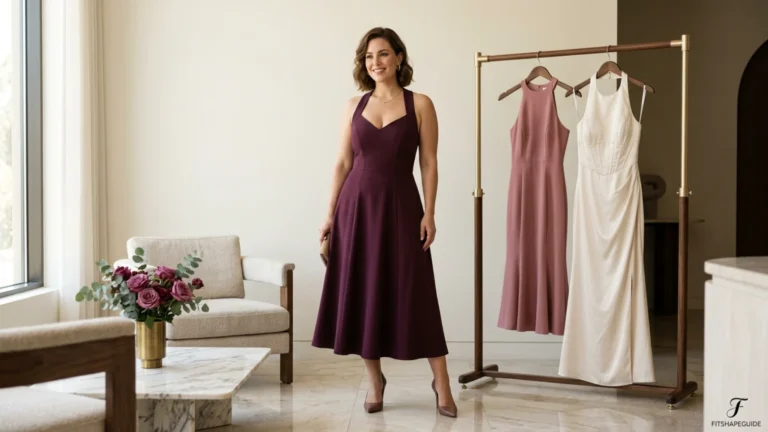
Best Strapless Dresses for a Large Bust
A reliable strapless dress is engineered from the torso upward: shaped bust room, a close underbust or waist anchor, vertical structure, a resilient top edge and enough center-front length to stay secure while you sit, reach, walk and dance.
Quick answer
The best strapless dresses for a large bust usually have a longline shaped bodice, adequate cup depth, vertical boning or firm panel seams, a close underbust or waist anchor, gripper tape and a top edge that returns after movement. Boned fit-and-flare dresses, longline corset-seamed styles, structured ponte columns, lined ruched-mesh designs and formal A-line gowns are dependable starting points. The dress should stay up because its torso structure fits—not because the neckline crushes the bust.
The 60-second strapless-dress fit check
- Confirm that the top edge stays level without cutting in, rolling outward or standing away.
- Check that darts or princess-seam curves point toward—not above or below—the bust apex.
- Look sideways: the waist seam should not climb onto the lower bust, and the front hem should not lift sharply.
- Cross your arms, raise them, sit and lean forward. The neckline must retain coverage without hand-adjusting.
- Walk quickly and turn. The skirt may move, but the bodice should remain anchored.
- Photograph the front and side in event lighting to check lining, shine, pulling and bra outlines.
Best strapless dresses for a large bust by construction
Boned fit-and-flare strapless dress
Best for: a defined waist with secure torso anchoring. Curved princess seams create projection while flexible vertical boning resists folding. The waist seam should reach the natural waist before the skirt releases. Compare the construction checks in our fit-and-flare dress guide.
Longline corset-seamed dress
Best for: formal structure without painful compression. Look for multi-panel shaping that extends to the waist, curved bust room, a stable back closure and boning ends that are safely capped. Decorative “corset” lacing alone is not support, and tiny pre-shaped cups are a warning sign.
Structured ponte strapless column
Best for: close fit with controlled stretch. Dense ponte can move while a longline facing, waist stay or internal power-mesh layer carries the load. Stretch should assist breathing and sitting rather than substitute for bust depth. Review the bodycon dress fit tests before buying.
Ruched-mesh dress with stable lining
Best for: flexible surface texture over a supportive base. The hidden lining must contain the bust without becoming sheer, and the outer ruching should remain evenly distributed. Side seams, boning channels and the top edge should return after a self-hug instead of twisting downward.
Structured-front, smocked-back strapless dress
Best for: small size fluctuations when the front already contains real projection. Dense back smocking can refine ribcage fit, but it should not be the only anchor or pull the dress backward. Choose a lined, seamed front, a stable upper edge and strong recovery.
Formal strapless A-line gown
Best for: weddings, galas and long events. A longline inner bodice, waist stay and shaped lining can support a heavier skirt without dragging the neckline down. Confirm that the lining offers the same cup depth as the shell and use the A-line dress guide to assess skirt balance.
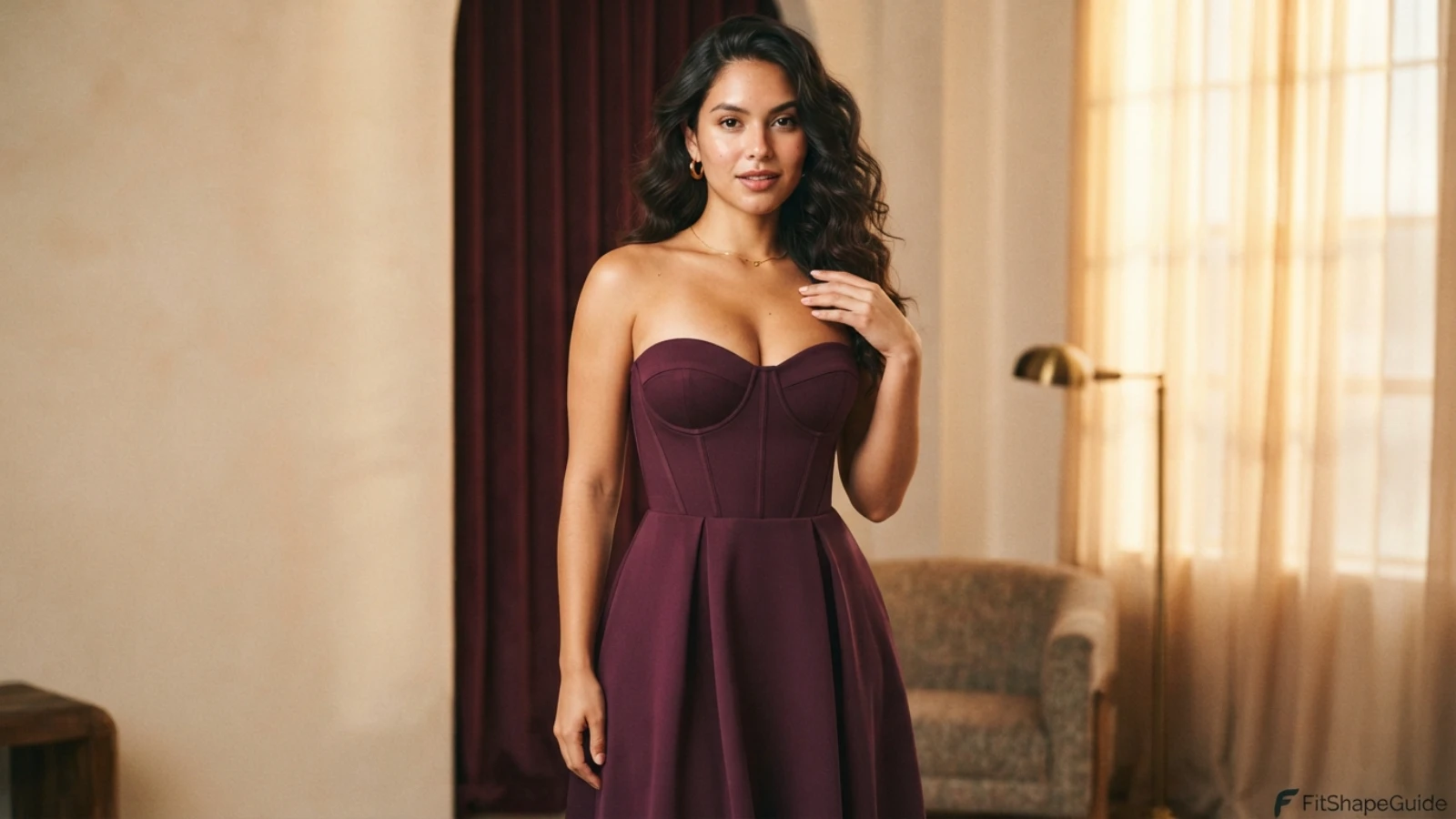
Why bodice length, projection and anchoring decide strapless-dress fit
Bust width and bust projection are different needs
A fuller bust needs fabric to travel forward as well as across. A dress can match the overall circumference and still be too flat through the front. The result is diagonal pulling, forward-drifting side seams, a lifted front hem or a top edge that rolls outward. Princess seams, curved cup panels and a shaped longline lining can create projection. Simply sizing up adds width everywhere and may leave the ribcage anchor and upper edge unstable.
Center-front bodice length protects waist placement
The fabric must travel over the bust before it reaches the waist. If the front bodice is too short, a seam intended for the natural waist rises onto the ribcage or lower bust. This is especially important in formal dresses because decorative waistbands are often firm. Shoppers with a fuller bust and compact torso should also read the large bust and short torso guide: extra center-front length does not automatically require a longer back torso.
Underbust, ribcage and waist create the anchor
A strapless dress should be supported below the bust, not suspended from a painfully tight top edge. The lining, waist stay, underbust shaping and close ribcage fit spread the load; vertical boning stops the bodice collapsing. If the anchor is too loose, the dress rotates or slides. If it is too tight, breathing and sitting become uncomfortable even when the upper edge looks secure.
A defined waist must not be a compression band
Waist definition can provide a useful visual and mechanical anchor, but the seam must sit below all breast tissue. A tight band directly under or across the bust can push tissue upward and make a V-neck less secure. Compare this with the correctly placed seam guidance in our empire-waist dress guide.
Top-edge shapes and bra compatibility for strapless dresses
Assess the upper edge with the exact bra or built-in support you intend to wear. A well-fitted strapless bra may offer familiar shaping, while a genuinely supportive longline dress may be wearable without one. Adhesive cups can add coverage or shaping but do not anchor a heavy dress. The garment still needs cup depth, ribcage control and a stable edge.
| Top-edge shape | What can work | Check before keeping |
|---|---|---|
| Straight across | Shaped inner cups, a longline facing and gripper tape | Edge must not crush tissue, roll outward or stand away at center front |
| Sweetheart | Curved cup panels with a firm center notch and adequate vertical coverage | Curves should contain the bust without cutting across its fullest point |
| Soft scoop | Reinforced facing, flexible boning and enough height at the sides | Lean and self-hug; the curve should return without exposing the bra |
| Notched or V front | A rigid center insert or carefully stabilized plunge with separate anchoring | Notch must not spread, twist or depend only on fashion tape |
| Foldover portrait edge | A decorative outer fold attached to a secure inner longline bodice | Outer fabric should not carry support or drag the inner edge down |
| Asymmetric strap-free edge | Internal waist stay, balanced boning and non-slip tape | Dress must not rotate toward its lower side during walking |
For broader neckline geometry, use the best necklines for a large bust guide. Fashion rules about “minimizing” are less useful than checking edge stability, cup placement, support compatibility and movement. For similar strap-free fit logic in separates, compare the bandeau tops guide.

Best fabrics and linings for a fuller-bust strapless dress
Ponte and structured jersey
Dense ponte can combine movement with surface control. Look for useful recovery: after the fabric stretches, it should return rather than remain bagged. A stable double knit generally communicates seam lines more cleanly than thin jersey. Hold it to strong light, stretch it gently and check whether color pales or the texture opens.
Stretch crepe
Stretch crepe can provide a matte, event-appropriate surface with moderate flexibility. It still requires darts or panels; stretch does not replace projection. Check whether the lining stretches in the same direction and whether the neckline has facing or tape to prevent growth.
Satin and charmeuse
Satin reflects light and reveals tension quickly. Diagonal shine lines over the bust are evidence that the pattern is being pulled, not a body problem. Bias-cut satin can adapt to curves but may grow during wear. Choose adequate ease, opaque lining and seam allowances that do not show through.
Lace, mesh and sequins
Decorative overlays can look flexible while the hidden base layer is tight. Test the lining first. Beading and sequins add weight, and rough embellishment near the underarm edge can irritate during dancing. Inspect whether altered seams would disrupt a motif or require expensive handwork.
Velvet and jacquard
Velvet and jacquard can create luxurious structure, but both demand accurate fit. Crushed pile and reflective motifs may exaggerate pulling. A small amount of elastane may aid movement; it does not guarantee recovery. Review our broader fabric guide for fuller-bust clothing before comparing listings.
Lining rule: pinch the shell and lining separately at the fullest bust. If the shell has room but the lining is taut, the lining controls the fit. It should not pull the outer fabric upward, restrict breathing or twist the side seam.
Measurements worth comparing before ordering
| Measurement | How to use it | Warning sign |
|---|---|---|
| Finished bust circumference | Compare with your bust plus the ease required by the fabric and silhouette | Listing gives only a broad body-size range with no garment measurement |
| Top edge to waist, center front | Shows whether the bodice can travel over the bust and reach the waist | Front waist is visibly higher than the back or cup seam sits too low |
| Underbust and upper-ribcage circumference | Predicts whether the longline lining can anchor without painful compression | Only bust and waist measurements are supplied for a boned bodice |
| Side-bodice height | Helps assess coverage, bra-wing concealment and underarm comfort | Side edge cuts into tissue or exposes the intended bra |
| Top-edge width and cup depth | Compare with the intended strapless bra or the dress’s internal cup geometry | Listing gives cup letters with no band, depth or garment measurements |
| Waistband circumference | Check against natural waist and lower ribcage, especially in rigid bands | Band must stretch across breast tissue to close |
| Dress length | Assess sitting coverage, venue and footwear—not only standing photos | Front is already shorter because the bodice lacks projection |
When measurements are absent, ask the seller for the garment laid flat without stretching, then double width measurements where appropriate. Compare with a dress you already own in a similar fabric. Body measurements and finished-garment measurements are not interchangeable.
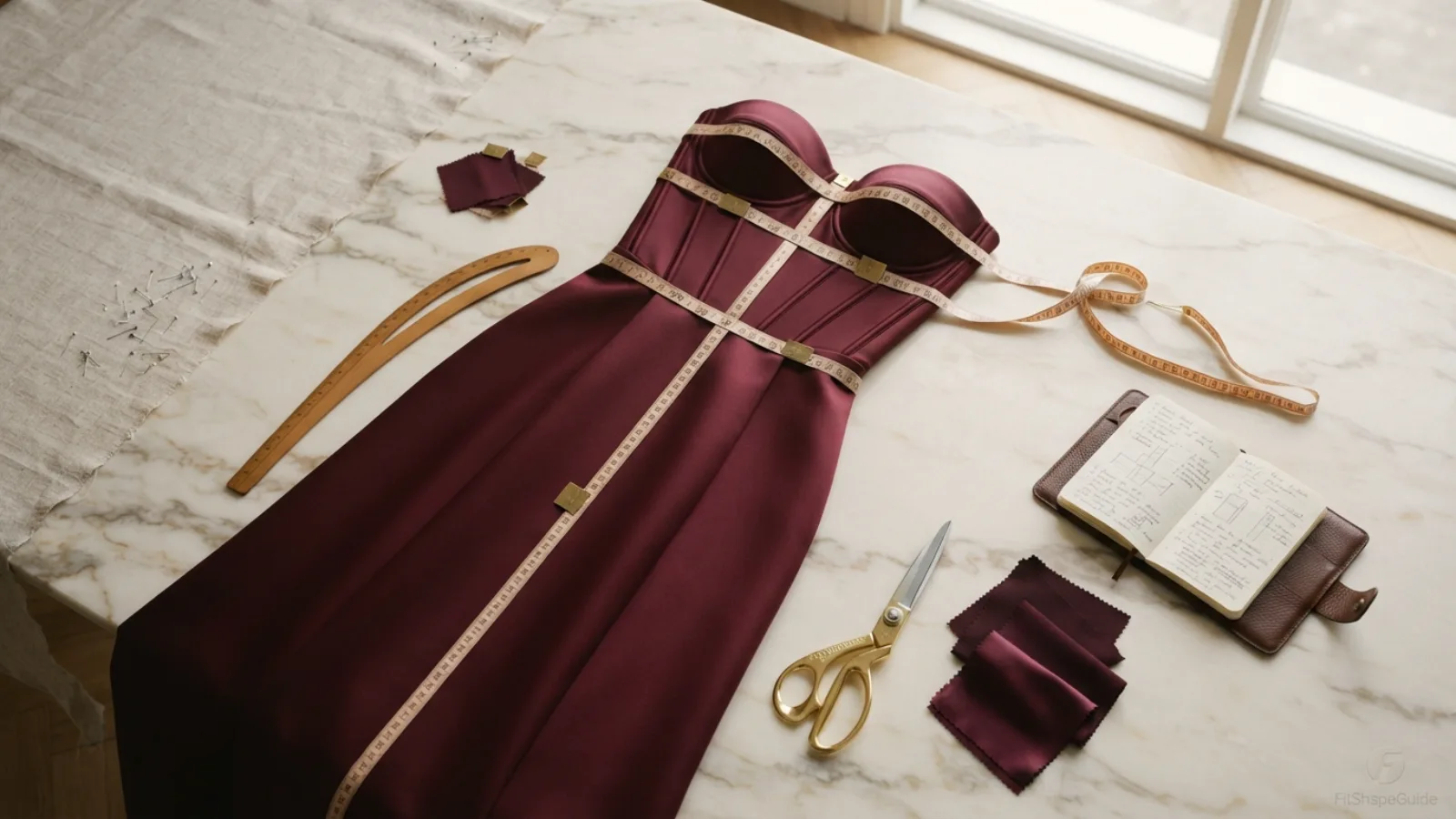
How to shop online for the best strapless dresses for a large bust
Read construction before marketing copy
Search product details for curved seams, cup depth, flexible boning, a waist stay, gripper tape, longline lining, back smocking, stretch percentage, zip position and care instructions. “Built-in bra,” “corset,” “flattering” and “supportive” are incomplete claims unless the listing explains the structure and provides useful measurements.
When comparing the best strapless dresses for a large bust, shortlist by the features you can verify rather than by a model image alone. A clear size chart, front and back views, fabric details, lining information and a usable return policy provide stronger buying evidence.
Use reviews as garment evidence
Prioritize reviews that include the reviewer’s usual size, approximate measurements, bra type and the size ordered. Look for repeated observations about sliding, cup depth, zipper strain, top-edge pressure, lining, boning and whether the dress rotates. One person’s “too revealing” may be another person’s ideal edge height; construction details travel better than verdicts.
Verify any Amazon recommendation on the day you publish
This guide is Amazon affiliate-ready, but it does not invent products, ASINs, prices, stock, ratings or review counts. Before inserting a product module, confirm the live listing, seller, fabric composition, size chart, return terms and current availability. Mark affiliate links with rel="sponsored nofollow" and keep editorial criteria independent from commission.
Check returns before ordering two sizes
Occasionwear often has final-sale rules, short return windows or deductions for removed tags. Confirm whether return shipping is paid, whether trying on with makeup can affect acceptance and whether multiple sizes are permitted. Do not schedule the first try-on on the day of the event.
Movement tests every strapless dress should pass
The best strapless dresses for a large bust should stay secure through the movements required by the real event, not only through a brief fitting-room pose. Perform these checks with the intended bra, shoes and outer layer.
The seated dinner test
Sit upright, lean toward a table and remain seated for five minutes. Check neckline coverage, underbust pressure, waist comfort and skirt position. A dress that looks excellent while standing can become restrictive when the torso compresses. The zipper and lining should not pull sharply across the bust.
The no-hands and rotation test
Walk briskly, rotate the torso and take several dance steps without touching the neckline. Mark the original top-edge position mentally or with a mirror reference. The bodice should remain level rather than spiraling or descending. Repeatedly pulling it up is a failed fit test, even if fashion tape temporarily slows the movement.
The raised-arm and self-hug test
Raise both arms, lower them, then hold a firm self-hug for ten seconds. The upper edge, boning channels and side seams should return close to their original positions. Watch for rolled gripper tape, a center notch spreading, boning bowing away from the body or breast tissue escaping above or beside the cups.
The deep-breath, lean and coat test
Take several full breaths, lean forward, return upright and add the planned wrap or jacket. You should be able to breathe without the waist stay cutting in, while the top edge remains secure. Fashion tape can add insurance to an already stable edge; it should never be the primary structure holding an undersized bodice in place.
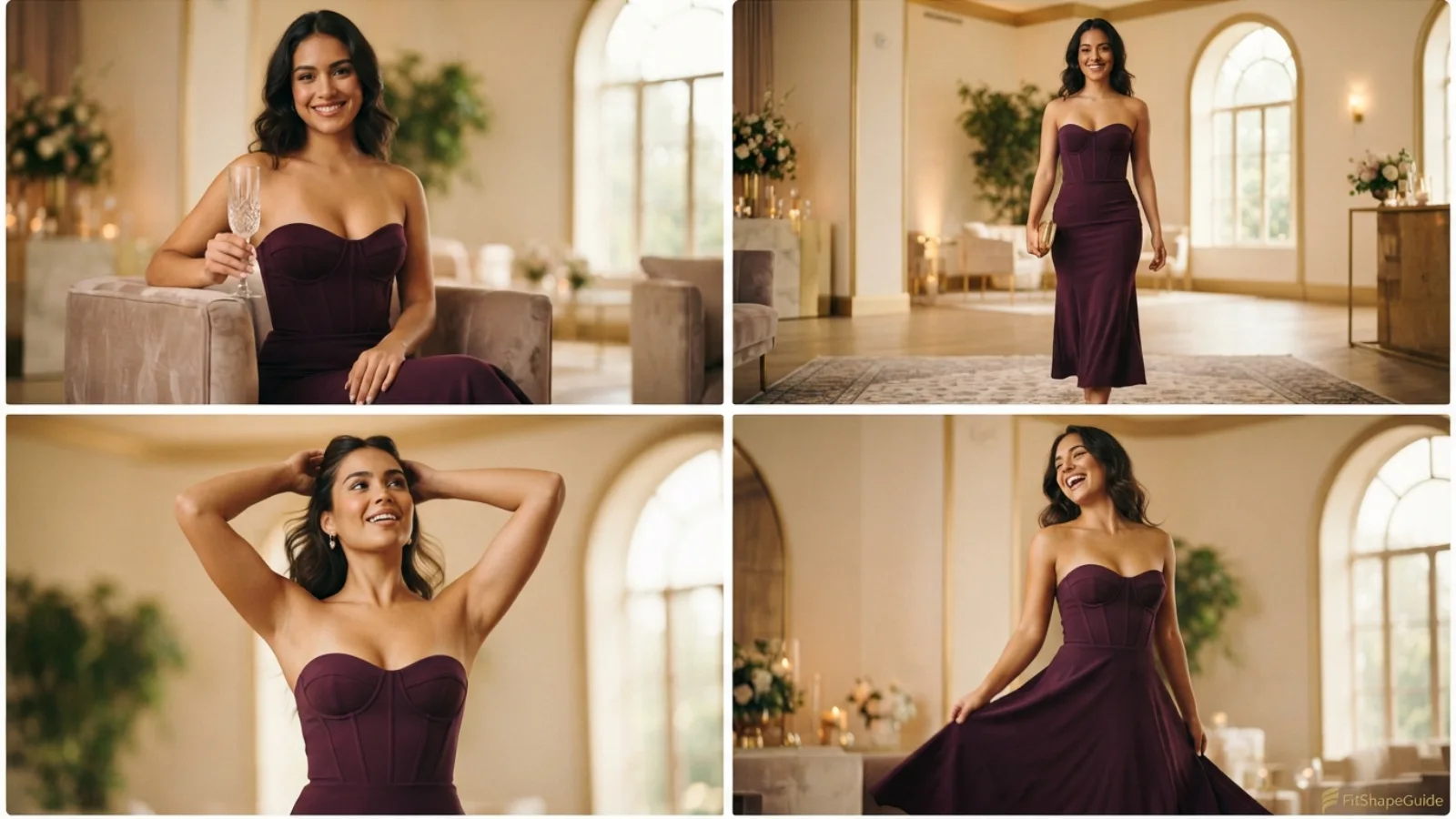
Fit problems to avoid in the best strapless dresses for a large bust
| Symptom | Likely cause | Better response |
|---|---|---|
| Diagonal lines from bust to waist | Insufficient front projection or bodice length | Try princess shaping, a fuller-bust cut or a different design |
| Top edge stands away | Upper bodice too wide, edge stretched or bust pulling fabric forward | Choose closer ribcage anchoring with more cup depth; minor edge stabilization may be alterable |
| Waist seam sits on breast tissue | Front bodice too short or seam positioned too high | Choose longer front shaping; do not force the seam down with a tight belt |
| Underarm edge cuts or gapes | Wrong side height, upper-ribcage width or cup depth | Change cut; reshaping a fully boned side panel may be complex |
| Front hem rises | Bust is borrowing length from the skirt | Choose more center-front length and shaped projection |
| Zip closes only when bust is compressed | Dress is undersized or too flat through the front | Size up only if the torso anchor remains stable; otherwise change construction |
| Strapless dress rotates | Insufficient internal anchoring or mismatch through bust and ribcage | Choose a structured longline bodice or a strapped style |
When sizing up helps
A larger size can restore cup depth, close a zip, reduce shine lines and improve breathing. It works only when the ribcage, upper edge and waist can still be fitted or realistically altered. If the larger size slides down yet still flattens the bust, the pattern is too shallow. For close-fitting alternatives, consult the bodycon dress guide.
Alterations worth considering
Hemming, taking in a simple waist or upper back, replacing tired gripper elastic and stabilizing a slightly loose top edge can be realistic. Adding substantial cup depth, moving an entire waist seam, rebuilding molded cups or enlarging heavily boned or beaded panels is more complex. Ask an alteration professional before the return window closes and use our tailoring guide for a large bust to assess risk.
Styling a strapless dress without relying on minimizing rules
Styling the best strapless dresses for a large bust begins after fit is solved. Color, jewelry, shoes and layering can express the event mood, but they should never be used to disguise a neckline, seam or bodice that does not stay in place.
Wedding guest or formal dinner
A lined boned midi or longline A-line gown can work across long events when the upper edge remains stable through sitting and greetings. Check the invitation, venue and cultural expectations before choosing color, length or coverage. Bring the intended wrap or jacket to the fitting so it does not push the dress downward.
Layered evening or work event
A strapless column or fit-and-flare dress can sit beneath a bolero, cropped jacket or evening wrap. The layer needs enough chest and upper-arm room and must not catch the top edge when you reach. Test sitting at a desk or table as well as standing with a drink or bag.
Date night or party
Choose the neckline and silhouette you enjoy, then engineer security through fit. A statement earring, shoe, clutch or texture can carry the visual focus without changing the body. There is no requirement to hide a fuller bust; comfort and intentional styling are the useful goals.
Accessories and underlayers
A correctly fitted strapless bra, longline bra or the dress’s own engineered lining may provide support; choose the option that works with the actual top edge. Adhesive cups and fashion tape are optional styling aids, not load-bearing foundations. Shapewear is optional and should permit comfortable breathing and sitting.
Care, value and final buyer checks
Before paying a premium for occasionwear, read the sewn-in fiber and care labels. The U.S. Federal Trade Commission explains that clothing care labels provide regular-care instructions; its official Care Labeling Rule guide is a useful reference. The FTC also outlines apparel fiber and origin labeling. For garments that include boning, molded components or specialty lining, follow the dress label rather than assuming ordinary wash methods are safe.
Inspect seam allowance, lining attachment, zip quality, loose embellishment and whether the fabric can tolerate the care method. Dry-clean-only beaded garments may cost more across repeated wears. Store clean occasion dresses with adequate support, and avoid hanging heavy stretch garments by narrow straps for long periods.
- Bodice contains the bust without flattening or overflow.
- Top edge works with the intended strapless bra or internal support.
- Underbust or waist anchor stays secure without restricting breath.
- Boning remains vertical and lining matches the shell’s capacity.
- Dress passes no-hands walking, sitting, leaning and raised-arm tests.
- Care cost, alterations and return terms suit the purchase value.
- Product evidence is current before any affiliate recommendation is published.
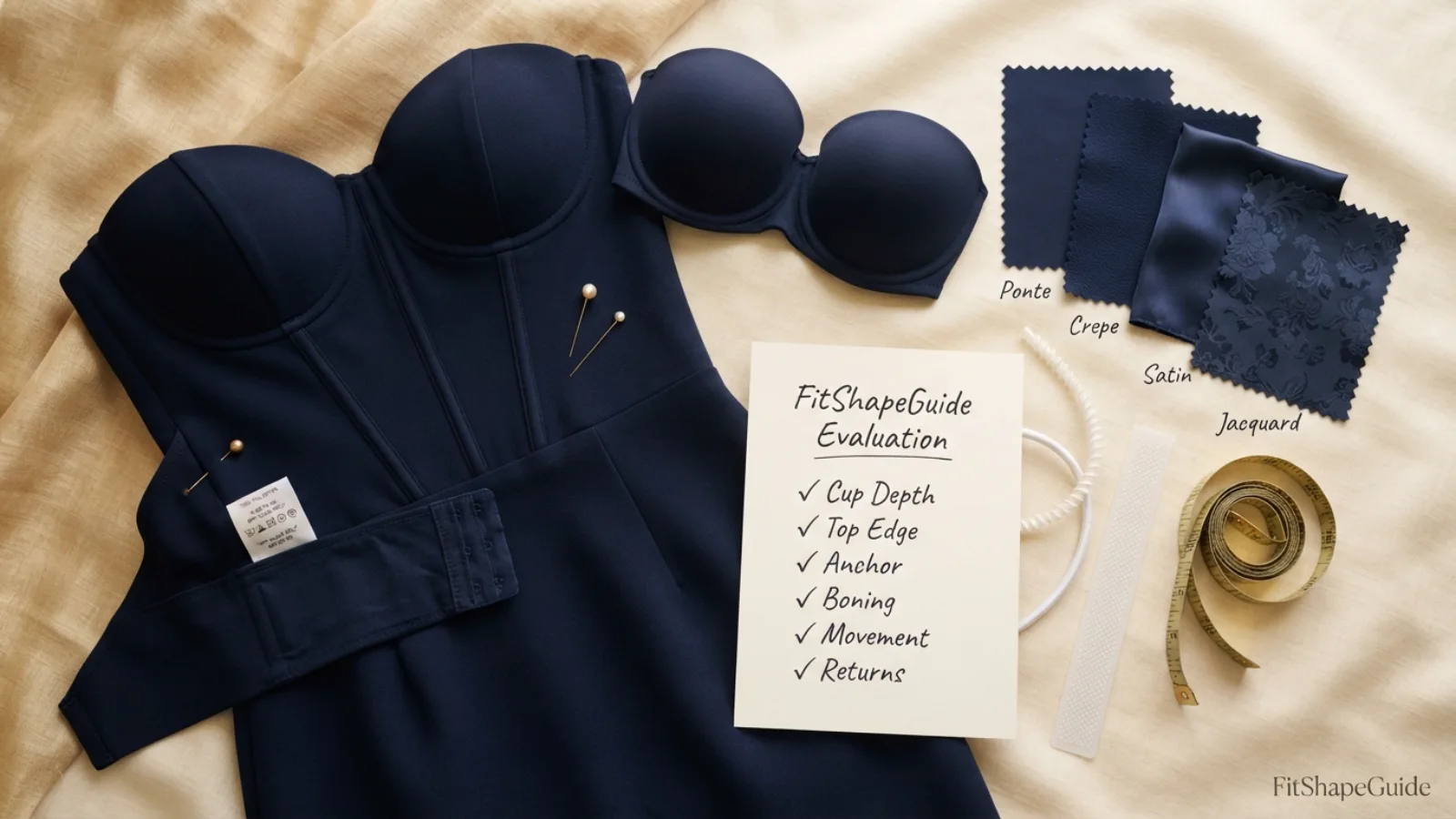
The best strapless dresses for a large bust combine shape with security
Start with construction: princess seams, long darts, stable edges, adequate front length and a lining that matches the shell. Then test the actual event movements—sitting, leaning, greeting, walking and dancing. The best strapless dresses for a large bust let the bodice do its job without constant adjustment, painful compression or dependence on styling tricks. A well-chosen dress should support the occasion and your preferences, not ask your body to compensate for a flat pattern.
Frequently asked questions
What strapless-dress style is best for a large bust?
Boned fit-and-flare, longline corset-seamed, structured ponte, stable-lined ruched mesh and formal A-line designs are strong starting points. The best style has enough cup depth, a close torso anchor, resilient top edge and comfortable breathing room.
Can a large bust wear a strapless dress?
Yes. A fuller bust can wear a strapless dress when its longline bodice is shaped and anchored correctly. Test rotation, deep breathing, sitting, self-hugging and raised arms. If it stays up only through severe compression or continual pulling, choose a better-engineered design.
Does a strapless dress need boning?
Not every design needs rigid boning, but most fuller-bust strapless dresses benefit from vertical structure such as flexible boning, firm panel seams or a longline inner layer. Structure prevents collapse; it still needs correct cup depth and ribcage fit.
Should I size up in strapless dresses for a large bust?
Size up if it restores cup depth, breathing room and a smooth zip while the ribcage and top edge can remain secure. If the larger size slides yet still flattens the bust, choose a pattern with more projection instead of continuing to size up.
What fabric is most secure for a fitted strapless dress?
Dense ponte and stable stretch crepe can offer useful movement and recovery, while woven satin, jacquard and formal crepe can work over a structured lining. No fabric replaces adequate pattern room, vertical support and a secure torso anchor.
How do I stop a strapless dress from sliding down?
First confirm that cup depth, underbust, ribcage and waist fit correctly. A waist stay, gripper tape or upper-back alteration may refine an already suitable bodice. Fashion tape cannot safely replace missing structure or make an oversized torso fit.
Which bra works under a strapless dress?
A well-fitted strapless or longline bra may work when its cup edges and back stay hidden. Some engineered dresses provide enough internal support without one. Adhesive cups can add coverage but do not support the dress itself; always test the complete combination.
How early should I buy a strapless dress before an event?
Allow time for a full movement try-on, exchange and alterations—ideally several weeks for an important event. Confirm the retailer’s return window and the alteration professional’s schedule before removing tags or changing the garment.