Best Structured Coats for a Large Bust
A construction-first guide to bust shaping, lapel control, button stance, shoulder structure, front balance, sweater layering, coat length and seated movement.
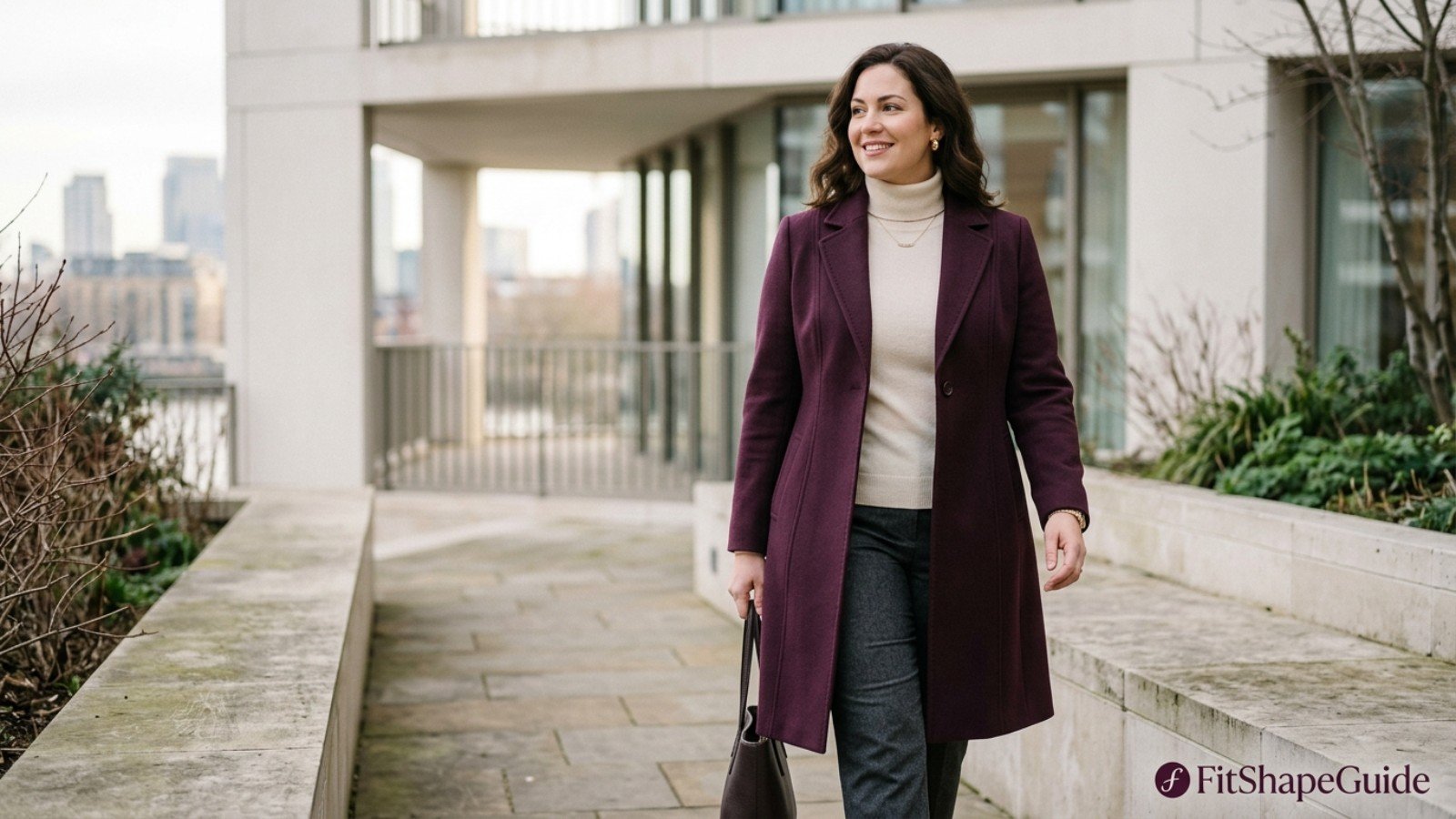
The 90-second structured-coat check
- Wear the exact bra, top and thickest likely sweater beneath the coat.
- Settle the coat from the shoulders before touching the closures.
- Fasten every intended button or hidden snap without pulling the sides.
- Check lapel roll, button strain, pocket flare and side-seam position.
- Cross the arms and reach forward as if driving or using a keyboard.
- Lift both arms, then confirm that the coat settles back into place.
- Sit for one minute and take several complete, comfortable breaths.
- Walk a long stride and verify that the hem, vent and lining move freely.
Best structured coats for a large bust by construction
“Structured” can describe crisp cloth, shoulder padding, tailored seams, internal canvas, a defined collar or simply a rigid silhouette. None of those details guarantees fuller-bust fit. The useful construction is the one that places volume where the chest needs it while keeping the shoulder, sleeve, closure and hem intentional.
Single-breasted princess-seam coat
Best for: targeted bust depth, a clean center front and the least closure bulk. Curved seams can shape from shoulder or armhole through the chest. Trade-off: poor seam placement can flatten or create a point, and one badly positioned button may carry too much strain.
Tailored A-line coat
Best for: a defined upper body with more sweep through waist, hip and stride. It can reduce lower-button strain and work over dresses. Trade-off: a sharply nipped waist may still pull beneath the bust, while a very full skirt adds visual and physical volume.
Double-breasted structured coat
Best for: generous front overlap, formal presence and multiple closure points when the pattern includes real chest depth. Trade-off: two button columns, wide facings and lapels add layers; a flat double-breasted front can buckle more visibly under strain.
Structured collarless coat
Best for: a quieter neckline, lower chest bulk and easy coordination with scarves or statement collars. Trade-off: it provides less neck protection, and a high round edge can press the throat if the front length or upper-back reach is insufficient.
Tailored cocoon or straight coat
Best for: deliberate volume that layers over the bust without a sharply defined waist. A controlled shoulder and tapered or straight hem keep the shape intentional. Trade-off: extra body room may look oversized over thin layers and can restrict stride if the hem narrows too much.
Structured belted trench coat
Best for: transitional weather, adjustable waist definition and a tailored collar with practical coverage. Trade-off: storm flaps, epaulettes, double layers and stiff water-resistant fabric may stack bulk; a belt cannot repair missing bust depth.
The best structured coats hold a clear line without asking the body to hold still. Start with the coat’s intended use, then compare its front shaping, closure system and shoulder. For a broader strategy, use how to dress a large bust.
Bust shaping, lapels and button stance
A structured woven coat usually stretches very little, so pattern shape must perform the work. Princess seams, darts and curved side-front panels create three-dimensional volume. A lining should follow that shape without pulling, and any internal canvas or facing should support the lapel rather than flatten the chest.
Princess seams and darts
Princess seams may begin at the shoulder or armhole and travel through the bust area. Their curve should follow the garment’s intended shaping without collapsing. A side or waist dart provides more localized depth. Both are useful evidence, but their placement matters: a seam that sits too far inward or a short dart that ends abruptly can create distortion rather than room.
Read the lapel break point
The lapel break is where the front folds into the lapel. If that point sits directly over high strain, the lapel may spring outward or bow. A lower break can create a longer open line, while a higher closure offers more upper-chest coverage. Neither is universally better. The successful version stays calm when closed and does not press the neckline. Compare neckline relationships in the necklines guide.
Match button stance to chest depth
A single button near the waist may anchor a shaped coat with less pressure than one directly across the fullest point. A longer row distributes closure but requires every button position to align. In a double-breasted coat, overlap provides more fabric only when the under-front reaches naturally; dragging it across shifts side seams and lapels. Decorative buttons do not count as functional anchors.
Inspect the front facing
The facing supports the front edge and lapel. If it is too rigid for the outer cloth or poorly joined to the lining, it may create a ridge over the chest. Let the coat hang open, then close it without smoothing. A well-balanced facing falls back into position rather than flipping outward.
| Construction detail | Useful evidence | Closure test | Trade-off |
|---|---|---|---|
| Princess seam | Curved volume through the front panel | Close without horizontal drag | Wrong curve placement can flatten or point |
| Side or waist dart | Localized depth in rigid fabric | Check that dart remains smooth while seated | Short or misplaced darts may distort |
| Single waist button | Low-strain anchor below the bust | Sit and breathe with it fastened | One point carries most closure load |
| Button-through front | Several aligned anchors and weather coverage | Fasten every intended button | More opportunities for gaping |
| Double-breasted closure | Natural overlap and stable inner anchor | Test both functional button rows | More facing, lapel and button bulk |
| Hidden snap or hook | Low-profile stabilization | Cross arms and check for release | Fixed placement may sit under strain |
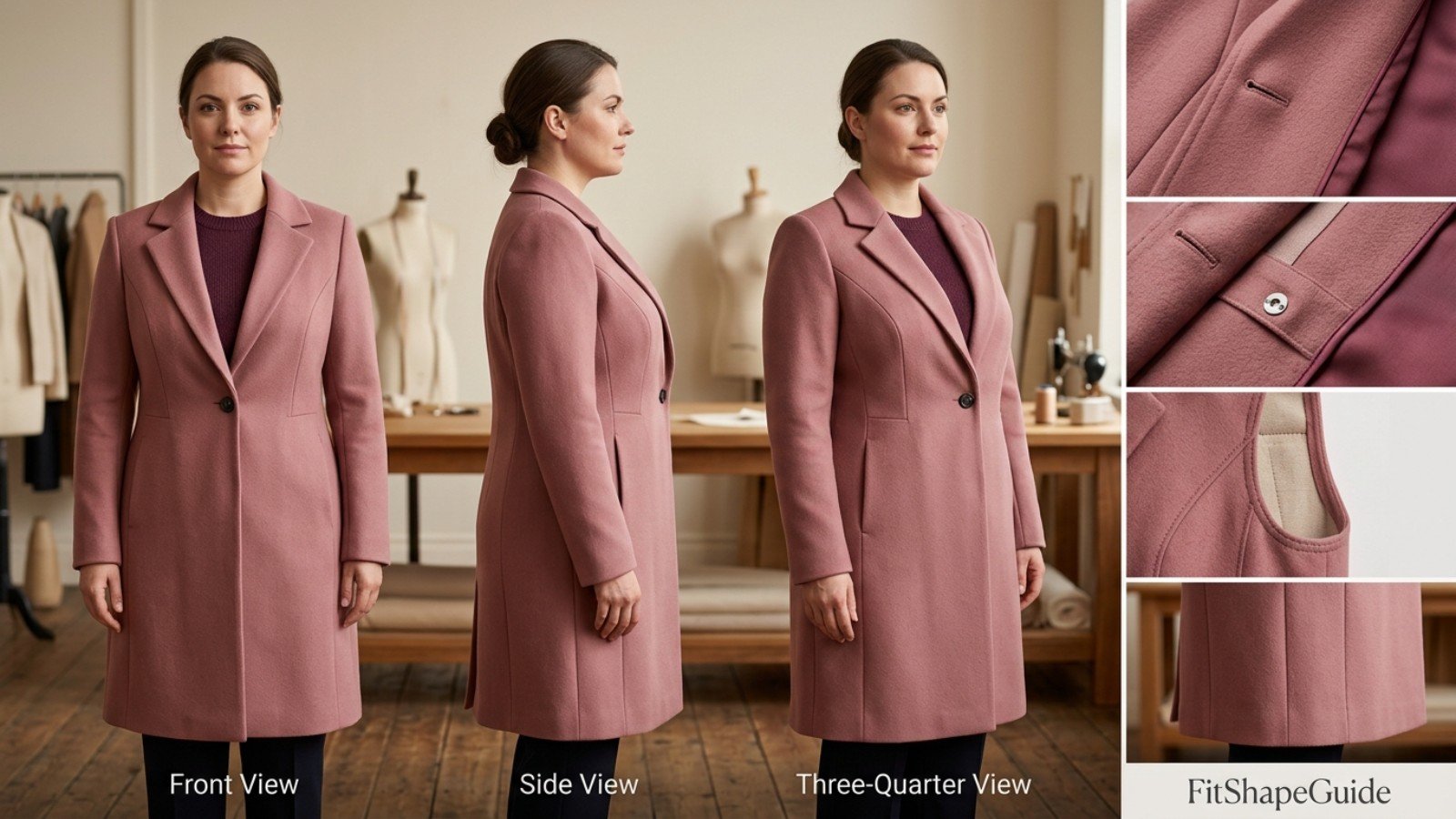
The best structured coats for a large bust close because the pattern contains chest volume—not because buttons force two flat panels together.
Shoulder structure, sleeves and upper-back movement
Shoulder pads, sleeve heads and canvas can create a polished outline, but too much width or stiffness makes the coat feel like armor. The shoulder should support the design while allowing the upper back to expand. Chest and back fit interact: a tight back pulls both fronts outward during reach.
Find the intended shoulder point
On a traditional set-in coat, the shoulder seam usually sits near the shoulder edge. A small pad may extend or square that line intentionally. Decide whether the design is classic, sharp or oversized before diagnosing placement. What matters is symmetry, smoothness and movement—not forcing every coat to the same seam position.
Check pad thickness and sleeve head
Light padding can prevent collapse and balance a larger lapel. Heavy padding adds width and may compete with a fuller chest. The sleeve head should enter the armhole smoothly without dents, peaks or bunching. If the pad floats above the shoulder or the sleeve twists when arms rest naturally, the structure is not following the wearer.
Test upper-back reach
Cross the arms as if hugging, reach toward a steering wheel and extend one arm forward at a time. Some tension is normal in firm coating, but the coat should not choke the neckline, pop a button or prevent the action. A center-back vent helps the hem, not the upper back; enough width and sleeve pitch are still required.
Evaluate upper arm and sleeve lining
A lined sleeve should slide over the planned sweater without gripping. Bend both elbows and rotate the forearms. If the outer sleeve feels roomy but the lining binds, the internal layer may be undersized or twisted. Tailoring can adjust some sleeve details, but significant upper-arm restriction usually calls for another cut.
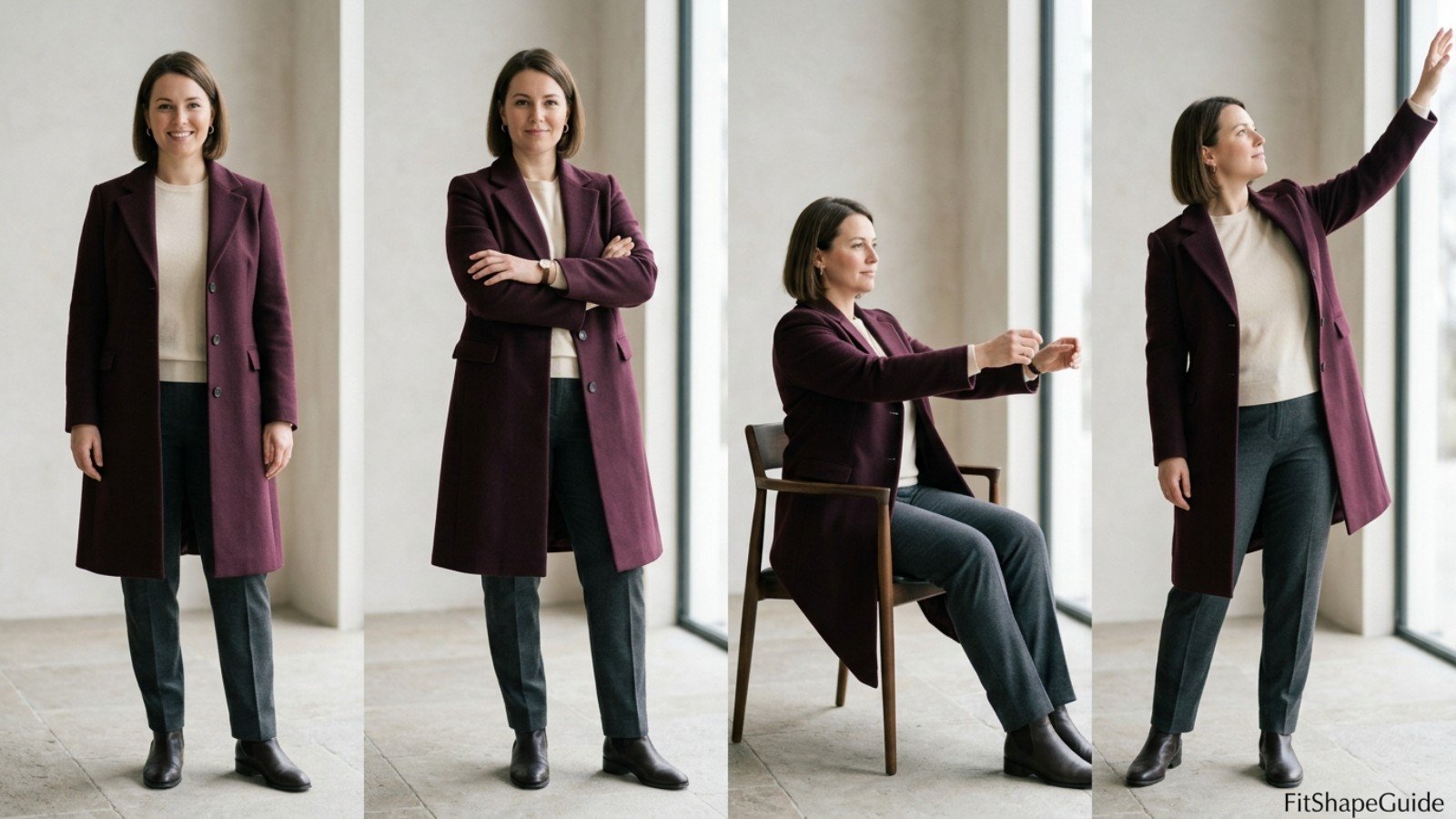
A structured coat can feel precise without feeling restrictive. If ordinary movement causes pain, numbness, restricted breath or repeated closure failure, stop and refit.
Coat length, silhouette and sweater layering
Length changes weight, stride, warmth and where front imbalance becomes visible. The coat also needs enough room for its real underlayer. Fitting over a thin T-shirt and later adding a chunky knit can alter the bust, armhole, sleeve and neckline simultaneously.
Hip and car-coat lengths
Shorter structured coats are easier for driving and frequent sitting. Their hem sits close to the hip or upper thigh, so insufficient front length is easy to see. Check that the front does not rise sharply over the bust or catch on a trouser waistband. A short double-breasted shape may concentrate many buttons and pockets in a small area.
Knee length
Knee-length tailoring offers more weather coverage without the management required by a calf-length hem. It works well with a back vent or adequate sweep. Sit on a chair and in a car-like position: the coat should arrange without driving the collar into the neck.
Midi and calf length
A long structured coat creates a continuous vertical line and greater coverage. It is also heavier, and rigid fabric may resist a long stride. Verify center-back length, vent depth and hem circumference. “Midi” is not a standard measurement; model height alone cannot predict where the hem will land.
Straight, A-line and cocoon shapes
A straight coat needs adequate room through chest, waist and hip. An A-line shape adds lower sweep after a more defined upper body. A cocoon shape deliberately adds mid-body volume and may taper at the hem. None is universally flattering. Choose according to movement, preferred proportion, pocket use and the outfit underneath.
| Layering plan | Structure to verify | Movement test | Trade-off |
|---|---|---|---|
| Fine-knit office layer | Precise shoulder, shaped chest, smooth lining | Reach for a bag and sit | Close fit may not accept thicker knits |
| Button-down shirt | Room for collar, placket and sleeve seams | Cross arms without double gaping | Two structured fronts can stack bulk |
| Chunky sweater | Deeper armhole, upper arm and upper-back ease | Lift elbows and reach forward | Coat may look loose over thin layers |
| Tailored dress | Lining slip and compatible waist/hem position | Sit without coat catching the dress | Two defined waists may conflict |
| Frequent driving | Shorter length, flexible vent and low-strain closure | Sit, rotate and reach controls | Less lower-body weather coverage |
| Long outdoor walks | Knee/midi length, hem sweep and secure buttons | Take stairs and a long stride | More weight and wind exposure at lapels |
Use the exact base layer during fitting. Compare adaptable options in the best tops guide and structured shirting in the button-down shirt guide.
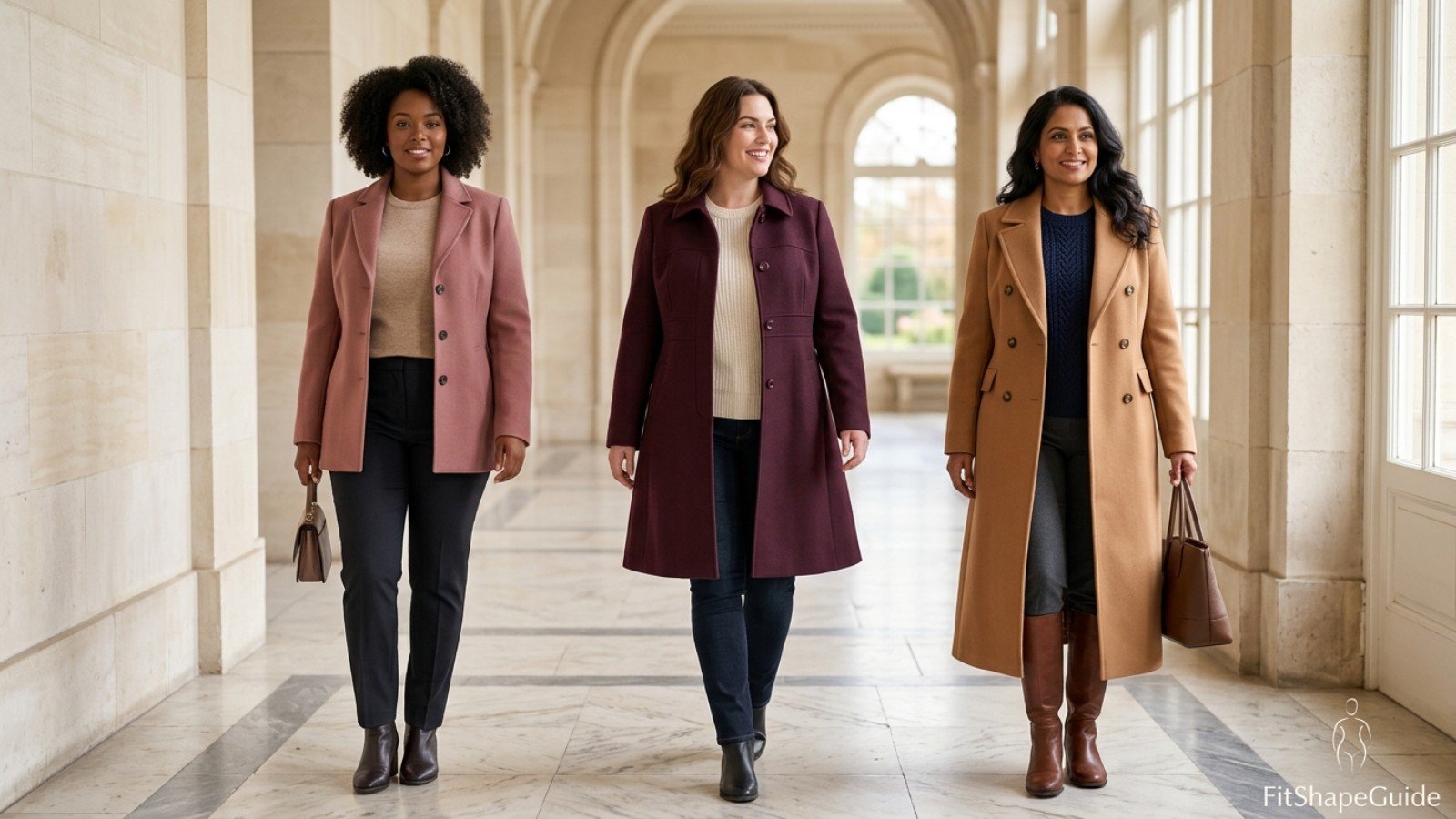
Fabric, lining, canvas, pockets and warmth
Structure can come from the outer cloth, internal canvas or fused interlining, shoulder pads, sleeve heads, facings, lining and seam placement. A coat does not need to be board-stiff to look tailored. In fact, excessive rigidity can magnify missing bust depth because the fabric cannot redistribute.
Wool and wool-blend coatings
Dense wool coating can hold a sharp lapel and block more airflow; softer double cloth creates gentler structure. Fiber percentage alone does not predict warmth. Weight, weave density, lining, seam construction, length, closure and the sweater beneath all contribute. A wool-rich coat can still be lightweight, while a blend may be substantial.
Canvas and fusible structure
Traditional tailored garments may use canvas through the front to shape lapels and support the chest. Some use partial or half-canvas construction; many use fusible interlining. These are construction methods, not automatic quality rankings for every wearer. The useful result is a front that returns to shape without bubbling, ridging or flattening.
Full, partial and sleeve lining
Full lining helps the coat slide over knits and protects internal construction. Partial lining reduces layers and may feel lighter. Sleeve lining is especially important when textured sweaters are planned. Inspect whether the lining pulls across the upper back, twists in the sleeve or hangs below the hem. A smooth outer coat with a tight lining is still a failed fit.
Lapels, collars and chest pockets
Wide lapels create a strong frame but add folded layers. A narrow notch, collarless edge or lower break can reduce surface bulk. Chest welt or flap pockets may sit directly over the fullest area and distort if the front is strained. Side welt or seam pockets often keep the chest quieter, though loaded pocket bags can pull the front downward.
Back vents and hems
A center vent supports stride and sitting in a straight or slim coat. Side vents add movement at the hip. Confirm whether temporary vent stitches should be removed after purchase. The hem should hang cleanly with the coat open and closed; a flared or twisted edge may indicate strain elsewhere.
Care and long-term shape
Follow the sewn-in care label for the exact coat. Structured fronts, pads, canvas and shaped lapels may need specialist cleaning. Empty pockets, close or support buttons according to the care instructions and use a broad, supportive hanger. Do not store the coat compressed beneath heavy garments because shoulder and lapel structure can distort.
If adjustable overlap matters more than a fixed tailored front, compare the wrap-coat fit guide. For a shorter professional layer, use the blazer fit guide.
How to shop online for a structured coat
A useful listing should show the coat open and closed from front, side and back. It should state fit category, closures, fabric, lining, pockets, vent, care and actual length. “Tailored,” “sharp” and “structured” are not standardized fit measurements.
Measure a known-good coat
Record flat chest width, shoulder width, upper arm, sleeve, waist, hip, center-back length and hem circumference. If possible, measure the front panel from side seam to center front at bust height; this helps distinguish targeted front room from general width. Compare over the same sweater thickness. Confirm whether the seller chart gives body or garment measurements.
Look for shaping evidence
Zoom in for princess seams, darts, curved panels, lapel break, shoulder seam, functional buttons, lining and vent. A model image can suggest proportion but cannot replace measurements. Note whether the coat is described as slim, classic, regular, relaxed or oversized, then verify what that brand means for the exact style.
Do not transfer assumptions between coats
Current official listings illustrate the variation: Burberry describes structured examples with double-breasted closures, A-line shaping, exaggerated lapels, full lining and padded shoulders, while Max Mara lists coats with straight cuts, low-set sleeves, partial lining and side slits. These details create different fit outcomes even when both products are called tailored wool coats.
Read reviews for observable evidence
Prioritize reviews that include body and garment measurements, purchased size, sweater thickness and a specific result: button strain, lapel lift, shoulder restriction, sleeve length, pocket placement, lining drag or front-hem rise. Ratings and “true to size” statements do not predict fuller-bust fit without this context.
Amazon verification workflow
Use only a direct live product-detail page after confirming the brand or authorized seller, exact variant, current chart, measurements, shaping seams, closure, fabric, lining, pockets, vent, care and return eligibility. Never publish a search-results URL. Do not hard-code changing prices, coupons, ratings, review counts, stock claims or delivery promises into evergreen copy. Place the affiliate disclosure close to recommendations.
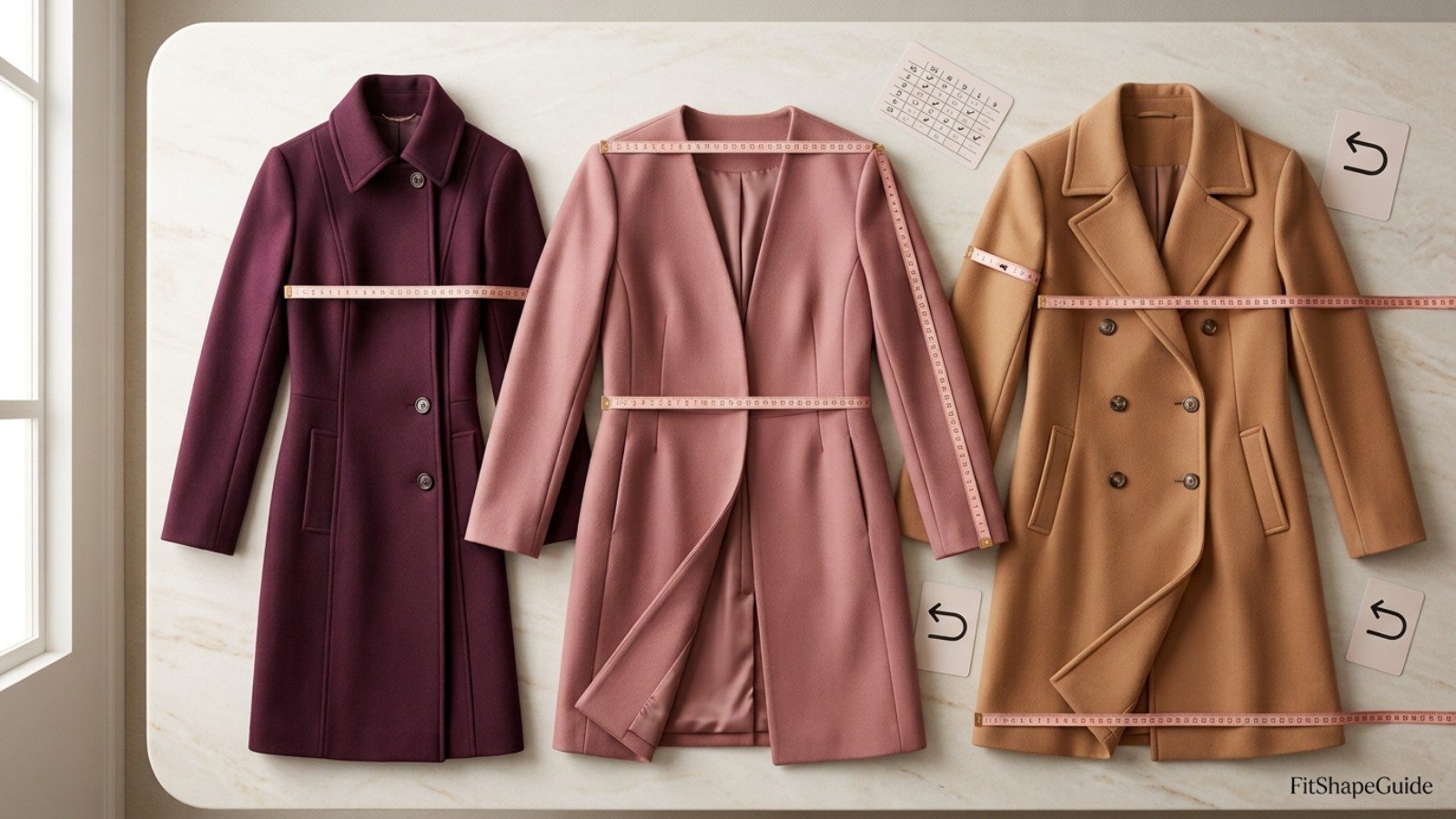
Listings for the best structured coats for a large bust make shaping, closure and layering evidence visible before checkout.
Common structured-coat fit problems
| Symptom | Likely cause | Better next step |
|---|---|---|
| Lapels spring or buckle | Insufficient chest depth, wrong break point or rigid facing | Choose more shaping and a compatible lapel stance |
| Buttons pull into X-shaped folds | Flat front or closure placed across high strain | Try princess seams, darts or a lower-strain button position |
| Front hem rises sharply | Missing front length or chest depth | Choose a shaped or deliberately longer front |
| Neckline presses the throat | Chest or upper-back tension pulls coat upward | Add front depth and reach; stop if breath is restricted |
| Shoulders drop after sizing up | Global width added without targeted bust room | Choose a better-shaped front or intentional relaxed cut |
| Sleeve lining binds | Internal sleeve is narrow or twisted | Test another coat or have a tailor assess the lining |
| Pockets flare open | Front strain or pocket placed across a curved area | Choose lower-profile placement and more panel depth |
| Long coat restricts stride | Narrow hem, closed vent or rigid cloth | Open intended vent or choose more sweep/shorter length |
Do not size up automatically
A larger size may close over the bust but create dropped shoulders, long sleeves, a loose waist and misplaced pockets. Diagnose where the missing room occurs. Targeted chest depth, upper-back ease or upper-arm room often solves the actual problem more cleanly.
Do not judge the coat only while open
If the design has functional closures, test them all. Wearing a strained coat open may hide insufficient front depth, while closing it reveals the intended structure. An open-front style is a separate construction and should still hang vertically.
Do not blame the body for distorted tailoring
The best structured coats for a large bust account for three-dimensional front volume. Pulled buttons, flipped lapels and a rising hem are garment evidence—not body failures. Choose the construction that supports ordinary breath and movement.
Choose shaped structure, not restrictive stiffness
The best structured coats for a large bust combine targeted front depth, a calm lapel, low-strain closures, stable shoulders, upper-back reach and lining that moves over the intended sweater. Start with a single-breasted princess-seam coat for clean shaping, an A-line coat for lower sweep, or a properly cut double-breasted coat for formal overlap. Keep the coat that remains balanced while fastened, reaching and seated.
Frequently asked questions
These answers explain how the best structured coats for a large bust should shape, close and move.
What structured coat style is best for a large bust?
A single-breasted coat with princess seams is a strong starting point because it creates targeted chest depth with less lapel and closure bulk.
Can a large bust wear a double-breasted coat?
Yes. Choose natural front overlap, enough chest depth, compatible button placement and shoulders that remain balanced when every functional button is closed.
Are princess seams useful in a structured coat?
They can be very useful because curved panels add three-dimensional front volume, provided the seam placement follows the garment’s intended bust shaping.
Where should a structured coat button sit?
There is no universal position. The best button stance closes without strain, keeps the lapels smooth and remains comfortable while sitting and breathing.
Why do coat lapels spring open over the bust?
Common causes include insufficient chest depth, an incompatible lapel break point, a rigid facing or a closure placed under excessive strain.
Should a structured coat have shoulder pads?
Light padding can support a clean shoulder and balance the lapel, but it should follow the wearer without floating, adding excessive width or restricting reach.
Should I size up in a structured coat?
Only if the shoulders, sleeves, waist and pockets remain intentional. A different cut with targeted front depth is often better than extra width everywhere.
How do I test a structured coat before keeping it?
Wear the thickest planned layer, close every fastening, cross and raise the arms, reach forward, sit, breathe fully, walk and inspect lapel and hem balance.
Editorial and verification standards
This guide evaluates observable construction: front-panel depth, princess seams, darts, lapel roll, button stance, shoulder and sleeve structure, lining, length, hem, pockets, vents, fabric, care and returns. It recommends coat constructions rather than inventing products or universal fit promises.
Current construction examples were checked against official Burberry pages for a double-breasted A-line wool tailored coat and a half-canvas set-in-sleeve tailored jacket, plus an official Max Mara page for a partially lined double-breasted wool coat. These sources illustrate why “structured” can involve different silhouettes, lapels, shoulders, linings and closures.
Before publishing a product module, verify the direct live seller, measurements, shaping, closures, fabric, lining, pockets, vent, care and returns. Affiliate relationships should be disclosed clearly and close to recommendations under the FTC endorsement guidance.
“Best” means a suitable verified coat for an individual body, sweater, climate, movement needs and styling preference—not a guarantee that one silhouette works for everyone.