Best Button-Down Shirts for a Large Bust
The right shirt is not simply “stretchy” or one size larger. It has enough room where the pattern needs it, a placket that stays stable, and seams that shape the fabric without turning the rest of the shirt into a tent.
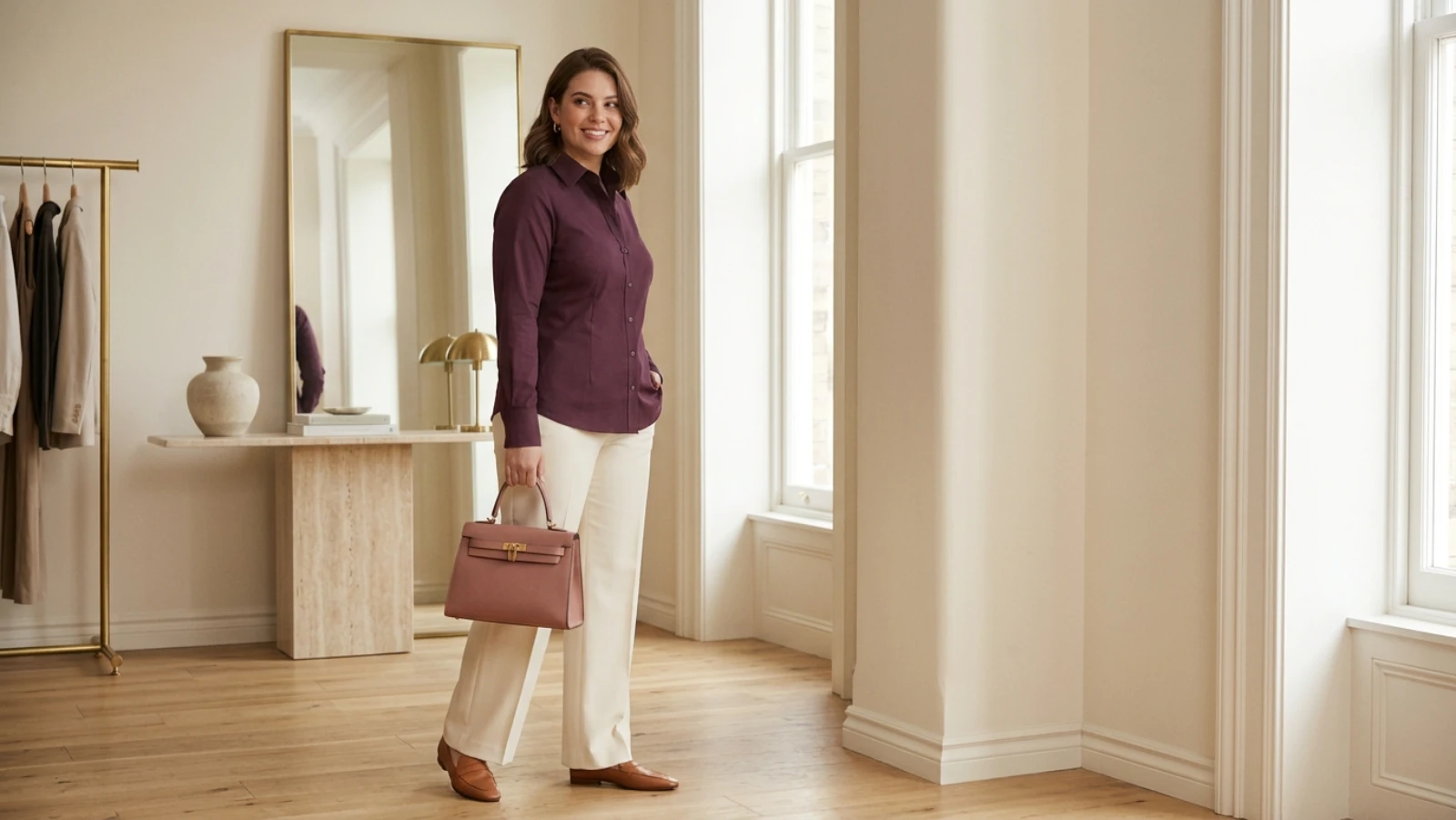
A button-down can look perfectly calm on the hanger and change the moment it is fastened. The buttons pull sideways, the collar shifts back, the front hem lifts, or the shoulders become too wide after sizing up. Those are pattern and construction problems, not evidence that button-down shirts are off-limits. The best button-down shirts for a large bust combine targeted bust room with a reinforced front, useful shaping, and fabric that recovers after movement. That might be a darted stretch-poplin shirt for the office, a princess-seam style for a defined waist, or a fluid button-up for travel. The label matters less than the engineering.
Quick answer
Choose a button-down with visible bust shaping, about enough garment ease to sit and reach without horizontal strain, a firm or concealed placket, and fabric that balances drape with recovery. The strongest all-purpose choice is usually a semi-fitted shirt with bust darts or princess seams, a small amount of elastane, and buttons positioned at—and just above—the fullest part of the bust. Size for the bust and shoulders first, then tailor excess at the waist only when the shirt’s seams allow it.
Five details worth checking first
- A flat placket while standing is not enough; it must remain flat while sitting, reaching, and taking a full breath.
- Bust darts should point toward the fullest area without ending directly on it or sitting noticeably above or below it.
- A little stretch helps with movement, but high stretch cannot rescue a shirt that lacks sufficient pattern room.
- Shoulder seams should end near the shoulder edge; sizing up until the chest closes often makes the entire shirt look borrowed.
- Hidden internal buttons, close button spacing, and proper placket interfacing are more reliable than fashion tape as a permanent solution.
What makes the best button-down shirts for a large bust different?
Product roundups often treat every button-down as the same object in different colors. They are not. A straight-cut men’s-inspired oxford, a fitted darted shirt, a soft viscose blouse, and a princess-seam work shirt distribute fabric in completely different ways. The useful shopping question is not “Which brand is best?” but “Which pattern solves the fit problem I actually have?”
It keeps the recognizable crisp-shirt look while giving the bust controlled room. Choose a matte, medium-weight fabric with modest stretch. The trade-off is that very crisp poplin can still show tension lines if the dart or button placement is wrong.
Long vertical seams create volume over the bust and remove it below, so the shirt can fit without a boxy waist. The trade-off is precision: misplaced curves are harder to alter than ordinary side seams.
A softly draped shirt tolerates sitting and movement and is less likely to form sharp radiating creases. The trade-off is a less traditional, less structured office appearance.
A shorter curved hem reduces bunching and prevents the front from visually extending too low. The trade-off is less tucking length, especially with low-rise trousers.
| Shirt construction | Best use | Why it can work | Check before buying |
|---|---|---|---|
| Darted stretch poplin | Office and smart casual | Combines a crisp finish with targeted shaping and movement | Dart height, button position, and whether the fabric turns shiny when stretched |
| Princess-seam shirt | Defined, tailored silhouette | Adds room through curved vertical seams instead of overall width | The seam’s fullest curve must align with the bust rather than the upper chest |
| Hidden-placket shirt | Minimal workwear | A second fabric layer helps conceal closures and visually quiet the front | The concealed layer should lie flat, not roll or add a stiff ridge |
| Fluid button-up | Travel, dinners, relaxed offices | Drape softens small fit fluctuations and moves without sharp pulling | Opacity, static cling, and whether the front edge collapses between buttons |
| Jersey-knit button shirt | Comfort-first days | Knit movement reduces restriction across the chest and upper back | Recovery; weak knit can grow during the day and make the placket wavy |
| Relaxed oxford | Layering and casual wear | Deliberate volume makes extra ease look intentional | Shoulder width and front hem lift; oversized should not mean misaligned |
The placket is the load-bearing part of the shirt
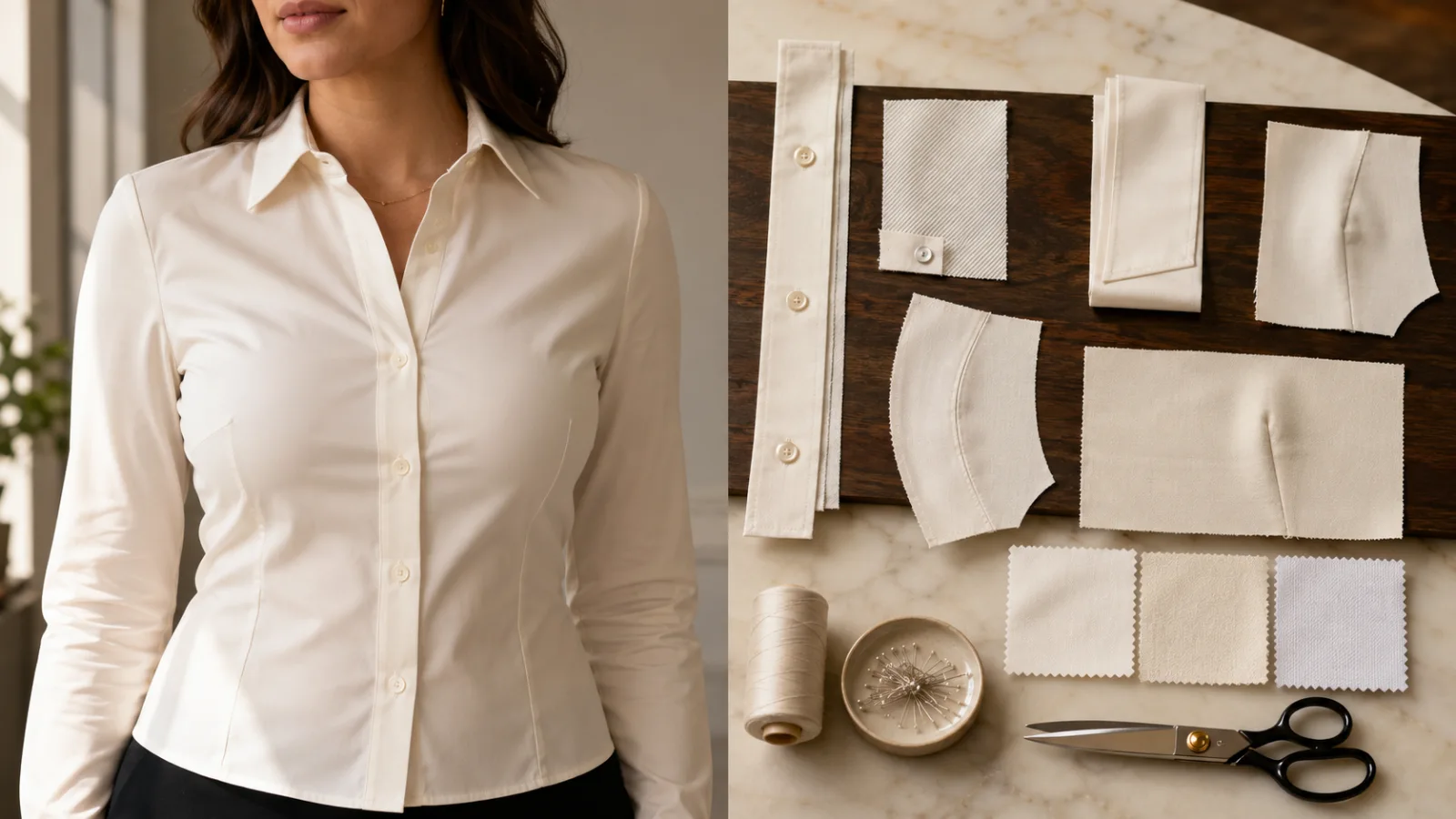
The vertical band holding the buttons and buttonholes is called the placket. On a fuller bust, it is not merely decorative finishing; it is the structure resisting horizontal pull. If the placket is flimsy, widely buttoned, or cut off-grain, the front can ripple even when the shirt technically has enough circumference.
Look for stability without cardboard stiffness
A good placket usually contains interfacing, a hidden internal layer that supports the fabric. Press the placket gently between two fingers. It should feel more stable than the shirt body, yet still bend naturally. An under-supported placket twists around each button. An excessively stiff one can stand away from the chest and create a shelf-like edge. Medium support is the useful middle ground.
Button spacing matters just as much. One button should sit close to the fullest horizontal line of the bust, with another reasonably close above it. If the fullest point falls exactly halfway through an unusually wide gap, the fabric has no closure where the pressure is highest. A concealed snap or an internal “modesty button” can solve that local weakness without changing the visible design.
Before trying the shirt on, hold the placket vertically and give the two sides a light diagonal tug. If the band corkscrews, the buttonholes stretch open, or the fabric turns visibly shiny under mild tension, it is unlikely to become more stable during a full day of wear.
Hidden plackets are helpful, but not automatically gap-proof
A hidden placket places the visible front over a concealed row of buttons. This can disguise minor separation and creates a clean, uninterrupted line. It does not create extra bust room. If the shirt is too small, the cover layer may flip, curl, or reveal the buttons beneath. Treat hidden construction as reinforcement, not permission to buy a smaller fit.
Double-breasted fashion shirts and decorative covered buttons can be less forgiving because the closure placement is fixed by the design. If the style relies on a single hook, loop, or low tie near the bust, move through your normal range of motion before trusting it. Attractive hardware is not a substitute for distributed closure strength.
Bust ease should come from the pattern, not a desperate size-up
Bust ease is the difference between the garment’s internal circumference and the space the body occupies. A close shirt needs enough ease for breathing and movement; a relaxed shirt needs more because looseness is part of its design. There is no universal number that works across every fabric, cut, and support layer. A stiff woven needs more room than a resilient knit, and a fitted office shirt needs the room placed more precisely than an oversized weekend oxford.
The practical approach is to compare the new shirt with a shirt that already fits. Button the reference shirt, lay it flat without stretching, and measure straight across at the fullest bust level. Double that measurement for the approximate garment circumference. Also record shoulder width, back length, and the distance from shoulder seam to bust dart. These garment measurements are often more useful than relying on a retailer’s body-size chart alone.
Darts must create depth in the correct place
A bust dart is a stitched wedge, usually entering from the side seam. Its tip should point toward the fullest area but stop short of it. If the dart ends too high, the lower bust can pull the shirt forward while loose fabric sits above. If it ends too low, the upper front may collapse and the shirt can look dragged downward. A dart that is slightly long may sometimes be shortened; moving the entire dart is a more involved alteration.
Princess seams offer a different solution. They run vertically through the front and curve to build three-dimensional volume. They are especially effective when the bust and waist require noticeably different amounts of room because shaping is spread along a longer line. Their trade-off is that seam placement becomes visually obvious when it misses the correct curve. Examine the shirt from the front and side, not only in a mirror straight on.
Do not sacrifice the shoulders to close the chest
If the next size closes comfortably but the shoulder seams drop onto the upper arm, the collar floats, and the cuffs cover the hands, the larger shirt is solving one area by misfitting several others. A deliberately dropped shoulder can look good in a relaxed shirt; an accidental dropped shoulder in a tailored shirt makes the whole garment collapse.
This is where a fuller-bust-specific cut earns its value. It adds front depth without increasing every dimension equally. If that cut is unavailable, choose the size that fits the bust and upper back with the least shoulder compromise, then assess whether the waist and sleeves are simple to alter. For a deeper explanation of fixing excess fabric without losing bust room, use the large-bust tailoring guide.
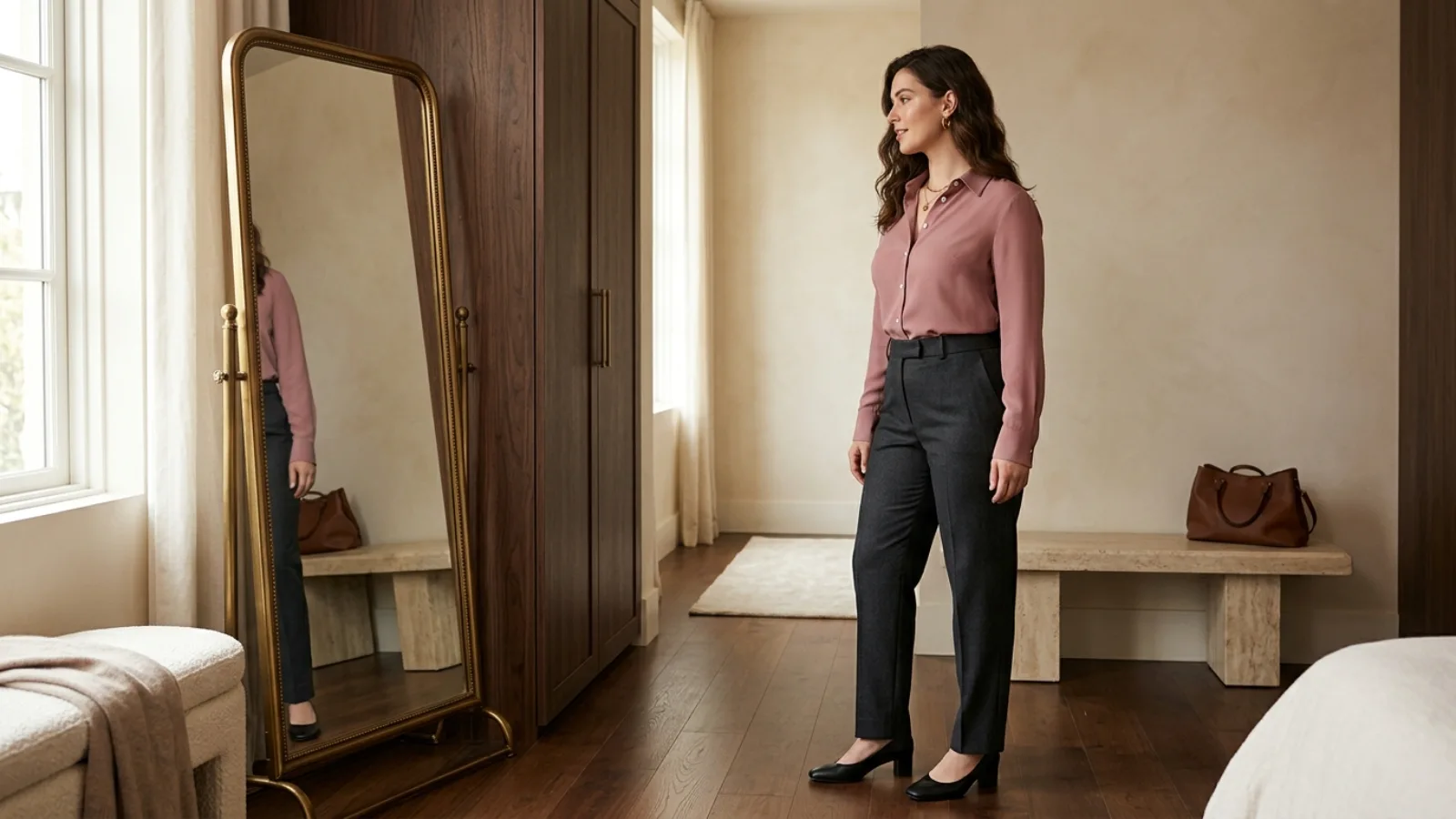
Choose fabric for recovery, opacity, and the level of structure you want
“Stretch” is one of the most overused promises in shirt descriptions. Stretch tells you that the fabric expands; recovery tells you whether it returns to shape. A shirt with plenty of stretch but weak recovery can become longer across the front, develop a scalloped placket, and feel less secure by afternoon. Pinch a discreet section, extend it gently, then release it. The fabric should return quickly without a softened bubble.
Stretch poplin: crisp with controlled forgiveness
Cotton poplin blended with a small amount of elastane is a strong office option because it keeps the familiar smooth surface while allowing movement. Medium-weight poplin is usually more forgiving than paper-thin cloth, which may turn translucent or show every line where it strains. The trade-off is wrinkle visibility and the risk of a shiny stretched area in lower-quality blends.
Viscose twill and crepe: drape instead of rigidity
Fluid woven fabrics fall around projection rather than forming hard folds. They are useful for travel, dinners, and workplaces where a softer blouse reads appropriately polished. Choose a fabric with enough substance that the placket does not collapse. The trade-off is that slippery fabrics can creep at the seams, and some require gentler washing or steaming.
Oxford cloth: excellent only when the cut allows room
Oxford cloth has body, texture, and casual authority. It does not disguise insufficient ease. In a relaxed cut, that structure makes the silhouette intentional and layers well over a fitted tank. In a narrow cut, the same structure broadcasts every tension line. Choose an oxford for ease and layering, not because thick fabric will somehow hold a too-tight front closed.
Linen and linen blends: breathable, visibly relaxed
Linen can be excellent when wrinkles, softness, and a less formal finish suit the outfit. A linen-viscose or linen-cotton blend may drape more predictably than pure crisp linen. Check the weave density by holding the garment toward light; an open weave can reveal strain around buttons more clearly. For a broader explanation of material behavior, compare the options in the fabric guide for a large bust.
Look inside the shirt at the bust level. If the front is lined or doubled only around the placket, make sure the layers move together. A loose inner layer can bunch even when the outside looks smooth on the hanger.
Match the shirt to the job it must perform
A “best” shirt for an eight-hour office day is not automatically the best shirt for a flight, a layered winter outfit, or weekend errands. Start with the movement, dress code, and maintenance you expect. Then choose construction.
Choose darts, stable poplin, and a medium collar
A semi-fitted stretch-poplin shirt with side darts gives the cleanest bridge between tailoring and comfort. A medium-scale collar tends to sit more steadily than a tiny collar on a substantial shirt front, while an exaggerated collar may add bulk beneath a blazer. Test the shirt under the exact jacket you plan to wear; armhole tightness often appears only after layering.
Choose soft drape, a concealed closure, and a curved hem
A fluid twill or crepe shirt is less likely to hold deep sitting creases. A hidden internal snap at the bust adds security when reaching for luggage, and a curved hem works tucked, half-tucked, or loose. Avoid very long rigid tails if you have a shorter torso; they can bunch at the hip and push the front upward.
Choose an intentional relaxed oxford
Wear it open over a close-fitting base or buttoned with generous ease. The visual success comes from clear design signals: a dropped shoulder that is deliberate, a straight or curved hem that hangs evenly, and sleeves that can be rolled without pulling the upper arm. “Oversized” should still have a coherent shoulder line and a front that hangs vertically.
Choose princess seams or back shaping
Vertical front seams build room through the bust while narrowing below it. Back darts or a shaped center-back seam can remove excess without disturbing the placket. Avoid aggressive waist ties positioned directly under a strained front; they can pull the shirt backward and increase separation between buttons.
Read the wrinkles: they reveal what the shirt needs
A fitting-room mirror shows the result, but wrinkle direction often reveals the cause. Do not judge only from one still pose. Button the shirt over your normal support layer, let the fabric settle, then stand naturally before checking the front, side, shoulders, and back.
| What you see | Likely cause | Best next move |
|---|---|---|
| Horizontal lines radiating from one button | Too little ease or no closure at the point of highest pull | Try a fuller-bust cut or larger bust measurement; add a hidden snap only if the shirt otherwise fits |
| Front hem rises while the back hangs low | The front length or three-dimensional depth is insufficient | Choose a shaped shirt with extra front length or deeper darts; sizing up alone may not level it |
| Loose fabric above the bust with pulling below | Bust dart or princess-seam curve sits too high | Try a different cut; moving the shaping is usually more work than a simple waist alteration |
| Collar moves backward or throat feels tight | The front is borrowing length and pulling the neckline backward | Look for more front length and bust depth rather than a wider neck |
| Shoulder seam drops after sizing up | Standard grading added width everywhere | Choose targeted bust shaping or plan a substantial shoulder alteration |
| Placket edge curls despite adequate room | Weak interfacing, off-grain cutting, or poor recovery | Choose a better-supported placket; extra size will not correct unstable construction |
If the only issue is a small gap and every seam, hem, and shoulder sits correctly, a hidden snap may be sensible. If several symptoms appear together, the shirt needs a different cut. The complete button-gaping guide separates quick fixes from pattern problems in more detail.
Check the shirt standing, sitting, reaching forward, lifting both arms to shoulder height, and crossing your arms. A useful fit does not need to remain perfectly motionless, but the placket should return flat, the collar should settle back into place, and the cuffs should not drag sharply up the forearm.
How to shop online without trusting the product photo
Product photography can hide the exact information a fuller-bust shopper needs. The model may wear the shirt open, half-tucked, pinned at the back, or photographed from a single angle. Read the garment page like a technical sheet instead.
- Find garment measurements. Prefer an actual finished-garment bust measurement over a chart that lists only body measurements.
- Read the fabric composition. Note fiber, stretch content, lining, and whether the retailer calls the material rigid, structured, fluid, or fitted.
- Zoom into the side seam. Look for a bust dart, princess seam, panel, pleat, or other evidence that depth was drafted into the front.
- Count buttons near the bust. Wide spacing is a risk when no button or snap aligns with the fullest point.
- Check front and back lengths. Extra front length or a curved hem can prevent the shirt from looking shorter in front.
- Study the shoulder. A seam beyond the shoulder may be intentional in a relaxed cut; in a fitted cut it signals a size or grading mismatch.
- Inspect the care instructions. A high-maintenance shirt is poor value if it will sit unworn because laundering is impractical.
- Confirm the return route. Fit cannot be proven by composition and measurements alone; movement still needs a real try-on.
Reviews can help only when they describe the garment rather than assign a vague star rating. Useful comments mention fabric transparency, button spacing, sleeve width, shoulder fit, shrinkage, or whether the shirt measurements match the listing. Ignore unsupported claims that a style “runs perfect for everyone.” Fit is produced by the relationship between a particular pattern and a particular wearer.
Use your best shirt as a private size chart
Record six measurements from a shirt you already enjoy: flat bust width, shoulder width, front length, back length, upper-arm width, and sleeve length. When a retailer supplies equivalent garment measurements, compare them directly. When it supplies only body measurements, contact the retailer rather than assuming the listed size includes a certain amount of ease.
Do not pull the reference shirt flat enough to stretch it while measuring. Smooth it gently and keep the placket buttoned. For darts and seams, also measure vertically from the shoulder seam to the point where the shaping is fullest. That extra measurement explains why two shirts with the same circumference can fit completely differently.
Buy the hard-to-alter areas correctly; tailor the easy excess
Tailoring is most effective when the shirt already fits the bust, upper back, armholes, and shoulders. Excess at the waist or sleeve length is usually more straightforward than creating missing fabric across the front. This is why “size for the bust, then tailor” can be good advice—but only after checking that the larger size has not moved the shoulder and armhole too far out of position.
Alterations that are often reasonable
Taking in the side seams below the bust, adding or deepening back darts, shortening a straight sleeve, refining the waist, or adding a hidden snap can turn an almost-right shirt into a reliable one. The tailor needs enough seam allowance and must preserve balance between the front and back. A dramatic waist reduction can make side seams swing forward, so shaping may need to be shared between side seams and back darts.
Alterations that may cost more than the shirt deserves
Rebuilding shoulders, lowering an entire armhole, moving complex princess seams, replacing a badly warped placket, or adding substantial front width are structural jobs. They can be worthwhile for a treasured or high-quality garment, but they are not sensible rescue plans for every inexpensive shirt. Evaluate fabric quality, seam allowance, and expected wear before paying for major reconstruction.
A tailor can also add a tiny internal loop-and-button system where a metal snap would show through delicate fabric. This is a particularly useful detail for silk-like shirts. The closure should support the placket without pulling one layer out of alignment. Ask for the shirt to be pinned while worn over the support layer you normally use.
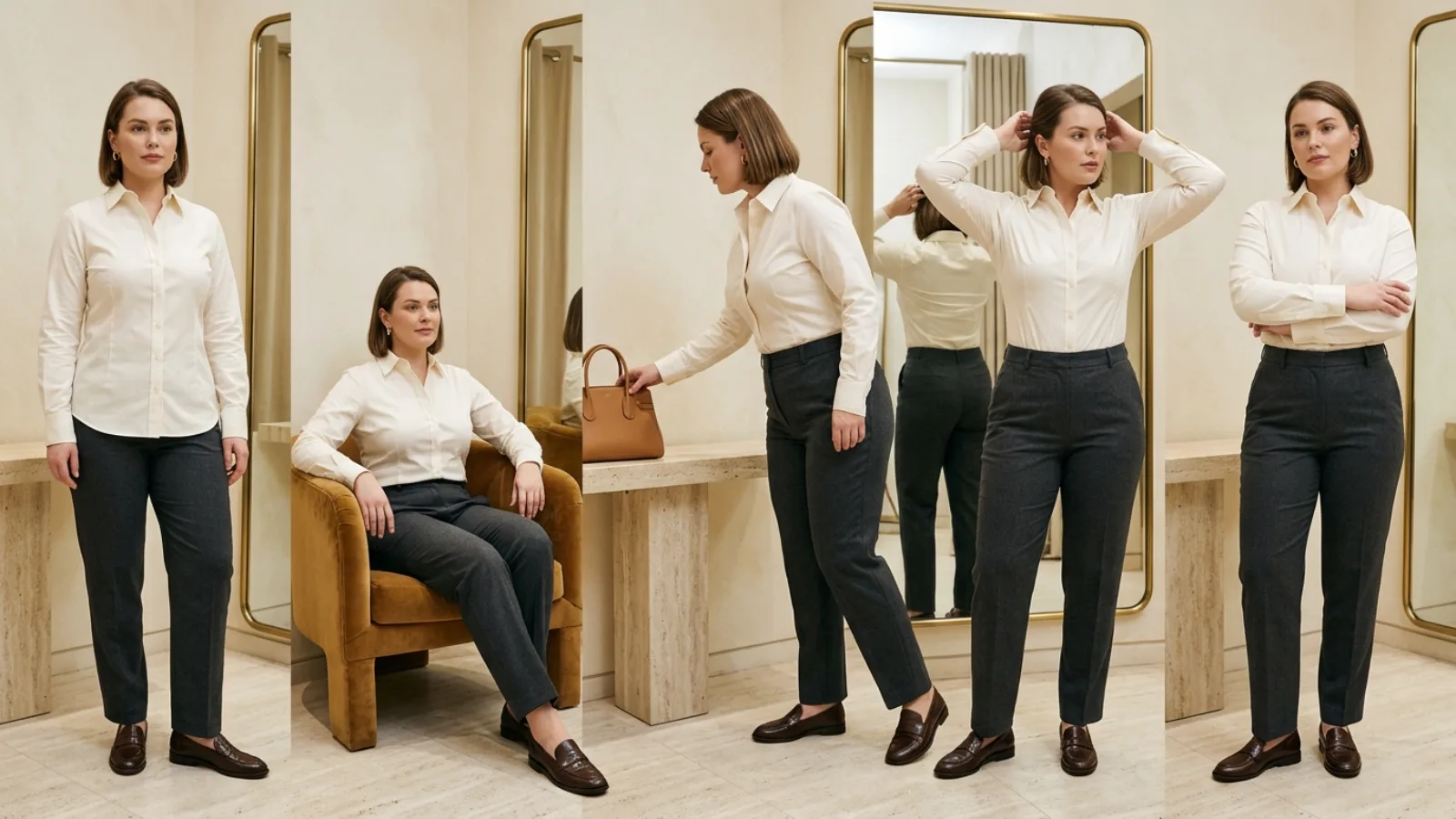
Style the shirt so its construction remains visible
Once a shirt fits, styling should support its line rather than compensate for tension. The clearest outfits repeat one idea: crisp with crisp, fluid with fluid, or relaxed with deliberately relaxed. That makes ease look chosen.
For the office: darted shirt, high-rise trouser, open blazer
Use a semi-fitted stretch-poplin shirt tucked into a high-rise straight or wide-leg trouser. Leave the blazer open so its vertical edges frame rather than compress the shirt front. A medium V created by the open collar lengthens the central line without requiring a low neckline. If you want more neckline-specific options, see the best necklines for a large bust.
For polished weekends: fluid shirt, straight denim, short front tuck
A fluid button-up can be tucked only at the center front, with enough fabric released at the sides to keep the placket vertical. The goal is not to pull the shirt tight into the waistband. Pair it with straight denim and a shoe with visual weight, such as a loafer or streamlined sneaker. The trade-off is that a very slippery shirt may work loose and need retucking.
For layering: relaxed oxford, fitted base, open vertical front
Wear a relaxed oxford open over a close-fitting, opaque tank. Roll the sleeves to show wrist or forearm and keep the hem loose. The open edges create strong vertical lines, while the fitted base prevents the outfit from becoming shapeless. This is also a useful way to wear a shirt with generous bust room when the weather does not require it to be fully closed.
For evening: soft shirt, tonal bottom, deliberate collar opening
Choose a fluid, opaque shirt in a deeper solid color and pair it with a tonal skirt or trouser. Open the collar only to the point where it lies flat; forcing a higher closure can push the collar backward, while opening too far may cause the front edge to collapse. A short necklace sitting above the opening or a longer pendant below the bust can finish the line without crowding the placket.
Print and color can change emphasis, but they cannot correct fit. If you prefer a quieter chest area, medium-scale prints, matte finishes, and continuous tonal dressing tend to keep the eye moving. If you enjoy bold stripes or contrast buttons, wear them—the important test is whether lines stay deliberate rather than bending around strain. The main large-bust styling guide explains how garment lines, proportion, and layering work together across an entire wardrobe.
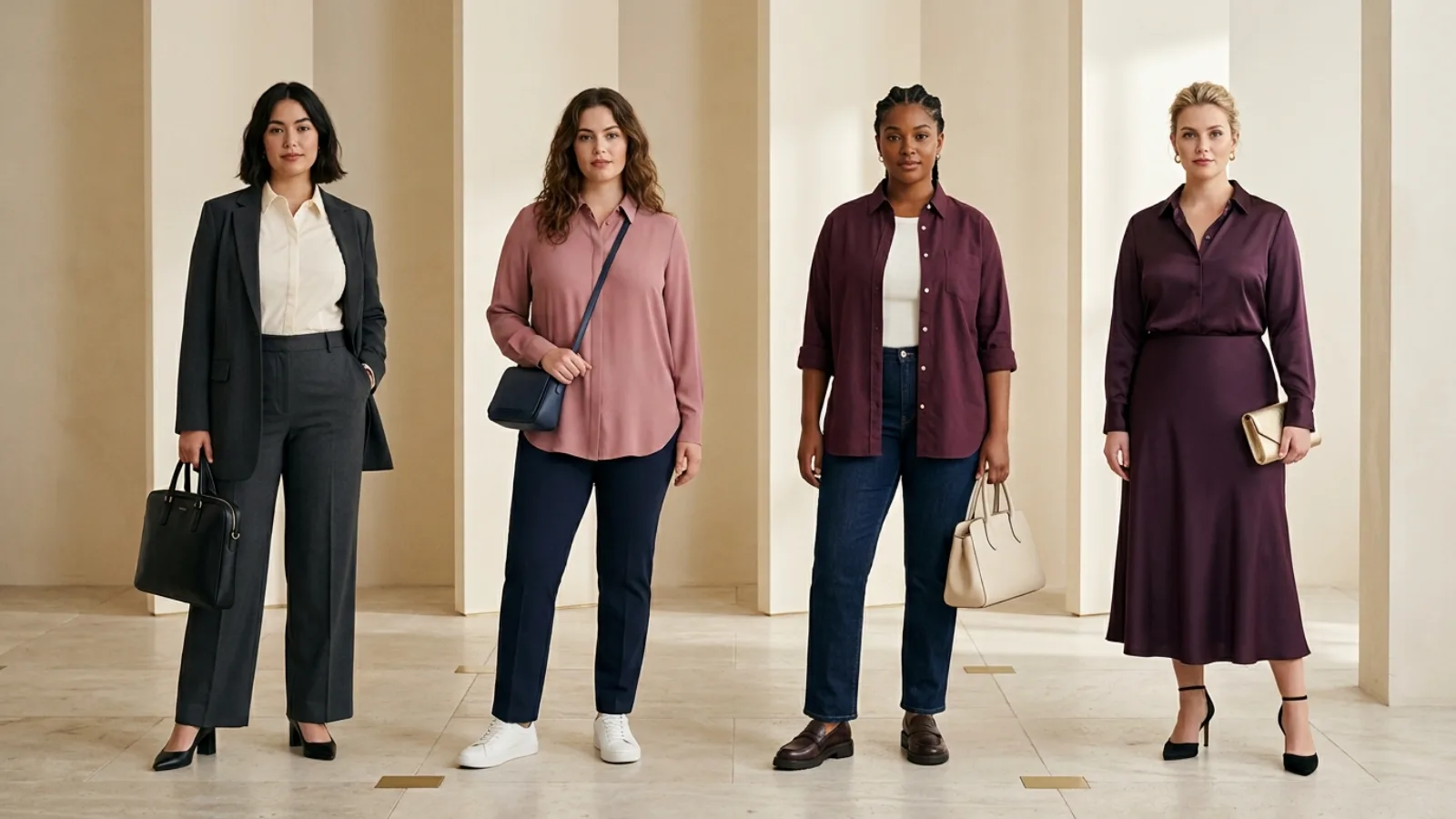
A good shirt should survive wear, washing, and repeated movement
Value is not the lowest price or the highest fiber count. It is the number of comfortable, useful wears a shirt can deliver while keeping its shape. Before buying, inspect button attachment, buttonhole stitching, seam finish, pattern matching, and spare-button provision. Pulling threads, puckered seams, and off-grain plackets usually become more visible after laundering.
Follow the garment label, especially for viscose, silk, linen blends, and stretch cotton. High heat can damage elastane recovery and shrink natural fibers, changing the very ease that made the shirt fit. Fasten buttons only loosely for washing when directed, use a mesh bag for delicate fabrics, and reshape the placket while damp. Press from the reverse when the surface develops shine easily.
Recheck fit after the first wash before altering the shirt. Cotton-rich fabrics may relax or shrink depending on construction and care, while fluid fibers may temporarily lengthen when wet. A responsible seller’s care instructions should guide the process; do not assume every “washable” shirt tolerates a hot dryer.
The highest-value purchase is often neither the most rigid “premium” shirt nor the stretchiest budget option. It is the shirt whose pattern already handles the bust, whose shoulders remain aligned, whose placket is properly supported, and whose fabric fits your real maintenance routine. Those qualities reduce the need for clips, tape, constant adjustment, and replacements.
Editor’s final verdict
Start with a semi-fitted darted or princess-seam button-down made from medium-weight stretch poplin if you want one dependable work-to-weekend option. Choose fluid twill or crepe when comfort and drape matter more than a crisp finish, and choose a relaxed oxford when the volume is intentional or the shirt will be worn open. In every case, prioritize correct bust depth, shoulder alignment, recovery, and a reinforced closure before color, trend, or brand name. A hidden snap can improve an almost-right shirt; it should never be asked to hold a too-small pattern together.
Frequently asked questions
How do I stop a button-down shirt from gaping at the bust?
First confirm that the shirt has enough bust ease and that its darts or seams sit at the correct height. If the fit is otherwise clean, add a hidden snap or internal button at the point of separation. Fashion tape can help briefly, but it does not correct inadequate room, unstable fabric, or poor button placement.
Should I size up in button-down shirts for a large bust?
Size up only if the larger size gives needed bust and upper-back room without badly dropping the shoulders or enlarging the armholes. If sizing up distorts several areas, look for a fuller-bust cut with darts, princess seams, or extra front depth instead. Excess waist room is usually easier to tailor than a major shoulder mismatch.
What fabric is best for a button-down shirt with a fuller bust?
Medium-weight stretch poplin is a reliable crisp option, while fluid twill or crepe works well for softer drape. The fabric should be opaque, stable at the placket, and able to recover after stretching. Rigid oxford and pure linen can work when the cut includes enough ease; fabric thickness alone does not prevent gaping.
Are princess-seam shirts better for a large bust?
Princess seams can be excellent because they create front depth and waist shaping along a long vertical seam. They are most successful when the curved part of the seam aligns with the fullest bust area. If the curve sits too high or low, the shirt may still pull or collapse despite having adequate overall circumference.
How much room should a button-down have across the bust?
It needs enough garment ease to breathe, sit, reach, and cross the arms without persistent horizontal pulling. The exact amount depends on fabric stretch and intended silhouette, so compare the shirt’s finished garment measurement with a button-down that already fits well. Do not rely on a body-measurement chart alone when garment measurements are available.
Can a tailor fix a button-down that is too tight at the bust?
A tailor can sometimes release side seams if sufficient seam allowance exists, but adding substantial front width is difficult. Tailoring works better when the shirt already fits the bust and shoulders and only needs the waist, sleeves, or closure refined. A hidden snap can close a small local gap, not replace missing fabric.
Do hidden buttons make a shirt gap-proof?
Hidden buttons or snaps strengthen the closure and reduce visible separation, but they do not add ease. On a properly sized shirt they are useful insurance. On a too-small shirt they may pull the concealed layer outward, create new wrinkles, or move the strain to the next button.
Why does the front hem of my button-down sit higher than the back?
The shirt may lack enough front length or three-dimensional depth over the bust, causing fabric to travel upward. Look for extra front length, well-positioned darts, princess seams, or a shaped hem. A longer overall size can make the back too long without correcting the front balance.