Best Cardigans for a Large Bust
A construction-first guide to cardigans with calm front edges, useful bust room, stable closures, reliable knit recovery, and balanced layering.
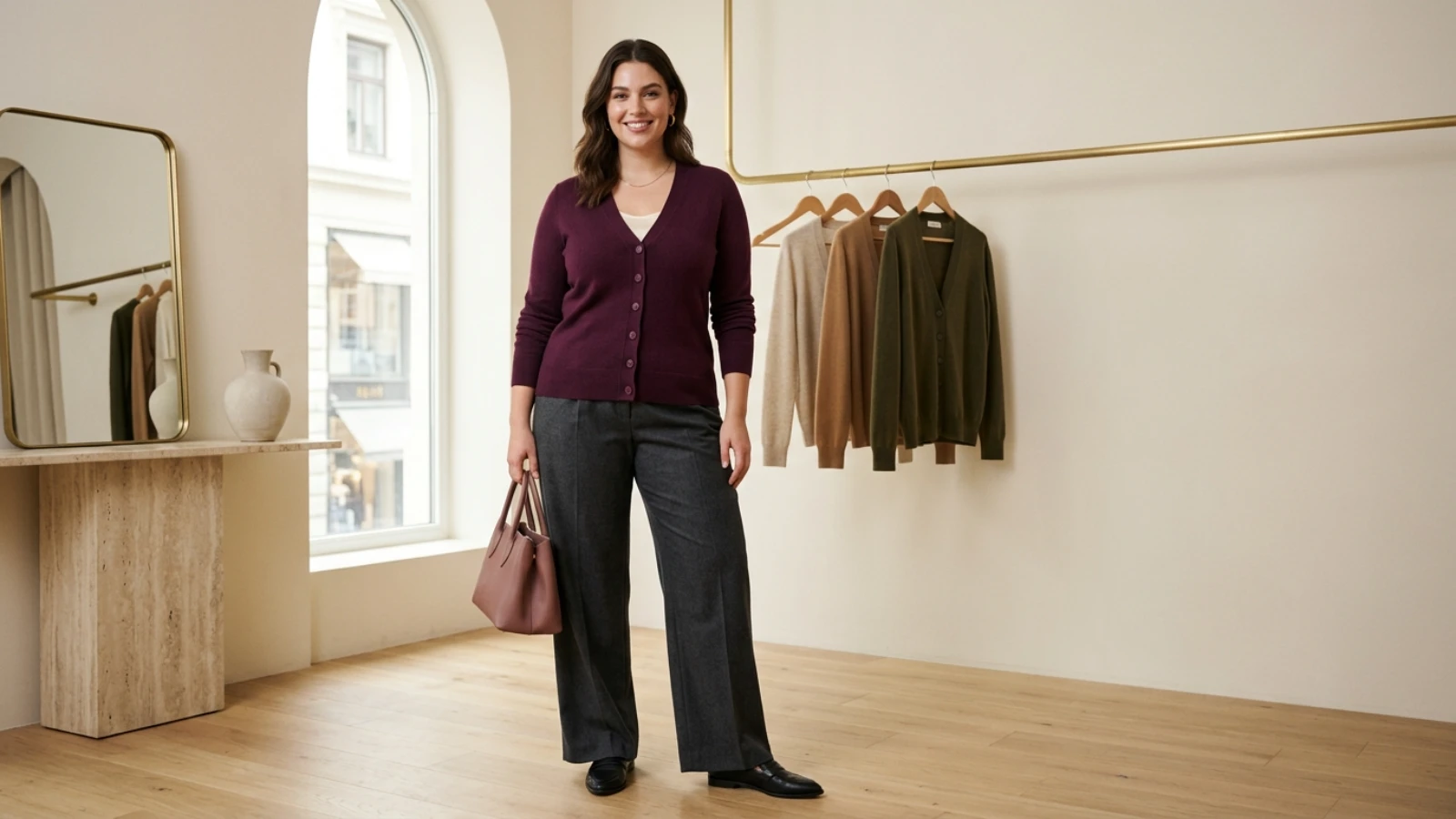
The best cardigans for a large bust are selected by what the knit and pattern do around projection, not by a rule that every fuller-bust woman must wear an open front or avoid buttons. A cardigan has more moving parts than a simple pullover: two front panels, one or more edges, a neckline, optional closures, pockets, sleeves, and a layer underneath. If the front width is too small, buttonholes stretch, the edges swing outward, the side seams move forward, and the hem climbs. If the whole cardigan is sized up to solve only the bust, the shoulders may collapse, sleeves may become heavy, and the back may look borrowed. Good fit keeps those competing areas in balance. This guide explains six practical constructions, how to read button and edge behavior, which knit qualities matter, what to measure online, how to test movement and layering, what a tailor can change, and when a cardigan earns its price. Product modules are intentionally left unpublished until real listings, garment measurements, materials, returns, and current availability can be checked. That protects the page from pretending that a product photograph or generic size label proves fuller-bust fit.
The 60-second cardigan test
Wear the intended bra and base layer, then check these eight points before removing the tags.
- The shoulder seam sits close to the shoulder point without being pulled inward by the bust.
- Open front edges hang calmly instead of swinging toward the outer chest or curling backward.
- Buttoned styles close without horizontal strain lines, distorted buttonholes, or visible gaps.
- The side seams stay near vertical and the front hem does not rise dramatically above the back.
- The knit remains opaque and returns after the cardigan is buttoned, opened, and moved.
- The armhole and upper sleeve allow reaching without transferring tension across the chest.
- Pockets remain flat enough for the intended outfit rather than adding stiff volume at the bust or hip.
- Sitting for ten minutes does not make the band buckle, collar shift, or hem creep upward.
Best cardigans by type and wardrobe need
The best cardigans do different jobs. A style that works over a thin shell in an office may not be the right answer over a winter knit, and a cardigan intended to stay open should not be judged by the same closure test as a buttoned twinset. The best cardigans for a large bust begin with a clearly defined role; start with that role, then evaluate the construction.
Clean open-front cardigan
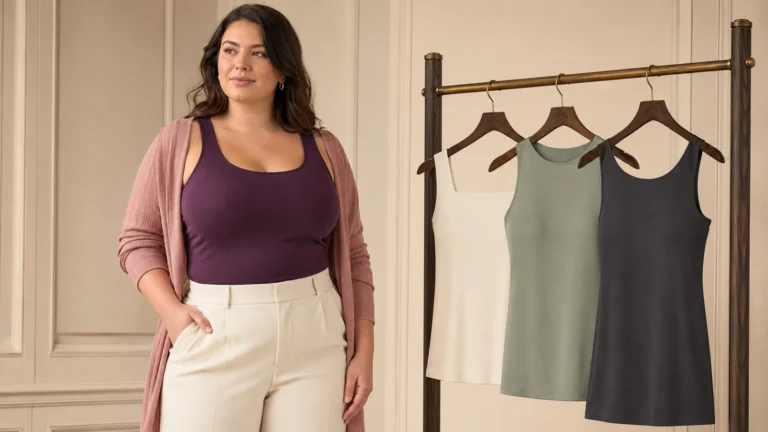
Best for: flexible layering and avoiding button strain. Choose straight, stable front edges with enough panel width to frame the torso rather than disappearing toward the side seams. A slightly weighted edge can help, but a bulky shawl collar may add more fabric than desired.
V-neck button cardigan
Best for: polished outfits and adjustable coverage. A reinforced band, closely spaced buttons, and adequate finished bust measurement matter more than decorative buttons. The V should begin where the band can lie flat without the upper chest or fullest bust forcing it apart.
Fine-gauge fitted cardigan
Best for: office layers, skirts, and wearing under jackets. Fine gauge reduces bulk, but it must remain opaque and recover after stretch. A smooth bra and calm base layer help; the cardigan itself should not rely on compression to look neat.
Belted wrap cardigan
Best for: adjustable waist placement and soft cold-weather structure. The tie should anchor near the natural waist or slightly below the bust without sliding upward. Generous overlap, a stable shoulder, and controlled collar volume stop the garment from becoming a bundle of fabric.
Cropped waist-length cardigan
Best for: high-rise bottoms and dresses. The hem should finish deliberately near the waist rather than being lifted there by insufficient front length. Check the side view: a true crop remains balanced, while a poor fit becomes much shorter only at the center front.
Longline cardigan coat
Best for: travel, transitional weather, and a strong outer vertical layer. It needs enough shoulder stability to carry its weight, pockets that do not drag, and side vents or hem room for walking. Dense fabric should skim rather than cling to the base layer.
| Cardigan type | Main advantage | Inspect closely | Good use case |
|---|---|---|---|
| Open front | No closure strain | Edge hang and panel width | Flexible daily layer |
| V-neck button | Adjustable polish | Band stability and spacing | Work or smart casual |
| Fine-gauge fitted | Low layering bulk | Opacity and recovery | Under blazer or coat |
| Belted wrap | Adjustable waist | Overlap and tie anchor | Soft structured warmth |
| Cropped | Clear waist proportion | True front length | Dresses and high rises |
| Longline | Coverage and movement | Weight, vents, pockets | Travel and outer layer |
How the best cardigans handle open fronts, buttons, zips, and belts
A cardigan front reveals fit quickly because it creates a visible line from neckline to hem. On an open style, that line should feel intentional. It may fall vertically, angle gently, or form a controlled waterfall, but it should not be yanked around the bust. If the edges begin near the center at the shoulder and then swing far outward at chest level, the front panel may lack width or the shoulder may be too narrow. More fabric is not automatically better: excessive drape can collect at the sides of the bust and create heat and bulk. The best cardigans keep this front architecture calm without demanding constant adjustment.
Button bands must do structural work
A buttoned cardigan places repeated loads along a narrow knitted band. The best cardigans use a band that resists rolling and lengthwise stretching. Closely spaced buttons reduce the unsupported distance between closures, but spacing cannot compensate for insufficient garment width. Button every button, stand naturally, and look for star-shaped pulls around the buttonholes, horizontal lines across the bust, and a band that becomes wavy. Then sit. A cardigan that looks calm only while standing still may open under ordinary torso flexion.
Selective buttoning is a valid styling choice when the garment already fits. Closing one or two buttons near the waist can create shape while leaving the bust open. It is not a fit solution if the closed button bears all the load, the band twists, or the hem forms an inverted V. For more guidance on closure behavior, compare the placket principles in our button-down shirts for a large bust guide.
Zips and hooks change the pressure
A zipper distributes closure tension continuously, which can look smooth, but it also exposes a shortage of bust ease immediately. Check whether the zipper remains straight or bows outward. Tiny hooks can create a minimal appearance yet concentrate force at a few points; they are better on stable, adequately sized knits than on a stretch-thin fabric. Decorative clasps should lie flat and should not be treated as the only support for a heavy cardigan.
Belts need a home
A wrap cardigan should have enough overlap before it is cinched. If the tie must be pulled extremely tight to create coverage, the neckline can plunge, the side seam can migrate, and the back can bunch. Belt loops should align with your preferred waist placement, not force the tie across the fullest bust. Test the knot or buckle while sitting and reaching. If it repeatedly climbs under the bust, the torso length, overlap, or loop height is wrong for you.
Bust ease, shoulders, sleeves, and front balance in the best cardigans
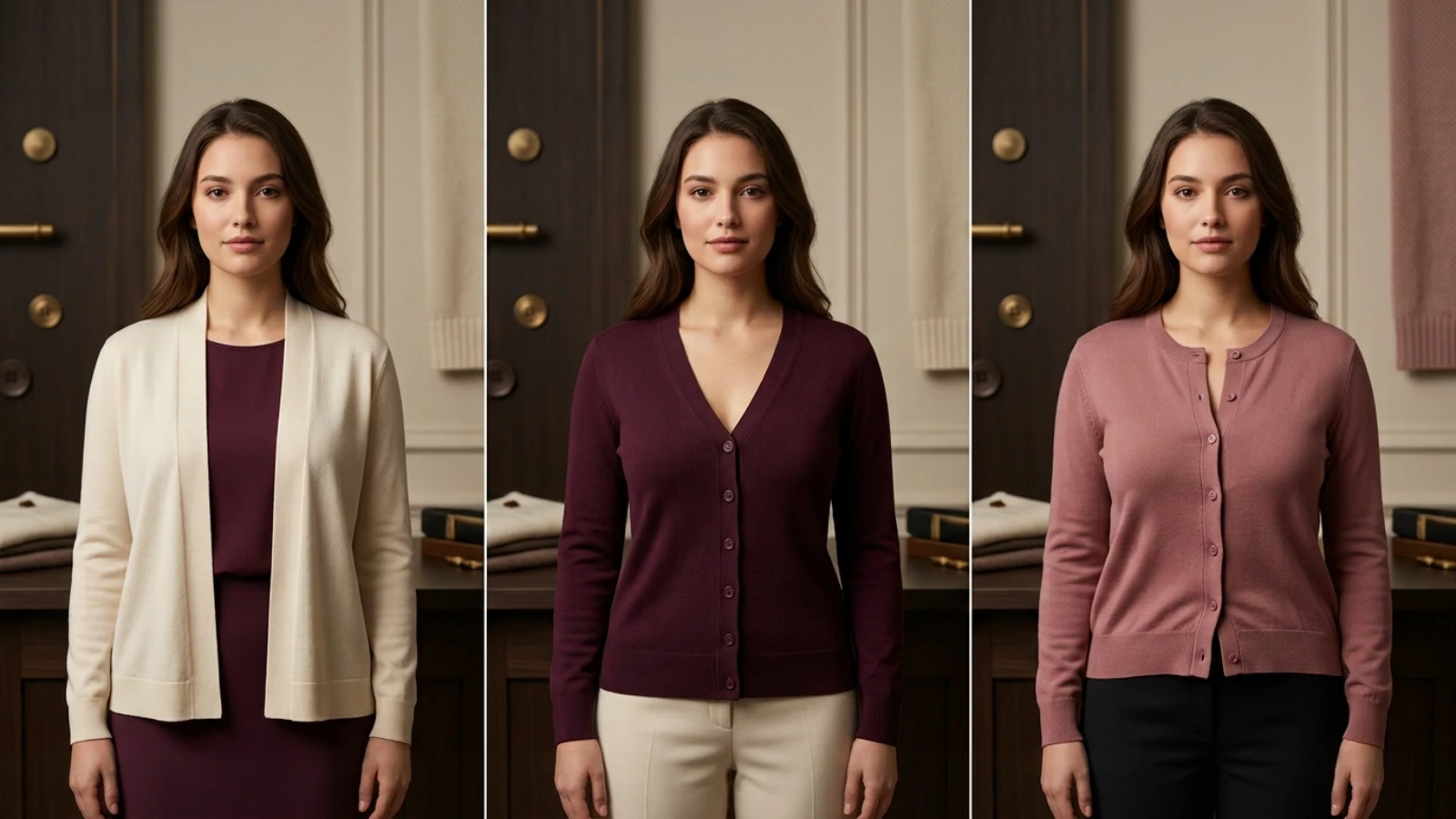
The finished bust measurement is the first number to request, but it is not the whole answer. Knitwear stretches, and brands sometimes expect negative ease; nevertheless, a cardigan that is designed to be worn open, buttoned, or over a blouse needs room for that purpose. The best cardigans for a large bust balance that room with a shoulder and sleeve that still look intentional. Compare the garment with a cardigan you own rather than converting a body measurement into a universal size. Measure your reference flat from underarm to underarm without stretching, then double it. Record whether it is comfortable over a camisole, T-shirt, blouse, or thin sweater. That context turns a number into useful evidence.
Shoulders control the entire upper garment
When the shoulder is too narrow, the sleeve head is pulled inward and the front panel loses reach. The result may resemble a bust problem even when the chest width looks generous on paper. A set-in shoulder should sit near your shoulder point. A dropped shoulder is intentionally lower, but its seam and sleeve weight should still feel balanced. Very oversized dropped shoulders can make a cardigan look relaxed, yet they may also add volume at the upper arm and make a coat difficult to layer over it.
Armhole depth must match movement
A high, well-shaped armhole often allows more motion with less fabric, while an excessively deep armhole can drag the whole body of the cardigan upward when you lift an arm. Check the underarm for cutting, bunching, and exposed base layer. Then reach forward as if typing or driving. If the back becomes tight and the front edges travel several centimeters, you need a different shoulder, back width, or armhole—not necessarily a larger bust measurement alone.
Front length is separate from overall length
A fuller bust uses vertical fabric as it travels forward and down. Two cardigans with the same back length can behave differently if one has extra center-front length or shaping. Examine the side seam and hem. A modest front rise may be part of a curved design; a strong accidental rise, especially with horizontal chest lines, signals insufficient projection room. This is particularly important for cropped cardigans, where a few centimeters determine whether the hem meets a waistband or floats above it.
| Visible sign | Likely cause | Best next check | Do not assume |
|---|---|---|---|
| Front edges swing outward | Low front width or narrow shoulder | Compare panel and shoulder | All open fronts do this |
| Buttons form star pulls | Insufficient ease or weak band | Measure closed garment | A hidden snap will solve it |
| Front hem climbs | Low center-front length | Compare front and back | The crop is intentional |
| Side seams move forward | Bust borrowing back width | Check bust depth and front panel | Size label is wrong everywhere |
| Sleeves twist or pull | Shoulder/armhole mismatch | Reach and driving test | Only upper-arm width matters |
| Back looks baggy after sizing up | Size increased globally | Seek bust-shaped cut | Oversize is the only solution |
For the wider principles behind projection, proportion, and outfit balance, see how to dress a large bust. The useful goal is not visual reduction; it is a garment that behaves predictably on the body you have.
How the best cardigans use fabric weight, recovery, and opacity
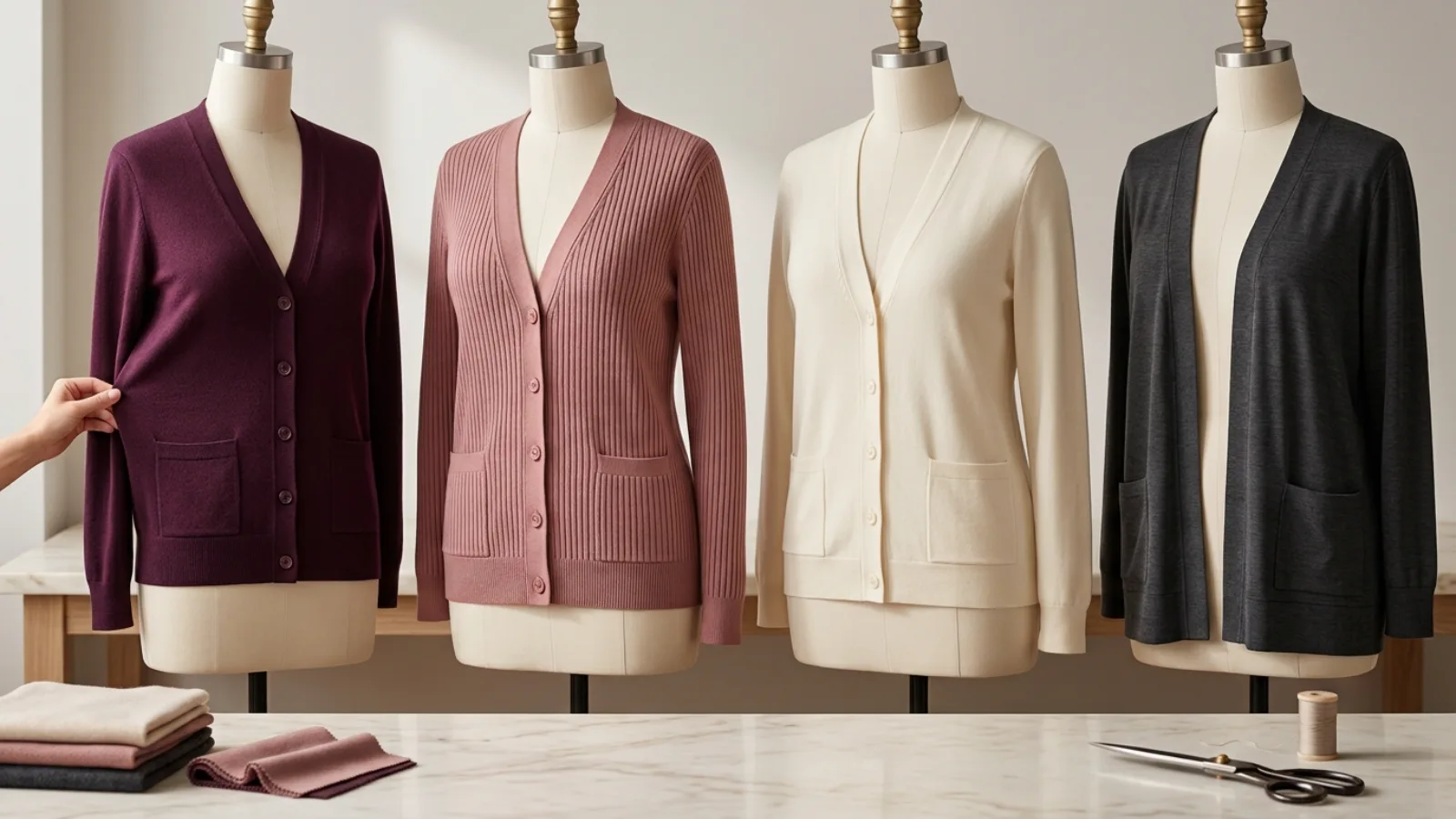
Fiber content tells you what fibers are present, not how the finished cardigan will behave. Two cotton cardigans can differ dramatically because of yarn quality, gauge, knit structure, finishing, and elastane content. The best cardigans combine enough give to move over the bust with enough recovery to return. The best cardigans also keep their opacity and edge shape at the garment’s highest-stress points. Recovery matters at buttonholes, elbows, cuffs, pockets, and the front edge. A cardigan that stretches easily but stays stretched may look acceptable during the first fitting and tired after one day.
Fine gauge versus chunky knit
Fine-gauge knits are useful under blazers and coats because they add less volume. They can also reveal bra texture and become translucent when stretched, so test opacity over the fullest area in natural light. Chunky knits provide warmth and texture, but large ribs, cables, patch pockets, and shawl collars add physical bulk. That is not forbidden; it simply needs to be chosen intentionally and balanced with adequate shoulder structure and a calm base layer.
Rib scale changes across projection
Rib knit expands by opening the valleys between ribs. On a fuller bust, narrow ribs may spread significantly at the center while remaining compressed at the sides. Check whether the color appears lighter, the underwear becomes visible, or the rib pattern distorts. A stable medium rib with good return may be more forgiving than an extremely soft loose rib. For a deeper fabric-selection framework, use our guide to the best fabrics for a large bust.
Wool, cotton, viscose, and synthetics
Merino and other wool blends can provide warmth without excessive thickness, but softness, pilling, and care vary. Cotton can feel breathable and crisp, yet heavy cotton knits may grow downward. Viscose or modal blends can drape smoothly, although weak recovery can produce stretched elbows or edges. Polyester and nylon blends may improve strength and recovery, but comfort and breathability depend on construction. Elastane can help, though a small percentage does not guarantee quality. Read the actual label and care directions rather than relying on a marketing fabric name. In the United States, the FTC textile-label guidance explains fiber-content and related labeling requirements.
How to buy the best cardigans online accurately
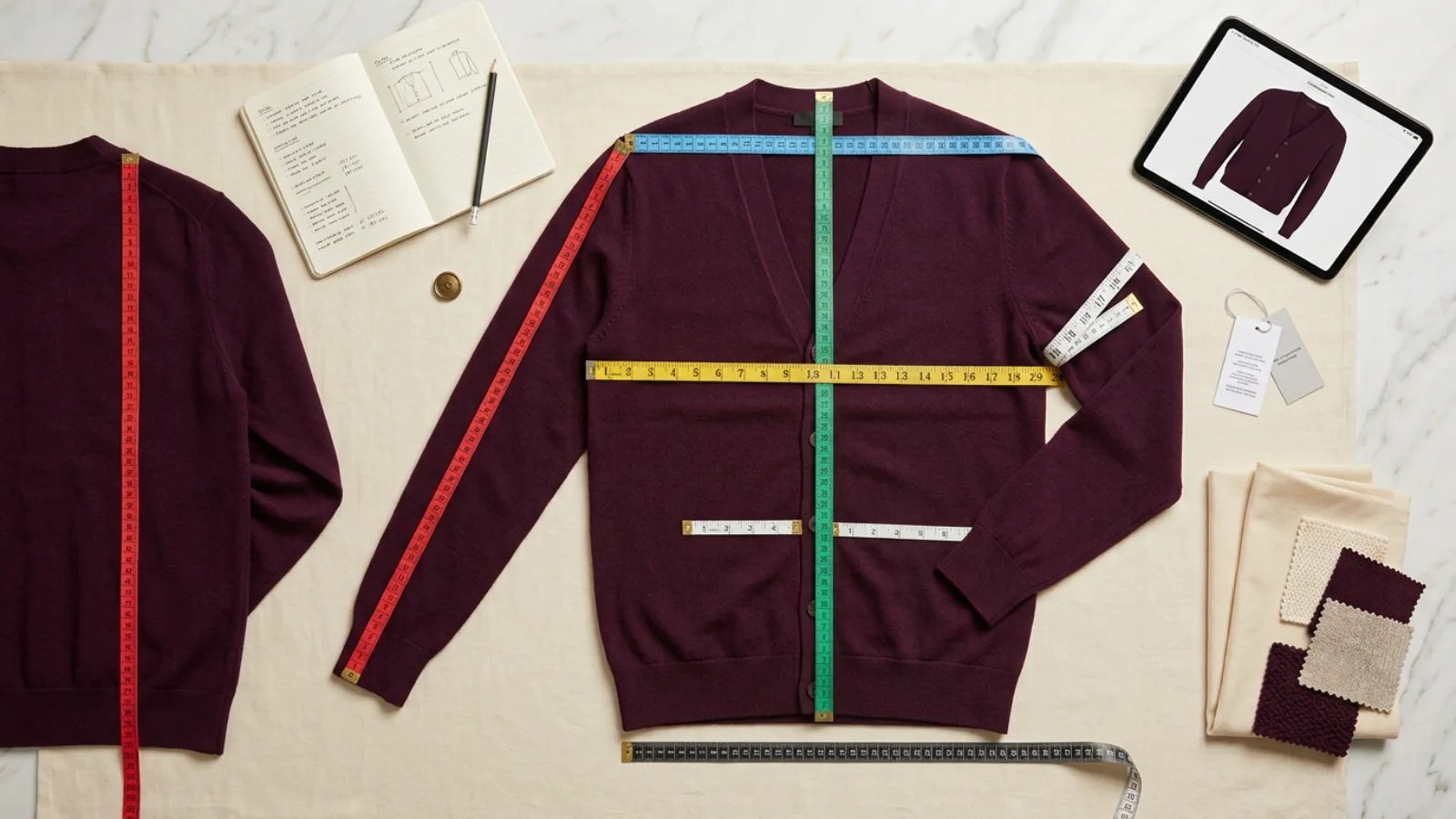
Online shopping becomes safer when you treat the listing as incomplete evidence rather than a promise. The best cardigans for a large bust can be shortlisted online only when the listing supplies enough evidence for the intended use. Start by defining how you will wear the cardigan: open over a thin shell, buttoned as a top, layered over a blouse, or used as light outerwear. The same body may need different garment measurements for each role. Next, confirm whether the size chart contains body measurements or finished garment measurements. A body chart helps choose the brand’s intended size; a garment chart tells you how much physical room the item provides. They are not interchangeable.
- Measure a reference cardigan. Record flat bust, shoulder, upper arm, sleeve, front length, back length, and hem. Note what you wear under it.
- Read the product description. Identify closure, fit label, knit structure, fiber percentages, care, lining if any, and model size information without treating the model as a fit guarantee.
- Request missing garment data. Ask customer service for underarm-to-underarm width, shoulder, and center-front length in the size you are considering.
- Study every view. Look for a true side view, rear shoulder, button band, pocket position, hem, and how the cardigan hangs when both open and closed.
- Read reviews selectively. Prioritize comments that mention measurements, base layers, closure behavior, shrinkage, pilling, or body proportions. “Runs small” without context is weak evidence.
- Check returns before purchase. Note the return window, shipping deductions, final-sale status, marketplace seller, and whether worn or tagless garments are excluded.
| Measurement | How to take it | Why it matters | Red flag when absent |
|---|---|---|---|
| Garment bust | Double flat underarm width | Front coverage and closure ease | Only generic S/M/L chart |
| Shoulder width | Seam to seam across back | Controls sleeve and front reach | Oversized label without data |
| Center-front length | High shoulder to front hem | Predicts bust-related hem lift | Only back length supplied |
| Upper arm | Double flat sleeve width | Layering and movement | No sleeve data on fitted knit |
| Hem width | Double flat bottom edge | Hip fit and edge hang | Longline style with no sweep |
| Button spacing | Center to center | Gap control when closed | Only styled-open photographs |
If a retailer supplies no finished measurements, compare several customer reports and choose only when the return policy makes uncertainty acceptable. A discount does not create value if the fit cannot be evaluated or returned.
The ten-minute test for the best cardigans
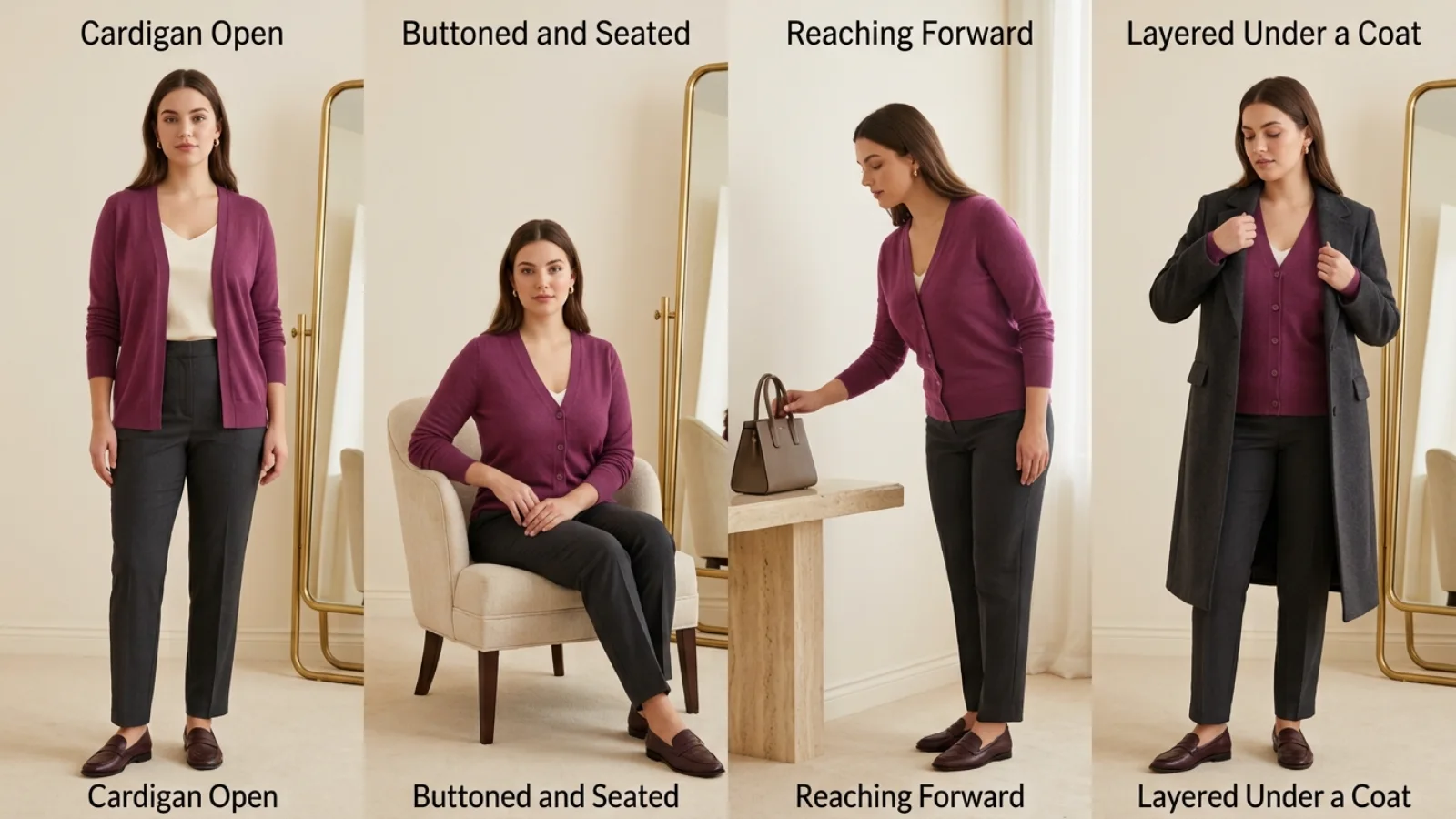
The best cardigans must work in motion, not only in a front-facing product pose. Try the cardigan at the warmest realistic layer thickness. A fine-gauge style may be intended over a camisole; a longline winter cardigan may need to clear a blouse or thin sweater. Button or belt it as intended, then sit, type, reach to a high shelf, cross your arms, imitate driving, and put on the coat you plan to use. Notice whether the cardigan rides upward, the base layer bunches, the cuffs trap the shirt sleeves, or the collar becomes crowded.
Next, open the cardigan and walk. Front edges should move and settle rather than remaining flared around the bust. Put your phone or keys in a pocket only if that reflects real use. Heavy pocket contents can distort soft knits, especially longline styles. Finally, leave the cardigan on for ten minutes. Heat and movement reveal collar irritation, static, scratchiness, and edge curl that a mirror check misses.
Keep / alter / return rule
Keep when shoulders, bust, sleeves, and front balance are already right. Alter when the core fit works and the change is small, such as replacing weak buttons or adding one discreet snap. Return when the bust is compressed, shoulders collapse, the band is strongly distorted, arm movement is restricted, or a heavy knit grows while you wear it.
For combinations involving several layers, our layering tips for a large bust explain how neckline, fabric weight, and outerwear interact without requiring the body to disappear under oversized pieces.
Common fit problems even the best cardigans must avoid
The best cardigans make fit evidence easy to read: the front, shoulder, sleeve, and hem support one another. When one area fails, diagnose that visible behavior before changing sizes or styling around it.
The cardigan fits open but gaps when buttoned
This is not automatically a reason to discard it if you bought it strictly as an open layer. If the style is sold and intended to close, however, gaping indicates inadequate closed circumference, insufficient front shaping, weak button-band stability, or all three. Compare the finished bust measurement and button it over the thinnest intended layer. Strong strain means a different cut is more honest than relying on pins.
The front edges disappear toward the sides
Open-front cardigans still need enough front-panel width. An edge that is vertical at the upper chest but abruptly travels outward at the bust may be borrowing width. Check the shoulder, side seam, and back. A cardigan marketed as edge-to-edge may not meet at center, but its opening should look designed rather than forcibly widened.
The hem is much shorter in front
Confirm whether the design has an intentional curved or high-low hem. If not, strong front lift comes from insufficient center-front length, low bust room, or a fabric that clings to the base layer. Sizing up may add some length and width but can damage shoulder fit. A style with bust shaping, a curved front, or more front length is usually cleaner.
The button band waves after wear
Waving can come from strain, weak knit recovery, laundering, or a band that was poorly stabilized during manufacture. If it appears only across the bust, fit is the first suspect. If the entire band ripples while unworn, construction or care may be responsible. Steam may relax minor storage marks, but it cannot rebuild stretched fibers.
The cardigan looks bulky even though it fits
Examine where the bulk lives. A thick shawl collar, patch pockets, large cables, balloon sleeves, and a long dense body can each contribute. Remove one variable at a time: use a smoother base layer, try a V instead of a shawl collar, compare inset pockets, or choose a fine gauge. Bulk is a garment property and styling choice, not a body failure.
What a tailor can realistically change in the best cardigans
Even the best cardigans may need a small personalized adjustment, but knit alterations are more specialized than alterations to woven shirts. A tailor may be able to shorten sleeves or body, replace buttons, add a discreet internal snap, move a belt loop, reinforce a pocket, or reduce some side width. The feasibility depends on knit structure, seam construction, ribbed edges, and whether cutting causes unraveling. Ask for experience with knitwear before authorizing work.
A tailor generally cannot create substantial missing bust width, restore permanently stretched yarn, change a narrow shoulder into a correct one, or add meaningful center-front length invisibly. Moving a button slightly may improve a tiny alignment issue, but moving it far can make the band asymmetric and does not create more fabric. Strong gaping needs a better size or pattern. Our guide to tailoring for a large bust helps separate high-value alterations from expensive rescue attempts.
| Change | Often feasible? | Conditions | Better alternative when not |
|---|---|---|---|
| Replace buttons | Yes | Band and holes are sound | Return if band is already strained |
| Add internal snap | Sometimes | Only a small local gap | Choose more bust ease |
| Shorten sleeves | Sometimes | Cuff and knit allow it | Seek correct sleeve length |
| Shorten body | Specialist job | Hem can be reconstructed | Buy intended crop |
| Add major bust room | Usually no | Visible panels would be needed | Choose different cut |
| Fix stretched knit | Usually no | Minor reshaping only | Replace poor-recovery item |
How to style the best cardigans for work, weekends, and travel
The best cardigans for a large bust should multiply outfits rather than require a special combination to conceal poor fit. These formulas start with sound construction, then use proportion, neckline, and fabric weight to match the setting.
Work: fine gauge + clean base + tailored bottom
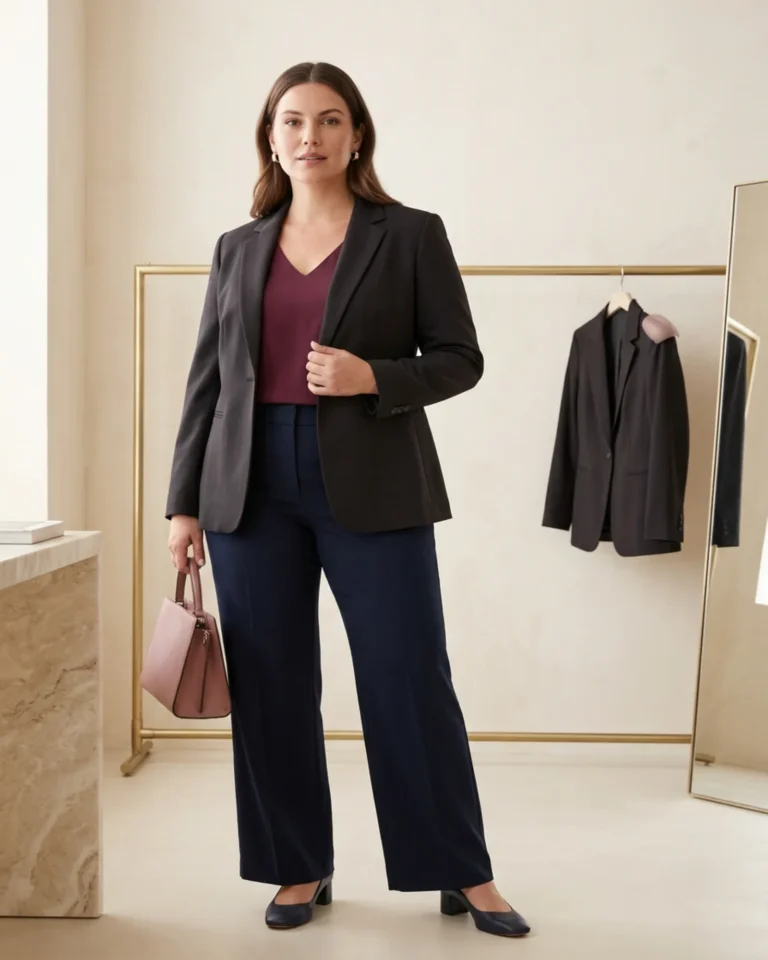
Use a fine-gauge V-neck or open-front cardigan over a smooth shell, then add straight or wide-leg trousers. Keep the base neckline deliberate so it does not compete with the cardigan opening. A low-bulk cardigan fits more easily beneath a blazer or coat, while a stable shoulder preserves polish when the cardigan is worn alone.
Weekend: cropped cardigan + high-rise bottom
A true cropped cardigan can meet a high-rise jean or skirt without excessive tucking. Wear it buttoned as a top only when the band remains flat and the neckline provides the coverage you want. Otherwise, layer a fitted tank beneath it. The crop should stay intentional from the side rather than lifting only at center front.
Travel: longline cardigan + column base
A compact longline knit over a tonal T-shirt and comfortable trouser creates a flexible temperature layer. Look for pockets that hold essentials without sagging, a hem that permits walking, and sleeves that fit under a jacket. Avoid carrying a heavy shoulder bag on a loose delicate knit because friction and pressure can cause pilling or distortion.
Evening: refined button cardigan + fluid skirt
A polished cardigan with jewelry-like buttons can replace a blouse or light jacket. The decorative closure still needs a stable band; ornament does not compensate for strain. A smooth skirt or tailored trouser lets the knit detail lead. If the neckline is the styling focus, compare the principles in our best necklines for a large bust guide.
Soft tailoring: belted cardigan + straight trouser
A wrap cardigan can create adjustable structure when the overlap is generous and the tie sits securely. Keep the base layer thin and allow the belt to define the garment without compressing the bust. A straight trouser balances the softness of the upper layer, while simple shoes keep the outfit useful rather than costume-like.
Care, value, and the final decision on the best cardigans
The best cardigans are valuable when their cost per useful wear is low, not merely when their purchase price is low. Before buying, estimate how many outfits and seasons each candidate serves, whether its care method fits your routine, and whether the knit is likely to recover. Inspect seams, button attachment, spare yarn or button, edge finishing, pocket anchoring, and pattern matching. A refined cardigan that replaces both a light jacket and an indoor layer may justify more than a novelty knit worn once.
Follow the sewn-in care label. The FTC care-label guidance explains the U.S. rule requiring care instructions for covered garments. Many cardigans last longer when washed less frequently, aired between wears, turned inside out, protected from friction, and dried flat when instructed. Heavy knits should generally be stored folded so gravity does not stretch the shoulders. Buttoning before folding can help keep bands aligned, but avoid pulling a damp garment into shape aggressively.
Pilling is affected by fiber, yarn, friction, and wear. It is not always proof of poor quality, though rapid heavy pilling in low-friction areas is a warning. Remove surface pills gently with an appropriate tool and test on a hidden area. Repair loose buttons before they enlarge the hole. Address small snags without cutting the yarn, because a knit loop may travel.
Final buying scorecard
- Fit: shoulders, bust, armholes, sleeves, and hem remain balanced.
- Front behavior: edges hang cleanly and closures stay calm.
- Fabric: knit is opaque enough, comfortable, and resilient.
- Function: it works over the intended layer and under outerwear.
- Evidence: useful garment data and a realistic return policy exist.
- Care: maintenance fits the time and budget you will actually give it.
The best cardigan is the one whose front stays intentional
The best cardigans for a large bust are not defined by a compulsory open front, a dark color, or an oversized label. They are defined by engineering: correct shoulders, enough bust and front-panel room, stable closures or edges, reliable recovery, useful front length, and sleeves that permit ordinary life. Start with a clean open front, V-neck button cardigan, or fine-gauge layer according to your purpose. Then verify the garment while open, closed, seated, moving, and worn beneath the intended coat. When the front line stays calm and the knit returns, the cardigan becomes a dependable wardrobe tool rather than a piece you constantly adjust.
Frequently asked questions
What cardigan style is best for a large bust?
A clean open-front cardigan, a V-neck button cardigan with adequate bust ease, or a structured fine-gauge knit is often a useful starting point. The best choice is the one whose shoulders fit, front edges hang vertically, buttons remain calm when closed, and hem stays balanced over your intended base layer.
Are open-front cardigans flattering for a large bust?
They can be, because an open front removes button strain and creates a flexible vertical opening. However, flattering fit still depends on shoulder width, front-panel coverage, fabric recovery, pocket placement, length, and whether the edges fall cleanly instead of swinging toward the sides of the bust.
Should a cardigan be sized up for a fuller bust?
Size up only when the current size pulls at the buttons, rotates the side seams, restricts the arms, or shortens substantially at the front. If sizing up makes the shoulders, sleeves, neckline, and back too loose, choose a cut with more bust room or a different closure rather than accepting an oversized upper body.
Can I wear a buttoned cardigan with a large bust?
Yes. Look for enough garment bust measurement, closely spaced stable buttons, reinforced button bands, useful stretch recovery, and a V depth that closes without gaping. Test the cardigan while sitting, reaching, and wearing the intended bra and base layer before removing tags.
What cardigan length works best with a large bust?
There is no universal best length. Cropped cardigans can define a waist, hip-length styles are versatile, and longline cardigans create coverage and movement. The useful length is one that stays balanced front to back, does not end at an unwanted focal point, and works with the rise and volume of your bottoms.
Which cardigan fabrics work well for a fuller bust?
Fine-gauge merino blends, resilient cotton-modal blends, stable rib knits, substantial jersey knits, and compact synthetic blends can work well when they are opaque, recover after stretching, and resist edge curl. Fiber names alone are not enough; density, knit structure, garment cut, and care method change performance.
How do I stop cardigan buttons from gaping at the bust?
Confirm that the garment has enough bust ease and that the button band is stable. Smaller gaps may improve with an internal snap, modesty panel, or selective buttoning, but strong radiating pulls and distorted buttonholes usually mean the garment is too small or too flat through the bust.
What measurements should I check when buying a cardigan online?
Check garment bust width, shoulder width, armhole depth, upper-arm width, center-front and center-back length, sleeve length, hem width, button spacing, and stretch information. Compare those numbers with a cardigan you already like, and verify whether the retailer chart shows body measurements or finished garment measurements.