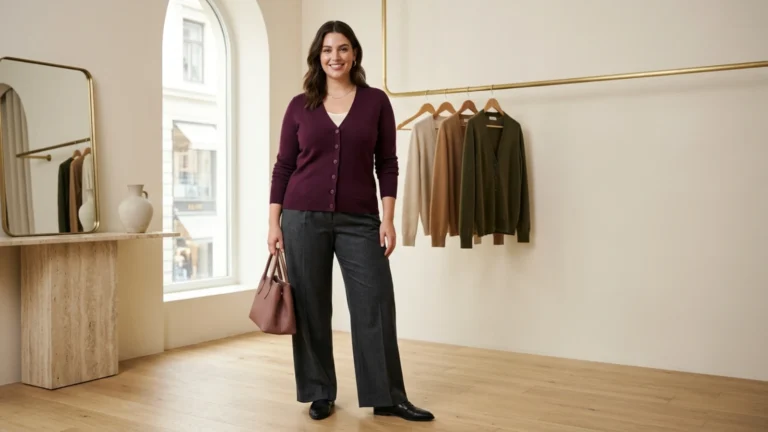
New Year’s Eve Outfits for a Large Bust
Six festive outfit formulas designed for real NYE conditions—flash photographs, cold streets, warm venues, dining, dancing and midnight movement—with secure fuller-bust construction at the center.
The NYE reality test
- Wear the exact bra, hosiery, base layer and footwear planned for the night.
- Photograph front, side and back with normal room light and phone flash.
- Sit for ten minutes, lean toward a table and take three relaxed breaths.
- Raise both arms, put on the coat, carry the bag and check neckline recovery.
- Walk quickly, climb a step and dance for one full song without adjusting clothing.
- Stand outdoors briefly if safe, then return indoors and assess heat, static and comfort.
If the outfit requires a hand on the neckline, repeated strap adjustment or holding a wrap closed, it is not ready for a long NYE night. Fix the construction or change the formula before adding accessories.
Choose New Year’s Eve outfits for a large bust by venue
NYE is not one dress code. A sofa-based house gathering, reserved restaurant, hotel cocktail party, nightclub, rooftop countdown and formal gala demand different levels of polish and different physical performance. Begin with the invitation and host cues. “Festive,” “cocktail,” “black tie,” “glam,” “casual” and a named theme are practical instructions, not interchangeable marketing words.
Current Emily Post guidance describes festive attire as cocktail party dressing with a seasonal holiday touch, and includes cocktail dresses, long dressy skirts with tops, dressy pants outfits, separates and a little black dress. That range supports multiple fuller-bust-friendly routes. Sparkle is optional; polish and appropriateness are the real requirements.
For a house party, prioritize sitting on soft furniture, reaching for food and temperature variation. A shaped knit with a metallic skirt or a relaxed velvet dress can feel festive without a rigid bodice. For a restaurant, the neckline must stay secure while leaning toward the table and the waistband must remain comfortable through a long meal.
A dance venue changes the test. Straps, wrap overlap, zippers, vents and shoe grip matter more than a posed mirror view. A rooftop or outdoor countdown adds wind, cold, wet pavement and a coat that may remain on for much of the night. A formal gala raises fabric, length and finish; verify whether the invitation says black tie rather than assuming every New Year’s event welcomes a cocktail hem.
Travel matters too. Rideshares and public transport require sitting and outerwear. A long hem needs ground clearance. Beading can catch in car upholstery. A backless dress may become difficult under a winter coat. Build the outfit from the most demanding part of the evening, not only the midnight photograph.
| NYE setting | Reliable outfit start | Priority test | Common failure |
|---|---|---|---|
| House party | Velvet midi or metallic skirt + shaped knit | Soft-seat comfort and indoor heat | Rigid waist or scratchy embellishment |
| Restaurant dinner | Structured LBD or tailored jumpsuit | Lean, breathe and long sitting | Neckline gape at the table |
| Cocktail reception | Long-sleeve cocktail dress or festive suit | Standing, greetings and coat transition | Ordinary office styling |
| Nightclub / dancing | Jumpsuit or secure stretch-crepe dress | One-song dance and strap recovery | Riding hem or shifting cups |
| Rooftop / outdoor countdown | Festive separates under a real winter coat | Wind, warmth, shoe grip and bag | Exposed neckline under inadequate layer |
| Gala / black tie | Formal gown, elevated jumpsuit or dressy separates | Invitation-level formality and long-event support | Treating “NYE” as permission to underdress |
Six reliable New Year’s Eve outfit formulas
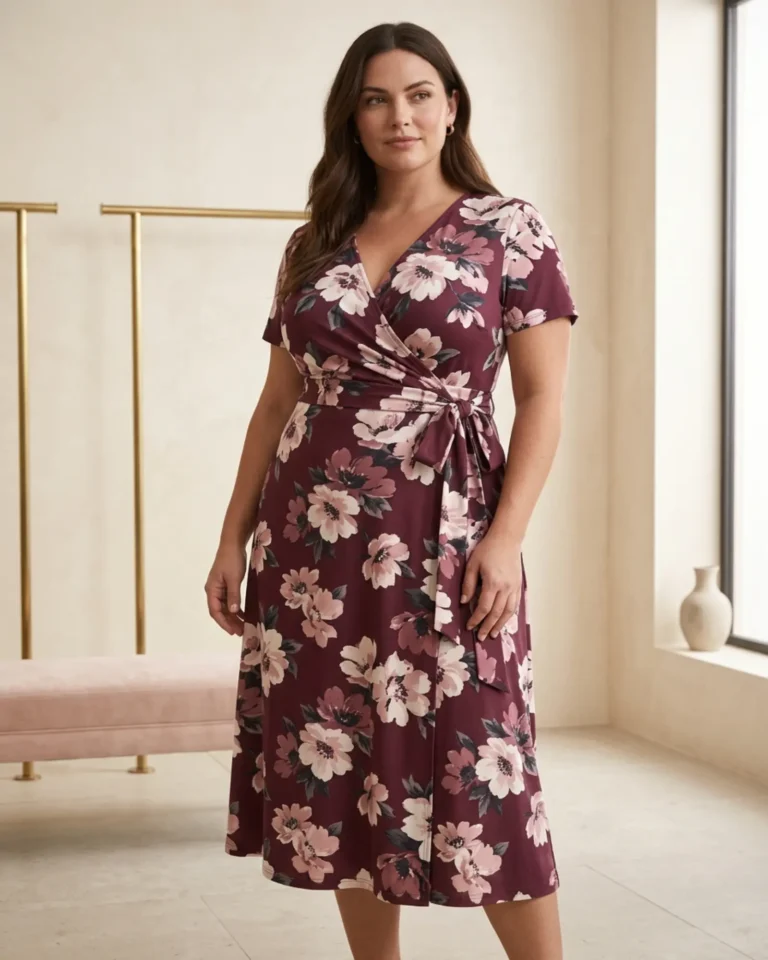
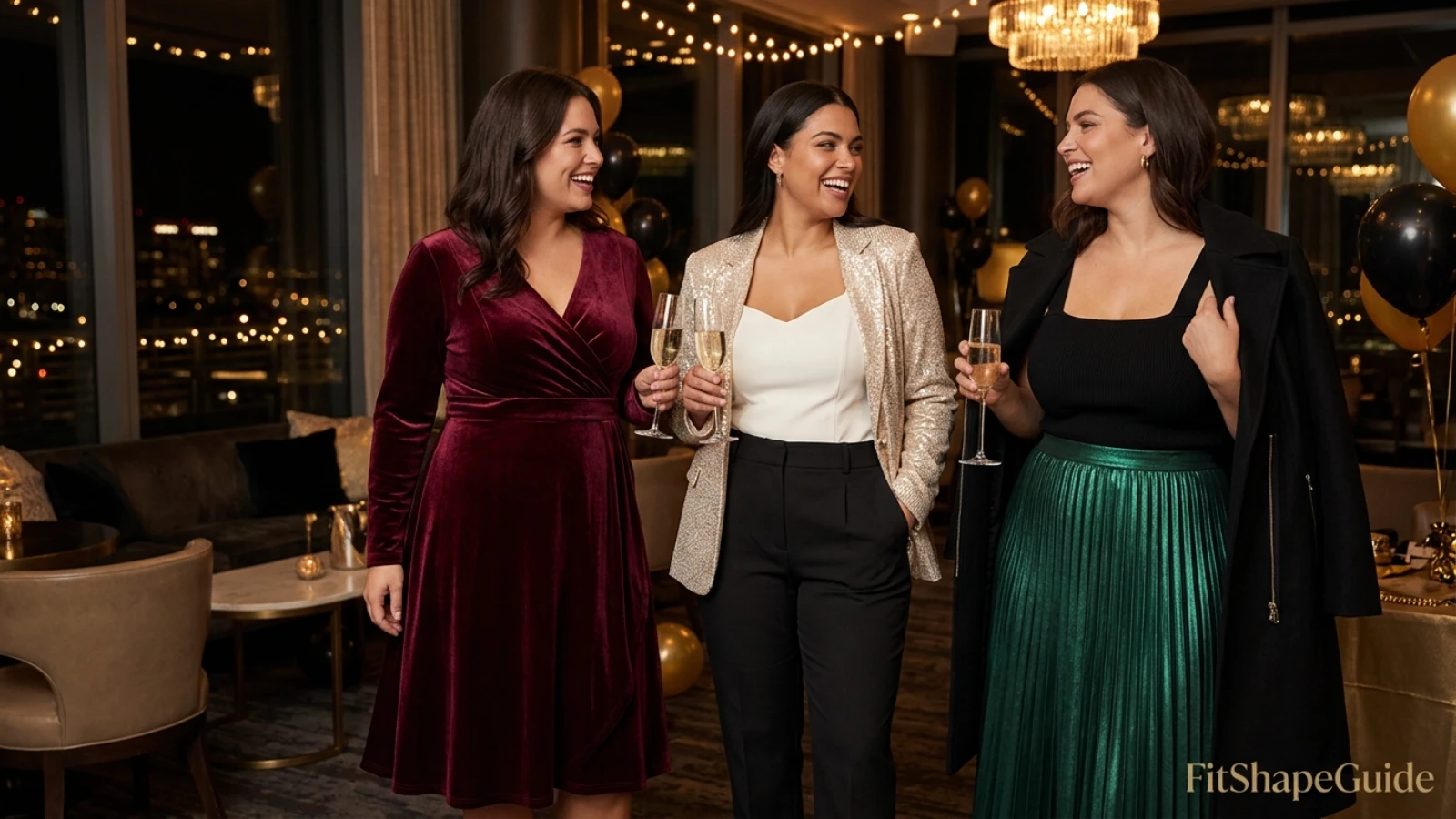
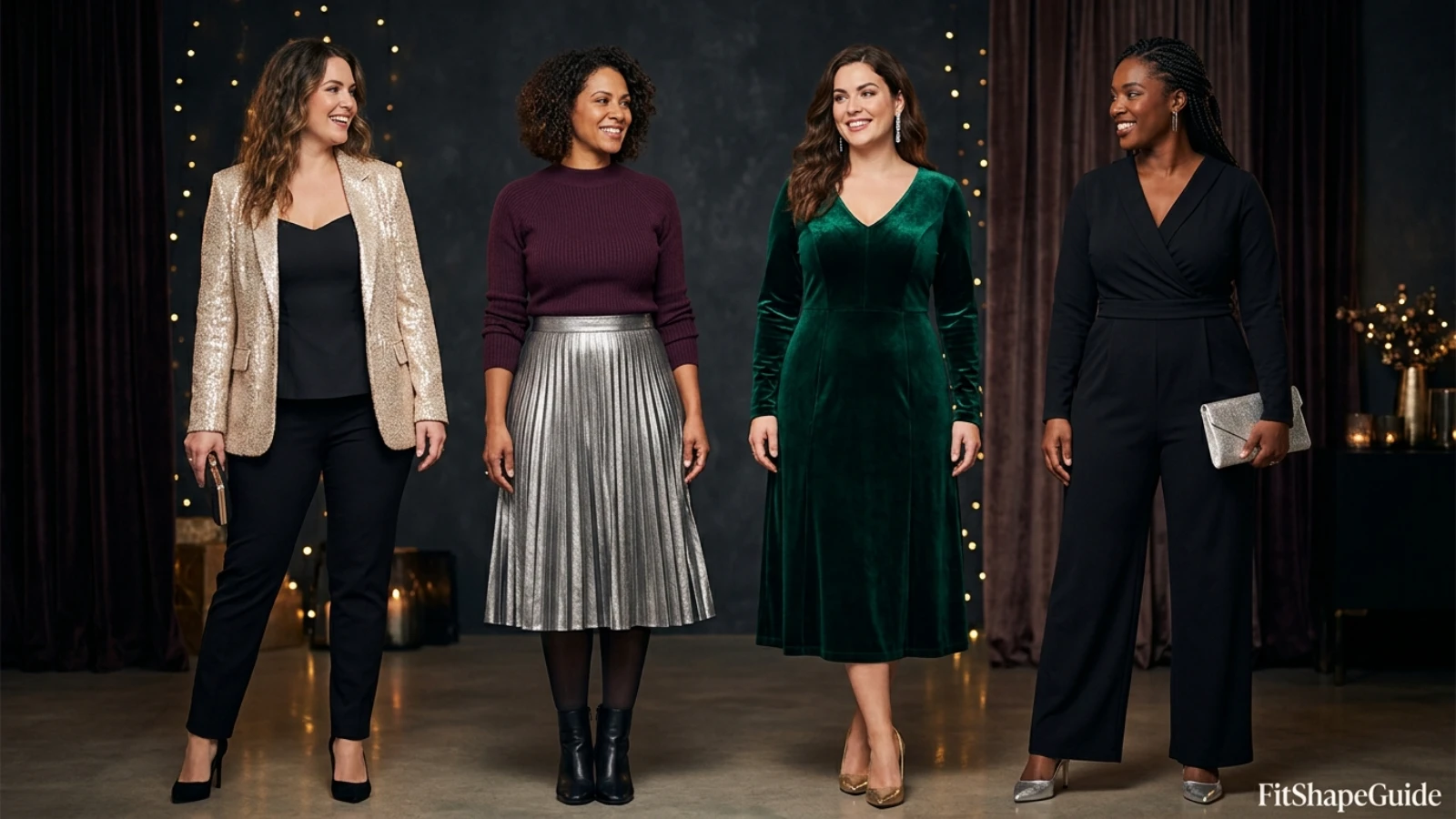
Velvet wrap-style midi
Best for: dinner, house parties and cocktail receptions in colder weather. Velvet supplies visual richness while the diagonal bodice can create bust room and waist definition.
Construction: choose genuine panel width, a fixed neckline point or internal anchor, substantial ties and enough skirt overlap. Long sleeves should allow reaching without pulling the bodice.
Trade-off: velvet can feel warm, crush under a tight coat and show pressure marks. Tie tension cannot replace missing crossover width.
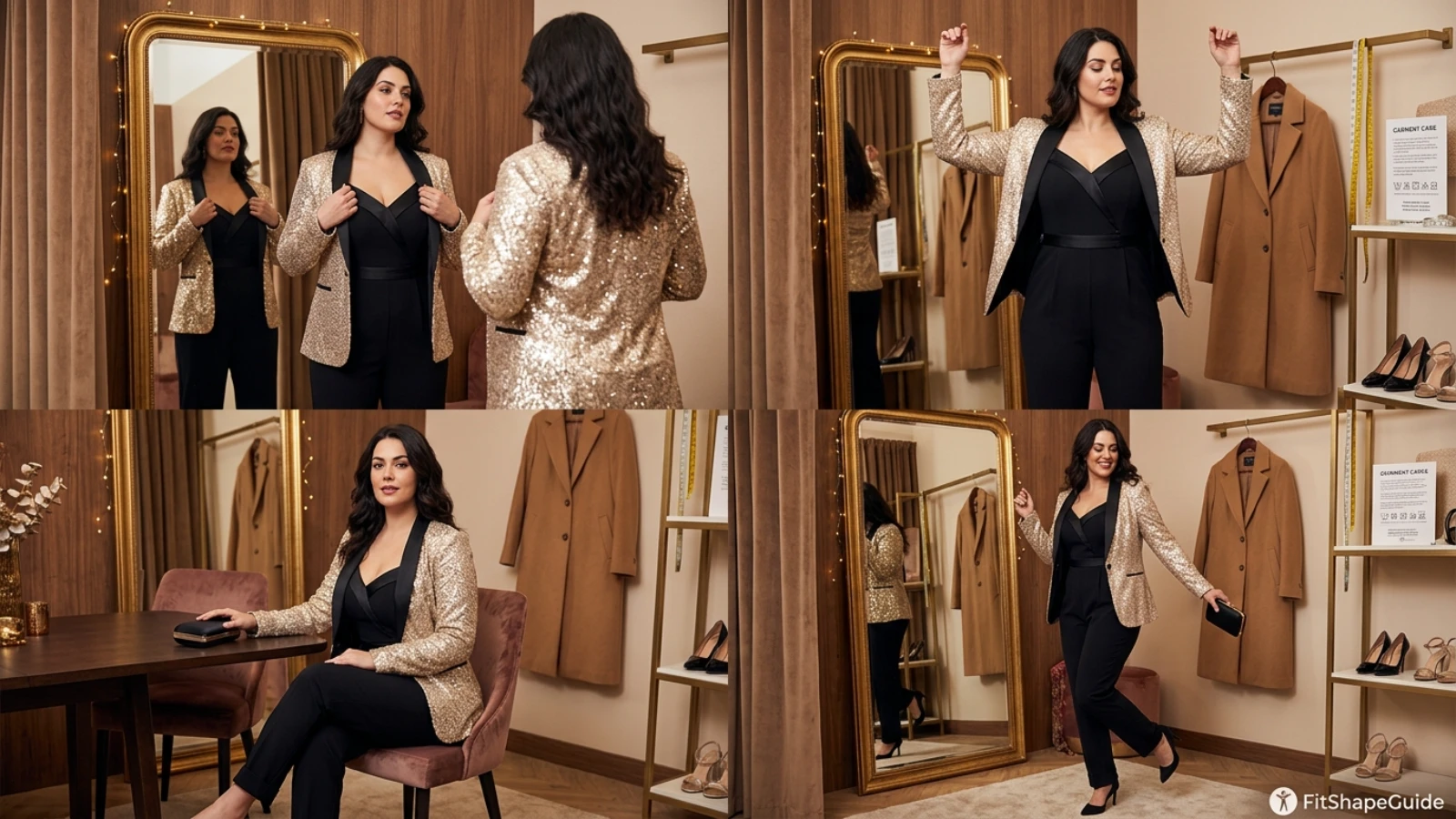
Sequin blazer with tailored trousers
Best for: modern cocktail events, restaurants and venues where a dress is not required. Sparkle sits on the outer layer while the shell underneath controls neckline and bra compatibility.
Construction: use a shaped shell, trousers with a comfortable seated waist and a blazer whose lapels, shoulders and upper arms move cleanly. Keep jewelry simpler to avoid snagging.
Trade-off: a sequin blazer can scratch the neck or underarm and catch a bag. It should look intentionally festive rather than like officewear with one accessory.
Metallic midi skirt with shaped knit
Best for: separate sizing, house parties and semi-formal dinners. The upper garment can be selected for bust depth while the skirt fits waist and hip independently.
Construction: choose a fine-gauge square, scoop or soft V-neck knit with enough front length. A-line or softly pleated skirt construction should stay calm at the waist and move at the hem.
Trade-off: metallic coatings and pleats may be care-sensitive. Thick tucks can roll the waistband, and lightweight fabric may build static over tights.
Tuxedo-style jumpsuit
Best for: dancing, city events and polished one-piece dressing. A lapel-inspired bodice and tailored trouser create evening structure without managing a skirt.
Construction: verify bust darts or princess shaping, torso length, waist placement, rise, shoulder reach and zipper access. A secure camisole can raise coverage without becoming a structural fix.
Trade-off: bust, torso, waist, hip and rise must work simultaneously. Test restroom practicality with the actual layer and fastening.
Long-sleeve cocktail dress
Best for: winter receptions, dinner and venues with repeated indoor-outdoor movement. Sleeves provide coverage while the bodice and skirt carry the festive shape.
Construction: look for stable crepe, stretch velvet or lined mesh sleeves attached to a shaped bodice. Check upper-arm room, armhole height and raised-arm recovery.
Trade-off: sleeves do not replace a coat outdoors, and tight armholes can pull the neckline upward every time the arms move.
Structured LBD with statement accessories
Best for: repeat wear and uncertain dress codes. A proven black dress can move from dinner to cocktail party through shoes, jewelry, bag and a festive jacket.
Construction: prioritize princess seams or darts, bra-friendly straps, stable neckline edges, a level waist and a skirt or vent that allows dancing.
Trade-off: black does not hide zipper strain or shallow cups under flash. The garment must pass bright-light fit before accessories earn attention.
| Formula | Festive element | Support route | Main NYE test |
|---|---|---|---|
| Velvet wrap midi | Rich pile and jewel color | Standard or plunge bra by neckline | Overlap, heat and coat crushing |
| Sequin blazer + trousers | Outer-layer sparkle | Dependable bra under shaped shell | Lapel, underarm scratch and bag snag |
| Metallic skirt + knit | Reflective lower texture | Standard bra under chosen neckline | Tuck, static and flash opacity |
| Tuxedo jumpsuit | Evening tailoring | Standard or plunge; optional secure camisole | Torso, dance and restroom access |
| Long-sleeve cocktail dress | Velvet, crepe, mesh or embellishment | Bra matched to bodice | Arm reach and indoor heat |
| Structured LBD | Statement jacket, jewelry or shoe | Previously proven bra | Flash, movement and repeat comfort |
Use our cocktail party outfit guide when the invitation uses cocktail or semi-formal language. It separates dress-code fit from garment fit before festive styling is added.

Sequins, metallics, velvet and the “sparkle map”
There is no need to avoid shine on a fuller bust, but placement should be chosen intentionally. A “sparkle map” simply identifies where texture or reflection sits: entire dress, blazer, skirt, sleeve, neckline trim, bag, jewelry or shoe. The best placement is the one attached to a garment that already fits and does not create friction, weight or instability.
All-over sequins make a strong statement, but they add weight and can reduce flexibility when sewn densely to mesh or woven backing. Inspect the base layer. Stretch mesh covered in sequins may expand, yet the lining or zipper tape may remain rigid. Raise the arms and check the underarm for scratching. Sit against a chair to see whether the back embellishment catches or feels uncomfortable.
A sequin blazer moves sparkle away from the bodice base. This can be useful when a dependable shell and bra are already proven. The blazer still needs chest depth, clean lapels and shoulder reach; leaving it open does not excuse a distorted front. A smooth bag and minimal necklace reduce snag points.
Metallic skirts and trousers let the top be selected independently. Check whether the finish is woven, coated, foil printed or knitted, because care and recovery differ. Rub an inconspicuous area gently according to the seller’s handling guidance and inspect for flaking or transfer. Flash photography may exaggerate creases, thin spots and lining boundaries.
Velvet provides light variation without hard sparkle. Pile direction changes appearance and can show crushing at the seat, bust or under a tight coat. Steam or care only as the label directs. Avoid pressing pile directly unless the garment instructions specifically permit it. Choose enough ease so the fabric is not flattened by tension across the bust.
Satin-like surfaces offer fluid shine, but the underlying weave can snag or suffer seam stress. Inspect zipper areas, darts and side seams for tiny openings. A beautiful drape does not compensate for a shallow bodice. Use the same construction standards described in our cocktail dress guide.
Flash-test everything. A fabric that seems opaque indoors may reveal lining, undergarment edges or stretched areas under flash. Photograph from the front, side and back while standing and seated. This is an objective check, not an instruction to conceal the body; it ensures the material behaves as expected.
Neckline security, front length and bra compatibility
A New Year’s outfit may be worn for six hours or more, so bra fit must work beyond the first photograph. The band should stay level and feel firm but comfortable. Cups should contain breast tissue without overflow, cutting or empty collapse. Straps should remain secure without being tightened until they dig. Current Bravissimo guidance similarly treats the band as the anchor and recommends straps that stay in place without carrying all support.
Fit the garment over the exact bra. A different bra changes bust projection, width and height, which affects darts, waist placement and neckline coverage. A full-cup or balconette may suit a wide-strap square, scoop or higher V. A plunge may clear a lower V. A strapless or convertible option needs its own movement test; do not assume the standard bra size transfers perfectly across constructions.
Front length is critical. A fuller bust uses more fabric vertically as well as horizontally. If a bodice is shallow, the waist seam rises at the front, the hem tilts and the neckline may pull downward or outward. Princess seams, curved darts, shaped cups or controlled gathers should create three-dimensional room without relying on extreme stretch.
Square necklines need strong corners and enough width. A V needs edges that stay close when leaning. A scoop should not collapse forward. A wrap front needs genuine overlap and an internal anchor. A high neck needs enough center-front length so it does not pull backward against the throat. Security is a pattern-and-edge question, not simply how much skin is covered.
Strapless NYE dresses need a firm, comfortable band and bodice support that remains stable while dancing. A corset-inspired seam is not proof of internal structure. Look for correctly placed cups, underbust anchoring, boning or stable panels when claimed. Test sitting because longline bands and boning can feel very different after a full meal.
Fashion tape controls a suitable edge; it does not create missing cup volume or replace a band. If used, follow directions, patch-test and apply only to suitable intact skin. A discreet snap or stitch can stabilize a nearly correct wrap edge. If the crossover lacks fabric width, choose a different garment rather than tightening it until breathing or movement is restricted.
Coats, sleeves, hosiery and temperature changes
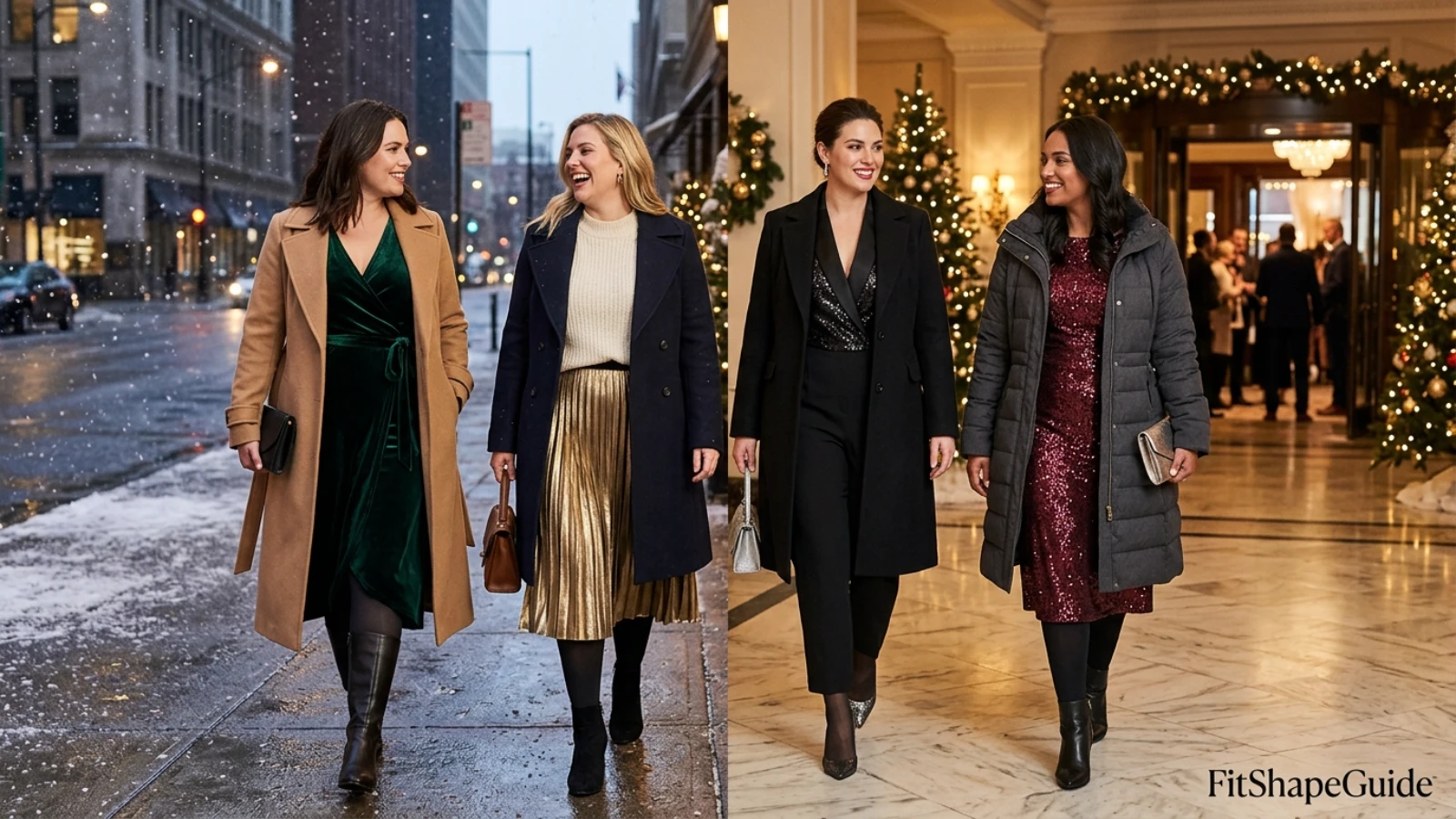
New Year’s Eve often combines cold travel with a warm, crowded venue. Dressing only for one environment creates predictable discomfort. Start with a real coat rated by your own climate experience, then fit it over the actual outfit. The coat should close without compressing the bust, the sleeves should fit over the garment, and the hem should not trap a full skirt or wide trouser.
A shaped wool coat, insulated dress coat or polished weatherproof layer can preserve formality. A two-way zipper may improve sitting when available. If the venue has a coat check, confirm that the base outfit remains complete without the coat. If you will stay outdoors at midnight, the coat becomes part of every photograph and should not be treated as an afterthought.
Blazers work indoors but are not winter coats in cold climates. A sequin or velvet blazer can be the festive layer under a larger coat. Check combined shoulder and upper-arm room. Two tight armholes stacked together can pull the inner neckline upward. The same lapel and chest-depth principles in our blazer guide remain useful even when the fabric becomes more festive.
Long sleeves add coverage but may trap heat. Mesh sleeves feel lighter but can snag. Velvet and dense crepe sleeves need upper-arm ease. Bell or embellished cuffs may enter food or catch jewelry. Raise the arms with the coat on and off to confirm that the bodice resettles.
Hosiery changes friction. Tights can create static under satin, metallic and lightweight skirts. Test the exact pair, not a bare-leg fitting. A slip may reduce cling when it fits smoothly and does not alter the waistband. Carry a compatible anti-static solution only when the garment care permits it.
Footwear must handle wet pavement, stairs, standing and dancing. A stable block heel, refined flat, polished boot or lower heel can all suit the event. Check sole grip and hem clearance. If packing backup flats, test the garment length with both shoes; a long hem fitted to heels may drag after the change.
Dancing, sitting, bags and late-night comfort
Dancing tests vertical and rotational movement. Raise the arms, turn, step sideways and bounce lightly. The bra band should stay level, the neckline should return, the waist should not climb and the skirt or trouser should permit a normal stride. Dense sequins add weight; a weak neckline may be pulled downward as the garment moves.
Wrap dresses and skirts require a separate overlap test. Sit with one leg forward, walk into a fan or safe outdoor breeze, and turn quickly. Internal buttons, ties or snaps should anchor an already adequate overlap. If the panel opens broadly, more fabric is required. Our wrap dress guide explains panel width, tie placement and neckline control in detail.
A backless or cutout outfit changes the support route. Decide whether you will use a conventional bra preserved by the cutout, a low-back solution, garment structure or an adhesive product before buying the dress. Heat and perspiration can affect adhesives. Use our backless dress guide for support-first checks rather than relying on fashion tape.
Seating can reveal problems that dancing does not. A structured waistband may dig after dinner; a short skirt may rise; a jumpsuit torso may pull; boning may press; and a low neckline may open when leaning. Sit in a dining chair and a soft seat because the torso angle differs. Keep only garments that allow full breath without unfastening.
Bags create pressure and snag points. A crossbody strap may compress the bust, shift a wrap neckline or roughen sequins. A shoulder bag may catch sleeve embellishment. A clutch avoids straps but occupies one hand. Test how you will hold a phone, drink and coat at once; convenience is part of the outfit.
For separate sizing, pair a shaped top with a skirt whose waistband and movement already work. Our skirt guide compares A-line, pleated, bias, denim and column behavior. If the event is more formal than festive cocktail, apply the same long-event, venue and ceremony-level checks used for formal guest dressing.
Online shopping, alterations and a repeatable NYE capsule
Write the event conditions before shopping: dress code, venue, indoor/outdoor time, dancing, transport, coat storage and likely weather. Then record bust, underbust, preferred neckline coverage, comfortable waist, torso length, hip, garment length and shoe height. Compare those with the exact seller chart and garment measurements, not a remembered size from another brand.
Read construction details before marketing language. Useful terms include princess seams, darts, adjustable straps, full lining, underbust seam, internal fastener, back or side zip, stretch composition, vent, wrap overlap and garment length. “Party,” “sparkly,” “corset” and “sculpting” do not prove fit or structure.
Inspect listing photographs for front, side, back and movement. Hair, arms, coats and bags can hide straps, low backs and side coverage. Zoom into zipper seams, underarms and embellishment edges. Save the listing and size chart because marketplace details, sellers and materials can change.
Review evidence is most useful when it includes measurements, bra size system, ordered size, support garment and time worn. Repeated comments about a short bodice, scratchy sequins, weak zipper, static, riding hem or overheating deserve attention. A reviewer saying “very flattering” or “no bra needed” does not establish construction for everyone.
Alterations can improve a strong near-fit. A tailor may shorten straps, stabilize a neckline edge, refine a waist, hem a skirt or trouser, add bra keepers or secure a suitable wrap. Creating missing bust projection, replacing shallow built-in cups or rebuilding an armhole is more complex. Get the assessment before tags are removed or the return deadline passes.
Read the sewn-in care label before wearing. The FTC’s current Care Labeling Rule requires regular care instructions on covered clothing. Sequins, velvet, metallic finishes, bonded fabrics and mixed linings can have different limits. A garment that requires specialist care after one night may still be worthwhile, but that cost belongs in the buying decision.
A repeatable festive capsule needs fewer risky bodices: one proven LBD or jumpsuit, one shaped evening top, one metallic or satin skirt, one festive blazer, one real coat and two shoe options. Combine these rather than buying an untested neckline every December.
| NYE checkpoint | Evidence to confirm | Warning sign | Better response |
|---|---|---|---|
| Bust and neckline | Seams align; edge returns after movement | Spillage, collapse, pull or exposed bra | More projection or different neckline |
| Festive surface | Secure embellishment, calm seams, compatible lining | Snagging, scratching, flaking or seam slippage | Move sparkle to layer/accessory |
| Indoor comfort | Full breath and seated ease after ten minutes | Heat, digging waist or rigid boning | Lighter layer or more compatible construction |
| Outdoor transition | Coat closes; hem and shoe handle conditions | Compressed bust, trapped hem or unsafe sole | Different coat, hem or footwear |
| Movement | Neckline, straps and waist resettle | Riding, opening or repeated adjustment | More overlap, recovery or secure anchor |
| Care and value | Label, alteration cost and repeat use understood | Unmanageable care or final-sale uncertainty | Choose repeatable capsule piece |
Common NYE outfit problems and practical fixes
Sequins scratch the arms or neck
Check whether the embellishment ends at raw underarm or neckline edges. A properly finished binding or facing can help, but widespread scratching usually requires a different garment. Moving sequins to a blazer, skirt, bag or shoe keeps the festive effect away from sensitive areas.
The waist rises after the coat comes off
The coat armhole or upper back may pull the dress upward, or the bodice may lack front length. Test the dress alone and then with the coat. Choose more coat reach or a bodice with greater projection rather than repeatedly pulling the waist down.
The neckline opens while dancing
Check edge length, cup volume, strap placement and bra shape. A minor snap or tape may control a nearly correct edge; major movement needs a more stable neckline or better-fitting bodice. High coverage is not automatically secure if the pattern is shallow.
Static makes the skirt cling to tights
Test a compatible slip, different hosiery or garment-safe anti-static method according to care instructions. Humidity and fiber combinations affect static. Do not spray an untested product onto metallic coatings, sequins or delicate velvet.
The strapless bra slides down
Recheck band and cup fit; a strapless design relies strongly on the band and its own construction. The dress should not push the bra downward. If the combination fails movement, choose a neckline with straps or sleeves rather than tightening until uncomfortable.
The outfit looks like officewear
Keep the well-fitted tailored base and change texture, shell, shoe, bag or jewelry. A sequin blazer, velvet jacket, metallic skirt or evening shell raises formality more effectively than a random novelty accessory. Fit remains the foundation.
The long hem becomes unsafe with backup flats
Hem for the lowest shoe you realistically expect to wear, or choose a cropped trouser or midi length. Temporary lifting methods can distort the garment or fail while dancing. Floor clearance is a safety and care issue.
The outfit becomes too hot indoors
Separate the warmth layer from the festive base when possible. A real coat plus a lighter dress or shell is often more adaptable than heavy fabric everywhere. Check whether the venue has coat storage and avoid underlayers that cannot be removed discreetly.
Build one secure base, then decide where the celebration goes
The most versatile NYE choice is a proven shaped base—velvet wrap midi, tailored jumpsuit, long-sleeve cocktail dress or structured LBD—with one festive surface or accessory. Use separates when independent bust, waist and hip sizing will improve fit.
Venue comes first, then bra and bodice, then sparkle. Test flash, dining, dancing, coat, bag, weather and late-night transport. The winning outfit is the one that still feels intentional after midnight without requiring you to manage it constantly.
Frequently asked questions
What New Year’s Eve outfit is best for a large bust?
A shaped velvet wrap-style midi, tailored jumpsuit or structured LBD is a strong starting point. Festive separates also work well because the top and bottom can be sized independently. Choose by venue, support needs and movement.
Can someone with a large bust wear sequins?
Yes. Sequins can cover a dress, blazer, skirt, sleeve or accessory. The base garment must first provide genuine bust room, stable seams and comfortable edges. Move sparkle away from the bodice if weight, scratching or fit becomes a problem.
What neckline works for a New Year’s Eve outfit with a large bust?
Secure V, square, scoop, wrap and higher necklines can all work when they provide enough center-front length, stable edges and coverage for the planned bra. The neckline should return after leaning and dancing.
What bra should I wear under a NYE dress?
Use a well-fitting standard, balconette, plunge, strapless or convertible bra that matches the garment’s neckline and straps. Fit the exact bra and outfit together, then test sitting, raised arms, coat layering and dancing.
How do I stay warm in a festive NYE outfit?
Use a real climate-appropriate coat that closes over the bust, then keep the indoor base adaptable. Test sleeve and shoulder layering, tights, shoe grip and hem clearance. A blazer is an indoor layer, not a substitute for a winter coat.
Are pants or jumpsuits suitable for New Year’s Eve?
Yes. Dressy trousers with a shaped evening top and festive blazer, or a tailored jumpsuit with secure bust construction, can meet festive cocktail attire. A black-tie invitation may require a more formal interpretation.
How should I test a New Year’s Eve outfit before buying?
Wear the exact bra, coat, bag, hosiery and shoes; photograph with flash; then sit, breathe, lean, raise both arms, walk, climb a step and dance. Every component should resettle without repeated adjustment.
What should I pack for an NYE outfit emergency?
Carry only garment-compatible essentials for minor issues: a spare closure pin, blotting paper and a suitable anti-static option if needed. A backup kit should not be expected to rescue an unstable neckline, inadequate overlap or poor bra fit.
Related FitShapeGuide guides
Editorial and verification standards
This guide evaluates invitation language, venue, garment construction, bra compatibility, festive surfaces, winter layers, movement, care, alterations and returns. Festive-attire ranges were checked against the Emily Post Institute’s current attire guidance. Bra-fit and strapless principles were checked against Bravissimo’s current fitting guidance. Care-label requirements were checked against current Federal Trade Commission apparel guidance.
No outbound source link appears in the visible article. FitShapeGuide does not invent product names, ASINs, prices, ratings, review counts, sellers, materials, stock or performance. Before an Amazon module is published, verify the direct listing, current seller, size chart, garment measurements, fiber content, care, returns and image rights; place a clear affiliate disclosure near the recommendations.
“Best” means the most suitable verified outfit for an individual body, support preference, venue, climate and activity—not a promise that one neckline, festive fabric or support method works for everyone.