Best Skirts for a Large Bust
A construction-first guide to skirts that stay secure at the waist, move comfortably through the hip and coordinate with fuller-bust tops—without treating one silhouette as a rule for every body.
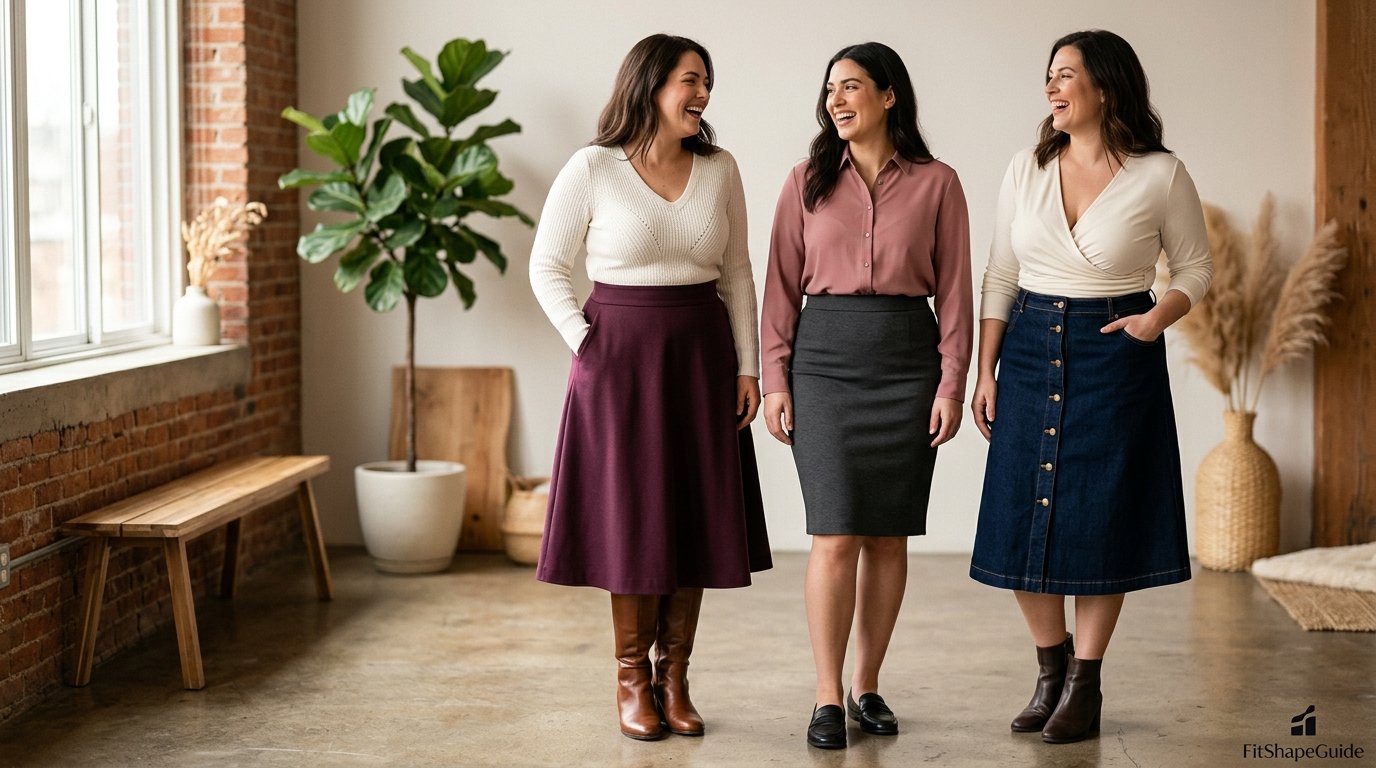
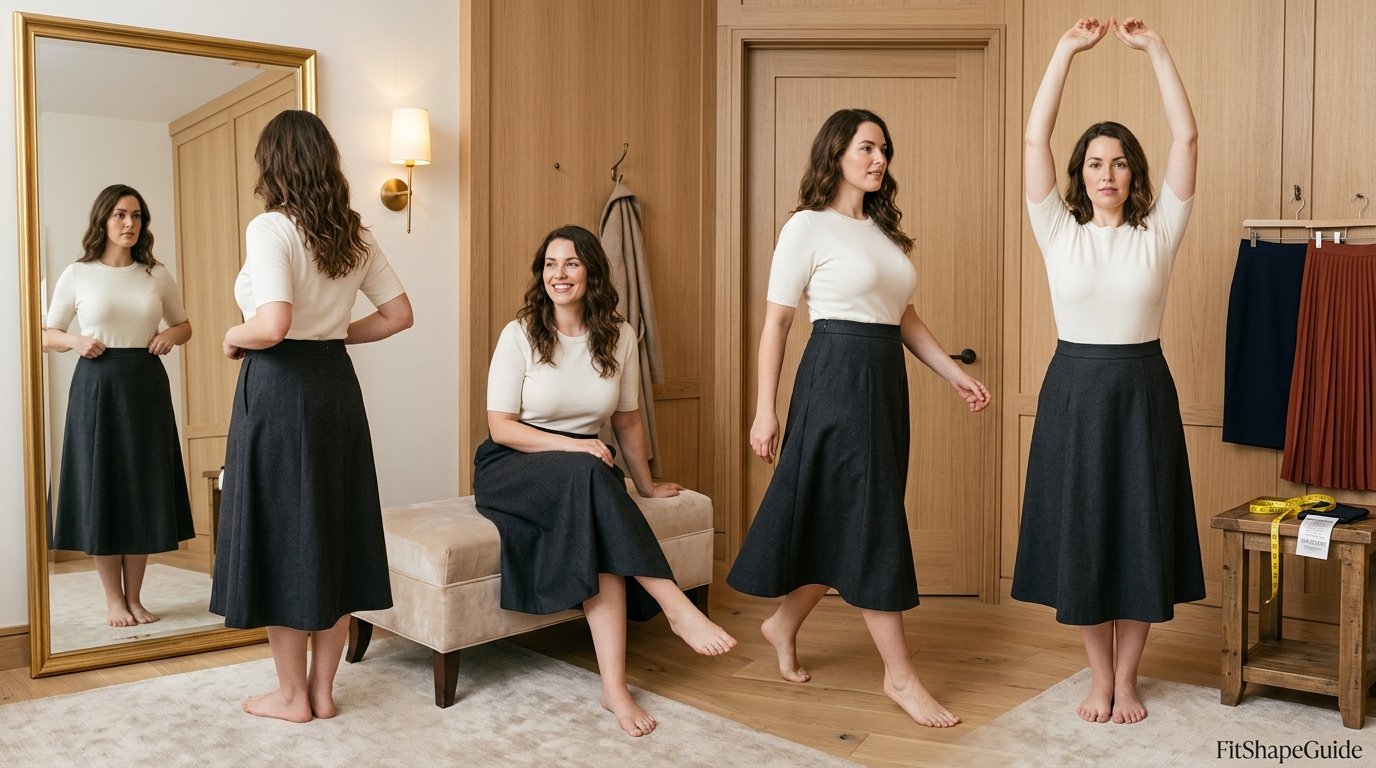
The two-minute skirt fitting test
- Wear the bra, top and underlayers planned for the outfit; they change the waistband junction.
- Fasten the skirt without pulling it above or below its intended rise.
- Sit for thirty seconds, cross one leg and lean forward as you would at a desk.
- Stand, take six long steps, climb one stair and check whether the skirt resettles.
- Use the pockets, test the vent or wrap overlap and confirm the lining does not twist.
- Raise both arms and check that the top stays connected to the waistband without exposing or bunching.
If you need to keep pulling the skirt down, rotating it forward or rearranging the top, the outfit is not stable enough yet. A different rise, waistband, fabric or top length is more useful than styling tricks.
How a skirt should fit before you style it
A skirt interacts with a fuller bust indirectly. The bust changes how a top falls, where its front hem lands and how much fabric enters the waistband. It may also change the apparent distance between bra band and skirt waist. None of that means the skirt must be wide, dark or high-waisted. It means the upper and lower garments must meet cleanly and remain comfortable during real movement.
Begin with waist and hip measurements rather than the size worn in another brand. The official Levi’s measurement guidance treats waist and fullest hip as separate measurements, which is exactly why a single size label cannot describe skirt fit. Compare those body measurements with the garment chart and, where available, actual waistband, hip and length measurements. If your waist and hip fall into different sizes, a curvy cut, elastic-back waist, adjustable construction or alteration may solve the mismatch more cleanly than sizing only for one point.
Next identify the intended rise. A high waist may create a stable anchor for a tuck, but it can contact the lower ribcage or bra band while seated. A mid rise can leave more torso clearance and accommodate a longer top. A lower rise changes the top length needed to avoid repeated untucking. The best rise is the one that stays level without pressure, not the one attached to a universal “flattering” claim.
Check the hip path from front, side and back. Horizontal drag lines usually indicate that the fabric is being asked to travel farther than the pattern allows. Diagonal lines toward a pocket, zipper or vent identify a local stress point. A side seam that swings forward or backward can reveal imbalance between front and back room. A skirt may technically zip while still failing these checks.
Finally, look at movement. A-line and full skirts gain stride room from sweep. Pencil and column skirts need stretch, a vent, slit or walking ease. Wrap skirts need overlap. Bias skirts need enough ease to hang rather than cling. Pleated skirts need pleats that remain controlled at rest and release for movement. Construction—not the silhouette name—determines whether the skirt works.
| Fit area | Good evidence | Warning sign | Better response |
|---|---|---|---|
| Waistband | Level, secure and comfortable sitting | Rolling, gaping, digging or zipper strain | Contoured band, elastic-back waist or alteration |
| Hip and seat | Fabric hangs without drag lines | Pockets flare, pleats open or seams swing | More hip room, different cut or curvy proportion |
| Front closure | Zip, buttons or wrap lie flat | Fly buckles, snaps pull or overlap opens | More ease, firmer overlap or side/back closure |
| Movement | Normal stride, stairs and sitting feel natural | Short steps, riding up or twisting lining | Vent, stretch, wider sweep or different length |
| Top junction | Top stays smooth enough after movement | Hem escapes, bunches or forces waistband down | Longer front, thinner tuck or waist-length top |
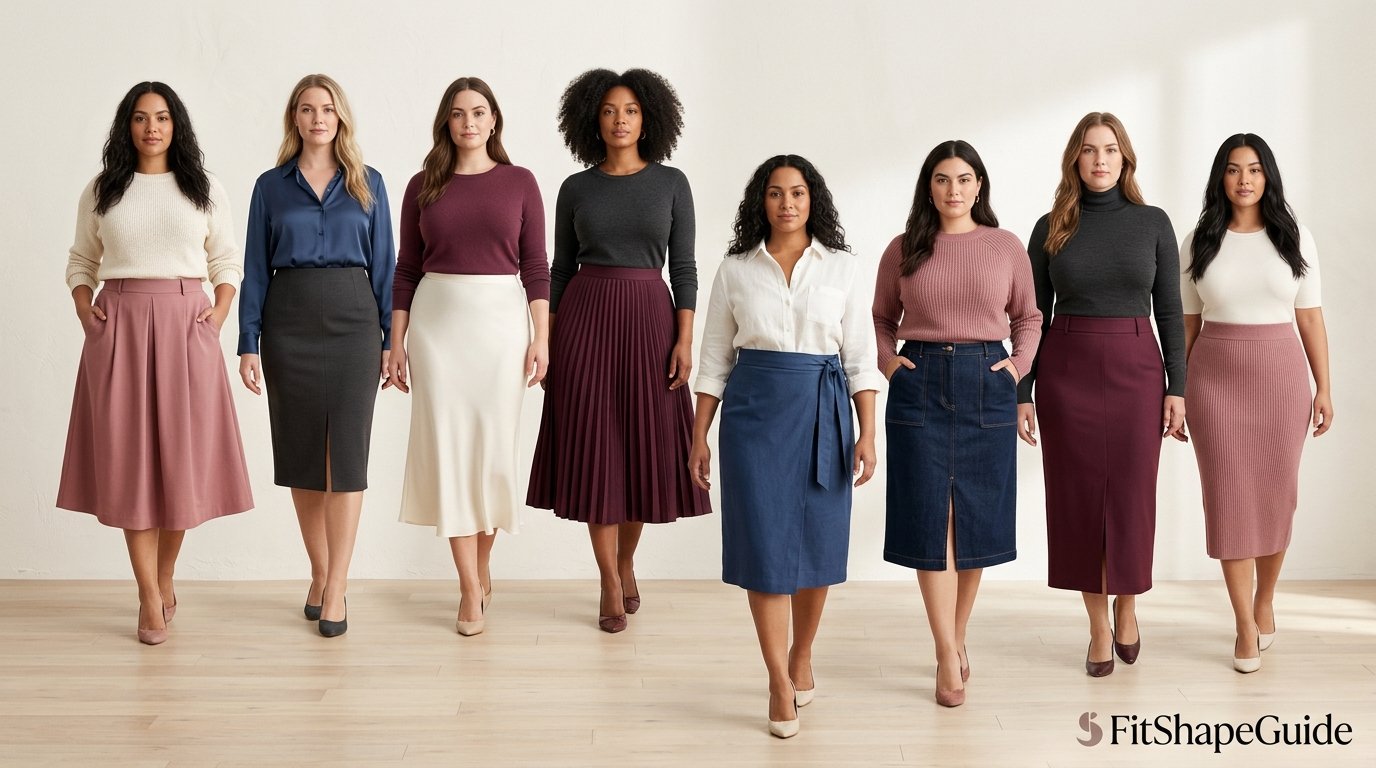
Eight skirt styles compared for a fuller bust
A-line midi skirt
Best overall starting point: a fitted waist with gradual release through the hip gives standing and seated ease without requiring stretch. A midi length works across casual, work and occasion wardrobes.
Trade-off: too much gathering at the waist can add bulk under a fuller-bust top. Look for darts, panels or controlled pleats when you want a cleaner upper line.
Ponte pencil skirt
Best for polished structure: a stable double knit can skim the hip while recovering after sitting. A flat waistband and purposeful vent make it useful for work.
Trade-off: “stretchy” does not guarantee stride room or recovery. A narrow skirt without a vent may restrict walking even when the fabric expands.
Bias-cut midi skirt
Best for fluid drape: fabric cut on the bias can follow the body softly and create movement without waist gathering. It pairs well with compact knits and shaped tops.
Trade-off: lightweight satin-like cloth may cling, show underwear lines or grow unevenly. Check side seams, opacity and hem after the skirt has hung.
Pleated midi skirt
Best for movement and texture: stitched-down or narrow pleats can remain controlled at the upper hip and open lower down. The sweep makes walking easy.
Trade-off: pleats that begin under a thick elastic waist can create volume exactly where a tucked top also adds bulk. Inspect whether pleats lie calmly while standing.
Wrap skirt
Best for adjustable waist fit: ties, internal buttons or multiple fastenings can accommodate small waist changes and create a diagonal line.
Trade-off: the overlap must remain closed when sitting, walking and in wind. A decorative wrap with minimal overlap is not a secure option for an active day.
Denim midi skirt
Best for structured casual outfits: denim gives the lower outfit a clear line and works with tees, knits, shirts and jackets. A front or back vent can restore stride.
Trade-off: rigid denim, five-pocket construction and a heavy fly can add bulk and restrict sitting. Stretch denim may feel easier but still needs recovery.
Column or straight skirt
Best for a clean vertical silhouette: a straight cut can look minimal and modern, especially in suiting, ponte or substantial jersey.
Trade-off: hip ease and vent placement are decisive. If the skirt narrows below the hip without enough stretch or opening, the wearer compensates with shorter steps.
Pull-on knit skirt
Best for comfort and travel: a wide flat elastic band and stable knit can distribute pressure and simplify long periods of sitting.
Trade-off: weak elastic may roll, thin jersey may cling and pocket weight may drag the waist down. Recovery matters more than maximum stretch.
| Skirt style | Upper construction | Movement source | Useful top relationship | Main trade-off |
|---|---|---|---|---|
| A-line midi | Darts, panels or controlled waist | Hem sweep | Shaped tuck or waist-length top | Gathering can add bulk |
| Ponte pencil | Flat band, stretch knit | Stretch plus vent | Non-gape shirt, shell or fine knit | Recovery and stride vary |
| Bias-cut midi | Minimal waist bulk | Bias give and fluidity | Compact knit or smooth tuck | Cling, opacity and seam drift |
| Pleated midi | Elastic or fixed band, pleats | Pleat expansion | Thin full tuck or short top | Waist/hip volume |
| Wrap | Tie, button or buckle | Overlap and hem sweep | Secure neckline and smooth front | Opening risk |
| Denim midi | Structured band and fly | Vent, slit or stretch | Tee, bodysuit, shirt or short knit | Weight and stiffness |
| Column/straight | Clean fitted block | Vent or adequate ease | Shaped top or longer blazer | Restricted stride |
| Pull-on knit | Flat elastic waistband | Knit stretch | Untucked, front tuck or thin tuck | Rolling and cling |
Waistband, rise and hip ease matter more than “balance”
A waistband is the anchor for every skirt. A straight band is cut as a relatively simple strip and works well when the body shape and skirt position do not require much contour. A contoured band is shaped to follow the difference between waist and upper hip; it can reduce back gaping when waist and hip measurements differ. Elastic-back and hybrid bands allow adjustment while keeping the front cleaner. None is automatically superior—the best choice depends on placement, fabric and how much change occurs between waist and hip.
Try the skirt at the height where it naturally settles. If it immediately climbs toward the narrowest point, the hip may be too tight or the pattern may not match your shape. If it descends and turns, the waist may be too loose, pocket weight may be pulling it or the skirt may lack internal grip. Do not rely on a belt to correct significant imbalance; a belt can hold excess fabric but may create folds under a tucked top.
For a high-rise skirt, sit long enough for your torso to relax. The waistband should not press into the lower ribs, meet the bra band uncomfortably or fold at the front. This interaction can be more noticeable with a fuller bust because the top and bra already occupy the upper torso. The same seated-clearance logic discussed in our high-waisted jeans guide applies to skirts, even though a skirt has no crotch seam.
At the hip, inspect pocket openings, darts, pleats and zippers. Pockets that flare may mean the hip needs more space, the pocket angle is incompatible or the waistband is being cinched too firmly. Pleats that stay spread while standing are often supplying missing hip room. A side zipper that bows can indicate tension across the waist or high hip. These signals are more reliable than the front-view silhouette alone.
Length, vents, overlap and real movement
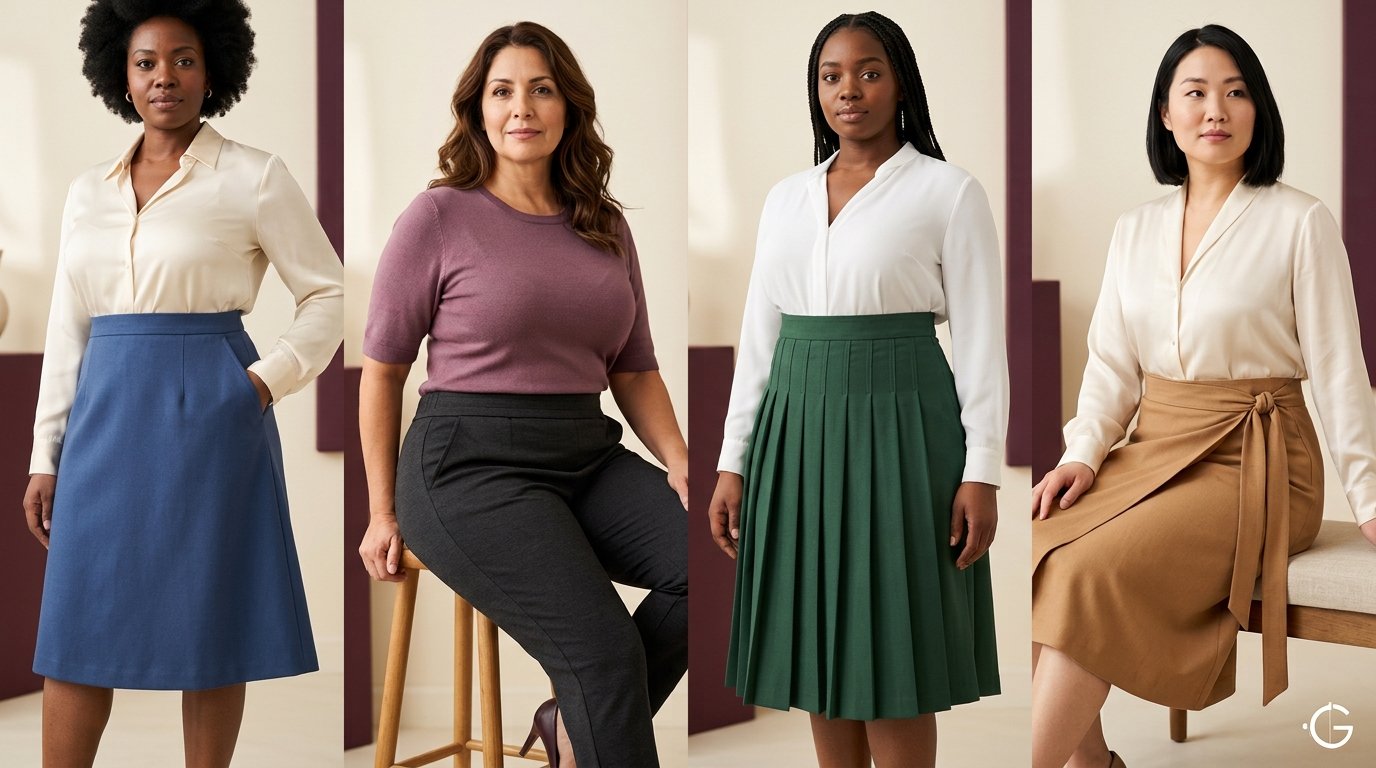
Mini, knee, midi and maxi are broad categories, not precise measurements. The same listed length lands differently according to height, torso-to-leg proportion, skirt rise and waistband width. Use the garment’s waist-to-hem measurement when available, then compare it with a skirt you already own. Measure from the top edge of the waistband, not from the body’s natural waist unless that is exactly where the garment sits.
A shorter skirt needs enough ease to remain in place while walking and sitting. If it climbs at the front or back, check hip room, fabric friction and lining before blaming the length alone. A knee-length pencil needs a vent or stretch that permits a normal stride. A midi can offer coverage and versatility, but a rigid column midi still restricts movement. A maxi needs stair and footwear clearance, especially when its fabric is fluid or the hem is wide.
Vents and slits are functional components. Test the opening at the longest natural stride, when stepping into a car and when climbing stairs. A back vent can pull open if the seat is tight. A front slit may become more exposed while seated than while standing. A side slit can work well but may reveal more during cross-legged sitting. The right position depends on your activity and coverage preference.
For a wrap skirt, separate total skirt width from functional overlap. Sit and place one leg forward. If the inner panel no longer covers the intended area, the overlap is insufficient even if the waist feels adjustable. Look for an internal button, snap or tie that anchors the underlayer. In wind, a heavier hem or more generous overlap is safer than relying on fashion tape as the primary structure.
Walking is not the only test. Bend to retrieve something, reach overhead, carry a shoulder bag and put on a coat. Bags can catch pleats or rotate a soft skirt. A long coat may grip a textured fabric and pull it upward. Tights can increase static under an unlined skirt. If the outfit is intended for work, travel or an event, test those specific conditions before removing tags.
Fabric, stretch, lining and care
Fabric controls whether a skirt holds a clean shape, follows the body, swings away from it or changes after sitting. Medium-weight woven suiting supports darts, panels and A-line shapes. Denim holds structure but may feel stiff around the waist and seat. Fluid viscose, satin-like weaves and crepe can create beautiful movement but need opacity, static and snag checks. Linen breathes well and develops creasing as part of its character. Jersey stretches easily but may cling or grow.
Ponte is useful for pencil, column and pull-on skirts because it is a stable double knit. CottonWorks explains that double knits are generally heavier and more stable than single knits, and identifies Ponte di Roma as thicker and more stable than interlock, with good recovery when made with stretch yarns. That makes ponte a promising construction—not a guarantee. Weight, fiber blend, stitch density, waistband and vent still vary by garment.
Stretch measures how far fabric can expand; recovery describes how well it returns. Pull the skirt gently at the hip and waistband, release it and observe whether it immediately returns. Then sit for several minutes and inspect the seat and knees. A very stretchy skirt with poor recovery may become loose during the day, while a stable fabric with modest stretch may hold its line better.
Bias-cut cloth behaves differently from mechanical stretch. The diagonal grain allows the material to yield and drape, but it can also lengthen unevenly. A new bias skirt may need time to hang before hemming. Side seams should remain close to vertical rather than spiraling. Because fine bias fabrics can reveal seams and underlayers, inspect the garment in daylight and under bright indoor light.
Lining should support rather than fight the shell. It needs enough hip and stride room, smooth seams and a compatible length. A non-stretch lining inside a stretch shell can become the real restriction. A short lining under a fluid skirt may create a visible horizontal line. If static is likely, test with the tights, slip or underwear intended for the outfit.
Read the care label before buying. A skirt that requires pressing after every wear may not suit a low-maintenance capsule. Denim can transfer dye onto light tops or bags. Pleats may require careful steaming or professional care to retain shape. Delicate bias fabrics can snag against desks and jewelry. Purchase price is only one part of practicality; care time and alteration cost matter too.
What tops to wear with skirts and a large bust
The top-skirt junction is where many outfits either become stable or require constant adjustment. A fuller bust often uses more of a top’s front length, so a shirt that appears long on the hanger may become too short for a high-waisted skirt. Check the front hem while standing, sitting and raising the arms. If the back stays tucked but the front escapes, choose more front length, a different tuck or a top designed with bust shaping.
A full tuck works best when the top is thin enough for the waistband and long enough to remain anchored. Bust darts, princess seams, stretch recovery and no-gape plackets create shape without requiring the waist to absorb a large amount of fabric. Our guide to the best tops to tuck into jeans explains the same front-length and hem-bulk checks; those principles transfer directly to skirts.
A waist-length untucked top can meet the waistband without adding tuck bulk. It should finish deliberately near the waistband rather than at the widest part of the hip by accident. A fine knit shell, shaped tee or cropped-to-waist cardigan can work. “Cropped” here describes garment length, not exposure: the hem can meet a high-rise skirt with full coverage.
A secure wrap or surplice top can echo a wrap or A-line skirt, but neckline stability comes first. Look for enough front coverage, a fixed overlap or discreet internal fastening. A button-down needs a placket that stays vertical and closed through reaching. A bodysuit removes untucking but must have enough torso and bust length; excessive vertical tension can pull the neckline down or make the shoulders uncomfortable.
Layers should not trap the skirt. A blazer ending near the high hip works with many A-line, pencil and pleated styles, provided the jacket closes or hangs cleanly over the bust. For office outfits, the construction tests in our large-bust blazer guide help with lapel behavior, shoulder reach and seated comfort. A denim jacket can create a compact upper layer with a softer skirt; compare closure and hem options in our denim jacket guide.
| Skirt | Reliable top starting point | Why it works | Check before buying |
|---|---|---|---|
| A-line midi | Shaped tee, fine knit or non-gape shirt | Clean waist with released hem | Gathering plus tuck bulk |
| Ponte pencil | Fluid shell, fitted knit or tailored shirt | Soft top can contrast stable lower line | Top riding above flat waistband |
| Bias-cut midi | Compact knit or smooth waist-length top | Preserves fluid drape | Rough hems catching delicate fabric |
| Pleated midi | Thin tuck, bodysuit or short cardigan | Limits waistband bulk | Pleats forced open by top fabric |
| Wrap skirt | Secure V-neck, crew knit or camisole plus layer | Keeps one adjustable element dominant | Two unstable overlaps competing |
| Denim midi | Shaped tee, shirt, knit polo or wrap top | Balances denim structure with upper flexibility | Fly and full tuck becoming bulky |
| Column skirt | Shaped untucked top or longer blazer | Maintains clean vertical line | Too many tight layers restricting movement |
| Pull-on knit | Fine knit, tunic-length layer or partial tuck | Works with flexible waistband | Elastic rolling under thick fabric |
For a work capsule, start with one stable neutral skirt and test it with at least three tops already owned. The outfit formulas in our business-casual guide can help separate ordinary desk days from presentations and client-facing situations. For a wider lower silhouette, compare the different waist and top relationships in our wide-leg pants guide.
A practical shopping and alteration plan
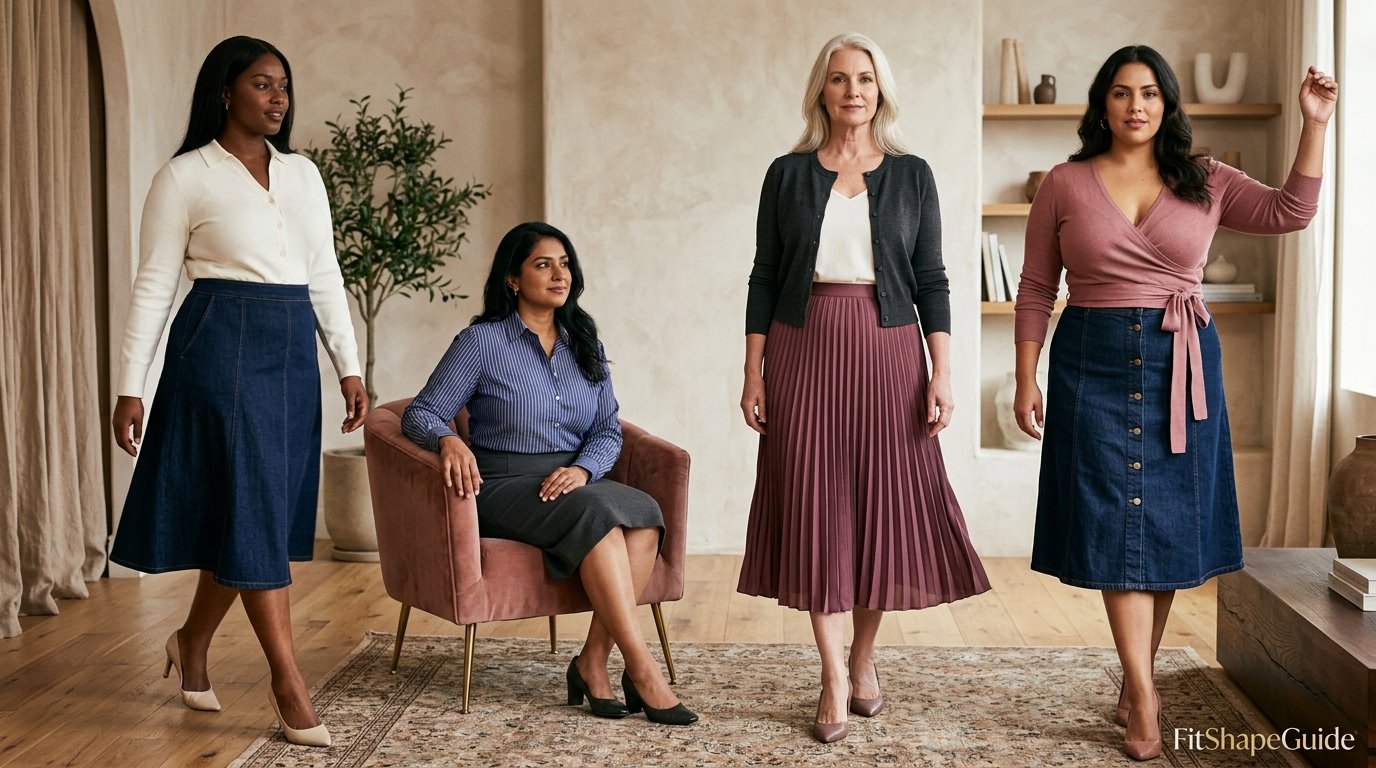
Before shopping, record four body or garment references: preferred waistband circumference, fullest hip, comfortable waist-to-hem length and the rise position where a skirt stays level. Add the measurements of one skirt that already works. Brand size charts are useful only when paired with the exact garment’s cut, stretch and intended ease. If a product page supplies only a generic chart, verify return terms before committing.
Bring or wear a realistic top. A thick sweater changes waistband pressure; a silky blouse tests grip; a bodysuit changes vertical tension. Use the intended shoes for a maxi or long midi. If the skirt is for work, sit at desk height. If it is for an event, walk quickly, turn, climb stairs and test the bag or coat.
Inspect inside construction. Look for smooth zipper installation, finished seams, a lining with enough ease, firmly attached hooks, secure wrap fastenings and a vent that returns to position. Check pattern matching at prominent seams when relevant. On pleated skirts, compare whether pleats are permanently set, stitched down or dependent on pressing. On denim, inspect fly bulk, pocket depth, hem weight and dye transfer risk.
Alterations can make a strong near-fit excellent. Taking in the waist may work when the hip, darts and zipper already fit; the tailor must preserve waistband shape and distribute the change. Hemming an A-line or pencil is usually straightforward, while shortening a pleated, bias, bordered or unusually shaped hem can be more complex. Moving or extending a vent changes function and may affect lining. Ask for an alteration quote before treating a sale purchase as inexpensive.
A useful two-skirt capsule is not defined by color alone. Choose one structured option—such as denim, ponte or tailored A-line—and one fluid option—such as bias, pleated or soft wrap. Each should work with at least three tops and two shoe types. Photograph complete outfits so you can compare actual repeatability rather than an isolated fitting-room impression.
- Keep: the waistband stays level, hip lines remain calm, stride feels normal and the top connection survives movement.
- Alter: the hip and movement are excellent but the waist or hem needs a manageable correction.
- Return: the skirt twists, rides up, restricts walking, exposes an insecure wrap, or requires constant top adjustment.
Common skirt problems and the most likely fixes
The skirt rotates while walking
Rotation can come from an uneven fit between waist and hip, asymmetry, a side seam or zipper under tension, a twisted lining, or the friction of a bag. Empty the pockets and test without the bag. If the skirt still turns, compare the side seams and waistband from front and back. A different cut or alteration is more reliable than repeatedly rotating it into place.
The waistband rolls or folds
A band may roll because it is too tight, too soft, too high for the seated torso or overloaded by a thick tuck. Test with a thinner top and at a lower natural settling point. A wider band is not automatically better; it needs adequate structure and compatible placement. If the band touches the ribcage or bra band while seated, try a mid-rise skirt.
The front hem appears shorter
The skirt may be tilting because it needs more front hip or abdomen room, or the waistband may be rising at the front. Check the side seam and waistband level. A top can also create the illusion by ending at different heights over the bust. Photograph the skirt with the top removed or lifted to separate garment fit from styling.
Pleats spread open at the hip
Pleats are designed to create controlled volume, but they should not remain fully strained at rest unless that is the intended style. Try a size or cut with more hip ease, stitched-down pleats or pleats beginning lower on the body. Do not press stretched pleats flat; pressing cannot replace missing room.
The pencil skirt climbs upward
Riding up often means the skirt is seeking a narrower point because the hip is tight, the fabric grips the underlayer or the cut narrows too quickly. Test a larger hip measurement, more stable stretch, a straighter column or a smoother slip. More waistband tightness may worsen the problem.
The wrap opens while sitting
More overlap is the primary answer. An internal fastener or discreet snap can support an already adequate wrap, but it should not be used to stretch inadequate panels across the body. Test seated coverage before relying on fashion tape. For windy or high-movement days, choose a mock-wrap or fully sewn skirt.
The top will not stay tucked
Check top front length, armhole and bust room before blaming the skirt. A longer shirt, bodysuit, partial tuck or waist-length untucked top may work. Reduce fabric bulk inside a narrow waistband. If the skirt itself descends during movement, address waist fit or pocket weight as well.
The lining twists or catches
Confirm that the lining is not smaller than the outer skirt, caught in a seam or affected by static. Test with the intended tights. A slip may help friction, but a structurally short or tight lining needs alteration or a different garment. The shell cannot move correctly when its lining acts as a restraint.
Choose the skirt that stays calm while you move
For the broadest versatility, start with an A-line midi that fits the waist and releases cleanly through the hip. Choose ponte pencil or column styles for stable polish, bias or pleated skirts for movement, denim for casual structure, and wrap or pull-on designs when their fastenings and recovery truly work.
The fuller bust does not create a required skirt silhouette. It changes the top length, tuck volume and torso space that meet the waistband. Fit those junctions together, test sitting and walking, and keep the skirt that needs the least adjustment during a real day.
Frequently asked questions
What skirt shape is best for a large bust?
An A-line midi is the most versatile starting point because it can fit securely at the waist and release through the hip. However, pencil, bias, pleated, wrap, denim and column skirts can all work when their waist, hip, movement and top connection fit properly.
Are high-waisted skirts good for a large bust?
They can be, especially with tucked or waist-length tops. The waistband must remain level and comfortable while seated without colliding with the lower ribcage or bra band. A mid rise may be better when more torso clearance is needed.
Can I wear a pencil skirt with a large bust?
Yes. Prioritize enough hip room, stable stretch, fabric recovery and a vent or slit that allows a normal stride. Pair it with a bust-shaped top that stays connected to the waistband without excessive tuck bulk.
What top should I wear with an A-line skirt?
A shaped tee, fine knit, non-gape shirt, secure wrap top or waist-length cardigan can work. Choose a full tuck only when the top has enough front length and the waistband can hold it comfortably.
Do pleated skirts add too much volume?
Not automatically. Narrow, stitched-down or softly controlled pleats can lie flat at the upper hip and release lower down. Pleats that remain spread while standing may indicate insufficient hip room or too much waistband bulk.
How do I stop a skirt from riding up?
Check hip ease, cut, lining and fabric friction. A skirt often rides toward a narrower point when the hip is tight or the silhouette narrows too quickly. More stable stretch, a straighter cut or smoother underlayer may help.
How should a wrap skirt fit?
The waist should fasten securely and the panels should maintain adequate overlap while sitting, walking and in wind. Internal buttons or snaps can support the overlap but should not compensate for panels that are too small.
What should I check before buying a skirt online?
Compare waist, fullest hip, rise position and waist-to-hem length with the garment chart and a skirt you own. Verify fabric, lining, stretch, closure, vent or overlap, care instructions and return terms before ordering.
Related FitShapeGuide guides
Editorial standards
This page separates garment construction from body-shape claims. Measurement guidance was checked against Levi’s official size guidance. Knit behavior was checked against CottonWorks’ textile education on double knits and ponte. Current examples were reviewed to confirm that real skirts combine different silhouettes, waistbands, stretch systems, vents and fabrics; no product was ranked without complete listing verification.
FitShapeGuide does not invent ASINs, prices, ratings, stock, materials or product performance. Any future commercial recommendation must be rechecked for its exact size chart, fabric composition, garment measurements, care, availability and return terms. Affiliate relationships must be disclosed clearly near recommendations in line with current FTC endorsement guidance.