Business Casual Outfits for a Large Bust
Practical outfit formulas built around neckline security, bust-aware shaping, balanced layers, desk movement, workplace formality and pieces that can be recombined instead of worn once.

The 90-second outfit check
- Stand naturally: neckline, lapels, placket and waist should settle without adjustment.
- Sit for one minute: check that the top does not ride, open or press the throat.
- Reach forward: imitate a keyboard, steering wheel and meeting-table reach.
- Add the real layer: blazer or cardigan should slide over sleeves without twisting them.
- Carry essentials: a laptop tote or crossbody strap should not pull the neckline or distort buttons.
- Check context: confirm the outfit is neither more casual nor more formal than the day requires.
What business casual actually means
Business casual sits between casual clothing and a matched business suit, but its boundaries are not universal. A technology office may accept dark, clean jeans and refined sneakers. A client-facing financial, legal, government or executive environment may expect tailored trousers, a blouse and a jacket. A university career fair may define the phrase differently from a normal Friday in the same employer’s office.
The safest method is to check the written policy, look at what trusted colleagues wear on ordinary days and ask a manager or recruiter when the context is unclear. For a first meeting, presentation or new workplace, moving one step more polished is usually easier than discovering that an outfit is too casual after arrival.
| Work situation | Useful starting level | Fuller-bust outfit formula | Main trade-off |
|---|---|---|---|
| Regular desk day | Relaxed business casual | Shaped knit + trousers + cardigan | Soft layers can look too casual if fabric pills or collapses |
| Internal meeting | Standard business casual | Secure blouse + tailored trousers + optional blazer | Rigid layers may reduce seated comfort |
| Client meeting | Upper end of business casual | No-gape shirt + structured blazer + dark trousers | Can read as a full suit if colors match exactly |
| Presentation | Polished and camera-aware | Solid V-neck shell + jacket + column bottom | Very fine knits may show seams or cling under lighting |
| Creative office | Expressive business casual | Draped blouse + wide-leg trousers + refined flats | Too many loose pieces can lose intentional structure |
| Casual Friday | Employer-defined lower edge | Fine-gauge knit + dark jeans + soft blazer | Denim is not accepted in every workplace |
Eight business-casual outfit formulas
These formulas are templates, not uniforms. Change color, sleeve length, footwear and fabric for the climate and workplace. Each begins with a top or dress that stays secure through movement, then uses the layer and bottom to set formality.
Moderate-V knit + straight trousers + open blazer
A fine-gauge knit creates a clean base without buttons, while a single-breasted blazer adds a vertical frame. Straight trousers keep the formula dependable for meetings and desk days.
Trade-off: a deep V or thin knit may need a compatible base layer; a rigid blazer can undo the comfort gained from the knit.
No-gape button-down + ankle trousers + loafers
A shirt with bust shaping and a hidden chest closure gives traditional polish. Slightly cropped tailored trousers and loafers keep the outfit below full-suit formality.
Trade-off: crisp woven fabric may restrict reach; verify the placket while seated rather than covering strain with a jacket.
Draped blouse + A-line midi skirt + refined flat
A controlled drape provides chest depth without a center-front closure. An A-line skirt creates lower-body movement and a clear waist reference without requiring a tight tuck.
Trade-off: excess fabric, large neck ties or slippery satin can shift and create bulk. Choose a stable neckline and manageable drape.
Shaped shell + long cardigan + column trousers
A substantial shell manages the neckline, a long cardigan adds a soft vertical line, and trousers preserve a work-ready base. This is useful for temperature changes and long computer days.
Trade-off: a very soft or stretched cardigan can appear lounge-like. Look for clean edges, controlled shoulders and a hem that does not drag.
Wrap-style top + wide-leg trousers
A secured faux-wrap or stitched surplice top offers adjustable-looking diagonal shaping without relying on a button placket. Wide-leg trousers add a tailored counterweight.
Trade-off: true wraps can loosen and low crossovers can move. A fixed overlap or concealed modesty stitch is more predictable for work.
Knit dress + cropped jacket
A dress reduces outfit decisions, while a waist- or high-hip jacket adds structure without covering the entire dress. Look for vertical seams, substantial knit and a secure neckline.
Trade-off: thin ribbing can cling or grow during the day; the cropped layer must end at a deliberate point rather than cutting across the fullest area.
Collarless blouse + tapered trousers + belt
Removing lapels and a shirt collar reduces upper-body construction. A neat blouse with bust darts, tapered trousers and an optional belt produces a streamlined everyday formula.
Trade-off: a high collarless neckline may press the throat if the front lacks length; a belt can pull a short blouse out of place when seated.
Fine-gauge knit + dark jeans + soft blazer
Where clean denim is explicitly allowed, dark non-distressed jeans can anchor a knit and blazer. The jacket keeps the combination intentional rather than weekend casual.
Trade-off: employer rules override styling logic. Keep an alternative trouser formula ready for meetings or policy changes.

Choose a secure, office-ready base top
The top carries the most fit pressure in a fuller-bust outfit, so choose it before the jacket. A reliable top supplies front depth, keeps its neckline in place and allows forward reach. The best choice is not automatically high-necked or oversized. A moderate V, open collar, square neck with stable corners or softly scooped neckline can all work when the garment remains secure in normal movement.
Fine-gauge knit shells
A smooth knit can move with the chest and remove placket strain. Choose enough density for opacity and recovery, plus armholes that cover the intended underlayer. Ribbing should return after stretching rather than remaining widened. A slightly shaped side seam usually layers more cleanly than a boxy tee beneath a blazer.
Blouses with darts or curved seams
Darts and princess seams create actual three-dimensional room. Fluid fabric can soften the outline, but the neckline and shoulders still need stability. Avoid assuming that a large bow, ruffle or pleat is automatically unbalanced; assess whether it lies flat, shifts during typing or creates bulk beneath the chosen jacket.
Button-down shirts
Look for targeted bust room, a firm placket and hidden closure between visible buttons. The no-gape button-down guide gives a complete seated and reach test. If the placket still shows hard diagonal folds, an open blazer does not make the shirt fit.
Wrap and surplice tops
Diagonal construction can shape around the bust and create a useful neckline. For work, verify overlap depth, inner tie security and fabric recovery. Faux wraps or stitched crossovers are easier to predict than a tie that relaxes over a full day. A discreet camisole may add security when it does not create heat or bulk.
More construction options appear in the broader best tops for a large bust guide.
Blazers, cardigans and lightweight layers
A layer changes the outfit’s level quickly. A structured blazer moves a knit and trousers toward meetings. A clean cardigan softens a blouse and skirt for everyday work. A collarless jacket offers polish with less lapel interaction. The layer should support the outfit rather than conceal a top that gaps, rolls or requires constant adjustment.

Open versus closed blazer
An open blazer creates an uninterrupted vertical frame and is often the easiest business-casual styling. If the blazer has a functional closure, it should still close without pulling for situations where that is required. A jacket that only looks calm when held open may lack chest depth or have an incompatible button stance. Use the work-blazer construction guide for lapel, shoulder and seated checks.
What makes a cardigan look polished
Choose a knit with recovery, clean front edges and shoulders that do not collapse. Fine-gauge merino, compact cotton blends and structured Milano-style knits usually read more polished than fuzzy or visibly stretched fabric. Buttons should lie flat even if the cardigan will normally stay open. A longline hem can create flow; a waist-length hem can clarify proportions with wider trousers or an A-line skirt.
Collarless and soft jackets
Collarless jackets reduce lapel bulk and can work over a crew, scoop or moderate V. Soft unlined jackets support movement and warm climates, while lined construction slides more easily over sleeves. The trade-off is that very unstructured layers may wrinkle or lose their office-ready edge.
Trousers, skirts and dresses that complete the formula
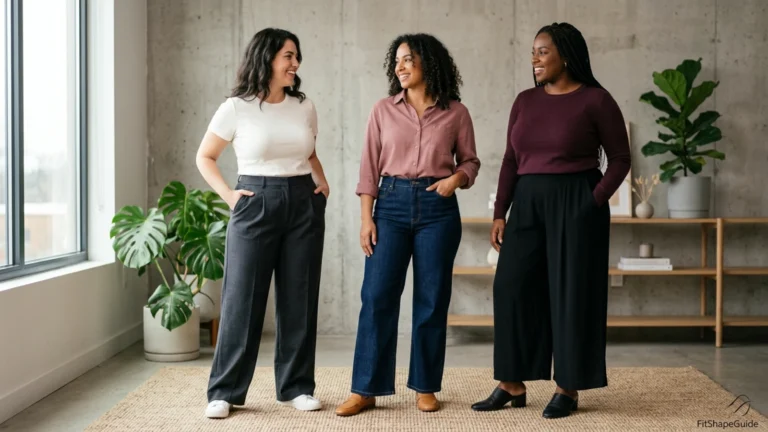
Bottoms do not need to “balance” the body according to a fixed shape rule. Their practical job is to coordinate formality, movement and visual structure with the top. Straight, tapered and wide-leg trousers can all work. The useful pair stays smooth at the waistband when seated and does not pull the tucked top downward.
Tailored trousers
Straight or gently tapered trousers create a conventional office base. Wide-leg trousers can add movement and look intentional with a closer, shaped top. Pleats need enough room to remain closed; pockets should not flare. Test the waistband after lunch posture, not only while standing tall.
Midi and knee-area skirts
A-line skirts accommodate stride and pair well with shaped blouses. Straight or pencil skirts provide a sharper column but need a back vent or stretch for walking and sitting. Workplace policies vary, so treat hem length as a contextual requirement rather than a universal body rule.
Business-casual dresses
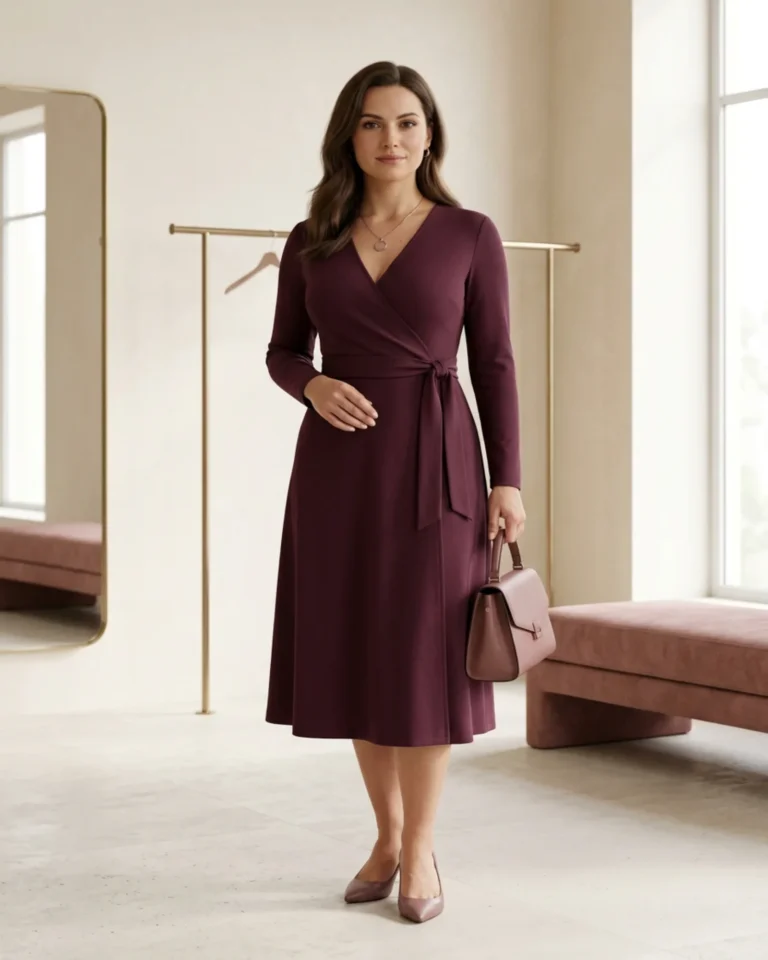
A knit sheath, faux-wrap dress, fit-and-flare dress or shirt dress can simplify the outfit. Check neckline security, bust seam placement, waist location and seated hem. Add a blazer for meetings or a cardigan for desk days. The work-dresses guide compares these constructions in detail.
| Base piece | Pairs well with | Useful fit check | Common trade-off |
|---|---|---|---|
| Straight trousers | Blouse, knit shell, shirt | Waistband stays level when seated | A tight tuck can pull the top down |
| Wide-leg trousers | Shaped knit, short jacket | Pleats and pockets lie flat | Long loose top can remove all structure |
| Tapered ankle trousers | Button-down, cardigan | Rise permits sitting and reaching | Cropped length may feel less formal |
| A-line midi skirt | Draped blouse, fine knit | Waist does not rotate under a tuck | Very full fabric can feel cumbersome |
| Straight skirt | Shell, collarless jacket | Vent permits a normal stride | Rigid fabric can restrict sitting |
| Work-ready dress | Blazer, cardigan, belt | Bust seams and waist sit correctly | One-piece fit requires several landmarks to align |
Proportion, color and visual structure
Proportion advice should help garments communicate intention, not claim that the body needs correction. A long open layer can create a vertical frame. A clear waist seam can organize a dress. A shorter jacket can work with high-rise trousers. A monochrome column can reduce outfit decisions. None of these is mandatory, and the wearer can choose emphasis rather than concealment.
Use one clear structural point
If the top is fluid, use a clean trouser crease, defined cardigan edge or deliberate tuck. If the trousers are wide, a shaped top or shorter layer can clarify the silhouette. If the blazer is oversized, keep the base layer secure and the hem lengths visibly intentional. Multiple loose, soft pieces may be comfortable but can appear less work-ready when every edge collapses.
Color without unnecessary rules
Neutral colors are easy to recombine, but business casual is not restricted to black, navy and white. Muted rose, forest green, burgundy, soft blue and warm brown can function as work neutrals. A patterned blouse is easier to repeat when its colors connect to at least two bottoms or layers. Place pattern wherever preferred; judge scale by the complete outfit rather than by a rule about the bust.
Accessories and bag straps
Necklaces should work with the neckline rather than fall into a moving placket. Scarves can add color but may increase heat and fabric around the chest. A crossbody strap can press the top and shift a wrap neckline; test it loaded. A structured tote keeps the torso clear but must remain comfortable at the shoulder.
The full large-bust dressing guide covers neckline, waist and layering principles beyond office wear.
Seasonal business-casual fabrics
A polished outfit that overheats, clings with static or stays damp is not practical. Build the formula around the office climate, commute and laundering routine. Air-conditioned offices may require a layer even in summer; heated winter workplaces may make a heavy blazer unnecessary indoors.
Warm weather
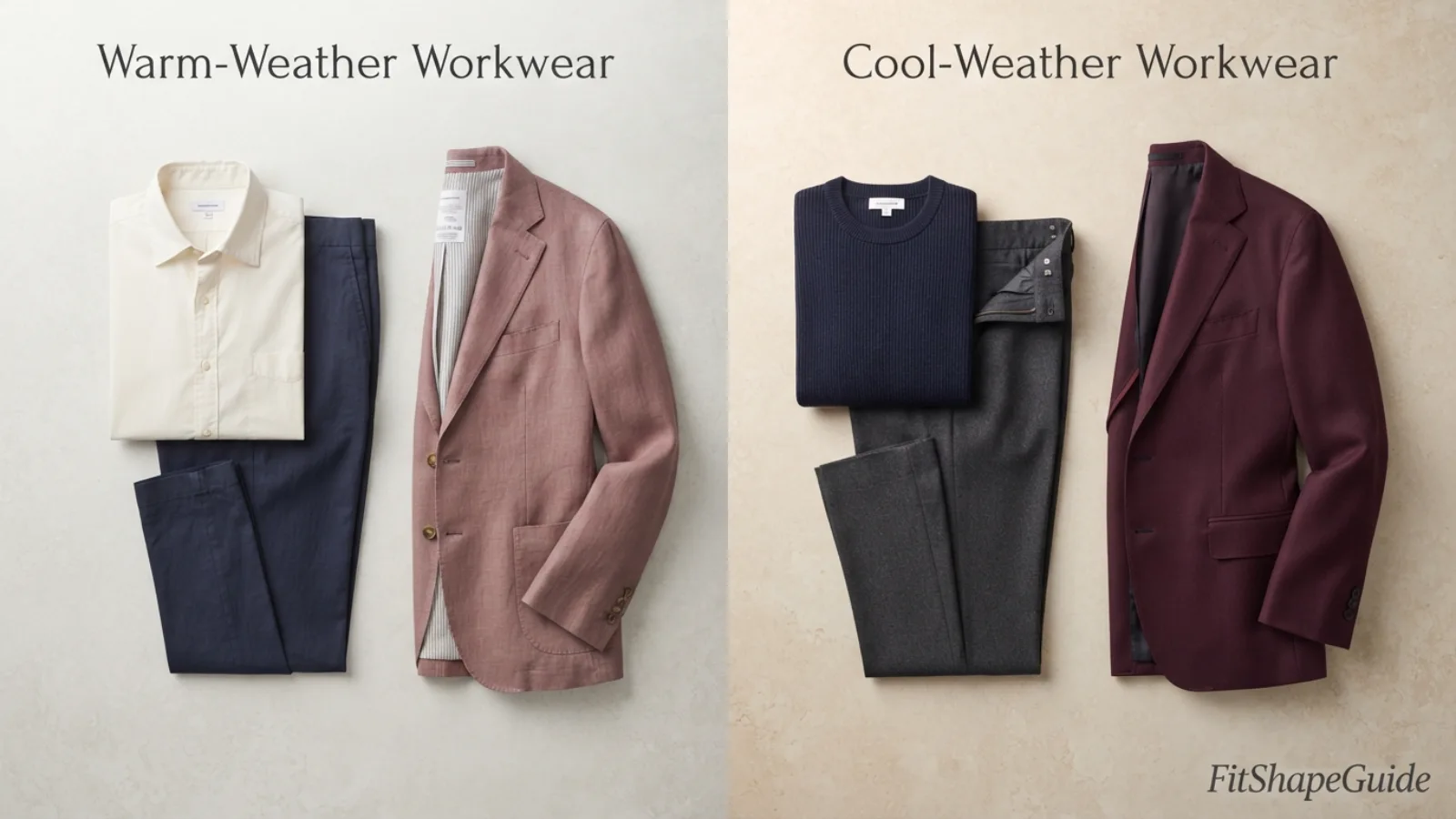
Look for breathable cotton, linen blends, lightweight crepe and unlined or partially lined layers. Linen wrinkles are part of the fabric’s character, but a blend may offer more recovery. Pale fabric needs an opacity check in daylight and after movement. A sleeveless shell can work under a jacket if the armholes provide the desired coverage and the workplace accepts it without the layer.
Cool weather
Fine-gauge merino, ponte, compact knits, twill and light wool blends provide warmth without excessive bulk. Test a coat over the complete outfit because blazer shoulders plus coat padding can restrict reach. Turtlenecks may be comfortable for some wearers, but the front needs enough length so the collar does not press backward.
Travel and hybrid work
For travel, prioritize wrinkle recovery, washable fabrics and layers that fit into a tote. For video meetings, a secure solid or controlled pattern near the face generally reads clearly, but test the real camera and lighting. The visible top still needs seated comfort for the entire call.
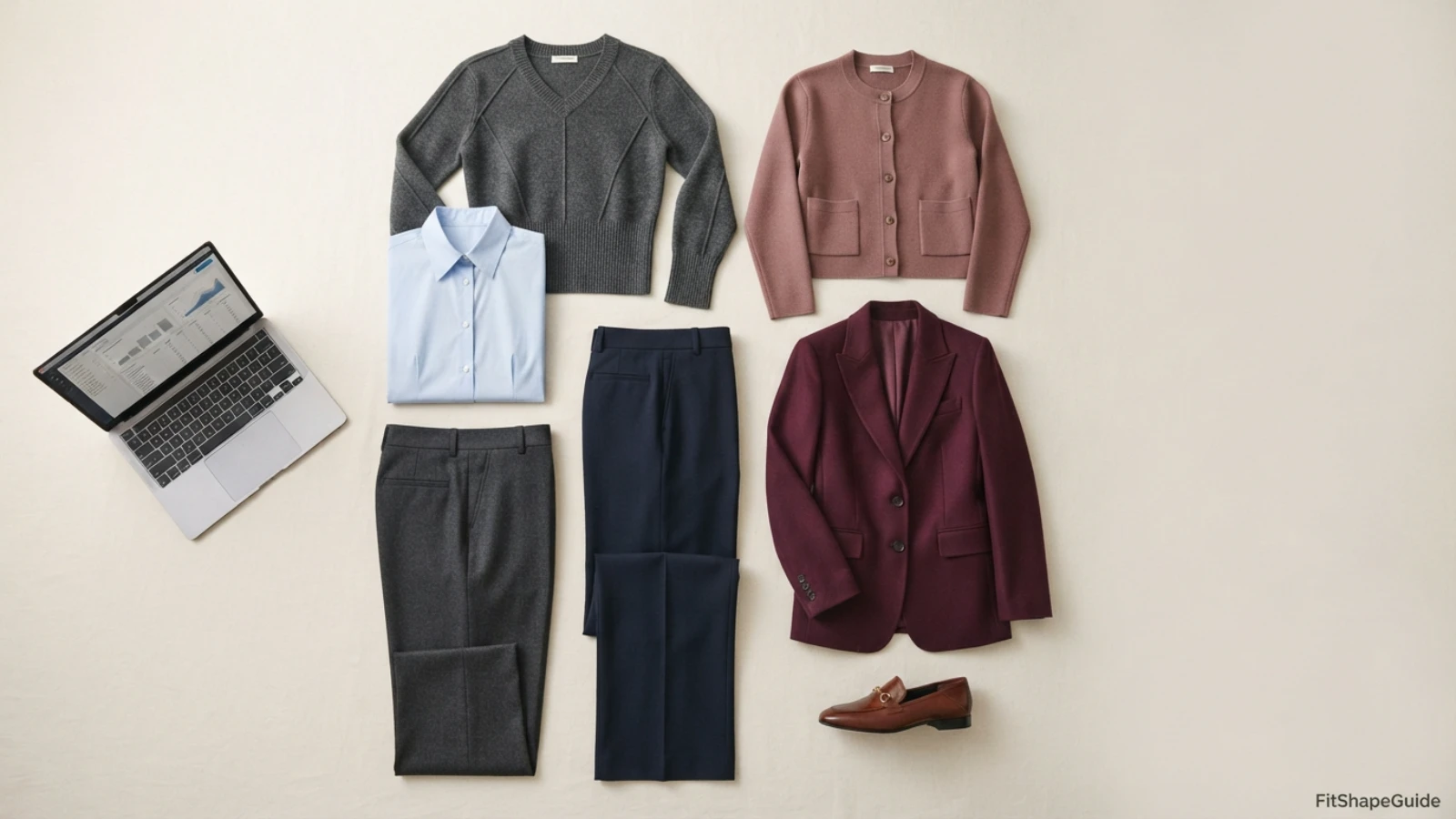
Build a fuller-bust business-casual capsule
A useful capsule is a compatibility system, not a fixed number of beige garments. Start with the days that actually occur: ordinary desk work, internal meetings, client contact, presentations, travel and casual Fridays. Buy for the most frequent scenario first.
- Choose two reliable tops: for example, one fine-gauge knit and one no-gape shirt.
- Add two bottoms: one straight or tapered trouser and one wide-leg trouser or skirt.
- Select two layers: a meeting-ready blazer and an everyday structured cardigan.
- Add one dress if useful: only when dresses suit the role, climate and personal routine.
- Use a controlled palette: ensure each top works with both bottoms and at least one layer.
- Test complete outfits: footwear, bra, base layer, bag and outerwear included.
This small starting set can already create multiple combinations. Expand only after identifying a real gap: heat, presentation formality, frequent laundering or a need for an additional neckline. The office-specific guide to dressing a large bust for work can help map those needs.
Read online listings like a construction sheet
Check garment measurements, not only body size charts. Look for darts, princess seams, stretch percentage, lining, button position, neckline depth, shoulder seam and back length. Use model images for styling clues, not proof of personal fit. Confirm care and returns before buying several colors of an untested cut.
Common business-casual outfit problems
| Problem | Likely cause | Construction-first response | Avoid |
|---|---|---|---|
| Top rides up under blazer | Short front length, friction or tight jacket | Longer shaped top, smoother lining, movement test | Repeatedly pulling the hem down |
| Button-down opens at chest | Insufficient front room or closure spacing | Darts, hidden button/snap, different cut | Using the blazer to hide strong strain |
| Lapels spring outward | Jacket lacks chest depth or break point conflicts | Single-breasted shaped blazer or collarless layer | Assuming a larger size always solves it |
| Neckline changes when seated | Front rides, wrap loosens or bag strap pulls | Fixed crossover, stable edge, longer front | Relying on constant adjustment |
| Outfit feels too formal | Matched suit pieces and rigid shirt | Swap one element for knit, cardigan or contrast trouser | Changing every item at once |
| Outfit feels too casual | Soft fabric, worn edges or multiple loose pieces | Add one tailored layer or sharper trouser | Assuming dark color alone creates polish |
| Layers feel bulky | Thick sleeves, dropped shoulders or rough friction | Fine-gauge base, lined sleeve, larger armhole compatibility | Compressing with a smaller jacket |
| Tuck pulls downward | Top too short or waistband too tight | Longer hem, partial tuck where allowed, different rise | Pinning the shirt under continuous strain |
The complete-outfit seated test
Dress fully, including the intended bra, base layer, belt, shoes and jacket. Sit at a desk for five minutes, type, reach, stand and walk. Check neckline position, placket, lapels, waistband, hem and temperature. A mirror pose cannot reveal whether the outfit will remain comfortable during a meeting.
When tailoring is worthwhile
Buying a shirt or jacket for the bust and refining the waist can be effective when shoulders, armholes and length already fit. Hemming trousers and adjusting sleeves often improves a capsule because the piece becomes easier to repeat. Major shoulder or armhole changes are more complex; compare alteration cost with choosing a more compatible cut.
Final verdict
The strongest business casual outfits for a large bust begin with a secure top that supplies real front depth, then use one polished layer or tailored bottom to set the formality. A moderate-V knit with trousers and an open blazer is the easiest all-round formula. A no-gape shirt sharpens the look; a structured cardigan makes it more relaxed; and a work-ready dress simplifies mornings.
Do not build around hiding the body or monitoring the neckline all day. Verify the workplace standard, test the complete outfit seated and moving, and choose pieces that recombine with at least two existing items. Consistent garment security and intentional construction create professionalism more reliably than restrictive rules or size labels.
Frequently asked questions
What is the easiest business casual outfit for a large bust?
A secure moderate-V knit, straight trousers and an open single-breasted blazer create a flexible starting formula for many offices.
Are V-neck tops appropriate for business casual?
Yes, when the depth suits the workplace and the neckline remains stable while sitting, reaching and carrying a work bag.
Can I wear a blazer open with a large bust?
Yes. An open blazer creates a useful vertical frame, but a functional closure should still close comfortably when the situation requires it.
Which tops work best in fuller-bust business casual outfits?
Fine-gauge knits, darted blouses, secured wrap tops and no-gape button-downs work well when they provide enough front depth and movement.
Can dark jeans be business casual?
Only when the employer permits denim. Choose clean, non-distressed jeans and add a polished knit, blouse or blazer.
How do I stop a work shirt from gaping?
Choose targeted bust shaping, a stable placket and a hidden chest closure, then test the shirt while seated and reaching.
What dress styles work for business casual offices?
Secure faux-wrap, knit sheath, fit-and-flare and shaped shirt dresses can work when their seams, neckline, hem and movement suit the workplace.
How should I test a business casual outfit before work?
Wear every intended layer, sit, type, reach, walk and carry the usual bag while checking neckline, placket, lapels, waistband and temperature.
Editorial and verification standards
This guide evaluates garment security, front depth, shaping, neckline stability, plackets, lapels, shoulders, sleeves, fabric recovery, opacity, seated movement, climate, care and outfit compatibility. It does not treat a fuller bust as a professionalism problem or promise that one formula fits every body or workplace.
Dress-code context was checked against current guidance from the Harvard Mignone Center for Career Success, which includes shirts, trousers, skirts and related pieces in business-casual guidance; Berkeley Career Engagement, which advises observing workplace culture and adapting to employer norms; and Gardner-Webb University’s attire guide, which recommends asking the employer to clarify its definition.
Outfit versatility was cross-checked against the official BOSS blazer-styling guide, which shows blazers combined with shirts, V-neck blouses, trousers, dresses and skirts. These examples illustrate combination logic, not fit guarantees or a requirement to buy a specific brand.
Before publishing a product module, verify the direct live seller, exact variant, garment measurements, construction, fabric, care, workplace suitability and returns. Affiliate relationships should be disclosed clearly and close to recommendations under the FTC endorsement guidance.