How to Dress a Large Bust for the Office
A fit-first office wardrobe guide to shirts, knit tops, blazers, dresses, necklines, layers, opacity, seated comfort and repeatable outfit formulas.
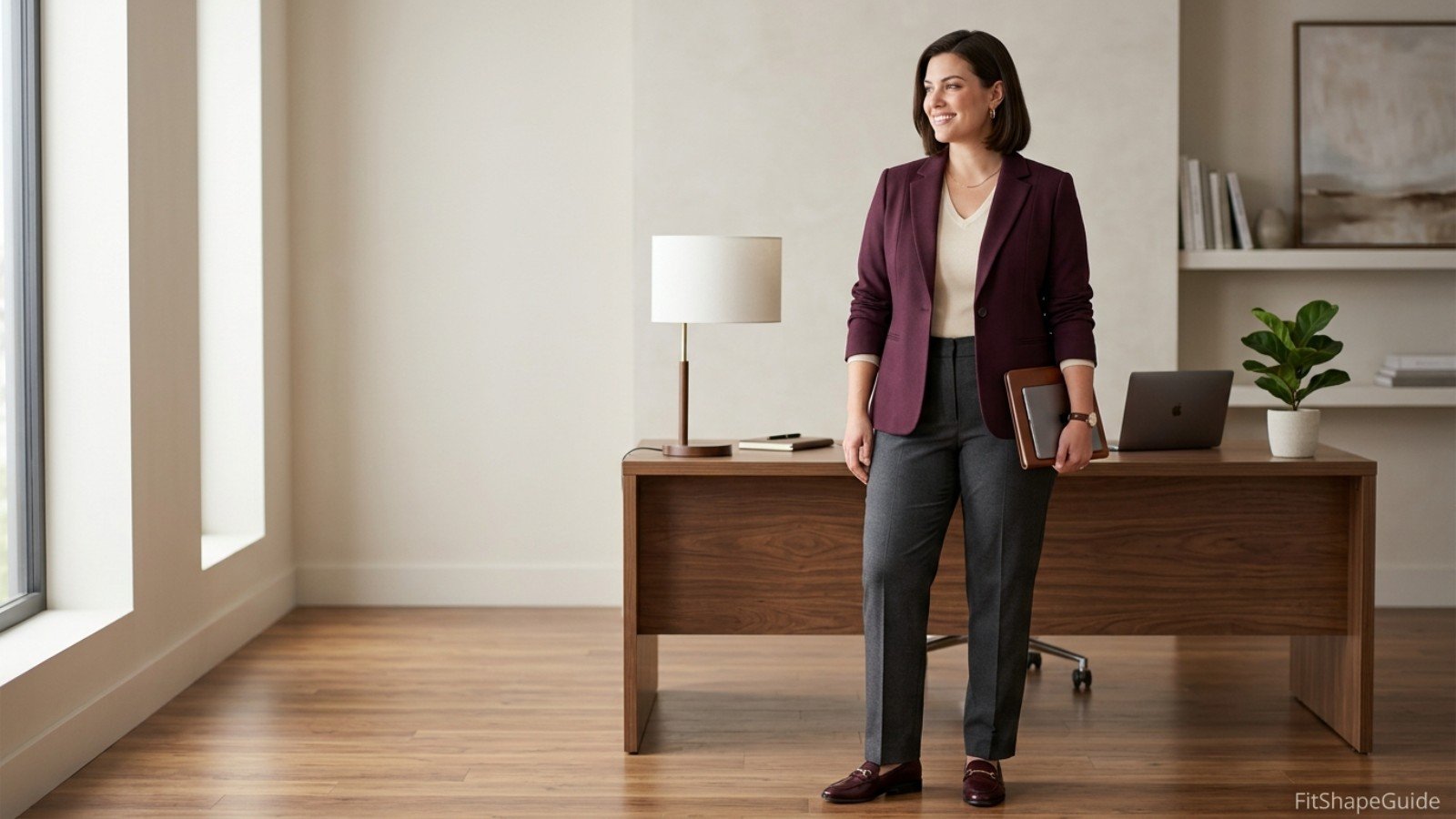
The 90-second office-outfit check
- Confirm the written dress code, safety rules and planned level of formality.
- Wear the bra and base layer intended for the full workday.
- Fasten every functional shirt, dress and blazer closure.
- Sit, lean toward a desk and check neckline and button coverage.
- Reach for a keyboard, shelf and bag without throat or shoulder pressure.
- Walk ten steps and confirm the hem, slit and waistband remain stable.
- Check opacity in front, side and strong daylight or office lighting.
- Load pockets lightly and wear the usual lanyard, bag or ID badge.
Six reliable office outfit formulas
Office dress ranges from uniforms and safety clothing to formal business attire, creative workwear and remote-video dressing. No single outfit is universally professional. These formulas are starting structures that can be adjusted for employer policy, climate, mobility, religious dress, sensory needs and personal style.
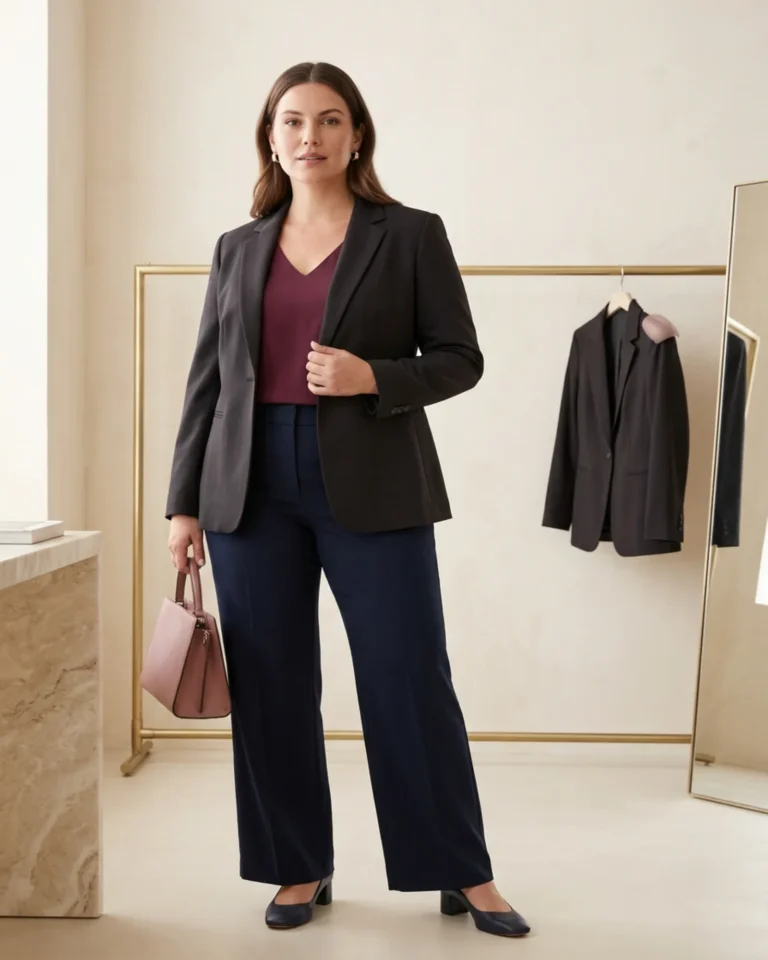
Shaped knit top + single-breasted blazer + trousers
Best for: interviews, presentations and business-formal environments where a jacket is useful. A smooth knit reduces placket issues, while the blazer supplies structure. Trade-off: two warm layers may be uncomfortable in heat, and the blazer still needs enough chest and upper-back room.
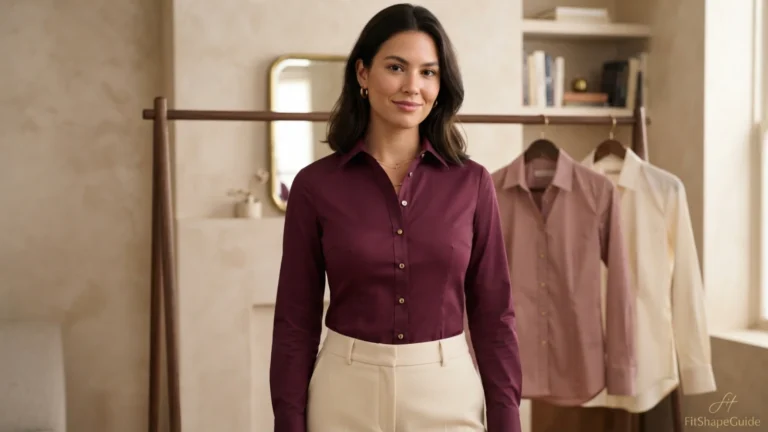
Darted button-down + high-rise trousers
Best for: classic business casual with a clean collar and defined waistband. Bust darts, a hidden placket or closer button spacing can stabilize the front. Trade-off: crisp woven fabric reveals missing chest depth quickly and may need careful ironing.
Wrap-style top + straight skirt + cardigan
Best for: adjustable neckline framing and soft layers in temperature-variable offices. Trade-off: a true wrap can shift while leaning forward, so secure overlap and an appropriate base layer may be necessary.
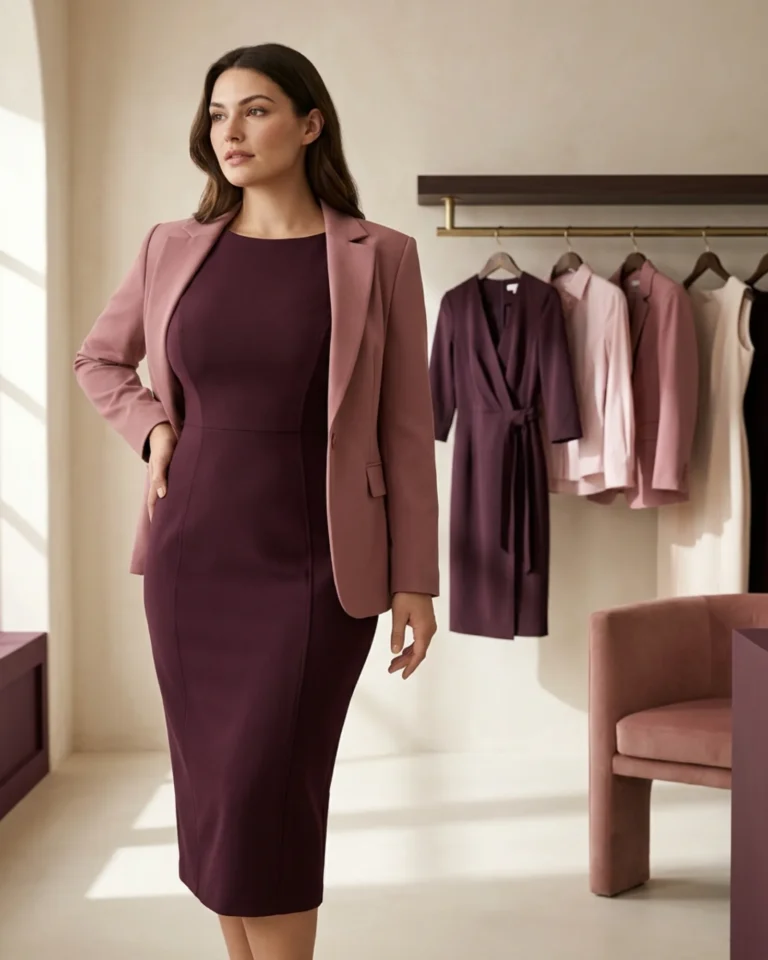
Princess-seam work dress + optional blazer
Best for: one-step dressing with targeted chest shape and a clear waist or straight silhouette. Trade-off: a dress must fit bust, torso, waist, hip and length at once, making alterations or another cut more likely.
Fine-knit shell + longline vest + trousers
Best for: sleeveless structure, vertical layering and free arm movement in mild offices. Trade-off: open fronts may swing aside, while closed vests need controlled armholes and enough front-panel depth.
Soft blouse + A-line midi skirt
Best for: a polished outfit with fluid upper-body room and easy lower-body movement. Trade-off: very slippery blouses can shift at the neckline, and excess gathered fabric may stack beneath a waistband.
Use the broader large-bust dressing guide to adapt proportion and personal style beyond workwear.
Office tops, shirts and neckline control
The office top controls most visible fit issues: button gape, neckline movement, opacity, sleeve reach and front-hem balance. Choose construction first, then color or print. A top that stays smooth at a desk is more useful than one that works only in a standing product photo.
Shaped knit tops
Fine-to-medium gauge knits can follow the chest without a rigid placket. Look for opaque fabric, useful recovery, shoulder stability and a neckline binding that lies flat. A small amount of stretch supports movement but should not be the only source of fit. Very thin ribbing may become sheer or show every seam beneath a blazer.
Button-down shirts
Useful features include bust darts, princess seams, curved side panels, stretch woven fabric, a hidden placket or closer button spacing. Fasten every button that the shirt is designed to close. If one gap remains, a discreet internal snap may stabilize an otherwise well-fitting shirt; it should not pull a shallow front together. The detailed button-down shirt guide explains the full fit test.
Blouses and wrap tops
A soft blouse can provide chest room through darts, pleats or controlled ease. Avoid assuming all drape is generous; a blouse may be wide overall but short at the front. For wrap styles, check overlap while seated and leaning forward. A camisole or shell can add chosen coverage, but should not be required to repair a front that will not stay closed.
Choose neckline by stability and policy
Moderate V, scoop, square and open-collar necklines can create space above the bust. Crew, mock and high necks provide more coverage but may feel visually or physically crowded when the front is short. The useful neckline is one that suits the workplace, stays in place during movement and works with the intended bra or base layer. See the necklines guide for construction comparisons.
Opacity and fabric behavior
Check the top in daylight and bright office lighting while standing and stretching. White and pale fabrics may need a skin-tone underlayer; patterned fabrics can disguise minor creasing but do not fix strain. Test whether the fabric attracts lint, wrinkles during sitting or traps heat beneath a jacket.
| Office top | Useful construction | Desk test | Trade-off |
|---|---|---|---|
| Fine-knit shell | Opaque recovery knit and stable neckline | Lean forward and raise arms | Thin fabric may show underlayer seams |
| Button-down shirt | Darts, stretch woven, close button spacing | Sit and reach without placket gape | Needs precise chest and front length |
| Soft blouse | Controlled ease and secure front opening | Check neckline after moving | Slippery fabric can shift or cling |
| Wrap-style top | Generous overlap and stable side seam | Lean, twist and sit | Overlap may move without an anchor |
| Mock-neck knit | Enough front length and flexible neck | Turn head and breathe fully | Can feel warm beneath a blazer |
| Square-neck top | Stable shoulder width and reinforced edge | Reach without shoulder slipping | Wide opening needs bra-strap planning |

Blazers, cardigans and polished third pieces
A third piece can raise formality, provide temperature control and create a repeatable uniform. It should not be used to hide a gaping or transparent base. Fit the top first, then evaluate the layer open and closed.
Single-breasted blazers
A one-button or low-button stance usually creates less closure bulk than a double-breasted front. Princess seams, darts and curved side panels provide chest depth. The lapel should roll smoothly and the shoulder should allow forward reach. If the blazer includes a functional button, it should close without X-shaped strain—even when the preferred styling is open.
Double-breasted blazers
Front overlap can be useful, but two button columns and wide facings add layers. The under-front should reach naturally without dragging the side seam forward. Test every functional button while seated. A double-breasted blazer works when it has real chest depth, not simply more fabric at the center.
Collarless jackets
A collarless jacket reduces lapel bulk and can frame a blouse, dress or necklace cleanly. A high round edge needs enough front length so it does not pull toward the throat. Edge-to-edge versions should hang vertically even if they have no closure.
Cardigans and knit jackets
Cardigans provide softer layering and are often easier in temperature-variable offices. A V-neck cardigan can echo the base neckline; a crew cardigan offers coverage. Buttons should not gape if closed. Longline knits add movement and warmth but may stretch at pockets or seat level. The best choice depends on dress code and desired structure.
Shoulders, sleeves and desk reach
Cross the arms and reach for a keyboard. The jacket should not choke the neck or pull the shirt through the armhole. Check sleeve length with elbows bent and wrists on a desk. A smooth lining improves slip, but a tight lining can restrict even when the outer jacket looks roomy.
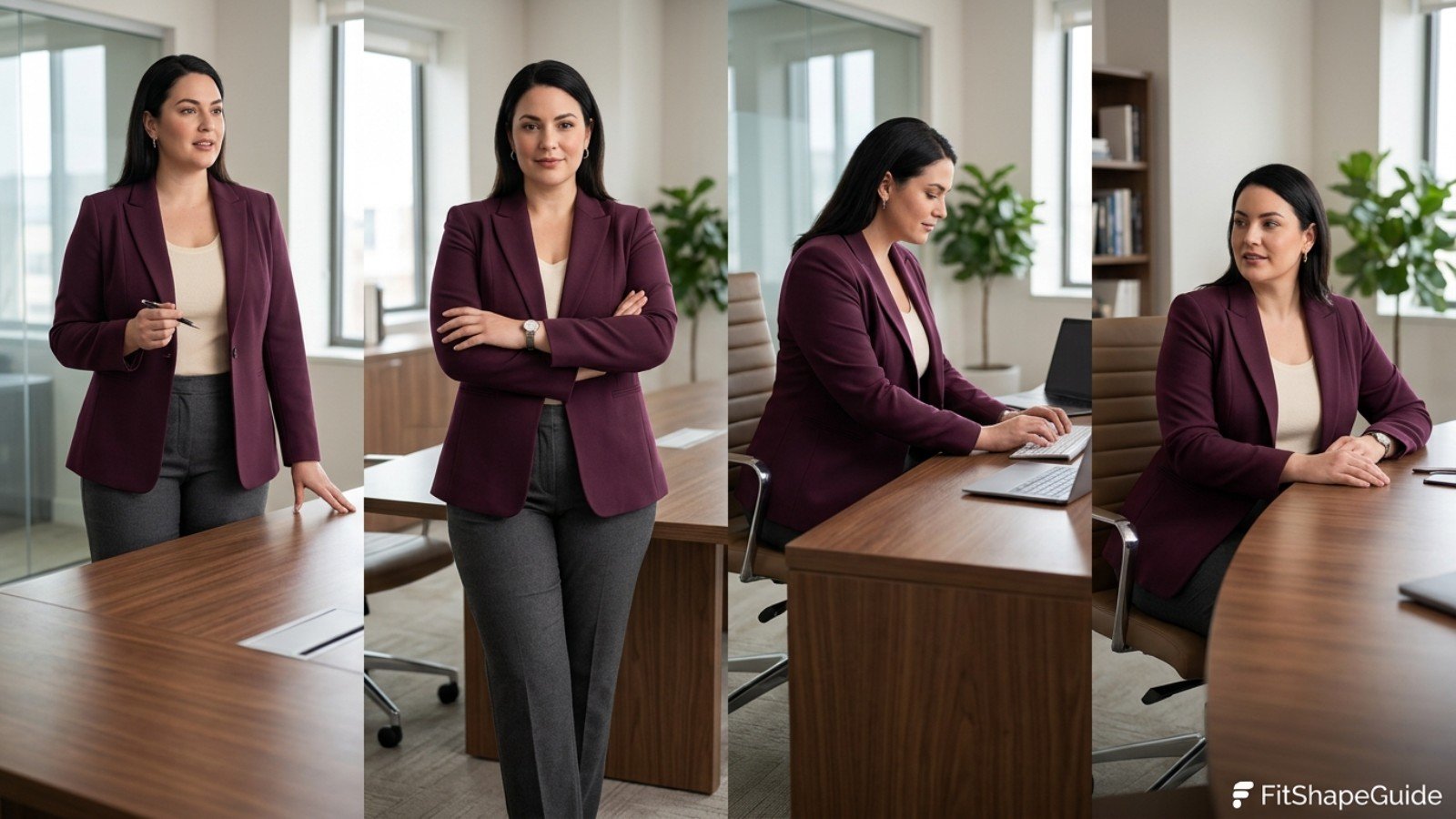
For deeper construction guidance, compare the blazer fit guide.
Dresses, skirts, trousers and seated proportions
Bottoms do not change bust fit directly, but they determine where the top ends, how layers meet and whether the outfit stays comfortable at a desk. Choose waistbands and rises that let the top lie smoothly instead of catching or ballooning.
Work dresses
Princess-seam, wrap-style, shirt and knit dresses can all work when their construction fits the task. Princess seams provide targeted depth; a secure wrap allows some adjustment; a shirt dress needs button control; a knit dress needs opacity and recovery. Test sitting, stairs and reaching because one garment must coordinate bust, torso, waist, hip and hem. Explore fuller options in the work-dress guide.
Trousers
Mid- and high-rise trousers can create a stable junction for tucked or untucked tops. The waistband should not press the ribs while seated. Straight, wide and tapered legs each create a different line; none is universally best. Check pocket flare, rise, hem and whether the shirt stays smooth after sitting.
Skirts
A-line skirts provide stride and allow a blouse to fall or tuck cleanly. Pencil skirts create a narrow line but require a functional vent or stretch. Pleated skirts add movement and volume; ensure the waistband does not trap extra blouse fabric. Sit for several minutes before judging length and slit coverage.
Tucking choices
A full tuck can define the waistband but may pull a short-front shirt upward. A half tuck is more casual and may not suit every dress code. An untucked top should have a deliberate hem and enough front length. Use the option that keeps the outfit stable and appropriate for the workplace rather than following a universal proportion rule.
| Office situation | Reliable outfit structure | Movement check | Trade-off |
|---|---|---|---|
| Formal meeting | Shaped knit, single-breasted blazer, trousers | Button blazer, sit and present | Warmer and more structured |
| Business-casual day | Darted shirt, straight trousers, optional cardigan | Reach and check placket | Woven shirt needs precise fit |
| Warm office | Opaque shell, longline vest, lightweight trousers | Check armholes and side coverage | Less sleeve coverage |
| Cold office | Fine knit, cardigan, lined trousers or skirt | Close layers and use keyboard | Multiple necklines can stack bulk |
| Presentation day | Princess-seam dress with stable jacket | Raise arms and walk stage | Dress must fit several body points |
| Commute-heavy day | Stretch blouse, easy trousers, packable blazer | Sit, carry bag and walk briskly | Softer structure may read less formal |

Build a repeatable fuller-bust work capsule
A capsule is useful when every piece fits the same real-life conditions. It is not a rigid number of garments. Start with the required dress level, laundry frequency, climate and number of office days, then build enough combinations to cover a normal week plus one higher-formality event.
Choose two proven base shapes
Select one woven or blouse shape and one knit shape that pass the desk test. Repeat them in colors or fabrics that coordinate with existing bottoms. This is more reliable than buying five unrelated tops that each need a different bra, camisole or jacket.
Add one formal and one soft layer
A shaped blazer handles meetings and interviews. A cardigan or knit jacket provides flexible daily warmth. Both should work over the same base tops and fit inside the commuter coat if needed. Compare collar, sleeve and hem stacking before purchase.
Use a limited color system
Choose one dark neutral, one lighter neutral and one or two accent colors that suit personal preference and workplace norms. Monochrome is optional, not mandatory. Contrast can direct attention intentionally; prints can reduce the visibility of wrinkles. Fit and function matter more than color rules.
Plan a rescue layer
Keep a clean cardigan, scarf or blazer at work only if it serves a real temperature or formality need. A rescue layer should not be the permanent solution for transparent fabric, a gaping shirt or a moving neckline. Repair or replace the unstable base.
Photograph successful formulas
Save mirror or phone photos of outfits that passed a complete workday. Record which bra, top, layer and bottom were used. This makes repeat dressing easier and prevents purchasing duplicates that solve no new problem.
Fabric, climate, pockets, bras and care
Office comfort depends on heat, commute, air conditioning, sitting duration, movement and laundering. Fiber content alone does not predict performance; weave, weight, stretch, lining and garment construction all matter.
Breathability and temperature
Lightweight woven fabric and fine knits may feel cooler, while lined tailoring holds more warmth. Natural fibers can be comfortable but vary widely; synthetic blends may add recovery or wrinkle resistance. Test the complete layered outfit because a breathable top beneath a dense blazer still feels warm.
Stretch and recovery
Stretch supports reach and sitting, but excessive stretch can encourage buying a front that is too small. The garment should return after movement rather than remain distorted. Check elbows, bust, waistband and seat after wearing for ten minutes.
Pockets, badges and devices
Load work pockets with the actual phone, card or keys. Chest pockets and lanyards can add visual and physical layers over the bust. A badge clip may pull a delicate blouse. Side, inside or trouser pockets may distribute weight more comfortably.
Foundation fit
A supportive bra can help clothes sit consistently, but it cannot create missing garment depth. Wear the bra intended for work when trying on shirts and dresses because strap position, cup seams and neckline coverage affect the final outfit. Comfort, not concealment, is the goal.
Care and morning effort
Read care labels before buying. Dry-clean-only tailoring, hand-wash knits and wrinkle-prone blouses may be appropriate when the result justifies maintenance. A practical capsule should match the time, budget and laundry access available. Steam or iron only at a temperature safe for the exact fabric.
How to shop online for office clothes
A useful listing should provide a current size chart, front/side/back photos, model information, fabric and stretch, lining, closures, pockets, care, length and returns. “Workwear,” “tailored,” “relaxed” and “wrinkle resistant” are descriptions, not standardized fuller-bust measurements.
Measure known-good garments
For tops and jackets, record flat chest, front-panel width, shoulder, upper arm, sleeve and front/back length. For dresses, add waist, hip, rise or torso length and hem. Compare garments with the same intended ease and underlayer. Confirm whether the seller chart lists body or finished garment measurements.
Find construction evidence
Zoom in for bust darts, princess seams, placket guards, button spacing, lapel break, lining, vents and hem. A styled blazer worn open does not prove the functional button works. A dress photographed standing does not prove seated neckline or slit coverage. Look for multiple angles and exact dimensions.
Read reviews for observable outcomes
Prioritize reviews with body and garment measurements, purchased size, workplace use and a specific result: button gape, neckline movement, sleeve reach, opacity, front-hem rise, waistband comfort or wrinkles after sitting. Ratings and “flattering” statements alone cannot predict fit.
Amazon verification workflow
Use only a direct live product-detail page after confirming the brand or authorized seller, exact variant, current chart, measurements, fabric, opacity, closure, lining, pockets, care and return eligibility. Never publish a search-results URL. Do not hard-code changing prices, coupons, ratings, review counts, stock claims or delivery promises. Keep the affiliate disclosure close to recommendations.
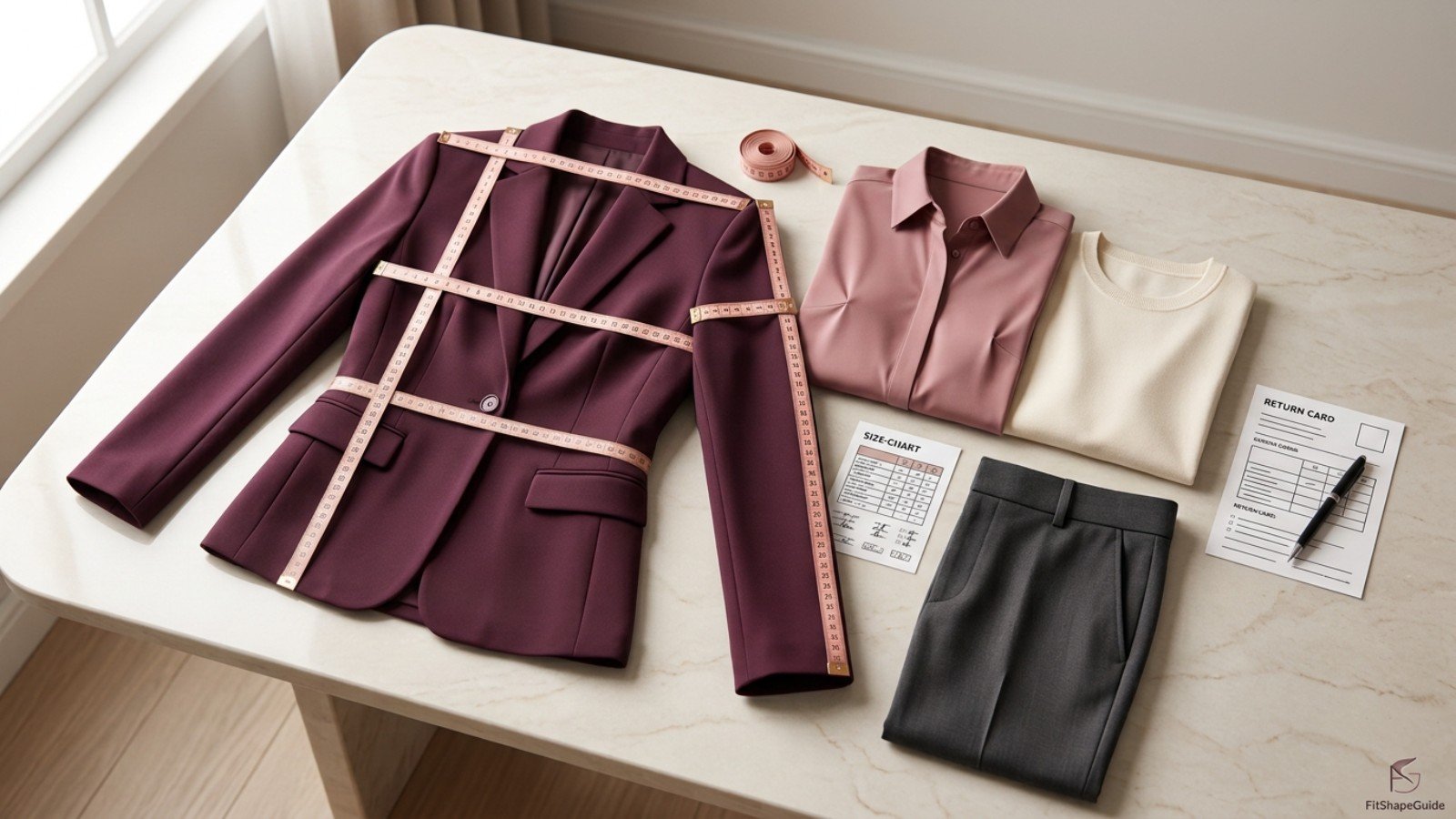
Learning how to dress a large bust for the office becomes easier when listings provide transferable garment evidence instead of vague style promises.
Common office-workwear fit problems
| Symptom | Likely cause | Better next step |
|---|---|---|
| Shirt buttons gape | Front lacks chest depth or button spacing is too wide | Choose darts, shaped panels, stretch woven or better placket |
| Blazer lapels spring outward | Chest strain, wrong break point or stiff facing | Restore front ease before changing styling |
| Neckline opens while seated | Unstable edge, shallow overlap or short front | Choose reinforced neckline or secure generous overlap |
| Top rides out of waistband | Insufficient front length or incompatible rise | Try longer front, bodysuit base or different tuck |
| Shoulders drop after sizing up | Global width added without targeted chest depth | Choose a fuller-bust cut or intentional relaxed shoulder |
| Dress waist rises in front | Bust uses bodice length or waist seam is misplaced | Choose more front length or flexible seam position |
| Fabric becomes sheer at bust | Material is stretched beyond intended opacity | Choose more ease, denser fabric or planned underlayer |
| Outfit restricts desk breathing | Combined bra, waistband, top and blazer pressure | Refit the full system and stop if pain persists |
Do not size up automatically
A larger shirt or blazer may close at the bust while creating dropped shoulders, deep armholes and long sleeves. Diagnose whether the missing room is at the chest, upper back, upper arm or front length. Targeted shaping is often more useful than width everywhere.
Do not use “professional” to mean hidden
A fuller bust is not inherently less professional. Workplace appropriateness comes from the actual policy, safety needs, job function and consistent treatment—not requiring one body to disappear. Garments should offer chosen coverage and stable fit without shame-based rules.
Do not blame the body for garment strain
When learning how to dress a large bust for the office, treat gaps, rising hems and restrictive layers as construction evidence. The useful solution is a better garment or outfit system, not discomfort through a full workday.
Build professional outfits around stable fit
The clearest answer to how to dress a large bust for the office is to follow the real workplace policy, then choose shaped tops, controlled necklines, low-strain layers and bottoms that stay comfortable while seated. Start with a reliable knit or darted shirt, add a single-breasted blazer when formality requires it, and repeat combinations that survive a full workday. Professional polish should support movement, confidence and the job—not hide the body.
Frequently asked questions
These answers summarize how to dress a large bust for the office with stable, practical workwear.
What office tops are best for a large bust?
Shaped knit tops, darted blouses and princess-seam shirts are strong options because they provide chest depth while keeping necklines and closures controlled.
How do I stop a work shirt from gaping?
Choose more front depth, bust darts, closer button spacing or a hidden placket; an internal snap can stabilize a shirt that already fits.
What blazer is best for a fuller bust?
A single-breasted blazer with princess seams, a low-strain button stance and smooth lapels is a reliable starting point for office layering.
What necklines look professional on a large bust?
Any stable neckline that follows the workplace policy can work, including moderate V, scoop, square, crew and open-collar styles with chosen coverage.
Are work dresses good for a large bust?
Yes. Look for princess seams, darts, secure wrap overlap or an accommodating knit, then test the bodice, waist, neckline and hem while seated.
Should office clothes be loose around a large bust?
They need adequate ease, not uncontrolled volume. The best garments provide targeted chest room while shoulders, armholes, waist and hem remain intentional.
Should I size up in office shirts and blazers?
Only if the shoulders, sleeves, armholes and waist remain balanced. A different cut with targeted chest depth is often better than extra width everywhere.
How do I test an office outfit before wearing it?
Fasten every closure, sit, lean toward a desk, reach, walk, check opacity and coverage, load pockets lightly and wear the intended bra and work bag.
Editorial and verification standards
This guide evaluates observable construction: chest depth, darts, princess seams, neckline stability, button spacing, lapel roll, shoulder reach, opacity, front length, waistbands, hems, pockets, fabric, care and returns. It recommends outfit systems rather than inventing products, office policies or universal professionalism rules.
Workplace dress requirements vary by employer, role, safety need and jurisdiction. U.S. readers can review the EEOC workplace discrimination guidance and its information on religious dress accommodations; other locations have different laws and agencies. This page is general styling information, not legal advice.
Current tailoring construction was cross-checked against an official J.Crew page for a lined single-breasted stretch-wool blazer. Before publishing a product module, verify the exact live seller, measurements, fabric, closures, lining, care, workplace suitability and returns.
Affiliate relationships should be disclosed clearly and close to recommendations under the FTC endorsement guidance. “Best” means suitable for the individual wearer, workplace, climate and job—not a universal dress rule.