Best Raincoats for a Large Bust
A construction-first guide to waterproof evidence, seam sealing, bust depth, front zippers, storm flaps, hoods, ventilation, layering and seated movement.
The 90-second raincoat check
- Wear the thickest top, knit or midlayer planned beneath the shell.
- Close the zipper and every intended storm-flap snap without pulling.
- Cross the arms and reach forward as if walking, driving or cycling.
- Raise the hood, adjust it and check side vision with the front closed.
- Open and close pit zips or vents without distorting the chest.
- Sit, breathe fully and test any two-way zipper from the bottom.
- Take a long stride and climb a step to check hem and vent mobility.
- Load pockets lightly and confirm the front still hangs evenly.
Best raincoats for a large bust by construction
Rainwear ranges from soft city coats to technical shells and insulated systems. The right construction depends on rain intensity, time outdoors, activity, temperature, packability and planned layers. “Waterproof” describes protection, not fuller-bust fit; both must be verified.
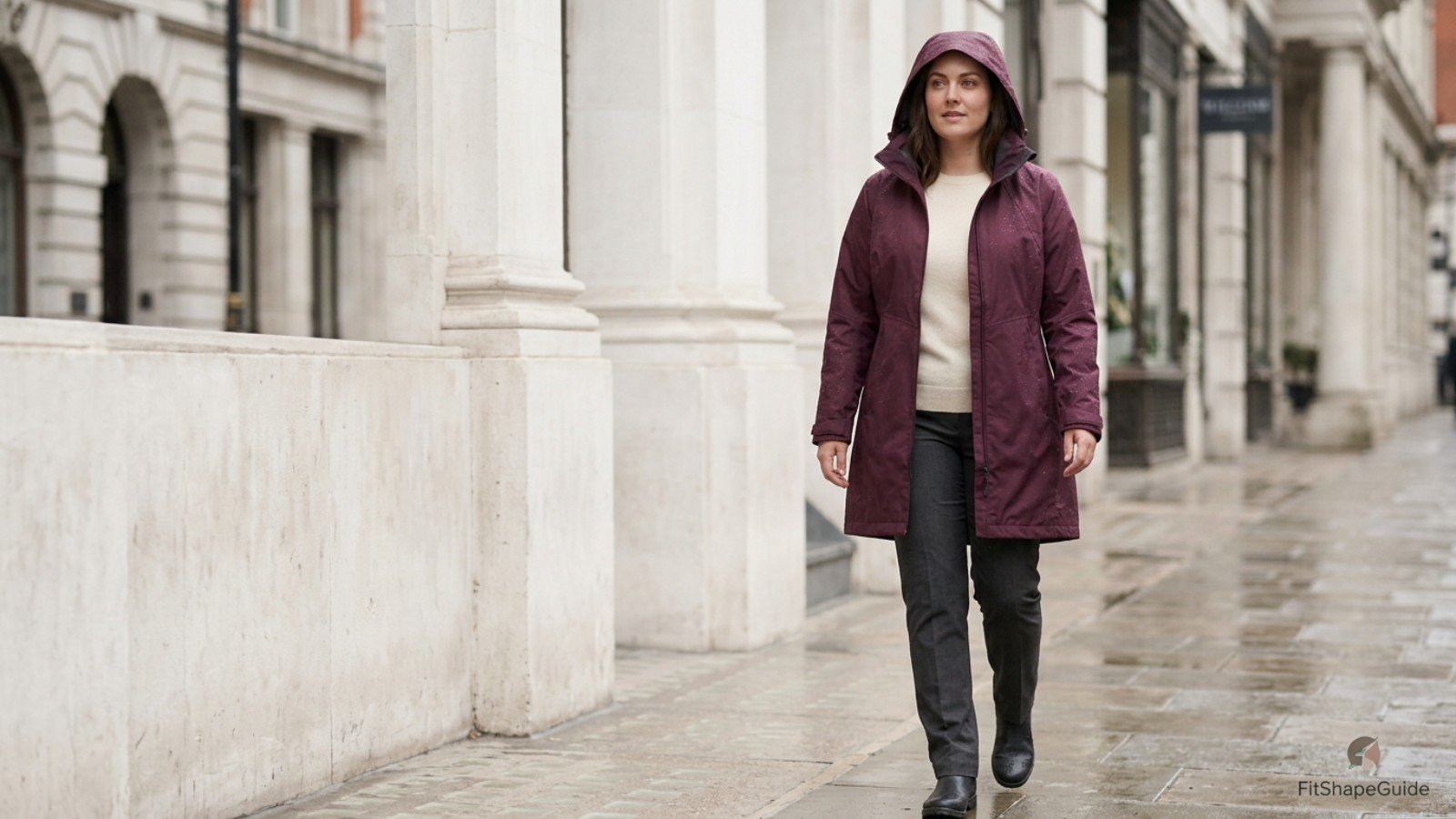
Shaped mid-length commuter raincoat
Best for: everyday coverage, seated travel and polished outfits. Curved panels, a two-way zipper and moderate A-line sweep can balance chest and hip room. Trade-off: longer fabric adds weight and warmth, and a sharply fitted waist may restrict sweater layering.
Lightweight 2.5-layer technical shell
Best for: hiking, travel and packability when verified seam taping, hood adjustment and ventilation are present. Trade-off: thin shells reveal zipper strain, may feel less comfortable against bare skin and usually provide little insulation.
Stretch waterproof shell
Best for: active reach, cycling or repeated arm movement. Mechanical or fiber stretch can reduce restriction across the upper back. Trade-off: stretch does not replace front depth, and a closer athletic cut may still pull at the bust or hem.
A-line raincoat with two-way zipper
Best for: hip room, long strides, public transport and sitting. The lower zipper can release pressure without opening the chest. Trade-off: the hardware is heavier and can be harder to align; opening from below reduces lower-front rain coverage.
3-in-1 waterproof coat
Best for: changing seasons because shell and insulating liner can be worn together or separately. Trade-off: two closures, collars and armholes add bulk; all three configurations need independent fit and movement testing.
Waterproof trench-style raincoat
Best for: city wear, adjustable waist and a tailored appearance when seams and closures are truly weather-ready. Trade-off: storm flaps, belts and double fronts add layers, and a belt cannot repair missing bust depth or shallow overlap.
The best raincoats solve a specific exposure and movement problem. For broader proportion and layering choices, use how to dress a large bust.
Waterproof, seam-sealed and water-resistant
Rainwear terms are often used loosely in shopping copy. A surface treatment can make water bead initially, but full-garment protection also depends on the base fabric or membrane, seams, zipper, hood, cuffs, hem and condition. Read the manufacturer’s exact wording for the exact model.
Waterproof versus water-resistant
A water-resistant garment is designed to resist some moisture but may not protect through prolonged or heavy rain. A waterproof claim generally indicates a barrier intended to stop water penetration under specified conditions. Brands use different tests and rating systems, so numbers are not perfectly comparable unless the methods are also stated. Do not invent a performance level from fabric feel.
Seam sealing and seam taping
Needle holes can allow water through even when the fabric is waterproof. Fully seam-sealed or fully seam-taped construction protects all relevant seams; critically taped designs protect selected high-exposure areas. Inspect the listing and interior photos. A phrase such as “waterproof fabric” does not confirm that the finished garment has sealed seams.
Zippers, storm flaps and garages
A water-resistant or protected zipper can reduce entry at the front and pockets. An external or internal storm flap adds another barrier, while a zipper garage prevents the slider from rubbing the chin. No zipper should be treated as submersible unless the manufacturer explicitly says so. For fuller-bust fit, rigid zipper tape must stay straight rather than bowing under strain.
DWR is not the membrane
A durable water-repellent finish helps droplets bead on the outer face. It is distinct from the internal waterproof barrier. When the face fabric wets out, the barrier may still resist water, but breathability and comfort can feel reduced. Follow the exact wash and reactivation guidance because incorrect detergent or fabric softener may affect performance.
| Listing term | What it can indicate | Evidence to verify | Fit-related trade-off |
|---|---|---|---|
| Water-resistant | Limited protection from light moisture | Brand definition, finish and intended use | Softer fabric may drape well but offer less exposure protection |
| Waterproof | Barrier designed to prevent penetration | Membrane/coating, test or brand standard | Barrier can feel warmer during exertion |
| Fully seam-taped | All relevant seams protected internally | Explicit manufacturer statement and inside view | Tape can reduce stretch at seam lines |
| Critically taped | Selected high-exposure seams protected | Which seams are included | Unsealed areas may limit prolonged-rain use |
| Protected front zipper | Coated zipper or storm-flap barrier | Zipper type, flap and chin guard | Added layers can increase chest stiffness |
| DWR-treated face | Outer surface encourages beading | Finish type and care instructions | Performance needs maintenance over time |
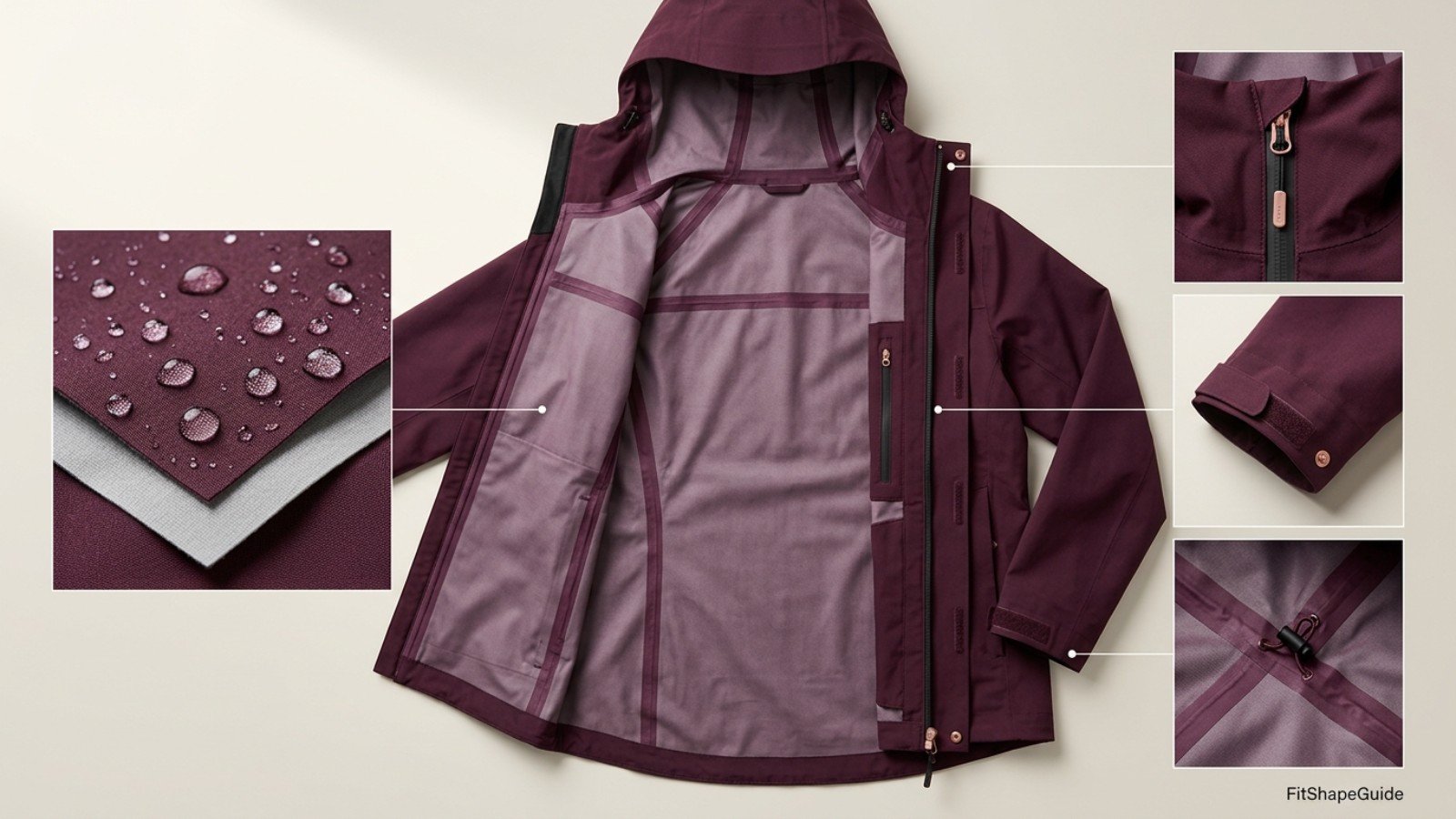
Bust depth, zippers, storm flaps and hem balance
Technical fabric often has limited stretch, while coated zippers and seam tape are firmer still. The raincoat needs pattern room through the chest before the zipper closes. Useful signs include princess seams, curved side-front panels, articulated shaping, a deliberate relaxed cut or size-specific front dimensions.
Start the zipper without pulling
Bring the bottom ends together naturally and engage the slider. If the sides must be dragged inward, the front is already under tension. Zip slowly and watch whether the track remains vertical. A bowed zipper, diagonal drag lines or a collar rising toward the throat shows that the shell is redistributing strain rather than fitting.
Use two-way zippers correctly
A two-way zipper can release the lower coat for sitting, stairs or cycling while preserving upper-body closure. It does not create missing bust depth. Close it fully while standing, sit, then lift the lower slider only as much as needed. Confirm that both sliders operate smoothly and that the open lower section does not exceed the desired rain coverage.
Read the storm flap
An external flap should lie flat over the zipper without snaps pulling sideways. An internal flap should not bunch into the track. Double front layers can add useful protection but also stiffness across the bust. If the flap twists or exposes the zipper during reach, restore front ease before tightening any waist drawcord.
Check waist and hem adjusters
Waist drawcords and belts can refine a roomy shell after the chest and upper back fit. They should not be used to disguise an oversized shoulder or shallow front. A hem drawcord may seal wind but can make the coat ride under the bust or restrict stride. Adjust gradually, walk and sit before deciding.
Evaluate length in motion
Hip length is packable and agile but provides less lower-body rain coverage. Mid-thigh and knee lengths protect more clothing. Long shells need a back vent, side snaps or two-way zipper for stride. The front should not rise dramatically relative to the back; strong upward pull is a pattern-depth issue, not a body flaw.
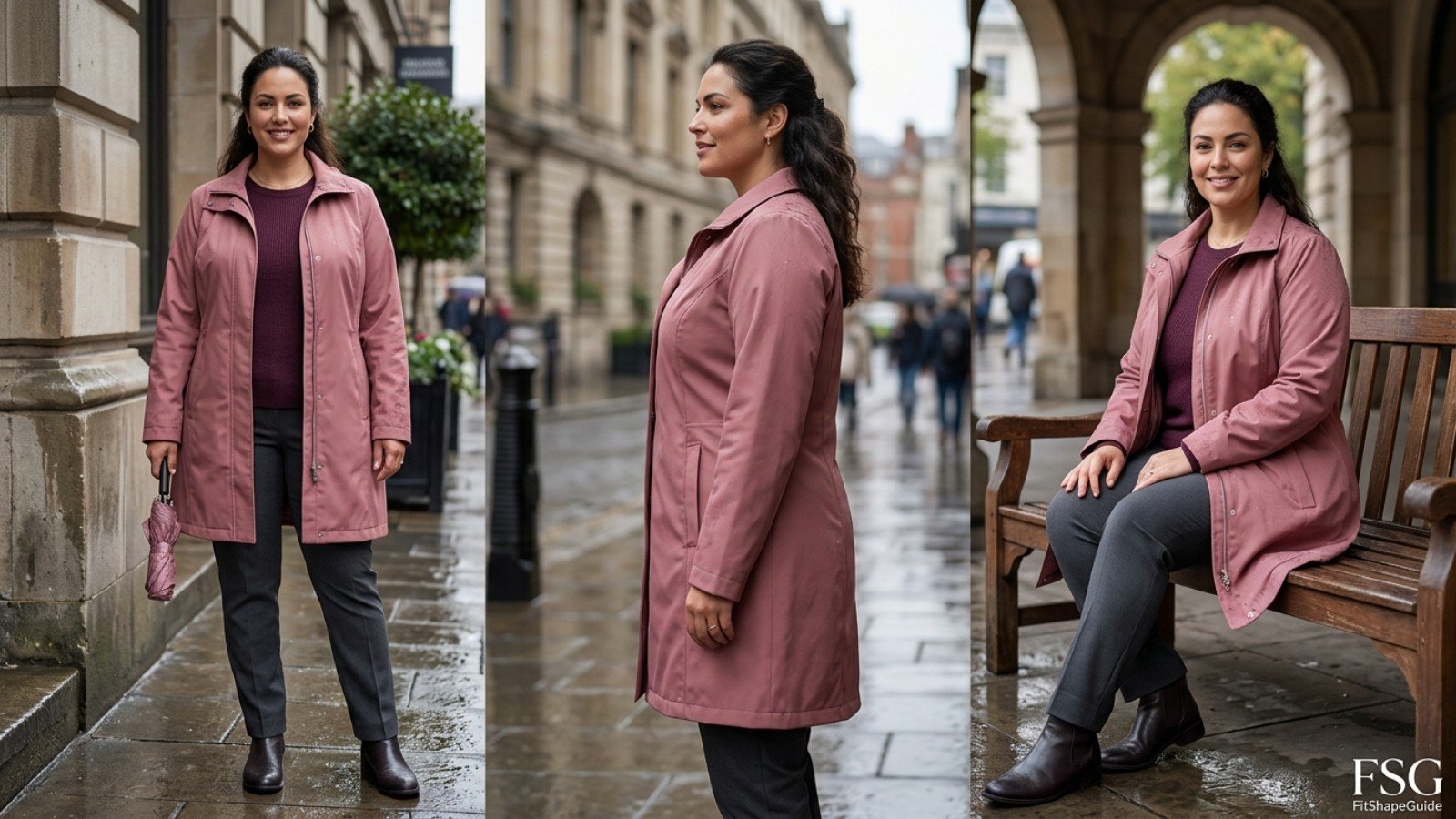
The best raincoats for a large bust stay protected because the front contains enough usable depth—not because a rigid zipper compresses the layer beneath.
Hoods, shoulders, sleeves, vents and layers
Rain reaches through moving openings. A hood that blocks vision, cuffs that expose wrists or a hem that climbs during reach can undermine otherwise strong fabric. Fit every adjustment while wearing the real underlayer and carrying any usual bag.
Hood adjustment and vision
A useful hood controls crown volume, face opening and rear position. Put it on, secure the front and turn the head left, right, up and down. The hood should move with the head without covering peripheral vision. A brim can direct water away from the face. Helmet-compatible hoods add volume and may feel excessive without a helmet, so match the design to use.
Shoulder and upper-back reach
Set-in sleeves can create a clean city silhouette when the shoulder seam and upper back allow movement. Raglan or articulated sleeves may support active reach. Cross the arms, extend them forward and lift one at a time. If the zipper bows or the collar presses the throat, the upper body needs more room.
Cuffs and sleeve length
Adjustable hook-and-loop or snap cuffs can close around gloves and reduce water entry. Bend the elbow and reach forward; the sleeve should still cover the wrist. Excessively long sleeves can interfere with hands, while short sleeves leave a gap. Inner cuffs add protection but may feel warm.
Pit zips and passive vents
Waterproof-breathable fabric cannot eliminate all heat and moisture during activity. Pit zips, back vents and mesh-lined pocket vents provide mechanical airflow. Open them with the coat closed and check whether access is blocked by the bust, backpack strap or pocket load. Venting can admit some water depending on construction and exposure.
Backpacks and crossbody straps
A pack compresses the shell against the upper back and chest, changes ventilation and can cover pockets. Wear the loaded pack during the reach test. A crossbody strap may press zipper hardware or storm flaps. Reposition straps rather than accepting a pressure point.
| Planned use | Raincoat details to prioritize | Movement test | Trade-off |
|---|---|---|---|
| City commute | Mid-length coverage, two-way zip, secure hood | Sit, walk and carry a bag | Longer shell adds weight and warmth |
| Hiking | Seam-taped shell, pit zips, pack-compatible pockets | Wear pack and reach for poles | Technical cut may feel close over thick knits |
| Cycling | Drop-tail hem, articulated sleeves, rear visibility | Hold riding position and look over shoulder | Bike-specific length may feel unusual standing |
| Travel | Packability, adjustable hood, secure pockets | Pack, unpack and layer quickly | Ultralight fabric may feel less durable |
| Cold rain | 3-in-1 or insulated shell with sealed seams | Test liner alone, shell alone and together | More bulk, weight and closure complexity |
| Occasional light rain | Comfortable water-resistant city coat | Walk and sit over daily clothes | Not intended for prolonged heavy exposure |
Build the base from the best tops guide. For active alternatives, compare the athletic-jacket guide, hiking-top guide and cycling-top guide.
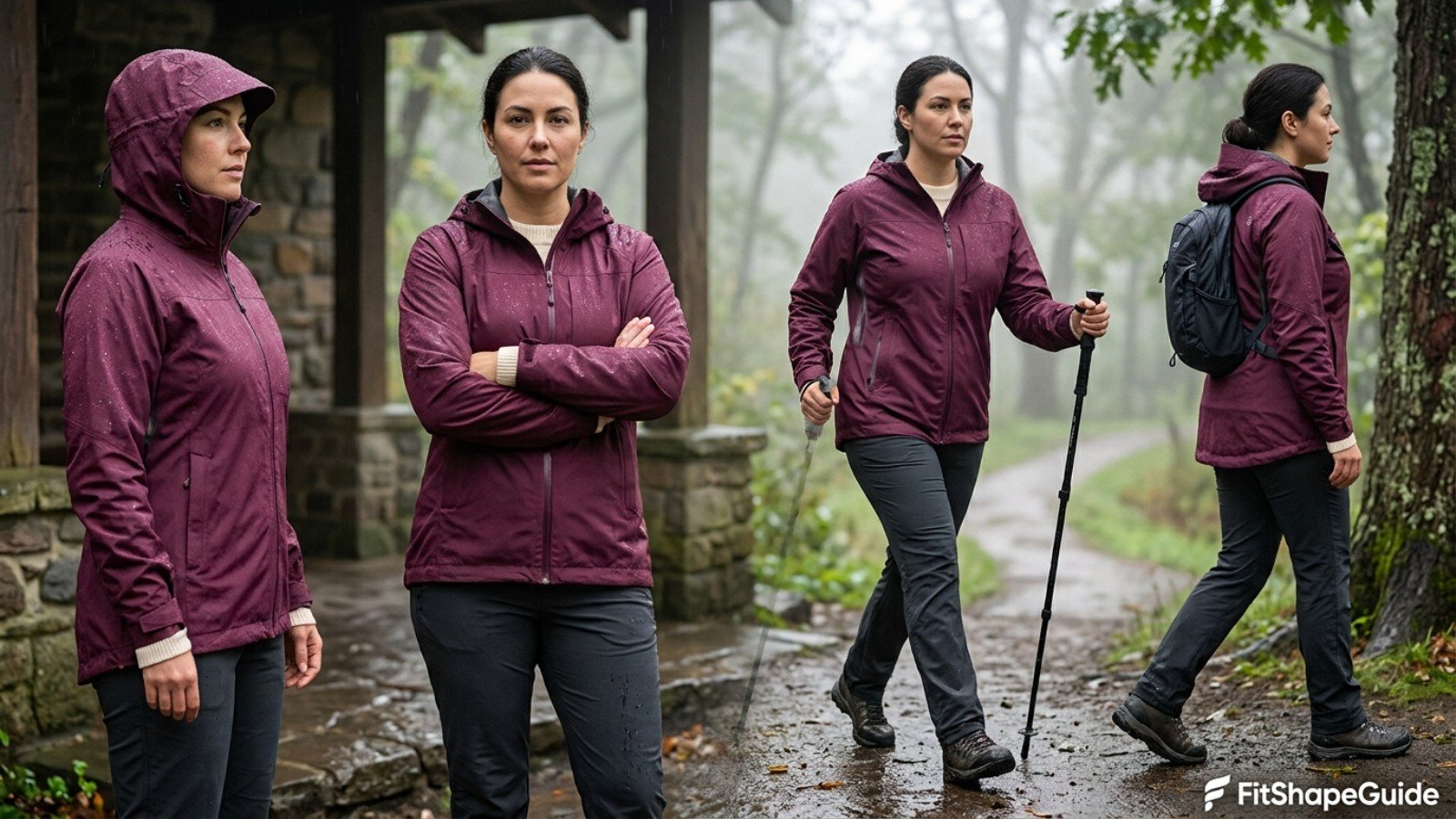
Breathability, lining, insulation and care
Waterproof protection and moisture-vapor movement are separate performance questions. A breathable barrier can move some vapor, but output, humidity, temperature, contamination and ventilation affect real comfort. No shell keeps every wearer dry from both rain and perspiration in every condition.
Two-layer, 2.5-layer and three-layer shells
In a two-layer garment, the protective barrier is bonded to the outer fabric and typically protected by a separate lining. A 2.5-layer shell uses a printed or textured inner treatment instead of a full liner, reducing weight. Three-layer construction bonds outer, barrier and inner backer together for technical durability. These categories do not predict bust fit; each needs its own pattern and layering test.
Lined versus unlined comfort
A smooth hanging lining can improve comfort over shirts and knits, but adds weight and can hold warmth. An unlined or 2.5-layer shell packs smaller yet may feel clammy against short sleeves. Inspect whether the lining pulls across the upper back before the outer shell. A roomy exterior with a tight lining is still restrictive.
Insulated raincoats
Integrated insulation simplifies cold-weather dressing but narrows seasonal range. Check fill type, distribution, liner attachment, care and total weight. Insulation can compress unevenly across a shallow front, so verify zipper behavior. A removable liner offers flexibility, but its snaps or attachment zipper must not create pressure points.
Fabric noise, weight and packability
Stiff face fabric can rustle and hold a strong shape; soft shells may drape more quietly. Ultralight fabric reduces pack size but may trade abrasion resistance. Product weight is useful only alongside size, length and features. Choose based on use rather than assuming lighter always means better.
Wash and reactivate correctly
Follow the sewn-in care label and manufacturer instructions for the exact garment. Close specified zippers, use the recommended cleaner and avoid fabric softener when instructed. Some products direct low-heat tumble drying to reactivate the water-repellent finish. Do not apply generic treatments without checking material compatibility.
Know when maintenance is needed
If clean water stops beading, first clean the garment according to instructions because oils and dirt can impair surface performance. Reapply a compatible finish only as directed. Peeling seam tape, bubbling barrier material or damaged zippers may require professional repair or replacement rather than more spray.
For a firmer city silhouette rather than a technical shell, compare the structured-coat guide.
How to shop online for a raincoat
A useful listing should state whether the finished garment is waterproof or water-resistant, how seams are treated, the shell-layer construction, front protection, hood, cuffs, ventilation, pockets, fabric, care and length. It should also show the coat closed from front, side and back.
Measure a known-good shell
Record flat chest width, front-panel width at bust height, shoulder, upper arm, sleeve, waist, hip, center-back length and hem circumference. Measure over the same midlayer planned for the new coat. Confirm whether a seller chart gives body or finished garment measurements and whether intended layering ease is already included.
Search for exact protection evidence
Look for the waterproof technology, fully or critically sealed seams, zipper protection, DWR description, hood adjustments, cuffs, hem and venting. If the listing mentions only “weather-ready” or “rain friendly,” do not upgrade the claim. Product photos of interior seams and front construction are valuable evidence.
Check length and zipper mechanics
Model height alone cannot predict where a coat will finish. Find center-back length and, if available, front length. For a two-way zipper, confirm operation in photos or specifications rather than assuming two sliders are functional. For long coats, find back vent, side snap or lower-opening details.
Use reviews for observable outcomes
Prioritize reviews that include body and garment measurements, purchased size, underlayer thickness, rain duration and a specific outcome: zipper bowing, chest room, hood vision, sleeve coverage, ventilation access, seam leakage or hem restriction. Ratings and “kept me dry” statements without conditions are not transferable evidence.
Amazon verification workflow
Use only a direct live product-detail page after confirming the brand or authorized seller, exact variant, current chart, measurements, waterproof statement, seams, closure, hood, ventilation, fabric, care and return eligibility. Never publish a search-results URL. Do not hard-code changing prices, coupons, ratings, review counts, stock claims or delivery promises. Keep the affiliate disclosure close to recommendations.
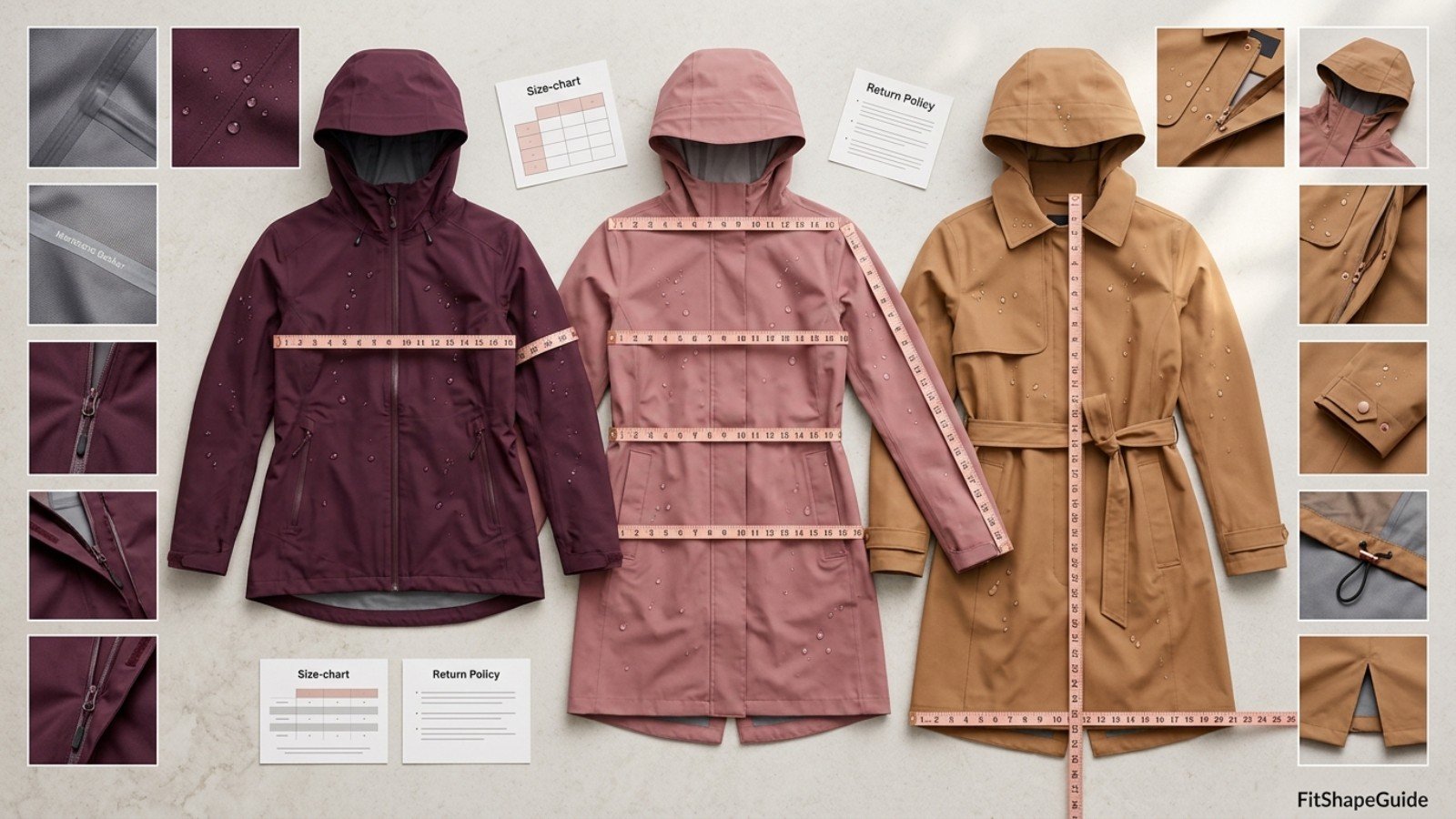
Listings for the best raincoats for a large bust make both fit evidence and protection evidence visible before checkout.
Common raincoat fit and function problems
| Symptom | Likely cause | Better next step |
|---|---|---|
| Front zipper bows outward | Rigid tape crosses insufficient chest depth | Choose shaped panels or more usable front room |
| Collar presses the throat | Bust or upper-back tension pulls coat upward | Add front depth and reach; stop if breathing is affected |
| Storm flap twists or opens | Front strain or misaligned snap positions | Restore ease before tightening waist or hem |
| Hood blocks side vision | Too much volume or inadequate adjustment | Choose crown, face and rear adjustment |
| Sleeves expose wrists in reach | Sleeves too short or upper back restrictive | Check arm length, articulation and back ease |
| Moisture builds inside | High exertion, blocked vapor transfer or closed vents | Use pit zips, reduce insulation and manage pace/layers |
| Front hem rises sharply | Missing chest depth or front length | Choose shaped or longer front construction |
| Long coat restricts stride | Narrow hem, closed vent or one-way zipper | Try more sweep, vent, side snaps or two-way zip |
Do not size up automatically
A larger size may close over the bust but create a loose hood, dropped shoulders, long sleeves and inaccessible vents. Diagnose whether the missing room is at the chest, upper back, upper arm, hip or midlayer. A differently shaped shell often solves the actual problem more cleanly.
Do not trust surface beading alone
Fresh DWR may produce impressive droplets while seams or closures remain unprotected. Read the full construction details and follow maintenance guidance. Beading is useful surface evidence, not a complete waterproof test.
Do not blame the body for zipper strain
The best raincoats for a large bust coordinate front depth, zipper length, upper-back ease and the intended layer. Bending, riding and popping closures are garment evidence—not body failures. Choose protection that permits normal breath and movement.
Choose verified protection with usable front depth
The best raincoats for a large bust combine a verified waterproof system, sealed seams, a protected straight zipper, shaped chest room, upper-back reach, adjustable hood and enough hem mobility for the intended layer. Start with a shaped two-way-zip commuter coat for daily use, a seam-taped ventilated shell for activity, or a 3-in-1 system for variable cold. Keep the coat that stays protected while closed, reaching, walking and seated.
Frequently asked questions
These answers explain how the best raincoats for a large bust should protect, layer and move.
What raincoat style is best for a large bust?
A shaped mid-length raincoat with sealed seams and a two-way zipper is a strong starting point because it balances chest room, weather coverage and seated mobility.
What is the difference between waterproof and water-resistant?
Water-resistant garments handle limited moisture, while waterproof garments use a barrier intended to prevent penetration; seams and closures must also be verified.
Why are sealed seams important in a raincoat?
Needle holes can admit water even when the fabric is waterproof, so seam tape or sealing protects those construction lines against moisture entry.
Is a two-way zipper useful for a fuller bust?
It can improve sitting and stride by opening the lower coat while keeping the upper front closed, but it does not replace adequate chest depth.
How should a raincoat hood fit?
The hood should adjust at the crown, face and rear, move with the head, preserve peripheral vision and remain compatible with the intended collar or helmet.
Should a raincoat fit over a sweater?
Yes, when that is the intended use. Test the exact sweater so the chest, upper back, armholes, sleeves and zipper work as a complete system.
Should I size up in a raincoat?
Only if the hood, shoulders, sleeves, vents and hem remain intentional. A different cut with targeted front depth is often better than extra width everywhere.
How do I test a raincoat before keeping it?
Wear the thickest planned layer, close every fastening, adjust the hood and cuffs, reach, sit, breathe, walk a long stride and inspect zipper and hem balance.
Editorial and verification standards
This guide evaluates observable construction: waterproof statement, shell layers, seam sealing, front protection, chest depth, hood, shoulders, sleeves, ventilation, cuffs, hem, fabric, lining, insulation, care and returns. It recommends raincoat constructions rather than inventing products or universal performance promises.
Current technical examples were checked against official pages for the Outdoor Research Helium rain jacket, the Outdoor Research Stratoburst Plus shell, the Helly Hansen Koster raincoat and the Helly Hansen Vika 3-in-1 raincoat. These sources illustrate why shell layers, seams, vents, hoods, zippers, lining and insulation must be verified separately.
Before publishing a product module, verify the direct live seller, measurements, protection claim, seams, closures, hood, vents, care and returns. Affiliate relationships should be disclosed clearly and close to recommendations under the FTC endorsement guidance.
“Best” means a suitable verified raincoat for an individual body, underlayer, climate, exposure and activity—not a guarantee that one shell protects everyone in every condition.