High-Waisted Jeans and a Large Bust: What to Know
A construction-first guide to rise height, torso space, waistband shape, denim recovery and top pairing when high-rise jeans meet fuller-bust proportions.

The 90-second high-rise test
- Locate the top edge: it should not press into the bra band, underwire area or lowest ribs.
- Sit and breathe: inhale fully without the waistband folding, rolling or causing sharp pressure.
- Check the back: the band should stay level rather than gap, rise or drop during a forward reach.
- Test the top: the neckline should not move downward when the shirt is tucked and you sit.
- Use the pockets: phone or hand should not force the front opening to flare or the band to migrate.
- Stand again: denim and top should recover without repeated pulling or retucking.
Why high-waisted jeans can work—or not
High-waisted jeans place the waistband higher on the torso than a brand’s mid- or low-rise options. There is no universal measurement that makes a jean “high rise.” A front rise that reaches one person’s natural waist may sit above or below another’s because torso length, pelvis, seat shape and the pattern all differ.
The main advantage is a stable meeting point between top and denim. A shaped knit, shirt or shell can tuck into a broad waistband, and a jacket can fall from the shoulder without meeting a low waistband gap. High rise can also support a wide or flared leg by anchoring its volume higher on the garment. These are outfit functions, not promises to flatten, lengthen or visually correct the body.
The main trade-off is vertical crowding. On a shorter torso or when the bust sits lower, the jean may come close to the bra band. Sitting raises the thighs and changes the torso angle, so a waistband that feels acceptable while standing can press the ribs or underwire area at a desk. A stiff button fly, thick belt and tucked shirt add more layers at the same point.
| What you want | High rise can help when | Trade-off to test | Alternative if it conflicts |
|---|---|---|---|
| A stable full tuck | Front length reaches the band without neckline pull | Bulk from shirt, fly and belt | Mid rise or untucked shaped hem |
| Support for wide-leg denim | Band stays level and seat has enough room | Heavy fabric and seated pressure | Mid-rise wide leg with contoured band |
| Coverage when bending | Back rise follows the seat and remains anchored | Back gap despite tall front rise | Longer back rise or curvy waistband |
| A clear jacket-to-jean line | Jacket hem clears band and pockets | Short jacket catches on thick loops | Longer jacket or smoother waistband |
| Less low-waist pressure | Upper waist is a more comfortable position | Rib or bra-band collision | Lower high rise or mid rise |
| A vintage denim shape | Rigid fabric has enough hip, seat and thigh ease | Limited sitting mobility | Comfort stretch or relaxed cut |
Torso length, bust position and bra-band clearance
Torso length is not simply height. Two people of the same height can have different distances between the natural waist, lower ribs, bra band and bust. High-rise jeans occupy some of this vertical space. The useful measure is where the actual waistband lands on your torso, especially after sitting.
Shorter torso or close-set waistband and bra band
If only a small gap remains between the waistband and bra band, thick layers can stack. A wide jean band, belt buckle, tucked knit, underwire and blazer closure may all meet when seated. Try a lower high rise, thinner stable waistband, belt-free styling or an untucked top. Do not shorten bra straps or change posture to create space for incompatible jeans.
Longer torso
A taller front rise may reach the intended waist without contacting the bra band. Even then, back rise and seat shape need separate evaluation. A high front with a short back can tilt downward during sitting. Compare both dimensions and use the forward-reach test.
Natural waist is not a required target
The narrowest torso point can be above or below the most comfortable band position. A jean may be marketed as “waist-defining,” but comfort and stability matter more than locating an ideal line. Choose the level where the waistband can remain horizontal without rolling or restricting breathing.
Bust position and underwire contact
A fuller bust may sit closer to the waistband depending on torso dimensions, bra shape and posture. The jean should not repeatedly push against the underwire or bra band. If the two touch only when slumping deeply, check desk ergonomics as well as clothing; if they touch during ordinary sitting, change the jean rise or waistband construction.
Normal asymmetry and movement
Ribs, waist, pelvis and posture are not perfectly symmetrical. A waistband may feel higher on one side or rotate because the cut, closure or body geometry differs. The goal is even comfort and stable seams, not forcing visual symmetry with a tighter belt.

Front rise, back rise and overall rise
Front rise is commonly measured along the front seam from the crotch junction to the top of the waistband. Back rise follows the rear seam to the top back band. Retailers may use different methods, and curved seams are difficult to measure consistently. Compare measurements from the same source or replicate one method on a working pair.
Measure a pair that already works
- Fasten the jeans and lay them flat without stretching the waistband.
- Smooth the front while preserving the natural curve of the rise seam.
- Measure front rise from crotch seam junction to top edge of front waistband.
- Turn or reposition the pair and measure back rise along the rear seam.
- Record waistband, hip, thigh and inseam because rise cannot be judged alone.
- Note where the band lands on the body standing and seated.
A number is useful only with context. A tall rise combined with a small hip or short seat can still feel restrictive. A shorter front rise paired with a longer back rise may improve coverage for someone whose jeans drop during reaching. The pattern’s distribution matters as much as total height.
Compare rise to closure length
A tall front rise may use a longer zipper, button fly or extended waistband. Check whether the closure lies flat and bends comfortably when sitting. Multiple rigid buttons can add pressure; a zipper can buckle if front room is insufficient. Neither closure is universally more comfortable.
Do not extrapolate across sizes or washes
Rise can change by size, and different washes of the same named fit may use another fabric or finishing process. Confirm the exact variant. If reordering a successful pair, use the style code when available and compare fiber content, measurements and wash rather than relying on the marketing name alone.
Standing position
Record where the band lands relative to the navel, ribs and top hem without pulling the jeans upward.
Seated position
Check pressure, rolling, front closure and the distance to the bra band after five minutes.
Forward reach
Observe back coverage, waistband gap and whether the tuck drags the neckline downward.
Recovery
Stand and wait thirty seconds; the band, knees, seat and top should return without rearranging.
Waistband construction and comfort
High-rise jeans concentrate the waistband higher on the torso, so small construction differences become important. Width, curvature, interfacing, seam bulk, belt loops and stretch all affect comfort. A very wide band can distribute pressure; it can also cover more rib area and roll if its shape does not match the torso.
| Waistband type | Potential advantage | Trade-off | Best test |
|---|---|---|---|
| Contoured waistband | Follows a waist-to-hip curve and may reduce back gap | Curve may still sit at the wrong height | Sit, reach and check level back position |
| Straight waistband | Simple structure and familiar belt fit | Can gap at back or dig at upper edge | Check two-finger comfort and pocket use |
| Wide waistband | Distributes pressure over more area | May reach ribs or roll on a shorter torso | Full breath while seated for five minutes |
| Stretch waistband | Adapts during sitting and daily fluctuation | Weak recovery can migrate or sag | Photograph before and after ten minutes |
| Hidden elastic or internal adjuster | Can refine waist stability without a belt | Elastic may create gathers or pressure points | Inspect inside and test all settings |
| Extended tab or hook closure | Creates a clean trouser-style front | Hardware can press when sitting | Lean forward and check the closure edge |
Back gap
If the hips and seat fit but the waistband gaps, the band may be too straight for the waist-to-hip difference. Try a contoured or curvy cut, or ask a tailor about a waist adjustment. Do not size down when that creates hip tension, pocket flare or a zipper that will not lie flat.
Rolling and folding
A waistband can roll because it is too tall, too soft, too stiff, too tight or placed where the torso bends. There is no single fix. Compare a narrower band, lower rise, stronger recovery or different curve. A tight belt over a rolling band usually adds pressure without correcting shape.
Belt loops and belts
A belt is optional. Use one for style or minor stabilization, not to force an incompatible waist. On a high rise, a large buckle may meet the bust or bra band when seated. A flat, smaller buckle or belt-free outfit can reduce stacked bulk. Check whether the blazer button and belt buckle collide.
Inside finish
Run a hand along the waistband interior. Rough seam allowances, exposed elastic, labels and hardware can irritate through a long day. A soft facing or clean binding may improve comfort, but it still needs durable stitching and recovery.
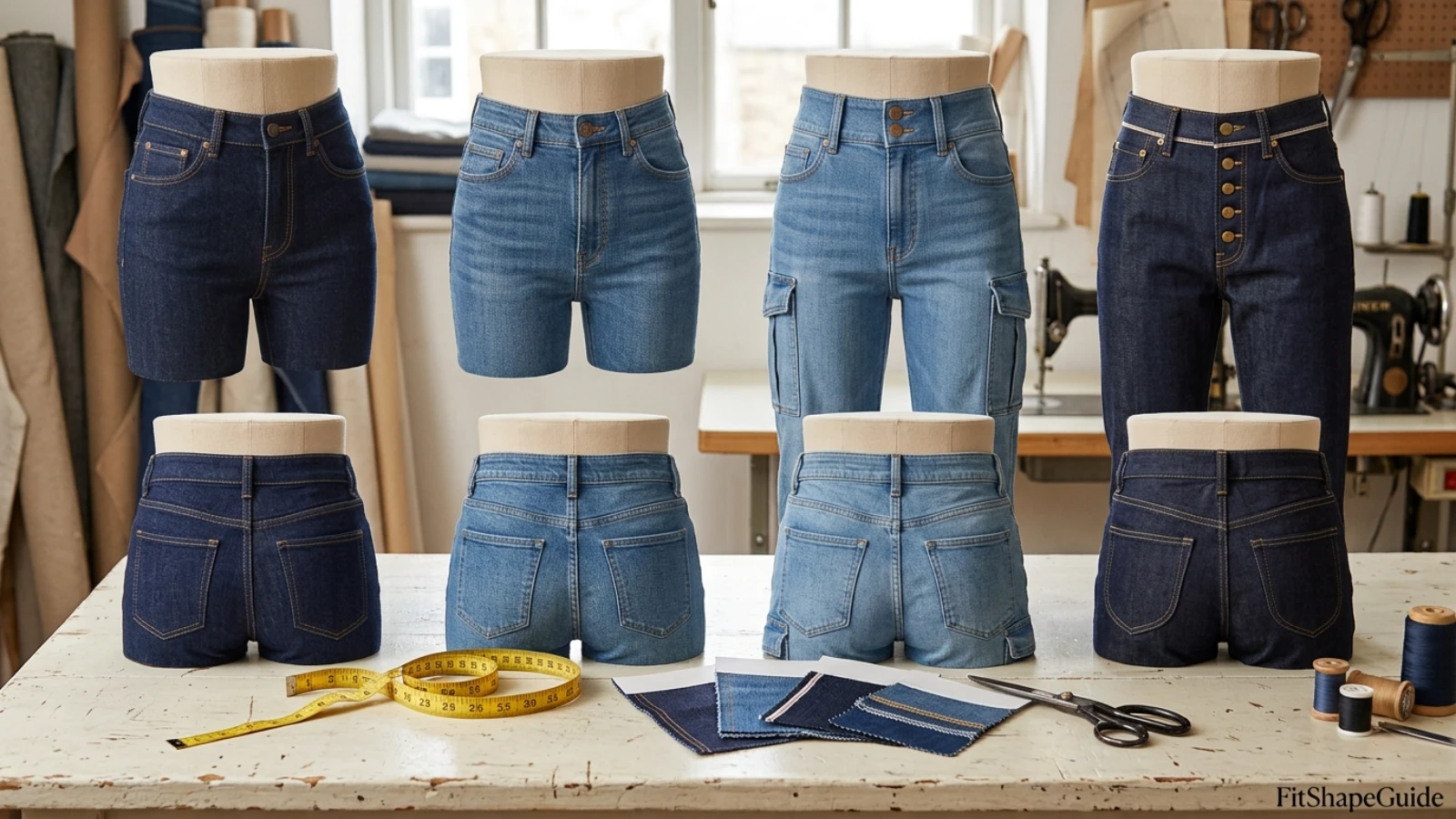
High-rise straight, bootcut, wide and tapered jeans
High rise can be combined with almost any leg shape. The waistband controls the upper anchor; the leg determines movement, hem width and which top lengths feel deliberate. Choose them as separate decisions.
High-rise straight jeans
This is the most versatile combination. The stable upper band supports a tuck, while the straight leg works with shaped knits, shirts and blazers. In rigid denim, confirm seat and thigh ease. In stretch denim, test waistband and knee recovery.
High-rise bootcut jeans
Bootcut jeans stay closer through the thigh before opening below the knee. A high waist can create a defined tuck point for a no-gape shirt or fine knit. The trade-off is inseam dependence: the hem must suit the intended boot, loafer or heel.
High-rise wide-leg jeans
A high anchor can support the weight and volume of a wide leg, but heavy denim adds physical bulk. Check front pockets, crotch depth and seated pressure. Pair with a shaped top, controlled tuck or shorter jacket when you want the waistband visible, but the top does not need to be tight.
High-rise flare jeans
A flare creates a stronger change below the knee than a bootcut. It works with a simple shell, mock neck or fitted shirt. Full-length flares need precise hemming and are less practical in wet weather.
High-rise tapered or mom jeans
These styles often combine a tall rise, room through seat or thigh and a narrower ankle. They can feel relaxed while standing, but the high band and extra front fabric need a seated test. Pair with a popover, cropped jacket or neat knit.
High-rise slim-straight jeans
A compact leg leaves space for longer blouses and blazers. Confirm that thigh and calf ease are sufficient and that the tall waistband does not require an overly short top. “Slim straight” measurements vary by brand.
For a complete comparison of these leg shapes, use the jeans and large-bust outfit guide. It explains straight, bootcut, flare, wide, tapered, barrel and relaxed options without treating one as a body-correction rule.
Tops, tucks and jackets with high-waisted jeans
A high waistband changes where the top ends and how much fabric sits underneath it. The top needs enough bust circumference and front length before tucking. If the neckline moves downward, buttons strain or the hem escapes when seated, solve the top length or rise rather than tightening the jeans.
Full tuck
Use a lightweight but opaque shaped top with enough front length to stay anchored after sitting. Spread fabric evenly around the waistband instead of packing all excess at the front. A thick sweater and rigid high rise can create uncomfortable bulk; choose a finer gauge or partial tuck.
Partial tuck
A small front tuck can show the waistband while leaving side and back ease. It works best when the top hem is soft, the front rise is comfortable and front pockets remain usable. The tuck should not pull the neckline or create a large knot of fabric at the fly.
Untucked shaped hem
An untucked top is fully compatible with high-waisted jeans. Choose a hem that clears or intentionally covers pockets and belt loops. A curved or split hem can accommodate bust length without needing a tuck. Explore neckline and shaping options in the best tops for a large bust.
Button-down shirts
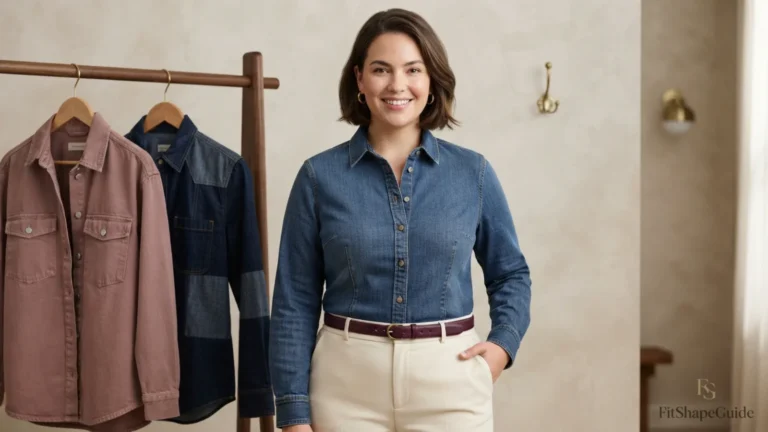
The placket should stay closed before and after tucking. A high rise can pull a short shirt downward when seated, increasing gaping. Look for bust darts, princess seams or adequate front width and length. Do not use waistband pressure as a substitute for shirt fit.
Blazers
A blazer can end above, at or below the high waistband. Check whether the hem catches on belt loops and whether the button meets a thick buckle. An open single-breasted jacket usually reveals the high-rise line most clearly; a longer jacket can cover it while keeping a compact silhouette. Compare lapels and button stance in the work blazer guide.
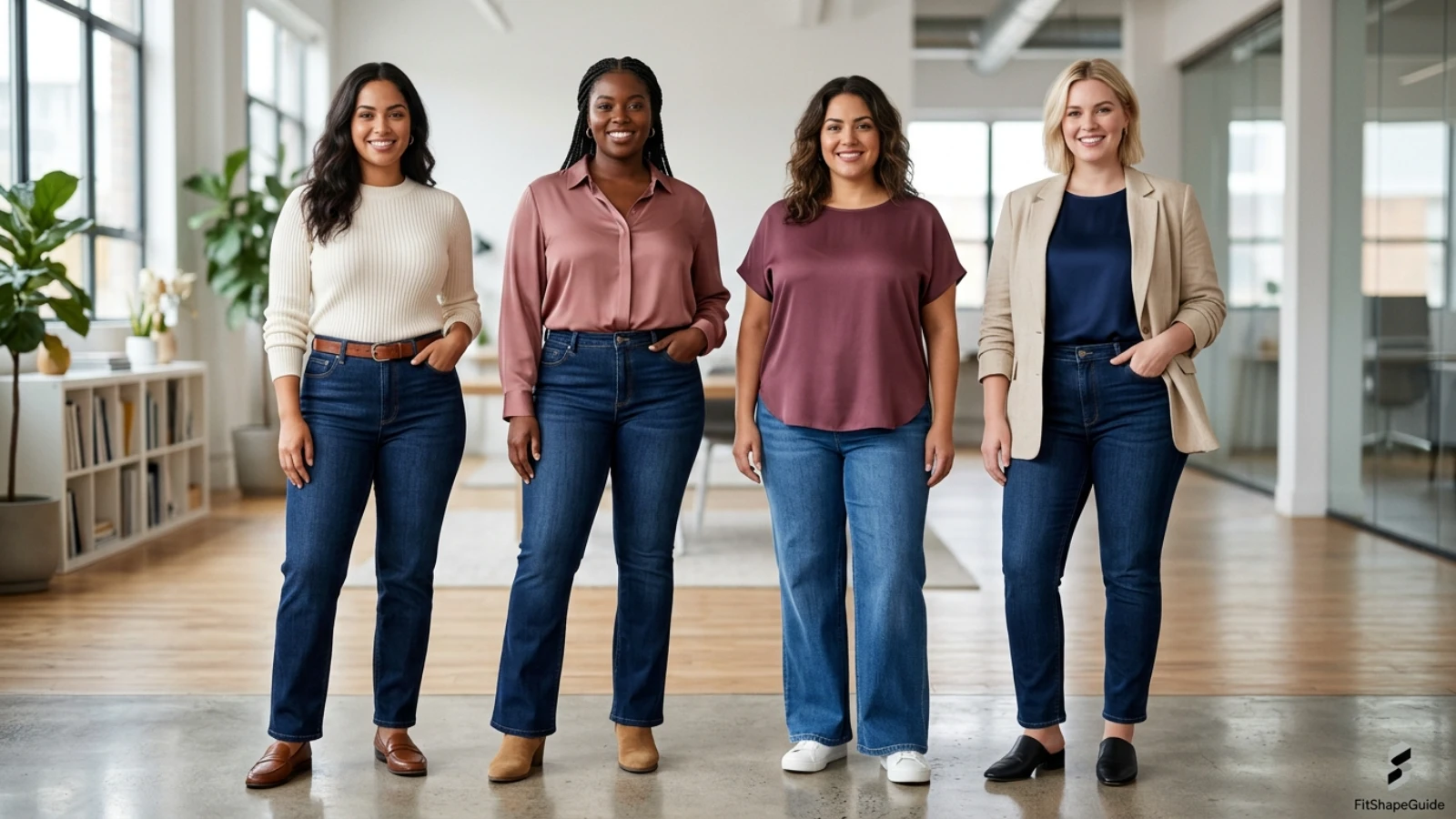
For repeatable trouser-and-top formulas, use the work pants and top pairing guide. The same rise, tuck and jacket interactions apply even when the fabric is not denim.
Denim stretch, weight and high-rise stability
High-waisted jeans place more fabric and waistband area on the torso, so denim behavior is easy to notice. Rigid denim holds a defined shape but needs enough pattern ease. Stretch denim adapts during sitting but can grow if recovery is weak. Fiber percentages alone do not predict the result.
Rigid or low-stretch denim
Rigid high-rise jeans can create a clean waistband and structured leg. They should fasten without breath-holding and permit sitting before any break-in. Buy for actual hip, seat and thigh mobility, not for a promise that discomfort will disappear.
Comfort stretch
Limited stretch can reduce pressure while preserving denim character. Test the waistband after ten minutes. It should adapt during sitting and return when standing. If the band expands while the top and pockets migrate, another fabric or size may work better.
High stretch
High stretch supports close fits and daily movement, but the tall waistband needs stable recovery. Watch for rolling, knee bagging and a seat that drops. More elastane is not automatically higher quality, and product finishing affects performance.
Denim weight
Heavy denim can support wide or straight legs but may feel warm and rigid across a tall rise. Lightweight denim can drape and feel easier, yet opacity and pocket outlines need checking. Choose weight for climate, movement and care routine rather than assuming heavier always lasts longer.
Care and heat
Stretch-denim recovery and shrinkage can be affected by fiber and heat setting, so follow the exact care label. Do not use a hot dryer automatically. Close fastenings, separate compatible colors and follow instructions for washing temperature and drying. Dark or raw denim may transfer dye to light tops, bags or seating, especially when new.
Seated movement, daily fluctuation and accessibility
A standing mirror cannot predict a high-rise workday. Sitting changes the angle between thighs and torso and can move the waistband upward. Test on a firm chair, soft seat and car seat when relevant. The top edge should not cause sharp pain, numbness, breathing restriction or repeated underwire contact.
Desk work
Sit for at least five minutes with both feet supported. Type, reach toward the mouse and rotate to each side. Note whether the waistband folds, the zipper buckles, the back gaps or the top neckline shifts. A jean that requires unfastening at the desk is not the right work fit.
Commute
Car and public-transport seats can place the torso at different angles. Wear the coat and carry the usual bag. A long jacket may push the high waistband, and a crossbody bag may rest on the fly. Test the full system rather than blaming the jean alone.
Normal daily change
Waist comfort can vary through the day. A contoured band with modest recovery, internal adjuster or slightly lower rise may accommodate change better than a rigid edge. The appropriate solution is personal and should not involve painful compression.
Closure accessibility
High rises can use long zippers, multiple buttons, hooks or side closures. Choose hardware you can manage easily and quickly. Button flies distribute closures but require more steps; hooks create a clean front but can be small. Test dressing and restroom use before removing tags.
Belts and adjustment tools
A belt can style or lightly stabilize a good fit. Elastic button extenders and temporary devices may change closure tension, but they should not expose the fly, distort the zipper or replace correct sizing. Avoid sharp improvisations or forcing hardware under high tension.
For workplace-specific layers and seated tests, use the business-casual outfit guide.
Online shopping, alterations and care
Measure a successful pair using the same method for every comparison. Record front rise, back rise, waistband, hip, thigh, inseam and leg opening. Note the fiber content, stretch, closure and where the waistband lands standing and seated. A body size chart is not a substitute for garment dimensions.
- Confirm the exact variant: size, wash and fabric may change measurements or feel within one named fit.
- Read front and back rise: use both when available and compare with a working pair.
- Inspect waistband shape: look for contouring, width, elastic, interior finish and belt-loop placement.
- Check the full leg: high rise is independent from thigh ease, knee, hem and inseam.
- Review materials and care: verify stretch fiber, wash instructions, drying and dye-transfer notes.
- Confirm returns: keep tags attached until the seated, commute and full-outfit tests are complete.
Useful alterations
A tailor may reduce a back-waist gap when the rise, hip, seat and pockets already fit. Hemming can preserve a straight, bootcut or wide-leg proportion when done for the intended shoe. Major rise changes are complex because they affect fly, pockets, yoke and crotch shape. A different cut is often better.
Build a two-rise capsule
If high rise works only with some tops or days, keep one high-rise pair and one dependable mid rise. The high pair can support tucks and shorter jackets; the mid rise can handle long seated days or thicker layers. A capsule should solve contexts rather than enforce one rise.
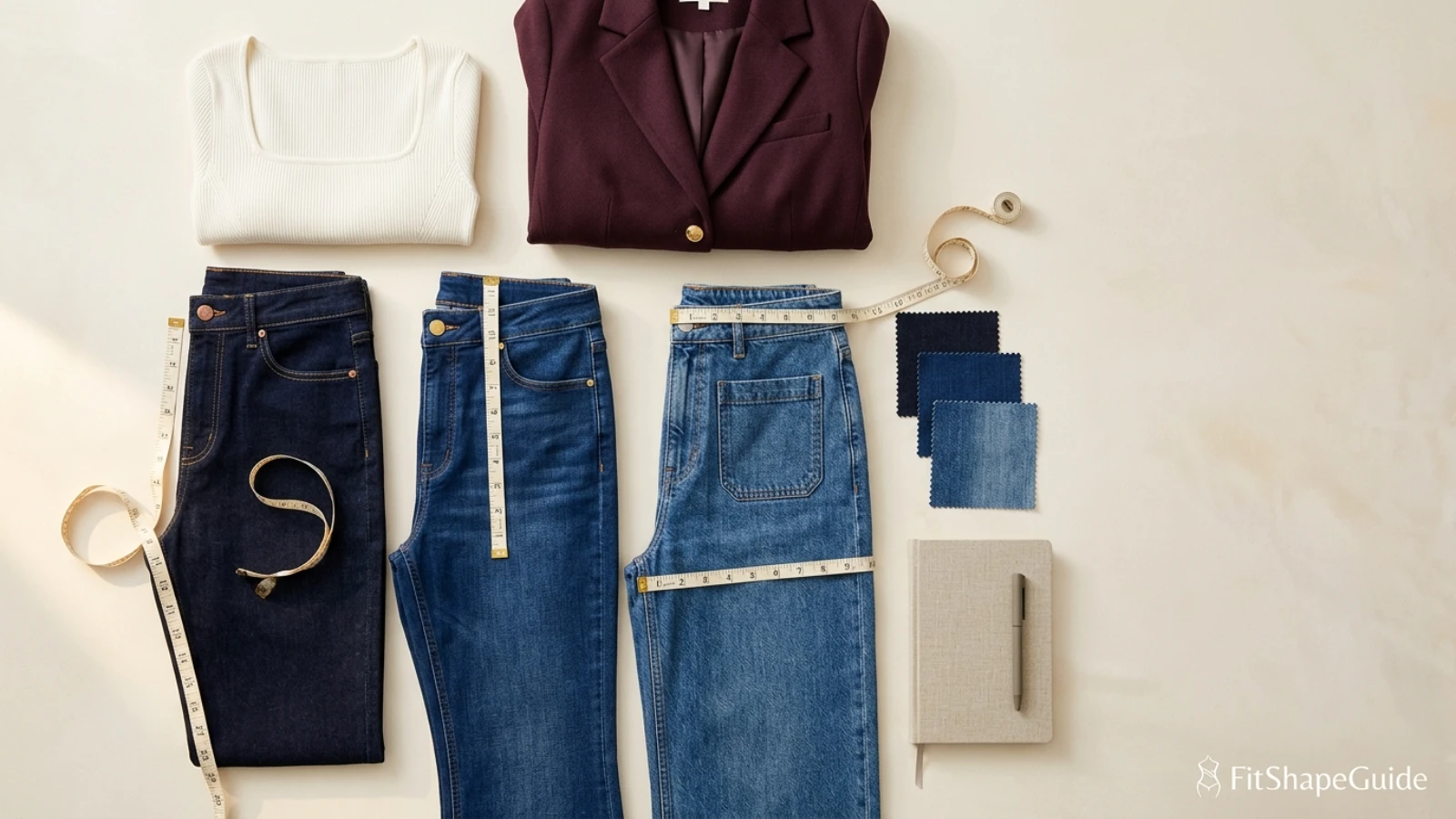
Use the broader office-dressing framework to connect rise choice with meetings, commute, footwear and dress code.
Common high-waisted jeans problems
| Problem | Likely cause | Try next | Avoid |
|---|---|---|---|
| Waistband touches bra band | Rise too tall for available torso space | Lower high rise, mid rise or narrower band | Changing posture all day |
| Top neckline pulls down | Tuck is tight or top lacks front length | Longer top, partial tuck or lower rise | Overtightening the waistband |
| Band rolls when seated | Band height, curve, stiffness or circumference conflicts | Different width, shape or rise | Adding a tight belt over the roll |
| Back gaps while hips fit | Straight waistband on a greater waist-to-hip curve | Contoured band, curve cut or alteration | Sizing down into hip tension |
| Fly buckles outward | Insufficient front room or rigid long closure | Different rise, size or closure construction | Hiding tension beneath a long top |
| Waist loosens after sitting | Fabric growth or weak recovery | Different denim or waistband structure | Buying painfully tight for predicted stretch |
| Wide leg pulls waistband down | Heavy denim plus limited seat or waist stability | Lighter denim, better rise or stronger band | Extreme belt tension |
| Buckle meets blazer button | Hardware and layer closures occupy one point | Smaller buckle, belt-free styling or another jacket length | Forcing both closures shut |
High rise looks good but feels wrong
Appearance does not override comfort. Try another front-rise height, softer band, different curve or mid rise. High waist is a styling option, not a requirement for a fuller bust.
The waist fits only before lunch
Choose a waistband with appropriate give, internal adjustment or a more comfortable position. Do not plan to unfasten the jeans privately through the day. Fit should accommodate ordinary daily change.
The bra and waistband stack under a fitted top
Reduce one layer’s height or thickness. A lower rise, narrower band, untucked shaped top or finer bra band may separate the components. The bra should still provide correct support and the jean should still fit independently.
The high rise creates too much front fabric
The front-rise shape, not only its height, may be incompatible. Try a flatter front, different fly length, alternative pocket bags or lower rise. Sizing down can worsen zipper strain and sitting pressure.
Final verdict
High-waisted jeans can work well with a large bust when the rise creates a stable top-to-jean connection without crowding the bra band or ribs. Measure front and back rise, choose a waistband curve and width that remain level, and make sure seat and thigh room prevent the band from being dragged out of position.
Test the complete outfit while seated, breathing, reaching and standing. A top should stay secure, the waistband should not roll or press sharply, and denim should recover. If torso space is limited, a lower high rise or mid rise is an equally valid and often better choice.
Frequently asked questions
Are high-waisted jeans good for a large bust?
They can be when the waistband stays comfortable below the bra band, the rise remains level and the intended top does not pull during sitting.
Can high-rise jeans sit too close to the bra band?
Yes. On a shorter torso or with a very tall waistband, the two can touch when seated, making a lower high rise or mid rise more comfortable.
What rise works best for a shorter torso?
A lower high rise or mid rise often preserves more space between waistband and bra band, but actual front-rise measurements and seated comfort matter most.
How do I measure the rise of jeans?
Lay fastened jeans flat and measure along the front seam from the crotch junction to the waistband top, then repeat along the back seam.
Do high-waisted jeans balance a large bust?
They can create a clear outfit line, but the body does not need correcting. Choose high rise only when its comfort, top pairing and leg shape suit you.
What tops work with high-waisted jeans?
Shaped knits, secure shirts, shells, popovers and curved-hem tops work well through full, partial or no tuck when they have enough bust room and front length.
Why do high-waisted jeans gap at the back?
The waistband may be too straight for the waist-to-hip difference. A contoured band, curve cut or careful waist alteration may fit better.
Should high-waisted jeans feel tight at first?
They may feel firm, but they should allow full breathing, sitting and walking without pain. Do not depend on uncertain stretching to correct poor fit.
Editorial and verification standards
This guide evaluates high-rise jeans through front rise, back rise, waistband shape, torso space, closure, seat and thigh ease, denim recovery and full-outfit movement. General measurement guidance was checked against the official Levi’s product size guide, which separates waist, hip and inseam measurements, and the Levi’s women’s jeans guide for current high-rise straight and bootcut terminology. These are construction references, not product endorsements.
Stretch and recovery are treated separately. CottonWorks shrinkage guidance notes that stretch denim commonly includes spandex and that heat setting affects shrinkage, recovery and growth. Care therefore remains product-specific, and the sewn-in label overrides generic washing rules.
Before publishing a product module, verify the direct seller, exact style and wash, size range, garment measurements, front and back rise, waistband, closure, seat, thigh, leg opening, inseam, fiber content, stretch, care, current availability and returns. Affiliate relationships should be disclosed clearly and close to recommendations under the FTC endorsement guidance. No product ranking appears until those facts can be checked.
“Best” means compatible with an individual’s torso dimensions, bra, comfort, movement, top wardrobe, climate and care routine. High rise is never presented as mandatory, slimming or universally better than mid or low rise.