Best Denim Shirts for a Large Bust
A construction-first buyer’s guide to denim shirts that close smoothly, move comfortably, layer cleanly, and keep their intended shape: bust ease, seams, stretch, weight, plackets, shoulders, length, wash behavior, and care.
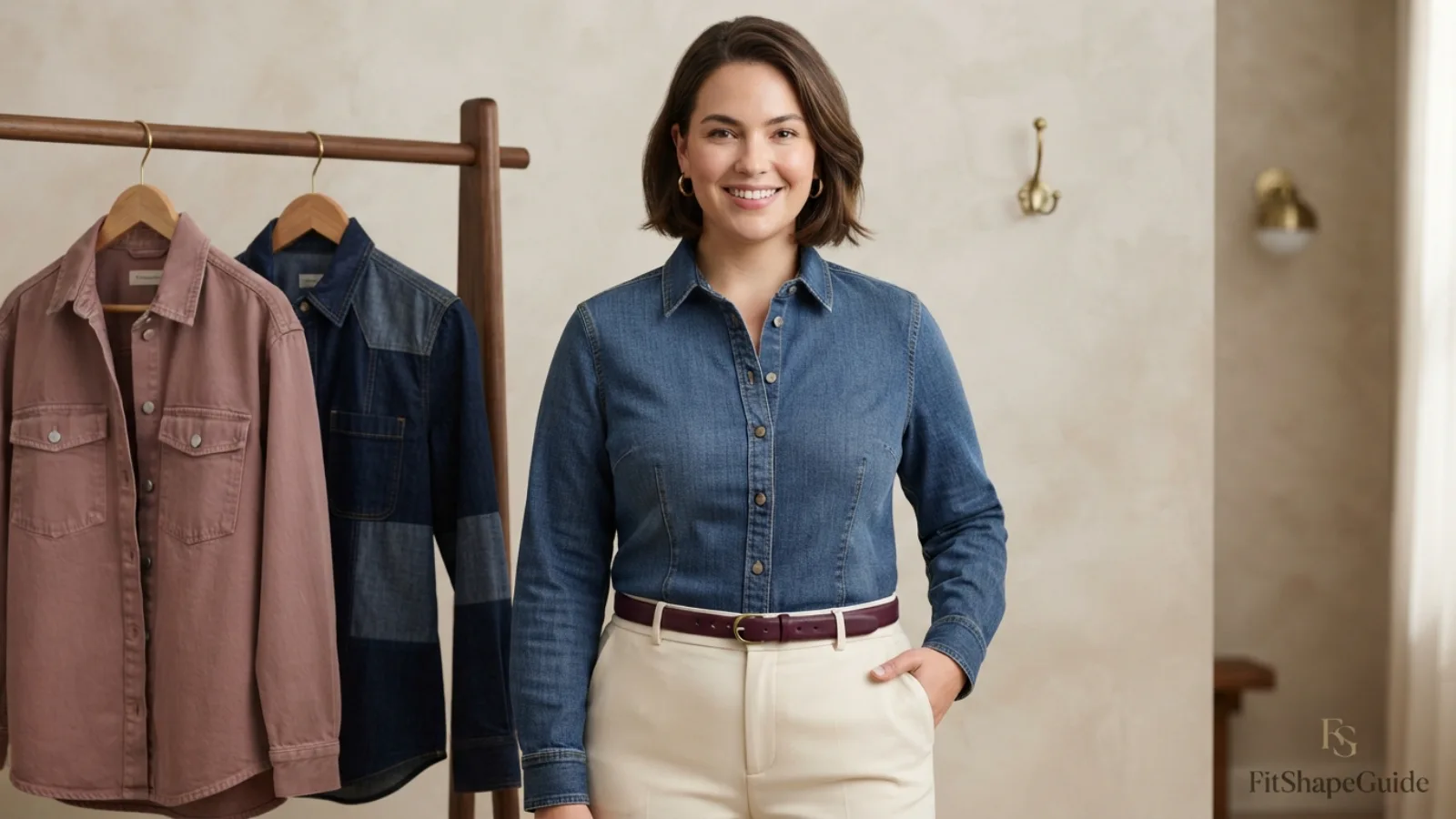
The best denim shirts for a large bust do not rely on looseness alone. They combine enough finished garment room with three-dimensional shaping, a stable button placket, correct shoulders, usable upper-back ease, and sufficient center-front length. Denim is a diagonal-rib twill fabric, but the word covers very different garments: a rigid 100% cotton western shirt, a soft washed lightweight shirt, and a cotton-rich stretch-denim shirt will not fit or recover in the same way. A flat, stiff front that is too shallow can pull buttons sideways, form diagonal lines from bust to armhole, rotate side seams forward, shorten the front hem, and restrict reaching. Simply sizing up may release the bust yet drop the shoulders, enlarge the collar, deepen the armholes, and turn the waist into a box. A stronger solution places volume where it is needed through bust darts, princess seams, curved panels, controlled front ease, a fuller-bust block, or a softer open-layer construction. This guide compares those options and shows how to evaluate product measurements, photographs, fabric composition, closures, movement, shrinkage, color transfer, alterations, styling, and care before you buy.
The 60-second denim shirt check
- Close every button: the placket stays flat and each button remains vertical instead of being pulled sideways.
- The shoulder seam lands near the shoulder edge unless the design is intentionally dropped.
- Side seams hang vertically and the center front does not climb sharply over the bust.
- Darts aim toward the fullest area and stop before it; princess seams travel smoothly over the bust without collapsing.
- Reach forward and lift the arms: the upper back, armholes, biceps, and placket should remain comfortable.
- Look across the fullest horizontal line for pale strain, diagonal drag lines, button gaps, or distorted pockets.
- If stretch is present, the shirt should settle back after movement rather than remain rippled or enlarged.
- If you will layer it, repeat the fit test over the exact bra, camisole, or T-shirt you intend to wear.
Best denim shirts by construction
Construction should lead the buying decision because two shirts in the same fabric can behave very differently on a projected bust. The six categories below are not fabricated product recommendations. They are evidence-based product types to use while comparing real listings. A product belongs on your shortlist only after its measurements, material, closure, care, returns, stock, and retailer information have been checked.
Shaped midweight denim shirt
Best for: one versatile shirt worn closed, tucked, untucked, or partly open. Look for side bust darts or subtle curved seams, a firm but not bulky placket, close button spacing, a shaped waist, and a curved hem with extra front length. Midweight denim can skim the body and hold a collar well, but it exposes missing projection quickly. The shirt should close before the denim is asked to stretch.
Comfort-stretch denim shirt
Best for: commuting, reaching, and all-day movement. A small elastane percentage may improve crosswise give, but the pattern still needs bust room and a stable placket. Confirm whether stretch runs across the body, whether recovery remains smooth, and whether the collar and button band are stabilized. High stretch cannot correct short center-front length or misplaced darts, and a strained shirt may grow during wear.
Princess-seam or panelled denim shirt
Best for: a pronounced difference between bust and waist. Curved seams distribute shaping over a longer route and give a tailor more visual guidance than a featureless front. The curve should pass over the fullest area, side seams should remain vertical, and the waist should not be dragged upward. Thick flat-felled seams add bulk, so inspect how the panels are joined and whether topstitching lies smoothly.
Fuller-bust button-front denim shirt
Best for: shoppers whose standard shoulder size fits but whose usual shirt pulls across the chest. A genuine fuller-bust block may add front width, dart intake, button coverage, or front length without enlarging the neck and shoulder area equally. Look for a stated cup option or a clear explanation of front-specific pattern changes. A generic “curvy fit” label does not confirm extra bust projection.
Lightweight chambray shirt
Best for: the visual language of denim with softer drape and less bulk. Chambray is generally a plain weave rather than denim’s twill weave, so it is related in appearance but not identical in construction. It can be easier to tuck and layer, yet a very light cloth may show pull lines, bra texture, or pocket outlines more clearly. Seek darts, a stable placket, useful opacity, and enough front room.
Relaxed denim overshirt
Best for: open layering over a fitted base. A dropped shoulder, boxier body, and larger armhole can be intentional when the shirt functions like a light jacket. Judge it over the intended underlayer and verify that the fronts can overlap without being forced, even if you normally leave them open. An overshirt is not the best choice when you need a crisp tucked shirt or a close waist fit.
| Construction | Strongest advantage | Evidence to confirm | Main trade-off |
|---|---|---|---|
| Shaped midweight | Versatile polished structure | Darts, flat placket, curved hem, finished bust | Rigid versions expose missing room |
| Comfort stretch | Greater active mobility | Fiber percentage, stretch direction, recovery, stable closure | May grow or cling when undersized |
| Princess seam | Closer bust-to-waist shaping | Curve placement, smooth topstitching, vertical side seam | Misplaced curves are hard to alter |
| Fuller-bust block | Extra front room without oversized shoulders | Cup option or explained pattern difference | Availability and sizing systems vary |
| Chambray | Soft, tuckable, lightweight feel | Plain-weave composition, opacity, shaping, placket | Less classic denim body and abrasion resistance |
| Overshirt | Easy open layering | Layer measurements, armhole room, front overlap, hem length | Not automatically suitable as a fitted shirt |
How the best denim shirts control the placket and bust
A button band is a structural beam
The placket carries repeated horizontal load whenever the garment is short of room. A good denim placket uses appropriate interfacing, even topstitching, and buttons close enough to prevent one long unsupported interval crossing the fullest part of the bust. Western-style snaps can be quick to use, but they are not a cure for a tight pattern; excessive tension may pop a snap open more suddenly than a sewn button. On any closure, the two front edges should meet naturally before fastening. If you must pull them together, the shirt is relying on hardware rather than fit.
Button position matters as much as button count
Two shirts can have the same number of buttons but behave differently because the spacing falls differently on the body. The most vulnerable point is often between buttons rather than directly under one. Look at the shirt fully closed from the side and during a reach. A hidden internal button or snap can protect a small interval when the shirt already has enough room. It should not create a new dimple, pull the placket off center, or be used to force a gap closed.
Darts turn width into projection
A side bust dart removes fabric below and beside the bust so that the front can project without remaining equally wide at the waist. It should aim toward the fullest area while stopping before it; exact placement varies with body and design. A dart ending too high, low, or far away can create a hollow, point, or diagonal fold. Deeper darts need thoughtful pressing in denim because bulky intake can show. Split or curved shaping may distribute the same volume more smoothly.
Princess seams distribute shape over distance
Princess seams can travel from the shoulder or armhole through the bust toward the hem. Their advantage is continuous contouring, especially where the bust and waist need different amounts of room. The best denim shirts with panelled fronts use curves that sit over the actual fullest area, not beside it. Decorative topstitching makes alignment easy to inspect but also highlights puckering. If the curve is substantially misplaced, a different cut is usually smarter than complex reconstruction.
Pockets can reveal tension
Chest pockets, western yokes, flaps, and decorative seams add horizontal and diagonal reference lines. When the shirt is tight, pocket edges may tilt, flaps may lift, and yoke points may pull toward the center. Large high-contrast pockets can also make small fit distortions more visible. This is not a body problem; it is useful garment evidence. Prefer pockets and yokes that lie flat before and after a reach, or choose a cleaner front when shaping is the priority.
Denim weight, cotton content, stretch, wash, and recovery
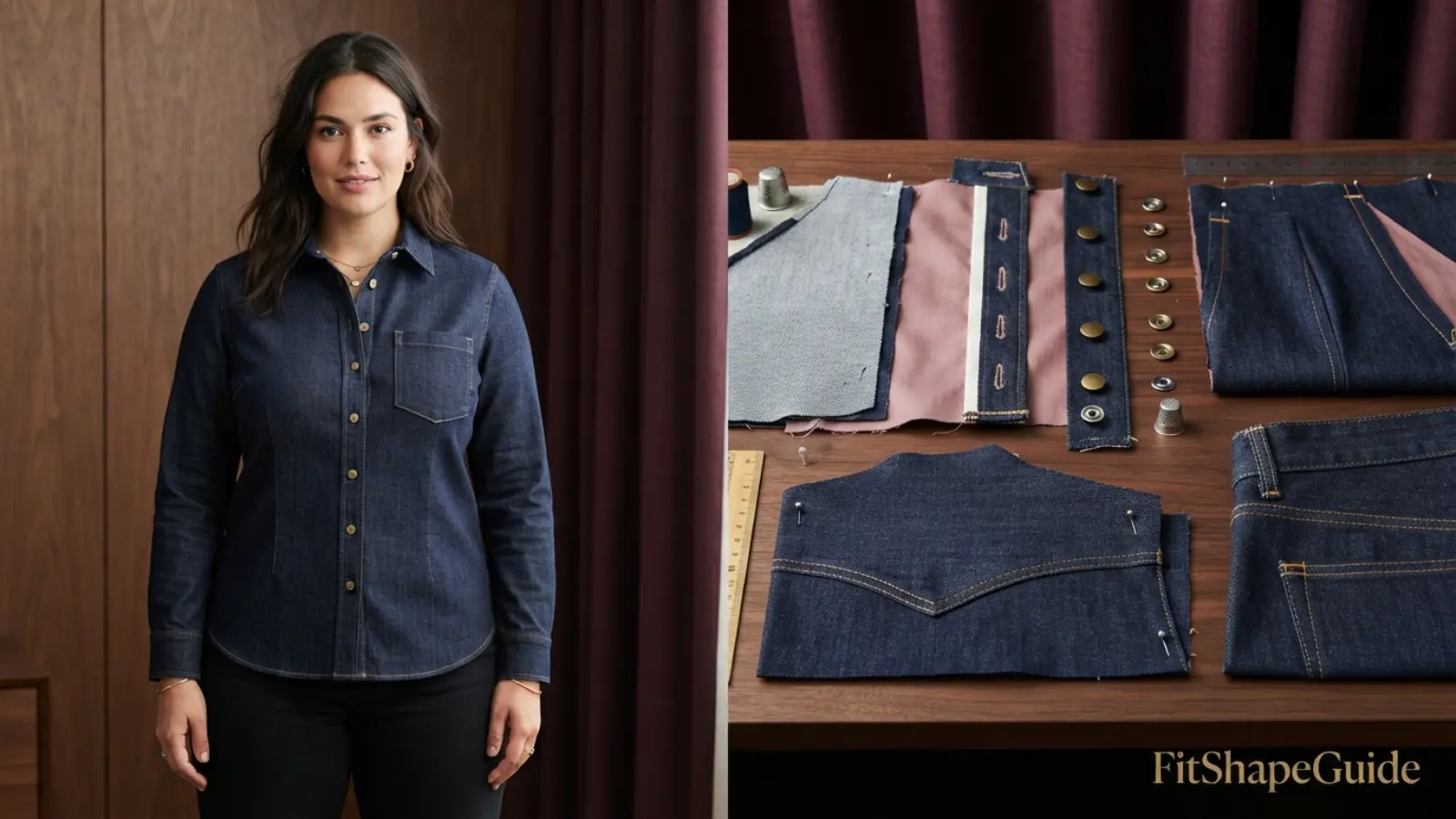
“Denim shirt” describes a category, not a standardized weight or performance level. Product listings may use ounces per square yard, grams per square meter, or only adjectives such as lightweight and substantial. Those terms are not perfectly comparable between retailers. When numerical fabric weight is available, use it as one clue alongside fiber composition, wash, weave, garment design, and reviews. The best denim shirts balance textile behavior with the intended structure; the goal is not automatically the lightest or stretchiest cloth.
Rigid cotton denim: stable but unforgiving
Classic 100% cotton denim may soften with wear and laundering, yet a new rigid shirt offers little immediate mechanical help across the bust. That stability can create a clean collar, straight placket, and crisp overshirt shape. It also makes missing ease obvious. Choose rigid denim only when the closed garment already accommodates breathing, reaching, and front length. Do not buy a visibly strained shirt on the assumption that it will stretch into a correctly shaped pattern.
Comfort stretch: useful, not unlimited
A cotton-rich blend with elastane or another elastic component may provide crosswise give and recovery. The actual experience depends on percentage, yarn, weave density, finishing, panel direction, and garment measurements. A tiny elastic percentage can be meaningful, while a higher percentage in a tightly constructed shirt may still feel restrictive. Stretch can improve movement, but if the placket bows and the fabric turns pale under tension, the garment is using stretch to compensate for missing room.
Lyocell and viscose blends: softer hand, different structure
Denim-look fabrics may include lyocell, viscose, modal, or blends that produce more fluid drape. These can feel lighter and tuck more easily than rigid cotton denim. They may also collapse around a stressed placket, show moisture differently, or require gentler laundering. Read the exact fiber percentages and care label rather than assuming all blue twill will behave like a five-pocket jean fabric.
Chambray is not simply “thin denim”
Chambray commonly uses a plain weave with colored warp and lighter weft yarns, while classic denim uses a twill weave with a visible diagonal rib. Both may be cotton and both can create a familiar blue shirt, but their surface, drape, strength, and visual depth differ. Chambray can be a smart choice for heat, tucking, or gentle layering; it should still have adequate bust room and a stable closure.
Wash and finishing change hand and color
Rinse washes, enzyme washes, stonewashed effects, sanding, and other finishing can soften denim and alter appearance. A distressed shirt may have intentionally faded seams or weakened areas. Dark indigo can transfer color through rubbing, especially when new, so check the maker’s warnings and test cautiously according to instructions. “Prewashed” does not guarantee zero further shrinkage, zero color transfer, or identical behavior across all garments.
Recovery is visible after motion
Stretch without recovery can leave horizontal ripples, a widened placket, bagged elbows, or a distorted hem after sitting and reaching. Recovery is the fabric’s ability to return toward its prior shape; it depends on the full textile and construction, not only on a composition number. During the try-on, hold a natural posture after each movement and let the shirt settle without smoothing it. Persistent distortion is a stronger warning than a temporary fold.
Bust ease, shoulders, armholes, biceps, and front length
Measure a successful shirt first
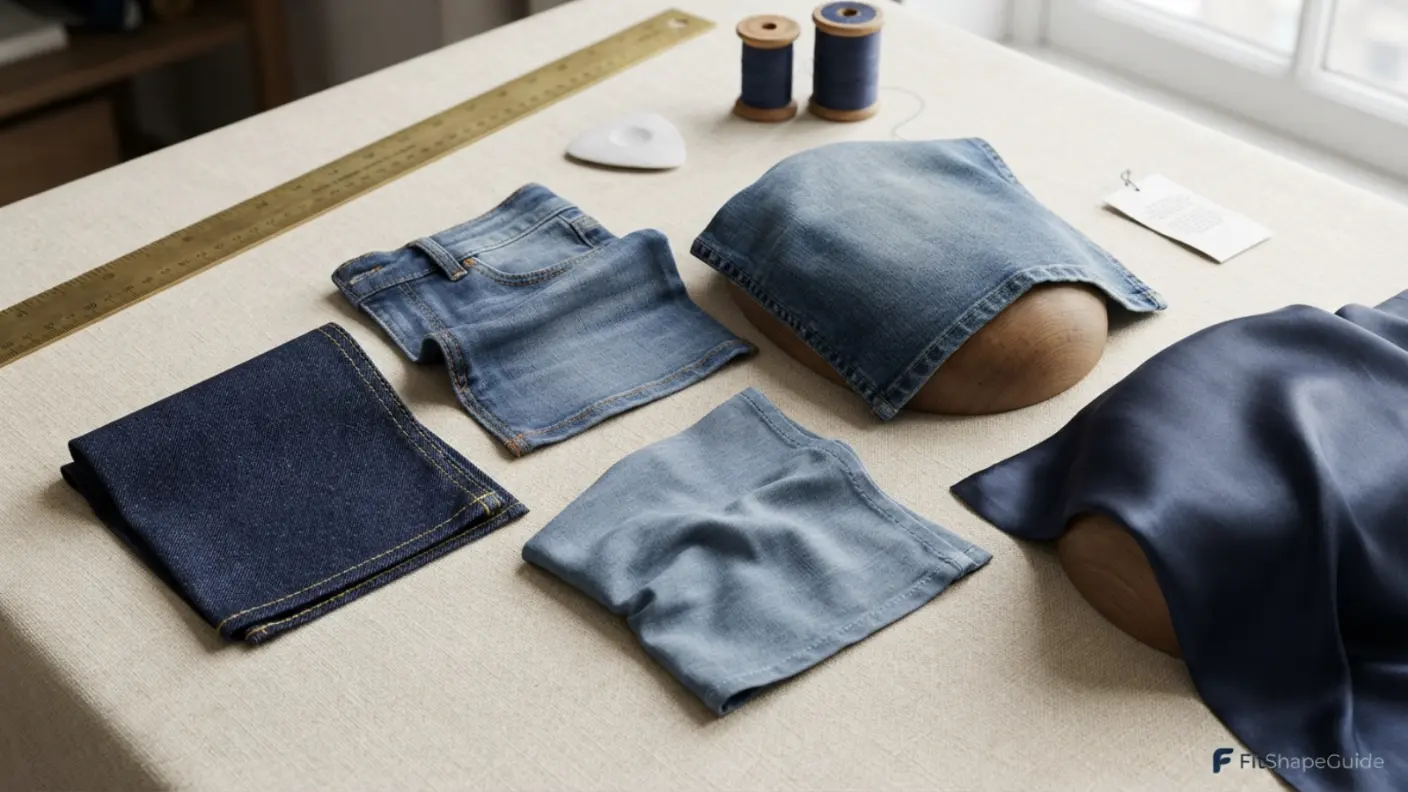
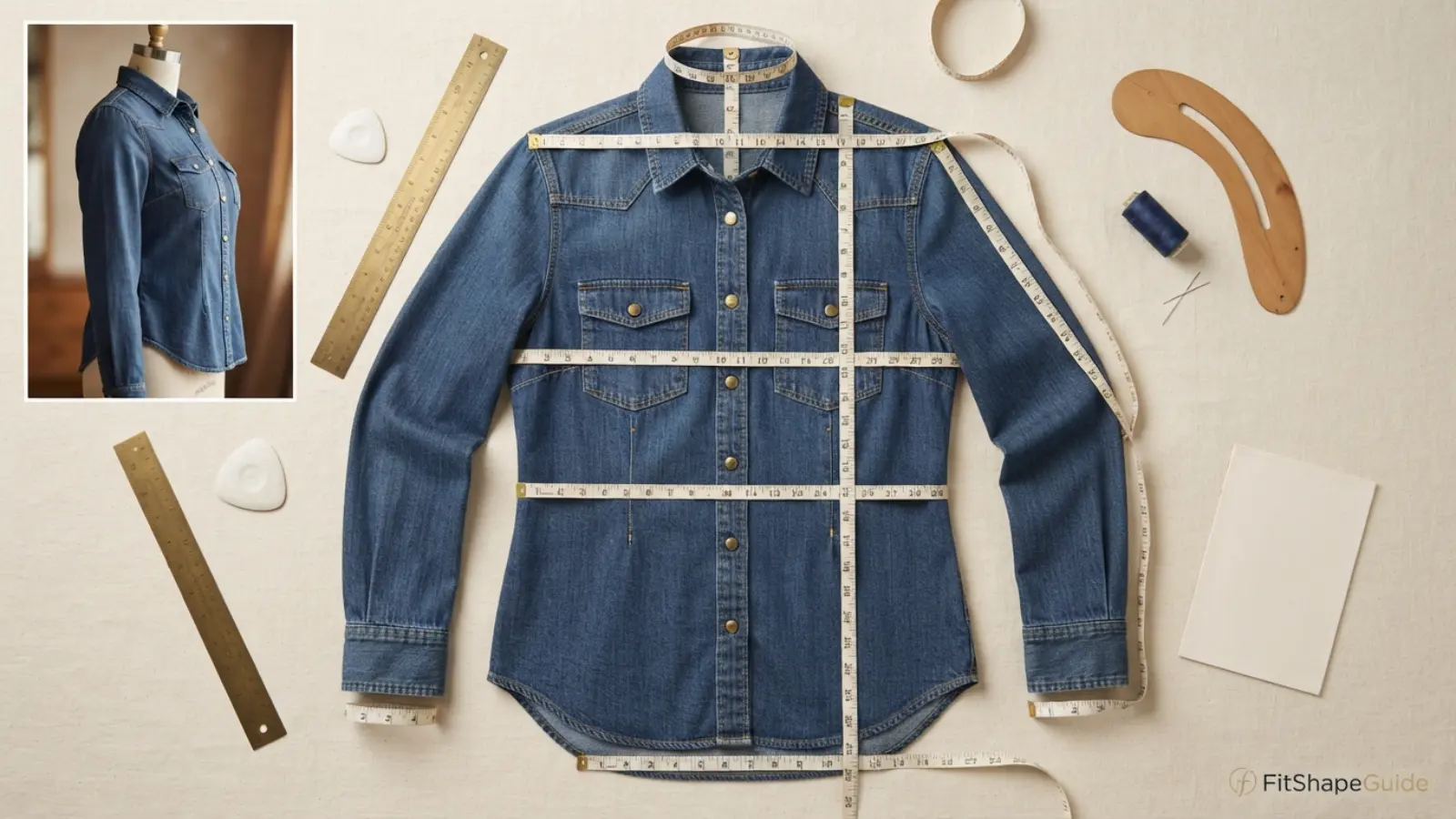
A body bust measurement alone cannot predict shirt fit because desired ease changes with fabric, cut, underlayers, and personal comfort. The best denim shirts should be compared with a garment that already performs well. Close that reference shirt, lay it flat without stretching, smooth only obvious wrinkles, measure underarm to underarm, and double that number for an approximate garment circumference. Also record shoulder width, waist, hem, center-front length, center-back length, armhole depth, bicep, sleeve, and cuff. Compare garments using the same method and size.
Finished garment measurements are more useful than body ranges
A size chart often states the body measurements intended for each size. That helps select a starting size, but it does not reveal the shirt’s built-in ease. Finished garment measurements describe the actual item. If the retailer provides only body ranges, ask customer service for garment bust, shoulder, bicep, and front length. Avoid applying a universal ease number: rigid closed shirts, fluid chambray, and open overshirts need different relationships between body and garment.
Shoulders are an early limit on sizing up
When the next size releases the chest but moves shoulder seams far down the arms, the standard block may be growing in the wrong places. Dropped shoulders are legitimate in an overshirt, but on a tailored button-down they can create sleeve twist, excess upper-body volume, and a collar that no longer anchors. A fuller-bust cut, darted front, or panelled design may retain the better shoulder size while adding projection.
Upper-back and bicep room protect the front
Forward reaching widens the upper back. If that area or the biceps are tight, the garment can pull from behind and make the front placket appear too small even when standing. Compare the upper back, armhole, and bicep with a successful woven shirt. Stretch panels may help, but seam placement and sleeve cut still determine mobility. A shirt that fits only with arms hanging down is not ready for normal use.
Bust projection consumes vertical length
A front panel must travel outward over the bust and back toward the torso. That route uses length. A shirt with adequate width but insufficient front length may show a high center-front hem, pockets tilting upward, side seams swinging forward, or the back appearing longer. Compare center-front and center-back lengths, observe the hem from the side, and check where the shirt ends after sitting. Extra width alone does not necessarily solve this geometry.
| Measurement | How to check | What it helps predict | Common mistake |
|---|---|---|---|
| Finished bust | Flat underarm-to-underarm × 2, without stretching | Basic closed-shirt room | Comparing garment numbers with body numbers as if they were identical |
| Shoulder width | Across back between sleeve joins | Collar anchor and sleeve position | Sizing up until shoulders collapse |
| Front and back length | Use retailer method consistently | Hem balance over projection | Checking back length only |
| Waist and hem | Measure flat at stated locations | Tucking, sitting, and lower-body ease | Assuming a large bust measurement guarantees lower-front room |
| Armhole and bicep | Compare with a successful non-stretch shirt | Reach and upper-arm comfort | Ignoring sleeves until after purchase |
| Button interval | Locate closures against the fullest bust point | Gap resistance | Counting buttons without assessing their positions |
| Dart or seam height | Compare to your fullest bust level | Whether shaping lands correctly | Assuming any dart equals a bust-friendly fit |
How to find the best denim shirts for a large bust online
Read the composition line literally
Check every stated fiber percentage for the shell and any contrast panels. “Stretch denim,” “denim feel,” and “chambray look” are not complete fiber disclosures. The best denim shirts present enough material information to set realistic expectations. The FTC’s textile-label guidance explains the general requirements around fiber content, country of origin, and responsible company identification for covered textile products. Use the label to understand what the garment is made from; do not infer exact softness, stretch, recovery, or shrinkage from fiber names alone.
Inspect photographs for construction, not mood
Useful images show the shirt fully closed from front, side, and back; collar and shoulder placement; sleeve and cuff; pocket alignment; placket and button intervals; hem; inside seams; and fabric close-up. Zoom in on the fullest bust line. Check for pale horizontal strain, V-shaped gaps, diagonal folds to the armhole, rotated side seams, tilted pockets, and a rising front. A shirt styled open cannot prove that it fits closed. A front tuck can hide a short or distorted hem.
Translate reviews into location-specific evidence
Reviews become useful when they identify size, garment location, and action. “Tight across bust when reaching,” “biceps restrictive,” “placket opens between the third and fourth buttons,” “dark dye transferred,” or “shrunk after following care” is more actionable than “runs small.” Compare repeated patterns and recent reviews for the same color and style. Different washes within one listing may use different fabric blends or finishing, so verify the exact variant.
Check returns before choosing between sizes
When measurements place you between sizes, order testing is safer only if returns allow it. Confirm return window, final-sale status, shipping cost, tag rules, and whether washed items are excluded. Do the indoor fit test before laundering or altering. Dark indigo should be kept away from pale upholstery and layers until you have reviewed any color-transfer warning.
Separate product verification from affiliate placement
A commercial article should not turn search convenience into fake certainty. Before a named item is inserted, verify that the listing is live, the seller is identifiable, the size and composition correspond to the reviewed variant, images can be used, and the URL includes the correct affiliate disclosure and tracking tag. Price, ratings, review counts, and stock change; they should never be hard-coded here without a current source and maintenance plan.
The five-position test for the best denim shirts
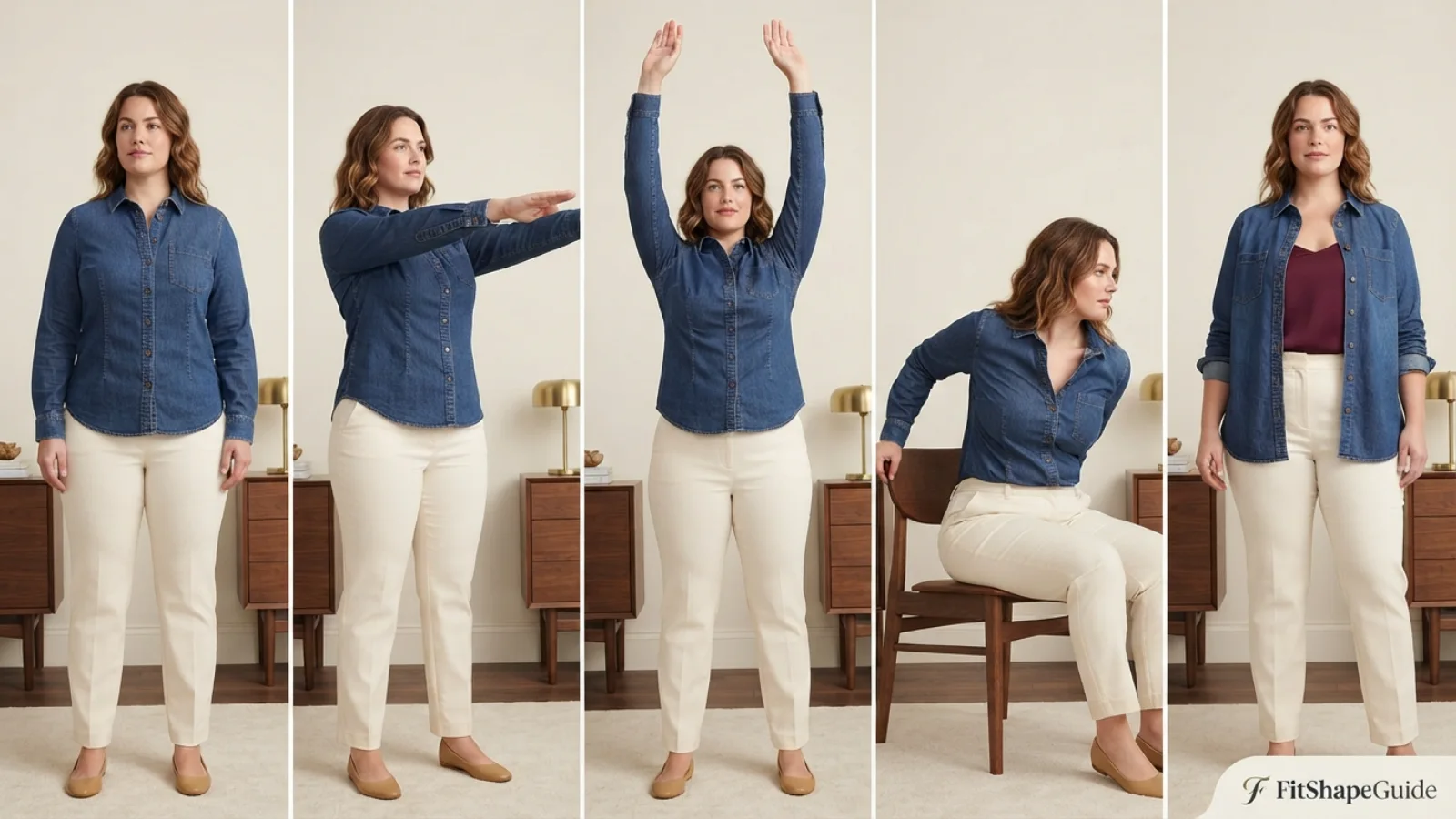
Test over the exact bra and base layer you expect to wear. The best denim shirts need to perform beyond a still mirror pose. Fasten the shirt as intended and keep tags attached. Use a mirror or short phone video from front and side because a placket can look calm in a still front view while the hem and side seams move. Stop if a closure feels insecure or movement is painful.
1. Neutral breath
Stand naturally, inhale comfortably, and let the arms rest. The collar should not choke, the placket should remain flat, and the front should not turn pale or glossy from tension. Check dart position, pocket level, side seams, and front hem. A shirt that begins strained has no useful reserve for sitting or reaching.
2. Forward reach
Reach as if using a keyboard or steering wheel. Watch the upper back, armholes, biceps, and button intervals. The shirt may shift temporarily, but it should not cut under the arms, pull the collar backward, or open between buttons. This test distinguishes missing back or sleeve room from a purely front-fitting problem.
3. Controlled arm lift
Raise both arms only to a comfortable height. Note how far the hem travels, whether the placket twists, and whether sleeves restrict the motion. Some hem lift is normal in a set-in sleeve, especially in structured denim. The important question is whether the movement is usable and whether the shirt returns afterward.
4. Seated lean and turn
Sit, breathe, lean slightly forward, and turn each direction. Check lower-front ease, waist pressure, pocket tilt, collar movement, and the interval nearest the fullest bust. A shirt used tucked should stay secure without bunching painfully. An untucked shirt should not ride up and remain trapped above the bust.
5. Layer and recovery
Add the intended camisole, T-shirt, or fine knit and repeat a reach. If the denim shirt is an outer layer, test it both open and closed. Then return to neutral without smoothing the fabric. The best denim shirts recover with the placket centered, side seams near vertical, collar settled, sleeves untwisted, and hem close to its starting level.
Fit failures that eliminate the best denim shirts
A visible symptom can have more than one cause. Diagnose the whole system before changing size. For example, a button gap may come from missing bust width, insufficient front length, tight upper back, poor button placement, rigid fabric, or several factors together. The best denim shirts resolve the underlying cause rather than hiding the symptom. The table prioritizes the most likely checks and the lowest-risk response.
| Visible symptom | Likely cause | Check next | Best first action |
|---|---|---|---|
| Gap between buttons | Missing front room or poor closure placement | Finished bust, front length, upper back, interval position | Try a shaped or fuller-bust cut; add a hidden closure only if edges meet easily |
| Diagonal lines to armhole | Insufficient bust projection or misplaced dart | Dart/seam height, side-seam rotation, placket strain | Choose deeper correctly placed shaping |
| Front hem rises | Insufficient center-front length | Front versus back length and side view | Seek extra front length or a curved hem; width alone may not solve it |
| Shoulders drop after sizing up | Standard size grading adds room everywhere | Neck, shoulder, armhole, sleeve position | Return to shoulder size and seek front-specific volume |
| Placket ripples after wear | Stretch used under constant load or weak recovery | Fabric relaxation, button band, fit at neutral | Increase usable ease or choose a more stable construction |
| Chest pockets tilt or lift | Fabric pulled across projection | Side seams, yoke, front width and length | Change cut rather than treating the pocket alone |
| Reach pulls collar backward | Upper-back, armhole, or bicep restriction | Back width, sleeve cut, shoulder placement | Try more back/sleeve mobility or a different armhole |
| Color transfers | Indigo or finish releasing under friction | Maker warning and care instructions | Follow the label, separate from pale surfaces, and avoid improvised harsh treatments |
When sizing up works
Move up when it releases the chest, upper back, and biceps while the collar, shoulders, armholes, sleeves, and lower body still suit the intended silhouette. This often works for a relaxed overshirt or when measurements place you narrowly between sizes. Re-test with the intended underlayer and check that the longer body still tucks or ends where you want.
When a different construction is smarter
Change the pattern when the shoulder size fits but the front strains, the next size collapses at the neck and shoulders, darts sit far from the fullest area, the front is short, or the placket must be forced closed. A princess seam, fuller-bust block, soft chambray, shaped stretch denim, or open overshirt changes the geometry instead of asking one larger rectangle to solve every dimension.
Which denim shirt alterations are realistic?
Reasonable adjustments
When the bust and shoulders already fit, a tailor may take in the waist through side seams or existing darts, shorten sleeves, refine cuff position, adjust hem length, or add a discreet internal closure where the placket edges already meet. The best denim shirts should need refinement rather than reconstruction. Denim can retain old stitch marks or fading lines, so alterations should be planned around wash and topstitching. Matching heavy thread, hardware, and seam finish may affect cost and visibility.
Possible adjustments with trade-offs
Side seams may be released only if useful allowance exists and the original finish permits it. A dart can sometimes be adjusted, but moving its point changes the pressed area and may reveal old needle holes. Repositioning a button can improve one interval if the shirt has enough room; moving it too far distorts the center front. Shortening a curved or shirt-tail hem may change proportions and remove faded edges.
High-risk reconstruction
Adding substantial front width, creating missing center-front length, rebuilding armholes, relocating an entire princess curve, enlarging a collar, or inserting panels into a finished washed shirt is major reconstruction. The result can disrupt pocket placement, yokes, topstitching, fading, grain, and placket alignment. For a new purchase, the best denim shirts for a large bust should not need this level of correction.
How to style the best denim shirts
Polished: shaped denim with tailored trousers
Choose a medium or dark wash with restrained distressing, a secure collar, and clean topstitching. Tuck fully into high-rise trousers only if the front and side lengths stay smooth when seated. A pointed or softly open neckline can create vertical space, but it should remain anchored. Keep the belt and shoes quiet if the shirt has pockets or western details.
Soft contrast: denim with fluid skirt
A shaped or lightweight denim shirt balances a fluid midi skirt by giving the upper body a defined fabric surface. A full tuck, narrow front tuck, or deliberate untucked curved hem can work; choose one based on shirt length and lower-body volume. Do not use a tuck to hide a strained or sharply raised front hem.
Open layer: overshirt over a clean base
Wear a relaxed denim shirt open over a stable camisole, sleeveless top, or fitted T-shirt. The base can create a continuous vertical line while the open fronts frame it. Verify that the overshirt has enough upper-back and bicep room and does not swing behind the bust. For close-fitting foundations, the camisole fit guide helps assess straps, armholes, and neckline coverage.
Denim-on-denim: separate washes intentionally
Pairing a denim shirt with jeans can look coherent when the washes are clearly coordinated or deliberately contrasted. Similar but slightly mismatched blues can appear accidental. Use texture, wash depth, or a belt to create separation. More important, keep both garments functional: a shirt should still reach and sit, and the waistband should not force a short front upward.
Under a cardigan or blazer: reduce seam bulk
Lightweight denim or chambray sits more easily under a fine layer than a heavy western shirt with large pockets and thick yokes. Test collar, sleeve, and upper-back movement inside the layer. The cardigan fit guide explains front-edge and shoulder balance; use it when the outer layer must remain open without sliding backward.
Button strategy is styling only after fit
Leaving one or two upper buttons open can create neckline space, but it should be a chosen look—not an emergency release for a tight bust. A half tuck can adjust visual proportion, but it should not conceal a side seam pulled forward. Styling works best after the shirt passes the closure and movement tests.
Care for the best denim shirts without changing the fit
Follow the garment’s own care label because fiber blend, dye, wash, interfacing, thread, snaps, buttons, patches, trims, and finishing determine the safe method. The best denim shirts keep their intended fit only when their actual construction is respected. The FTC’s textile-label guidance explains general fiber-content labeling, and its care-label guidance explains care-instruction responsibilities. A general internet denim routine should not override the specific label.
Before the first wash, review warnings about indigo transfer and wash the item separately when instructed. Fasten buttons or snaps as directed, empty pockets, and avoid harsh treatments unless the label permits them. High heat can change cotton dimensions and may affect elastic fibers, finishes, interfacing, or hardware. Reshape seams, placket, collar, cuffs, and hem during drying if allowed. Do not judge final fit by the hope that deliberate shrinking or stretching will correct an unsuitable pattern; both can produce uneven changes.
Value is cost per successful wear
A lower price is not good value if the shirt stays open because it gaps, cannot reach comfortably, transfers color to core outfits, or needs major reconstruction. A more expensive shirt is not automatically better if measurements, material, and care are vague. Value improves when the best denim shirts for a large bust work in several intended roles, remain comfortable through a normal day, coordinate with existing layers, and can be maintained according to their labels.
Final buyer checklist
- Exact shell fiber percentages and any stretch component are stated.
- The listing distinguishes denim, chambray, and denim-look fabric accurately enough to set expectations.
- Finished garment bust, shoulders, front/back length, waist, hem, bicep, and sleeve are known or comparable.
- Darts, princess seams, or a fuller-bust block provide front-specific room.
- The placket lies flat with sensible closure spacing at the fullest level.
- Pockets, yokes, side seams, and topstitching remain level rather than being dragged toward tension.
- The shirt passes breathing, reaching, arm-lift, seated, turning, layering, and recovery checks.
- Care, shrinkage expectations, color-transfer warnings, returns, stock, and seller details are understood.
- Any alteration is small, feasible, and compatible with the denim wash and seam finish.
- No recommendation depends on an unverified product name, price, rating, review count, or performance promise.
Related large-bust guides
The best denim shirt is shaped before stretch is asked to help
Start with a shaped midweight shirt when you want one versatile option. Choose comfort stretch for active movement, princess seams for a stronger bust-to-waist difference, a fuller-bust block to preserve shoulder fit, chambray for lighter drape, or an overshirt for deliberate open layering. The winning evidence is not a western pocket, dark wash, or oversized label. It is usable front room, correctly placed shaping, a stable placket, balanced shoulders, adequate back and sleeve mobility, enough center-front length, understood textile behavior, and recovery after movement. That combination separates the best denim shirts for a large bust from a standard flat-front shirt that is simply pulled larger.
Frequently asked questions
Are denim shirts good for a large bust?
Yes, when the shirt has enough finished bust room, targeted front shaping, a stable placket, balanced shoulders, adequate upper-back and bicep ease, and sufficient center-front length. Denim structure can skim the body, but rigid fabric will expose missing projection. Judge the complete construction and movement rather than the fabric name alone.
What are the best denim shirts for a large bust?
A shaped midweight denim shirt is the most versatile starting point. Comfort-stretch denim supports movement; princess seams suit a larger bust-to-waist difference; a fuller-bust block protects shoulder fit; chambray provides lighter drape; and a relaxed overshirt works for open layering. Choose using finished garment measurements and a movement test.
Should I size up in a denim shirt for a fuller bust?
Size up when the larger size releases the bust, upper back, and biceps while the collar, shoulders, armholes, sleeves, waist, and hem still suit the intended shape. If the shoulders collapse before the placket lies flat, seek darts, princess seams, extra front length, or a fuller-bust cut instead.
How do I stop a denim shirt from gaping at the bust?
First confirm enough finished garment bust room, upper-back ease, front length, and correctly placed shaping. A hidden internal closure may secure one interval only when the placket edges already meet without force. If buttons pull sideways, side seams rotate, or the fabric pales under tension, a snap or tape cannot replace missing pattern room.
Is stretch denim better than rigid denim for a large bust?
Not automatically. Stretch denim may improve reach and comfort, but it still needs adequate room, correct recovery, a stable placket, and enough front length. Rigid denim can hold a clean shape when properly fitted. Choose the fabric behavior that suits the design and intended use, then test recovery after movement.
Is chambray the same as denim?
No. Chambray is generally a plain-weave fabric, while classic denim uses a twill weave with a diagonal rib. Both may be cotton and blue, but weight, drape, texture, and structure can differ. Chambray is often lighter and easier to tuck, yet it still requires bust shaping and closure stability.
Can a tailor alter a denim shirt that is tight at the bust?
Only sometimes. A tailor may release usable side-seam allowance, adjust existing darts, reposition a button slightly, or add a hidden closure where the edges already meet. Adding substantial front width, creating missing front length, moving an entire princess curve, or rebuilding armholes is complex and may disturb fading, pockets, and topstitching.
What measurements should I check when buying a denim shirt online?
Check finished garment bust, shoulder width, center-front and center-back length, waist, hem, armhole depth, bicep, sleeve, cuff, collar, and button spacing. For shaped shirts, compare dart or princess-seam height. Also confirm exact fiber percentages, stretch direction, wash, care, color-transfer warnings, and return conditions.