Best Wrap Blouses for a Large Bust
How to compare crossover depth, neckline control, bust shaping, tie placement and fabric before a flattering product photo becomes an expensive fit problem.
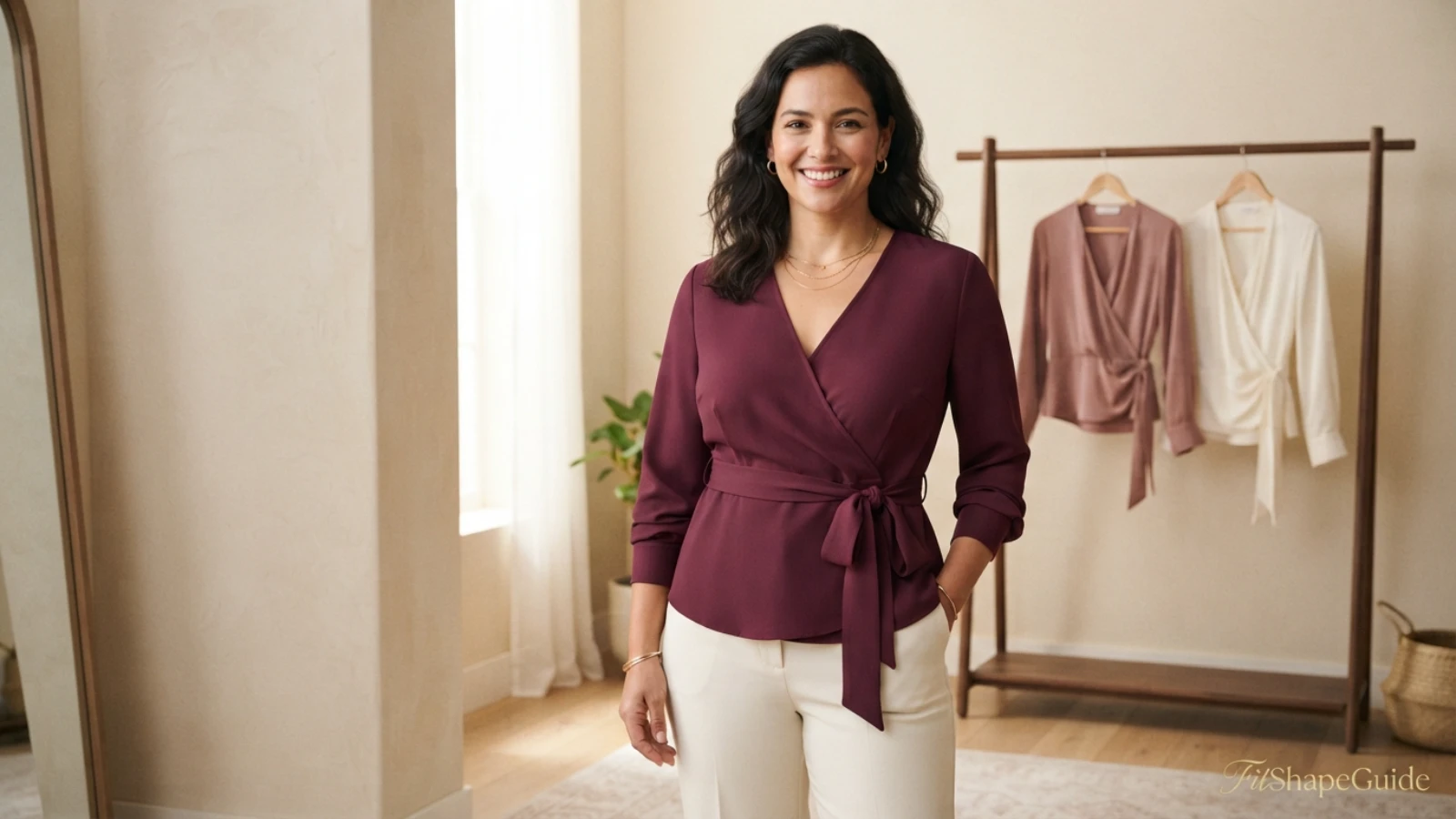
The best wrap blouses for a large bust create shape without asking the neckline, waist tie or bra to compensate for missing fabric. The front panels must be wide enough to overlap across the fullest point, long enough to travel over bust projection, and stable enough to remain crossed when you sit, reach and turn. A good blouse also keeps its shoulder seams in place, preserves sleeve mobility and lets the waist close without pulling the side seams forward.
That sounds simple, yet “wrap” is used for several constructions. A true wrap opens fully and usually has an inside tie plus an outside tie. A faux wrap has a crossover neckline sewn into place. A hybrid may have a fixed neckline with an adjustable waist sash. These designs do not offer the same flexibility. More importantly, the tie cannot manufacture bust room: tightening a too-small front often lowers the neckline, rotates the side seams and creates a short front hem.
Quick answer
The best wrap blouses combine generous front-panel overlap, a neckline edge that does not stretch open, shaping through darts, gathers or curved seams, and a tie anchored at or slightly below the natural waist. Look for finished garment measurements, a clear view of the inner closure, adequate front length and a return policy. In a fitting room, the crossover should cover your bra while seated and stay flat through a five-position movement test without requiring a safety pin.
The 60-second keep-or-return test
- Close the inner anchor comfortably, then tie the waist without compressing the bust.
- Confirm at least comfortable overlap at the fullest bust point and along the bra cup edge.
- Sit, reach forward, lift both arms, rotate and bend slightly; the neckline should recover.
- Check that shoulder and side seams stay close to their intended positions.
- Reject diagonal strain, a rising front hem, rolling neckline edges or a tie in the under-bust crease.
Best wrap blouses by construction and purpose
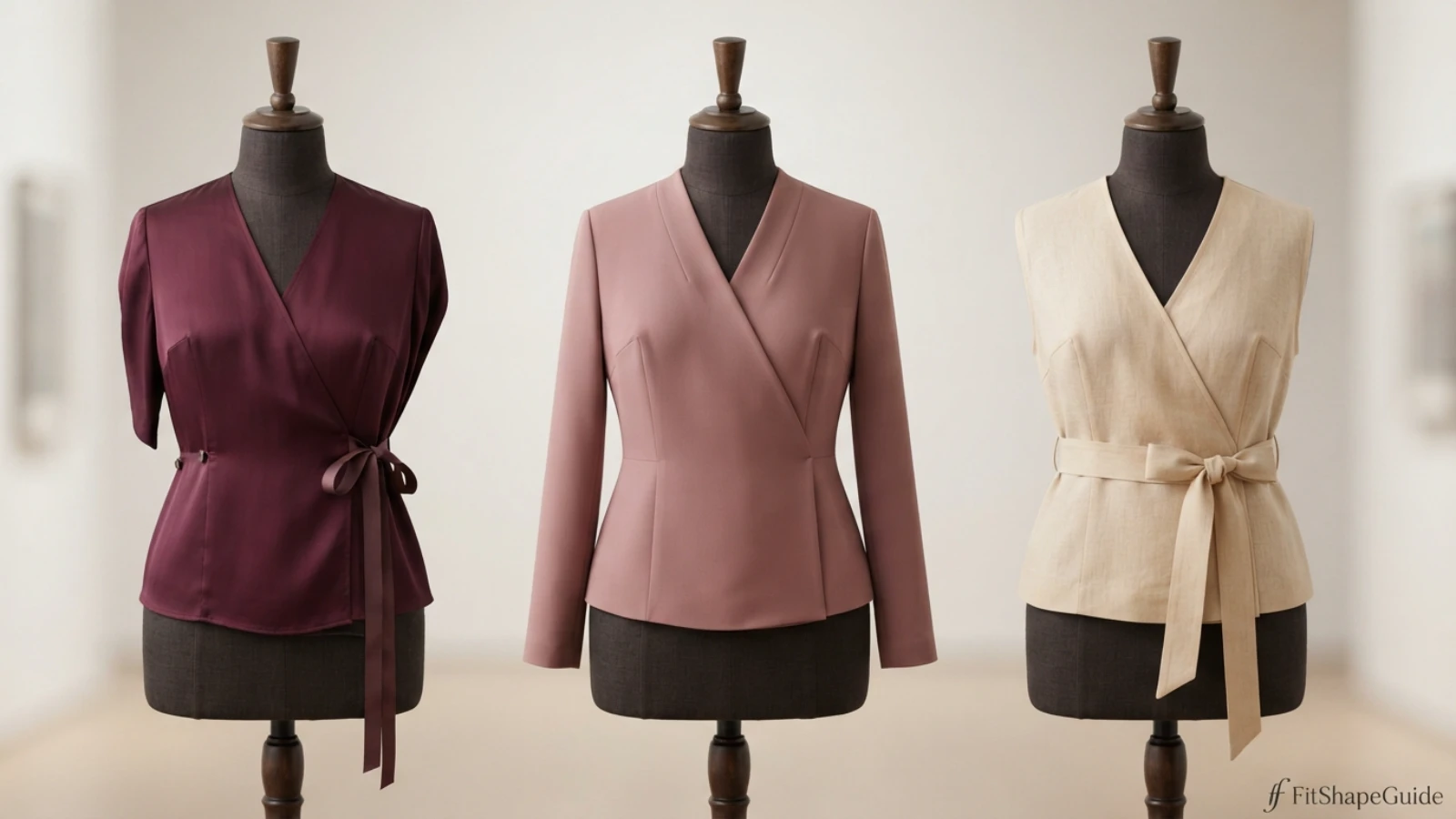
The phrase best wrap blouses for a large bust describes a result, not one universal pattern. Start by choosing the construction whose adjustability and security match how you will wear it. The six categories below are product-type filters rather than claims about unverified listings.
True-wrap woven blouse
Two functional front panels, an internal anchor and an external tie allow meaningful waist adjustment. It works best when the panels are already broad and shaped for projection; pulling a narrow panel farther across only distorts the neckline.
Faux-wrap crepe blouse
A sewn crossover can control the neckline better than a fully functional wrap. Look for waist shaping at the side seams or back so security does not come with a boxy torso.
Darted or panelled wrap blouse
Side-bust darts, princess seams or carefully placed gathers provide three-dimensional room. This is usually more useful than extreme stretch because the blouse can follow the bust and return cleanly to the waist.
Wrap with integrated modesty panel
A sewn insert or stable underlayer prevents the V from dropping too low. The insert should lie flat rather than pulling the outer wrap apart or ending directly across the fullest point.
Longline or tunic wrap blouse
Extra front length helps compensate for the vertical distance over a fuller bust. Check where the tie channel lands; longline does not help if the waist anchor still sits in the under-bust crease.
Wrap-style bodysuit blouse
A blouse upper attached to a bodysuit can stop the hem from escaping a waistband. It introduces torso-length and gusset comfort requirements, so it must be evaluated as both a wrap blouse and a bodysuit.
| Construction | Main advantage | Evidence to inspect | Common risk |
|---|---|---|---|
| True wrap | Adjustable waist and some overlap control | Panel width, inside anchor, tie opening reinforcement | Neckline pulled lower when overtightened |
| Faux wrap | Stable crossover and faster dressing | Stitch line, neckline recovery, waist shaping | Fixed overlap may not suit bust projection |
| Hybrid wrap | Secure neckline with adjustable sash | Which sections are functional versus decorative | Marketing implies more adjustment than exists |
| Modesty-panel wrap | Higher visual coverage | Panel height, attachment points, tension | Insert cuts across bust or rolls outward |
| Longline wrap | More torso and front-hem coverage | Center-front length and tie height | Extra length only at back, not over bust |
| Bodysuit wrap | Stays tucked | Torso length, gusset positions, blouse ease | Downward pull opens the neckline |
True, faux and hybrid wrap construction
True wraps are often recommended for fuller busts because they appear adjustable. The useful adjustment is mainly at the waist. If the front panel lacks width or vertical length, the wearer cannot tie new fabric into existence. Pulling harder shifts the crossing point, drags the shoulder seam toward the neck, rotates the side seam and may expose more bra. The best wrap blouses for a large bust fit across the bust before the tie is tightened.
Inspect how the inner panel stays in place. A fabric tie threaded through a reinforced side opening spreads tension better than a tiny button sewn to a delicate seam allowance. An internal button can be excellent when it is positioned at the waist and used for alignment, but it should not look as if it is carrying the entire front. If two button positions are supplied, test both; the tighter option may control the waist while lowering the neckline.
Faux wraps solve a different problem. Because the crossover is stitched, it cannot fall fully open. However, the fixed overlap may be too shallow, and a stitched point can pull into a sharp X across the chest. Look behind the decorative drape. The blouse still needs bust shaping, adequate armholes and a stable neckline edge. A beautiful folded front is not evidence that the pattern contains enough room.
In the best wrap blouses, security comes from the pattern and edge finish working together, not from one overstressed closure.
Hybrid wraps can offer the most practical balance: a sewn neckline for coverage, with an external sash to define the waist. Confirm whether the sash is attached at the side seam, threaded through loops or entirely removable. A high fixed loop may force the belt into the under-bust crease; a lower, broader sash often creates a smoother transition from bust to waist.
How the best wrap blouses control the neckline
A crossover neckline sits partly on the bias, the diagonal direction that can stretch more than the fabric grain. On a fuller bust, that edge also travels farther and carries more tension. A stable facing, narrow tape, clear elastic, understitching or well-engineered lining can help the V return to place. Stabilization should be discreet: a thick facing may roll outward, while overly short elastic can create ripples.
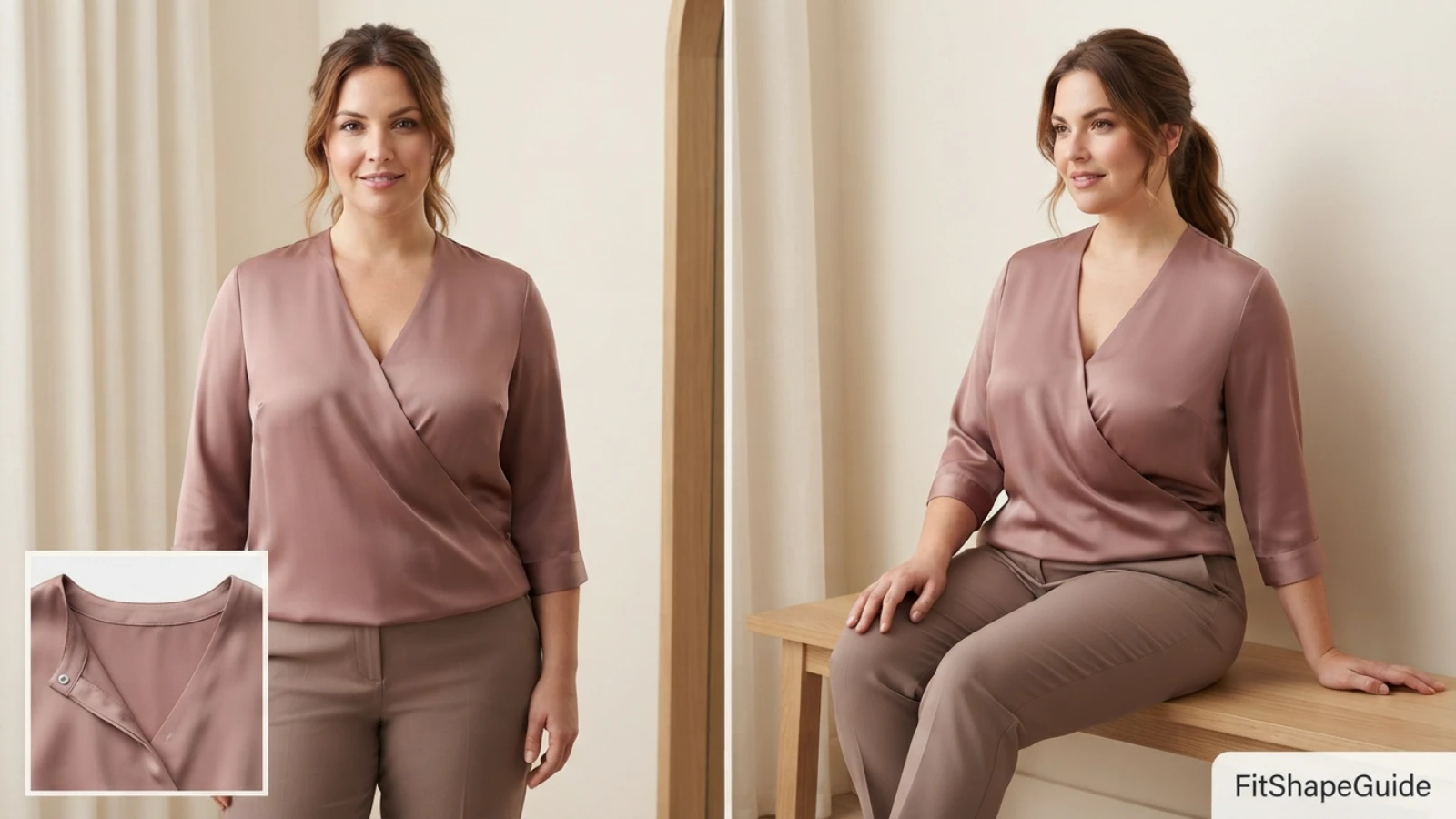
Overlap must be judged in motion rather than only while standing square to a mirror. Place a hand flat over the crossover and relax it. If the panels separate immediately, the garment is relying on constant body tension. Sit naturally and turn your torso. The inner panel should remain under the outer panel, and the bra cup edge should stay covered from the front and from a slight side angle.
Why a snap is not always the answer
A small concealed snap can control a narrow, clean gap in an otherwise well-fitting blouse. It cannot correct missing panel width, excessive tension or a neckline edge that has stretched out. When a snap is forced to hold too much tension, it creates a puckered point and may pop open during movement. It can also change the V into an awkward shape. Treat it as refinement, not structural rescue.
Modesty panels, camisoles and bra compatibility
An integrated panel gives predictable coverage and preserves the intended diagonal line better than a randomly chosen underlayer. It should be wide enough to remain hidden at the sides and soft enough not to push the outer panels apart. A separate camisole is more flexible but adds bulk and another neckline to manage. Choose a smooth edge near the blouse color when you want it to disappear, or a deliberate contrasting layer when you want it to look intentional.
Check bra straps at the shoulder and armhole, not only the center V. A wrap blouse can look covered from the front while exposing a strap at a widened shoulder line. A supportive everyday bra with a centered gore and smooth cup often provides the most predictable base, but the blouse—not the bra—must supply appropriate outer coverage.
Tie placement, bust depth and waist balance
The tie should close the blouse around the torso after the front has accommodated bust projection. When it rides into the under-bust crease, one of three things is usually happening: the anchor is drafted too high, the blouse is too short from shoulder to waist, or the bust is borrowing vertical fabric from the torso. Lowering a removable sash may improve proportion, but a fixed side opening or seam cannot be relocated casually.
A broader tie distributes pressure and often creates a smoother waist line. A very narrow tie can cut into soft fabric and emphasize diagonal strain. Long ties offer styling flexibility but can add bulk at the side; short ties may force a small knot under tension. Inspect whether the tie begins at the same height on both sides and whether the opening is reinforced. Uneven anchors create twisting even when the size is correct.
The best wrap blouses let the tie define an already-correct waist position instead of pulling the whole front into place.
Torso proportions matter. A short-waisted wearer may prefer a slightly higher, narrower waist definition if it remains below the bust. A long-waisted wearer often needs more shoulder-to-waist length and a lower anchor. The goal is not to place the tie at an abstract “smallest point” while ignoring construction. It is to let the diagonal panels settle, then define the torso without altering the neckline.
| Visible signal | Likely cause | Test before deciding | Better response |
|---|---|---|---|
| V drops after sitting | Shallow overlap or unstable edge | Sit and rotate without holding fabric | Choose deeper panels or a sewn crossover |
| Tie enters under-bust crease | Short front length or high anchor | Loosen tie and observe seam position | Seek more front length and lower waist placement |
| Side seams swing forward | Front lacks width or projection | Check side seam from armhole to hem | Choose darts, panels or a fuller-bust cut |
| Front hem rises sharply | Insufficient vertical bust length | Compare center-front and back hem | Look for longer front patterning |
| Neckline ripples | Bias edge stretched or facing mismatched | Lay edge flat off the body | Return or professionally stabilize |
| Inner panel twists | Weak, high or misplaced anchor | Open blouse and inspect tie path | Choose reinforced waist-level closure |
Fabric in the best wrap blouses for a large bust
Fabric changes how the pattern behaves, but fiber content alone does not predict fit. A matte crepe can drape over projection with less shine at tension points, while crisp poplin makes every drag line visible and requires more exact shaping. Silk can feel luxurious yet reveal seam stress or perspiration depending on weave and color. Jersey recovers differently from woven fabric and may cling beneath a sash. Read the composition label, then judge weight, opacity, recovery and seam quality separately.
Darts, gathers and princess seams
A side-bust dart should point toward the fullest area without ending at it. If it sits too high or low, fabric collapses above or below the bust. Gathers can distribute room softly, especially near the shoulder or under-bust seam, but dense gathers placed on the fullest area may add visual bulk. Princess seams offer controlled shaping when their curve follows the body rather than cutting across it. The best construction is the one that supplies space where your body needs it and returns cleanly toward the waist.
Opacity and lining
Hold the fabric against light and stretch it gently at the seam allowance when possible. A blouse can appear opaque on a hanger but become sheer over the bust because the cloth is under tension. Full lining improves opacity but can reduce usable ease if the lining is smaller or less flexible than the shell. In a wrap, the lining must also move with the diagonal edge; a tight lining can pull the outer neckline open.
Seams, openings and reinforcement
Inspect the side opening where a tie passes through. It should be neatly finished and reinforced without a hard patch that irritates the skin. Check stitching at the V point, internal anchor and waist seam. Loose loops, skipped stitches or puckering at those high-stress locations are more meaningful warning signs than a minor loose thread at a low-stress hem.
Print and shine placement
Diagonal wrap fronts can break a print attractively, but large motifs split at the crossover may look accidental. High shine highlights every area of tension; matte surfaces usually make fit changes less obvious. Neither is inherently more flattering. Choose the visual effect deliberately after confirming the underlying construction works.
The five-position test for secure wrap blouses
A standing mirror check is the easiest position for a wrap blouse. Daily life is not. Perform the following sequence with the support bra and likely underlayer you plan to wear. Tie the blouse once at comfortable tension and do not retie between positions. The best wrap blouses should recover without constant adjustment.
- Stand naturally. Release your shoulders, breathe fully and check the V, side seams, tie height and front hem.
- Sit upright, then relax. The neckline should not drop dramatically, and the tie should not press into the ribcage.
- Reach forward at desk height. Watch for separation at the crossover and binding at the back armhole.
- Raise both arms. The blouse may move slightly, but the inner panel should stay anchored and the hem should settle again.
- Rotate and bend slightly. Confirm side-angle bra coverage, knot security and whether the neckline edge returns flat.
Repeat the test with a jacket only if layering is part of the intended outfit. A blazer can pin a loose neckline temporarily, while its armholes reveal sleeve or shoulder tightness. Do not count the jacket as a fix. The blouse should remain wearable when the layer is removed.
The best wrap blouses pass this sequence without pins, repeated retying or a protective hand at the neckline.

Fit problems that sizing up may not solve
Sizing up helps when the entire garment is uniformly too small: shoulders, upper back, sleeves, bust and waist all feel restricted. It is less successful when the pattern shape is wrong. A larger size may add back and waist volume while the crossover remains shallow or the dart stays misplaced. If the current blouse fits the shoulders but strains only over the bust, prioritize more front shaping rather than automatically adding circumference everywhere.
Diagonal drag lines from bust to waist
These lines usually indicate that the fabric is being pulled toward the tie because the front lacks room or length. Loosen the tie. If the lines disappear but the neckline and waist become uncontrolled, the garment needs a different pattern, not simply a tighter knot.
A floating shoulder seam
When a shoulder seam migrates toward the neck or front, the bust may be pulling the panel downward and inward. Check back width and armhole comfort too, but do not assume the shoulder is too narrow solely because the seam moved. The cause may begin at the front panel.
A high-low hem you did not choose
A modest front rise is common because fabric travels over projection. A dramatic rise signals insufficient front length. Tucking the blouse may hide the symptom, but it can increase tension and cause the fabric to escape the waistband. Look for a center-front measurement and compare it with a blouse that already hangs evenly.
A gaping back with a tight front
This combination shows that total circumference is distributed incorrectly. Sizing up adds more back fabric. A fuller-bust cut, front darts, princess seams or a waist that can be reduced independently is usually more promising.
How to shop for the best wrap blouses for a large bust
Online product pages often show only a front pose with the model standing still. That is not enough evidence for a functional wrap. Seek rear, side and open-garment views; zoom into the side opening and neckline; read the composition and care label; and check whether the listing describes a true or faux wrap. If “wrap style” is used without closure details, assume nothing.
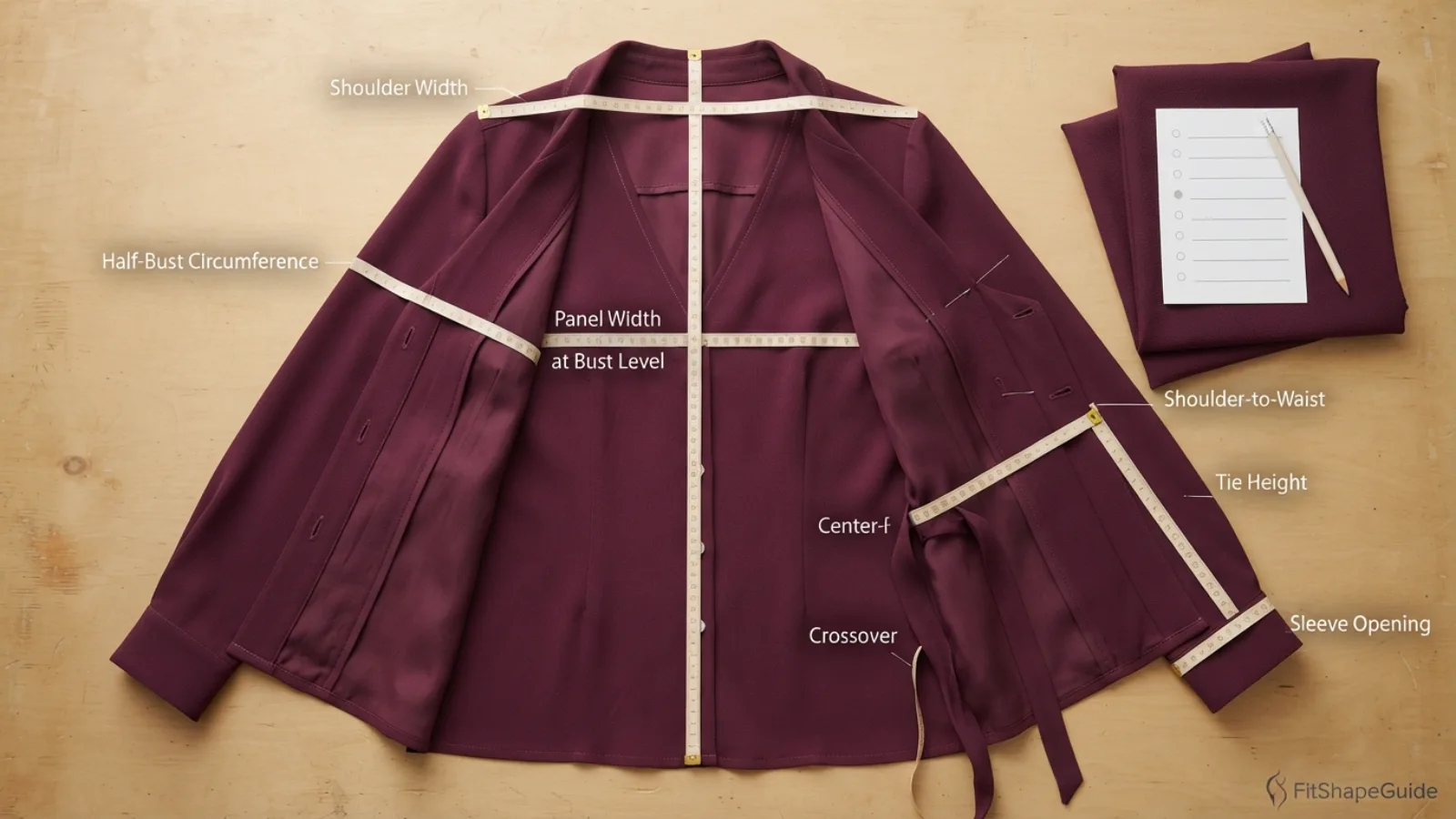
Record body measurements in the support bra you expect to wear. Then compare them with finished garment measurements, not only a generic body-size chart. A blouse needs wearing ease, but the appropriate amount depends on fabric and intended silhouette. Woven crepe usually needs real garment room; stretch fabric still needs enough pattern capacity to prevent distortion.
| Evidence | How to use it | Warning sign |
|---|---|---|
| Finished bust circumference | Compare with your full bust plus suitable wearing ease | Only body measurements are supplied |
| Shoulder width | Compare seam to seam with a blouse that fits | Size-up solution makes shoulders excessively wide |
| Center-front length | Check enough vertical distance over bust to waist and hem | Only back length is listed |
| Panel overlap or open view | Estimate coverage at bust level before tying | No image or description of inner panel |
| Tie and anchor position | Compare shoulder-to-waist length with your torso | Anchor appears directly beneath bust |
| Fiber and care label | Assess likely drape, opacity and maintenance | Vague “silky” or “stretchy” wording only |
| Return terms | Confirm try-on window and condition rules | Final sale before fit is established |
Measure a successful blouse, not only your body
Lay a well-fitting blouse flat without stretching it. Measure shoulder width, underarm width, center-front length, back length, sleeve opening and waist. For a crossover garment, also note where the neckline crosses and where the waist sits. These comparisons expose proportion differences that a standard size label cannot.
Read reviews as clues, not proof
Reviews can reveal recurring issues such as a snap that pops, a tie opening that frays, inconsistent sizing or unexpected sheerness. They cannot guarantee your fit because reviewers may use different bras, have different torso proportions or prefer different coverage. Give more weight to repeated, construction-specific observations than to broad claims such as “flattering” or “runs small.”
Verify textile and care information
The U.S. Federal Trade Commission explains labeling expectations for covered textiles in its textile-label guidance and describes care-instruction requirements in its care-label guidance. Use the garment’s actual label as the care authority. A fiber name alone does not prove stretch, opacity, durability or fuller-bust fit.
Alterations: useful refinements versus expensive rescues
A tailor may add a discreet snap, stabilize a slightly loose neckline, reinforce a tie opening, move an internal button a modest distance, shorten ties, refine sleeves or reduce excess waist and back fabric. These are sensible changes when shoulders, armholes, bust capacity and panel overlap already work.
Alterations become difficult when the blouse lacks front-panel width, front length or seam allowance. Adding a wedge or modesty insert can change the style line and require matching fabric. Recutting armholes or relocating major darts may cost more than the garment and still leave the print or grain misaligned. Before buying a final-sale blouse with an alteration plan, ask whether the required fabric exists inside the seams and whether the change affects the crossover.
For the best wrap blouses, tailoring is a finishing step rather than a condition of basic wearability.
Styling the best wrap blouses for a large bust
Create a clean lower line
Because a wrap already creates diagonals and a waist focal point, simple trousers, straight jeans or an uncluttered skirt let the construction lead. A high waistband can support a shorter front hem, but it should not trap the ties or pull the inner panel out of position. If tucking, arrange the tie above the waistband and check movement again.
Layer deliberately
A smooth camisole adds coverage; a blazer adds structure; a cardigan softens the line. Keep the underlayer neckline either clearly below the V or intentionally visible. A half-visible edge that shifts during movement looks accidental and can make the blouse feel more complicated than it is.
Choose necklaces around the V
A short pendant or open chain can echo the diagonal without crowding the tie. Large necklaces may catch the neckline edge or compete with a print. Earrings offer a clean alternative when the blouse already has dramatic sleeves, sheen or an expressive pattern.
Protect the neckline and ties
Follow the care label. Close internal buttons and loosely secure ties before washing when machine care is allowed; a mesh bag may prevent long straps from twisting. Do not hang a heavy wet blouse from the shoulders. Store ties untangled and avoid pressing a stretched bias edge into a permanent wave.
Calculate cost per successful wear
Include the required camisole, specialist cleaning, tailoring and time spent readjusting. A less expensive blouse that needs a new snap, neckline tape and frequent pressing may cost more in practice than a well-built option. The best wrap blouses earn their place because they remain secure, coordinate easily and survive real movement—not because the initial product photo is persuasive.
Buy front geometry before waist definition
For the best wrap blouses for a large bust, prioritize panel overlap, vertical bust length, shaping and a stable neckline before judging the knot. Close the blouse at comfortable tension, test all five positions and return any design that needs constant holding. A secure wrap should make dressing easier, not turn every movement into a coverage check.
FAQs about wrap blouses for a large bust
Are wrap blouses flattering for a large bust?
They can be when the front panels contain enough width and vertical length, the neckline stays stable and the tie sits at the waist rather than across breast tissue. The diagonal V and adjustable waist can create definition, but a wrap label alone does not guarantee suitable bust room.
Is a true wrap or faux wrap blouse better for a fuller bust?
A true wrap offers more waist adjustment, while a faux wrap often provides more predictable neckline security. The better choice depends on panel overlap, bust shaping and your coverage needs. Neither construction solves insufficient front width automatically.
How do I stop a wrap blouse from gaping?
First check whether the blouse has adequate overlap and a stable neckline edge. A discreet snap, fashion tape or camisole can refine a small gap, but persistent separation, strain lines or a popping closure usually means the front is too narrow or short.
Should I size up in a wrap blouse for a large bust?
Size up if shoulders, upper back, sleeves and bust are all tight. If only the bust strains while the back and waist are already loose, a larger size may create new problems. Look instead for fuller-bust shaping, wider panels or more front length.
Where should the tie sit on a wrap blouse?
It should usually sit at or slightly below the natural waist and remain clearly below the bust. If it climbs into the under-bust crease, the anchor may be too high or the blouse may lack enough shoulder-to-waist length over bust projection.
What fabric works best for wrap blouses on a large bust?
Medium-weight crepe, stable viscose blends and other fabrics with controlled drape are often practical because they skim without becoming flimsy. Crisp fabrics need more precise shaping, while stretchy knits need recovery. Fabric quality cannot replace correct panel dimensions.
Can a tailor fix the neckline of a wrap blouse?
A tailor can often add a small snap, stabilize a slightly stretched edge, move an internal button or add a modesty panel. Major missing overlap, inadequate front length or severely misplaced shaping usually requires reconstruction and may not be economical.
How should a wrap blouse fit when sitting?
The neckline should continue covering the bra, the tie should not dig into the ribs or under-bust crease, and the inner panel should remain anchored. Some fabric movement is normal, but the blouse should recover when you stand without being retied.
Editorial note: Product modules remain unpublished until current product details and merchant links are verified.