Best Bandeau Tops for a Large Bust
A construction-first buyer’s guide to upper-edge grip, side-bust coverage, shaping, boning, lining, back security, bra compatibility, front length, and movement.
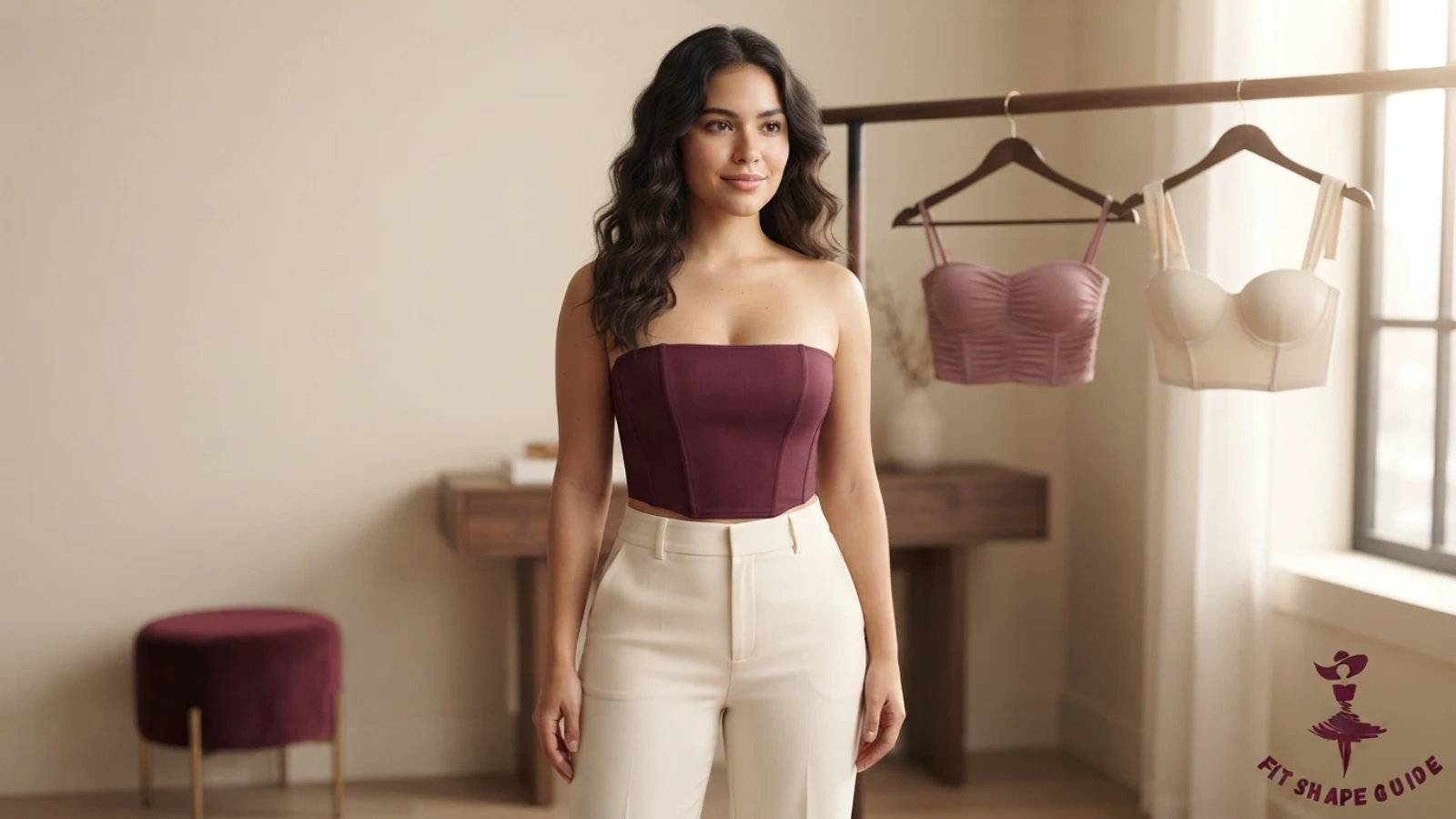
The best bandeau tops for a large bust are not simply tight tubes. A flat tube becomes smaller wherever it stretches most, so it may turn sheer across the bust, pull the side seams forward, roll at the upper edge, and rise at center front. A well-engineered bandeau solves a more complex problem: it needs enough three-dimensional room in front while maintaining controlled contact around the upper back, sides, and underbust. That contact may come from power mesh, wide elastic, silicone grip, a fitted back, vertical boning, a longline band, removable straps, or a combination of several features. The aim is security without painful compression. This guide compares six useful constructions, shows how to read retailer evidence, and explains which fit symptoms reveal a design problem rather than a body problem. Product modules remain private until live names, measurements, materials, care, returns, stock, imagery rights, affiliate links, and retailer details are verified.
The 60-second bandeau security check
- The upper edge touches the body evenly; it neither pinches the center front nor stands away above the bust.
- The top contains the intended bra, tape, or built-in support at the sides and back.
- Seams, cups, gathers, or panels create forward room instead of relying on maximum stretch.
- The back remains horizontal rather than climbing upward as the front drops.
- Fabric stays opaque and its print, ribs, or texture do not become severely distorted.
- Boning ends are cushioned and remain vertical without digging into the underarm or waist.
- The center-front hem is long enough to meet the planned waistband after sitting.
- After movement, the upper edge returns without a hand adjustment.
Best bandeau tops by construction
The best bandeau tops do not all create security in the same way. A wearer who wants a clean occasion top may benefit from shaped cups and boning; someone using a bandeau as a layer may prefer a compact double-knit tube with less hardware. Start with the construction that matches the intended support and setting, then evaluate its dimensions.
Structured sweetheart bandeau
Best for: an occasion look with deliberate bust shaping. Seek separate cup panels or curved princess seams, a stabilized sweetheart edge, firm lining, high side wings, vertical boning, and a secure zipper or hook back. This architecture creates projection instead of flattening it. The trade-off is exact sizing: cup position, torso circumference, and vertical length must align, and an undersized cup cannot be fixed by a looser back.
Longline boned bandeau
Best for: distributing tension over more torso area. A longer body, multiple boning channels, reinforced side seams, and a firm lower band can reduce dependence on the upper edge. Look for flexible spiral or plastic boning with cushioned ends rather than one rigid center strip. Longline stability is valuable, but the waist and ribcage must both match; a tight waist can push the whole garment upward when seated.
Ruched mesh-overlay bandeau
Best for: softer visual texture over a supportive base. The ruching should sit on a separate opaque lining or power-mesh foundation so decorative gathers are not carrying all the load. Controlled gathers can accommodate projection and disguise small tension changes. Check that the overlay is anchored at seams and does not drag the top edge downward. Fine mesh requires careful jewelry, laundering, and storage.
Wide-smocked-back bandeau
Best for: circumference flexibility with a shaped woven front. The front may use darts, princess seams, or gathers while a deep smocked back adapts through breathing and sitting. Smocking should span a substantial vertical area and return after stretching. Narrow rows can curl or concentrate pressure. Because elastic relaxes with wear, judge the unstretched and comfortably stretched measurements, not a broad size label alone.
Convertible bandeau with optional straps
Best for: changing between strapless styling and added movement security. Look for several reinforced strap loops, wide-set and halter positions, shaped lining, high sides, and an upper edge that can work before straps are attached. Straps should stabilize rather than rescue a loose body. This is practical for events, but decorative narrow straps may concentrate weight and visible loops should sit below the neckline.
Double-layer compact-knit bandeau
Best for: casual outfits, layering, and moderate stretch. Two dense layers, a broad encased elastic, a stable lower edge, and adequate side height are more reliable than one thin tube of jersey. Rib lines should remain mostly vertical and fabric must stay opaque over the fullest point. This type may not replace a supportive bra; it works best when the wearer has a compatible support plan and realistic activity level.
How the best bandeau tops for a large bust create grip
A bandeau stays up through controlled friction, circumference tension, shaping, and vertical structure. Compression alone is a poor substitute for pattern engineering. If the top is equally tight everywhere, the largest area bears the highest stretch while the narrower underbust and upper back may still lack contact. The best bandeau tops create more room where the body projects and more stable contact where the garment needs an anchor.
The upper edge must be wide, stable, and continuous
A narrow elastic behaves like a cord: it can cut, flip, and leave marks without stopping the bodice below from moving. A wider elastic or stabilized facing distributes pressure across more skin. The edge should remain continuous through the front, sides, and back, even if the inner materials change. Look for a flat line in product photos. Sharp dips at the side seam, waves above the cups, or a center front visibly pulled downward suggest uneven tension.
Silicone grip is an assistant, not the foundation
A thin silicone strip can increase friction, but it cannot provide missing cup volume, correct a loose back, or prevent a short side panel from exposing the bra. Some skin is sensitive to prolonged occlusion or adhesive-like surfaces, so comfort matters as much as holding power. A removable or interrupted grip strip may feel different from a wide continuous strip. Retail descriptions should disclose its presence; inspect return rules before wearing a close-fitting garment for a long test.
Back structure controls the front more than most photos reveal
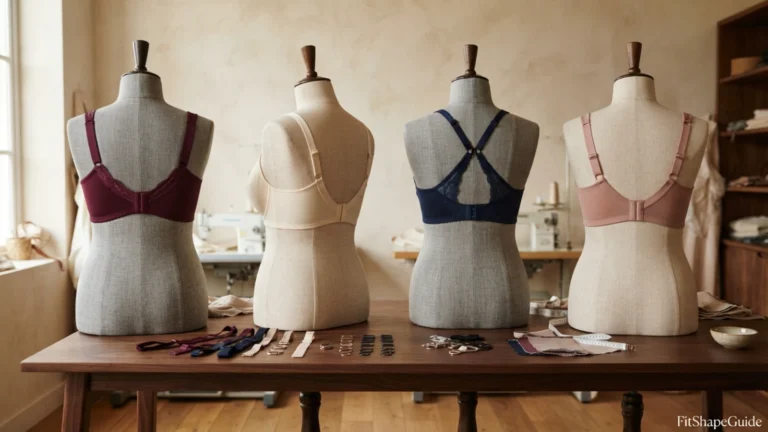
A fitted zipper back offers a clean finish but little adjustment. Hooks provide multiple settings, smocking expands with breathing, and power mesh supplies controlled recovery. Whichever system is used, the back should sit horizontally and at a similar height to the upper side edge. When it rides upward, the front can rotate down. Request back photographs because a polished front view can hide a narrow elastic strip doing all the work.
| Feature | What it controls | Evidence to inspect | Main trade-off |
|---|---|---|---|
| Wide encased elastic | Even upper-edge tension | Elastic width, seam waves, pressure marks in model photos | Can roll if the casing is soft or too narrow for it |
| Silicone grip strip | Friction against skin | Placement, width, continuity, care instructions | May irritate sensitive skin and cannot correct poor sizing |
| Vertical boning | Prevents vertical collapse and side rolling | Number, location, end cushioning, channel alignment | Poorly placed ends can dig when seated |
| Power-mesh back | Firm stretch and recovery | Layer count, stretch direction, back height | May feel warmer and exposes weak seams when overstretched |
| Hook or corset back | Circumference adjustment | Number of settings, underlap, reinforcement | Bulk and pressure can show beneath a close outer layer |

How the best bandeau tops for a large bust use fabric and shaping
The best bandeau tops use fabric for the job it can actually perform. A dense knit can stretch and recover, but it does not automatically create support. A woven satin can hold a crisp edge, but it cannot borrow missing circumference. Lining, interfacing, mesh, seam placement, gathers, and panel geometry determine whether the outer fabric looks calm.
Curved seams create room without enlarging the whole torso
Princess seams, cup panels, darts, and curved side-front seams convert a flat surface into volume. Their fullest curve should align near the wearer’s fullest bust level, then narrow toward the upper edge and underbust. When the curve sits too high or too low, empty fabric and cutting can occur at the same time. A front view reveals seam direction; a side view reveals whether the garment has genuine projection.
Gathers and ruching need a stable anchor
Gathers can distribute extra length across the bust, especially at the side seam or center front. They work best when the upper and lower edges remain controlled. Random all-over ruching on one thin layer can migrate, becoming dense in one area and sparse in another. A lined base, fixed gathering stitches, or a shaped underlayer gives the texture somewhere to live without asking it to provide all support.
Dense knit must be tested at wearing stretch
Hold a similar fabric over a contrasting color and stretch it to the percentage expected on the body. If the surface turns shiny, ribs spread dramatically, print fades, or the inner layer shows, the garment is depending on too much stretch. Recovery matters after ten seconds, not just after one pull. A knit that slowly lengthens can drop at the upper edge during wear even though it felt secure in the first minute.
Lining changes both opacity and usable stretch
A woven lining can restrict a stretch outer shell; a power-mesh lining can reinforce it; a soft jersey lining can add opacity but also weight. Retailers sometimes list one fiber blend for the shell and hide lining details under an expandable tab. Read both. Seams joining layers should lie flat, and the lining should not be visibly smaller at the upper edge unless it is intentionally providing controlled support.

Bra compatibility and built-in support
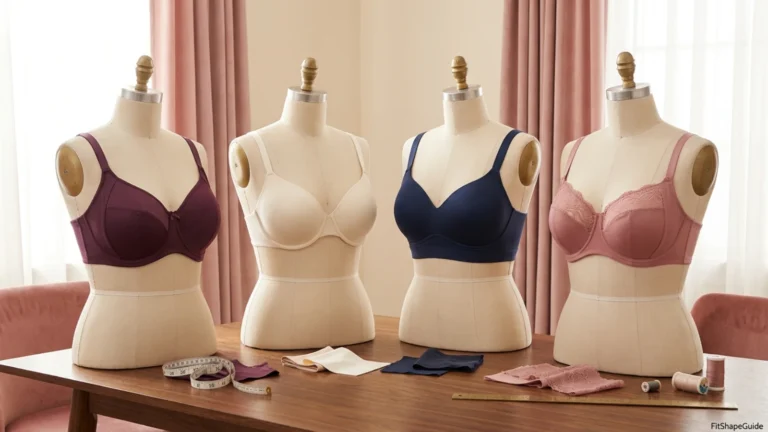
A bandeau neckline removes conventional shoulder coverage, so support must be planned before purchase. “Built-in bra” is not a complete specification. It might mean a loose shelf band, molded foam, removable pads, an underwire frame, or only a double front. Each behaves differently on a fuller bust. The best bandeau tops state what is inside and leave enough vertical and side depth for the intended foundation. The best bandeau tops also explain whether removable straps stabilize the body or function as its primary support.
Strapless bra beneath a separate top
This option separates support from fashion and may offer the broadest size range. The top must be tall enough to cover the bra’s center front, cups, side wings, and back band during movement. Compare the top’s side height with the bra’s side measurement and inspect back photographs. A low straight bandeau may expose the center gore or cup edge even when its torso circumference fits.
Convertible bra or removable garment straps
Convertible support can add security for walking, dancing, or travel while preserving multiple necklines. Confirm the strap paths before the event: halter, cross-back, one-shoulder, and wide-set positions interact differently with the top. If the garment’s optional straps are thin, their loops must be reinforced. They should stop rotation, not carry a bodice that is several centimeters too loose.
Integrated cups and longline structure
An integrated system can produce the cleanest exterior, but cup depth and underwire shape must match, not merely the letter printed on a general clothing size. Seek separate cup or full-bust measurements, multiple back settings, underwire information, and a clear return policy. Removable pads smooth the surface; they do not create meaningful cup depth. If the cups flatten or the wire sits on tissue, the design is not supportive for that body.
Fashion tape is backup, not structural fit
Body-safe garment tape can control a small edge or prevent a neckline from separating during a specific outfit. It should not be used to force an undersized, rolling, or poorly shaped bandeau to stay up. Follow the manufacturer’s skin-test and removal instructions, avoid damaged skin, and consider heat and perspiration. A top that works only when aggressively taped is not the strongest everyday purchase.
How to find the best bandeau tops for a large bust online
Online shopping becomes more reliable when “stretchy,” “supportive,” and “non-slip” are translated into measurable evidence. Compare a candidate with a strapless or close-fitting top that already stays secure for the same activity. Do not use a loose T-shirt as the reference: its chest ease and shoulder support solve a different problem.
Measurements worth requesting
Ask for the relaxed and comfortably stretched upper-edge circumference, garment bust at its intended level, underbust or lower-edge circumference, side height, center-front and center-back height, total front length, waist or hem, and closure adjustment. For shaped cups, request cup width and depth or the brand’s full-bust sizing method. Record whether dimensions are flat or around the garment, and whether stretch figures represent maximum strain or comfortable wear.
Photographs that reveal the pattern
A neutral front view shows neckline shape and seam placement. A true side view reveals projection, side height, underarm coverage, and front hem lift. The back shows closure, smocking, grip distribution, and whether the upper edge stays horizontal. A seated or walking image tests recovery. Cropped, twisted, or heavily posed images may be useful for styling but weak for fit evaluation.
Read reviews for location-specific facts
Useful reviews identify the wearer’s relevant garment size or measurements, support choice, activity, and the exact failure location: “upper back loosened after two hours,” “boning pressed at the left underarm when seated,” or “side height covered my strapless bra.” Statements such as “runs small” are ambiguous because they do not say whether the cup, upper edge, waist, length, or closure caused the problem.
| Evidence | Why it matters | Strong signal | Warning signal |
|---|---|---|---|
| Upper-edge measurement | Predicts anchoring pressure | Relaxed and wearable-stretch figures | Only a broad bust range |
| Side and back height | Predicts bra and side coverage | Garment dimensions plus back photo | Front-only cropped imagery |
| Internal construction | Explains support and recovery | Lining, grip, boning, cups, and closure specified | “Supportive” without construction detail |
| Front and back length | Predicts hem balance over projection | Both measurements stated separately | One “top length” number with no method |
| Returns and hygiene policy | Allows a careful home fit test | Clear unworn return conditions | Ambiguous final-sale or liner rules |

How the best bandeau tops for a large bust pass the movement test
The best bandeau tops should survive the movement expected in the real outfit. Test over the exact foundation, with tags and hygiene protection intact, within the retailer’s return policy. Do not judge only from a carefully arranged mirror pose. Observe the upper edge, side panels, back, boning, and hem before movement, immediately after it, and after thirty seconds.
1. Neutral breathing and side view
Take three slow breaths without holding the torso rigid. The edge should expand enough for comfort and recover without sliding. From the side, check that the top edge does not angle sharply downward toward the front and that the side seam remains near vertical. Confirm that cup or seam shaping reaches the fullest point rather than compressing it above or below.
2. Forward reach and self-hug
Reach toward a table, then cross the arms gently as if hugging. This loads the upper back and side seams. Watch for the back edge climbing, side panels rotating forward, or the front edge separating. A small temporary shift can be normal; the important question is whether the garment returns when the arms relax.
3. Controlled arm lift
Raise both arms to shoulder level, then overhead if the intended activity requires it. A bandeau has no shoulder anchor, so aggressive overhead movement is a demanding test. The top should not expose the bra, roll beneath the bust, or travel several centimeters. Optional straps may be the practical choice for an active event even when the body fits correctly.
4. Sit, lean, and turn
Sit on a firm chair, lean forward slightly, and turn to each side. Check boning ends, lower-edge pressure, waist compression, neckline gape, and front overlap with the waistband. A longline style that looks excellent standing may buckle where the ribs meet the waist. If it is only comfortable when the spine is held unnaturally straight, the vertical dimensions are wrong.
5. Walk and add the planned layer
Walk for several minutes, then add the jacket, shirt, or wrap intended for the outfit. Friction from a layer can drag a soft bandeau downward or twist ruching. Remove the layer and inspect again. Keep the garment if the edge, seams, and hem recover and comfort remains steady; reject it if adjustment becomes an automatic habit.

Fit failures that eliminate the best bandeau tops
Do not solve every failure by sizing down. A smaller size may increase friction while reducing cup room, side height, opacity, breath capacity, and front length. Diagnose the location and direction of the strain before choosing a size or construction.
| Symptom | Likely cause | Try first | Walk away when |
|---|---|---|---|
| Front edge drops while back rises | Insufficient projection or loose/short back structure | More shaped front, firmer taller back, correct cup depth | Smaller size flattens the bust and worsens rotation |
| Upper edge rolls or cuts | Narrow elastic, too much tension, weak casing | Wider stabilized edge and more front room | Marks, numbness, or repeated rolling remain |
| Side spill or bra exposure | Side panel too low or cup volume too narrow | Higher wings and wider shaped front | Sizing up makes the upper edge gape |
| Boning bows or digs | Wrong curve, length, placement, or torso mismatch | Flexible boning, cushioned ends, different vertical length | Pressure persists while sitting and breathing |
| Center-front hem rises | Missing bust projection or front length | Curved seams, gathers, longer front, higher waistband | More width only makes the back and waist loose |
| Fabric turns shiny or sheer | Excess wearing stretch or weak lining | Denser fabric, larger size, shaped construction | Opacity fails at normal posture |
When sizing up works
Size up if the next size restores opacity, breathing room, side coverage, front length, and seam alignment while the upper edge, back, and lower band remain secure. Adjustable hooks, ties, or straps can refine a slightly larger body. If the larger size drops at the upper edge or loses underbust contact, the pattern needs more front projection without equal extra circumference everywhere.
When a different construction is smarter
Choose a princess-seamed or cup-shaped bandeau when a flat knit compresses. Choose a longline or boned body when a short tube rolls. Choose a smocked or adjustable back when rigid circumference conflicts with breathing. Choose optional straps when activity matters more than a completely bare shoulder. For more shoulder coverage while keeping a clean neckline, a sleeveless shell or bra-friendly tank may be the stronger construction.
Which bandeau alterations are realistic?
Small security refinements can be worthwhile on a well-fitting garment. Major cup or torso conflicts usually require reconstructing lining, boning, closure, and edge lengths together. Pin and move before cutting, and use a tailor experienced with structured occasionwear when the top includes cups or underwire.
Reasonable adjustments
A tailor may shorten detachable straps, add reinforced strap loops, replace worn grip elastic, secure a rolling facing, add a discreet internal waist stay, shorten flexible boning, add a hook setting, or take a small amount from a back seam while preserving side height. A modesty insert or deliberate matching panel may increase coverage, provided it is integrated as design rather than stretched between stress points.
High-risk reconstruction
Adding substantial cup depth, moving underwire channels, raising both side wings, lengthening the entire front, or converting a thin tube into a supportive corset are pattern-level projects. Taking in the back can make an already narrow cup pull harder; shortening the top edge can distort a sweetheart curve; adding thicker elastic changes the casing. Compare alteration cost with a garment drafted closer to the required proportions.
How to style the best bandeau tops
Styling should support the wearer’s intended coverage and activity rather than “hide” a fuller bust. Start with a bandeau that already fits, then use waist placement, outer layers, texture, and jewelry to set the mood. A secure base makes styling feel intentional instead of corrective.
Longline bandeau with high-rise tailoring
Pair a longline structured bandeau with high-rise wide-leg trousers so the waistband meets or slightly overlaps the lower edge while seated. A fluid open blazer adds vertical framing without holding the top up. Check that the blazer lining does not catch on boning or drag the neckline. This formula suits events because the outfit remains composed with the layer on or off.
Compact-knit bandeau as a base layer
Use a dense double-layer bandeau beneath an open linen shirt, semi-sheer blouse, or relaxed cardigan. The outer layer provides adaptable coverage while the bandeau prevents bulky tucking. If you want more vertical coverage or conventional straps, a camisole is often the stronger base. Test the two fabrics together because a rough shirt interior can twist a soft rib knit.
Sweetheart bandeau for occasion dressing
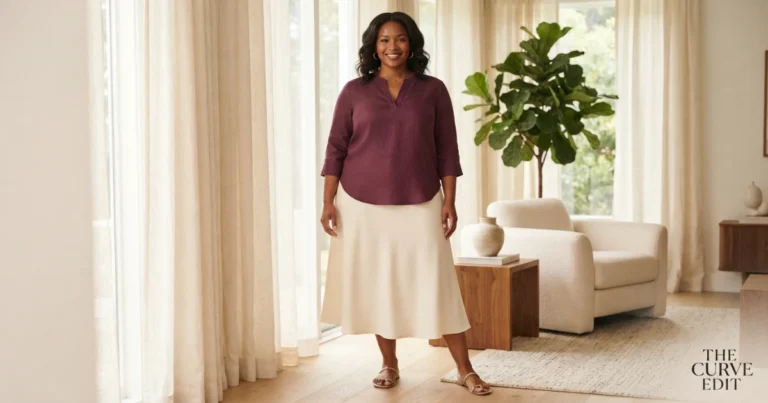
A shaped sweetheart top works with an A-line midi skirt or high-rise tailored column. Keep the neckline area simple if the seam architecture is already prominent, or add a short necklace that ends above the top edge. Off-the-shoulder and one-shoulder constructions offer alternative bare-shoulder lines, but each uses a different anchor and bra plan.
Crop length and waistband overlap
Bust projection consumes front length, so two tops with the same back length may reveal different amounts at center front. Decide the intended overlap while sitting, not only standing. If short proportions are the main goal, evaluate front hem lift and waistband pairing with the same seated test used for a crop top.
Care for the best bandeau tops without weakening grip
Read the garment’s own care label because shell, lining, silicone, foam, elastic, boning, and hardware may require different treatment. The FTC’s textile-label guidance explains required fiber disclosures, while its care-label guidance explains care-instruction responsibilities. Heat can degrade elastic and grip surfaces; twisting can bend boning or distort cups; hanging a wet bandeau can stretch the very edge responsible for security. Close hooks and zippers, remove detachable straps or pads when instructed, place delicate pieces in a mesh bag if machine washing is permitted, and reshape them flat.
The best bandeau tops preserve their security when their internal structure is stored correctly. Keep shaped cups without folding one inside the other. Lay longline boned garments flat or hang them from sturdy internal loops if supplied, never from the upper edge. Keep silicone grip clean according to the label because body oil and fabric conditioner may affect friction. Address a loose boning end, detached lining stitch, or rippling casing early before it damages the outer fabric.
Value is cost per secure wear, not the lowest ticket price. Count the support options the top accepts, the activities it handles, the bottoms and layers it works with, the care it demands, and whether elastic or hardware can be repaired. The best bandeau tops earn repeat wear because the wearer can breathe, move, sit, and focus on the event rather than the neckline.
Final buyer checklist
- Upper-edge tension is even and comfortable around front, sides, and back.
- Seams, cups, gathers, or panels create real bust projection.
- Side height covers the intended foundation throughout movement.
- Back closure, smocking, power mesh, or elastic recovers after stretching.
- Boning remains vertical and cushioned while standing and sitting.
- Shell and lining stay opaque at normal wearing stretch.
- Center-front length meets the waistband as intended after sitting.
- The upper edge returns after the five-position movement test.
- Care, returns, stock, and affiliate disclosure are clear before purchase.
Frequently asked questions
Can someone with a large bust wear a bandeau top?
Yes. The strongest options use shaped bust panels or cups, a wide stabilized upper edge, high side coverage, a firm back, opaque lining, and enough front length. Support may come from a compatible strapless bra, an integrated longline structure, or optional straps. Judge the specific construction and movement recovery rather than assuming every flat tube will behave the same way.
What type of bandeau top is best for a large bust?
Structured sweetheart, longline boned, ruched lined, wide-smocked-back, convertible, and dense double-layer knit bandeaus can all work. Choose shaped or boned construction for occasion support, smocking for adjustable circumference, optional straps for more activity, and compact knit for casual layering. The best type is the one that matches your foundation, torso proportions, coverage, and movement.
How do I stop a bandeau top from slipping down?
Check that the front has enough projection, the back is firm and horizontal, the upper edge is wide and stable, and side panels are tall enough. Silicone grip can assist friction, but it cannot fix a loose back or shallow front. If sizing down causes flattening, sheerness, rolling, or pain, choose a shaped, longline, boned, or adjustable-back construction instead.
Should I size down in a bandeau top?
Not automatically. Size down only if it improves upper-edge and back contact while preserving bust room, breathing, opacity, side coverage, and front length. If the smaller size cuts, compresses, bows the boning, or raises the front hem, the pattern needs more projection rather than more tension. Compare relaxed and wearable-stretch garment measurements with a useful reference top.
What bra works under a bandeau top for a fuller bust?
A properly fitted strapless or convertible bra often gives the widest independent support range. The bandeau must cover its cups, center front, side wings, and back band during movement. Some structured longline bandeaus include cups or underwire, but general clothing sizes may not predict cup depth. Removable pads smooth the surface; they do not substitute for accurate support.
Are bandeau tops with silicone grip better?
Silicone grip can reduce sliding by increasing friction, but it is only one part of fit. A secure top still needs correct circumference, front projection, side height, back structure, lining, and recovery. Continuous silicone may feel uncomfortable on sensitive skin, especially in heat. Check materials and care, perform a brief skin-comfort test, and do not use grip to force an undersized top.
Can a bandeau top be altered for more support?
Small changes may help: replace stretched elastic, secure a facing, add reinforced strap loops, shorten optional straps, add a hook setting, or make a minor back adjustment. Adding substantial cup depth, raising side wings, moving underwire, or converting a thin tube into a supportive corset requires reconstruction. Pin the proposed change and repeat the movement test before cutting.
What measurements should I check when buying a bandeau online?
Check relaxed and comfortably stretched upper-edge circumference, full-bust level, underbust or lower edge, side height, center-front and center-back height, front and back length, waist or hem, and closure range. For shaped cups, request cup width and depth or the brand’s fuller-bust method. Confirm shell, lining, grip, boning, stretch, care, and return conditions.