Best Cold-Shoulder Tops for a Large Bust
A construction-first guide to secure shoulder cutouts, reliable bra coverage, stable necklines, enough bust room, balanced sleeves, movement, and evidence-led online shopping.

The best cold-shoulder tops for a large bust do something more technical than simply expose a patch of shoulder. Unlike an off-the-shoulder neckline, a cold-shoulder design retains fabric across part of the shoulder, so the neckline can remain anchored while a cutout reveals skin between the neck and sleeve. That anchor can make a regular bra practical—but only when the shoulder bridge actually follows the bra-strap path and the cutout does not open into the armhole. Bust projection can pull the front panel outward, rotate the sleeves, widen the neckline, distort the opening, and shorten the front hem. Very thin knits may turn sheer; tight sleeve bands may pull the entire garment upward; oversized styles may let the shoulder bridges collapse. This guide identifies the useful construction evidence, compares six practical designs, explains cutout placement and sleeve mechanics, and shows how to verify a listing without relying on styled photographs. Product modules remain private until the live item, materials, measurements, returns, availability, and affiliate disclosure are verified. No Amazon product name, ASIN, price, rating, review, or personal wear claim is invented.
The 60-second cold-shoulder fit test
Put on the planned bra, let the top settle naturally, and check front, side, and back before adjusting the sleeves.
- The neckline stays centered and does not spread, drop, or pull toward one shoulder.
- Each shoulder bridge lies flat and covers the intended bra strap from front to back.
- The cutouts are similar in shape and do not collapse into the sleeve or expose the armhole.
- Fabric remains opaque and smooth over the fullest point without strong diagonal drag lines.
- Side seams stay near vertical, while the front hem remains reasonably balanced with the back.
- The sleeves allow reaching without forcing the neckline sideways or trapping the top beneath the bust.
- Cutout binding or elastic touches the skin comfortably and recovers without biting or flaring.
- Sitting, turning, and adding a jacket do not create unexpected bra exposure or sleeve twisting.
Best cold-shoulder tops by fit architecture
The best cold-shoulder tops for a large bust solve three connected tasks: the upper bridge anchors the garment, the cutout keeps its designed shape, and the front accommodates bust projection without borrowing fabric from the sleeves. Choose the construction that matches the dress code and movement level rather than treating every shoulder opening as equivalent.
Stable-neck jersey cold-shoulder top
Best for: casual wear and easy bra compatibility. Look for medium-weight opaque jersey, a bound crew or modest scoop neckline, substantial shoulder bridges, compact openings, and sleeves with bicep ease. The trade-off is heat and cling: a heavier knit may feel warm, while a thin one may distort or show bra texture.
Shaped woven cold-shoulder blouse
Best for: polished outfits and controlled drape. Darts, princess seams, back shaping, a facing, and matte crepe or stretch poplin create defined bust room. The trade-off is precision: rigid fabric cannot compensate for a misplaced bust point, narrow armhole, or shoulder bridge.
Faux-wrap cold-shoulder top
Best for: a diagonal neckline with more stability than many true wraps. Verify crossover depth, internal anchoring, shoulder coverage, and tie or seam placement below breast tissue. The trade-off is neckline migration if the front lacks overlap or the shoulder sections are too narrow.
Small-cutout long-sleeve knit
Best for: cooler weather and subtle exposure. A small slit or oval near the shoulder preserves more structure than a large open panel. The trade-off is sleeve torque: heavy, tight, or ribbed sleeves can pull the opening downward when the arms move.
Smocked-neck cold-shoulder top
Best for: relaxed warm-weather styling when the smocking stays above the bust and the sleeves are independently attached. The trade-off is upward creep and bulk. Wide elastic may press, while very loose bodies can bridge outward from the bust.
Draped occasion cold-shoulder top
Best for: evening outfits with lined crepe, soft pleats, or controlled gathers. The trade-off is hidden complexity: a fluid shell may look generous while a rigid lining, narrow side seam, or tight sleeve creates the real fit limit.
| Wardrobe need | Strong starting point | Evidence to verify | Main trade-off |
|---|---|---|---|
| Everyday bra-friendly top | Stable-neck jersey | Bridge width, opacity, recovery | Can feel warm or cling |
| Office or polished outfit | Shaped woven blouse | Darts, facing, bicep room | Needs precise pattern fit |
| Defined neckline | Anchored faux wrap | Overlap and shoulder stability | Can shift during movement |
| Subtle cool-weather detail | Small-cutout long sleeve | Sleeve weight and return | Sleeves can torque cutouts |
| Relaxed summer outfit | Smocked or gathered style | Elastic pressure and side height | May creep or add bulk |
| Evening finish | Lined draped crepe | Shell and lining measured separately | Hidden lining may restrict |
How the best cold-shoulder tops control the opening
The best cold-shoulder tops for a large bust use the opening to frame the shoulder without destabilizing the neckline or sleeve. Cutout size alone is not the full question. Position, bridge width, edge finish, armhole distance, and bra path determine whether the feature feels intentional.
Shoulder bridges must match the bra path
Measure the bridge at its narrowest point, then compare it with the bra strap while standing and reaching. A wide bridge near the neck may still miss a wider-set strap at the back. If a regular bra is part of the plan, the fabric must cover the complete path rather than only the front view. The camisole guide offers a similar strap-path method for narrow-strap layers.
Small and medium cutouts are easier to stabilize
A compact oval or slit usually leaves more fabric to control the sleeve and neckline. A deep opening extending toward the armhole exposes more skin but can turn the sleeve into a separate hanging panel. That may be intentional, yet it demands better binding and sleeve balance. Choose exposure by preference; judge security by whether the shape remains consistent.
The opening should sit outside the bust apex
When a cutout drops toward the fullest bust area, the edge can be pulled open by projection and may expose side-bust or bra components. A higher opening centered over the shoulder is often easier to fit. This is not a rule against larger cutouts; it is a reminder to verify where the lower point lands on the wearer.
Binding, facing, or elastic needs recovery
A bound edge gives visual definition, but it can stand away if stretched during sewing. Clear elastic or enclosed elastic can help a knit opening return, though excessive tension may bite into the arm. A woven opening benefits from facing, lining, or stable narrow binding. Look for smooth edges in relaxed product photos, not only posed shots.
How fabric and sleeve weight change cold-shoulder fit
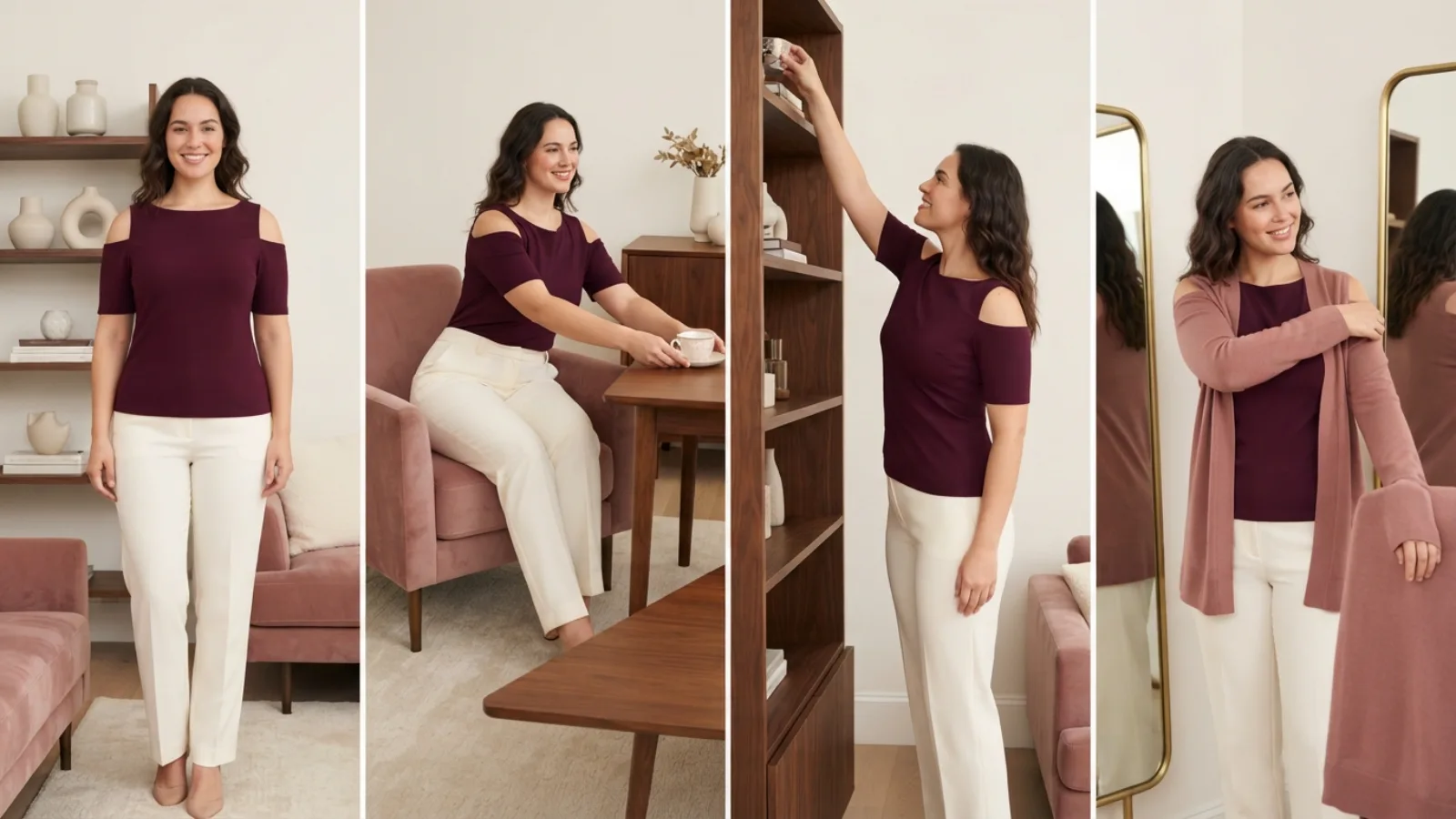
Cold-shoulder sleeves are interrupted at the top, so they cannot always share load with the shoulder seam in the same way as a conventional sleeve. The best cold-shoulder tops use fabric weight, armhole shape, sleeve cap, elastic, and edge recovery as one system. Comparing that complete system is more useful than choosing from fiber content alone.
Medium-weight jersey is forgiving when it recovers
A compact jersey can accommodate projection and allow the arms to move, but useful stretch must return. Gently stretch a concealed section widthwise and release it. If the fabric remains widened, the bridge and cutout may relax during wear. If the surface becomes shiny or sheer over the bust, the finished chest is too small for the intended look.
Crepe and stretch poplin need bust shaping
Matte crepe drapes cleanly, while stretch poplin creates a crisper silhouette. Both benefit from darts, princess seams, gathers placed below the shoulder line, or a genuinely roomy cut. A woven front pulling from armhole to bust is not likely to loosen enough to correct itself. See the large-bust fabric guide for a broader material comparison.
Bicep ease protects the cutout
A tight sleeve borrows fabric every time the elbow or shoulder moves. Measure the sleeve at the fullest upper arm and compare it with a comfortable top. Puff, bell, and bishop sleeves need enough cap and opening room to hang from their intended anchor; extra volume below does not repair a tight upper sleeve.
Heavy sleeves require stronger upper anchors
Long rib sleeves, beading, layered ruffles, or dense cuffs add downward pull. The shoulder bridge, neckline binding, and armhole attachment must resist that weight without stretching. The trade-off of a dramatic sleeve is maintenance: it may feel beautiful while standing but shift more during walking, carrying a bag, or adding a coat.
Lining can become the hidden fit limit
Check shell and lining separately. A stretch shell over a rigid lining can feel smaller than the label suggests; a loose lining may slide toward the cutout. The lining should preserve opacity and drape without restricting the bust or dragging the sleeve.
Neckline, bust room, side coverage, and front length
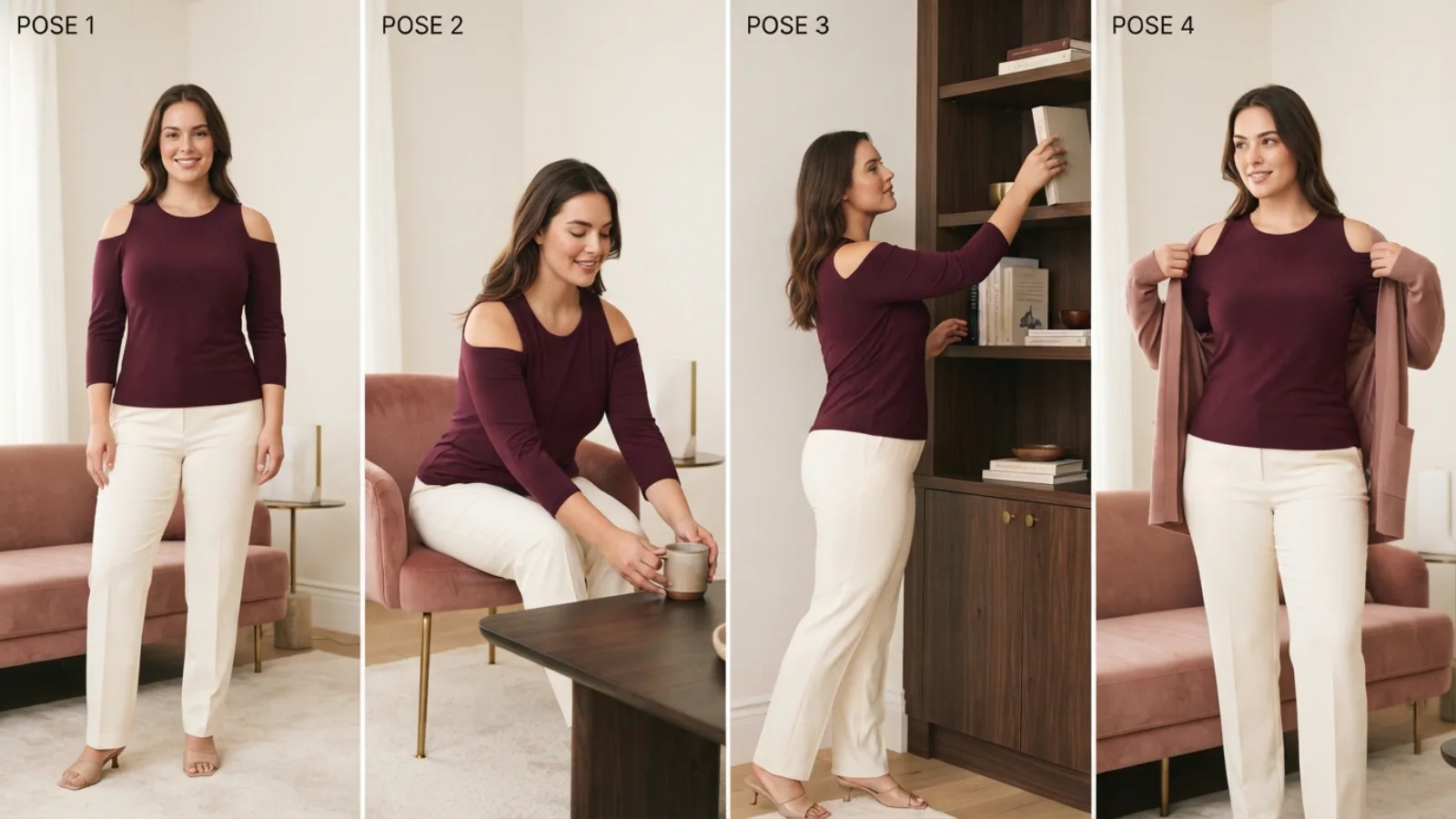
Cold-shoulder detail does not replace the normal requirements of a well-fitting top. The neckline still needs support, the front needs three-dimensional room, the armholes must cover the intended bra, and the hem must reach its designed position.
Stable necklines reduce competing movement
Crew, jewel, modest scoop, V, and square necklines can all work. The key is edge stability and shoulder connection. A square neckline needs reinforced corners; a V or wrap needs enough overlap; a scoop should not widen when the sleeves move. Use the neckline guide to compare visual and construction trade-offs.
Bust shaping keeps the cutouts symmetrical
Darts, princess seams, gathers from a controlled yoke, stretch panels, or sufficient front width allow fabric to pass over projection. Without that room, the front pulls outward and may rotate one or both cutouts forward. Side seams are useful evidence: strong forward sweep usually signals missing front width or shaping.
Side-bust coverage begins at the armhole
A cutout can make the upper body feel open even when the armhole is technically separate. Check whether the armhole dips low, whether the lower cutout point approaches the bra wing, and whether the sleeve gap widens while reaching. High side coverage is especially helpful when a regular bra is expected.
Center-front length controls hem lift
Bust projection uses front length. A top may fit around the chest yet finish much higher in front than intended. Compare center-front and center-back lengths on a successful garment, and inspect whether side seams remain vertical. A curved or slightly longer front hem can balance the body without adding width everywhere.
How to buy the best cold-shoulder tops online
Product photography rarely shows the information most likely to predict cold-shoulder fit. Models may hold their arms away from the body, a stylist may place the sleeves immediately before the photograph, and a jacket may hide the back bridge. The best cold-shoulder tops for a large bust are easier to identify when the listing supplies measurements, construction views, fabric details, and practical return terms.
- Choose a successful reference top. Use a blouse or knit whose bust, neckline, shoulder, armhole, sleeves, and length already work.
- Measure the reference relaxed. Record chest width, center-front length, shoulder width, armhole depth, bicep width, sleeve length, neckline, and hem.
- Map the cutout and bra. Measure bridge width, opening length and depth, and the planned bra-strap path at front and back.
- Separate body and garment charts. A body bust measurement does not reveal finished ease, and a flat chest width may not reveal shaped depth.
- Read shell, lining, and trim. Verify whether each layer stretches and whether the cutout edge uses binding, facing, or elastic.
- Inspect multiple views. Look for relaxed front, side, back, and raised-arm images rather than one posed angle.
- Check size scaling. Ask whether the bridge, cutout, bicep, sleeve, and length change between sizes.
- Confirm returns. Cutout placement is difficult to predict from a model image, so the return window, fees, and exclusions matter.
| Measurement or fact | Why it matters | How to compare | Warning sign |
|---|---|---|---|
| Finished chest width | Controls strain and opacity | Compare relaxed garment width | Only body chart supplied |
| Shoulder-bridge width | Anchors neckline and covers strap | Map front and back bra path | Only front styled view |
| Cutout length and depth | Predicts exposure and sleeve control | Compare with shoulder and armhole | No flat or side view |
| Bicep and sleeve | Affects movement and upward pull | Measure a comfortable reference | Volume shown but no upper-arm data |
| Center-front length | Predicts hem balance over bust | Use identical reference points | Only back length stated |
| Shell, lining, edge | Controls opacity and recovery | Read layers separately | Generic stretch claim only |
The U.S. FTC textile-label guidance explains fiber-content, origin, and responsible-business labeling requirements for covered textile products. Those facts can help verify a listing, but they do not prove cutout recovery, opacity, sleeve mobility, or fuller-bust fit.
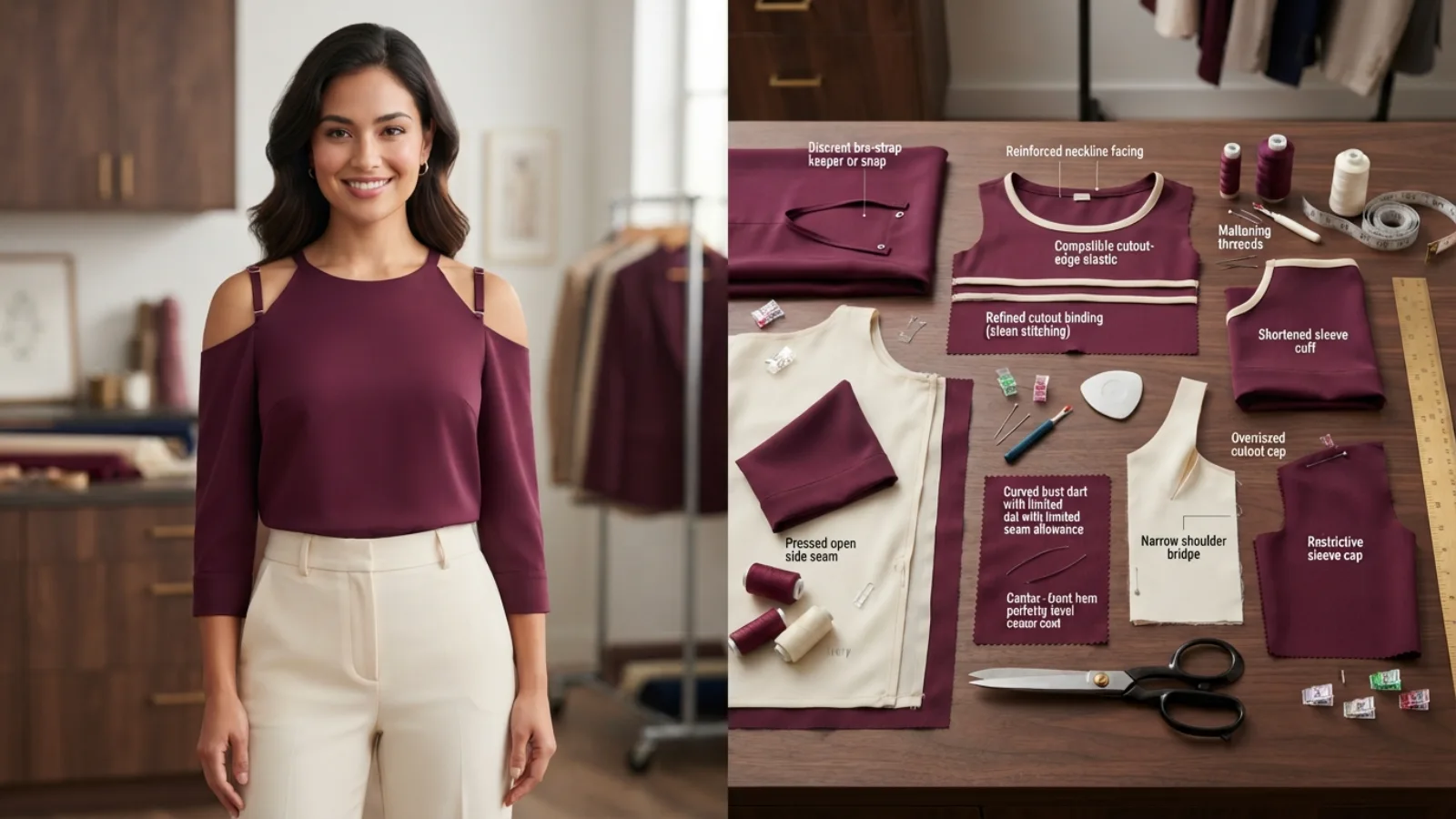
The movement test for the best cold-shoulder tops
A cold-shoulder top can look balanced in a still mirror and change once the arms move. The best cold-shoulder tops return close to their intended position without constant sleeve or neckline adjustment. This return test separates stable construction from a style that works only after manual placement.
Raise both arms and let them fall
Lift the arms overhead slowly, then lower them without pulling the garment down. The sleeves may move, but they should not remain trapped, twist the bridges, or drag the neckline off center. If the front hem stays caught beneath the bust, check bust room, armhole mobility, and sleeve tension.
Reach forward and across the body
This action reveals bicep and upper-back limits. Watch whether one cutout becomes larger, a bridge rolls, or a bra strap appears. A garment intended for desk work, driving, or dining should tolerate these movements with predictable coverage.
Sit for several minutes
Sitting changes torso length and places the arms forward. Check whether the neckline lowers, the front hem climbs, or cutout bindings press. Stay seated long enough for fabric friction to appear, then stand and observe whether the top settles naturally.
Add the planned outer layer
A jacket or cardigan can catch loose sleeves and fold cutout edges. Make sure the outer armhole has enough room and the inner sleeve does not bunch. If the shoulder detail must remain visible, choose an outer layer intended to be removed; ordinary jackets will cover it.
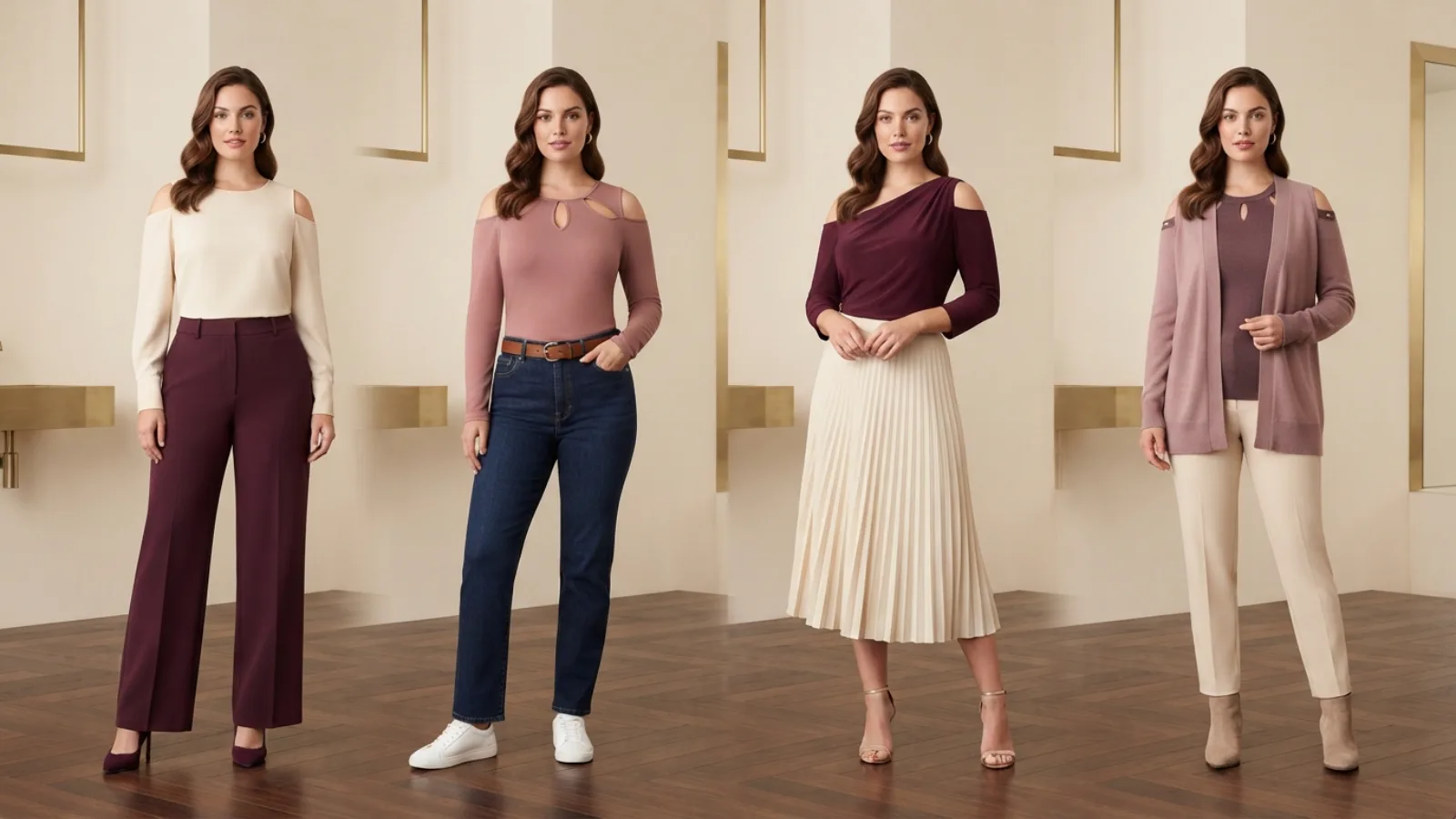
Keep / alter / return rule
Keep when neckline, bridge, cutout, bust room, bra coverage, sleeves, opacity, hem, and movement already work. Alter when the base fit is sound and a local adjustment—such as shortening a plain sleeve, refining a simple hem, or stabilizing a minor edge—is feasible. Return when the bridge misses the bra path, the front is fundamentally tight, cutouts collapse into the armholes, sleeves control the neckline, or the fabric becomes sheer.
Fit problems even the best cold-shoulder tops must avoid
Diagnose the cause before changing sizes. Several symptoms may come from one missing dimension: a tight bust can rotate cutouts, a tight sleeve can move the neckline, and a narrow bridge can expose the bra even when the opening itself looks modest. The best cold-shoulder tops keep these connected areas in balance rather than forcing one feature to compensate for another.
The cutouts rotate toward the front
The front may lack width or shaping, so bust projection pulls the garment forward. Check side seams and the lower cutout point. If the whole sleeve and bridge have moved, choose more finished chest room or a shaped front rather than enlarging the opening.
The bra straps appear after movement
The bridge may be too narrow, positioned too close to the neck, or unstable. A different bra can solve a styling mismatch, but a top advertised as bra-friendly should cover the planned strap during normal movement. Compare the front and back paths before deciding.
The sleeves ride up or twist
Likely causes include limited bicep ease, a shallow sleeve cap, tight elastic, heavy fabric, or an opening that removes too much upper support. If sizing up creates a loose neckline, seek a better sleeve pattern instead of accepting repeated adjustment.
The neckline pulls sideways
Uneven sleeve tension, an asymmetrical cutout, stretched binding, or insufficient bust room can shift the neckline. Test the garment with arms relaxed after moving. Persistent imbalance is more significant than temporary folds from dressing.
The opening flares away from the skin
Binding may have been stretched during construction, the edge may lack recovery, or the cutout may sit over a curved area the pattern did not shape. Minor flaring can sometimes be stabilized; major shape mismatch generally needs a different cut.
The front hem rises and the back pools
More center-front length or projection room is needed. A larger size helps only when it improves the front without creating excess shoulders and back. Look for darts, princess seams, stretch with recovery, or a curved longer front.
What a tailor can change in a cold-shoulder top
A tailor may refine a plain hem, shorten uncomplicated sleeves, reduce some waist or back width, add a discreet bra-strap keeper beneath a sufficiently wide bridge, or stabilize a small amount of neckline or cutout-edge gaping. Feasibility depends on seam allowance, lining, binding, elastic, print placement, and whether the opening is cut into a complex yoke.
Moving an entire cutout, widening a narrow shoulder bridge invisibly, adding substantial bust projection, rebuilding an armhole, or correcting a restrictive sleeve cap is more involved. The tailoring guide helps separate local refinements from pattern-level reconstruction. If the base garment is inexpensive and the structural problem affects several areas, returning it is often the more rational decision.
How to style the best cold-shoulder tops
The best cold-shoulder tops for a large bust work before styling begins. Once fit is secure, the cutouts can be treated as any other design feature: repeated, contrasted, softened, or made the focal point. No outfit must minimize the bust; the goal is to support the wearer’s chosen exposure, context, and visual balance.
Polished day: shaped blouse + tailored trouser
Choose a matte woven or stable stretch blouse with small or medium openings, discreet shaping, and controlled sleeves. A straight or wide-leg trouser gives the shoulder detail space without adding competing construction. Confirm the workplace policy because acceptable exposure varies.
Weekend: jersey top + denim
A compact jersey crew or scoop with three-quarter sleeves is easy to move in when the bridges are substantial. Add a simple necklace only if it sits above or within the neckline without fighting the cutout. The top should remain opaque and return after reaching.
Evening: draped crepe + high-rise skirt
A lined crepe style can combine shoulder exposure with a controlled front. Test the lining, crossover, and sleeves while seated. Keep accessories simple if the cutout, neckline, and sleeve already create several lines, or add statement jewelry if maximal detail is the intention.
Layered transition: camisole + cold-shoulder blouse
A low-bulk camisole can add neckline opacity beneath a fluid or wrap style, but it cannot change the shoulder cutout. Match strap paths so the layers do not create extra visible lines. Avoid a very tight underlayer that increases friction and pulls the blouse upward.
Alternative exposure: compare with off-the-shoulder construction
If the wearer wants a continuous open neckline rather than isolated shoulder windows, compare the off-the-shoulder guide. Cold-shoulder styles retain upper anchors and are often easier with regular bras; off-the-shoulder styles depend more heavily on neckline grip and strapless-bra planning.
Foundation first: use the complete large-bust styling guide
For outfit proportion, layering, fabric, and body-neutral wardrobe decisions beyond this single top category, start with How to Dress a Large Bust. Use those principles as options, not rigid rules.
Care, durability, and value in the best cold-shoulder tops
The best cold-shoulder tops retain their neckline, bridge width, cutout shape, sleeve balance, opacity, and front length after care. Inspect cutout binding, bridge seams, sleeve attachment, underarm stitching, darts, lining, elastic, and hem. Openings create extra edge length, so poor recovery becomes visible quickly. For that reason, the best cold-shoulder tops should be judged after reviewing both construction and the required care routine.
Protect cutout edges from stretching
Follow the sewn-in care label. Avoid hanging a heavy wet knit by narrow bridges, and do not pull the garment on by the cutouts. Fold knits that lengthen on hangers. If the top has a back closure, side zip, or wider neckline intended for dressing, use it instead of forcing the bridge over the bust.
Check elastic and binding after care
Before the return window closes, confirm the care method and consider whether the style will be practical to maintain. The FTC care-label guidance explains U.S. care-instruction requirements for covered garments. A compliant label is useful evidence, but it does not guarantee a cutout will retain shape.
Value comes from bra and outfit compatibility
A top that works with an existing bra, two bottoms, and a suitable outer layer may offer more realistic wear than a dramatic style requiring specialized foundations and constant adjustment. Before buying, list actual outfits, settings, temperatures, movement, care steps, and return conditions. Cost per wear is a planning tool, not a promised outcome.
| Final checkpoint | Pass signal | Trade-off to accept knowingly |
|---|---|---|
| Neckline and bridge | Centered, stable, bra-compatible | Wider bridges reveal less shoulder |
| Cutout | Balanced, smooth, away from armhole | Larger openings need stronger edges |
| Bust and side | Opaque, shaped, adequate coverage | More structure may feel warmer |
| Sleeves | Move and return without torque | Dramatic volume can complicate layers |
| Length | Front hem lands as intended | Longer fronts may look uneven flat |
| Evidence | Measurements, care, returns verified | Extra checking takes more time |
Frequently asked questions
What cold-shoulder top style is best for a large bust?
A cold-shoulder top with a stable neckline, substantial shoulder bridges, cutouts that sit outside the bra-strap path, enough finished chest room, high side coverage, and sleeves that move independently is the most dependable starting point. A shaped woven blouse or resilient medium-weight knit usually gives more control than a very thin, oversized, or deeply cut style.
Are cold-shoulder tops flattering on a large bust?
They can be, but flattering is personal and fit matters more than a body-type rule. The shoulder openings can add visual detail away from the center chest while the neckline remains anchored. The result works best when the cutouts stay in place, the bra remains covered as intended, and the fabric hangs cleanly instead of pulling across the bust.
What bra should I wear with a cold-shoulder top?
Many cold-shoulder tops work with a regular bra because fabric remains over part of the shoulder. Check the exact front and back cutout boundaries against the bra-strap path. If the opening exposes the strap, choose a compatible convertible or strapless bra only if it is comfortable and supportive for you; do not assume specialized underwear is mandatory for every style.
Should I size up in a cold-shoulder top for a fuller bust?
Size up when the fabric strains, turns sheer, pulls from armhole to bust, distorts the cutouts, or makes the front hem climb. If the larger size causes a loose neckline, dropped shoulder bridges, oversized armholes, or sleeves that twist, the pattern is the problem. Look for more bust shaping, a different cutout position, or fuller-bust sizing.
How do I stop cold-shoulder sleeves from riding up?
Look for enough bicep room, an armhole and sleeve cap that allow reaching, stable shoulder bridges, and elastic or binding that recovers without gripping harshly. Test both arms overhead and forward, then let the garment settle. If the sleeve stays bunched or pulls the neckline sideways, a different sleeve construction is more reliable than repeated adjustment.
Can I wear a cold-shoulder top to work?
That depends on the workplace dress code and the amount of exposure. A high-neck or modest scoop style with small controlled cutouts, opaque fabric, secure sleeves, and a polished trouser or skirt may suit some offices. Keep a cardigan or jacket available where temperature or policy changes, and confirm that the cutouts remain controlled while sitting and reaching.
Which fabric is best for a fuller-bust cold-shoulder top?
Medium-weight jersey, resilient rib, matte crepe, stable stretch poplin, and lined stretch fabric can all work. The useful qualities are opacity under stretch, neckline and cutout-edge recovery, enough drape over projection, sleeve mobility, and care stability. Fiber percentages alone cannot prove how the finished garment will behave.
What measurements should I check when buying a cold-shoulder top online?
Check finished chest width, center-front length, shoulder-bridge width, cutout length and depth, neckline width and depth, armhole depth, bicep width, sleeve length, hem width, fabric stretch, and lining. Compare those measurements with a successful top and the exact bra planned for wear, then verify the retailer return conditions.