Best Ruffle Tops for a Large Bust
A construction-first guide to ruffle placement, trim scale, gathering, neckline control, shaped bust room, front length, fabric behavior, movement, and evidence-led online shopping.
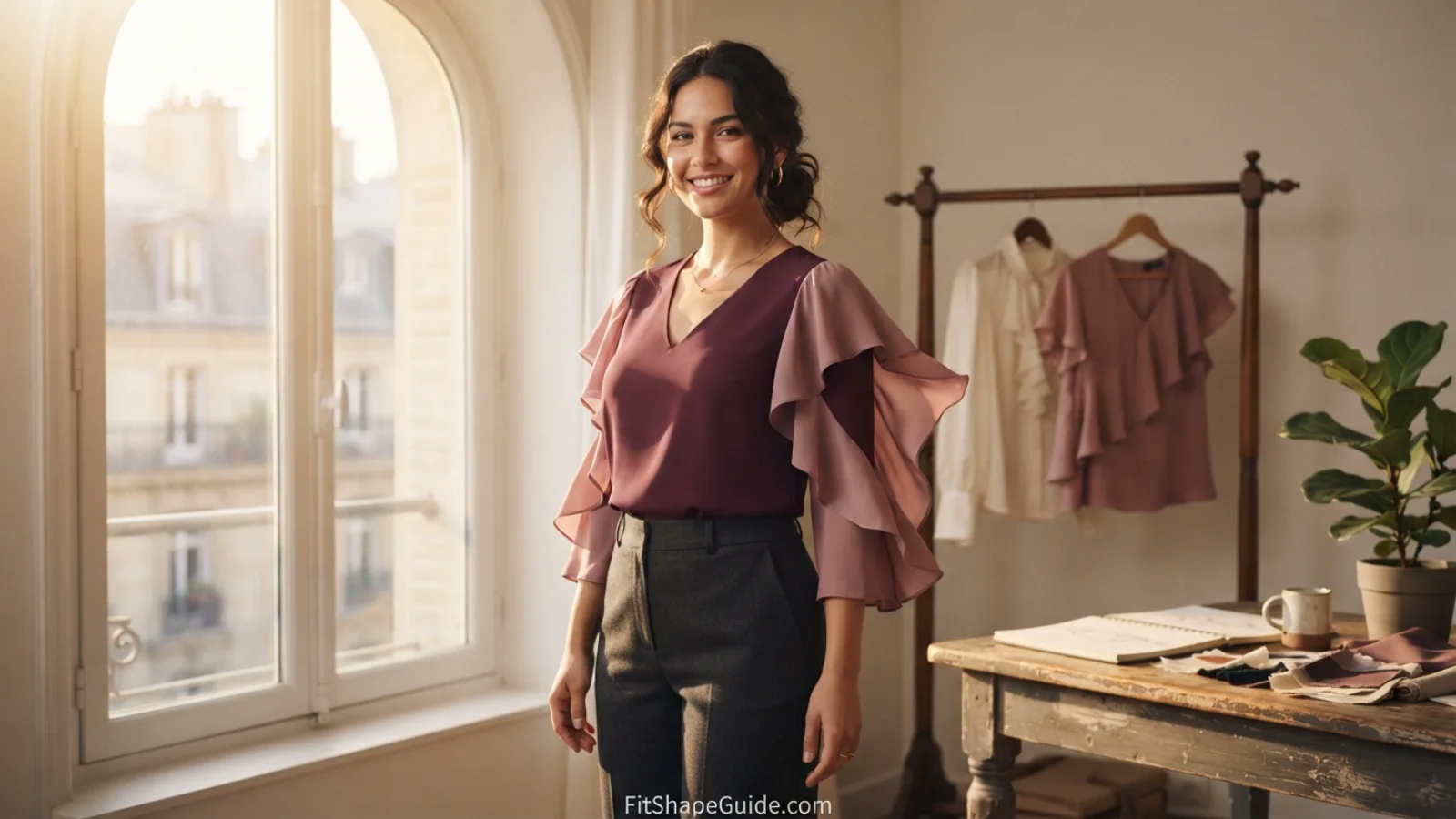
The best ruffle tops for a large bust are not defined by a rule that ruffles must always be avoided or moved away from the chest. A ruffle changes a garment in several ways at once: it adds surface area, creates shadow, introduces movement, and places extra fabric weight on a seam or neckline. Whether that detail feels balanced depends on where it begins, how wide it is, how densely it is gathered, which direction it travels, and whether the blouse underneath already has enough three-dimensional room for the bust. A small shoulder flounce on a shaped V-neck top can sit cleanly; a dense double ruffle attached to a strained neckline can roll, gape, or project forward. A vertical ruffle may create a useful line, but only if it remains vertical after the fabric travels over the bust. The answer is therefore construction, not prohibition. This guide compares six workable ruffle architectures, shows how to assess trim scale and fabric behavior, and provides a practical online-shopping and movement-testing system. Product modules remain private until the current product, exact measurements, materials, care, returns, availability, and affiliate disclosure are verified. No Amazon product name, ASIN, price, rating, review, or personal wear claim is invented.
The 60-second ruffle-top fit test
Wear the intended bra, let the top settle without arranging the trim by hand, and inspect the front, side, back, and neckline.
- Shoulder seams remain at their intended position and are not dragged forward by bust tension.
- The neckline lies flat; a ruffle attached to it does not roll outward, collapse inward, or reveal the bra.
- Darts, princess seams, gathers, or stretch create real projection room under the decoration.
- The ruffle begins and ends symmetrically unless the design is intentionally asymmetric.
- Decorative volume does not hide strong strain lines, button spread, or fabric sheerness at the bust.
- The center-front hem reaches its intended point and the side seams remain close to vertical.
- Sleeve and shoulder ruffles do not restrict the arm or twist after a forward reach.
- After sitting and moving, the trim falls back without constant smoothing or repositioning.
Best ruffle tops by fit architecture
The best ruffle tops for a large bust start with a stable base shape and use trim to support the design rather than conceal poor fit. These six constructions cover different levels of decorative volume, bra compatibility, structure, and occasion. None is universally flattering; each becomes useful when its seam placement, proportions, and materials match the wearer and the planned outfit.
V-neck top with shoulder flounces
Best for: adding movement near the upper frame while keeping the center bust relatively clean. Look for a V-neck finished with firm binding or facing, flounces attached outside the neckline edge, bust darts or princess seams, and a shoulder seam that stays located. A single lightweight flounce is easier to control than stacked stiff layers. Check that the trim does not cover the full shoulder seam and pull the neckline outward.
Sleeve- or cuff-ruffle blouse
Best for: shoppers who want a decorative effect away from the fullest bust. A clean bodice with shaped chest room provides the foundation, while ruffles at a short sleeve edge or cuff carry the detail. Confirm bicep width, sleeve-head mobility, cuff opening, and trim weight. A very heavy cuff can drag the sleeve and become impractical at a desk, but a soft controlled edge can work for both office and event dressing.
Narrow vertical-ruffle blouse
Best for: a refined front detail when the trim follows a stable placket, princess seam, or off-center line. The attachment line must stay straight after crossing the bust. Look for restrained width, low gathering, close button spacing if a placket is involved, and enough chest ease that the ruffle does not split into two outward-facing shelves. A vertical line is not useful if tension bends it around the fullest point.
Asymmetric side-flounce top
Best for: deliberate movement without placing equal volume across the whole chest. A diagonal or side flounce can work when it begins from a reinforced seam, avoids the apex, and ends where it will not be trapped by the arm. Check that the base neckline stays level, the side seam does not rotate, and the extra fabric does not make one side of the hem appear shorter. The asymmetry should be designed into the pattern rather than created by fit strain.
Wrap top with restrained edge ruffle
Best for: adjustable waist placement and a soft decorative neckline. The two fronts need generous overlap, stable edge finishing, a tie anchored near the natural waist or underbust, and a narrow ruffle light enough not to pull the wrap open. Test the neckline seated and during a forward reach. A faux wrap may be more stable, while a true wrap offers adjustment only when both panels provide enough coverage.
Shaped top with low peplum ruffle
Best for: keeping decoration below the bust while defining the waist transition. The bodice must contain the full bust before the seam, and the peplum should begin at a level that stays horizontal. A circular flounce creates movement with less dense gathering; a heavily gathered strip adds more bulk. Check center-front bodice length, seam position, flare angle, and whether the front edge lifts after sitting.
Choose placement, scale, and direction in the best ruffle tops
For the best ruffle tops for a large bust, placement affects more than visual emphasis. It changes seam weight, airflow, arm clearance, layering friction, and how easily a shopper can evaluate the base fit. Instead of asking whether ruffles make a large bust look larger, ask what the trim is physically doing and whether that effect suits the desired outfit.
Placement relative to the bust apex
A horizontal tier that crosses the fullest bust usually produces the strongest projection because its outer edge sits on top of an already projected surface. That may be an intentional dramatic look, but it also makes strain and sheerness harder to see. A shoulder, sleeve, neckline-edge, off-center vertical, or low-waist placement often keeps more of the base bodice visible. The critical issue is not distance alone: the attachment line must remain in the intended position once the garment is worn.
Trim width and gathering ratio
A narrow ruffle with modest gathering produces a small ripple; a wide strip gathered into a short seam produces deep folds and greater volume. Retail listings rarely state the gathering ratio, so inspect high-resolution photographs. Look at how closely the folds sit at the attachment seam, how far the outer edge projects, and whether the ruffle appears light or compressed. A circular flounce is cut as a curve and waves without the same dense gathering at the seam, which can create cleaner movement.
Direction and continuity
Vertical and diagonal trims can introduce direction, but only when their attachment seams remain straight or deliberately curved. Bust strain can force a vertical ruffle outward, make a diagonal line steeper on one side, or pull a wrap-edge ruffle open. Inspect both front and side views. If the design continues over the shoulder or around the back, confirm the transition does not add a hard lump under a jacket.
| Ruffle placement | What to verify | Common failure | Most useful when |
|---|---|---|---|
| Shoulder flounce | Shoulder location, neckline binding, trim weight, arm clearance | Flounce drags neckline outward or catches beneath the arm | The bodice is shaped and the center front remains relatively clean |
| Sleeve or cuff | Bicep width, cuff opening, sleeve length, desk practicality | Heavy trim twists the sleeve or falls into the hand | Decoration is wanted away from the bust |
| Narrow vertical front | Straight attachment line, chest ease, placket stability | Ruffle splits or bends outward over bust tension | The line is restrained and the base front is stable |
| Wrap neckline edge | Overlap, edge recovery, tie anchor, seated coverage | Ruffle weight pulls the neckline open | The wrap has generous overlap and a secure edge |
| Across fullest bust | Intentional volume, opacity, underlying shaping, symmetry | Tier exaggerates strain or hides an undersized bodice | A statement silhouette is desired and fit is proven underneath |
| Waist or peplum seam | Bodice length, seam level, flare angle, front lift | Seam rises under the bust and ruffle starts too high | The upper bodice fully contains projection |
How the best ruffle tops match fabric to construction
The best ruffle tops for a large bust match material behavior to the intended trim. The same ruffle pattern behaves differently in chiffon, crepe, poplin, organza, jersey, and rib knit. Fiber content is only a starting point. Weight, weave or knit structure, finish, layer count, edge treatment, and attachment method determine whether the trim floats, collapses, scratches, curls, or pulls the underlying garment out of position. The fabric guide for a large bust explains the broader relationship between drape, opacity, stretch, and recovery.
Fluid crepe and soft woven viscose
These materials can create soft flounces with lower projection and attractive movement. They are useful for shoulder, sleeve, wrap-edge, and asymmetric details when opaque enough or properly lined. Check static, cling, seam puckering, and whether the edge is narrow-hemmed without stiffness. Very soft fabric may collapse into a low neckline or collect at the center bust if the base garment lacks shaping.
Chiffon and georgette
Lightweight sheer fabrics produce airy layers, but multiple tiers can still become visually dense. Confirm lining coverage, edge finishing, snag risk, and whether the seam allowance scratches. A lined bodice with a single chiffon flounce can be controlled; several unlined layers may reveal the bra or make the garment hard to evaluate. Do not infer opacity from a dark studio photograph.
Poplin and crisp cotton blends
Crisp fabric holds a sculptural shape and makes a ruffle project farther from the body. This can look intentional at a sleeve or shoulder but may become rigid across the chest. The attachment seam needs reinforcement, and the base blouse needs darts, princess seams, or another source of projection. If the design has buttons, study spacing and placket stability rather than assuming stretch will prevent gaping.
Jersey and rib knit
Knit ruffles can be comfortable and washable, but cut edges may curl and attachment seams may wave. Check recovery at the neckline and shoulder. A heavy knit flounce can drag a soft neckline downward; a lightweight knit strip can lose its ripple after washing. Opacity should be assessed at the fullest bust while the fabric is stretched to the expected degree.
Organza and structured synthetics
Organza and similar materials create dramatic volume with relatively little fabric weight, but edges can feel firm and the trim can resist layering. Inspect arm contact, neckline abrasion, seam bulk, and how the ruffle behaves when compressed beneath a coat. Use this construction when sculptural effect is the goal, not when a low-profile everyday layer is required.
Edge finish and attachment
A narrow turned hem, rolled hem, binding, lace edge, laser cut, or raw knit edge changes weight and stiffness. The attachment seam should be smooth, reinforced where necessary, and protected from irritation. On printed fabrics, check whether the underside will be visible and whether it is designed to look finished. The strongest best ruffle tops do not depend on constant steaming to make each edge face the correct direction.
Fit the base garment before comparing the best ruffle tops
A ruffle cannot create missing bust projection. It may cover drag lines in a product photograph, but the underlying tension still affects the neckline, armholes, shoulders, side seams, and hem. Evaluate the base garment exactly as you would a simpler blouse, keeping the construction visible beneath the trim.
Shoulders and neckline
Shoulder seams should reflect the design: a set-in seam normally ends near the shoulder point, while a deliberate dropped shoulder sits lower without being dragged by the bust. The neckline must stay flat before the ruffle is arranged. Compare neckline shape with the options in the best necklines guide, but remember that no neckline compensates for an undersized chest.
Darts, princess seams, and gathers
A dart should point toward the fullest area and end before it; a princess seam should curve smoothly through the projected region; underbust gathers should distribute fullness without pulling the seam upward. Decorative ruffles may share or cross these seams, so inspect whether the construction remains visible. If a seam sits above the bust or creates a bubble below it, a different pattern is usually more useful than styling adjustments.
Armholes and sleeve anchoring
Shoulder and sleeve ruffles add weight near the armhole. The armhole should remain smooth, cover the planned bra, and allow a forward reach without cutting into the front crease. A sleeve head must not rotate because the bodice is pulled forward. On sleeveless designs, the ruffle should not be used to conceal a gaping armhole.
Center-front length and hem balance
Bust projection consumes vertical length. Measure the center front separately from the back, particularly when a waist or peplum ruffle must land at a precise level. If the front hem lifts and the ruffle is attached near that hem, the whole decorative line can tilt upward. A shaped high-low hem can be intentional; unexplained front shortage is a fit issue.
Buttons and closures
On a ruffle-front shirt, verify a button near the fullest bust point, close useful spacing, a flat reinforced placket, and enough chest ease. A dense ruffle can hide button spread in a front image. Study side photographs or video, and use the button-gaping guide to separate simple closure reinforcement from insufficient garment room.
How to find the best ruffle tops online
Finding the best ruffle tops for a large bust online becomes more reliable when decorative vocabulary is translated into measurements and construction evidence. “Romantic,” “statement,” “flutter,” and “voluminous” do not tell you whether the neckline will stay closed or the shoulder will fit. Use a repeatable process and reject listings that conceal essential information.
- Start with the intended bra and use. Decide whether you need standard-strap coverage, desk practicality, jacket compatibility, easy washing, or a more dramatic event silhouette.
- Identify the ruffle type. Distinguish a circular flounce from a gathered strip, a flutter sleeve from a shoulder overlay, and a true wrap edge from a sewn faux-wrap detail.
- Map the attachment line. Determine where the trim starts and ends in front, side, and back views. Note whether it crosses the fullest bust or relies on the neckline edge.
- Collect finished garment measurements. Chest circumference or pit-to-pit is essential but insufficient. Add shoulder, front length, back length, neckline depth, armhole, bicep, sleeve, waist, and hem.
- Estimate the trim’s physical scale. Compare ruffle width with familiar garment features such as the shoulder seam, neckline depth, sleeve length, or button diameter rather than relying on a close-up.
- Read material and lining data. Record shell, lining, trim composition, stretch direction, edge finish, and care. Confirm whether “ruffle” is a single layer or several layers.
- Inspect multiple views and video. Front-only posing can hide neckline opening, side projection, armhole gape, asymmetric attachment, and hem lift.
- Verify current returns and affiliate details. Save the retailer’s current conditions before purchasing. Product availability, price, ratings, and policies can change.
| Evidence to collect | Why it matters | How to compare it |
|---|---|---|
| Finished chest and shoulder | Shows whether the base top has room without oversized shoulders | Measure a similarly structured blouse that fits over the planned bra |
| Center-front and back length | Reveals whether bust projection may shorten the front or lift a waist ruffle | Measure vertically from the stated shoulder reference on a known garment |
| Neckline depth and width | Affects bra coverage and whether an edge ruffle can stay located | Use the same neckline reference and planned bra, not the model image alone |
| Armhole, bicep, and sleeve | Determines mobility beneath shoulder, flutter, or cuff ruffles | Measure a comfortable top with similar stretch and sleeve construction |
| Ruffle width and attachment route | Predicts projection, layering bulk, and where volume will sit | Request measurements or estimate against fixed garment features in full views |
| Shell, lining, trim, and care | Affects opacity, recovery, edge curl, pressing, and maintenance | Read the complete current label and care instructions, not fiber marketing alone |
How the best ruffle tops perform in five positions
The best ruffle tops remain attractive after ordinary movement instead of only in a carefully arranged mirror pose. Perform the test with the planned bra, then repeat the key positions with the intended jacket, cardigan, or coat if layering matters.
1. Neutral standing
Drop the arms naturally and do not smooth the trim. Check shoulder location, neckline edge, ruffle symmetry, side seams, and front hem. A circular flounce should form natural waves; a gathered ruffle should distribute folds consistently without a dense clump at one point.
2. Forward reach and self-hug
Reach as if typing or driving, then make a gentle self-hug. Watch for front-armhole cutting, back restriction, neckline spread, sleeve twist, and an attachment seam that pulls tight. When arms return, the trim should settle without exposing a raw underside or remaining folded backward.
3. Seated position
Sit upright and then lean slightly forward. A wrap-edge ruffle must not pull the neckline open; a waist ruffle should not rise under the bust; a front tier should not compress into the neck. Check whether the bra remains covered and the front hem stays at the intended level.
4. Turn and walk
Rotate the torso and take several steps. Asymmetric ruffles should move but return to their intended side. Heavy trim should not rotate the top around the body. If the side seams spiral or the neckline shifts, examine whether the issue is trim weight, fabric torque, or an undersized bust.
5. Add the planned layer
Put on the actual jacket or cardigan. A shoulder flounce may fold or create a ridge under a narrow armhole; a cuff ruffle may need to extend intentionally beyond a sleeve; a front ruffle may trap beneath a zipper. The large-bust layering guide can help coordinate neckline, fabric, and outer-layer depth.
Fit problems that disqualify the best ruffle tops
Do not treat every problem as evidence that decorative tops are unsuitable for a fuller bust. Diagnose the base garment, attachment seam, and trim separately. The same visible symptom can come from different causes, so change one variable at a time.
| Visible symptom | Likely cause | Best next check |
|---|---|---|
| Neckline ruffle rolls outward | Edge is overloaded, binding lacks recovery, or bust tension pulls the neckline | Remove hand-arranging, assess base neckline flatness and chest ease |
| Vertical ruffle bends around bust | Insufficient projection room or unstable attachment line | Inspect darts, placket, side-seam rotation, and finished chest measurement |
| One shoulder flounce sits higher | Shoulder asymmetry, sleeve twist, uneven attachment, or garment rotation | Align shoulder seams and inspect back and side views before altering trim |
| Ruffle collapses into cleavage | Fabric is too soft or wide for the neckline, or edge lacks support | Check facing, overlap, trim weight, and seated neckline stability |
| Waist ruffle rises under bust | Bodice lacks front length or seam is positioned too high | Measure shoulder-to-seam front length and compare with the back |
| Sleeve ruffle twists after reaching | Narrow bicep, rotated sleeve, heavy trim, or tight front armhole | Test mobility without a layer and inspect sleeve grain and armhole |
| Trim looks unusually bulky only at center front | Dense gathering positioned on maximum projection or fabric compressed by tension | Verify design intent, base opacity, and attachment route in side view |
| Front hem lifts sharply | Bust uses available length or top is caught at the waist/hip | Compare center-front and center-back lengths and check side-seam angle |
When sizing up helps
A larger size can help when the chest shows strain, the neckline spreads, the armhole cuts, the front becomes sheer, or the attachment seam is stretched. Recheck shoulders, neckline width, sleeve placement, and waist in the larger size. If those become unstable while the bust still lacks shape, the grading or pattern is the problem rather than the nominal size.
When a different construction is better
Change the garment when the ruffle depends on an unstable neckline, the seam crosses the bust at an incompatible height, the trim is too stiff for required layering, or the base front has no useful shaping. Moving from a dense horizontal tier to a sleeve ruffle, narrow vertical detail, shoulder flounce, or low peplum changes both the visual line and the physical demands.
Alterations for the best ruffle tops—and their limits
Simple trim can make a garment look easy to alter, but ruffles often involve curved seams, narrow hems, bias edges, lining, or multiple layers. A tailor should inspect the entire attachment route before any seam is opened. The tailoring guide for a large bust explains which structural issues are realistic to correct.
Often possible: shortening an uncomplicated cuff ruffle, reducing excess gathering, securing a wrap neckline discreetly, adding a hidden snap, reinforcing an attachment seam, narrowing a simple shoulder flounce, or adjusting a side seam when sufficient allowance exists. Results depend on fabric, edge finish, print, and whether removal exposes permanent needle marks.
Sometimes possible: repositioning a waist ruffle, adjusting a neckline ruffle, shortening a multi-layer trim, or adding bust darts. These changes can alter the circumference, symmetry, grain, and drape of the base garment. Obtain a specific assessment and price before relying on the alteration.
Usually purchase correctly: shoulder width, armhole shape, bust apex position, princess-seam curve, major neckline dimensions, front torso length, wrap-panel coverage, and a complex ruffle route integrated into several seams. A decorative strip cannot supply missing fabric over the bust, and opening a finished flounce may not create usable material where needed.
Style the best ruffle tops according to placement
Styling should support a well-fitting top rather than disguise an undersized one. Start with the location and scale of the detail, then choose bottoms, layers, and accessories that give the outfit a clear rhythm. The complete large-bust styling guide offers broader proportion strategies.
Shoulder and sleeve ruffles
These details need room around the arm. Pair them with an open neckline or simple center front if that suits the design, and choose an outer layer with adequate shoulder and armhole space. Sleek trousers, straight jeans, or an A-line skirt can all work; the useful choice is the one that matches the top’s formality and hem position.
Vertical and asymmetric front ruffles
Keep necklaces from repeatedly catching the trim. A clean trouser or skirt waistband lets the front line remain visible, while a partial tuck is useful only when it does not distort the attachment seam. On an asymmetric top, repeat or deliberately contrast the diagonal direction through earrings, bag placement, or footwear rather than forcing perfect symmetry.
Wrap-edge ruffles
Choose a bra or modesty layer that remains hidden during sitting and reaching. A close-fitting camisole may help when the neckline is intentionally open, but avoid a bulky layer that pushes the wrap edge outward. Check its straps, armholes, neckline, and opacity with the full outfit.
Low peplum ruffles
Check where the peplum ends relative to the waistband and pockets of the bottoms. A smooth high-rise waistband can support a clean transition, but rise is not mandatory. The key is preventing two thick horizontal edges from colliding. Straight, tapered, bootcut, wide-leg, and skirt silhouettes can all work when the proportions are intentional.
Print, color, and texture
A solid color makes the shadow and shape of the ruffle more visible; a print can integrate the folds or make the underside more noticeable. Contrast piping emphasizes the edge. None of these effects is automatically slimming or enlarging. Choose the degree of emphasis you enjoy, then confirm the trim is symmetrical, colorfast according to its care requirements, and compatible with the rest of the wardrobe.
Care for the best ruffle tops and protect their shape
The best ruffle tops keep their neckline, attachment seams, edges, and intended volume after care. Follow the sewn label for the specific garment. The FTC’s textile-label guidance explains fiber-content and related labeling requirements, while its care-label guidance covers care instructions. These references explain labeling; they do not prove the performance of an individual top.
Before washing, inspect loose threads, narrow hems, attachment seams, underarm contact points, buttons, snaps, and any place where a ruffle is caught into another seam. Follow instructions for fastening, bagging, temperature, drying, reshaping, and pressing. High heat, uncontrolled agitation, or hanging a heavy wet garment may affect edges and alignment when the label warns against those methods.
After care, allow the top to dry or settle as directed before judging it. Compare the neckline, shoulder position, trim symmetry, and front length with the pre-wash condition. A quick steam may restore a compatible fabric, but a garment that requires complex pressing after every wear has a higher ownership cost.
Final buyer checklist
Use this checklist before keeping any candidate among the best ruffle tops for a large bust.
- The base shoulders, neckline, armholes, sleeves, and planned bra work before trim is arranged.
- The bust has shaped room without strain, sheerness, button spread, or severe front lift.
- Ruffle placement, width, gathering, direction, and stiffness create the intended effect.
- Attachment seams remain located through standing, sitting, reaching, turning, and layering.
- The edge finish is smooth, consistent, comfortable, and realistic to maintain.
- The front and back lengths, waist placement, and side seams stay balanced after movement.
- The top works with planned bras, bottoms, outer layers, activities, and care effort.
- Measurements, materials, lining, care, returns, availability, and affiliate disclosure are verified.
Frequently asked questions
Can women with a large bust wear ruffle tops?
Yes. The useful question is where the ruffle sits and whether the base top fits. Choose correct shoulders, a stable neckline, enough bust projection, opaque fabric, and adequate front length first. Then select a trim scale and position that creates the effect you want. Shoulder, sleeve, cuff, narrow vertical, asymmetric, wrap-edge, and low peplum ruffles can all work when their attachment seams remain stable through movement.
What ruffle placement is best for a large bust?
There is no single required placement, but shoulder flounces, sleeve or cuff ruffles, narrow off-center vertical trims, and low waist flounces are often simpler to evaluate because they leave more of the base bust fit visible. A ruffle across the fullest bust can also work as an intentional statement when the underlying bodice has enough room and remains opaque. Judge attachment, scale, and direction rather than using placement alone.
Do ruffles make a large bust look bigger?
Ruffles add surface area, shadow, and movement wherever they are placed, so a wide stiff tier across maximum projection creates a stronger volume effect than a narrow soft sleeve or vertical trim. That effect is not automatically undesirable. Decide how much emphasis you want, then verify that the garment is not adding accidental projection through strain, collapsed folds, or a ruffle that has been forced out of position.
What neckline works with a ruffle top for a fuller bust?
V-necks, split necks, open collars, scoops, and controlled wrap necklines are useful when their edges stay stable and cover the planned bra. Higher necklines can also work with soft shoulder or sleeve ruffles when the fabric drapes cleanly. The neckline must be judged with the ruffle’s weight: a trim attached to a weak edge can cause rolling or gaping even when the shape itself seems suitable.
Should I size up in a ruffle blouse for a large bust?
Size up when the chest strains, fabric becomes sheer, the neckline spreads, armholes cut, buttons gape, side seams pull forward, or the attachment line is distorted. Recheck shoulder and neckline control in the larger size. If those become too loose while the bust still lacks room, choose a blouse with fuller-bust shaping or a more compatible construction instead of continuing to increase the size.
Which fabric is best for ruffle tops for a large bust?
Fluid crepe, soft viscose, chiffon over an opaque lining, stable poplin, compact jersey, and lightweight organza can all work for different effects. Evaluate weight, drape, opacity, recovery, static, edge finish, and attachment strength—not fiber name alone. Softer fabrics create lower-profile movement; crisp fabrics hold more sculptural volume and require more room for layering.
Can a ruffle top be worn under a blazer or cardigan?
Yes, when the outer layer has enough shoulder, armhole, sleeve, and front space for the trim. Sleeve and shoulder flounces may fold under narrow layers, while dense front ruffles can interfere with lapels or zippers. Try the complete outfit and move the arms before keeping it. A narrow vertical trim, low peplum, or soft cuff detail may layer more easily than a wide structured shoulder ruffle.
What measurements should I check when buying a ruffle top online?
Check finished chest, shoulder width, center-front and back length, neckline depth and width, armhole depth, bicep and sleeve width, waist, hem, and closure spacing. Also identify ruffle width, number of layers, attachment route, shell and trim composition, lining, edge finish, stretch, and care. Compare with a similarly constructed top that fits rather than relying only on a body-size chart or posed model image.