Best Summer Dresses for a Large Bust
A construction-first buying guide to wide straps, bra-friendly necklines, shaped bust room, supportive smocking, breathable fabrics, waist placement and summer movement.
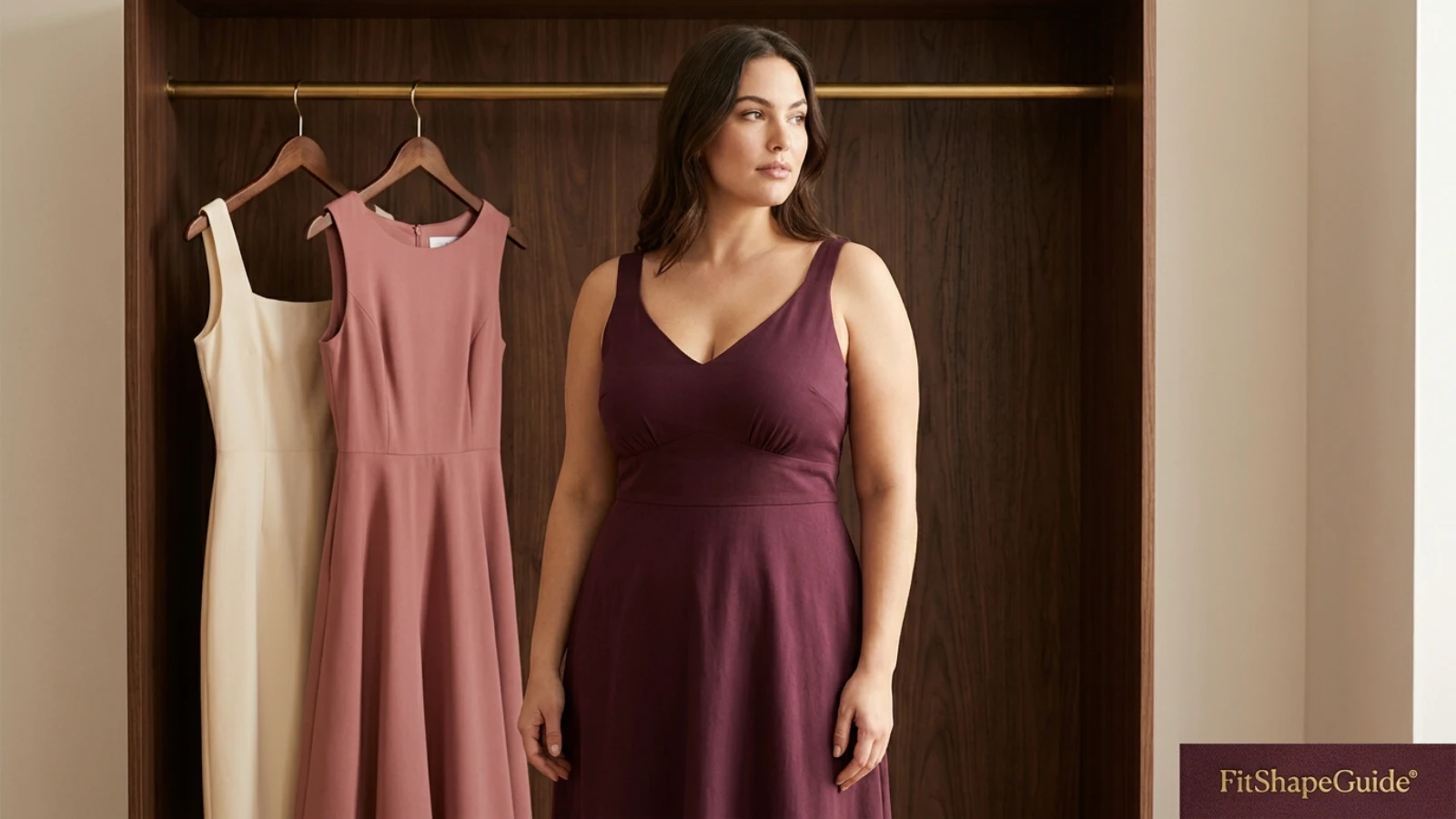
The 60-second summer dress fit check
- The neckline covers the intended bra and returns after leaning or reaching.
- Seams remain evenly spaced instead of widening dramatically over the bust.
- The fabric stays opaque and matte at the fullest point.
- Straps cover the intended bra and do not pull toward the neck or slide off the shoulder.
- Side seams remain vertical instead of curving sharply toward the front.
- The dress releases after a self-hug rather than remaining stretched or stuck high.
- The front hem is level by design, not shortened only because the bust borrowed length.
Best summer dresses for a large bust by design
“Summer dress” describes warm-weather intent rather than one fixed silhouette. Cotton poplin, linen blends, seersucker, viscose and stretch woven fabrics all behave differently. For a fuller bust, the useful design provides three-dimensional room without asking elastic, straps or a single row of smocking to do all the work. Start with how to dress a large bust, then compare these six constructions.
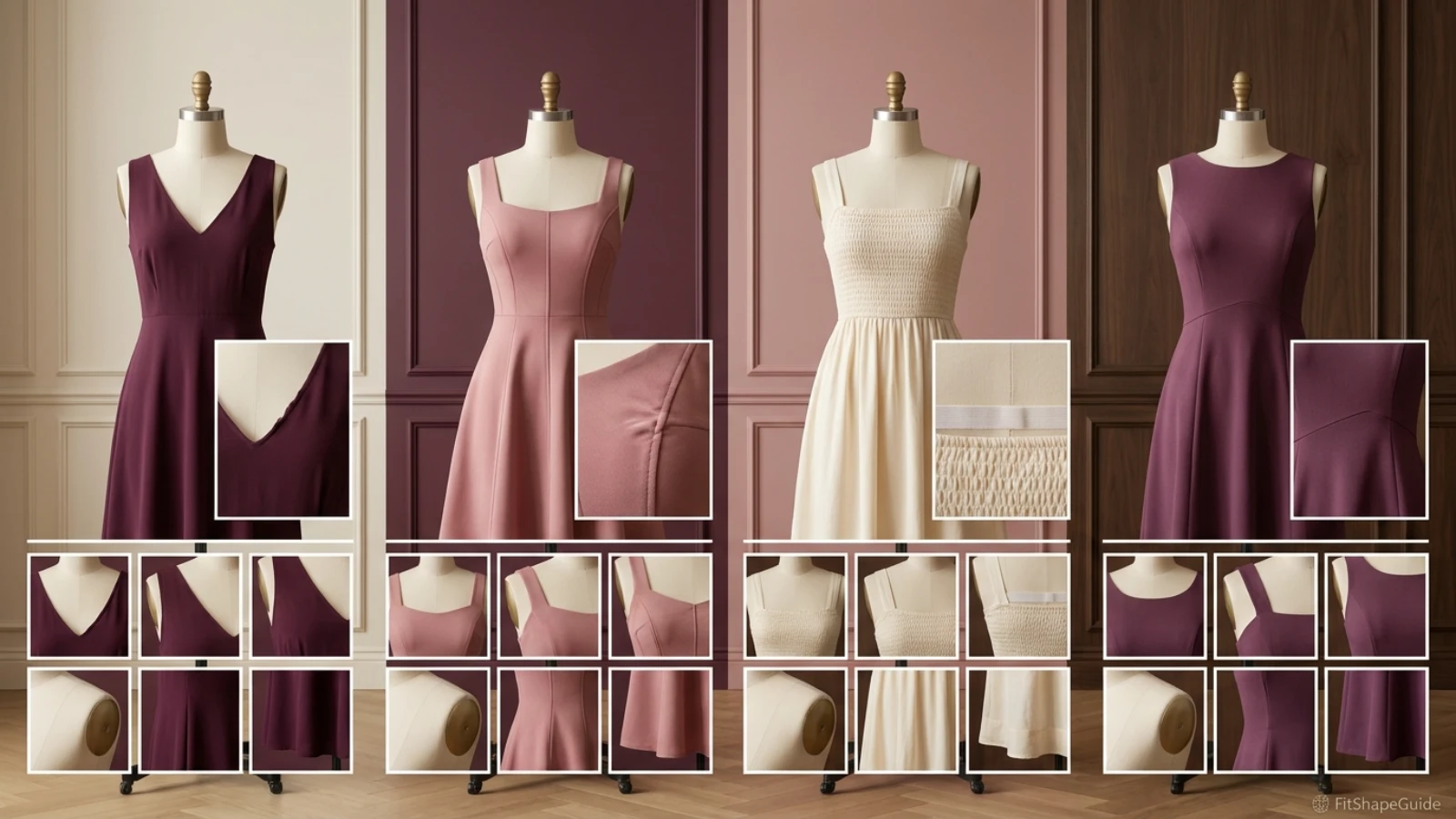
Wide-strap princess-seam summer dress
Best for: projected busts needing shaping without an oversized waist. Curved seams supply depth, while wide adjustable straps can cover everyday bra straps. Check that the seam curve meets the fullest point rather than cutting across it.
Supportive wrap summer dress
Best for: adjustable neckline depth and waist placement. Prefer generous crossover overlap, a fixed inner tie or snap and wide straps. Test the wrap while leaning and sitting; the waist tie should not be the only feature holding the neckline closed.
Structured-front, smocked-back summer dress
Best for: a shaped front with flexible breathing and movement room. Darts or cup seams should create projection before the back elastic stretches. Dense smocking should recover quickly and stop before it pulls the front neckline backward.
Square-neck fit-and-flare summer dress
Best for: stable bra-friendly coverage and natural-waist definition. Look for reinforced corners, correctly spaced straps and a bodice long enough to reach the waist. The square edge should remain flat during a reach test.
Bra-friendly tiered midi summer dress
Best for: relaxed summer movement. A shaped upper bodice should fit independently before the skirt tiers add volume. Choose tiers beginning below the waist so gathered fabric does not substitute for missing bust shaping.
Lined occasion summer dress
Best for: weddings, dinners and warm-weather events. Look for a shaped lining, secure neckline, non-slip straps and enough skirt sweep for sitting and dancing. Decorative cutouts should not remove essential bra coverage or structural support.
Why straps, bust shaping and center-front length decide the fit
Summer dresses vary from softly shaped cotton midis to fitted linen blends and elastic-back maxis. Product photos can hide pulling with poses, hair, clips or careful arm placement, so the straps and bodice need independent evaluation. Fuller-bust projection asks for horizontal expansion and extra vertical travel. If the pattern supplies neither, seams spread, the neckline widens, the waist rises, side seams arc forward and the front hem shortens. Use the large-bust neckline guide to compare depth, width, stabilization and bra coverage.
Straps, armholes and bust ease work together
Straps should sit securely without carrying the entire weight of an undersized bodice. Bust darts or princess seams should supply projection before smocking or elastane is considered. Check armholes from the front and side: they should cover the bra band without cutting into the underarm or standing away from the body.
Smocking, gathers and seams reveal tension clearly
Vertical seams should remain recognizably vertical. Smocking may expand over curves, but dramatic spacing, pale elastic channels, diagonal seams or horizontal stress bands show that it is operating at maximum extension. Gathers should be distributed intentionally rather than pulled flat only across the fullest point.
Necklines and straps anchor the dress
A V-neck needs a firm point and an edge that lies flat; a square neck needs stabilized corners; a wrap needs sufficient overlap. Wide straps usually work more easily with a standard bra, while narrow or widely spaced straps require deliberate bra planning. Compare coverage with the camisoles for a large bust and tank tops for a large bust guides.
Center-front length protects proportions
The dress must travel over the bust without borrowing excessive length from the skirt. When it cannot, a seamed waist climbs toward the underbust and the front hem rises. Petite, tall and short-torso labels do not solve this automatically. If high necklines and raised waists repeatedly crowd the same area, consult the large-bust short-torso guide.
| Construction evidence | What good fit looks like | Warning sign |
|---|---|---|
| Seam or motif | Pattern stays even and readable over the bust | Seams spread, pale or turn diagonally |
| Neckband | Lies flat and returns after movement | Rolls outward, ripples or exposes the bra |
| Shoulders | Set-in seam or intentional drop stays symmetrical | Whole dress is dragged toward the front |
| Waist shaping | Reaches the designed level without compression | Seamed waist climbs into the underbust |
| Side seam and hem | Side seam is vertical and hem looks balanced | Seam arcs forward and front hem lifts |
Best fabrics for summer dresses on a fuller bust
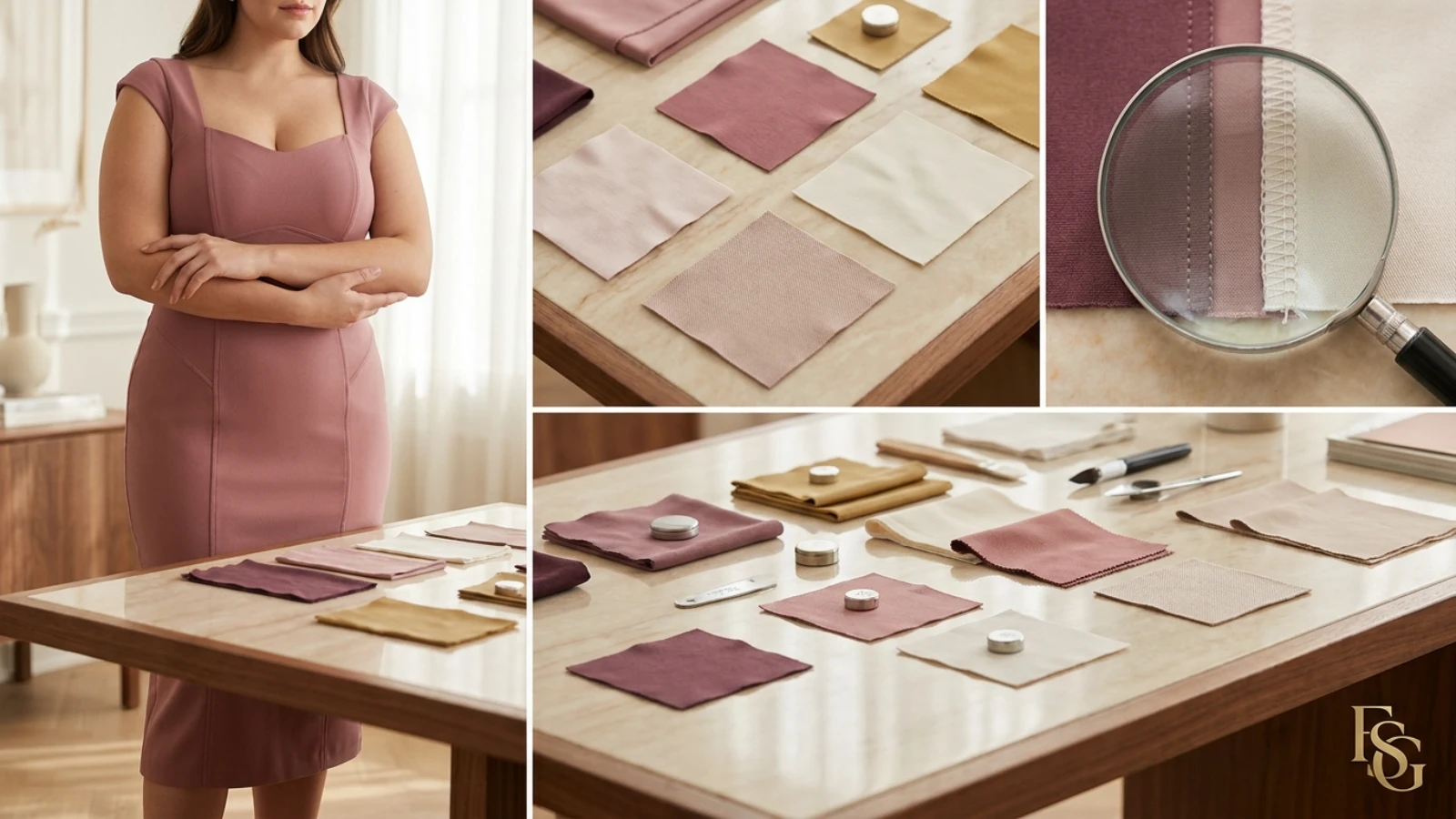
When comparing the best summer dresses for a large bust, fiber changes warmth, softness, color transfer, moisture handling and care; woven construction changes stretch, shape retention and shape. Both matter. A high percentage of cotton twill does not guarantee resilience, and a synthetic blend is not automatically poor quality. Use the fabric guide for a large bust alongside the retailer’s fiber, fabric weight, weave and care information.
Stretch poplin and cotton-elastane
A compact stretch woven can provide crisp definition with easier breathing and reaching room. Elastane should assist a correctly sized bodice rather than supply all bust capacity. Check opacity in daylight, recovery after a self-hug and whether the fabric remains comfortable at the underarms in heat.
Cotton poplin and broadcloth
Cotton feels breathable and can provide clean stitch definition, but heavy cotton often grows downward during wear and drying. A compact cotton blend with elastane or nylon may recover better. Compare center-front and center-back length after sitting, and avoid hanging a wet cotton summer dress from its shoulders.
Lyocell, rayon and modal blends
These fibers can create a smooth, fluid hand and elegant drape. Their weight may also pull the neckline lower or lengthen the skirt, especially when wet. Look for a stable blend, reinforced shoulders and clear drying instructions. A dense Tencel fabric can look polished; a thin one may reveal every stretched stitch.
Polyester crepe and satin blends
Synthetics can add durability, color retention and shape memory, but quality varies widely. Inspect color transfer, heat comfort, abrasion reports and surface shine. Nylon is often useful in a cotton-elastane blend for strength; elastane can assist shape retention when used with a stable base structure. Judge the actual fabric rather than treating any single fiber as a guarantee.
How to shop for the best summer dresses online
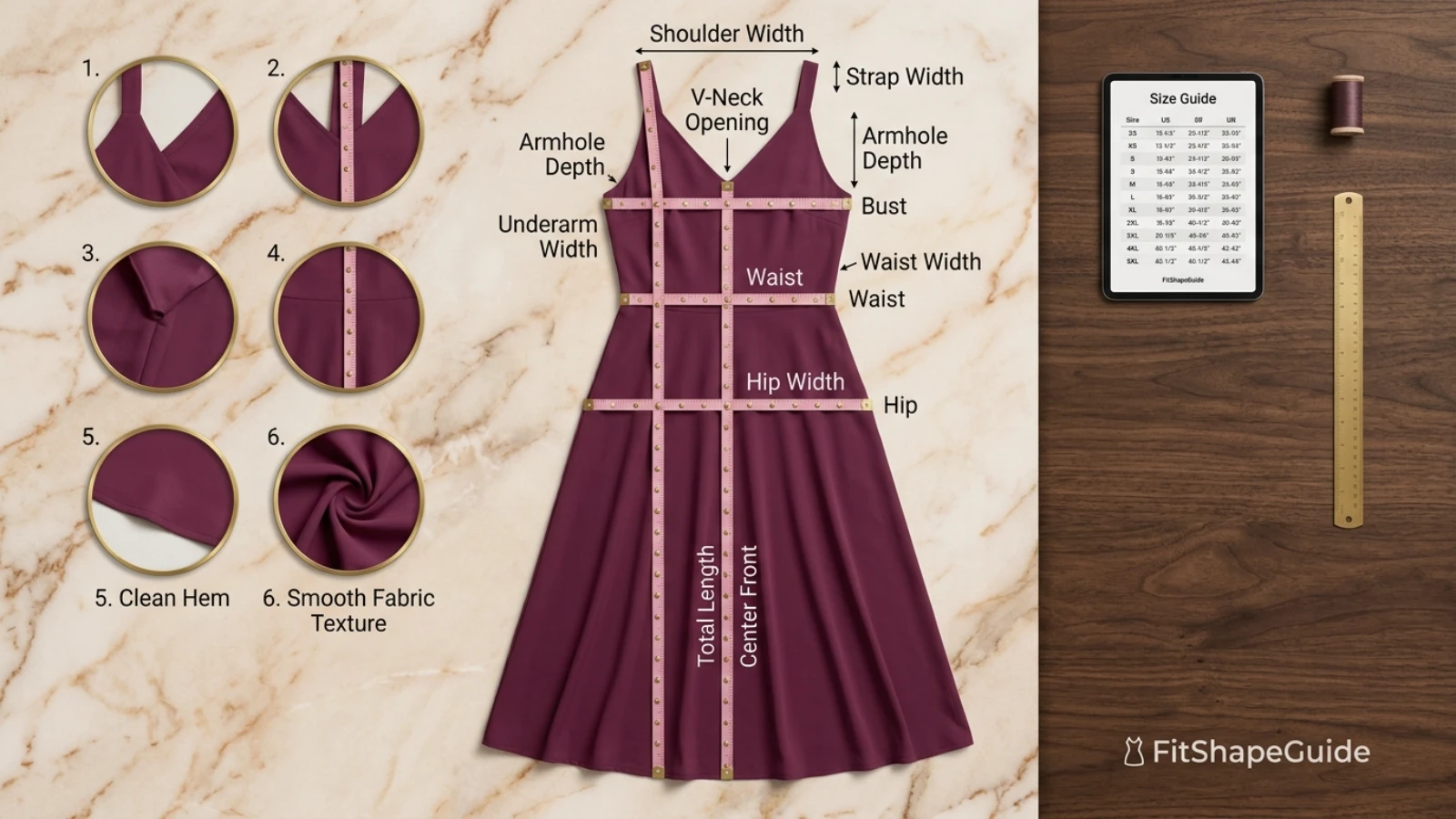
To shop online for the best summer dresses for a large bust, start with a summer dress that already behaves well. Rest it flat and record underarm width, front-bodice length, strap width and spacing, armhole depth, waist width and center-front length. Most woven summer dresses require positive ease; elastic-back designs may use less. Compare like with like instead of relying on the letter size alone.
| Measurement or evidence | How to use it | Risk when missing |
|---|---|---|
| Unstretched underarm width | Compare with a similarly dense fabric that fits | Maximum stretch may be expected to supply all bust room |
| Center-front and center-back length | Estimate whether projection will shorten only the front | Hem and waist shaping may rise visibly |
| Strap spacing and upper-chest width | Keep neckline and bra coverage anchored | A size-up may expose bra straps or drop excessively |
| Neck opening and band depth | Compare bra coverage and edge stability | Low overlap or a weak band can roll outward |
| Armhole depth and strap width | Confirm bra coverage and movement room | Deep armholes or narrow straps may expose the bra |
| Fabric weight, seam and fiber blend | Estimate density, warmth, stretch and shape retention | Fiber percentages alone cannot predict behavior |
| Care and garment weight | Plan washing, line drying and storage | Wet weight or hanging may permanently lengthen it |
Use reviews as evidence, not a universal verdict
Useful reviews name the size, height, approximate bust-waist relationship, fabric density, itch, color transfer, opacity, abrasion, wash method and whether the dress grew during wear. “Runs small” is less useful than “the seams became pale across the bust and did not recover.” Customer photos taken after several wears can reveal neckline growth and abrasion that polished launch imagery cannot.
What to verify before adding an Amazon recommendation
Confirm the exact color and variant because fiber blends sometimes differ by color. Verify current size chart, unstretched measurements, woven construction, fiber content, care, return eligibility and recent customer-photo evidence. Do not transfer claims from a similar listing or another seller. Prices, ratings, stock and coupons change, so omit them from permanent editorial copy unless updated accurately. Material affiliate relationships should be disclosed clearly; FitShapeGuide follows the FTC’s endorsement guidance.
Movement tests every summer dress should pass
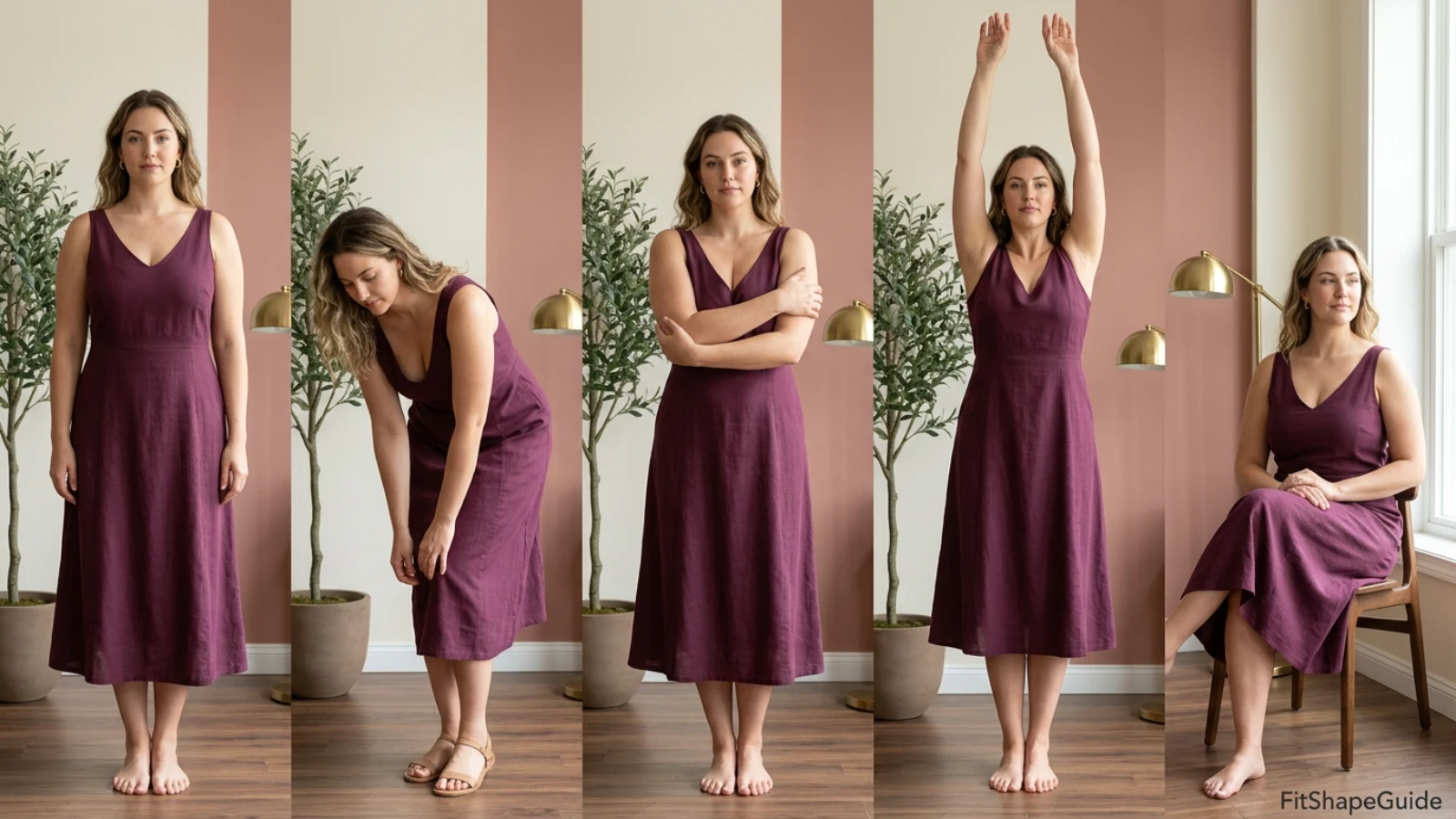
Lean and neckline-return test
Lean toward a table, return upright and inspect the neckline and armholes. The edge should return near the body instead of remaining open or revealing the bra. A camisole is optional styling, not a structural repair for a neckline that gaps during ordinary movement.
Ten-second self-hug
Cross the arms firmly for ten seconds, release and wait another ten. Watch the seams and surface over the bust. Quick return indicates useful shape retention; lingering pale channels, rippling or a bagged front suggest that the fabric is operating too close to its limit.
Overhead reach and strap test
Raise both arms, lower them and make a full forward reach. The dress should settle without manual pulling. Straps should remain on the shoulders, armholes should not expose the bra and the neckline should not migrate sideways. Adjustable straps are useful only when their hardware holds its setting.
Walk, sit and breeze test
Walk briskly, climb steps, sit for several minutes and turn as if caught by a breeze. The bodice should remain secure while the skirt offers coverage appropriate to the intended setting. Check slit height, wrap overlap, tier weight and whether a light skirt becomes transparent in strong daylight.
Fit problems to avoid in the best summer dresses for a large bust
| Visible symptom | Likely cause | Best next step |
|---|---|---|
| Fabric strains or buttons gape | Insufficient garment width or low-density fabric | Size up or choose a denser, less cling-dependent construction |
| Neckline rolls outward | Weak band, excessive bust tension or poor shape retention | Choose a reinforced edge and greater bust capacity |
| Waist detail sits under bust | Center front too short for projection | Seek more front length or a design without fixed waist placement |
| Side seams arc forward | Front is borrowing width from the back | Increase chest capacity or change fabric/pattern |
| Dress grows during the day | Heavy fiber, weak shape retention or loose structure | Prefer compact fabric and store folded |
| Abrasion appears immediately | Loose fibers plus friction from coat, bag or seat | Choose tighter fiber/structure and reduce repeated abrasion |
| Shoulders fit only after sizing up | Size increase added width everywhere | Try fuller-bust-friendly shaping or a controlled wrap |
When sizing up helps
A larger size can restore opacity, smooth seams, center-front length, armhole comfort and elastic recovery. It works when straps and neckline remain controlled. If the larger size drops from both shoulders, exposes the bra and still climbs at the front, the design is too flat or unstable. For continuous close fit, compare bodycon dresses for a large bust.
Alterations that are realistic
An alterations specialist may shorten a hem, adjust simple straps, secure a wrap overlap, add a discreet keeper or stabilize a slightly loose neckline. Major bust expansion, rebuilding an armhole or lowering an integral seamed waist is rarely simple. Ask before buying final sale and use the large-bust tailoring guide to judge risk.
How to style summer dresses without relying on “minimizing” rules
The best summer dresses for a large bust do not need to “minimize” the body. Once the neckline, fabric and length behave correctly, choose color, texture and silhouette according to taste. Medium seams, contrast stitching and occasion-ready twill simply create different surfaces; none is a moral or universal figure rule.
Polished summer daywear
A square-neck cotton midi or softly tailored linen-blend summer dress works with a light cardigan or cropped jacket. Test the layer over the complete dress: a tight armhole can drag an otherwise stable neckline. Choose a strap width and neckline that still look intentional when the layer is removed.
Casual and travel outfits
A medium-weight seamed or relaxed straight dress works with boots or sneakers. A slip can reduce color transfer and friction, but it cannot fix a overstretched or gaping bust area. Place a crossbody bag after dressing and move it away from the fullest point if repeated abrasion causes abrasion.
Light layering and sun coverage
A breathable button-down worn open, a light cardigan or a linen jacket can add coverage without changing the summer dress fit. Check that the layer has enough chest and arm room and that shoulder friction does not pull narrow straps outward. Sun protection should come from appropriate fabric coverage and sunscreen, not from assuming every dark or tightly woven dress provides a certified UPF rating.
Belts and waist definition
A flexible belt can add definition to a straight fabric, but it cannot correct a seamed waist already sitting on breast tissue. Avoid pulling a belt so tight that the upper body blouses and shortens. A softly shaped dress often needs no belt at all.
Summer Dress vs shift, wrap, midi and maxi
“Summer dress” describes warm-weather use, while shift and fit-and-flare describe silhouette; midi and maxi describe length. Choose a wrap dress for adjustable overlap, a fit-and-flare dress for a shaped waist, a midi dress for calf-length balance or a maxi dress when long-skirt weight and walking clearance suit the occasion.
Care and value checks before you buy
Read the care label before buying. The CottonWorks guidance on shrinkage and skewing explains why construction and laundering affect dimensional change. Follow the sewn-in care label; the FTC Care Labeling Rule guidance explains the required care instructions. Support a wet dress fully rather than hanging its weight from the shoulders.
Hang structured summer dresses on broad hangers or fold soft styles without hard creases. Wash only as needed, turn the garment inside out where the label permits and reduce abrasion from rough bags, coat linings and chair edges. Treat stains promptly according to the care label and test any product in a hidden area. Wash dark mulberry separately at first because crocking and dye transfer can occur.
Value comes from repeat wear, not softness in the first minute. Inspect neckband joins, underarms, side seams, cuffs, wrap ties and hem. Examine high-friction areas for fuzz before purchase. A slightly firmer, well-recovered fabric may outlast a cloud-soft loose fiber that bags and softens after one outing.
Final buyer checklist
- Bra-compatible neckline in neutral and moving positions
- Even, opaque seams or stitches over the fullest bust
- Quick shape retention after a ten-second self-hug
- Adequate center-front length and balanced hem
- Shoulder, bicep and cuff room tested independently
- Fiber blend, fabric weight and garment weight understood
- No immediate abrasion at high-friction points
- Care and washing and drying requirements compatible with real life
- Return policy checked before selecting an uncertain size
Frequently asked questions
Are summer dresses good for a large bust?
Yes. The best summer dresses for a large bust use adequate garment width, bust darts or princess seams, stable button overlap, located shoulders and enough center-front length. Stretch alone cannot compensate for a flat bodice pattern.
What type of summer dress is best for a fuller bust?
Princess-seam midis, belted summer dresses, stretch-fabric sheaths, A-line pinafores, fixed wrap-look dresses and occasion-ready fit-and-flare midis are useful starting points. Compare fabric weight, density, neckline stability, front length and shape retention rather than choosing only by silhouette.
How do I stop a summer dress neckline from gaping?
Check whether the whole front is under tension. If seams spread and side seams move forward, choose more bust capacity rather than pinning the edge. If the body fits and only the neckband is loose, an alterations specialist may be able to stabilize it or add a discreet keeper.
Should I size up in a summer dress for a large bust?
Size up when it restores opacity, even stitches, front length and sleeve comfort while shoulders and neckline remain controlled. If the larger size drops everywhere and the front still rises, switch to a denser or differently shaped design.
What bra works under a summer dress?
Match the bra to neckline depth, width and strap position. A smooth-cup style can reduce visible seams beneath fine fabric weight, while a plunge may suit a V-neck. Texture showing through is a styling choice, but the dress should not compress the bra cups or reveal their edges unintentionally.
Do button-front summer dresses work for a large bust?
They can. Choose enough chest ease, strong overlap, correctly placed darts or princess seams and buttons spaced closely through the bust. Diagonal drag lines, gaping buttons and a lifted front hem indicate excessive tension.
How can I prevent abrasion on a summer dress?
Reduce friction from rough coats, bags and seating; follow the care label; wash gently; and store folded. Some abrasion reflects loose surface fibers and cannot be prevented completely. Treat worn areas gently and avoid aggressive scrubbing that removes mulberry.
What fabric is best for a fuller-bust summer dress?
No fiber wins universally. Fine stretch fabric and cotton-elastane blends offer warmth, compact cotton blends offer definition, Tencel blends offer drape, and synthetics can add shape retention. Judge fabric density, fabric weight, opacity, resilience, abrasion tendency and care together.