Best Halter Dresses for a Large Bust
A construction-first buying guide to comfortable neck straps, genuine bust projection, torso anchoring, bra compatibility, side coverage, fabrics, sizing and event-ready movement.
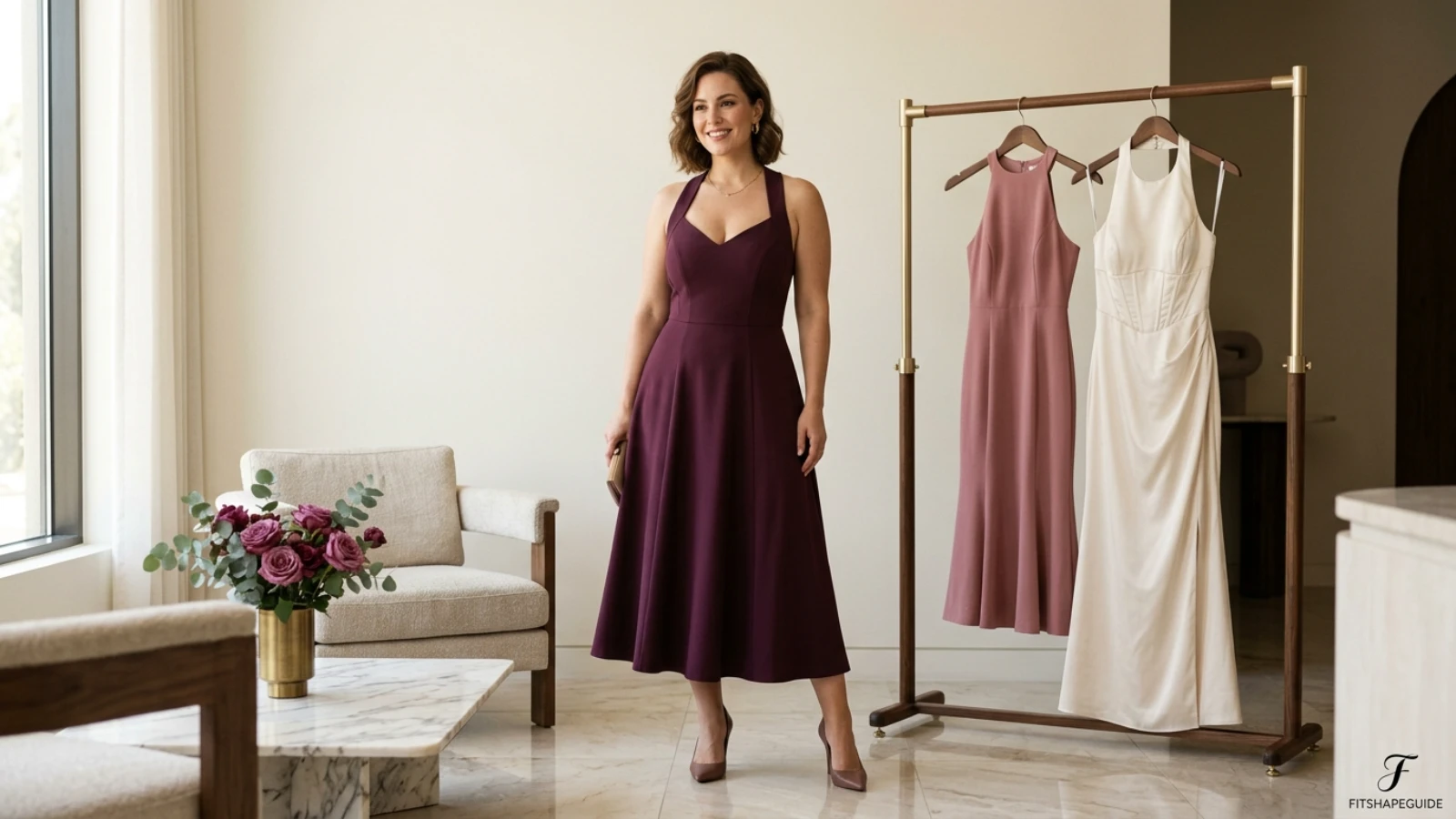
The 60-second halter dress fit check
- The neck band lies flat and distributes pressure without digging into the cervical area.
- The bust sits inside shaped panels, darts or controlled stretch rather than pushing the neckline outward.
- The under-bust, back or waist remains stable when the neck strap is loosened slightly.
- Armholes cover the intended bra cups and side tissue without cutting forward into the underarm.
- The center-front waist stays level and the front hem does not rise from missing bust length.
- The back closure remains horizontal instead of climbing toward the neck.
- You can sit, breathe, reach forward and turn your head without increasing neck tension.
Best halter dresses for a large bust by design
A halter neckline describes straps that travel toward or around the neck; it does not prove that a dress supports the bust. Two visually similar halters may distribute load very differently. One uses broad straps, shaped front panels, a stable back and a fixed waist. The other suspends a shallow gathered front from two narrow ties. The best halter dresses create projection in the bodice, anchor below the bust and ask the neck only to position the neckline.
Wide-strap V-halter A-line
Best for: wedding-guest events, dinners and cocktail settings when you want an open neckline with balanced skirt volume. Look for wide flat straps, princess seams or curved darts, high side panels, a firm mid-back closure and a level waist. Trade-off: a deep V may need a plunge or convertible bra, and a fixed neck length must match your torso precisely. Very wide shoulders may also feel restricted if the straps angle inward too sharply.
Adjustable tie-neck wrap halter
Best for: shoppers who need some control over neckline height and neck-loop length. A stitched or deeply overlapped front, separate waist tie and stable back can adapt better than a fixed loop. Trade-off: narrow ties can concentrate pressure, and pulling them tighter does not create bust depth. Confirm that the wrap is secured against leaning gape and that the waist anchor—not the neck knot—carries skirt weight.
High-neck racer halter dress
Best for: polished coverage, work-adjacent events and modern evening styling. A broad collar band, shaped armholes, vertical princess seams and a full back or firm zipper panel can feel contained without a low neckline. Trade-off: the inward shoulder line often exposes conventional bra straps, while a collar that is too short can pull forward at the neck. Check back-neck closure comfort while seated and turning the head.
Structured straight-neck halter
Best for: a clean, architectural neckline with wider straps and visible bust shaping. Seek a lined front, side or princess seams, reinforced top edge, high sides and a stable zip back. Trade-off: the straight edge may cut across the fullest area if the front panel is shallow, and rigid woven fabric leaves little room for measurement error. The neckline should stay horizontal without being pulled tight at the neck.
Corset-seamed formal halter gown
Best for: black-tie events when the dress has a genuine internal foundation. Look for multi-panel bust shaping, protected boning channels, firm lining, an under-bust or waist stay, a strong zipper foundation and broad halter straps. Trade-off: long or embellished skirts add downward force, alterations are technical, and decorative “corset-style” seams may provide no structure. Sitting comfort must be tested before purchase.
Supportive knit or smocked casual halter
Best for: warm-weather wear, travel and informal occasions where softness matters. Dense interlock, ponte, rib or broad smocking can distribute stretch through the torso, especially with a high back and defined waist. Trade-off: thin jersey may become sheer, lengthen over the bust or reveal bra edges. Smocking can compress rather than shape, and a heavy maxi skirt can still transfer load to the neck.
Across these six options, the best halter dresses are the ones whose visible construction matches the wearer’s support plan, activity and tolerance for neck contact—not simply the styles with the widest straps.
Neck-strap comfort, bust projection and torso anchoring decide the fit
The best halter dresses work as a load path. The neck band positions the upper edge. Shaped front panels create space over the bust. Side panels control lateral movement. The back and waist resist downward pull, while the skirt hangs from the waist instead of the neck. This is why a wider neck strap can improve comfort yet still fail if the dress has a loose back or shallow front. For a broader comparison of depth, width and strap placement, see the best necklines for a large bust.
Width matters, but surface area is only one variable
A broad, flat strap usually spreads pressure better than a cord or narrow rouleau tie. Its edge should be soft, its lining smooth and its path symmetrical. However, width cannot compensate for a skirt that hangs from the neckline. With the dress fastened, slide one finger under the neck strap and loosen an adjustable tie slightly. If the entire bodice drops, the torso anchor is not doing enough work. A successful dress may feel close at the waist or back while the neck remains comfortable.
Bust room needs width and vertical length
Full-bust fit is not solved by circumference alone. The bodice must travel from the neckline over the fullest point to the under-bust and waist. When center-front length is missing, the waist climbs, side seams swing forward, armholes open and the back neckline can pull toward the nape. Curved princess seams, side darts, shaped cups or controlled stretch should supply three-dimensional space without forcing the bust downward.
Armholes reveal whether the front is borrowing fabric
Halter armholes often cut inward more than ordinary sleeveless dresses. A high side edge can conceal a bra, but it must not press into the front of the underarm. Gaping at the side does not always mean the dress is too large; it may show that the bust is pulling the front forward and stealing length from the armhole. Check the seam from front, side and back before pinning it smaller.
The back determines how much the neck must do
A full zip back, firm mid-back panel, smocked torso, fitted waistband or internal stay can carry meaningful load. A very low or open back removes some of that stability and usually increases reliance on the neck and support garment. Neither is automatically wrong, but the trade-off should be visible. A dramatic open back is less forgiving for long wear, larger skirts and conventional bra concealment.
For the best halter dresses, every stabilizing part has a distinct job: the neck sets position, the front supplies depth, the sides contain, and the back and waist resist gravity.
| Halter construction | Why it can work | Evidence to confirm | Main trade-off |
|---|---|---|---|
| Broad flat neck band | Spreads pressure across a larger area | Band width, soft lining, adjustable or correctly sized loop | Can still pull if the torso is loose |
| Princess-seam front | Creates vertical and horizontal bust projection | Seam curve reaches the fullest point without flattening | Placement must match the wearer’s apex |
| Firm back or zipper panel | Anchors the bodice away from the neck | Level closure, usable ease and secure waist | May need exact sizing or tailoring |
| High side bodice | Contains side tissue and conceals bra cups | Side height, armhole curve and underarm comfort | Can chafe if cut too high or far inward |
| Under-bust or waist stay | Transfers skirt load to the torso | Stable internal band, hooks and protected seams | Must allow breathing and sitting |
| Open or low back | Creates visual drama and ventilation | Independent front support and realistic bra plan | Less anchoring and fewer bra options |
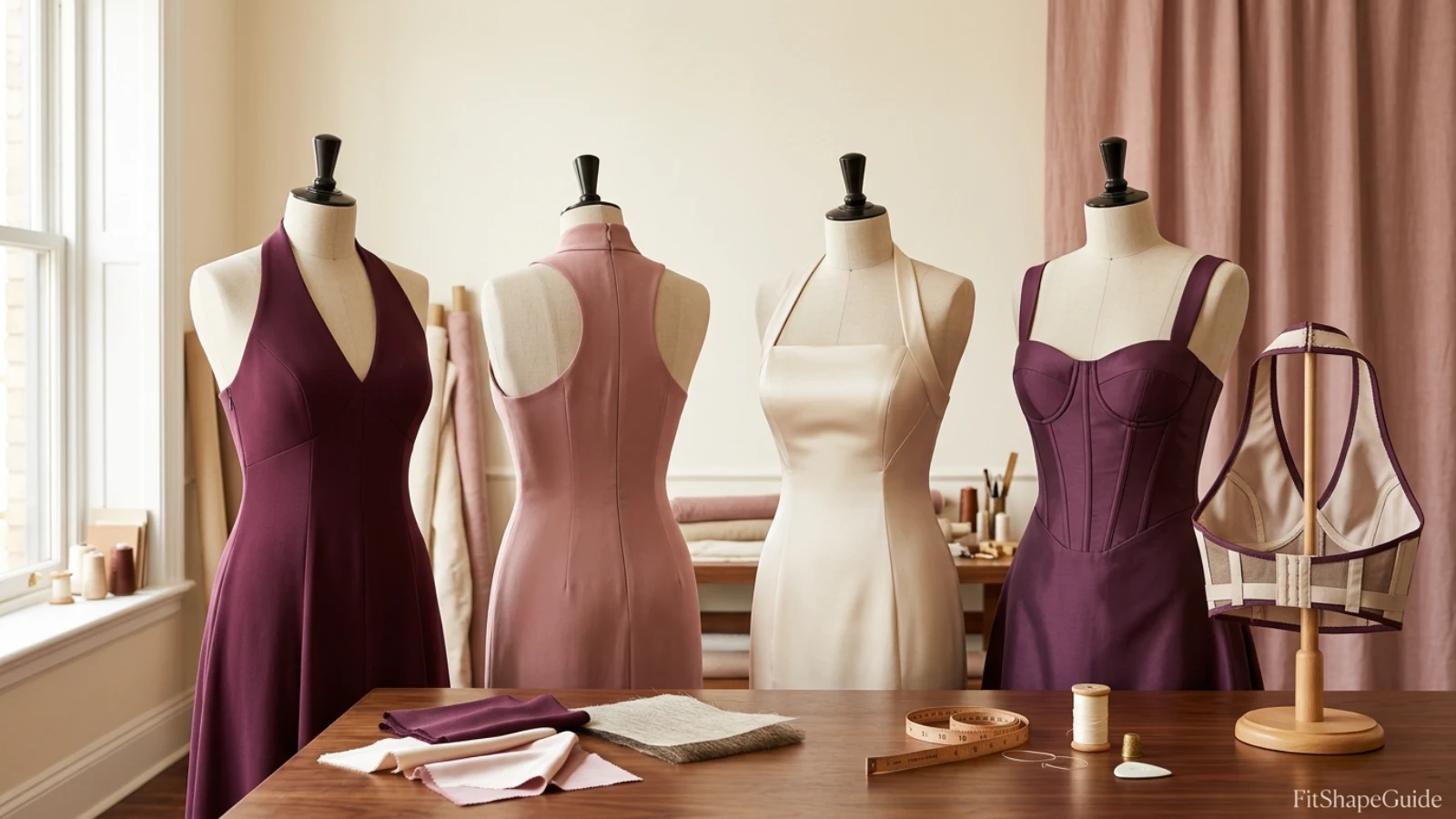
Fabric, lining and skirt weight change halter comfort
Fabric determines more than appearance. It controls how the bust panel shapes, how the armhole edge behaves, whether the neck strap lengthens, and how much weight transfers upward. The best halter dresses pair the shell with lining, seam reinforcement and skirt construction that recover together. A luxurious satin surface cannot rescue a weak neckline edge, and high stretch cannot replace missing front length.
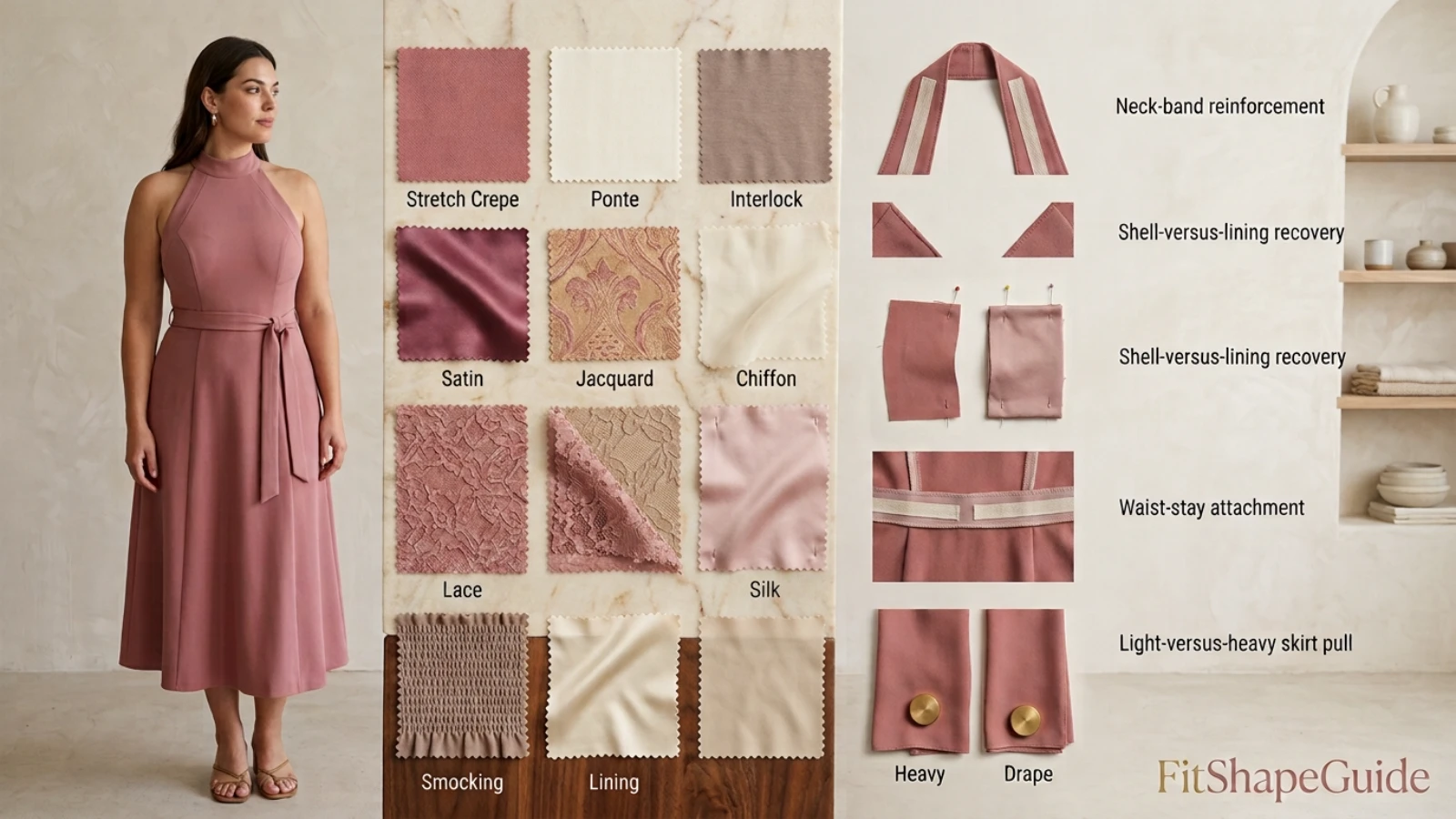
Stable crepe, ponte and interlock
Medium-weight stretch crepe, ponte and dense interlock can offer useful recovery without feeling rigid. They are often strong choices for shaped midis or simple A-lines because they smooth over seams and permit moderate movement. Look for opacity at the fullest bust, controlled rebound after stretching and a waist that remains defined. Excessive spandex can make a dress feel firm in the hand yet still pull downward when the skirt is long.
Woven satin, jacquard and taffeta
Stable woven fabrics can hold a precise neckline and formal silhouette, but they demand accurate pattern shaping. Princess seams, darts and curved panels matter because the shell will not stretch around missing volume. Satin also shows drag lines and seam puckering clearly. Jacquard and taffeta may support structure, though bulk at the neck seam or armhole can create pressure. Inspect the lining because a smaller lining can restrict the bust even when the shell appears roomy.
Chiffon, georgette and lace overlays
Airy overlays add movement, but they should sit over a separate supportive foundation. Chiffon gathered directly into a neck tie may increase fullness visually without controlling it. A lined under-bodice with darts, firm side seams and a waist anchor is more dependable. Lace motifs should not be cut into narrow load-bearing straps without reinforcement; beadwork near the neck can add concentrated weight and roughness.
Rib, smocking and elasticated casual fabrics
Rib knit and smocking can adapt across size differences, but recovery and vertical depth are crucial. Expand the fabric gently and release it: the surface should return without staying wavy or becoming translucent. Broad smocking across the torso can spread tension, while a narrow elastic strip directly under the bust may roll. For a maxi length, check whether the skirt is attached at a stable waist seam instead of hanging from the stretched upper bodice.
Lining is part of the fit
Compare shell and lining at the bust, side and armhole. A lining that stops high can create a visible ledge. One that is shorter or less stretchy than the shell can pull the waist upward. In a formal dress, inspect boning ends, zipper tape, waist-stay attachment and hanger loops. Hanger loops should carry storage weight; they are not evidence of support when worn.
The best halter dresses align shell stability with lining recovery and skirt attachment so comfort does not gradually deteriorate as the fabric warms and the event continues.
How to buy the best halter dresses online
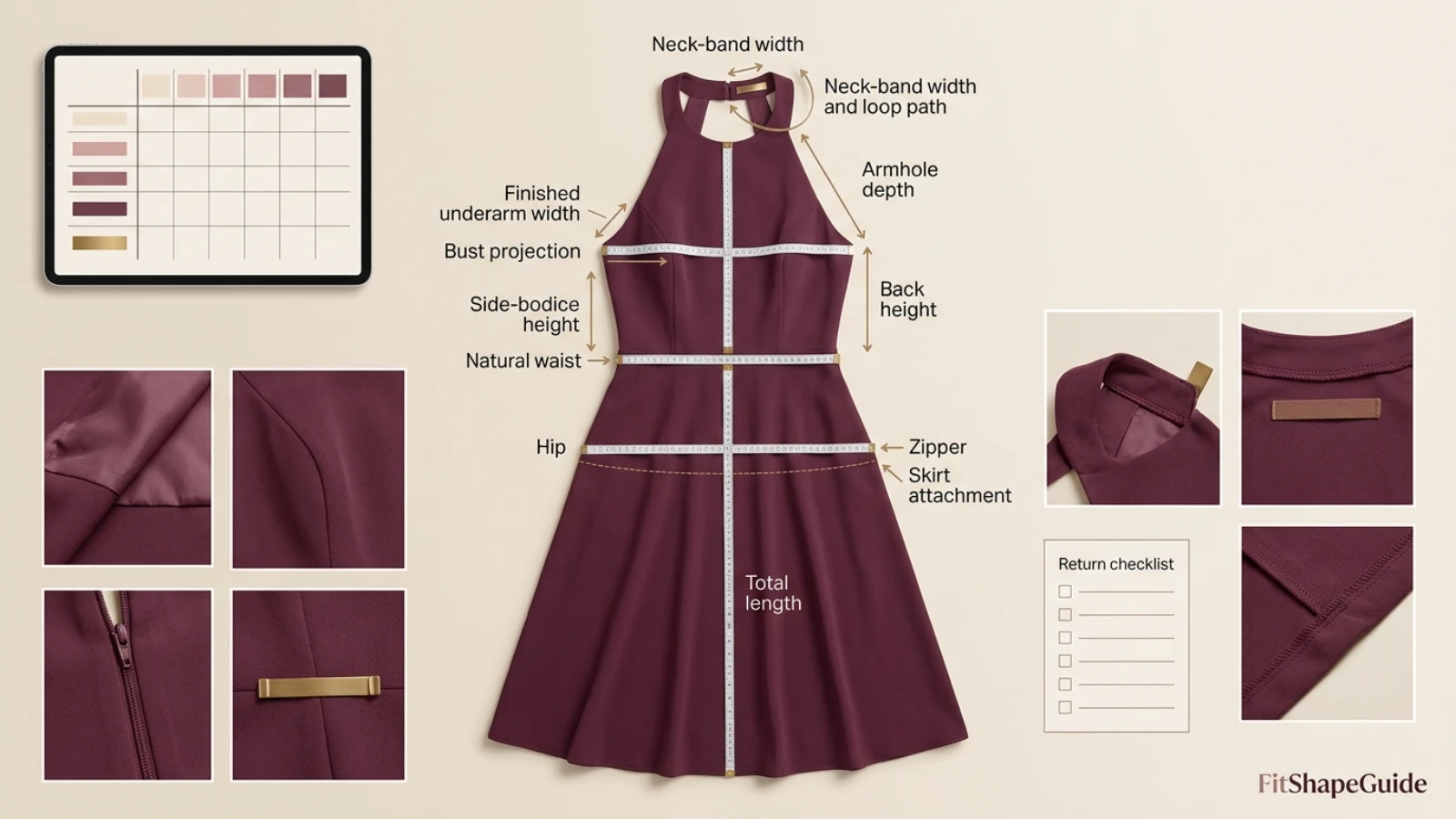
Measure over the exact bra or support setup intended for the dress. Record full bust, snug under-bust, natural waist, high and full hip, shoulder-to-bust apex, neckline-to-waist at center front, side-waist length, armhole depth, side-bodice height and intended dress length. For a fixed halter loop, note the approximate path from one front attachment point around the neck to the other without pulling the tape tight. The best halter dresses for a large bust make enough of this geometry visible to compare.
| Listing evidence | Why it matters | Warning sign |
|---|---|---|
| Finished bust and underarm width | Shows usable horizontal room and side coverage | Only a generic letter size |
| Center-front neckline-to-waist length | Protects bust projection, waist level and front hem | Only center-back length listed |
| Neck-band width and adjustment range | Predicts pressure spread and neckline position | No back-neck or tie photo |
| Side-bodice height and armhole depth | Predicts bra concealment and underarm comfort | Side view hidden by arms or hair |
| Back height, closure and waist measurement | Shows how the torso shares the load | Open back shown without construction details |
| Shell, lining and stretch percentages | Predicts ease, opacity, recovery and alteration behavior | “Stretchy” without composition |
| Skirt layers, embellishment and total length | Signals downward load and event practicality | Long gown described without lining or weight evidence |
| Return, care and alteration terms | Protects comparison fitting and ownership cost | Final-sale terms unclear before checkout |
Confirm what the size chart measures
A body chart tells you the range the brand intends to fit; a garment chart tells you the dress’s actual dimensions. Neither is complete without fabric and fit information. If bust and waist point to different sizes, prioritize enough front room and length, then assess whether the back or waist can be refined. Choosing a smaller size to obtain neck security often increases armhole gape, compression and front-waist lift.
Compare with a successful garment
Measure a shaped dress or halter you already wear comfortably. Compare underarm width, center-front length, waist, side height, back height and skirt attachment. Neck-loop dimensions are useful only when the neckline depth is similar. Record the bra worn with the reference. If you need to recheck the support size before comparing garments, use the bra size calculator as a starting point rather than treating an old label as fixed.
Read photos and reviews for construction evidence
Front images should show whether the neckline stays level and whether seams reach the fullest point. Side and back views reveal cup exposure, armhole gape, closure height and forward-swinging seams. Useful reviews mention measurements, bra setup, neck comfort after several hours, sitting, dancing, lining size, zipper behavior and laundering. A review saying “not for a big chest” is less useful unless it describes the actual failure.
Use an adjacent-size comparison when returns permit
Trying two nearby sizes can separate a size problem from a pattern problem. Use the same bra and neck adjustment, then run the same movement sequence. Keep the size that balances bust room, waist stability, side coverage and neck comfort. If one size crushes the front while the next leaves the back unstable, the cut may be too shallow for both.
Safe Amazon recommendation workflow
Before inserting a product module, verify the live product title, seller, size chart, neck-strap construction, back and waist closure, shell and lining composition, care instructions, current return eligibility and recent customer-photo evidence. Use the affiliate tag bracalculator-20 only on a confirmed Amazon URL. Do not publish a permanent price, rating, coupon, review count, stock or delivery claim because those details change.
The best halter dresses earn a recommendation only when the live listing supports a construction-led conclusion. If the front length, side coverage or anchoring method cannot be verified, state the missing evidence or omit the product rather than filling the gap with assumption.
This evidence standard separates the best halter dresses from look-alike listings that offer a dramatic neckline but disclose too little about front length, side coverage or torso anchoring.
Movement and neck-comfort tests every halter dress should pass
The best halter dresses for a large bust must remain comfortable after the first flattering pose. Fasten the intended bra, back closure and waist anchor, then set the neck strap only firmly enough to position the neckline. Let the dress settle for a few minutes. Repeated tightening during the test is evidence, not normal maintenance.
Neutral stand and slow-walk baseline
Stand without lifting the chest or pulling the shoulders back unnaturally. Walk, turn and pause. The neck band should remain flat, the back closure level and the waist horizontal. Side seams should not rotate forward. If the dress steadily drops, inspect waist and back anchoring. If the collar climbs into the neck, check missing front length, skirt pull and an over-short strap.
Twenty-minute wear and head-turn test
Wear the dress for at least twenty minutes before making a final decision. Turn the head left and right, look down, speak and take several deep breaths. Pressure that slowly develops matters more than instant softness. Stop if you experience pain, headache, tingling, numbness or persistent pulling. A beautiful neckline is not worth a load path that depends on discomfort.
Seated dining and lean test
Sit upright, then lean toward a table and return. Check neckline gape, cup or lining position, under-bust pressure, back closure and zipper ripples. A structured dress may feel close, but it should permit a full breath and natural posture. If sitting pushes the bust upward while the neck band tightens, the bodice may be too short or the waist too rigid.
Forward reach and self-hug test
Reach for a glass, hold a steering-wheel position and gently hug the shoulders. The armholes should not cut forward, expose the bra or pull the neckline sideways. When the arms return, the bust panels and side seams should resettle without adjustment. Gape that appears only during reach may come from a straight armhole edge that lacks shaping, not from overall looseness.
Dance, stairs and skirt-load test
Take several steps, climb a low stair if safe, complete a gentle turn and move to the rhythm expected at the event. A long skirt should hang from the waist; the neck strap should not tighten with every step. Test any slit while sitting and walking. For an embellished gown, notice whether beading changes balance toward the front or back.
Layer, bag and hair test
Add the intended coat, wrap, bag and hairstyle. A high collar can press a clasp into the nape. Long hair can catch around ties or hardware. A shoulder bag may shift the halter line, while a crossbody strap can press the bodice into the bust. The complete outfit should preserve comfort and access to adjustable closures.
The best halter dresses remain predictable across this full sequence; they do not convert every step, reach or head turn into extra pressure at the nape.
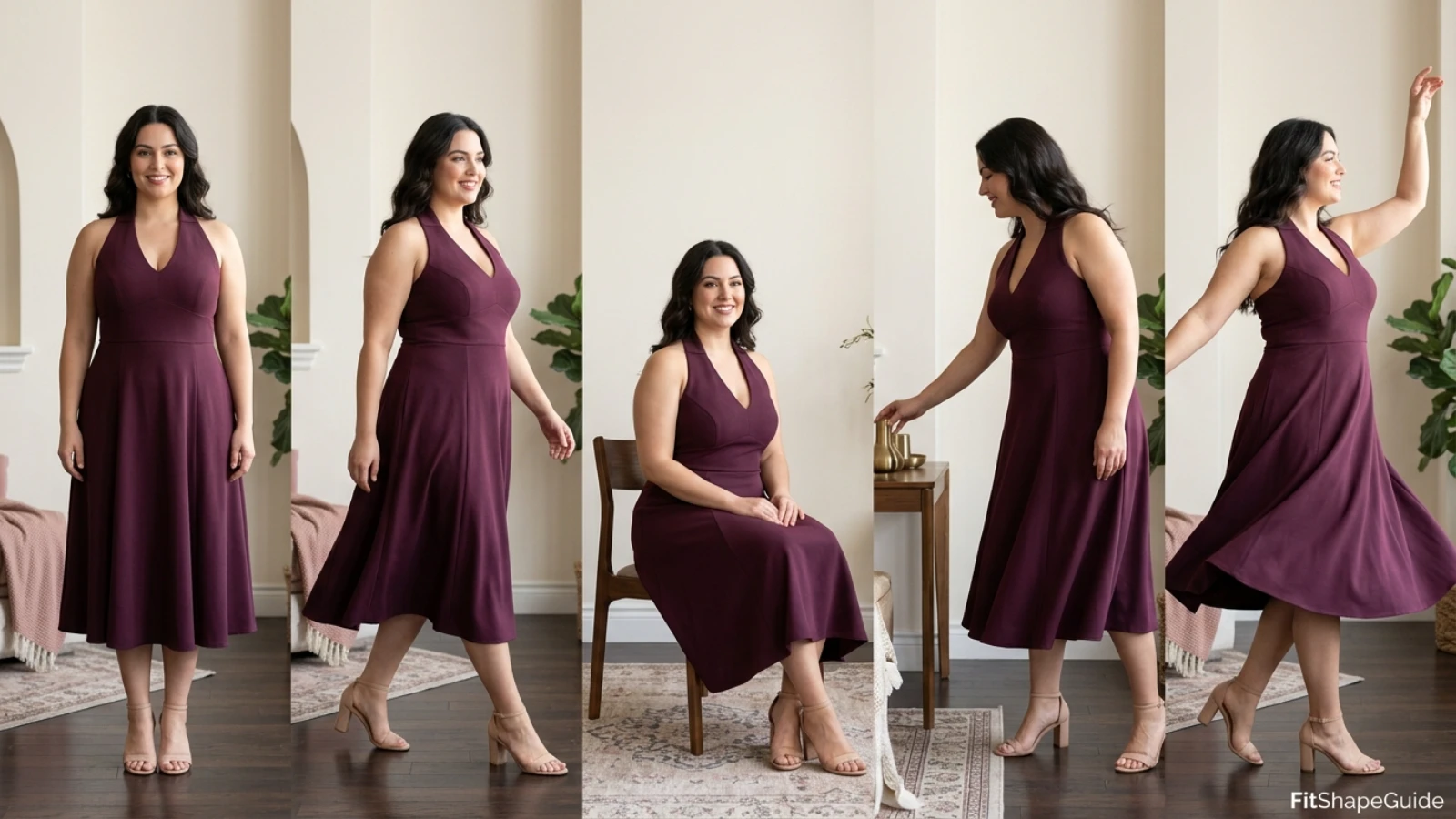
Common halter dress fit problems and what they mean
Fit symptoms point toward the construction that needs attention. Pressure at the neck suggests load is traveling upward. A rising front waist suggests missing center-front length. Armhole gape can mean excess circumference, but it can also appear when the bust pulls a shallow panel forward. Diagnose the whole dress before shortening the neck strap or pinching fabric out of one edge.
| Visible symptom | Likely cause | Best next step |
|---|---|---|
| Neck pain or a deep pressure line | Narrow band, heavy skirt, loose back or weak waist anchor | Choose a broader strap and stronger torso support |
| Front waist rises over the bust | Insufficient center-front bodice length | Seek longer front shaping rather than tightening the neck |
| Armholes gape near the bust | Shallow front, misplaced dart or excessive edge length | Restore projection before taking in the armhole |
| Armhole cuts into the front underarm | Side edge is too high, narrow or pulled forward | Try a different armhole curve or more front room |
| Back neckline or zipper climbs upward | Front is pulling down while neck loop is short | Increase front length and rebalance the back |
| Bra cups or wings show | Low side panel, inward armhole or incompatible bra | Change dress geometry or support setup after testing both |
| Neckline opens when leaning | Long loop, weak edge, shallow cups or unsecured wrap | Choose shaped coverage; a snap only helps adequate overlap |
| Dress lengthens or twists after wear | Poor recovery, bias growth or uneven skirt weight | Choose a stable fabric and inspect waist attachment |
When sizing up works
Size up when the next size restores bust room, center-front length, lining ease and armhole comfort while the back and waist remain controllable. It is less useful when the larger size leaves a loose back, a long neck loop and exposed bra sides while the front waist still rises. That combination indicates a proportion mismatch rather than a simple need for more circumference.
When sizing down is the wrong fix
A smaller size may shorten a loose neck loop, but it can also flatten the bust, pull armholes open, raise the waist and increase neck load. Security produced by compression is not the same as stable construction. Compare another style with a firmer back, more shaped front or independent neck adjustment before accepting discomfort.
What a tailor can realistically improve
A tailor may shorten an accessible neck strap, add adjustment hardware, refine a loose back or waist, stabilize a correctly sized neckline edge, add discreet bra-strap keepers, adjust a simple armhole or hem the skirt. Adding substantial bust depth, raising very low sides, rebuilding integrated cups, moving boning or converting an open back can require reconstruction. Fit the bust first and get an estimate before removing tags.
The best halter dresses make these diagnoses easier because their seams, closures and load-bearing parts remain stable enough to show where tension begins.
A discreet snap may secure an overlap that already covers the bust. Fashion tape can reduce small edge movement on clean, healthy skin when the dress already fits. Neither should carry a heavy skirt, create missing front depth or compensate for a painful neck band.
Bra compatibility, occasions and styling
The best halter dresses do not require the bust to look smaller; they require the neckline and support system to occupy compatible space. Decide whether the dress conceals a halter-convertible bra, works with a strapless or longline bra, contains genuine bra-sized internal support, or needs a deliberate visible layer. Try the complete setup before approving tailoring.
Classic V-halter and tie-neck styles
A convertible bra with straps routed around the neck may match the halter line, but the bra strap and dress strap should not stack into a painful ridge. A plunge center may be needed for a lower V. Strapless support avoids neck stacking but requires adequate side and back height. Adhesive cups can add coverage or shaping for some wearers; they do not provide the same band-based support as a well-fitted bra.
High-neck and faux-halter designs
Some wide-shoulder faux-halter dresses conceal conventional bra straps and a full back band, making them useful for longer events. Classic racer halters usually expose straight straps. Inspect the rear view rather than assuming a high front means bra-friendly construction. The halter tops guide for a large bust provides more detail on strap routing, back styles and neck-load distribution.
Match construction to the occasion
For a wedding guest, a shaped V-halter A-line or lined high-neck midi offers a polished starting point; compare the wedding guest dress guide for dress-code and seasonal trade-offs. For black tie, a boned halter gown needs enough internal foundation to balance its skirt; the formal gown guide covers long-skirt weight and alteration planning. For daytime, dense knit, broad smocking or a lighter A-line can reduce complexity.
Use the shoulder line intentionally
A halter already directs the eye inward and upward, so jewelry does not need to compete at the neck. Earrings, a bracelet or a low pendant with an open V can add emphasis. A high collar often works without a necklace. These are styling options, not rules for hiding the bust. A level waist and vertical seam line usually create more visual balance than a necklace chosen to “correct” the body.
Balance the skirt without adding neck load
An A-line skirt can distribute volume from a stable waist and is often easier to fit than a close column; compare the best A-line dresses for a large bust. A long full skirt should have a firm waist seam, while a slim skirt needs enough hip ease so it does not drag the bodice downward. A belt can highlight a correctly placed waist but cannot lower a seam that is riding over the bust.
Layer around the neck closure
An open blazer, wrap or coat with a low collar is less likely to press a knot or clasp into the nape. Check whether the layer catches at the armhole or shifts the neck band. If the dress has long ties, secure them so they cannot snag. Wear the intended hairstyle during the final test because pins, extensions or jewelry may interfere with closures.
Care, quality and final value checks
Follow the care label rather than assuming every halter can be washed or steamed the same way. Fasten hooks and zippers, protect ties and embellishment, and avoid hanging a wet dress from its neck band. A long gown should rest on correctly placed hanger loops or a padded fold so skirt weight does not stretch the bodice during storage. Heat can weaken elastane, grip and some adhesives, while rough washing can twist the lining against the shell.
Before the return window closes, inspect the neck-band join, edge stitching, armholes, princess seams, darts, side zipper, back closure, waist attachment, lining and hem. Pull gently across the band and release it. Check that the lining does not roll outward and the waist remains level after the dress hangs for several hours. For a beaded style, confirm that embellishment is reinforced and does not create a heavy patch near the neck.
Value includes the required bra, tailoring, specialist cleaning and probability of successful repeat wear. A lower-priced dress that needs a new support system, neck-band reconstruction and major bust alterations may cost more than a better-shaped option. The best halter dresses for a large bust provide repeatable comfort through real structure, not through constant retightening.
Final buyer checklist
- Broad, smooth neck strap with comfortable adjustment or correct fixed length
- Real bust projection through seams, darts, cups or controlled stretch
- Enough center-front length for a level waist and balanced hem
- High enough sides and back for the intended support garment
- Independent anchoring at the under-bust, back, waist or internal stay
- Opaque shell and lining with reliable recovery
- Skirt weight carried from the waist rather than the neck
- Comfort after sitting, reaching, walking and twenty minutes of wear
- Realistic alteration, care and return terms
Final verdict
The best halter dresses for a large bust share the load. Begin with a broad neck band, require genuine front depth, and look for a firm back, under-bust or waist that supports the dress independently. Then confirm side coverage, bra compatibility, lining, skirt attachment and recovery through normal event movement.
If you remember one rule, use this: the halter should frame the shoulders while the bra and bodice manage the bust. When comfort depends on tying the neckline ever tighter, the construction—not the wearer—is the problem.
FAQs about the best halter dresses for a large bust
Can women with a large bust wear halter dresses?
Yes. Choose a halter dress with genuine bust projection, a broad comfortable neck strap, adequate side coverage and stable anchoring through the back, under-bust or waist. The neck should position the neckline rather than carry the full weight of the bust and skirt.
What halter dress style is best for a large bust?
Wide-strap V-halter A-lines, shaped high-neck racer styles, structured straight-neck halters and properly founded formal gowns are strong starting points. The best choice depends on front length, bust shaping, side height, back stability, bra compatibility and skirt weight.
What bra should I wear with a halter dress?
A convertible bra routed into a halter position, a well-fitted strapless or longline bra, or verified bra-sized internal support may work. Match the bra’s cup edge, side wing, back band and strap path to the exact dress, then test both together while sitting and reaching.
How do I stop a halter dress from hurting my neck?
Choose a wider, flatter neck band and a dress with a secure back, under-bust or waist so the neck is not carrying the entire load. Loosen the tie to comfortable positioning. If pain, headache, tingling, numbness or persistent pulling develops, remove the dress rather than enduring it.
Should I size up in a halter dress for a fuller bust?
Size up when it restores bust ease, center-front length, armhole comfort and opacity while the back and waist remain stable. If the larger size creates a loose neck loop or exposed sides and still rides up at the front, choose a better-shaped construction instead.
How should a halter dress fit at the armholes?
The armhole should cover the intended bra and side tissue without gaping, cutting into the front underarm or pulling the side seam forward. Gape can come from a shallow front panel, so restore bust projection before automatically taking fabric out of the armhole.
Can a halter dress be altered for a large bust?
A tailor may shorten an accessible neck strap, refine a loose back or waist, stabilize an adequately sized edge, adjust a simple armhole or hem the skirt. Adding major bust depth, raising very low sides, rebuilding cups or changing a low back is more complex.
Are halter dresses comfortable for weddings and formal events?
They can be comfortable when the bodice and waist carry the dress, the neck band spreads pressure and the side panels contain the bust. Test at least twenty minutes of sitting, walking, leaning, head turning, reaching and gentle dancing in the intended bra and outer layer.
Related FitShapeGuide resources
How recommendations should be verified
FitShapeGuide may earn a commission when verified affiliate links are added, at no extra cost to the reader. Commercial relationships should be disclosed clearly and close to the recommendation, consistent with the FTC’s endorsement and review guidance and Disclosures 101. A commission must not change the construction evidence used to include or exclude a dress.
No Amazon product, ASIN, price, rating, review count, seller, stock, coupon or personal wear claim has been fabricated for this guide. Product slots remain deferred until the current listing can be checked. When details change or cannot be confirmed, update the module, state the limitation or remove the recommendation.