Best Corset Dresses for a Large Bust
A corset dress can feel exceptionally secure on a fuller bust—but only when its cups, seams, boning and closure are drafted for your actual projection. This guide separates useful structure from decorative “corset-look” details and shows how to test support without accepting pain or compression.
Quick answer
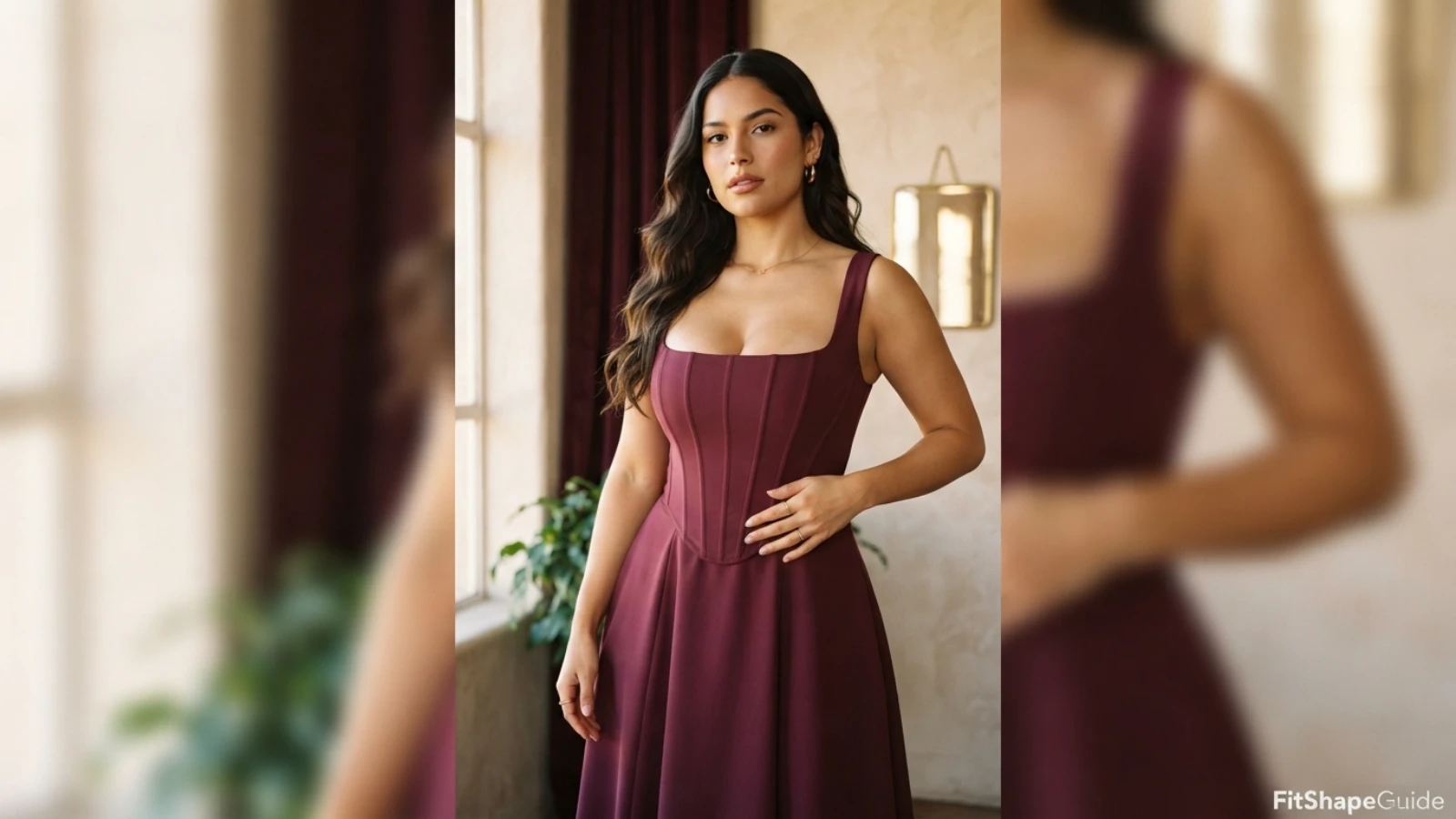
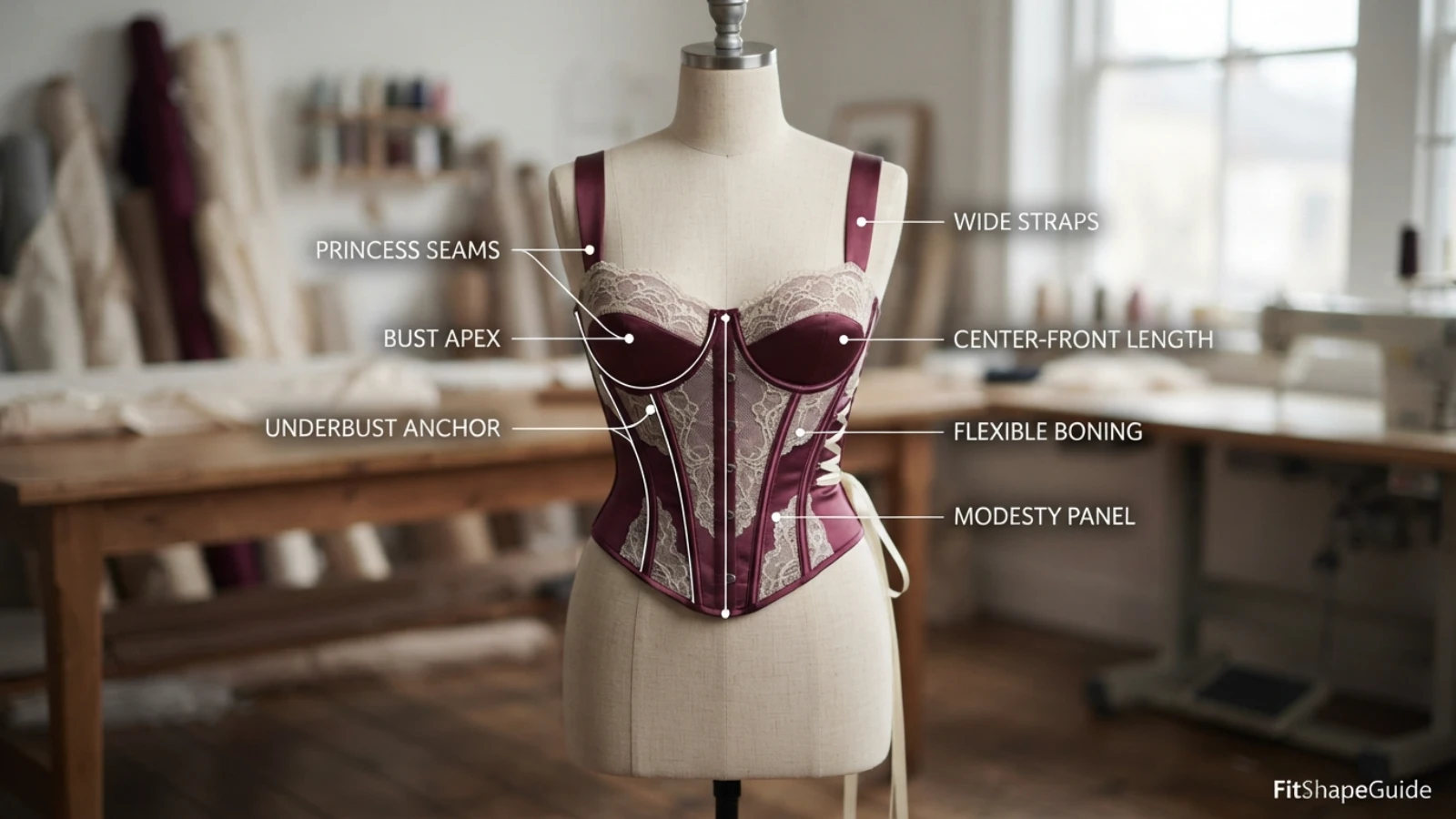
The best corset dresses for a large bust have correctly scaled bust panels, enough center-front length, a stable underbust anchor, flexible boning that follows the torso, and an adjustable closure with a sensible modesty panel. Princess seams, wide straps, firm lining and separate bust-and-waist shaping are usually more dependable than tiny molded cups or purely decorative boning. The right dress lets you breathe, sit, raise your arms and wear it for the intended event without numbness, spilling, a lifted waist seam or constant readjustment.
The 60-second corset fit check
- Place each breast fully inside the intended panel or cup; no seam should cut across tissue.
- Take three deep breaths. The waist may feel held, but the ribcage must expand without pain.
- Check the underbust line and waist seam from every angle; both should remain level.
- Sit, self-hug and raise both arms. Boning should not stab, buckle or push the neckline down.
- Inspect the closure. A zip must lie flat; lacing should form an even, controlled gap.
- Keep the dress only if it feels secure before fashion tape or emergency alterations.
Best corset dresses for a large bust by construction
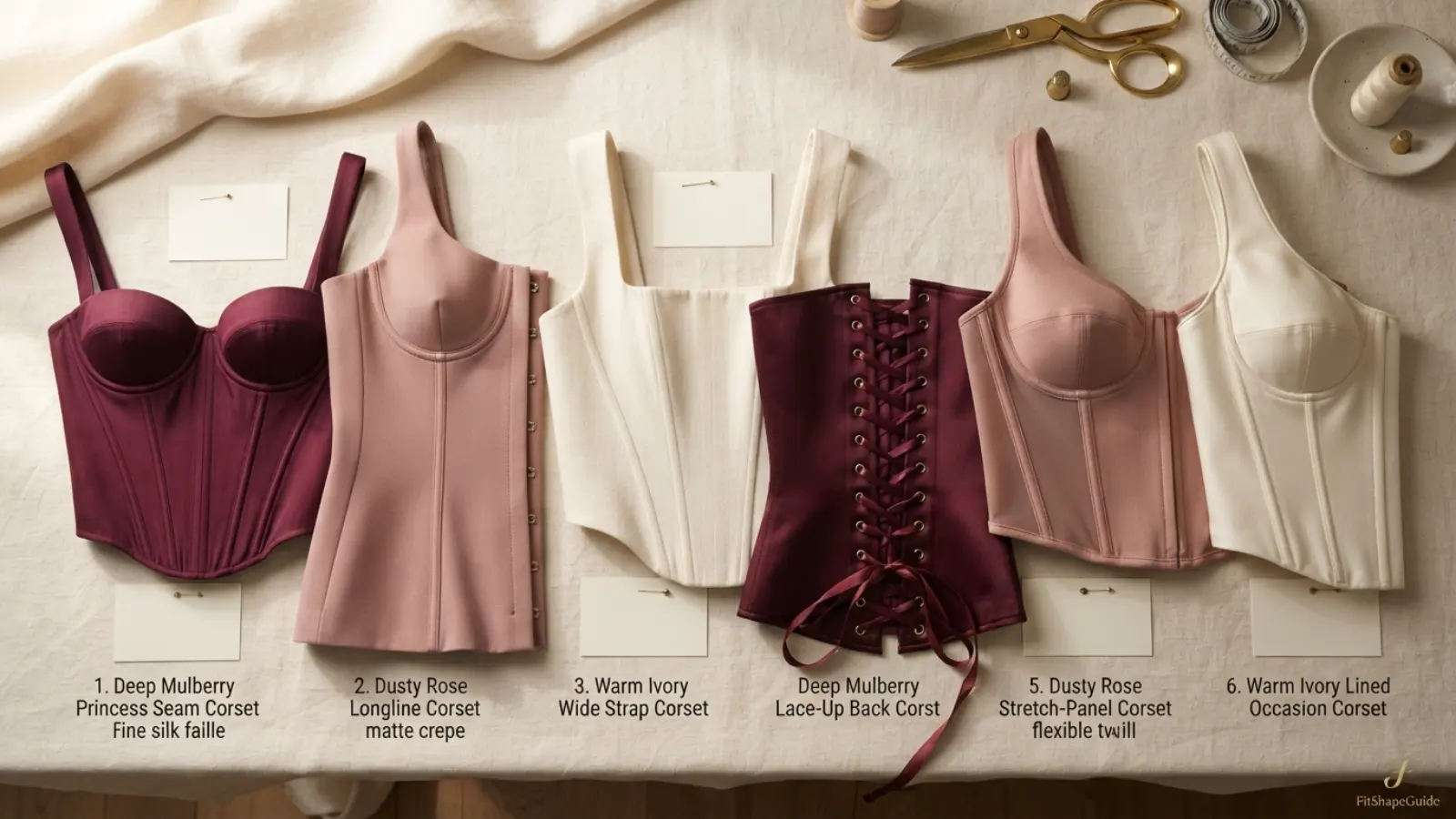
Princess-seam corset dress
Best for: creating forward projection without relying on a shallow molded cup. Long curved seams can distribute shaping from neckline to waist and are easier to assess than decorative bust outlines. Look for the fullest point of the seam to match your bust apex. If the curve sits too high, the dress will flatten below it and create overflow; if it sits too low, the upper panel may gape.
Longline underbust-anchored bodice
Best for: distributing support across the torso instead of hanging it from the neckline. A firm waist stay, supportive lining and vertical paneling can stabilize the bust while allowing the cup area to project. The anchor must sit beneath breast tissue, not across it. This construction is especially useful for formalwear when it remains comfortable through sitting and full breathing.
Wide-strap corset midi
Best for: wearing a supportive bra or sharing load across the shoulders. Wide straps can conceal bra straps and keep the upper edge stable, but they cannot compensate for missing cup depth. A midi skirt also offers practical movement for events. Compare proportions with our midi dress guide for a large bust.
Adjustable lace-up back dress
Best for: bodies with a marked difference between bust, underbust and waist. Proper lacing offers controlled adjustability, especially with a substantial modesty panel. The gap should remain reasonably parallel rather than forming an extreme V. Lacing is a fit tool, not permission to force an undersized bodice closed or compress breast tissue into shallow panels.
Stretch-panel corset-look dress
Best for: moderate structure with easier breathing and size flexibility. Stable front panels combined with a smocked or stretch back can accommodate fluctuation. Recovery matters: the panel should return after stretching and keep the waist level. Avoid thin elastic that pulls the structured front backward or turns decorative boning into pressure points.
Lined occasion corset dress
Best for: weddings, dinners and cocktail events where polish and long wear matter. A stable lining, finished boning channels, secure zip, shaped neckline and sufficient seated ease are more valuable than dramatic cleavage engineering. For adjacent event options, use our cocktail dress fit guide.
Real corsetry versus a corset-look dress
“Corset dress” is a broad retail label. One garment may contain multiple shaped panels, a waist stay, flexible boning and an adjustable back. Another may be ordinary stretch jersey printed with seam lines. Neither category is automatically good or bad, but they solve different problems. A structured bodice can provide real stabilization if its dimensions match you. A corset-look dress may be more forgiving and comfortable, yet still require a separate bra.
Check the product description for lining, boning material, cup construction, closures, stretch zones and internal elastic. Then verify those claims in clear photographs. Decorative underwire outlines that end halfway across the breast are a common warning sign. So are fixed foam cups scaled to a small size while the waist grades upward. Fuller-bust fit requires added depth and length, not merely a larger circumference.
| Feature | Functional version | Decorative version | What to verify |
|---|---|---|---|
| Boning | Supports panel shape and follows the torso | Thin strips added for appearance | Ends, channels, flexibility and buckling |
| Cups | Enough depth and width for contained tissue | Small fixed outlines or pads | Cup height, depth and seam position |
| Lacing | Adjusts controlled circumference | Ribbon over a closed stretch back | Modesty panel and usable range |
| Waist stay | Anchors tension independently | No internal anchor | Placement, comfort and closure |
| Straps | Stabilize without carrying everything | Very thin non-adjustable straps | Bra coverage and tension distribution |
Cup, seam and neckline geometry that works
Bust projection must exist before tightening
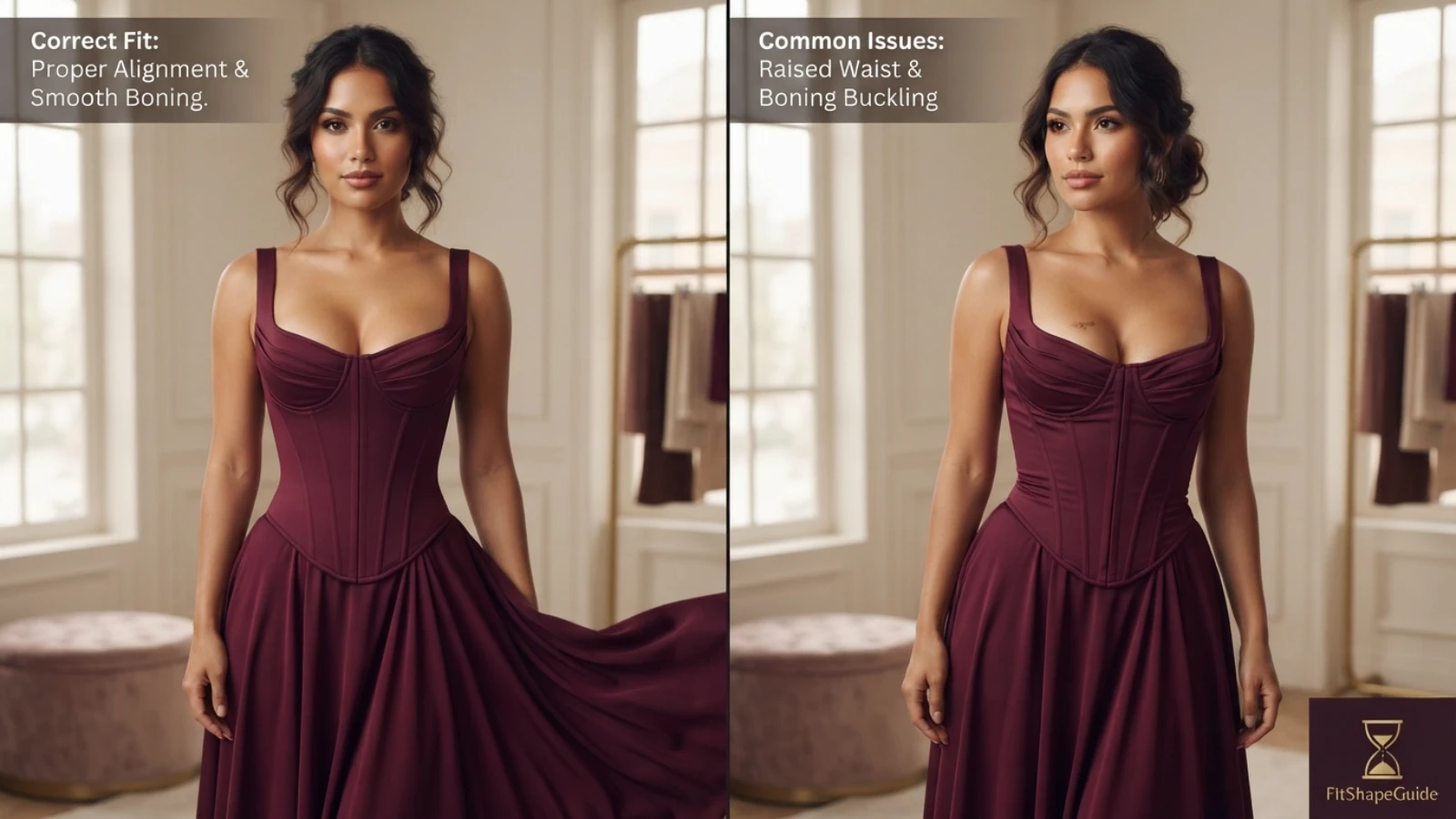
A corset bodice should already have three-dimensional space for the bust. Tightening the waist can refine the fit, but it cannot create missing cup depth. When the front is too shallow, tissue is displaced upward or sideways, the center front lifts, and the waist seam climbs. This is compression, not supportive shaping. Shoppers with a fuller bust and smaller waist can also use our large-bust, small-waist fit strategies.
The apex and cup boundary must match your body
If a dress uses defined cups, the apex should align with your fullest point and the cup edge must surround breast tissue. A seam crossing the fullest area may create a shelf, quadraboob or numb pressure. Many fashion corsets use the same cup at several dress sizes; never assume sizing up solves the cup if the cup itself barely changes.
Center-front length prevents the raised-waist effect
A fuller bust needs adequate vertical length over its curve. Without it, the neckline may cut low while the waist rises at the front. Compare shoulder-to-waist and neckline-to-underbust lengths with the dress whenever possible. People with compact proportions should balance this need against total torso length using our short-torso dressing guide.
Neckline stability is separate from cleavage
A sweetheart, square or straight neckline can all work when the upper edge returns after movement and does not slice into tissue. Choose coverage according to comfort and occasion, not a rule that fuller busts must hide or display cleavage. Our best neckline guide explains width, depth and strap interaction.
Side panels control containment
The outer bust needs sufficient height and firmness. Low side panels can expose bra cups or allow tissue to escape during a self-hug. Extremely high panels may cut into the underarm if the armhole is small. Check both arms down and raised; the side seam should remain vertical rather than being dragged forward.
Fabrics, linings and boning for supportive corset dresses
Stable woven shells
Firm crepe, jacquard, cotton sateen and structured satin can preserve panel shape. Their success depends on cut: a stable fabric with insufficient bust room becomes unforgiving. Look for smooth seams and enough wearing ease. Heavy embellishment may pull the neckline forward, while slippery satin makes drag lines especially visible.
Dense stretch fabrics
Ponte and structured stretch crepe can provide comfort when recovery is strong. Stretch is the ability to expand; recovery is the ability to return. Weak recovery allows the neckline and waist to grow during wear. A supportive front paired with a controlled stretch back is often more predictable than an entirely stretchy corset-look tube.
Lining and interfacing
The lining should protect skin from seam allowances and boning while supporting the shell. It must not create a smaller inner bodice than the outer garment. Inspect puckering, pulling and loose lining at the cups. Power mesh can reinforce selected zones, but it should not be used as a blanket compression layer over the bust.
Flexible boning versus rigid pressure
Boning keeps seams vertical and resists fabric collapse. It does not need to feel punishing. Flexible synthetic or spiral steel boning may follow curved areas better, depending on construction. Flat steel is directional and can be useful near closures. Any bone that twists, stabs, ends on breast tissue or buckles when sitting signals poor placement or fit. More boning is not automatically better.
Fabric weight, opacity and recovery should be evaluated separately; see our fabric guide for large-bust clothing for a broader framework.
Measurements to compare before ordering
| Measurement | Why it matters | Warning sign |
|---|---|---|
| Full bust | Indicates total circumference at the fullest point | Your body exceeds the finished-garment range |
| Underbust | Shows whether the lower cup and anchor can sit correctly | Underbust seam crosses breast tissue |
| Natural waist | Determines closure tension and waist-stay fit | You must over-tighten to close the dress |
| Bust-to-waist difference | Reveals whether one size can fit both zones | Correct bust leaves an unmanageable waist |
| Shoulder to waist | Checks vertical bodice length | Front waist rises or straps over-tighten |
| Cup height and depth | Tests defined fashion cups directly | Cup seam bisects or floats away from tissue |
| Side-panel height | Predicts containment and bra coverage | Underarm spilling or visible bra wing |
| Lacing/closure range | Shows safe adjustability | Extreme gap or distorted zipper |
Measurement rule: compare your body with the brand’s current chart and any finished-garment measurements. Your bra size alone cannot predict dress-cup capacity because brands draft and label corset cups differently.
Should you wear a bra under a corset dress?
You may wear one if it improves comfort, shape or security. A wide-strap corset dress can work over a conventional bra when the neckline and side panels conceal it. A strapless bra may suit a structured neckline, but both garments need compatible cup positions; stacking two mismatched cup systems can create pressure and ridges. A genuinely supportive longline bodice may be worn without a separate bra when its cup capacity and anchoring fit you.
Removable pads mainly add modesty or smoothness. They do not prove the bodice provides lift. Fashion tape can control an edge on an already suitable garment, but it should not carry bust weight or rescue a shallow cup. If using any adhesive, follow its directions, patch-test in advance, use it only on healthy skin and remove it gently. Comfort and skin safety outrank an invisible neckline.
For strap-free alternatives, compare the fit tests in our strapless dress guide. If the dress exposes the back, plan the support method with our backless dress guide before removing tags.
How to shop online for the best corset dresses for a large bust
Read specifications before marketing words
Search for princess seams, cup measurements, flexible boning, lining, waist stay, adjustable straps, modesty panel, stretch percentage and closure type. “Corset inspired,” “snatched” and “built-in support” are not construction specifications. Zoom into front, side and back photographs to see whether the model’s bust sits inside the panels and whether the waist remains level.
Use reviews as observations, not universal proof
Prioritize reviews that include full-bust, underbust and waist measurements, usual bra size, ordered size and time worn. Repeated reports of tiny cups, a sticking zipper, boning that bends outward or a rising waist are more useful than “flattering.” A reviewer going braless does not establish support for every bust shape or preference.
Verify Amazon recommendations before publishing
This page is Amazon affiliate-ready but deliberately contains no invented product names, ASINs, prices, ratings, review counts or stock claims. Before inserting a product, verify the live listing, seller, current size chart, materials, construction photographs and return terms. Affiliate links should use rel="sponsored nofollow"; editorial selection should remain independent of commission.
Check returns before bending or altering boning
Try the dress with clean skin and intended undergarments while tags remain attached. Confirm whether lacing, makeup, deodorant or adhesive products affect eligibility. Order early enough to conduct a calm indoor movement test. Never permanently bend boning or remove cups before deciding to keep the item.
Know what tailoring can realistically solve
Straps can often be shortened, a modesty panel enlarged, a waist refined or cups lightly reshaped. Adding substantial missing bust depth, relocating every bone or rebuilding a fixed cup is expensive and may change the dress. Review our tailoring guide for fuller-bust clothing before treating a structural mismatch as a simple alteration.
Movement and comfort tests every corset dress should pass
Full-breath test
Stand naturally and inhale deeply three times. The ribcage should expand without sharp pressure, dizziness or a feeling that breathing is restricted. A corset dress can feel firm without being painful. Do not normalize numbness, tingling, bruising or shortness of breath as the price of support.
Seated test
Sit upright, lean slightly forward and remain seated for ten minutes. Watch the lower ends of the boning: they should not dig into the abdomen or thighs. The top edge should not tip outward, and the cup seams should not press more aggressively as the torso shortens. Test the actual chair height likely at the event when possible.
Reach and self-hug test
Raise both arms, reach forward and hug yourself. Armholes should allow motion without pulling the neckline down. The side bust should stay contained, straps should remain flat and the front waist should return to its original position. If you must rearrange the bust after one reach, the dress is not stable enough.
Walk, stairs and dance test
Walk briskly, climb a few steps and rotate at the waist. Check that lacing remains secure and a zip does not creep. A flared skirt may improve stride room, but the bodice still needs to move with the body. For balanced skirt options, compare our fit-and-flare dress guide.
Common corset-dress fit problems and better responses
| Symptom | Likely cause | Better response |
|---|---|---|
| Cup seam cuts across bust | Cup is too small, shallow or wrongly placed | Choose a larger/deeper cup construction, not tighter lacing |
| Front waist rises | Missing bust depth or center-front length | Seek longer princess panels or fuller-bust drafting |
| Boning bows outward | Excess horizontal strain or poor-quality channels | Size for the bust and inspect stronger construction |
| Back lacing forms extreme V | Bust/upper torso needs more room than waist | Try a larger size or a better-curved pattern |
| Neckline gapes | Upper edge too large, straps too long or cup misplaced | Adjust straps; tailor edge only if bust fit is correct |
| Side spillage | Panels are too low/narrow or cup is shallow | Choose higher sides and greater projection |
| Zip ripples or separates | Closure is under excessive tension | Do not force it; change size or construction |
| Pain while sitting | Boning too long, rigid or badly positioned | Reject or consult a skilled alterations professional |
When sizing up helps
Sizing up can restore bust ease, vertical length and closure safety if the waist and straps are alterable. It does not help when the brand uses the same tiny cup across multiple sizes or when the apex is fundamentally misplaced. In that case, choose princess-seam shaping without a fixed cup, a brand offering bust options, or a dress designed around a separate bra.
When not to “break in” the dress
A fabric may soften slightly, but painful boning, restricted breathing, a cutting cup seam and a stressed zipper are not reasonable break-in expectations. A dress intended for a long event should pass its comfort tests at home. Do not rely on weight loss, extreme tightening or enduring pain to make a purchase workable.
Choosing a corset dress for different occasions
Daytime and casual wear
Choose corset-look shaping with stretch recovery, wider straps and a less rigid waist. Cotton sateen, denim with controlled stretch or ponte can create definition while remaining practical. The dress should work with ordinary seating, meals and outer layers rather than requiring event-level preparation.
Cocktail parties and weddings
The best corset dresses for a large bust at long events combine stable lining, a secure closure, adequate cup depth and enough seated ease. Test dancing, eating, photography and the intended bra. A polished dress that remains comfortable for hours is a stronger purchase than a dramatic neckline that works only while standing still.
Formal gowns
Heavier skirts transfer more force to the waist and bodice. Check whether the skirt hangs from a stable waist structure rather than pulling the neckline downward. Internal waist stays, balanced paneling and professional alterations may be worthwhile. Order early and test shoes, shapewear, bag and wrap together.
Date-night and fashion-forward styles
You can choose dramatic cleavage, sheer panels or a close silhouette if that matches your taste. The same structural rules still apply. Body neutrality means pursuing the look you want without treating pain or breast compression as mandatory. For cling and ride-up checks, use our bodycon dress guide.
Care, storage and value checks
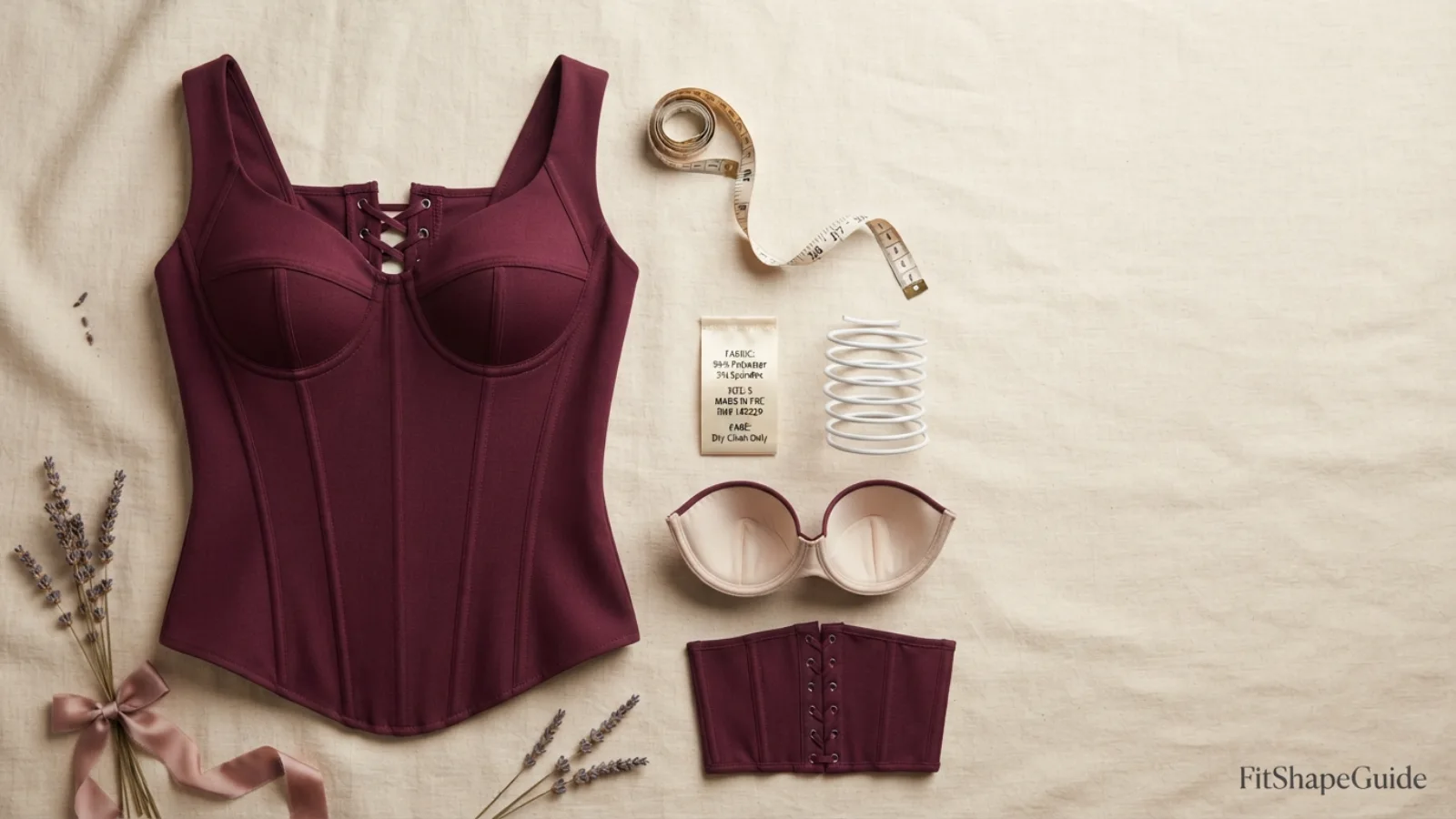
Structured dresses need careful handling because boning, molded layers, interfacing and delicate shells may react differently to washing. Read the sewn-in label rather than copying a generic internet method. The U.S. Federal Trade Commission’s official Care Labeling Rule guidance explains regular-care instructions, while its apparel labeling resources cover fiber content and related requirements.
Fasten zips and loosen lacing before storage so closures are not held under tension. Support heavy dresses on padded hangers if the label and construction permit, or store them flat with boning aligned. Do not crush molded cups. After wear, inspect boning ends, channel stitching, hooks, grommets and the modesty panel. Early repair is safer than wearing a closure already showing strain.
Value is not just price per wear. Include alteration cost, specialist cleaning, undergarments, adhesive products and the likelihood that the dress survives a full event comfortably. The best corset dresses for a large bust earn their place by fitting repeatedly—not by producing one flattering photograph while causing hours of discomfort.
- Confirm bust, underbust, waist and vertical bodice measurements.
- Check cup depth and side containment before tightening.
- Inspect boning ends, lining, zip, grommets and modesty panel.
- Test breathing, sitting, reaching, walking and stairs.
- Verify current returns, care and affiliate-listing details.
The best corset dresses for a large bust shape without punishing
A strong choice begins with enough bust projection and center-front length, then uses seams, lining, boning and a secure waist to stabilize that shape. It should remain level, breathable and dependable through real movement. Choose structure that follows your body, reject tiny fixed cups and painful pressure, and keep only the dress that feels supportive before emergency tape or major reconstruction.
Frequently asked questions
Are corset dresses good for a large bust?
Yes, when the bodice provides enough cup depth, center-front length, side coverage and underbust anchoring. Decorative boning or a tight waist alone does not create fuller-bust support.
Can a corset dress support a large bust without a bra?
Some can, especially a lined longline bodice with correctly scaled cups and secure anchoring. Others are corset-look dresses and work better over a compatible bra. Test the actual garment rather than trusting the label.
Should I size up in a corset dress?
Size for the fullest area that cannot be easily altered, usually the bust or upper torso. Sizing up helps only if the larger bodice adds meaningful depth and length and the waist can be adjusted safely.
Why does the waist seam rise at the front?
The bodice probably lacks bust projection or vertical length, so the bust borrows fabric from below. Tightening the waist will usually worsen this; seek a deeper, longer front pattern.
Is boning supposed to hurt when sitting?
No. Firmness is possible, but stabbing, numbness, bruising or restricted breathing signals poor fit, excessive length or unsuitable boning placement. Stop wearing the dress if it causes pain.
Are lace-up corset dresses more adjustable?
They can be, within the designed range. A modesty panel and reasonably parallel lacing gap are helpful. Lacing cannot correct cups that are too small or seams that sit on breast tissue.
Which neckline works best on a fuller-bust corset dress?
Sweetheart, square, straight and V-shaped necklines can all work. Prioritize a stable edge, correct cup boundary, side containment and straps that align with your preferred bra or support plan.
Can a tailor enlarge the cups of a corset dress?
Minor reshaping may be possible, but adding substantial cup depth often requires rebuilding panels, lining and boning. Ask an experienced alterations professional before purchase and compare the cost with choosing a better-drafted dress.