Best Modest Swimsuits for a Large Bust
A fit-first guide to full-coverage swimwear with genuine bust support, secure necklines, long sleeves, tunics, swim leggings, wet-fabric control and movement-ready construction.
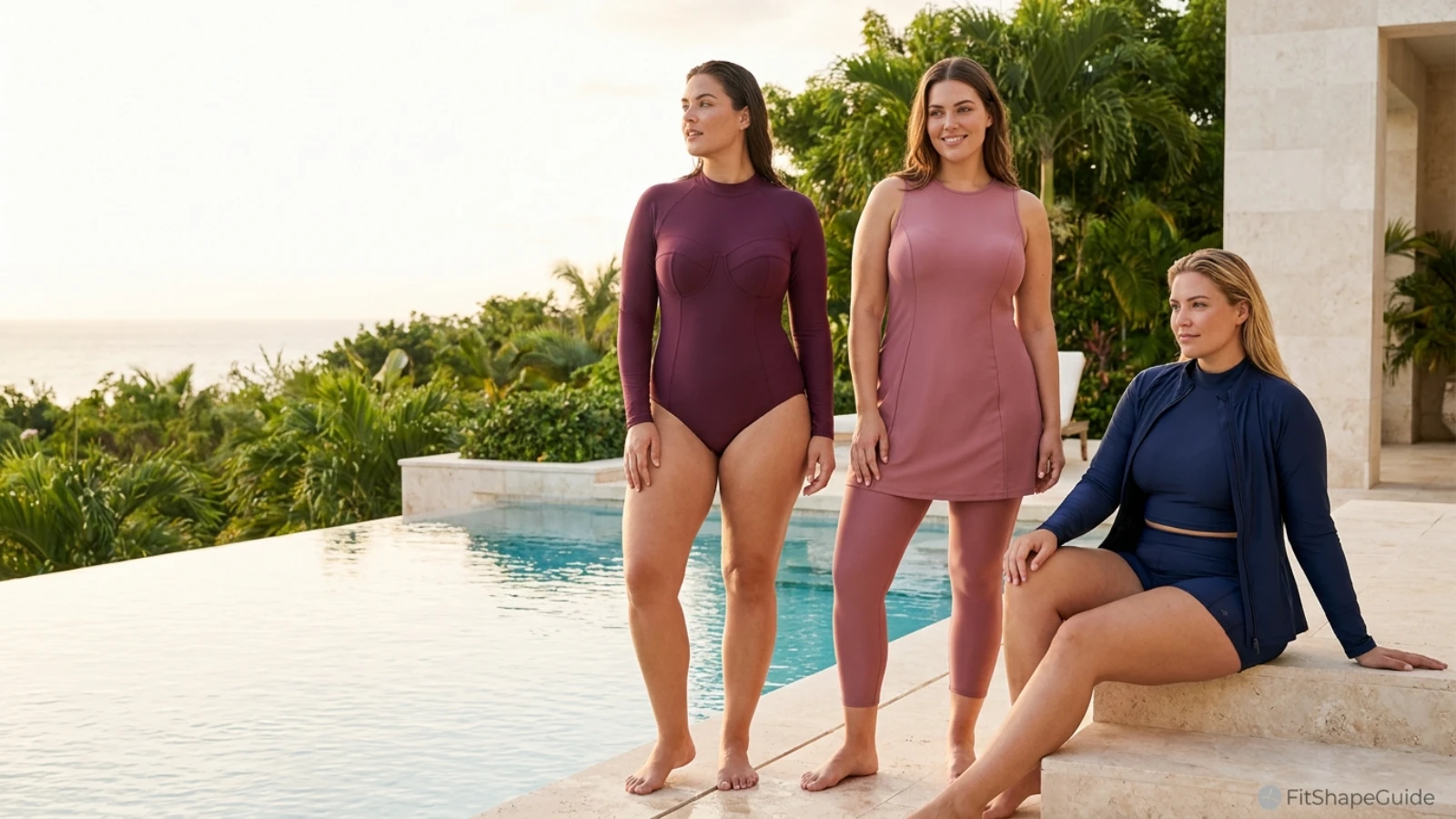
The 90-second modest swimwear check
- The neckline gives the chosen coverage without pressing across the upper bust.
- The bust is supported by cups, seams, a shelf, underwire or a compatible swim bra—not by sleeve tension.
- The under-bust anchor stays level when both arms lift.
- The armholes and side panels contain the intended swim top or bra.
- A zipper, tie or back closure stays flat and cannot open accidentally.
- The outer tunic, skirt or rash guard does not drag the support layer downward.
- The fabric remains opaque when stretched and wet.
- You can swim, sit, climb pool steps and walk ashore without repeated adjustment.
Best modest swimsuits by construction and activity
“Modest swimsuit” is not one fixed silhouette. For one swimmer it means a high neckline and secure seat coverage; for another it includes long sleeves, a tunic, skirt, shorts, leggings or head covering. The useful buying question is not which level is universally modest. It is whether the chosen coverage stays secure while the hidden foundation supports a fuller bust.
Supportive high-neck one-piece
Best for: streamlined coverage, recreational swimming and shoppers who prefer one garment. Look for shaped cups or curved front panels, high side wings, a firm under-bust shelf, wide adjustable straps and a clasped or stable racer back. Trade-off: a high neckline can visually cover the chest while the inner cup remains shallow. If the front is too short, the suit may pull the neck down, flatten the bust or cut into the leg opening. The high-neck swimsuit guide explains this distinction in detail.
Long-sleeve one-piece with internal support
Best for: upper-body coverage, water sports and days with repeated sun exposure. Raglan or well-shaped set-in sleeves should move independently from the bust panel, while cups, shelf elastic or an internal swim bra handle support. Trade-off: sleeves add wet weight and shoulder resistance. A single flat front with no bust shaping may migrate toward the neck whenever the arms reach forward.
Swim tunic with leggings
Best for: thigh-to-ankle coverage and a coordinated outfit that can be adjusted by piece. Choose a tunic with a shaped inner bodice, a close under-bust anchor, side vents placed below the hip and leggings with a secure non-rolling waist. Trade-off: a very loose tunic can balloon in water, while a very tight one may ride to the waist. Longer hems need enough weight or discreet internal attachment to remain controlled without pulling on the bust.
Secured swim dress or skirted set
Best for: upper-thigh coverage, poolside wear and gentle recreation. The most dependable versions place a supportive one-piece or tankini beneath the skirt and attach the skirt at a stable waist. Trade-off: a full or heavy skirt creates drag and may float upward. Choose a controlled A-line or split skirt with built-in shorts when movement matters. Compare more foundations in the swim-dress fit guide.
Rash guard over a supportive swim top
Best for: flexible sleeve and neckline coverage, surfing, paddling or mixing separates. Fit the underlying swim bra or high-neck top first, then add a rash guard with enough front length and side room to skim it. Trade-off: a rash guard is an outer layer, not automatically a bra. Compression across a shallow front can distort the support layer and make the hem creep upward.
Zip-front coverage suit
Best for: easier dressing, adjustable neckline access and secure upper-body coverage. A locking zipper, protective zipper garage, shaped bust panels, strong under-bust foundation and a stable torso make this design useful. Trade-off: the zipper is a rigid center line. If bust depth is insufficient, it may bow outward, ripple or unzip under tension; sizing down to make the torso tighter usually increases that strain.
The strongest full-coverage options are selected in layers: first support, then desired coverage, then activity. A beautifully covered suit that lacks cup depth or a stable anchor is not more functional than a supportive suit whose neckline, sleeves or hem do not match the wearer’s preferences.
What actually supports a large bust in modest swimwear
The best modest swimsuits make their load path visible. The bust sits within cups, darts or curved panels. An under-bust elastic, band or underwire anchors those shapes to the torso. Straps and the back stabilize the upper edge. The outer rash guard, tunic or dress then adds coverage without becoming the only structure holding everything in place.
Shaped cups and curved seams create depth
Removable foam pads are not the same as sized cups. A pad can conceal or smooth, yet it may sit on top of the bust if the pocket is shallow. The best modest swimsuits use cup seams, darts, princess panels or molded shapes that follow three-dimensional projection. In side photos, the front should extend around the bust without pulling the side seam forward or making the neckline stand away.
The under-bust anchor carries more than the neckline
A wide shelf elastic, fitted inner band or underwire frame helps keep support at ribcage level. Test whether it lies flat and remains horizontal when reaching. If the anchor rides upward, the cups may be too small, the band too loose or the front too short. Underwire can offer clear separation and anchoring when its width and depth match; it is not required for every swimmer. See the underwire swimsuit guide for the construction trade-offs.
High side panels prevent the outer layer from doing containment work
Side height matters even under a long-sleeve rash guard. A low inner armhole may allow the bust or swim-bra wing to escape when the arm reaches forward. The outer sleeve can hide the symptom without fixing it. Inspect the inner bodice separately and check whether cup, side panel and back form a continuous secure frame.
Straps and shoulders should stabilize, not bear the whole system
Wide straps spread pressure and are easier to conceal beneath a rash guard. Adjustable straps help with torso length, but they should not be shortened to the limit just to lift a shallow cup. Racerbacks can reduce strap movement during laps, while straight straps may offer more adjustment and less neck concentration. Match the back to the activity and personal comfort.
Closures must resist water movement
Hooks, zippers and ties need more scrutiny in swimwear because fabric becomes heavier and movement is multidirectional. A zipper should lock or be protected at the top. A back clasp should sit where it can be fastened securely. Ties should be wide enough to remain comfortable and should not be the sole bust anchor. Decorative front zips or ties are not evidence of support.
| Support element | What it should do | Evidence to check | Common false signal |
|---|---|---|---|
| Shaped cup or seam | Create forward and side depth | Curved panels, darts, cup sizing, side view | Loose removable pad in a flat pocket |
| Under-bust anchor | Hold support at ribcage level | Wide elastic, inner band or correctly fitted wire | Tight outer fabric with no separate foundation |
| High side panel | Contain the bust and support layer | Armhole height and side/back photographs | Long sleeve hiding a low inner armhole |
| Straps and back | Stabilize vertical and horizontal position | Adjustment range, wide attachment, secure back | Straps shortened fully to close the neckline |
| Closure | Stay secured during motion and water entry | Locking zip, zipper garage, firm clasp or protected tie | Decorative zip under visible tension |
| Outer coverage layer | Add coverage without distorting support | Independent ease, recovery and hem control | Compression shirt treated as a swim bra |
The best modest swimsuits treat these elements as a connected structure. More fabric can change coverage, but only correctly placed depth and anchoring change how the bust is supported.
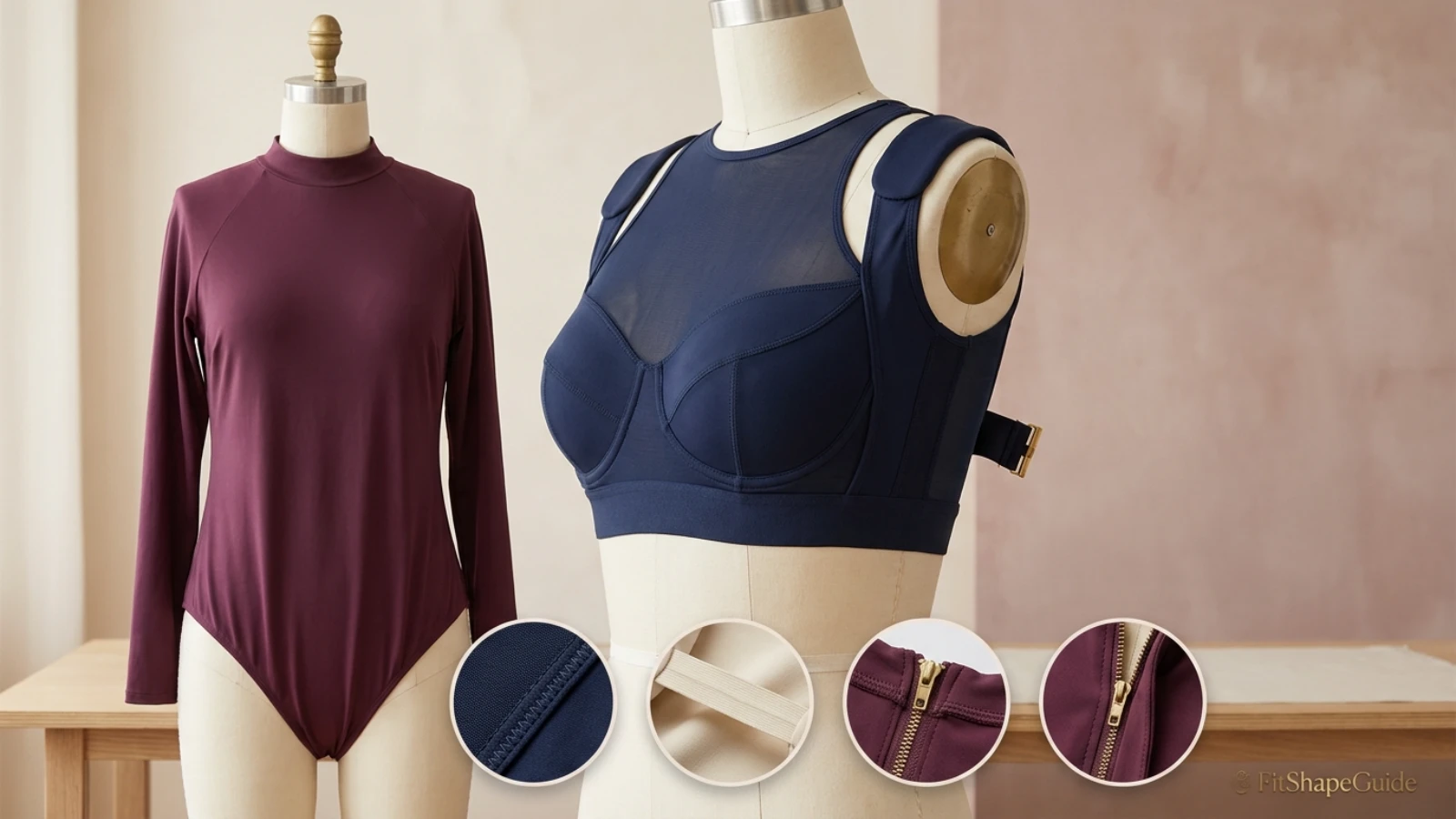
Fabric, opacity, recovery and wet weight
Modest swimwear uses more surface area than a standard suit, so fabric behavior has greater consequences. A tunic hem that feels light when dry may pull or balloon in water. Long sleeves can stretch at the elbow. A pale lining may become visible through an outer layer. The best modest swimsuits use fabric that remains opaque, recovers after stretch and suits the intended pool, sea or low-impact setting.
Opacity must be checked in stretch and in water
A dry fabric swatch held loosely tells little. Stretch a hidden area over the intended underlayer and view it under strong natural light. If permitted by the return policy, wet-test a small concealed section with clean water rather than immersing a returnable garment. Pale colors, mesh inserts and high-stretch panels deserve special attention. A fully lined bust may still be paired with unlined sleeves or leggings.
Recovery matters more than softness alone
Soft fabric can feel comfortable in the fitting room yet lengthen after repeated swimming. Recovery describes whether the material returns close to its original dimensions after stretch. The best modest swimsuits recover at the elbows, neckline, under-bust area, seat, knees and tunic hem. Dense resilient fabric usually controls movement better than a very thin, buttery knit, although density can also feel warmer and take longer to dry.
Wet weight changes the direction of pull
Long sleeves and skirts collect more water. If a tunic hangs from the shoulders with no stable torso, the wet hem can drag the neckline downward. If the waist is too loose, a skirt may float up; if it is too tight, it may roll. A supportive inner suit plus a separately balanced outer layer is usually easier to diagnose than one long garment asking the neck and shoulders to carry every panel.
Chlorine resistance and care claims need live verification
Fiber blend, lining, elastic and print can age at different rates. Read the current care label and retailer description rather than assuming every polyester or spandex blend behaves the same. For frequent pool use, prioritize clear chlorine-resistance evidence and reinforced high-stress seams. Speedo’s current official care guidance advises rinsing swimwear in cold, clean water after pool or sea use and drying naturally away from direct heat and sunlight.
UPF and coverage are separate decisions
Long sleeves increase physical coverage, but a protection claim should be treated as a product-specific claim that needs confirmation on the current listing or label. Fabric stretch, wear and construction can change how a garment performs. Choose the coverage you want, follow local sun-safety guidance and do not infer a numeric rating from color, thickness or sleeve length alone.
| Fabric or layer | Useful quality | Trade-off | What to verify |
|---|---|---|---|
| Dense stretch swim knit | Coverage, shape and predictable recovery | May feel warmer or dry more slowly | Opacity at full stretch and chlorine-care claim |
| Light rash-guard knit | Easy sleeves and active movement | Can cling, ride or reveal inner seams | Front length, hem grip and recovery |
| Double-layer bust panel | Opacity and smoother cup finish | Inner layer may be smaller or less stretchy | Separate shell and lining dimensions |
| Tunic or skirt panel | Hip and thigh coverage | Wet drag, floating or twisting | Hem shape, attachment and drainage |
| Swim leggings | Leg coverage and coordinated movement | Waist roll, knee bagging or ankle drag | Waist anchor, gusset, inseam and recovery |
| Mesh ventilation panel | Breathability and faster drainage | May conflict with desired opacity | Placement, lining and appearance when wet |
For the best modest swimsuits for a large bust, fabric is part of the support equation rather than a finishing detail. The ideal blend for lounging may not be the ideal blend for weekly laps, and a high-coverage silhouette needs enough recovery to return after every stroke.
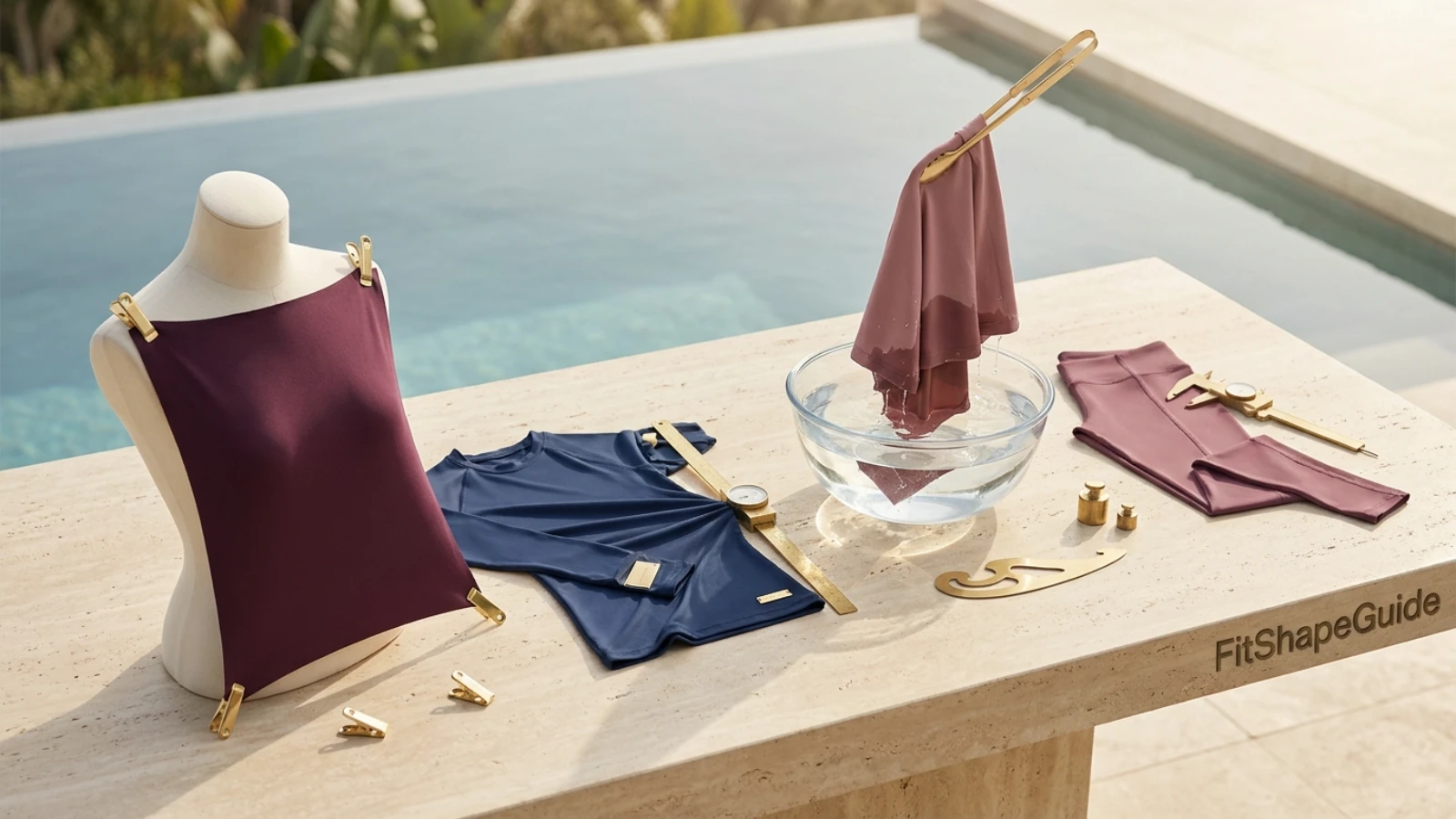
How to buy the best modest swimsuits for a large bust online
A generic size chart rarely explains how a multi-piece modest set will fit. The bust may suggest one size, the tunic another and the leggings a third. Some listings describe the outer garment but omit the inner support system. The best modest swimsuits can be assessed from complete measurements, clear layer-by-layer photographs and a return policy that permits a clean indoor try-on.
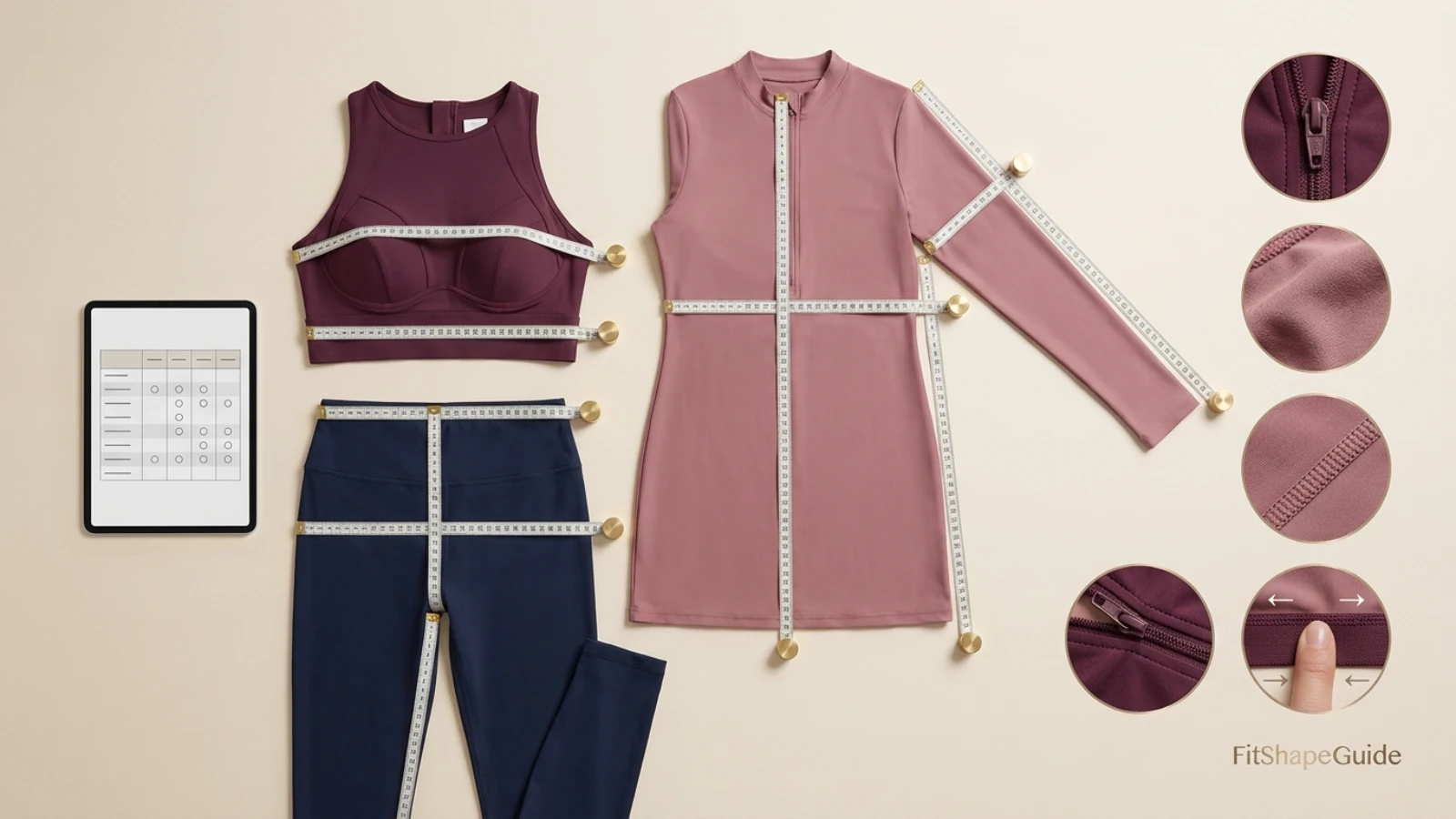
Measure the body and a successful swim garment
Record full bust in the intended swim bra or without one according to the brand instructions, snug under-bust, natural waist, fullest hip, torso loop, shoulder-to-bust point, upper arm and inseam when leggings are included. Then measure a swim top or sports top that fits: flat underarm width, under-bust band, cup height, front length, side height, strap length and back width.
Confirm whether the chart describes bodies or garments
Do not double a flat measurement unless the seller intends that conversion. Ask whether the listed bust measurement is a body range, relaxed garment width or maximum stretched width. A “stretchy” description is incomplete without recovery and finished dimensions. In a set, verify whether each piece follows the same size chart and whether separates can be ordered independently.
Inspect every layer and closure
Look for front, side, back and interior photographs. The best modest swimsuits provide enough visual evidence to confirm cup seams, pad pockets, shelf elastic, band, wire channel, zipper backing, clasp, lining, gusset, tunic attachment, sleeve seams and legging waistband. If the model photo shows only the closed outer tunic, support evidence is missing. A readable construction diagram can be more useful than a styled beach image.
Use reviews as behavior reports, not universal verdicts
Useful comments mention body measurements, chosen size, activity and specific symptoms: shelf riding up, zipper bowing, sleeves filling with water, tunic floating, leggings sliding, neckline stretching or color becoming transparent. “Supportive” and “modest” are personal conclusions. Translate them into observable construction and compare the reviewer’s version with the current listing.
Decide which measurement gets priority
For a one-piece, torso length and bust depth can be harder to alter than waist looseness. For a two- or three-piece set, fit the supportive top first, then choose tunic and bottom dimensions. In plus-size swimwear, inspect how grading affects cup placement, strap spacing and torso length rather than assuming every feature scales at the same rate.
Safe Amazon recommendation workflow
Before adding a product module, verify the live title, seller, complete size chart, cup or shelf construction, under-bust anchor, neckline, sleeves, closure, lining, fabric blend, opacity evidence, included pieces, care directions, current return eligibility and useful customer-photo evidence. Use the affiliate tag bracalculator-20 only on a confirmed Amazon URL. Never publish a permanent price, rating, review count, coupon, stock, seller-quality or delivery claim.
This evidence-first process keeps the best modest swimsuits grounded in observable construction rather than attractive photography or vague promises.
Dry and wet movement tests modest swimwear should pass
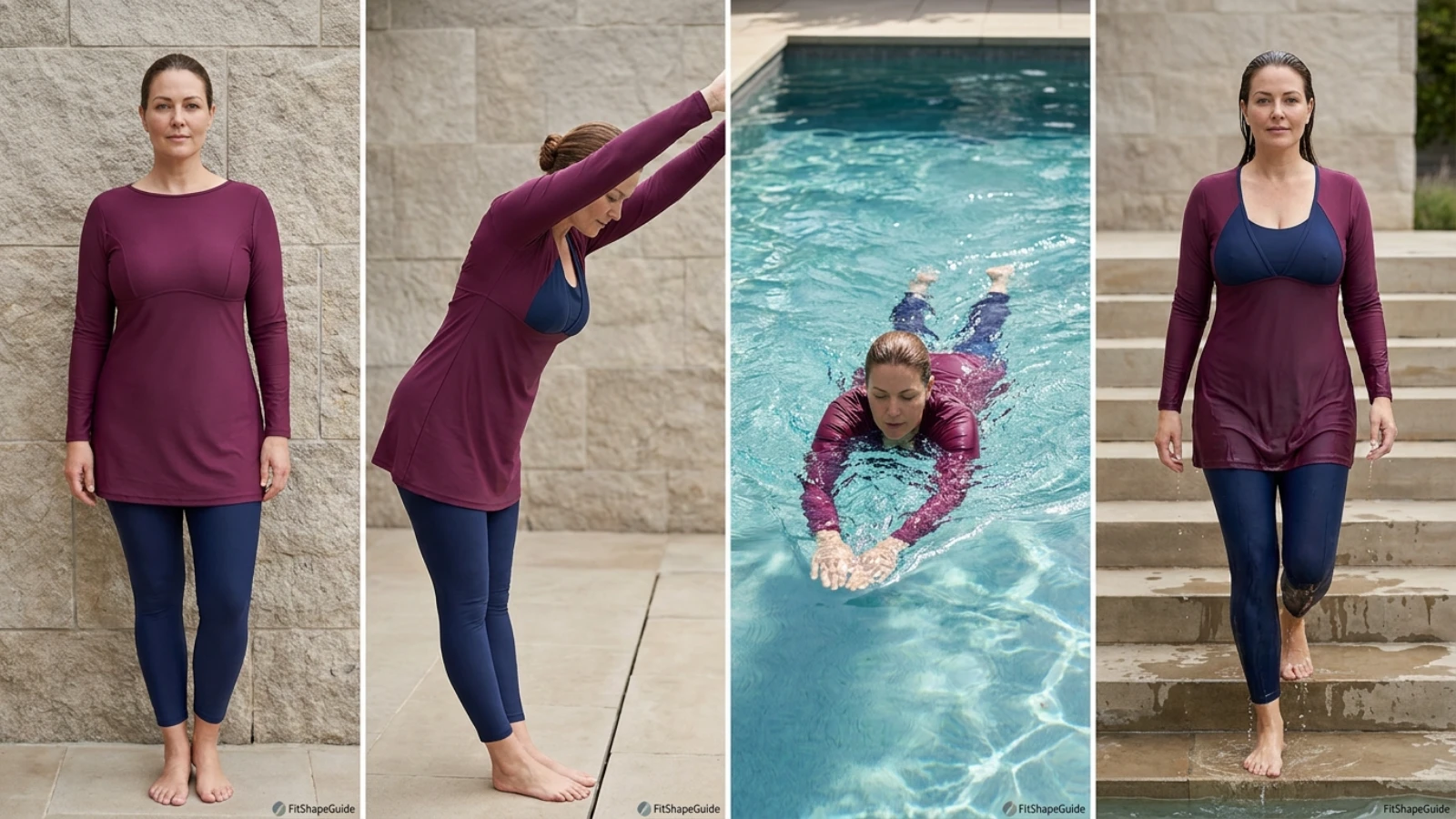
A standing mirror check cannot predict what long sleeves, a tunic or leggings will do after water enters the fabric. Test each layer alone, then as a set. The best modest swimsuits stay aligned through ordinary motion without asking the wearer to hold the neckline, pull down the hem or retighten the waist after every activity.
Neutral stand and full breath
Stand naturally and take several full breaths. The neckline, inner band and zipper should remain flat. Check whether bust seams sit in the correct place, side panels contain the support layer and the tunic hangs from the torso rather than the bust. A close fit can be appropriate for swimming; painful compression or restricted breathing is not.
Reach, stroke and shoulder rotation
Raise both arms, reach forward as if swimming and rotate one shoulder at a time. Sleeves should move without dragging the neckline up or pulling the under-bust band out of place. The torso should recover after the arms lower. If a rash guard climbs and stays at the bust, it may need more front length or a different hem and side-seam shape.
Sit, squat and pool-step test
Sit, bend into a shallow squat and step onto a low stable platform. Check the back neckline, seat, leg openings, tunic slit and legging waist. A high waist should stay in position without rolling. Built-in shorts should cover during the movement. Test carefully on a dry nonslip surface before trying pool steps.
Controlled clean-water test
After confirming the return terms or keeping the suit, use clean water to assess opacity, weight and recovery. Note how quickly sleeves, tunic and skirt drain. The bust anchor should remain level, and the outer layer should not become the main force pulling downward. Walk a few steps after leaving the water and see whether the set settles by itself.
Float, kick and moderate swim test
In a safe setting, float, kick and swim at the intensity the garment is intended for. A flowing tunic suitable for gentle recreation may not be the best lap garment. For frequent training, a closer silhouette with controlled seams and minimal drag is more practical; compare the support swimsuits for laps before choosing maximum skirt volume.
Exit-water and wind check
Coverage can change as fabric clings after water exit or lifts in wind. Check the garment from front, side and back while walking, raising a towel and sitting. A good set maintains opacity and lets panels separate from the body as they drain. If the tunic sticks uncomfortably or the skirt flies upward, built-in shorts or leggings should preserve the chosen coverage.
| Test | Pass signal | Warning signal | Likely cause |
|---|---|---|---|
| Full breath | Band and neckline remain level | Compression, cup spill or zipper bowing | Insufficient bust depth or band mismatch |
| Forward reach | Sleeves move without shifting support | Neckline climbs or shelf rides upward | Short front, tight armhole or linked sleeve tension |
| Sit and step | Waist, seat and tunic remain covered | Leggings roll or skirt exposes inner layer | Waist mismatch or uncontrolled hem |
| Wet opacity | Outer and inner layers remain opaque | Lining, pads or skin tone becomes visible | Thin, pale or over-stretched fabric |
| Moderate swim | Set stays aligned with manageable drag | Tunic balloons or sleeves fill heavily | Excess volume or poor drainage |
| Water exit | Fabric drains and recovers | Hem pulls neckline or panels stay distorted | Wet weight and weak recovery |
The best modest swimsuits for a large bust pass the tests that match their intended use. A resort-lounging tunic and a lap suit can both be excellent, but they should not be judged by the same drag, structure or coverage priorities.
Common modest-swimsuit fit problems and fixes
Extra layers can hide the origin of a fit problem. A riding tunic may be blamed on the hem even though a shallow inner bust panel is pulling the whole outfit forward. A high neckline may feel tight because the torso is short. Diagnose the first place where strain begins before tightening straps, shrinking the size or adding attachments.
The neckline pulls down or presses across the bust
Check center-front length, cup depth and wet garment weight. If side seams sweep forward and the front hem rises, more bust room is needed. If only the outer rash guard pulls, the support layer may fit while the coverage layer is too short. A higher neckline is not automatically more secure when its front panel cannot travel over projection.
The shelf bra rides upward
Confirm that the elastic is actually under the bust rather than across it. The band may be too loose, the cup too shallow, the torso too short or the outer layer may be lifting it. A firmer band helps only when it is positioned correctly and does not restrict breathing. Underwire or sized-cup alternatives may offer clearer separation for some swimmers.
The zipper bows or creates a wave
A center zipper is less flexible than surrounding knit. Bowing often indicates insufficient horizontal or projected room, while rippling can indicate extra torso length. Unzip, reset the bust within the inner support and fasten without pulling the sides together. If the zipper straightens only under uncomfortable compression, choose more bust depth rather than relying on a stronger zipper.
The tunic floats upward
Flowing hems naturally respond to water, but excessive ballooning may come from too much volume, trapped air, poor drainage or a loose waist. Side slits, a closer A-line, internal shorts or discreet attachment points can improve control. Avoid fastening a heavy tunic directly to a delicate inner neckline because the hem’s movement may transfer force to the bust.
The rash guard rides to the under-bust
Check front length, side shaping and hem recovery. A flat tubular rash guard may borrow length to cover the bust, becoming shorter at center front and wider near the waist. Sizing up can help when shoulders and sleeves remain manageable. If the larger size still climbs, look for curved front seams, a longer shaped hem or a tunic cut.
The sleeves feel heavy or restrict the stroke
Wet sleeve resistance can come from excess circumference, thick fabric, low armholes or seam placement that binds the shoulder. Raglan lines may offer movement, but only if the neckline remains stable. For active swimming, choose a closer sleeve with good recovery and flat seams; save more flowing sleeves for lower-intensity use.
The leggings slide or become transparent
A waistband can slide when it is too loose, overloaded by water or cut without enough rise. Transparency indicates thin or over-stretched fabric, particularly at the seat and knees. A double-layer gusset, secure high waist and sufficient hip room help. Test squat depth and wet stretch before relying on the leggings as the main lower-body coverage.
When sizing up works—and when it does not
Size up when it restores bust projection, front length, sleeve movement and opacity while the under-bust anchor, shoulders and waist remain adjustable. If the larger size makes the band float, the cups stay shallow or the tunic still pulls forward, a different pattern or separates are better. The best modest swimsuits solve proportion rather than simply adding circumference everywhere.
Match coverage to preference, setting and activity
Modesty can be religious, cultural, practical or personal, and no single amount of coverage should be treated as the correct standard. Write down the areas you want covered while dry, swimming and exiting the water. Then choose construction that preserves those boundaries without sacrificing breathing, safe motion or the bust support you prefer.
High neckline and secure seat coverage
A high-neck one-piece may be enough when the priorities are upper-chest coverage and a stable lower edge. Check that the back and armholes match the front coverage. A suit can appear closed at the neckline while using a low back or wide armholes. Adjustable straps and a secure clasp can improve fit without turning the neck into the anchor.
Long sleeves with shorts or a skirt
This arrangement adds upper-arm and upper-thigh coverage while preserving relatively free lower-leg movement. Choose built-in shorts that remain covered beneath a skirt and seams that do not chafe during walking. A skirt is a styling and coverage layer; the supportive one-piece or tankini beneath it should function independently.
Tunic with full-length leggings
A coordinated tunic set offers extensive coverage and lets the top and bottom be fitted separately. The best modest swimsuits in this category use a tunic length that remains practical when wet, side vents that begin below the chosen coverage line and leggings with a secure waist and opaque knee stretch. Petite and tall shoppers should check tunic, sleeve and inseam lengths rather than accepting one scale.
Head covering as a separate performance piece
For swimmers who want hair and neck coverage, choose a swim-specific hood or hijab designed to stay secure without loose fabric near the face. It should work with goggles, preserve hearing and peripheral awareness, and avoid pulling the suit neckline. Fit and safety depend on the exact activity and pool rules, so test the complete setup in a controlled setting.
Recreation, water sports and lap swimming need different volume
Resort wear can allow a softer tunic or skirt. Paddling and surfing need secure sleeves, hems and closures. Lap swimming favors closer lines and lower drag. For shoulder-intensive activity, the sporty swimsuit guide helps compare racerbacks, compression and movement. Choose the garment for the real activity rather than the most dramatic catalog pose.
Care protects support and coverage
Follow the label for washing, drying and storage. Rinse after pool or sea use, avoid wringing, and dry naturally away from direct heat unless the manufacturer states otherwise. Dry every layer fully before storage. Inspect the under-bust elastic, zipper, sleeve seams, tunic attachment, legging waist and any hook or tie before the next swim.
- Does the garment cover the exact areas I want during motion and water exit?
- Can I identify the real bust-support foundation beneath the coverage layer?
- Are torso, bust, sleeve, tunic, hip and inseam measurements available?
- Will every included layer remain opaque at intended stretch?
- Does the volume match lounging, recreation, water sports or laps?
- Are closure, care and current return conditions clearly stated?
The best modest swimsuits for a large bust make personal coverage practical. They do not force a choice between feeling covered and having a stable foundation; they use separate, compatible pieces so each job is handled deliberately.
Final verdict
The best modest swimsuits for a large bust begin with a supportive inner structure and add coverage without distorting it. A shaped high-neck one-piece is the simplest starting point; a long-sleeve suit adds upper-body coverage; a tunic-and-legging set offers the most adjustable full-coverage system; and a rash guard over a verified swim bra suits active layering. Prioritize bust depth, an under-bust anchor, high side panels, secure closures, opaque recovery fabric and controlled wet weight. If extra coverage pulls the neckline, lifts the shelf or restricts the stroke, choose a better-balanced construction.
Frequently asked questions
What are the best modest swimsuits for a large bust?
Strong starting points include a high-neck one-piece with shaped cups and an under-bust anchor, a long-sleeve suit with internal support, a structured tunic-and-legging set, a secured swim dress, or a rash guard worn over a supportive swim top. Choose according to coverage preference and activity.
Does a long-sleeve swimsuit support a large bust?
Not automatically. Sleeves add coverage, but bust support should come from shaped cups or seams, a shelf or band, underwire when preferred, high side panels and a stable back. A flat long-sleeve suit may compress without lifting and can pull toward the neck during movement.
Can I wear a swim bra under a modest swimsuit?
Yes, when the outer suit has enough room, side height and opacity to cover it without flattening or shifting it. Use a swim-appropriate support garment rather than a regular bra not designed for water, and test straps, cups, band and drying behavior as a complete layered system.
Are swim tunics supportive for a fuller bust?
A swim tunic can add chest, hip and thigh coverage, but support depends on its inner bodice or the separate swim top beneath it. Look for bust shaping, a stable under-bust anchor and enough front length. The tunic hem should drain without pulling the support layer downward.
How do I keep a modest swim top from riding up?
Check center-front length, bust depth, side shaping, hem recovery and the underlayer. A shallow front often borrows length and makes the hem climb. A longer shaped tunic, a close rash guard with adequate projection, or a secure attachment below the bust may work better than tighter fabric.
What fabric is best for modest swimwear?
Choose swim-specific fabric that remains opaque at intended stretch, recovers after movement and matches the pool or sea use described by the seller. Evaluate the outer fabric, lining, sleeves, tunic and leggings separately. Verify chlorine-resistance and protection claims on the current listing or label.
Should I size up in modest swimwear for a large bust?
Size up when it restores bust projection, front length, sleeve movement and opacity while the support band, shoulders and waist remain secure. If a larger size makes the band loose but the cups stay shallow, choose sized-cup swimwear, separates or a pattern with more deliberate bust shaping.
How should I test a modest swimsuit before swimming?
With hygiene protection and tags intact, stand, breathe, reach, rotate the shoulders, sit, squat and step on a low dry surface. Confirm neckline, support band, tunic, skirt and leggings remain aligned. After keeping the suit, test wet opacity, drainage, drag and recovery in a controlled safe setting.
Related resources
Compare neckline coverage, cup depth and back security. Best Underwire Swimsuits for a Large Bust
Evaluate wire fit, cup shape and stable anchoring. Best Swim Dresses for a Large Bust
Choose skirt control, inner support and movement-ready coverage. Best Swimsuits with Adjustable Straps
Match strap range to torso length and support.
How recommendations should be verified
FitShapeGuide evaluates visible construction, measurement evidence, coverage behavior, material recovery, support compatibility, movement and care practicality. Modesty and support preferences are personal, and a style category cannot guarantee fit across every body or brand. Product details and return conditions can change, so commercial modules must be checked against the current live listing before publication.
No Amazon product, ASIN, price, rating, review count, seller, stock, coupon or personal wear claim has been fabricated. Product slots remain deferred until the listing can be verified. When details change or cannot be confirmed, update the module, state the limitation or remove the recommendation. See the official FTC guidance on endorsements and reviews for disclosure principles and Speedo’s official swimwear care guidance for current rinse-and-dry advice.