Best Button-Down Shirts That Don’t Gape
A construction-first guide to hidden closures, bust shaping, placket stability, stretch recovery, shoulders, sleeves, office layering and the movement tests that reveal whether a shirt will stay closed.

The 90-second no-gape check
- Close naturally: every button should meet its hole without stretching the placket sideways.
- Inspect between buttons: stand in side light and look for a slit of skin or underwear.
- Read the folds: diagonal lines radiating from a button usually show front-width or front-depth strain.
- Move: hug yourself, type, reach forward and raise one arm as if taking a file from a shelf.
- Sit: check whether the lower placket rides, spreads or pulls the collar backward.
- Check recovery: after movement, the front should settle instead of remaining stretched or twisted.
Six useful button-down shirt types for a fuller bust
“Button-down” describes the closure, not the internal space of the shirt. Two shirts with the same labeled size can place very different amounts of fabric in front of the bust, use different button spacing and react differently when the wearer sits. Choose the construction that solves your most persistent fit problem.
Fuller-bust shirt with a hidden chest button
This is the most direct anti-gape design. The pattern adds room at the chest while a concealed button sits between visible buttons at the highest-strain point. It suits formal offices because the outside retains a traditional shirt appearance.
Trade-off: the hidden button prevents separation, but it cannot compensate for severely insufficient front depth. The surrounding fabric must still lie smoothly.
Stretch-poplin shirt with hidden snaps
Hidden snaps can close the longer section of placket between visible buttons, while a small amount of stretch supports reaching and typing. Crisp poplin preserves a polished collar and cuff, making this useful beneath tailored separates.
Trade-off: high stretch without recovery may ripple around the snaps or relax during the day. Examine fabric composition and the shirt after movement.
Darted or princess-seam button-up
Shaping converts a flat front into chest volume. Side-bust darts are subtle; shoulder or armhole princess seams distribute shaping over a longer line. This can give a neater waist without relying on a tight placket.
Trade-off: the dart point or fullest part of the seam needs to align with the intended bust area. Poor vertical placement can create pockets or drag lines.
Relaxed straight-cut shirt
A deliberate relaxed cut can work when it has enough front ease, a stable collar and shoulders that still relate to the body. It is practical for creative or business-casual offices and can be worn untucked, half-tucked or open over a fitted shell.
Trade-off: “oversized” can add width everywhere without adding usable chest depth. Dropped shoulders and a long hem may overwhelm a shorter torso or bunch under a blazer.
Popover or partial-placket shirt
A popover reduces the number of working buttons and moves the highest-risk area away from a full-length opening. A sufficiently deep opening still allows easy dressing while the lower front remains uninterrupted.
Trade-off: a short or rigid opening may be difficult to pull over the bust and can distort the collar. Check opening depth and fabric give.
Longline or tunic button-down
Extra length can stabilize an untucked office look and provide space for side vents. It is useful with slim trousers or leggings in less formal workplaces, provided the front and back hems remain balanced.
Trade-off: more length increases the effect of hip tension. If the lower buttons pull, side vents or a curved hem are more useful than extra bust room alone.
Why button-down shirts gape at the bust
Gaping is not a character flaw and it is not always a simple size problem. A woven shirt begins as relatively flat pattern pieces. A fuller bust requires additional length and width over a curved surface. If the pattern does not supply that volume, the body borrows space from the nearest flexible area: the opening between buttons. The placket rotates outward, and tension concentrates around one or two closures.
The location of the strain matters. A gap centered over the fullest part of the bust points to insufficient front volume or unhelpful button spacing. Pulling from the armhole toward the chest may involve both bust depth and a shallow armhole. A collar that drifts backward can indicate that the whole front is being pulled upward. Lower-placket separation may come from waist, stomach or hip tension rather than the bust.
| Visible clue | Likely cause | What to look for next | What not to assume |
|---|---|---|---|
| Skin shows between chest buttons | Button spacing and/or insufficient bust depth | Hidden chest closure plus added front shaping | A safety pin alone proves the size is correct |
| X-shaped folds around one button | Horizontal strain at the fullest area | More garment room, darting or a different cut | Stretch will erase severe strain |
| Placket bows while buttons stay closed | Front length is traveling around the bust | Fuller-bust patterning and better vertical balance | No exposed skin means the fit is solved |
| Shoulder seam drops after sizing up | Extra circumference was added everywhere | Smaller shoulder with more front-specific room | The larger size is automatically better |
| Collar pulls back at the throat | Front is riding up or upper back is restricted | More front length, chest depth or upper-back mobility | The collar itself is the only problem |
| Lower buttons spread when seated | Waist/hip tension or insufficient hem ease | Side vents, curved hem or different lower cut | Every opening is caused by the bust |
Use the diagnosis to narrow the search. The detailed button-down shirt fit guide explains how collar, shoulder and torso proportions interact, while the broader tops guide helps when a full placket is not essential.
Buttons, hidden snaps and placket stability
A useful closure does two jobs: it keeps the shirt shut and preserves the appearance of a straight center front. Standard visible buttons often sit far enough apart for the fabric between them to open under tension. An extra hidden button halves that unsupported distance. Hidden snaps can create a longer continuous hold, although they should release predictably and sit flat beneath the outer placket.
Button position is as important as button count. The strongest closure should sit near the area that experiences the most outward force—not so high that the collar becomes tight and not so low that the opening occurs above it. Because bust height and shirt proportions vary, a “no-gap” feature may land correctly on one person and miss the pressure point on another.
Inspect the placket itself. A folded or interfaced placket is usually more stable than a very soft single layer. It should be firm enough to resist rolling but not so rigid that it bridges over the bust like a board. On a striped shirt, the center stripe offers a clear visual test: it should remain close to vertical through standing, sitting and reaching.
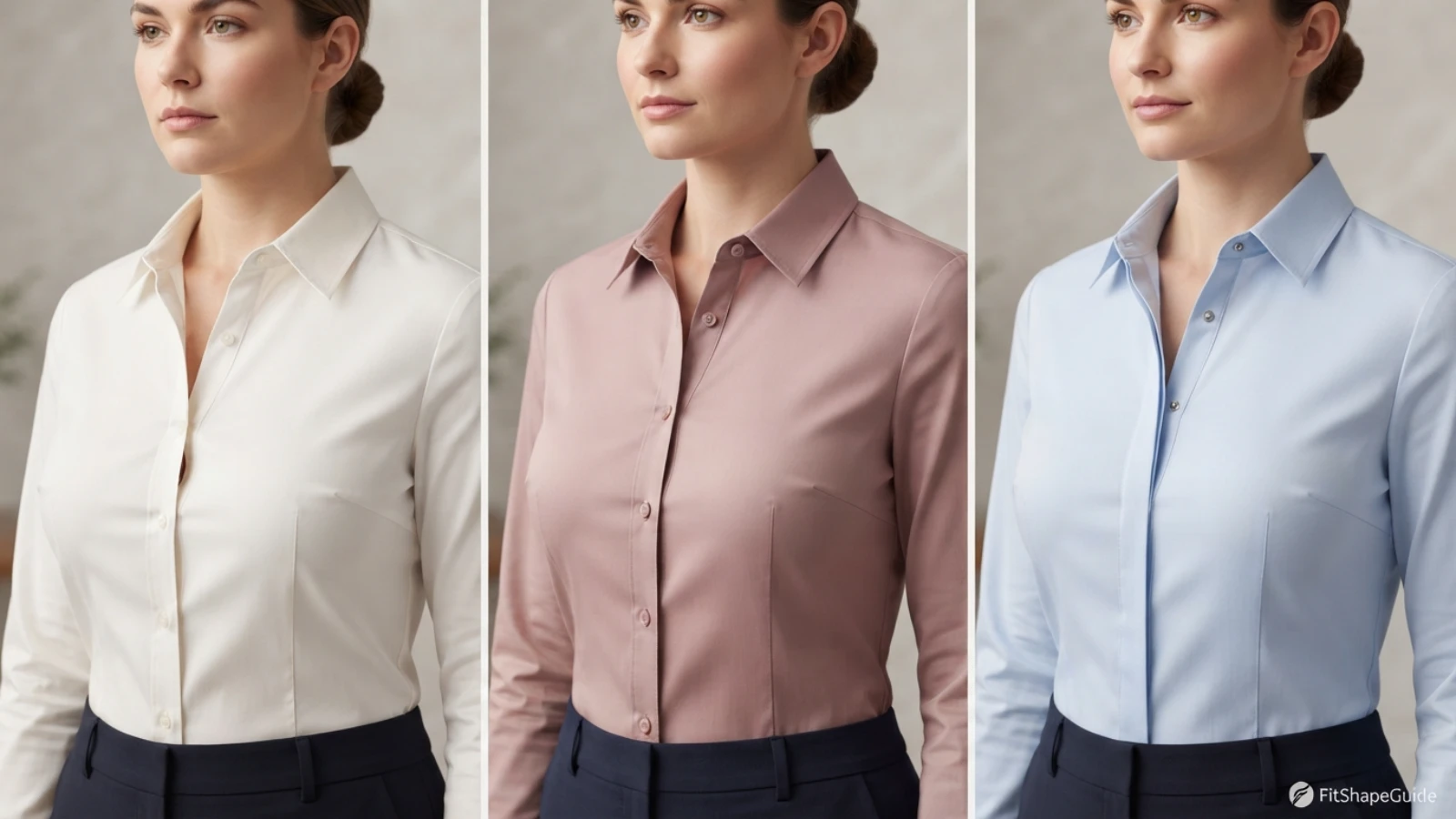
Hidden button versus hidden snap
A button uses a stitched buttonhole and normally allows a little controlled movement. A snap closes faster and creates a cleaner concealed point, but a weak snap can release suddenly while an overly strong one can strain the surrounding fabric. Neither system is universally superior. The best one is correctly positioned, securely attached and supported by adequate shirt volume.
Buttonholes, stitching and replacement
Look for dense stitching around buttonholes, secure bar tacks where needed and a spare button. Test a hidden closure several times before removing tags. If the fabric puckers even when the shirt is laid flat, the placket construction may be unstable. If it puckers only when worn, investigate fit before blaming the sewing.
Fabric, stretch, opacity and recovery
Fabric can improve comfort, but it does not create missing pattern volume. A small amount of elastane in cotton poplin can make desk movement easier. Mechanical stretch can come from yarn or weave structure without a high stretch-fiber percentage. Soft rayon-like cloth may drape around curves, while crisp cotton communicates more conventional office formality. Each choice changes how clearly strain shows.
Recovery is the ability to return after stretching. Test it by gently extending a small section across the grain, holding briefly and releasing. A useful office shirt returns close to its original width and does not remain rippled. Thin fabric that stretches easily but does not recover may look smooth for ten minutes and then develop waves around buttons, elbows or the back.
| Fabric/construction | Main advantage | Watch for | Best use |
|---|---|---|---|
| Stretch cotton poplin | Crisp appearance with controlled movement | Sheerness, noisy hand or weak recovery | Formal office, blazer layering |
| Oxford or broadcloth | Stable placket and durable structure | Limited give and bulky layering | Classic workwear and uniforms |
| Twill | Diagonal weave can feel substantial and opaque | Weight, heat and a less crisp collar | Cool-season workwear |
| Viscose/rayon blend | Fluid drape reduces rigid bridging | Shrinkage, wrinkling and placket collapse | Business-casual styling |
| Linen blend | Breathability and relaxed texture | Wrinkles, transparency and limited recovery | Warm-weather casual offices |
| Polyester blend | Easy care and wrinkle resistance | Heat retention, static and shine | Travel or uniform rotation |
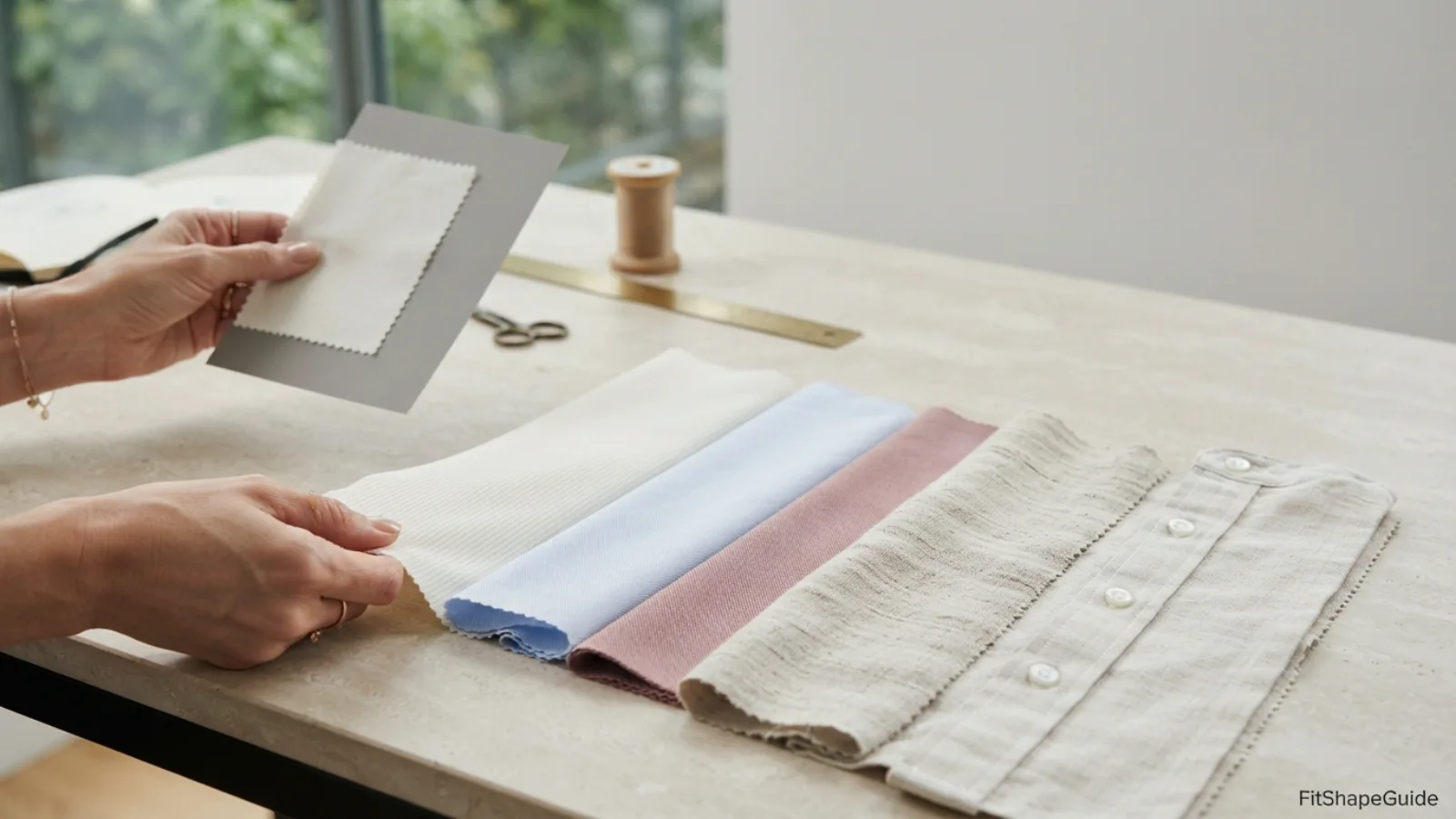
Check opacity before the office
White and pale shirts can become more transparent where the fabric stretches. Assess the shirt in daylight over the intended bra or camisole and again when seated. A close skin-tone base layer often shows less than bright white beneath white fabric. The aim is a combination that feels appropriate for the individual workplace, not a rule that everyone must add another layer.
Wash behavior matters
Cotton may shrink, rayon can change dimensions and interfacing may react differently from the main fabric. Follow the care label from the first wash. If the fit is close before laundering, leave a realistic shrinkage margin or choose a fabric whose care and stability are easier to verify. Recheck the placket after washing rather than judging only the new garment.
Shoulders, armholes, sleeves and desk movement
A shirt can close neatly while still restricting the upper body. The shoulder seam should generally end near the intended shoulder point unless the design is deliberately dropped. When sizing up causes the seam to fall down the arm, the sleeve head may rotate and create new pulling. A fuller-bust-specific shirt aims to keep the shoulder scale while increasing useful room in front.
Armholes influence both reach and bust tension. A very low armhole may feel roomy when standing but lift the whole shirt when the arm rises. A shallow armhole may cut into the front of the arm or send diagonal folds toward the chest. The useful armhole allows forward reach without dragging the placket sideways.
For sleeves, bend the elbows as if typing and reach for an imaginary steering wheel. The cuff should not pull hard, the sleeve should not twist, and the back yoke should allow the shoulder blades to spread. A back pleat can add movement, but too much central volume may balloon when tucked.
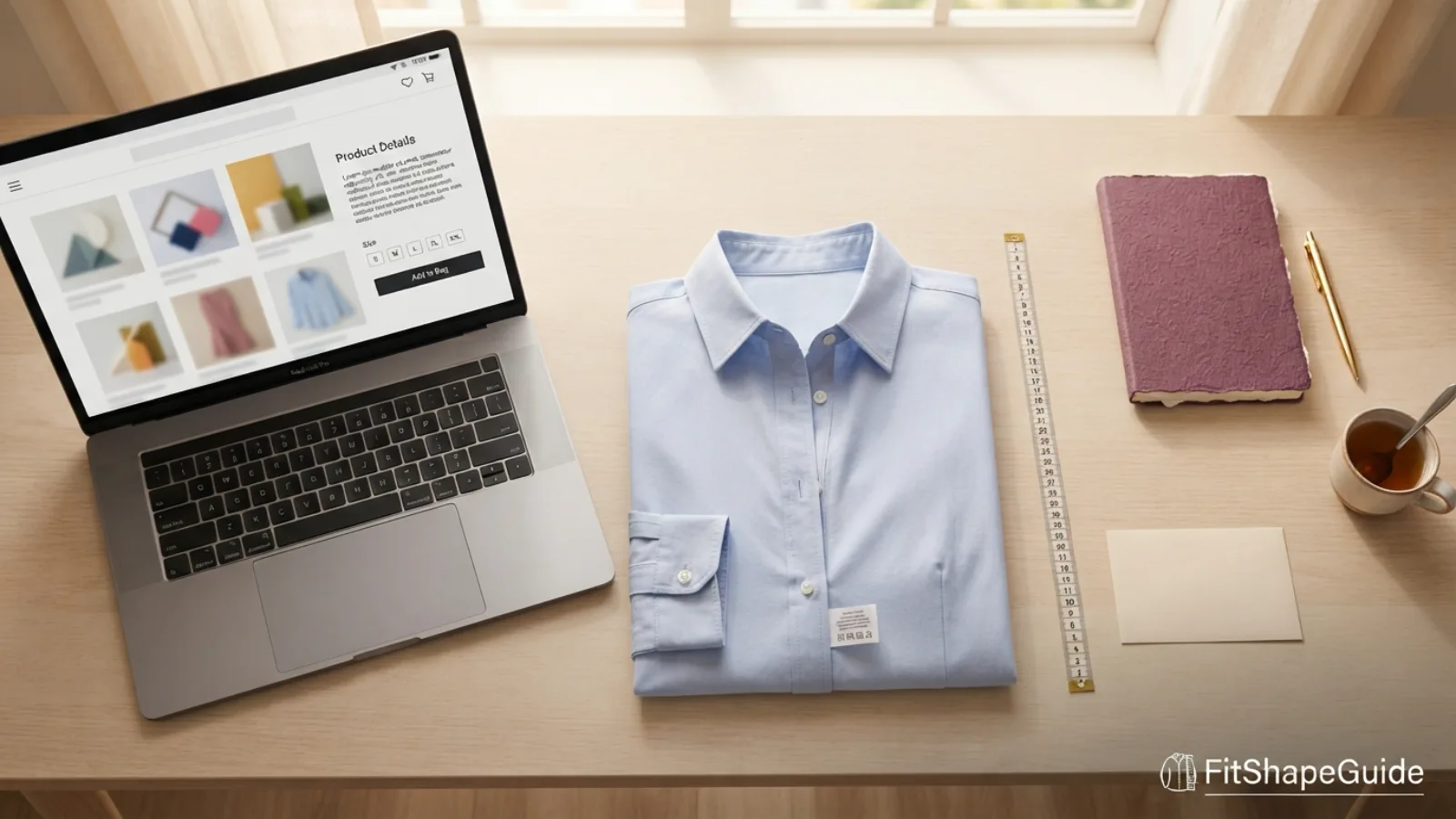
The seated minute
Sit in a typical work chair for at least a minute. Breathing should remain unrestricted. Check whether the placket pulls forward, the collar moves back, the hem rides above the waistband or the lower buttons spread. Repeat with a light blazer if that is the normal outfit. The office-focused guide to dressing a large bust for work can help coordinate movement, formality and layering.
Office styling, bras, tucking and layering
The same shirt can behave differently with different foundations and styling. Test the garment with the bra that will be worn most often because cup shape, projection and seam texture change how the shirt front sits. This is not an instruction to make the body smaller; it is a compatibility check between two garments.
Under a blazer
Choose a collar that fits comfortably inside the blazer neckline and sleeves that slide through the lining without twisting. Excessively wide cuffs or bulky dropped shoulders can bunch. The blazer must not be used as a clamp to hide a strained shirt. Start with a shirt that remains secure on its own, then use the work-blazer guide to check lapel, shoulder and seated compatibility.
Tucked into trousers or a skirt
A full tuck stabilizes the hem but can pull the front downward if the shirt is too short. Raise both arms after tucking, then let them fall and see whether the shirt has enough length to resettle. A bodysuit-style shirt stays tucked but must be long enough through the torso and comfortable when seated. A half tuck suits relaxed offices but should look intentional rather than conceal a lower-placket fit problem.
Worn open as a light layer
An open shirt over a shaped shell removes closure strain and can be a practical styling choice. The fronts should still hang vertically rather than swing backward from insufficient chest depth. This approach changes the garment’s job; it does not prove that a shirt fits when buttoned.
Neckline and button placement
Leaving one or two upper buttons open can create breathing room and a longer vertical line, provided the opening is secure and office-appropriate for the wearer. Do not rely on opening a button that is already under strain. A moderate V created by the collar is different from a forced diamond-shaped gap between closed buttons. Broader outfit principles appear in How to Dress a Large Bust.
How to buy a no-gape shirt online
Product copy may use “curve,” “stretch,” “tailored,” “relaxed” or “no-gap” without explaining the pattern. Read the size chart and construction details separately. A body chart tells you whom a size is intended to fit; a garment chart tells you the shirt’s actual dimensions. When both exist, garment bust minus body bust provides a rough view of total ease, but it does not show how much room is placed in the front rather than the back.
- Confirm closure: hidden button, hidden snap, continuous concealed placket or ordinary buttons only.
- Find shaping: side darts, vertical darts, princess seams, curved panels, back darts or pleats.
- Read fabric percentages: identify whether stretch is stated and whether reviews mention recovery after wear.
- Check model evidence: use the same shirt shown on several sizes when available; do not infer fit from one pose.
- Inspect length: compare shoulder-to-hem and sleeve measurements with a shirt that already works.
- Review care: determine whether washing could reduce a close-fitting margin.
- Verify returns: confirm the return window, final-sale status, shipping cost and whether trying over a base layer is allowed.

For a complete work capsule, coordinate the shirt with a compatible dress option from the work-dresses guide. This avoids buying several tops that all solve the same occasion while leaving other office needs uncovered.
Alterations, emergency fixes and when to return the shirt
A tailor can add a discreet snap or button where a well-fitting shirt has a small gap. This is a targeted closure alteration, not a substitute for major missing room. More involved options include releasing usable seam allowance, adding a modesty panel or reshaping the waist after buying enough bust room. Feasibility depends on the fabric, seam allowance, print and original construction.
| Problem | Potential fix | Best when | Return instead when |
|---|---|---|---|
| Small opening between otherwise calm buttons | Add hidden snap or button | Placket stays vertical and movement is comfortable | Strong X-folds remain around the closure |
| Bust fits but waist is very loose | Take in back/side seams or add darts | Shoulders, sleeves and hips already fit | Required reshaping would distort pockets or hem |
| Minor static cling or transparency | Compatible base layer and garment care | Fit and temperature remain comfortable | Layering creates heat or more placket strain |
| Lower placket pulls over hips | Open lowest button, add side vents or adjust hem | Work dress code permits and upper shirt fits | Hem continually rides or twists |
| Collar is slightly open | Move button minimally or add collar stay | Neck remains comfortable | Collar is being dragged backward by front strain |
| Severe pulling with restricted breathing | No quick fix | Not applicable | Return and choose more front volume |
Safety pins and fashion tape
A safety pin can help in an unexpected moment, but it may puncture delicate fabric, rotate visibly or open under strain. Fashion tape works best on clean compatible surfaces and should be patch-tested; it is unreliable on some textures and in heat. Neither solution should carry continuous structural tension through a full workday.
Why sizing up is not always the answer
Sizing up may be correct when every area is consistently small. It is less useful when only the bust lacks space and the larger size drops the shoulders, lowers the armholes and adds excessive waist volume. In that case, choose a different pattern or buy for the bust and plan a realistic waist alteration. The decision should be based on the whole shirt, not loyalty to a size label.
Final verdict
The best button-down shirts that don’t gape combine enough front depth with a closure positioned at the real pressure point. For most formal workplaces, a fuller-bust or well-darted shirt with a reinforced placket and hidden chest button is the strongest starting point. Stretch poplin with hidden snaps adds movement tolerance, while a shaped popover or controlled relaxed shirt works well when the dress code allows a softer look.
Judge the result while buttoned, seated and reaching. A closed placket is not enough if the shirt still shows hard diagonal folds, pulls the collar backward or restricts breathing. Choose construction before size labels, verify fabric recovery and opacity, and return a shirt that needs constant monitoring.
Frequently asked questions
What makes a button-down shirt less likely to gape?
Enough front bust room, targeted darts or seams, a stable placket and a hidden closure between visible buttons reduce the main causes of gaping.
Do hidden buttons completely solve shirt gaping?
No. They prevent separation at one point, but strong diagonal folds or restricted movement still indicate that the shirt may lack enough room.
Should I size up in a button-down shirt for a large bust?
Size up when the whole shirt is small. If only the bust is tight and the larger size drops the shoulders, choose targeted front shaping instead.
Is stretch cotton good for a no-gape work shirt?
Controlled stretch can improve movement, but the fabric should recover after stretching and the pattern must still provide adequate bust depth.
Why does my shirt gape only when I sit down?
Sitting changes torso length and pressure at the waist and hips, which can pull the placket downward or outward and expose a marginal fit.
Can a tailor fix a gaping button-down shirt?
A tailor can add a hidden snap or button for a small gap, but major pulling usually needs more fabric or a differently shaped shirt.
What should I wear under a slightly sheer work shirt?
A smooth, close-to-skin-tone camisole or compatible bra often reduces contrast, provided the extra layer does not increase heat or tightness.
How should I test a no-gape shirt before keeping it?
Wear the intended base layer, close every button, breathe fully, cross the arms, reach forward, sit for one minute and check recovery afterward.
Editorial and verification standards
This guide evaluates observable construction: bust room, darts, princess seams, placket reinforcement, button spacing, hidden closures, fabric stretch and recovery, shoulders, armholes, sleeves, length, care and returns. It does not treat “curvy,” “stretch” or “no-gap” as a universal fit guarantee.
Current construction examples were checked against official pages for the PerfectDD Classic Button Down, which describes added bust room and a hidden chest button; the Lands’ End No Gape Long Sleeve Stretch Shirt, which identifies a concealed anti-gape closure; and the Universal Standard Elbe Stretch Poplin Shirt, which lists hidden snaps, stretch poplin and fabric composition. These are evidence of construction approaches, not promises that one product fits every body.
Before publishing a product module, verify the direct live seller, exact variant, size chart, garment measurements, closure, shaping, fabric, care, workplace suitability and returns. Affiliate relationships should be disclosed clearly and close to recommendations under the FTC endorsement guidance.
“Best” means suitable for an individual bust shape, shoulder scale, torso length, workplace, base layer, climate and movement needs—not a universal ranking or fit guarantee.