Best Wrap Tops for a Large Bust
A construction-led buying guide to crossover panels that stay closed, ties that define rather than compress, fabrics that recover, and necklines that work with a real bra and a moving body.
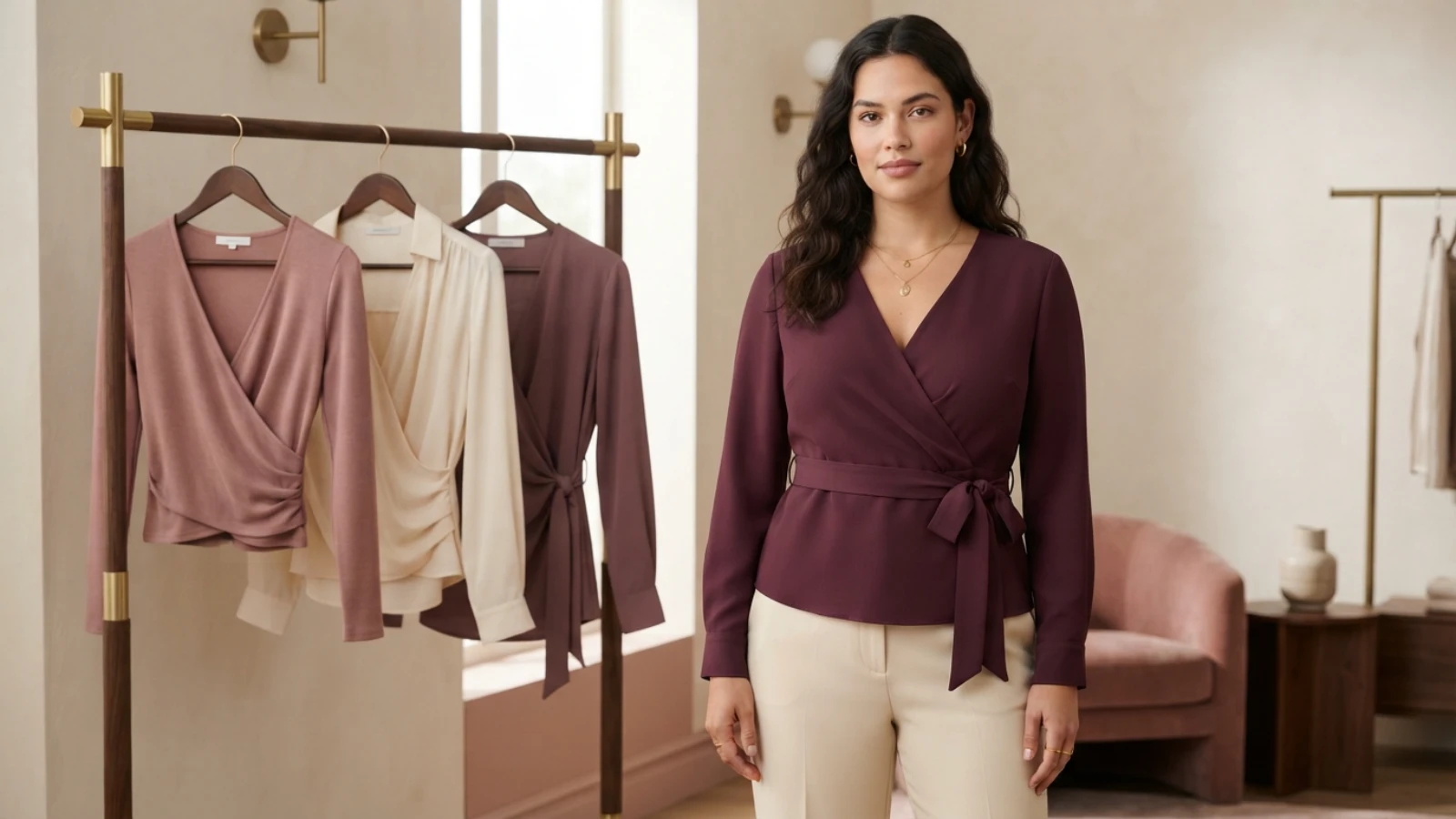
The best wrap tops for a large bust are not simply V-neck tops with a belt attached. A successful wrap is a small piece of garment engineering: two front panels must cross far enough to cover the bra and remain closed, the neckline edge must resist stretching, the bust needs three-dimensional room, and the tie must anchor the garment without cutting across breast tissue. When one relationship is wrong, the familiar problems appear—gaping during conversation, a neckline that drops when you sit, side seams pulled forward, a tie that creeps into the underbust crease, or a front hem that becomes much shorter than the back. This guide turns those symptoms into buying evidence. It compares true and faux wraps, panel overlap, surplice depth, modesty solutions, tie position, fabric recovery, bust shaping, bra compatibility, garment measurements, movement tests, alteration limits, and realistic wardrobe value. It also leaves product modules empty until an actual listing can be checked, so a flattering photograph is never presented as proof of fit.
The wrap-top keep-or-return test
Check these eight points with the intended bra before price, color, or a discount influences the decision.
- The crossover covers the center and cup edges of the bra in front and three-quarter views.
- The panels retain meaningful overlap when you sit, lean, reach forward, and turn.
- The neckline edge lies flat without rolling, stretching, or pulling toward the fullest bust.
- The tie or fixed waist seam sits below breast tissue and stays level around the torso.
- The bust has enough forward depth, so side seams remain close to vertical.
- The shoulders and armholes fit without being oversized merely to gain bust room.
- The fabric remains opaque and recovers after the crossover is gently opened and released.
- The complete outfit works for its real wearing time without constant neckline monitoring.
Best wrap tops for a large bust by type and purpose
“Wrap top” describes several different patterns. Some genuinely open and cross around the body; others imitate the diagonal line but are sewn closed. Some place the anchor at the natural waist, while others pull from a high underbust seam. The best wrap tops begin with the version whose adjustment and security match the occasion. These six archetypes are shopping filters, not product recommendations; a verified item still needs measurements, current availability, and a clear return policy.
True wrap woven blouse
Best for: adjustable waist definition and polished outfits.
A true wrap opens completely, threads or crosses one tie through a side opening, and closes with an outer tie. It can accommodate a difference between bust and waist because tension is adjustable. Look for broad front panels, bust darts or released gathers, reinforced tie points, and a side opening that does not stretch. Narrow panels may look adequate while standing but separate when seated. A fluid crepe or soft poplin with controlled drape usually holds the diagonal line better than slippery satin.
Faux-wrap knit top
Best for: easy dressing and a neckline that stays fixed.
The crossover is sewn into the side seam or waist seam, so there is no daily rewrapping. This can prevent a panel from opening, but the fixed geometry must already match your bust depth. Medium-weight jersey, rib, or ponte with strong recovery is preferable to thin fabric that grows during wear. Check whether the lower layer extends across the full front; some decorative crossovers only overlap near the neckline and provide little real security.
Surplice top with modesty panel
Best for: office wear, teaching, travel, and controlled coverage.
A modesty panel can be an integrated inset, a reversible snap-in piece, or a fitted underlayer. The most successful version follows the neckline without bridging stiffly between the panels. It should add coverage without pulling the crossover wider or creating a bulky stack at the center. An inset made from the same fabric can look seamless; a contrasting camisole can make the layering intentional. Compare the overall blouse construction with the best blouses for a large bust.
Wrap-front bodysuit
Best for: a smooth tucked line and high-rise bottoms.
The lower body anchors the crossover and prevents a short front hem from escaping the waistband. That stability helps only if the torso length is correct. A bodysuit that is too short pulls the neckline downward and the leg openings upward; one that is too long can bunch at the waist. Look for adjustable snaps, stretch recovery, sufficient back coverage, and a front panel deep enough to remain closed while sitting.
Wrap top with underbust seam
Best for: defined shaping and a small-waist or fuller-bust difference.
A shaped underbust seam can create depth through gathers, darts, or princess panels, then anchor the wrap below the bust. The seam must actually sit under breast tissue rather than across it. If it rides upward, the cups or upper panels are too shallow or the torso length is wrong. This type can be especially effective when the waist is much smaller than the bust, but ordinary small-to-large sizing may not provide enough vertical cup depth.
Longline wrap blouse
Best for: layering, soft waist shaping, and outfit flexibility.
A longer body gives the front panels more vertical distance to cross and provides insurance against a rising hem. It can be tied at the side, wrapped more loosely over a camisole, or worn with a partial tuck when construction permits. Choose side slits or enough hip ease so the lower garment does not push the blouse upward. The tie should be long enough for the intended knot without creating a heavy coil at the waist.
| Type | Primary advantage | Main fit risk | Evidence to verify |
|---|---|---|---|
| True wrap woven | Adjustable waist and overlap | Panels opening in motion | Panel width, tie anchor, side opening |
| Faux-wrap knit | Fixed neckline security | Insufficient built-in bust depth | Recovery, sewn overlap, garment bust |
| Modesty-panel surplice | Controlled coverage | Inset pulling or bunching | Panel attachment and neckline height |
| Wrap-front bodysuit | Smooth tucked line | Torso tension opening neckline | Girth, snap adjustment, front length |
| Underbust-seamed wrap | Three-dimensional shaping | Seam crossing breast tissue | Vertical bust depth and seam position |
| Longline wrap blouse | Length and layering flexibility | Hip restriction pushing top upward | Front length, hem width, side slits |
True and faux construction in the best wrap tops
A true wrap and a faux wrap can create the same diagonal neckline in a product photograph while behaving very differently. A true wrap lets you change how tightly the waist closes and, within limits, how much the panels overlap. That is useful when the bust-to-waist difference is larger than a standard pattern assumes. The adjustment is not unlimited: tying more tightly does not create wider front panels, more bust length, or a higher armhole. Overtightening often pulls the neckline lower and creates diagonal drag lines from bust to waist.
A faux wrap fixes one or both front panels at a seam. The neckline is faster to wear, less likely to open completely, and easier to layer. The tradeoff is that the overlap and waist position cannot adapt. If the sewn crossover lands too low or the upper panel is narrow, sizing up may loosen the shoulders before it provides enough center coverage. Look inside: the best wrap tops use a substantial lower panel extending toward the opposite side seam rather than a small triangular facing that only creates the appearance of overlap.
Hybrid constructions can be useful. Some faux wraps have a functional outer tie that adjusts the waist while the neckline remains sewn. Some true wraps add an internal button, waist stay, or concealed snap to keep the inner panel positioned. Judge each closure by the job it performs. An internal button should hold alignment, not bear so much tension that it strains the fabric. A snap can manage a small clean gap, but it is not a substitute for panel width.
How the best wrap tops keep the neckline covered
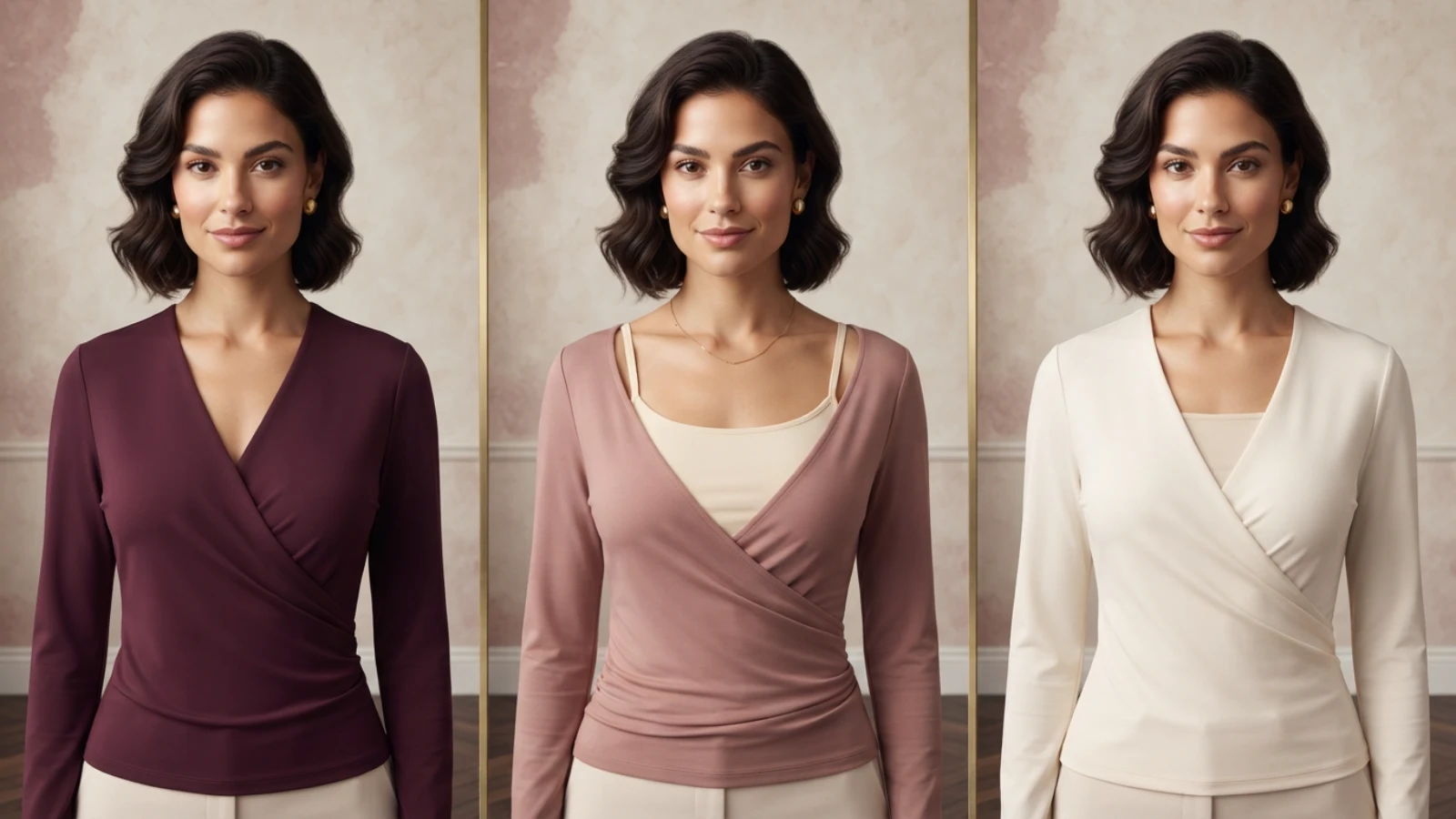
The neckline is controlled by overlap, edge stability, bust depth, and anchor position working together. “Deep V” and “modest V” describe the visible result, not the construction that keeps it there. Begin by tracing each front panel. At the fullest bust, the lower panel should travel far enough across the body that the upper panel still covers it after the fabric curves over projection. A crossover that only meets at the center while the top is flat may separate once worn.
Overlap width is dynamic. Sitting shortens the front torso, leaning changes gravity, reaching moves the shoulder point, and a full breath expands the ribcage. Test all four. If a small shift reveals the bra center or cup edge, the top has no coverage reserve. This is more important than whether a static neckline appears high. A slightly deeper V with broad underlying overlap can be more secure than a higher neckline made from two narrow panels.
Neck-edge stability prevents growth. A narrow facing, stay tape, clear elastic, binding, or double-layer construction can stop the diagonal edge from stretching under the weight of the garment. On knits, gently pull and release the neckline; it should return without rippling. On wovens, inspect whether the bias-cut edge waves. A stretched edge may gape even when the panels are wide enough.
Minor control should remain minor. A discreet snap, hook, or hand stitch can secure a small clean opening when the shoulders, bust, waist, and hem already fit. Place it where the panels naturally meet, not high enough to create a pulling tent. A fitted camisole or integrated inset is better when you want deliberately higher coverage. For broader neckline choices, compare the best necklines for a large bust.
The one-hand crossover test
With the tie comfortably secured, place one hand flat over the crossover and move through sitting, leaning, reaching, and turning. You should feel the panels glide slightly without pulling apart. If you must clamp the neckline closed, the pattern has failed the movement test.
Tie placement and waist tension in the best wrap tops
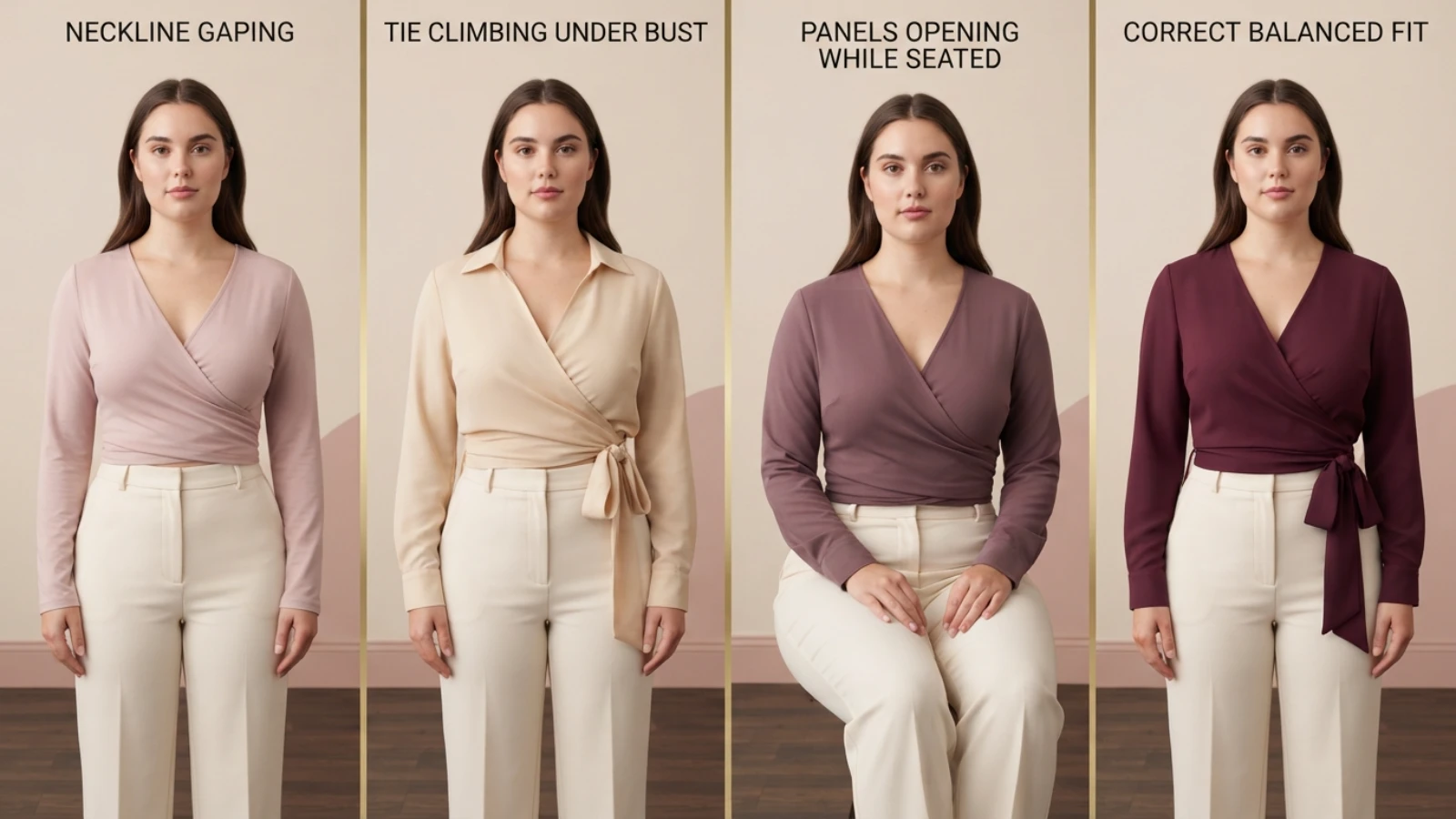
The tie should organize the front panels around the torso, not pull the bust downward. On many successful wraps, the inner panel anchors at the side waist and the outer panel crosses over it before tying at the natural waist or slightly above. The line may visually point toward the waist, but the physical tie should not run across breast tissue. If the tie climbs into the underbust crease, check whether the waist position is too high, the front length is too short, or the bust is pushing the entire garment upward.
Tie tension should be firm enough to keep the waist seam or panel junction level, yet loose enough for a full breath and a seated meal. An excessively tight knot can disguise a loose back or narrow panels in the mirror, then become uncomfortable and drag the neckline lower. Tie the top once at normal comfort, mark the knot position mentally, and retest after ten minutes of movement. A stable design should not require progressively tighter knots.
Examine the anchor hardware. A reinforced fabric loop or bound side opening should lie flat and resist distortion. A tiny unreinforced slit can elongate under tension. Internal buttons should have a secure backing and more than one position when adjustment is promised. Long ties create styling options, but the extra weight can pull on fluid fabric; short ties may force a small hard knot. The best wrap tops provide enough tie length for the designed closure without a bulky coil.
| What you see | Likely geometry issue | Test | Best next move |
|---|---|---|---|
| Tie climbs under bust | Short front or waist point too high | Sit, then check side-waist level | Try longer front or lower anchor |
| Neckline drops when tightened | Tie pulling panels diagonally downward | Loosen one step and reassess overlap | Choose wider panels, not more tension |
| Back waist rides up | Front projection borrowing back length | Check side-seam angle | Seek bust shaping and added front length |
| Inner panel twists | Weak or misplaced internal anchor | Open top and inspect tie path | Use reinforced, correctly placed closure |
| Knot becomes bulky | Heavy or excessively long ties | Try intended knot without doubling | Choose lighter tie or side bow |
| Waist feels tight but top is loose | Wrong shoulder/bust/waist proportion | Compare adjacent size and back fit | Select a shaped cut rather than cinching |
Fabric and bust shaping in the best wrap tops
Wrap tops ask fabric to curve over the bust, cross on the bias or diagonal, remain opaque where layers separate, and return after movement. A beautiful drape without stability can become a growing neckline; a very rigid fabric without darts can stand away from the chest. The best fabric is therefore matched to the pattern.
Medium-weight jersey and rib
A knit can adapt to projection, but it needs recovery. Stretch a hidden section gently and release it. The fabric should return without a pale, shiny, or rippled area. Double-layer front panels improve opacity and edge stability. Very thin jersey may cling to the bra, turn sheer over the fullest point, and curl along the neckline. The relevant comparison is not simply elastane percentage; yarn, knit structure, weight, and finishing all change behavior.
Crepe, viscose blends, and soft poplin
Fluid woven fabrics create a clean diagonal and work well in true wraps when the front includes darts, gathers, or generous panel width. Crepe provides surface grip; smooth satin and some viscose weaves can slide apart more easily. Poplin holds a polished line but needs real shaping because it does not stretch around projection. A lining should share sufficient depth with the outer layer, or it will become the hidden restriction.
Darts, gathers, and princess seams
A dart should point toward the bust apex and end before it, not above, below, or directly on it. Released gathers can distribute volume beneath the shoulder or above an underbust seam. Princess seams offer more precise depth but must curve in the correct place. If all shaping sits toward the side while the bust projects forward, the neckline and tie will compensate. The fabric guide for a large bust explains opacity, recovery, weight, and drape in more detail.
Print placement and seam matching
A diagonal wrap naturally breaks a print. That can create useful movement, but a large motif cut at the fullest bust or mismatched stripe can make the crossover look accidental. Small irregular prints, vertical scatter, and low-contrast patterns are forgiving. A solid color makes construction easier to inspect. Pattern is a style choice, not a rule for making a bust appear smaller; prioritize fit and the visual effect you enjoy.
Bra and modesty layers for the best wrap tops
Fit the wrap top over the bra you intend to wear. A smooth cup often lets the panels glide without catching, while bulky lace can create ridges or friction. The bra center should remain covered at normal posture and during movement. Cup edges should not emerge near the neckline or armhole. If changing to a lower-center bra improves the look, confirm that it still provides the support and separation you require; the fashion top should not dictate an unsuitable foundation.
A camisole is useful when you want higher coverage, temperature flexibility, or a deliberate color layer. Choose a fitted neckline that remains below or clearly above the crossover; an in-between edge can repeatedly peek and disappear. The straps should align with the bra or be intentionally visible. Thin slippery camisoles may rotate beneath a true wrap, while a substantial stretch knit can stabilize the whole front.
Integrated modesty panels vary. A small triangular insert controls the center but may not cover cup edges. A full inner front behaves more like a double-layer top and can improve security, though it adds warmth. Snaps provide flexibility if their placement does not distort the neckline. Avoid safety pins through delicate fabric: they concentrate stress, can open, and often pull the panels into a visible starburst.
Built-in “support” should be treated cautiously unless the top includes defined cups, an underbust band or seam, stable side panels, and sizing that acknowledges bust volume. A loose shelf lining may provide coverage, not lift. The best wrap tops for a large bust work with a clear support plan rather than relying on an ambiguous product description.
Best wrap tops for a large bust by occasion
A wrap that succeeds for a seated dinner may not suit eight hours of typing, a flight, or a day carrying a child. Match the security reserve, fabric, sleeves, and care demands to the activity.
For work and professional settings
Choose a sewn faux wrap, an integrated modesty panel, or a true wrap with broad overlap and a stable edge. Sit at a desk, reach for a keyboard, lean forward, and put on the actual blazer. A low-friction lining and flat side tie reduce bulk beneath tailoring. Pair with a straight trouser or simple skirt so the diagonal neckline remains the intentional focal line.
For travel
A medium-weight knit faux wrap is usually easier than a slippery woven true wrap because it has fewer loose ties and can recover after sitting. Check that a seat belt does not press a bulky knot into the waist. Carry a layer that opens at the front; pulling a fitted sweater over the head can disturb the neckline and tie. Wrinkle resistance matters, but so does the ability to reset the crossover privately and quickly.
For weddings and evening events
A structured crepe wrap, shaped underbust version, or longline blouse can feel polished. Test dining, photographs from multiple angles, dancing, and the coat you will wear. A discreet snap may be helpful when the overlap is already adequate. Fashion tape can steady a clean edge according to its directions, but it cannot add panel width, fix a short torso, or replace a supportive bra.
For weekends and warm weather
Light woven wraps can feel airy, but opacity and wind matter. Hold the doubled and single-layer areas against daylight; the lower panel may not cover the entire front. Choose a tie that stays secure without a heavy knot and sleeves that permit reaching. A camisole can solve transparency, but count the extra layer when judging heat and value.
Diagnose common failures in the best wrap tops
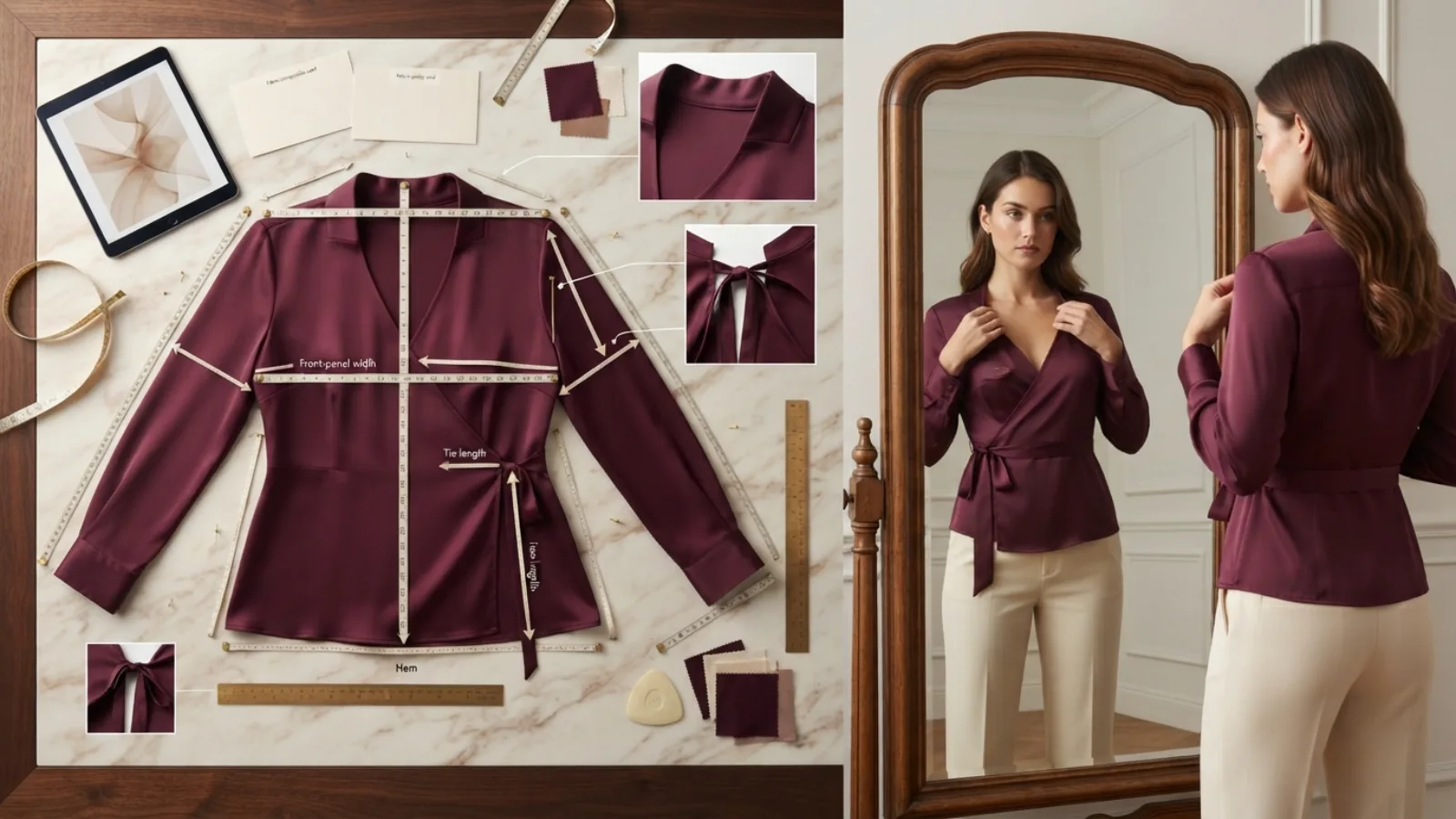
Wrap symptoms are easy to misread because the panels connect neckline, bust, waist, and hem. Gaping may come from narrow overlap, but it may also come from missing bust depth pulling the edge outward. A loose waist may be a size issue, or the bust may have forced you into a size whose shoulders and back are too large. Use the whole garment as evidence.
| Symptom | Likely cause | Try first | Keep, alter, or return? |
|---|---|---|---|
| Neckline gapes while standing | Stretched edge, narrow panel, or loose shoulder | Reset tie and inspect shoulder fit | Minor snap only if overlap is otherwise adequate |
| Panels open when seated | No coverage reserve across bust | Test larger size and wider-panel cut | Return if shoulders become loose |
| Tie cuts across bust | Anchor too high or insufficient front length | Place tie at designed waist without overtightening | Return if it climbs again |
| Side seams rotate forward | Missing front width or projection room | Compare garment bust and shaped style | Usually return; seam rotation is structural |
| Back becomes loose after sizing up | Standard bust-to-back proportion mismatch | Try darts, princess seams, or true wrap | Alter back only if shoulders and armholes fit |
| Front hem rises | Bust borrowing vertical length | Seek added front length or longline style | Return if hem balance is severe |
| Knit edge ripples | Poor recovery or stretched construction | Allow garment to rest, then retest | Return if rippling persists |
| Underlayer bunches | Too loose, slippery, or mismatched neckline | Use fitted camisole or integrated panel | Keep only if top works with practical layer |
Do not build a wardrobe around a rescue kit. A single hidden snap, carefully placed stitch, or compatible camisole can refine a good top. Multiple pins, repeated tape, an overtight knot, and a jacket that must stay closed indicate that the top is not performing. The best wrap tops remain functional without a collection of emergency fixes; a return is an evidence-based decision, not a failure to style creatively.
How to shop for the best wrap tops online
Online listings often provide bust circumference and length but omit the measurements that determine whether a wrap stays closed. Convert visual promises into questions. Determine whether the garment is a true wrap, faux wrap, or hybrid; whether the size chart shows body or garment dimensions; where the crossover is secured; how the fabric stretches; and how returns work after an indoor movement test.
- Begin with a known top. Measure a blouse that fits your shoulders, bust, armholes, front length, and waist placement.
- Identify the wrap type. Ask whether both panels open, whether the crossover is sewn, and whether the outer tie actually changes fit.
- Request panel information. The most useful figure is front-panel width at the fullest bust or the closed overlap at a stated garment bust.
- Separate body and garment charts. Body measurements describe the intended wearer; garment measurements describe the space and ease available.
- Check vertical proportions. Record shoulder-to-bust, shoulder-to-waist, front length, and the actual tie or seam position.
- Read fiber and construction together. Stretch percentage alone does not reveal weight, recovery, opacity, lining, or edge stabilization.
- Inspect every angle. Look for raised front hems, forward side seams, exposed bra edges, neckline ripples, and models holding the front closed.
- Protect the return path. Confirm final-sale status, fees, return shipping, packaging rules, and whether careful indoor try-on is permitted.
| Measurement or fact | Why it matters | How to compare it |
|---|---|---|
| Front-panel width at bust | Predicts coverage reserve | Compare with your horizontal bust span and known wrap |
| Closed bust circumference | Shows total space at stated overlap | Confirm whether relaxed or stretched |
| Crossover depth | Predicts center and bra coverage | Measure shoulder point to crossing point |
| Shoulder-to-waist length | Shows whether tie can sit correctly | Measure over the intended bra |
| Front and back length | Reveals bust-length allowance | Compare both, not center-back only |
| Tie length and anchor | Determines closure and knot bulk | Ask for each tie length and side opening position |
| Fabric weight and lining | Affects opacity, drape, and edge stability | Read composition, lining, close-ups, and care |
| Return terms | Protects movement-based fitting | Check deadline, fees, and final-sale exclusions |
The U.S. Federal Trade Commission explains the information generally required on covered textile labels in its textile labeling guidance. Wraps with ties, lining, elastic, snaps, or delicate bias edges may have specific cleaning needs, so also read the FTC’s care-label guidance and the garment’s actual label. Composition helps compare products, but it does not prove fit or recovery.
What tailors can change on the best wrap tops
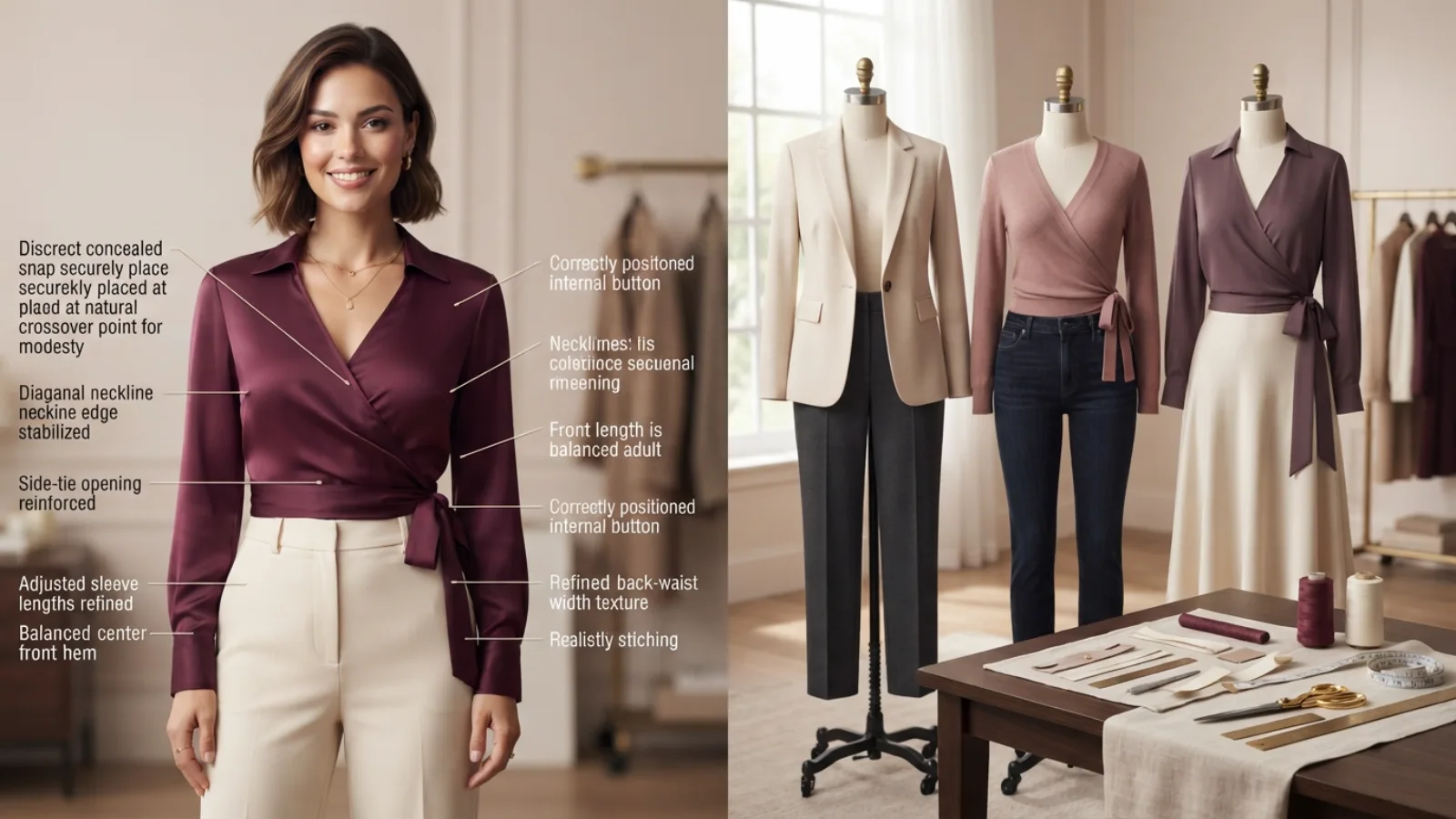
A tailor can often add a discreet snap, reinforce a tie opening, shorten an excessively long tie, stabilize a stretched neckline edge, reduce a loose back or waist, refine sleeve length, or add a modesty panel. These are refinements when the shoulders, armholes, bust capacity, and main overlap already work. A skilled tailor may also move an internal button or add a second position, provided the new tension does not distort the front.
Major limitations include panels that are too narrow, a crossover cut fundamentally too low, a short front with no hem allowance, an underbust seam sitting across breast tissue, or darts far from the bust apex. Adding invisible width to a diagonal front edge is difficult. Recutting both panels, lining, and ties may cost more than choosing a better pattern. Review the tailoring guide for a large bust before treating a final-sale bargain as a simple project.
Bring the intended bra and camisole to the fitting. Tie the top at normal comfort and demonstrate the exact movement that causes the issue. Ask how the alteration changes overlap while sitting, not only while standing. A technically possible fix is worthwhile only when the complete cost, time, and risk compare favorably with a return.
How to style, care for, and value the best wrap tops
The diagonal neckline already creates direction and the tie creates a focal point, so the rest of the outfit can support those lines. The aim is not to “minimize” a fuller bust. It is to keep the clothing intentional, balanced, and functional.
Build a clean lower line
High-rise straight trousers, wide-leg pants, A-line skirts, and simple jeans give the wrap a stable visual base. Place a side knot where it does not compete with a belt loop or pocket. A true wrap can sometimes be tied at the back, but only if the pattern permits equal tension and the knot remains comfortable when seated. For complete outfit strategy, use the guide to dressing a large bust.
Layer without disturbing the crossover
An open blazer, cardigan, trench, or soft jacket preserves the diagonal line and avoids compressing the knot. Check that the outer layer has enough bust and armhole room; closing a narrow blazer over a dimensional tie can push the wrap open. A fitted camisole beneath and an open layer above can make a low wrap suitable for more settings. The layering guide for a large bust offers more combinations.
Use accessories to continue, not clutter, the line
A short necklace sitting clearly above the V or a longer pendant ending clearly below the bust avoids collision with the crossover. Side-tied wraps may need little more than earrings. A belt is usually unnecessary when the tie already defines the waist; stacking both can create bulk and restrict adjustment.
Protect the bias edge and tie
Follow the care label. Fasten internal buttons and loosely tie long straps before placing the garment in a laundry bag when permitted, so they do not twist around other items. Avoid hanging a heavy wet knit from the shoulders, and do not iron a stretched diagonal edge into a permanent wave. Store ties untangled and check that hooks or snaps cannot snag the front panels.
Calculate complete cost per successful wear
Add any required camisole, tailoring, return shipping, and special cleaning to the purchase price. Then count realistic outfits and occasions. The best wrap tops earn value through secure repeat wear, not through the lowest ticket price. A moderately priced faux wrap that works with your existing bra, trousers, and jacket may outperform a dramatic bargain that needs a new underlayer and constant adjustment.
Buy overlap and geometry, not the wrap label
The best wrap tops for a large bust combine meaningful panel overlap, a stable diagonal edge, real projection room, a waist anchor below breast tissue, adequate front length, bra-compatible coverage, and fabric that recovers. Decide between true and faux construction according to the adjustment you need. Keep the top only when it remains covered, level, and comfortable through sitting, reaching, leaning, and layering.
FAQs about the best wrap tops for a large bust
Are wrap tops good for a large bust?
Yes, when the crossover has enough overlap, the neckline is controlled, the waist anchor sits below rather than across the bust, and the fabric has enough body to recover. A good wrap top creates adjustable definition without exposing the bra, compressing the bust, or needing constant neckline correction.
What type of wrap top is best for a large bust?
A true wrap blouse with generous front panels, a shaped faux-wrap knit, or a surplice top with a discreet modesty panel are dependable starting points. The best choice depends on how much adjustability, cleavage control, waist definition, bra coverage, and movement security you need.
Is a true wrap or faux wrap top better for a fuller bust?
A true wrap offers adjustable waist tension and overlap, but it can open during movement if the panels are narrow. A faux wrap keeps a fixed neckline and is easier to put on, but its bust depth cannot be adjusted. Choose according to the actual panel width, fastening system, fabric, and your proportions rather than the label alone.
How do I stop a wrap top from gaping at the neckline?
Start with a style that has deeper overlap, a stable neck edge, enough bust depth, and an anchor below the bust. A hidden snap or small stitch can control a minor gap when the rest fits correctly. Fashion tape cannot solve panels that are too narrow or a neckline pulled open by an undersized bust area.
Should I size up in a wrap top for a large bust?
Size up when the panels barely overlap, the neckline opens under light movement, the side seams rotate forward, or the front hem rises sharply. Do not size up automatically if the shoulders, armholes, and waist become unstable. When adjacent sizes exchange one failure for another, choose a different cut.
What should I wear under a low wrap top?
A smooth bra whose center and cup edges remain concealed is the foundation. For additional neckline coverage, use a fitted camisole, a purpose-made modesty panel, or a reversible insert that lies flat under the crossover. The underlayer should not bunch, compete with the tie, or pull the front panels apart.
Where should the tie sit on a wrap top?
The tie should usually anchor at the natural waist or slightly below the underbust, depending on the pattern, without cutting across breast tissue or sliding into the underbust crease. It should define the torso while allowing normal breathing, sitting, and eating. A tie that must be overtightened is compensating for poor panel geometry.
What measurements matter when buying a wrap top online?
Compare bust or underarm width, front-panel width at the fullest bust, crossover depth, shoulder width, armhole depth, front length, waist position, tie length, side-seam height, and hem width. Confirm whether the chart shows body or garment measurements and whether a true wrap is measured open, closed, or at a stated overlap.