Best Crop Tops for a Large Bust
A construction-first guide to balanced crop length, bust projection, bra coverage, neckline stability, opaque fabric, movement, and high-rise outfit pairing.
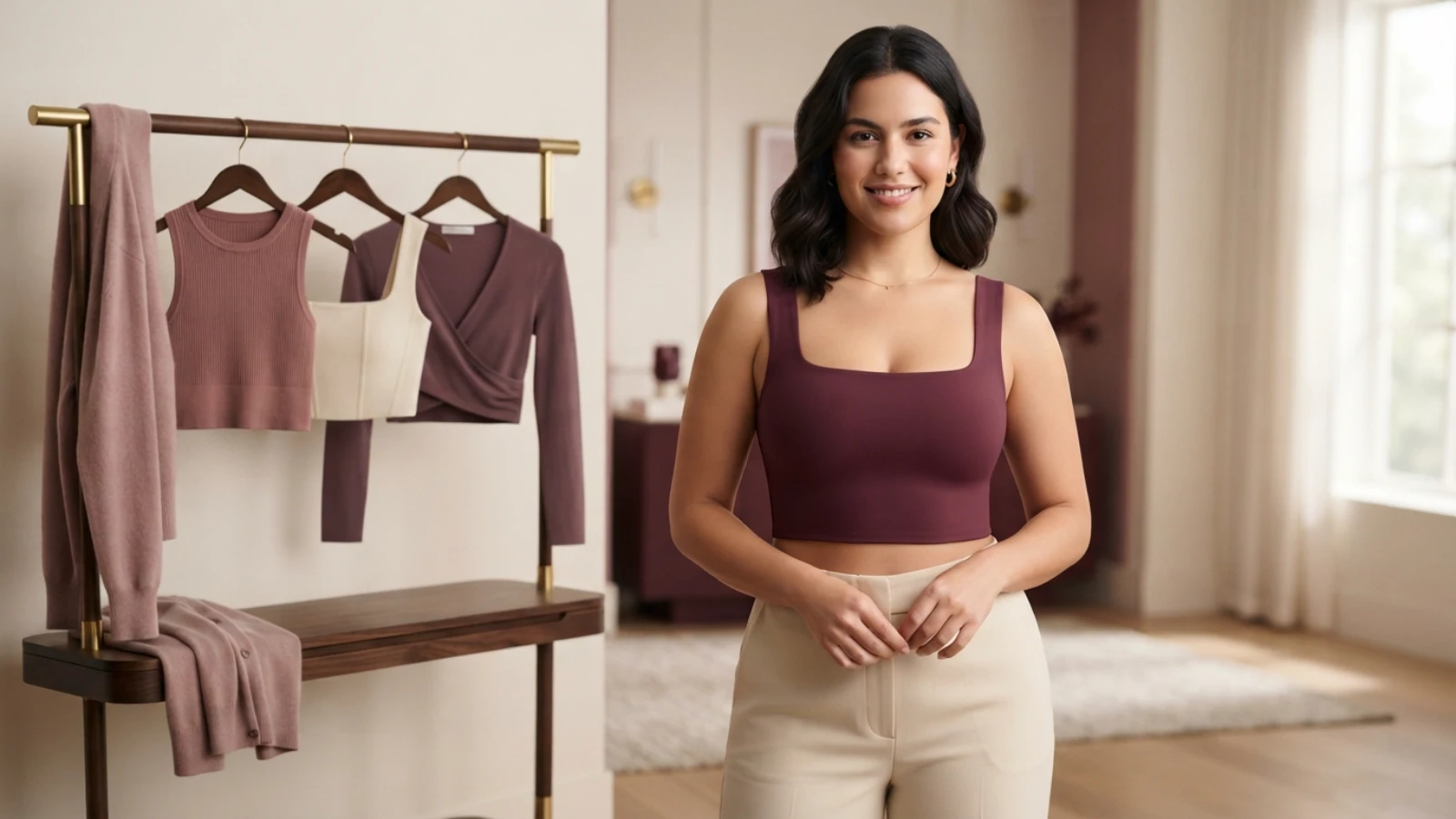
The best crop tops for a large bust are not simply ordinary tops cut shorter. Bust projection changes where a short garment lands: fabric travels forward and down over the fullest point, which can make the center-front hem appear much shorter than the back. If the pattern lacks front room, a crop top may ride beneath the bust, expose more midriff than intended, spread at the neckline, pull at the armholes, turn sheer, or rotate its side seams toward the front. Sizing up may restore width but create loose shoulders, a gaping back, and an unstable hem. A more reliable crop has enough finished chest room, sufficient center-front length, a neckline and sleeve or strap system that works with the intended bra, and a lower edge designed for the body area where it lands. This guide compares six practical constructions, explains how crop length interacts with high-rise bottoms, shows how to shop from garment evidence, and separates small alterations from pattern failures. Product modules remain private until current listing details, measurements, materials, return terms, and availability are verified. No Amazon product, ASIN, price, rating, review, or wear claim is invented.
The 60-second crop-top fit test
Wear the planned bra and bottom, relax the garment, and inspect it from front, side, and back before adjusting anything.
- The neckline stays centered and at the intended height without spreading or being dragged downward.
- Straps, sleeves, armholes, and back cover the intended parts of the bra.
- The fabric remains opaque and the knit, rib, or print does not visibly distort at the fullest point.
- Side seams remain near vertical rather than sweeping sharply toward the bust.
- The front hem lands where expected and does not rise dramatically above the back hem.
- The lower edge is secure but does not cut into breast tissue or roll underneath the bust.
- Reaching, sitting, and turning do not cause the entire top to migrate upward.
- The selected waistband gives the wearer the preferred overlap, small gap, or midriff exposure.
Best crop tops by construction and wardrobe need
The best crop tops for a large bust solve a specific length and support problem. A casual rib crop that follows the body behaves differently from a darted woven crop that holds its own shape. An active crop may be engineered for movement, while an occasion top may prioritize neckline and surface finish. Start with how much coverage, support, and waistband interaction the outfit needs; then compare the evidence inside that category.
Longline waist-skimming crop top
Best for: first-time crop wearers, high-rise bottoms, work-casual layers, and controlled coverage. Look for a hem designed to meet the natural waist or top of the waistband after passing over bust projection. The trade-off is that a style may look almost full length on a short torso, so buy by center-front measurement rather than the word longline.
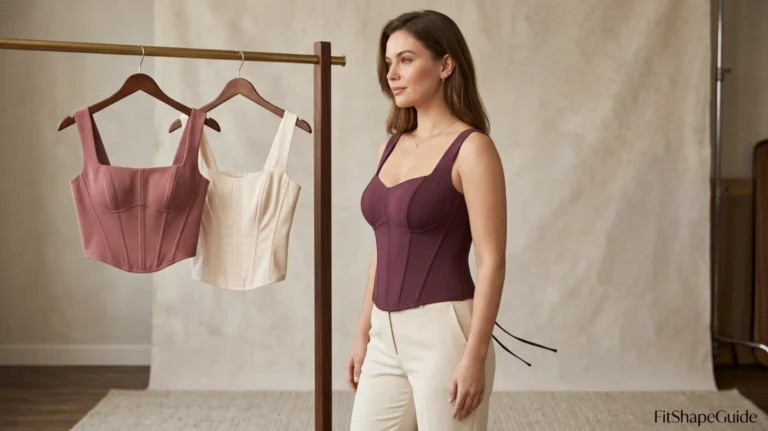
Structured square-neck crop top
Best for: polished outfits and clear neckline framing. Princess seams, darts, a lined front, reinforced corners, and wide straps can create space without excessive stretch. The trade-off is precision: if the bust point, neckline width, or underbust seam is misplaced, sizing up rarely corrects the pattern.
Resilient rib-knit crop top
Best for: close casual fits, easy layering, and stretch-based comfort. Dense ribs should expand without losing their channels and recover after wear. The trade-off is transparency, shine, bra texture, and upward migration when the knit is too thin or the hem is too tight.
Wrap or crossover crop top
Best for: adjustable neckline styling and defined waist placement. A true wrap offers some circumference control, while a faux wrap is often more stable. The trade-off is coverage: the crossover must remain deep enough during sitting and reaching, and the tie should anchor below rather than across breast tissue.
Boxy woven crop shirt
Best for: breathable warm-weather outfits and a relaxed architectural line. Shoulder fit, hem width, armhole room, and enough front length matter more than waist shaping. The trade-off is visual and physical volume; a perfectly intentional box can become a tent when the front lacks drape or the hem catches on the bust.
Supportive active crop top
Best for: activities within the garment’s verified support design. Look for a stable underbust anchor, real cup depth or compatible bra room, strong straps, secure edges, and activity-specific testing. The trade-off is that many fashion crops use the word supportive without offering the sizing architecture required for a fuller bust.
| Wardrobe role | Strong starting point | Evidence to verify | Main trade-off |
|---|---|---|---|
| Controlled everyday coverage | Longline waist crop | Center-front length and hem position | May read as regular length on short torsos |
| Polished neckline | Shaped square-neck crop | Darts, lining, strap placement | Requires precise pattern fit |
| Close casual fit | Dense rib crop | Opacity and recovery | Can cling, shine, or migrate |
| Adjustable styling | Wrap or faux-wrap crop | Overlap depth and tie anchor | Coverage can change with movement |
| Relaxed summer layer | Boxy woven crop | Shoulder, hem width, front balance | May bridge outward from bust |
| Exercise or high movement | Purpose-built active crop | Band, depth, straps, activity rating | Fashion claims may exceed construction |
How the best crop tops balance front length and waistband height
The best crop tops for a large bust make exposure predictable. That does not mean every hem must be level or every outfit must hide the midriff. It means the garment keeps its intentional line after the wearer breathes, sits, reaches, and turns. To plan that line, combine a garment measurement with the rise of the chosen bottom rather than judging the top and bottom separately.
Measure center-front length, not only shoulder-to-hem
Retailers often state a single length measured from the high shoulder point, but the route and sample size may be unclear. Ask for center-front length from the neckline edge or shoulder reference to the hem, then compare it with a top that already lands well. A deeper neckline can make a neckline-to-hem figure look shorter even when the shoulder-to-hem length is similar, so use the same reference points.
Bust projection consumes visible front length
When the pattern lacks shaping, the front travels outward over the bust and takes a shorter route to the hem beneath it. That creates front lift and may angle the side seam. Darts, princess seams, extra front length, stretch, or a deliberately boxy hem can manage projection in different ways. None is automatically best; the evidence is whether the intended hem survives movement.
The waistband should meet the crop in motion
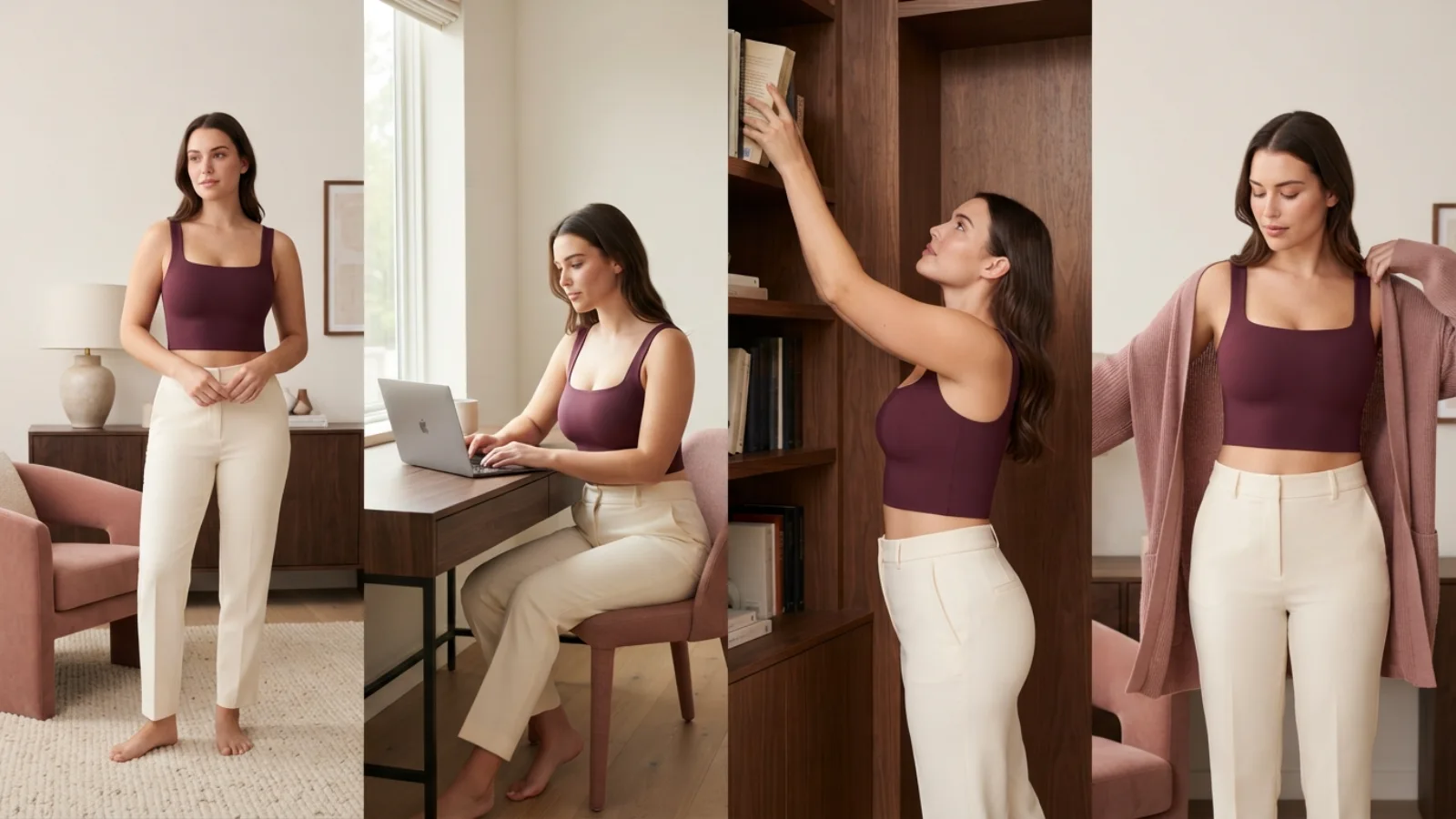
Stand relaxed, sit, raise both arms, and reach forward. A high-rise waistband rises and falls differently across the front, side, and back when seated. Decide whether the outfit should overlap, meet, or reveal a measured gap. A one-inch standing overlap can disappear when reaching, while a very rigid waistband may push a narrow crop hem upward.
A hem band is useful only when it lands correctly
A broad elasticized or ribbed band can stabilize the lower edge, but it should not sit on breast tissue or squeeze the rib cage merely to keep the top down. The band should recover without rolling and have enough circumference for its landing point. If the crop body is too short, a stronger band may make the failure more uncomfortable.
| Preferred outfit result | Crop length to test | Bottom to wear during fitting | Movement check |
|---|---|---|---|
| Full standing overlap | Waist-skimming longline crop | Actual high-rise waistband | Overlap remains acceptable while seated |
| Hem meets waistband | Natural-waist crop | Firm or soft rise planned for outfit | No unexpected gap after reaching |
| Small controlled gap | Measured above-waist crop | Exact rise and belt if used | Gap stays within preference while turning |
| Deliberate midriff exposure | Short crop with stable lower edge | Any chosen rise | Hem does not trap beneath bust |
| Under-jacket work layer | Longline crop with secure hem | Seated-work waistband | No rolling during extended sitting |
How the best crop tops use structure, stretch, and recovery
Short garments have less fabric below the bust to counter upward movement, so material behavior matters. The best crop tops remain opaque over the fullest point, recover at the neckline and hem, and hold the designed silhouette without depending on extreme compression. Read fiber content, but judge the finished knit or weave.
Compact jersey supports easy everyday shapes
A medium-weight cotton, modal, viscose, or synthetic-blend jersey can follow projection while keeping a clean surface. Pull a small section widthwise, release it, and observe whether it returns. If the fabric stays widened, the neckline and hem may relax during wear. If it turns shiny or the background becomes visible, the finished chest is too small for the intended opacity.
Rib knit should retain visible channels
Ribs provide widthwise expansion, but extreme spreading signals strain. Narrow, compact ribs typically look more polished than thin widely spaced ribs. Check whether the channels remain recognizable across the bust and whether the hem rib recovers after being stretched over the shoulders or bust during dressing.
Ponte and double knit create stable longline crops
Denser double knits can support square necklines, seams, and waist-length hems with less transparency. Their trade-offs are warmth and stiffness. A stable fabric still needs bust shaping; otherwise it may bridge outward from the fullest point rather than draping down toward the waist.
Woven crops need pattern room, not wishful stretch
Poplin, linen blends, satin, and crepe can make refined crop tops, but the front requires darts, panels, pleats, bias drape, or a genuinely roomy box shape. A woven top pulling from armhole to bust is not likely to relax with wear. For a broader material comparison, use the fabric guide for a large bust.
Lining must move with the shell
A stretch shell with a rigid lining can feel unexpectedly tight, while a slippery lining may shift beneath a stable outer fabric. Check both layers separately at the side seam and hem. The lining should preserve neckline stability and opacity without creating a hidden circumference limit.
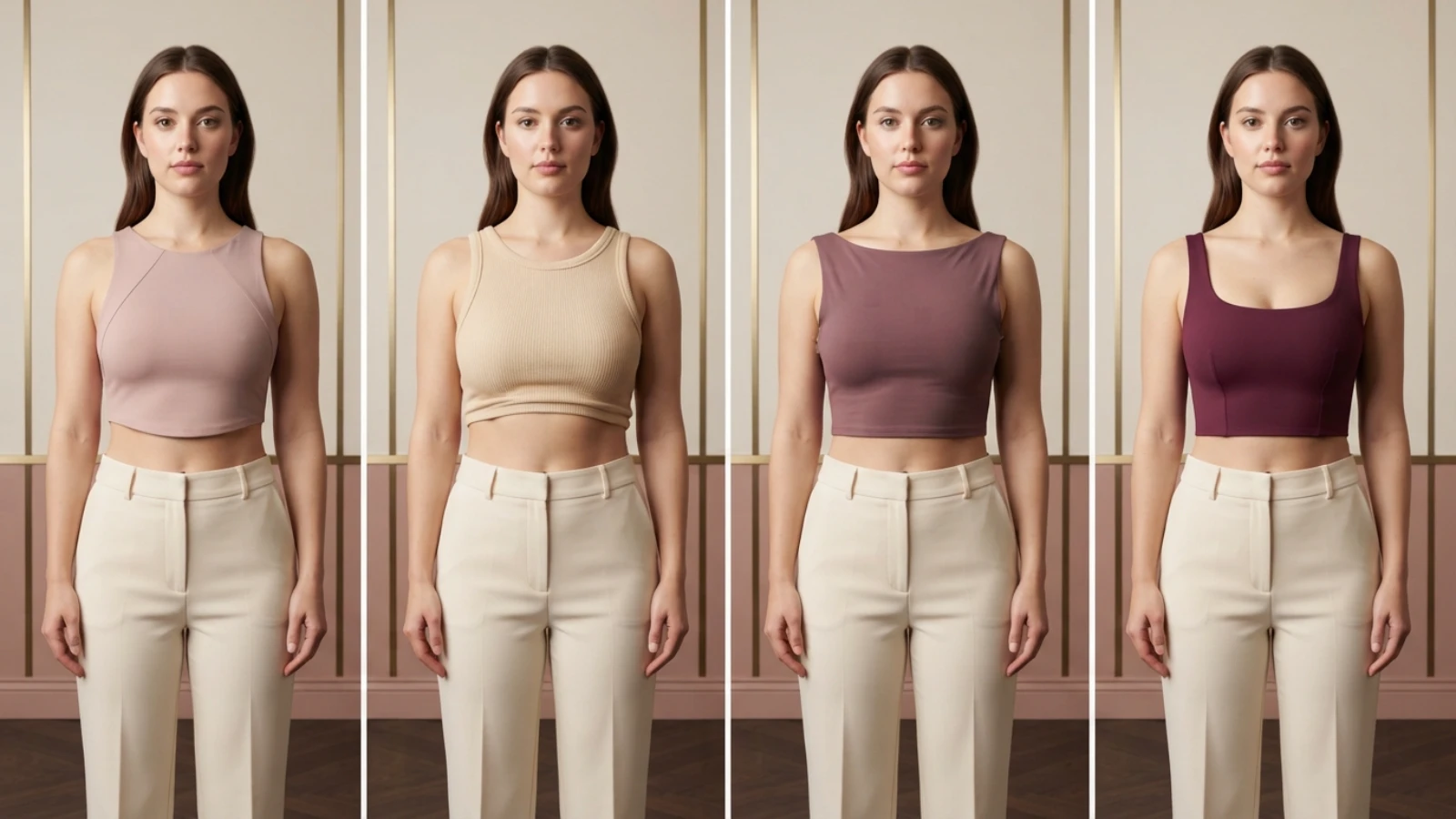
How the best crop tops handle necklines, straps, sleeves, and bras
A crop top’s short lower body makes the upper anchors especially important. If straps lengthen, sleeves pull, or the neckline spreads, the entire garment can shift. The best crop tops work with a realistic bra plan and keep the upper edge stable without requiring constant pinning.
Wide straps are easiest when their path matches the bra
Width helps conceal a regular bra, but placement matters equally. A crop strap near the neck will not cover a wider-set bra strap. Check front and back alignment because the paths may cross. Adjustable straps can refine height, but shortening them also raises armholes and the hem; they should tune a sound pattern rather than rescue one.
Sleeves can anchor or pull the crop
A well-cut set-in sleeve stabilizes the shoulder and allows the arm to move without borrowing fabric from the front. Tight biceps, shallow sleeve caps, and restrictive armholes can pull a short top upward. Raglan and dropped shoulders offer different mobility, but their seam angle and volume should still return cleanly after reaching.
Square and scoop necklines need edge stability
A square neckline should retain its corners instead of bowing across the bust. Scoops should remain symmetrical and lie close without cutting. Reinforcement, facing, lining, binding, or appropriate elastic can help. Neckline depth is a coverage preference, but migration is a fit issue.
Underbust seams must sit below breast tissue
Some crop tops use corset-style panels, cups, or underbust seams. These elements need enough depth and correct placement; a decorative seam cutting across the bust is not support. If cup boundaries are clearly too small, sizing up may enlarge the entire top without placing the seam correctly. Do not purchase an unalterable cup construction solely from a model image.
Built-in support needs separate evidence
A shelf layer, padded insert, or tight rib band does not automatically provide fuller-bust support. Verify band anchoring, cup depth, separation, strap strength, size architecture, and the activity promised. Many best crop tops work more predictably over a preferred regular bra than as all-in-one support garments.
How to buy the best crop tops online accurately
The phrase cropped is not a measurement. One retailer may mean a top ending at the natural waist; another may mean directly beneath the bust. Product images are influenced by model height, torso length, bust projection, sample size, pose, and waistband rise. Build the decision from comparable garment data.
- Choose a successful reference. Use a crop top or ordinary top whose bust, neckline, shoulders, and landing point already work.
- Measure it relaxed. Record chest width, center-front and back length, shoulder width, armhole depth, hem width, neckline depth, and sleeve or strap placement.
- Identify stretch direction. Note whether the reference relies on two-way or four-way stretch and whether its lining stretches similarly.
- Match the planned bottom. Record waistband rise and where it sits after several minutes of sitting and walking.
- Read the retailer chart definition. Determine whether dimensions describe the body, the finished garment, or an unstated sample.
- Check scale rules. Length and neckline depth may change between sizes even when the page lists one sample measurement.
- Verify returns before ordering. Crop length and bust shaping are hard to judge from flat images, so return conditions are material buying evidence.
| Measurement or fact | Why it matters | How to compare | Warning sign |
|---|---|---|---|
| Finished chest width | Determines room and stretch demand | Compare relaxed garment to reference | Only body chart is supplied |
| Center-front length | Predicts coverage over projection | Use identical start and end points | Only back or model length shown |
| Hem width | Controls lower-edge pressure | Measure planned landing area | Narrow rigid band with no stretch data |
| Neckline and armhole | Affects coverage and bra visibility | Compare with chosen bra | Only styled jacket photos |
| Fabric and lining | Affects opacity and recovery | Read shell and lining separately | Stretch claim without composition |
| Return conditions | Manages uncertain fit | Check window, fees, and exclusions | Final sale before measurements verified |
The U.S. FTC textile-label guidance explains fiber-content, origin, and responsible-business labeling requirements for covered textile products. Those facts help verify a listing, but they do not prove opacity, recovery, or fuller-bust fit. Compare fabric behavior as well as label data.
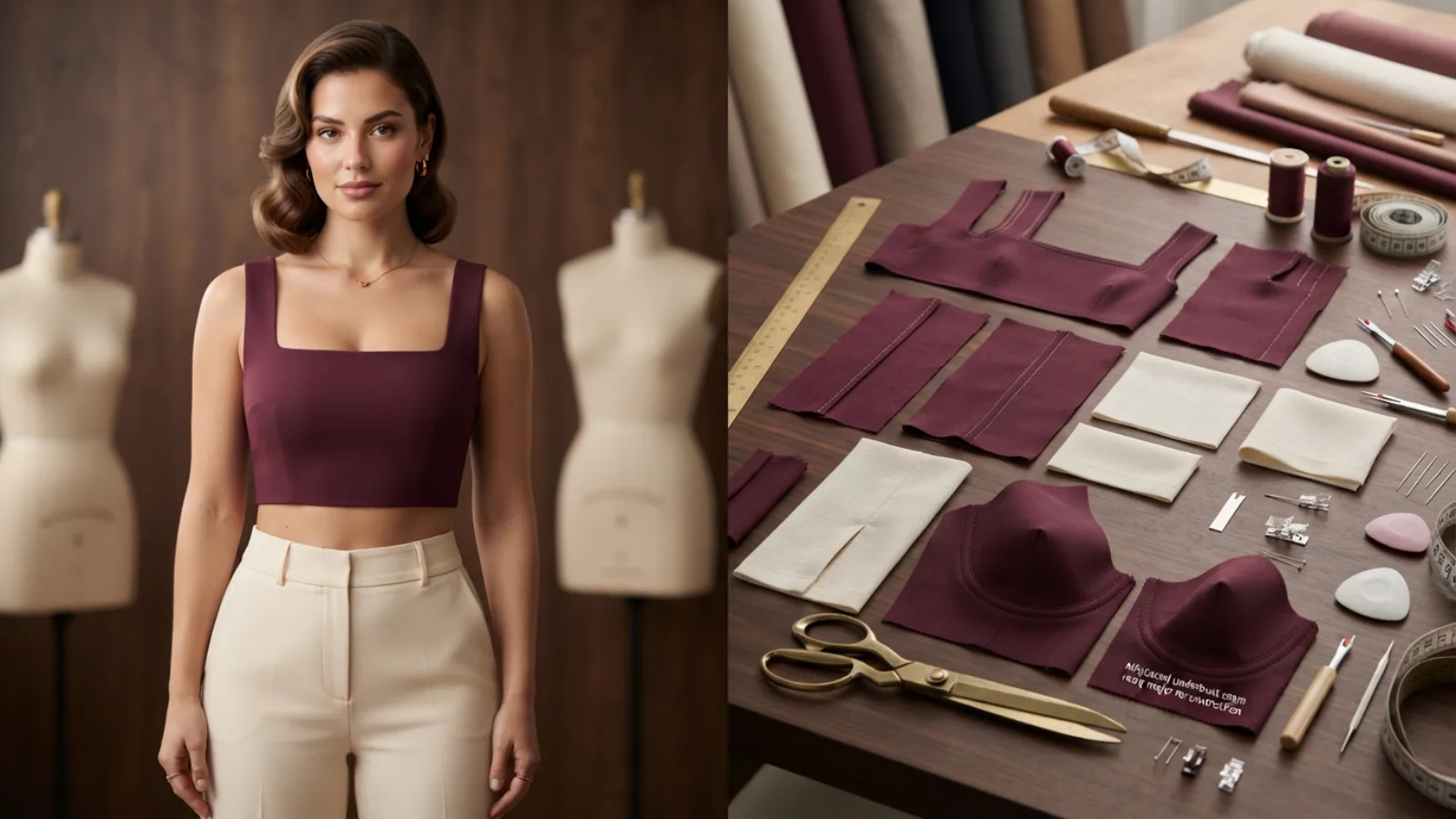
The ten-minute movement test for the best crop tops
A fitting-room mirror shows one posture. The best crop tops for a large bust maintain reasonable coverage and balance through the actions required by the outfit. Perform the test in the intended bra, bottom, and outer layer, then let the garment settle naturally instead of pulling it down after every movement.
Reach overhead and return
Raise both arms slowly, then lower them. Some upward movement is expected from a short top, especially a close knit. The useful question is whether the top returns. If the hem remains trapped beneath the bust, sleeves bind, or the neckline changes position, the garment lacks room, recovery, or mobility.
Sit for several minutes
Sitting changes torso length and waistband height. A narrow hem may roll, a rigid underbust seam may press, and the back may climb. Stay seated long enough for fabric friction to appear, then stand without adjustment. The outfit should settle into a predictable position.
Lean, twist, and reach forward
Check neckline security and side coverage. A crossover can open, a square edge can bow, and a loose boxy crop can swing away from the body. These are not moral problems; they are information about whether the garment matches the setting and desired coverage.
Add the actual outer layer
A rough cardigan can pull a rib crop upward, while a smooth jacket may slide against a satin top. Use the garment planned for the outfit. The cardigan guide can help verify that the outer layer hangs cleanly without compressing the crop beneath it.
Keep / alter / return rule
Keep when bust room, neckline, bra coverage, opacity, front length, hem, and movement already work. Alter when the base fit is sound and a local adjustment—such as shortening straps or refining a simple hem—is feasible. Return when the front is fundamentally too short, the fabric turns sheer, cup or underbust seams cross breast tissue, the neckline migrates, or the top repeatedly becomes trapped beneath the bust.
Fit problems even the best crop tops must avoid
Diagnose the behavior before changing sizes. The best crop tops preserve a coherent relationship between shoulder or straps, neckline, bust, side seams, hem, and waistband. One failure can create several visible symptoms.
The front hem is far higher than the back
The front may lack projection room or center-front length. Compare side seams: if they angle forward and the fabric is tight across the bust, more chest room or shaping is needed. If the front fits comfortably and the angled hem is clearly intentional, judge the design by preference rather than forcing it level.
The top becomes trapped beneath the bust
A tight lower edge, insufficient front length, weak recovery, or restrictive armholes can cause migration. A larger size may help only if it improves bust and hem dimensions without losing upper stability. Consider a longer crop, wider hem, shaped front, or more resilient fabric.
The neckline spreads or gapes
Possible causes include excessive horizontal stretch, unstable binding, a bust pulling the front outward, straps that are too long, or a neckline width that does not suit the shoulder frame. If shortening straps raises the hem and armholes too much, the base pattern is wrong.
Armholes or sleeves cut during reaching
The upper body may be too narrow, the sleeve may lack bicep room, or the armhole shape may be restrictive. Because crop tops have little weight below, arm tension can move the entire garment. Look for a better sleeve, raglan construction, dropped shoulder, or larger front pattern rather than repeatedly tugging the hem.
The fabric becomes shiny, sheer, or distorted
The garment is using too much stretch across projection. Increase finished chest width or choose a denser fabric with better recovery. A darker color can disguise transparency in a photograph but does not correct stitch distortion or material stress.
The bra shows unexpectedly
Check neckline depth, strap path, armhole height, side seam, and back cut while wearing the intended bra. A different bra may solve a styling mismatch, but the wearer should not need to buy specialized underwear simply to compensate for a crop top that was expected to be bra-friendly.
What a tailor can change in the best crop tops
A tailor may shorten plain straps, refine a simple hem, reduce some waist or back width, stabilize a small neckline gap, add a modest side slit, or alter a basic sleeve. Feasibility depends on seam allowance, lining, trim, elastic, fabric, and whether changing one edge affects the entire short garment.
Adding substantial bust projection, rebuilding integrated cups, lowering an underbust seam, creating missing center-front length, or changing a complex square neckline is more involved. A contrast band or extension can lengthen a valued crop, but it changes the design. The tailoring guide helps distinguish local refinements from pattern-level reconstruction.
| Possible change | Feasibility | Good candidate | Better buying response |
|---|---|---|---|
| Shorten plain straps | Often | Neckline and armholes otherwise fit | Verify usable adjustment range |
| Reduce waist or back width | Sometimes | Bust and shoulders already fit | Choose a shaped front size system |
| Stabilize minor neckline gap | Sometimes | Sound edge with small excess | Choose reinforced neckline |
| Add a hem extension | Sometimes | Simple hem and compatible fabric | Buy correct center-front length |
| Add major bust projection | Rarely simple | Planned panels or generous seams | Choose darts or fuller-bust pattern |
| Rebuild cups or underbust seam | Usually complex | Specialty redesign only | Buy correct cup architecture |
How to style the best crop tops for real wardrobes
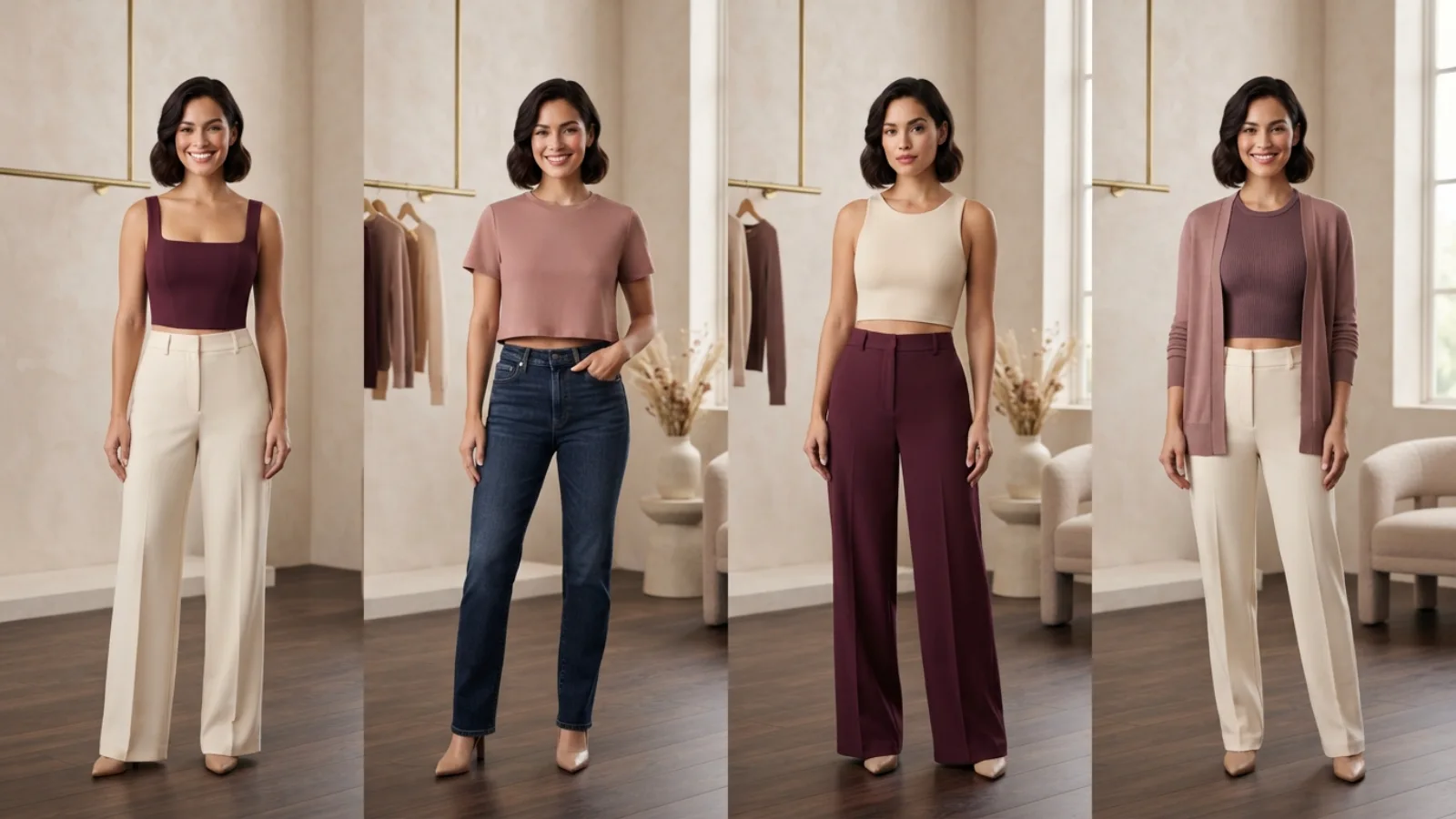
The best crop tops for a large bust should work before styling begins. Once fit is secure, the wearer can choose contrast, exposure, and proportion freely. High-rise bottoms are useful because they make coverage adjustable, not because every fuller-bust body requires a particular silhouette.
Easy first crop: longline top + high-rise trouser
Choose a waist-skimming crop with a stable hem and a trouser waistband that meets or slightly overlaps it while standing. Sit and reach to confirm the gap remains within preference. A tonal top and bottom can create a continuous line, while contrast emphasizes the crop boundary.
Weekend: resilient crop T-shirt + denim
A compact jersey crop with secure sleeves and enough front length can be simpler than a tight rib tank. Compare shoulder, sleeve, and neckline construction with the T-shirt guide. The crop should remain opaque and return after reaching rather than staying bunched under the bust.
Warm weather: bra-friendly crop tank + wide-leg bottom
Wide straps, high side coverage, and a stable scoop or square neckline support regular-bra wear. The tank-top guide explains strap and armhole evidence in more detail. Balance a close top with any bottom volume that feels useful; this is an outfit choice, not a correction rule.
Layered coverage: crop top + open cardigan
An open cardigan adds adjustable warmth and side framing without hiding the crop. Make sure its shoulder and sleeve room do not drag the base layer upward. A long outer layer over a shorter inner hem creates intentional contrast, while a waist-length cardigan can align with the crop.
Polished evening: shaped crop + high-rise skirt
A lined square-neck, wrap, or princess-seamed crop can pair with a skirt whose waistband gives the desired gap. Test the top without the jacket or outer layer so the outfit does not depend on camouflage. Smooth, secure fit is more important than maximum tightness.
Coverage bridge: camisole beneath an open crop shirt
A close, low-bulk camisole can create neckline or midriff coverage beneath a boxy cropped shirt. Use the camisole guide to verify straps, armholes, and layer friction. The underlayer should not be so tight that both garments migrate together.
Care, durability, and value in the best crop tops
The best crop tops retain neckline shape, strap or shoulder position, opacity, hem recovery, and intended length after care. Inspect inside seams, edge bindings, elastic, lining, darts, zipper ends, sleeve joins, and hem bands. Short garments concentrate tension around relatively few edges, so weak construction becomes visible quickly.
Length changes matter more in a short garment
A small amount of shrinkage can turn a waist-length crop into a much shorter top. Follow the sewn-in care label and compare pre- and post-wash length if fit is close to a boundary. The FTC care-label guidance explains U.S. care-instruction requirements for covered garments.
Elastic and rib bands need recovery care
High heat, aggressive agitation, and hanging a heavy wet garment can affect elastic and shape, depending on the label. Fold knits that stretch on hangers. Avoid dressing by pulling a narrow hem aggressively over the bust when a side zip, back zip, or wider opening is intended.
Value comes from outfit compatibility
A crop top that works with three existing high-rise bottoms and a preferred bra may deliver more useful wear than a dramatic piece requiring new underwear and constant adjustment. Before purchase, list realistic outfits, seasons, care steps, and coverage preferences. Cost per wear is planning, not a guaranteed performance claim.
Final buying scorecard
- Purpose: the crop has a defined setting, activity, bra, and bottom.
- Bust room: width and shaping preserve opacity and side-seam balance.
- Front length: the relaxed hem lands where intended over projection.
- Upper stability: neckline, straps, sleeves, armholes, and back remain secure.
- Lower edge: the hem or band stays down without cutting or rolling.
- Movement: the garment returns after reaching, sitting, and turning.
- Outfit system: waistband rise and outer-layer friction are tested together.
- Evidence: measurements, materials, care, returns, and availability are verified.
Frequently asked questions
What crop top style is best for a large bust?
A structured or resilient-knit crop top with a stable neckline, enough finished chest room, sufficient center-front length, secure straps or sleeves, and a hem that lands at a planned waistband is the most dependable starting point. The best choice depends on the bra, coverage preference, torso length, outfit proportions, and how much movement the top must handle.
Can someone with a large bust wear crop tops?
Yes. Crop tops are a length category, not a body-type restriction. Fit improves when the garment has enough room over bust projection, the front hem does not rise dramatically above the back, the neckline and armholes stay secure, and the chosen bottom creates the amount of overlap or midriff exposure the wearer wants.
Should I size up in a crop top for a fuller bust?
Size up when the fabric turns sheer, the neckline spreads, the sleeves or armholes pull, or the front hem climbs because the bust is using all available width and length. If the larger size becomes loose at the shoulders, back, neckline, or waist, look for a shaped front, fuller-bust sizing, a longer crop, or a different construction instead.
How do I stop a crop top from riding up under my bust?
Choose adequate finished chest width, resilient fabric, enough center-front length, and a lower edge that is not excessively tight. Check whether the armholes restrict reaching and whether a rough outer layer drags the top upward. A wide stable hem band can help, but it cannot repair a garment that lacks projection room.
What bra works best under a crop top?
The best bra is the one that supports comfortably and matches the top’s neckline, strap path, side height, and back. A regular bra works with many sleeved, wide-strap, crew-neck, square-neck, and wrap crop tops. Strapless or convertible options should be chosen for personal comfort and the specific garment rather than treated as mandatory.
What length crop top is most practical for a large bust?
A waist-length or longline crop that reaches the top of a high-rise waistband is often the easiest starting point because bust projection uses some front length. Measure center-front length on a successful top rather than relying on the label cropped. The ideal length is the one that creates your preferred coverage while sitting, reaching, and walking.
Which fabric is best for a fuller-bust crop top?
Compact cotton jersey, stable ponte, resilient rib knit, structured poplin with darts, and lined stretch crepe can all work. Judge opacity under stretch, recovery, edge stability, breathability, drape, and care. Fiber percentages alone do not reveal whether the finished fabric will stay level and opaque over the bust.
What measurements should I check when buying a crop top online?
Check finished garment chest width, center-front and center-back length, shoulder width, sleeve or strap placement, armhole depth, neckline depth, hem width, and stated stretch. Compare those figures with a crop or regular top that already fits, and confirm whether the retailer chart lists body measurements or actual garment measurements.