Best Structured Blazer-Tops for a Large Bust
How to compare bust capacity, lapel scale, button stance, shaping seams, shoulders and lining before a sharp product photo becomes a restrictive fit.

The best structured blazer-tops for a large bust create a polished jacket-like line without borrowing fabric from the waist, pulling the lapels apart or forcing the shoulders backward. They provide three-dimensional room through darts, princess seams, panels or carefully distributed ease. Their closures sit in a stable area of the torso, their fronts are long enough to travel over bust projection, and their armholes allow ordinary reaching without lifting the whole garment.
A blazer-top is designed to function as the main top rather than simply as an open outer layer. It may be sleeved or sleeveless, single- or double-breasted, wrap-front, collarless or peplum-shaped. That distinction matters. An ordinary blazer can appear to fit when worn open over a camisole even if it cannot close comfortably. A blazer-top must provide secure coverage, usable closure and seated comfort on its own, so judging it only in an open-front product pose hides the most important evidence.
Quick answer
Choose a blazer-top with published finished garment measurements, visible bust shaping, a closure that sits below or away from the fullest point, enough center-front length, and shoulder structure proportionate to your frame. Fasten it over your intended bra, breathe deeply, sit, reach and raise your arms. Keep it only if the lapels remain controlled, the buttons lie flat, the side seams stay vertical and the front hem returns to position without compression or exposure.
The best structured blazer-tops feel composed because their pattern carries the bust correctly—not because stiff fabric holds the wearer in one pose.
The 60-second keep-or-return test
- Fasten every functional closure without pulling the two fronts together by force.
- Check that lapels lie similarly on both sides and do not spring away from the chest.
- Confirm shoulder seams stay near the shoulder edge and pads do not tilt backward.
- Sit, reach forward, lift both arms and rotate while monitoring buttons, neckline and hem.
- Reject persistent X-shaped strain, side seams swinging forward, a rising front or restricted breathing.
Best structured blazer-tops by construction
The phrase best structured blazer-tops for a large bust describes a fit result rather than one compulsory silhouette. Start with the degree of coverage, waist definition and shoulder emphasis you actually want. The six categories below are construction filters—not endorsements of unverified listings.
Single-breasted blazer-top
One vertical row of closures reduces front overlap and usually leaves more usable bust width than a closely spaced double-breasted style. A low one-button or two-button stance can work well when shaping begins above the closure and the neckline remains secure.
Double-breasted longline top
A broad overlapping front creates strong structure and coverage. It requires generous finished bust circumference, stable inner anchoring and correct button placement; decorative outer buttons do not prove that the functional overlap fits.
Wrap-front blazer-top
A crossover front and belt can accommodate different waist proportions, but the panels must already contain the bust. The tie should define the waist rather than pulling narrow fronts across the chest.
Princess-seam peplum blazer-top
Curved seams can supply projection and return toward the waist before a peplum releases over the hips. Check that the seam apex and waist seam match your vertical proportions instead of cutting across the fullest area.
Collarless structured top
A clean jewel, V or square neckline removes lapel layers and can simplify fit. Edge stability, neckline coverage and bust shaping become more visible, so a collarless label is not permission for a flat, boxy pattern.
Sleeveless blazer or waistcoat top
Without sleeves it may offer easier movement and a cleaner line under coats. The armholes must cover the bra, the shoulder width must suit the intended look and the neckline must remain secure when worn without an underlayer.
| Construction | Main advantage | Evidence to inspect | Common risk |
|---|---|---|---|
| Single-breasted | Cleaner closure with less overlap | Darts, button stance, lapel break and front length | One button carries all bust tension |
| Double-breasted | Strong coverage and visual structure | Functional overlap, inner anchor and bust circumference | Parallel strain across two button rows |
| Wrap-front | Adjustable waist definition | Panel width, neckline stability and belt position | Overtightening opens the upper front |
| Princess-seam peplum | Three-dimensional shaping | Seam curve, waist height and peplum release | Apex or waist seam sits too high |
| Collarless | Less bulk around neckline and bust | Facing, neckline coverage and edge stability | Front edge rolls or gapes |
| Sleeveless waistcoat | Mobility and layer versatility | Armhole depth, shoulder width and side coverage | Bra exposure or armhole flare |
How structure should accommodate a fuller bust
Structure is useful when it controls the garment, not the body. Interfacing, facings, shoulder pads, lining and firm cloth help a blazer-top preserve its edges and silhouette. They do not create missing circumference or length. If the front is under-sized, firmer construction makes the strain more visible: lapels lift, buttons tilt, darts point incorrectly and the hem rises. The best structured blazer-tops for a large bust begin with enough pattern space, then use structure to keep that space looking intentional.
Finished bust measurement versus body chart
A body-size chart tells you which body range the brand associates with a label. A finished garment measurement tells you the actual circumference of the top. For a structured woven garment, you need positive wearing ease so you can breathe, sit and move. The exact amount depends on fabric, lining, silhouette and personal preference, so there is no universal number. Compare a successful fitted jacket or top with the listing rather than relying on the letter or numeric size alone.
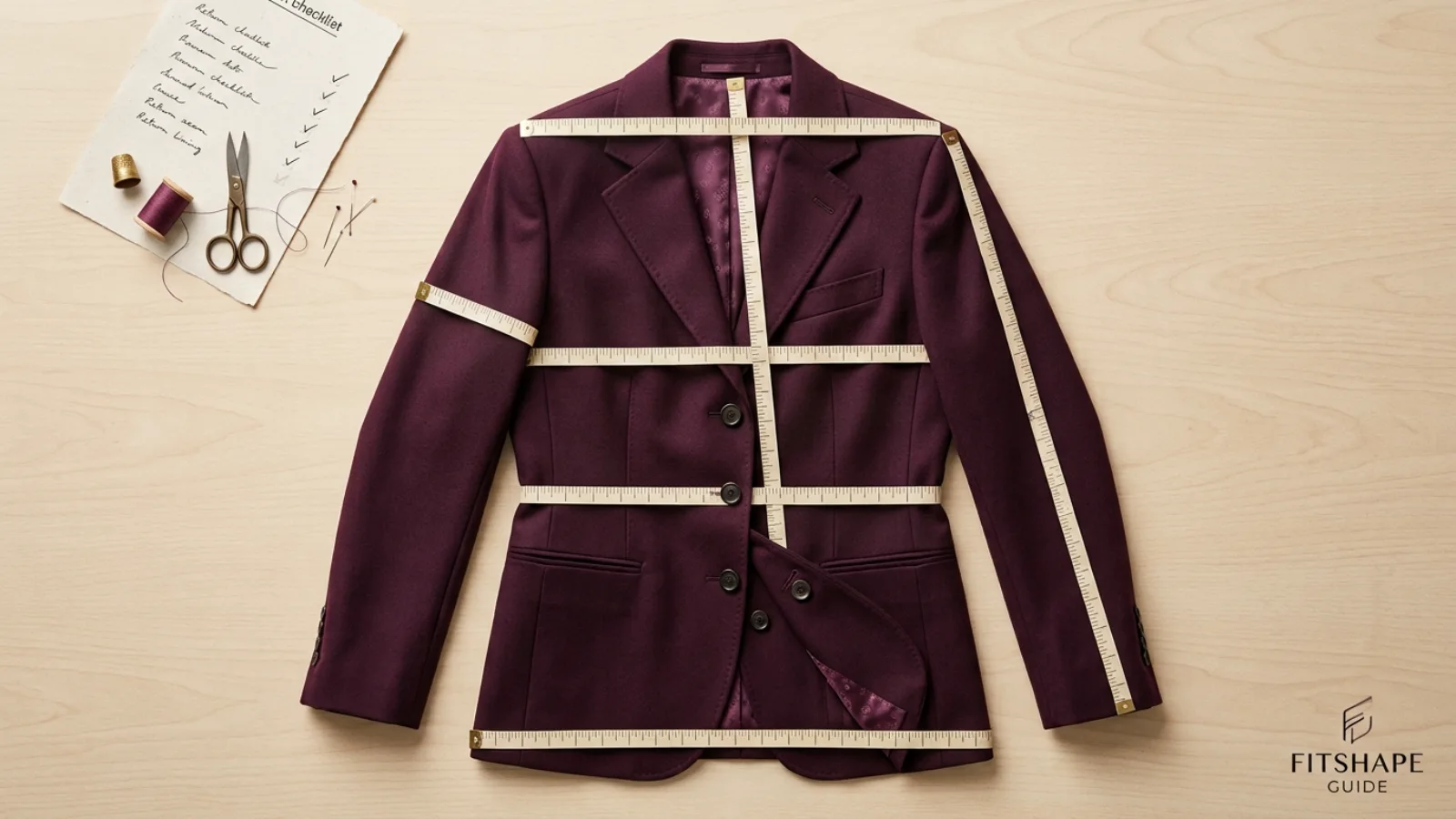
Measure the reference garment closed and flat at the underarm, double that width, and note whether the measurement crosses darts or a shaped panel. Also record waist, shoulder and center-front length. A stretchy knit top may fit at a smaller finished circumference than a lined woven blazer-top; transferring the same size logic between them is unreliable.
Darts and princess seams
A side-bust dart should point toward the bust apex without ending on it. Too-high or too-low placement creates a hollow fold on one side and tension on the other. Princess seams offer a longer shaping path from shoulder or armhole through the bust toward the waist. They can handle a pronounced bust-to-waist difference well when the curve matches your proportions. A seam that falls far inside or outside the fullest point will not perform its intended shaping even if total circumference is technically adequate.
Some blazer-tops use double-ended waist darts, curved side panels or under-bust seaming instead. Judge the effect rather than the label: there should be room at the fullest point, a clean transition below it and no hard horizontal seam cutting into breast tissue. Strategic gathers can also work, but heavy bunching beneath stiff lapels often signals that soft blouse construction and tailoring structure are fighting each other.
Front length and hem balance
Bust projection consumes vertical fabric as well as width. When a top lacks front length, its waist shaping climbs, the button stance shifts upward and the center-front hem rises. A longer garment is not automatically better; extra length added equally to front and back can simply lower the whole silhouette. Look for a center-front measurement or compare the shoulder-to-waist distance with a successful garment. A balanced design gives the front enough travel over the bust while keeping side seams and back hem close to their intended positions.
In the best structured blazer-tops, shaping follows the body in three dimensions instead of forcing a flat front to stretch across projection.
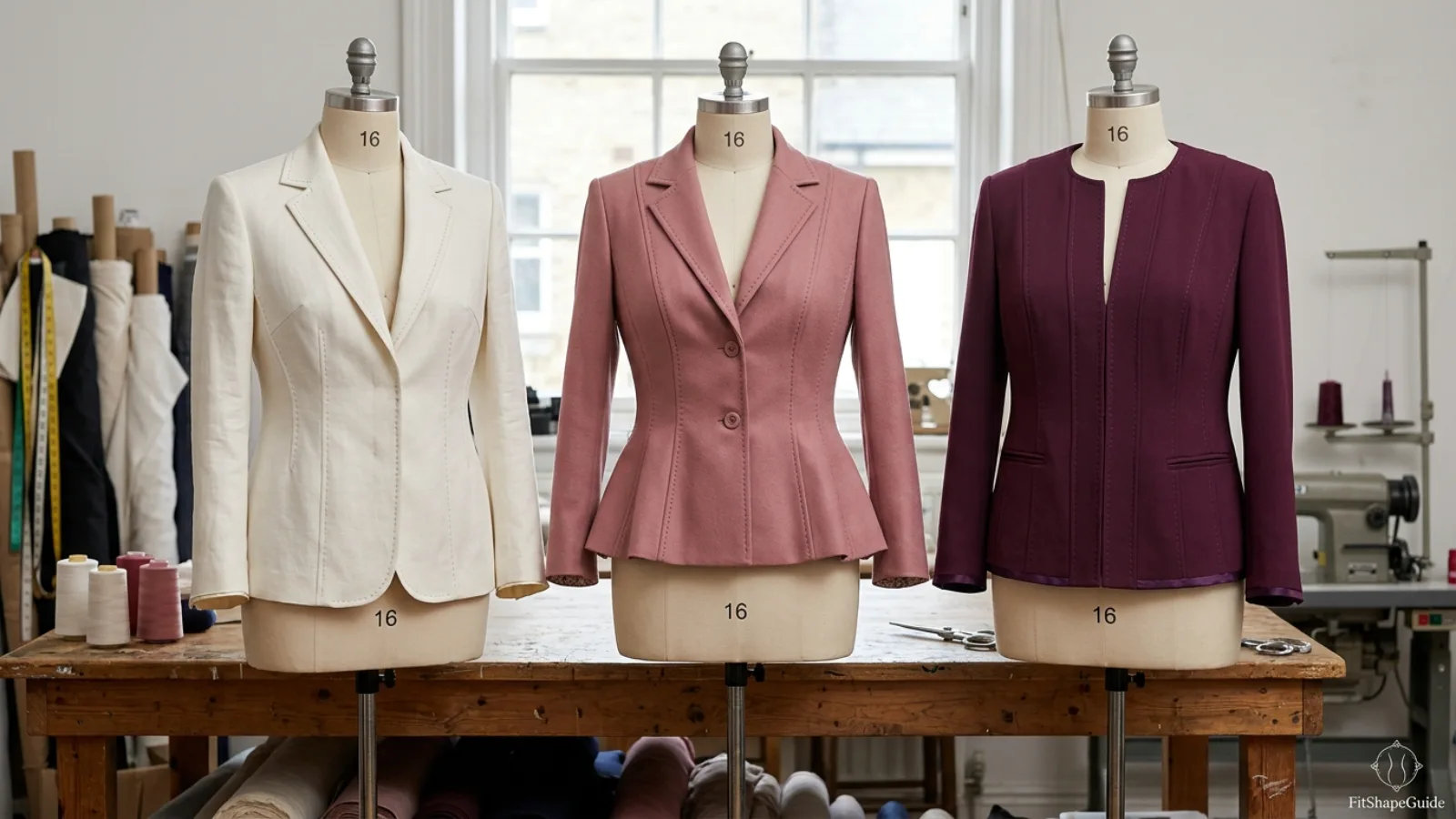
Lapels, necklines and closure placement
A lapel is a folded structural element, not simply decoration. Its roll line should settle consistently from collar to break point. On a fuller bust, a short or tightly shaped lapel may be pushed outward, while a broad lapel may cover more of the front and compete with bust projection. Neither narrow nor wide is universally best. The useful question is whether the lapel lies smoothly when the garment is closed, without being held down by posing or tape.
Where should the main button sit?
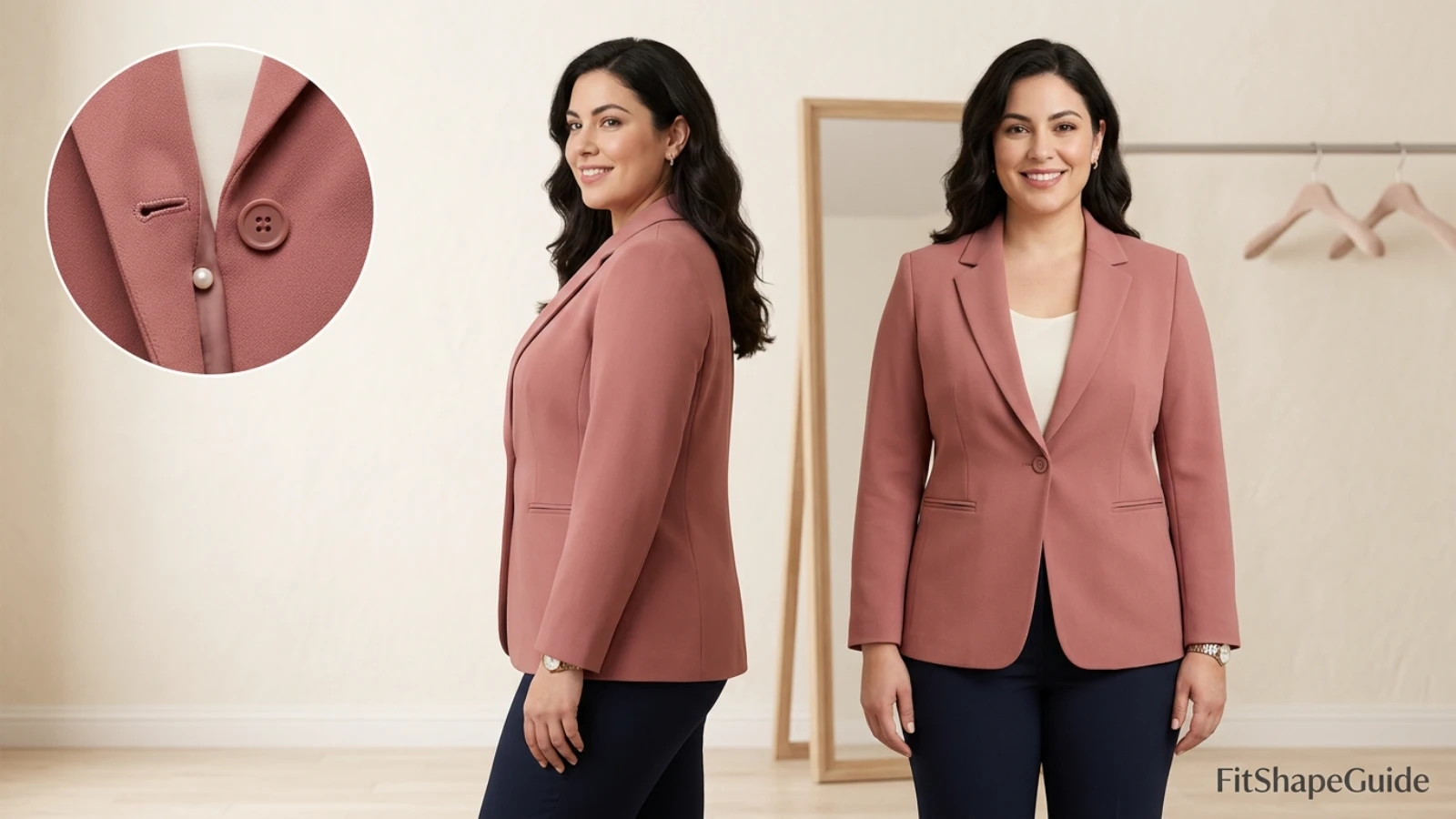
A button placed directly at the fullest bust point carries concentrated horizontal tension and often creates an X of drag lines. A lower stance can let the lapel open naturally above the bust, but a blazer-top worn alone still needs secure coverage. A higher neckline or concealed inner closure may provide that security. In double-breasted designs, both functional rows must remain vertical and level; decorative buttons can disguise where the actual load sits.
Test buttons individually before assuming all visible hardware works. Some designs have one functional button, an internal jigger button and several decorative buttons. The internal anchor should stabilize overlap without twisting the facing. Bound buttonholes and reinforced machine buttonholes should sit flat, and the button shank should allow the layered front to close without crushing it.
Plunging blazer-tops and coverage
A deep V may be intentionally worn over a camisole, bralette or bodysuit, but many product pages photograph it without showing movement. If you plan to wear the top alone, lean forward, sit and rotate to assess the complete neckline. Check the side angle as well as the center. Fashion tape can refine a stable edge for an event; it should not be responsible for controlling a front that lacks overlap or pulls apart under ordinary tension.
Collarless versions shift the challenge to the neckline facing. A clean V or jewel neckline should sit against the upper chest without rolling outward. Fusible interfacing that is too stiff can create a ledge; a facing that is too loose can ripple. Look for understitching, stable seam allowances and lining that does not drag the outer edge.
The best structured blazer-tops distribute closure load through the pattern and front support rather than asking one button, hook or strip of tape to rescue the fit.
Shoulder structure, sleeves, fabric and lining
Shoulder width and pad scale
A defined shoulder can balance a tailored silhouette, but the seam should relate to your actual shoulder edge unless an exaggerated shape is deliberate. When the bust pulls the front downward, the shoulder seam may migrate forward even if shoulder width is correct. Diagnose the whole front before choosing a smaller shoulder. A pad that tilts upward or backward can be a front-balance problem, a pad-placement problem or both.
Thin, extended and strongly built-up pads create different proportions. Petite or sloped shoulders may benefit from modest support, while broad or square shoulders may need little additional width. Removing a pad changes sleeve pitch and armhole balance, so do not assume it is a simple home alteration. Check the garment both from front and side, with arms relaxed.
Armholes, sleeves and reach
High, correctly shaped armholes often allow better movement than very low armholes because the sleeve can move without lifting the entire body. However, the armhole must not cut into the front of the armpit or expose the bra in a sleeveless design. Reach forward as if typing or driving. If the back binds, sleeves twist or fronts pull open, the problem may involve upper-back width, sleeve pitch or front bust capacity.
Full-length sleeves should allow elbow bend without dragging the shoulder. Bracelet sleeves reduce fabric and can feel more flexible, but they do not correct a restrictive upper arm. Rolled or pushed sleeves add bulk near the waist and may change proportion. For a sleeveless blazer-top, inspect the entire armhole: side-bra coverage, front flare, back gap and whether the facing stays inside.
Shell fabric and recovery
Wool blends, suiting polyester, ponte, crepe and linen blends can all create structure, but they behave differently. Woven suiting relies on pattern ease; ponte provides stretch and recovery; linen develops natural creasing; lightweight crepe drapes more softly. An elastane percentage does not prove comfort if the lining has no give or the cut lacks room. Pull the fabric gently off the body and observe whether it returns without rippling.
Lining is a second fit layer
A lined top has an inner garment that must fit too. The shell may appear smooth while a tight lining restricts breathing or pulls the armholes. Check pleats or ease at center back, lining attachment around sleeves and whether it hangs free at the hem where appropriate. Partial lining can reduce heat and bulk, while full lining improves opacity and helps the top slide over underlayers. Neither is inherently superior; the lining must support the intended use.
For warm climates, breathability depends on the complete system—shell, interfacing, lining and underlayer—not just one natural fiber listed first. A lightweight shell backed by dense synthetic lining may feel warmer than expected. For frequent office wear, also consider wrinkling, odor retention, pressing requirements and whether the care label fits your routine.
The best structured blazer-tops align shell, lining, shoulder support and sleeve shape so one layer does not quietly cancel the comfort of another.
The five-position test for the best structured blazer-tops for a large bust
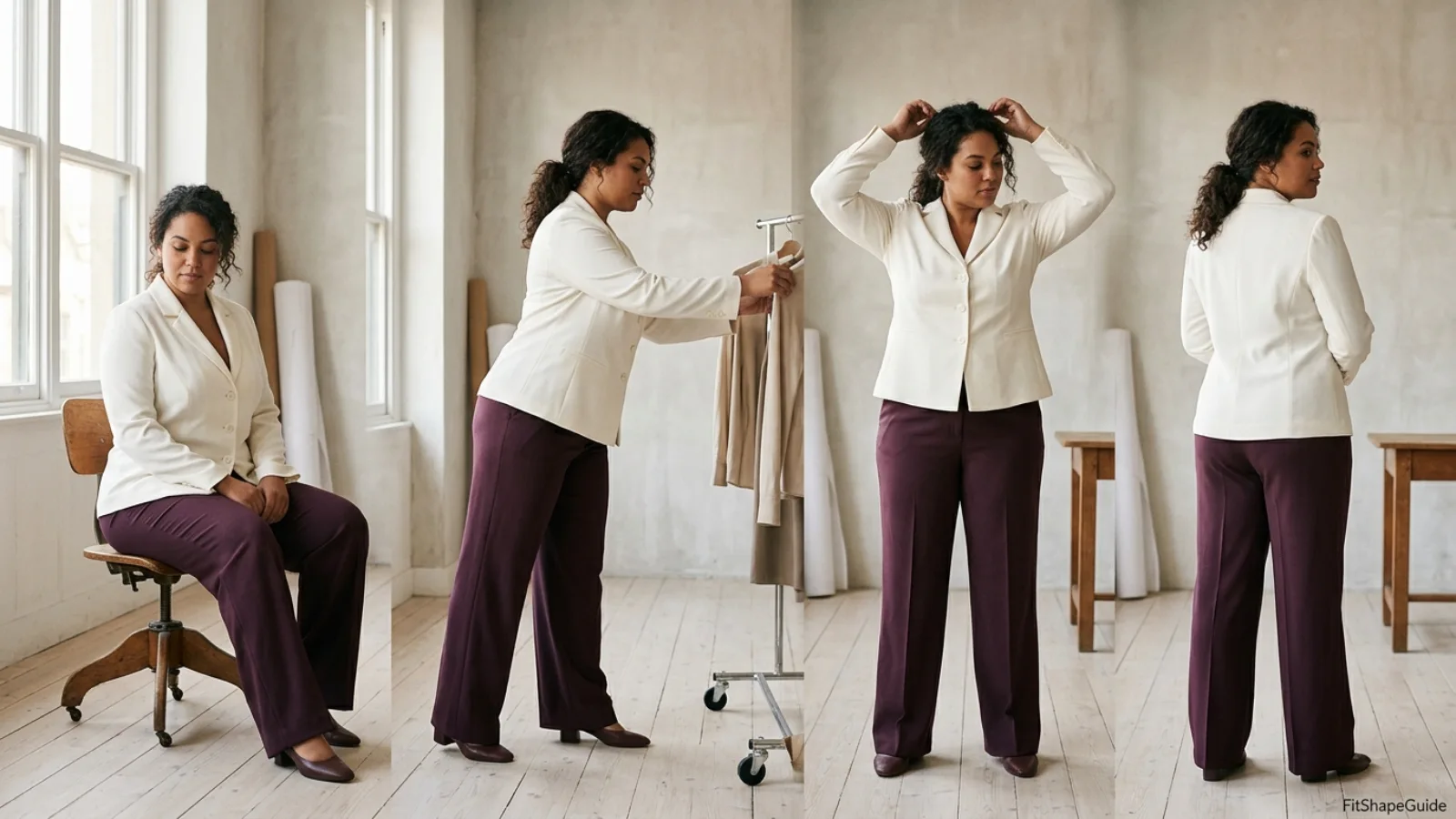
Tailored clothing can look excellent while the wearer stands still with shoulders pulled back. Real fit becomes visible in motion. Put on the bra and underlayer you expect to use, fasten every intended closure once and leave it at normal tension throughout the sequence. The best structured blazer-tops should recover after each movement without repeated smoothing.
- Stand naturally. Relax the shoulders, breathe fully and inspect lapels, buttons, dart direction, side seams and hem level.
- Sit upright, then relax. Confirm the closure does not press into the bust or abdomen and the neckline remains covered.
- Reach forward at desk height. Watch the upper back, armholes and front closure; ordinary reach should not make a button feel unsafe.
- Raise both arms. Some movement is normal, but the top should settle when arms lower and the lining should not twist.
- Rotate and bend slightly. Check side-angle coverage, lapel recovery, armhole position and whether the hem remains wearable.
Repeat the seated position for longer than a quick mirror check. A firm waistband, low button or longline front may become uncomfortable only after the torso relaxes. Slide a flat hand beneath the closure—not as a universal ease rule, but to identify sharp pressure, lining tension or a button digging into the body. Take a deep breath and speak a full sentence; tailored does not mean compressed.
If the garment is meant to be worn open sometimes, test it open after confirming it fits closed. The fronts should fall cleanly rather than flying toward the sides because the bust has permanently distorted the lapel roll. An open styling option is useful; it should not be the only position in which a blazer-top appears to fit.
Fit problems—and what they actually indicate
Sizing up is appropriate when shoulders, upper back, sleeves, bust and waist are all too small. It is less effective when the pattern distributes circumference incorrectly. A larger size may give the bust enough room while making shoulder pads extend too far, lowering armholes and adding a large back bubble. The goal is not the smallest possible size; it is the size and construction whose proportions require the fewest compromises.
| Visible or felt signal | Likely cause | Test before deciding | Better response |
|---|---|---|---|
| X-shaped lines at button | Insufficient bust room or poor button stance | Unfasten and observe seam recovery | Seek more front capacity or a different closure |
| Lapels spring outward | Front tension, short roll line or bust-lapel conflict | Check closed and open side views | Try different lapel geometry and shaping |
| Side seams swing forward | Front lacks width or projection | Trace seam from armhole to hem | Choose darts, princess seams or fuller-bust cut |
| Front hem rises sharply | Insufficient front length over bust | Compare center-front and back balance | Seek added front length, not only overall length |
| Shoulder pad tilts backward | Front balance pulls garment off shoulder | Loosen closure and reassess pad | Correct bust/front balance before pad alteration |
| Back is loose while front strains | Circumference distributed away from bust | Pin only excess back fabric temporarily | Prioritize front shaping, then tailor back |
| Lining binds before shell | Inner layer is smaller or lacks ease | Feel shell and lining separately | Choose adequate lining ease or expert alteration |
Why belting is not a complete fix
A belt can reduce waist volume after you size for the bust, especially on an unstructured or wrap-front piece. On a tailored blazer-top, it may crush lapels, distort vents and bunch interfacing. If the shoulders and bust fit and the only excess is at the waist or back, professional suppression at existing seams is usually cleaner. If the garment lacks bust space, tightening a belt makes the shortage more obvious.
When the neckline is secure but the fit is still wrong
A high neckline can prevent exposure while the lower front strains. Security and fit are related but not identical. Look at breathing comfort, dart placement, side seams, buttonholes and hem balance. A top that covers the body but restricts it is not a successful structured fit.
When shoulder sizing misleads
Advice to “always fit the shoulders first” is incomplete for a blazer-top with substantial bust projection. Shoulders matter, but front balance can pull the entire jacket off them. Evaluate shoulders with the garment properly positioned and the front closed at reasonable tension. If closing it drags the shoulder forward, the bust shortage must be solved before judging final shoulder width.
That whole-garment diagnosis separates the best structured blazer-tops from styles that look sharp only while unfastened.
How to shop for the best structured blazer-tops for a large bust
Online listings often prioritize a dramatic front pose while leaving the garment open, angled or held at the waist. Seek straight-on closed views, side and back images, and a close view of functional closures. Read whether the item is described as a top, blazer, waistcoat or dress; retailer categories are not standardized, so the construction and intended coverage matter more than the menu label.
Record measurements while wearing the support bra and likely underlayer. Then compare a successful garment. For a fitted blazer-top, useful numbers include finished bust, waist, shoulder width, center-front length, back length, upper arm, sleeve length and armhole depth. For double-breasted or wrap designs, also examine front overlap and inner anchoring. If only body measurements appear, ask customer service for garment measurements or prioritize a retailer with a practical return window.
| Evidence | How to use it | Warning sign |
|---|---|---|
| Finished bust circumference | Compare with your body and a comfortable structured top | Only a generic body chart is supplied |
| Waist and hip circumference | Check closed fit through the complete length | Size-up advice without garment dimensions |
| Shoulder width and upper arm | Compare with a tailored garment that permits reach | No back or arm measurement on a rigid style |
| Center-front length | Assess bust-to-waist and hem balance | Only center-back length is listed |
| Closure and inner anchor | Identify what is functional and where load sits | All photos show the front open |
| Shell, lining and stretch | Evaluate both layers and likely recovery | “Stretch blazer” without composition details |
| Return and alteration terms | Confirm try-on window before removing tags | Final sale before proportions are established |
Measure a successful garment
Button a blazer or structured top that already feels comfortable and lay it flat without stretching. Measure underarm width, waist, hem, shoulder, center-front, center-back, upper arm and sleeve. Photograph where the lapel breaks and the main button sits relative to the underarm and waist. Product-page measurements that match only the bust but differ greatly at shoulder or front length predict a different fit.
Read reviews as construction clues
Useful reviews mention repeatable observations: buttons pulling, lining running smaller than shell, armholes cutting forward, lapels refusing to lie flat, unexpected shoulder pads or a front that is shorter than pictured. Reviewers may have different bras, torso lengths and coverage preferences, so no single comment proves your outcome. Repeated, specific construction details carry more value than “flattering” or “size up.”
Verify labels and care before purchase
The U.S. Federal Trade Commission outlines covered fiber-label expectations in its textile-label guidance and explains care-instruction requirements in its care-label guidance. Use the sewn garment label as the care authority. A polished fabric name or “stretch” claim does not establish lining composition, usable ease, breathability or fuller-bust fit.
The best structured blazer-tops make enough construction information visible that you can evaluate more than color and styling.
When shopping online, the best structured blazer-tops for a large bust are the options whose measurements, closed views, materials and return conditions let you test the fit claim instead of guessing.
Alterations: valuable refinements versus reconstruction
A tailor can often reduce excess waist or back fabric, shorten sleeves, refine sleeve width, replace buttons, reinforce a closure, reduce modest shoulder pads or add a discreet inner snap. These changes are most successful when the neckline, bust capacity, armholes and front length already work. Ask the tailor to pin the garment while it is fully closed and while you sit; a standing-only pin fitting can remove ease needed for movement.
Major bust shortages are harder to solve. Releasing princess seams depends on available seam allowance and may leave needle marks or insufficient lining. Adding a side panel changes armholes, waist and hem. Moving a lapel break or main button significantly can expose the original buttonhole and disturb front interfacing. A longline double-breasted style with inadequate overlap is closer to pattern reconstruction than routine tailoring.
For the best structured blazer-tops, alteration is a finishing step rather than the price of basic breathing, closure or coverage.
Styling structured blazer-tops without losing the fit
Choose the underlayer before the final fit test
If the blazer-top needs a camisole for coverage, test it with that exact layer. A slippery thin camisole behaves differently from a ribbed bodysuit or button-down shirt. Keep the underlayer neckline clearly below the blazer V or make it intentionally visible. Bunched fabric beneath fitted seams can change closure tension and make a correct size feel too small.
Balance strong tailoring with a clear lower line
Straight or wide-leg trousers, clean denim and simple skirts let the jacket-like top remain the focal point. A peplum style usually works best when the waistband does not crush its flare. Longline tops need enough hip room to close and sit; if the hem catches on the hips, the upper front may ride upward and imitate a bust-fit problem.
Use jewelry around the lapel architecture
A pendant inside an open V can echo the neckline, while earrings keep a double-breasted or statement-lapel front uncluttered. Pins and brooches add concentrated weight; place them where the lapel is supported and confirm they do not pull the roll line outward. Avoid attaching heavy accessories to a thin facing.
Care for the structure, not only the shell
Follow the care label because interfacing, shoulder pads and lining may limit cleaning options even when the outer fabric seems washable. Empty pockets, fasten closures appropriately and use a shaped hanger wide enough to support the shoulders. Steam cautiously from a safe distance when permitted; pressing a lapel flat can erase its intended roll. Let perspiration dry before storage and avoid crowding the garment between heavy pieces.
Calculate cost per successful wear
Include specialist cleaning, tailoring, the required underlayer and the number of outfits the color and length support. A low-priced blazer-top that can only be worn open, cannot tolerate sitting or requires repeated tape is not necessarily better value. The best structured blazer-tops earn repeat wear because their construction remains comfortable and presentable beyond the product photo.
Buy bust architecture before styling drama
For the best structured blazer-tops for a large bust, prioritize usable front capacity, shaping, center-front length and movement before lapel trend, buttons or shoulder exaggeration. Close the garment, test all five positions and judge the lining as carefully as the shell. Good structure should make the silhouette dependable—not make your breathing, posture or coverage do the structural work.
The best structured blazer-tops stay polished because they fit through real movement, not because the wearer remains perfectly still.
FAQs about structured blazer-tops for a large bust
Are structured blazer-tops flattering for a large bust?
They can be when the pattern includes enough bust room, front length and shaping, while lapels and closures remain stable. Structure can create a polished line, but stiff fabric or shoulder pads cannot compensate for a front that is too narrow.
Should I size up in a blazer-top for a large bust?
Size up when the shoulders, upper back, sleeves, bust and waist are all tight. If only the bust strains while the shoulders and back are loose, look for princess seams, darts, more front length or a fuller-bust cut instead of adding volume everywhere.
Is single-breasted or double-breasted better for a fuller bust?
A single-breasted style often needs less front overlap and may be easier to fit. A double-breasted top can provide excellent coverage if its finished bust, functional overlap and inner anchor are generous. Construction evidence matters more than the label.
Where should a blazer-top button sit on a large bust?
The main button should sit where it can close without creating an X of strain or pressing directly into the fullest point. A lower stance can work well with stable neckline coverage, but the ideal position depends on torso length, bust height and lapel design.
How do I stop blazer lapels from gaping over the bust?
First check bust capacity, front length and closure tension. Fashion tape may refine a stable lapel for occasional wear, but persistent springing, strain lines or shifting side seams usually require a different size, pattern or lapel geometry.
Can a sleeveless blazer-top work for a large bust?
Yes, if the neckline is secure, the armholes cover the bra, the front has adequate shaping and the shoulders do not stand away from the body. Test side coverage and forward reach because armhole flare often appears only in movement.
Can a tailor alter a blazer-top for a fuller bust?
A tailor can often reduce excess waist or back fabric, refine sleeves, change buttons or adjust modest shoulder pads. Adding major bust room, front length or double-breasted overlap is more complex and may be limited by seam allowance, interfacing and lining.
How should a structured blazer-top fit when sitting?
It should remain closed without sharp pressure, preserve neckline coverage, allow a full breath and avoid buttons digging into the bust or abdomen. The lapels and hem may move slightly, but they should return when you stand without repeated adjustment.
Editorial note: Product modules remain unpublished until current product details and merchant links are verified.