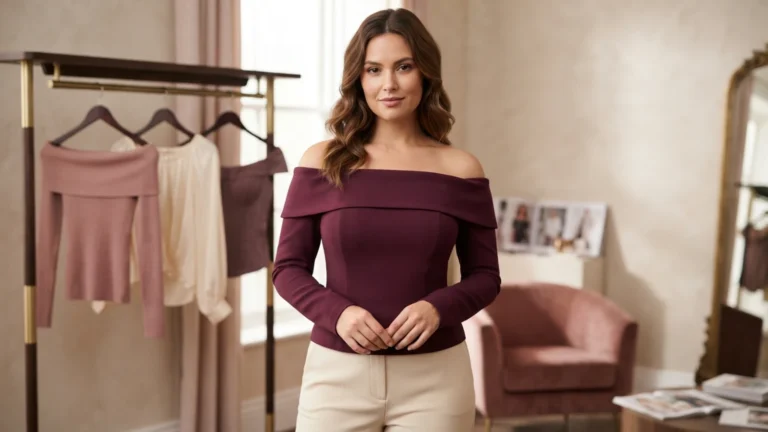
Best One-Shoulder Dresses for a Large Bust
A construction-first buying guide to balanced asymmetric necklines, genuine bust projection, secure bare-side edges, bra compatibility, fabrics, sizing and event-ready movement.
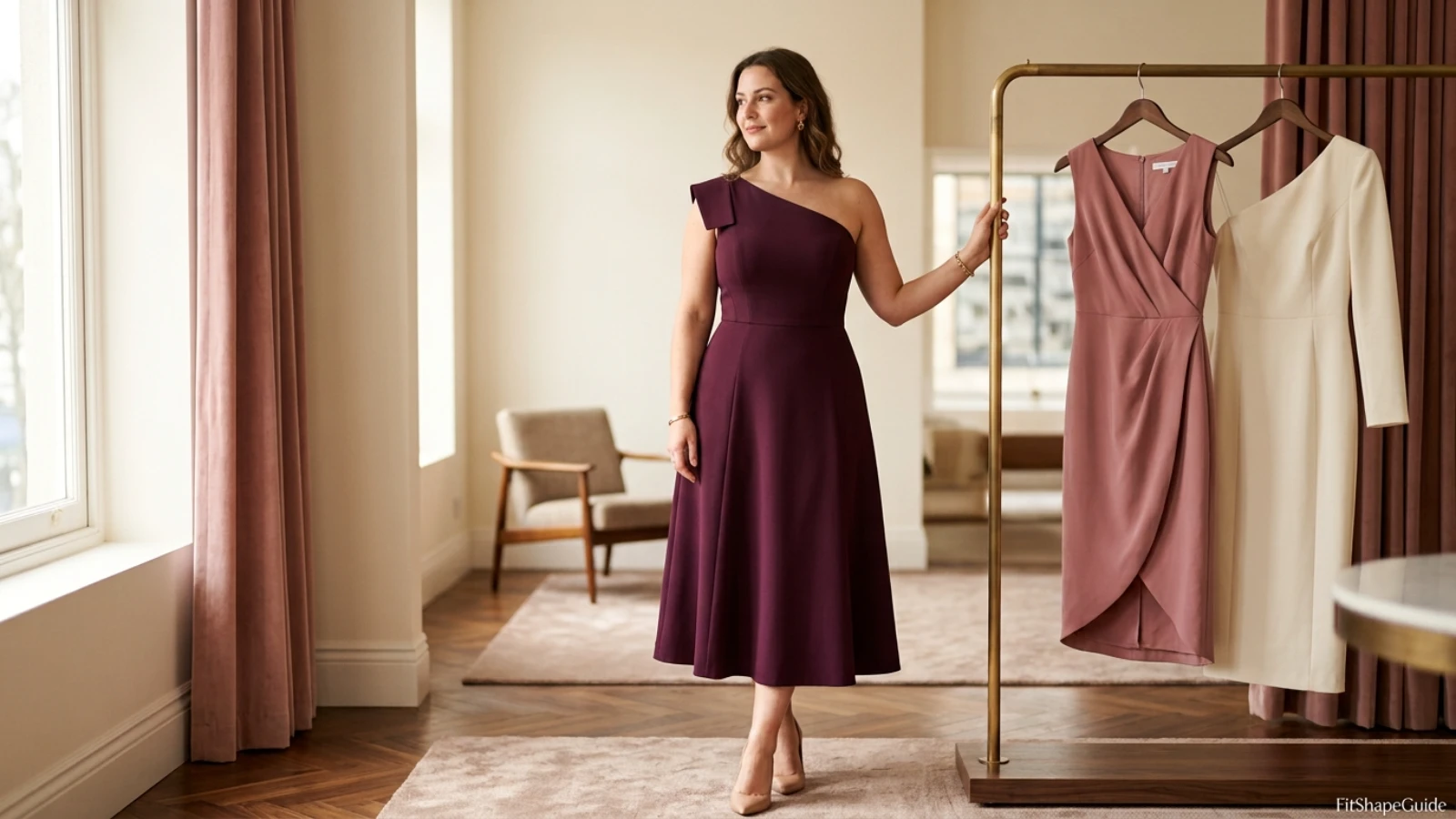
The 60-second one-shoulder dress fit check
- The anchored shoulder lies flat without carrying obvious downward weight.
- The bare-side edge stays against the chest without cutting in or opening.
- The diagonal neckline remains smooth instead of twisting toward the covered shoulder.
- The bust sits inside darts, seams or controlled stretch rather than flattening the front.
- The center-front waist stays level and the side seams remain vertical.
- The intended bra or internal support stays concealed from front, side and back.
- You can sit, breathe, reach and raise both arms without rotating the entire dress.
Best one-shoulder dresses for a large bust by design
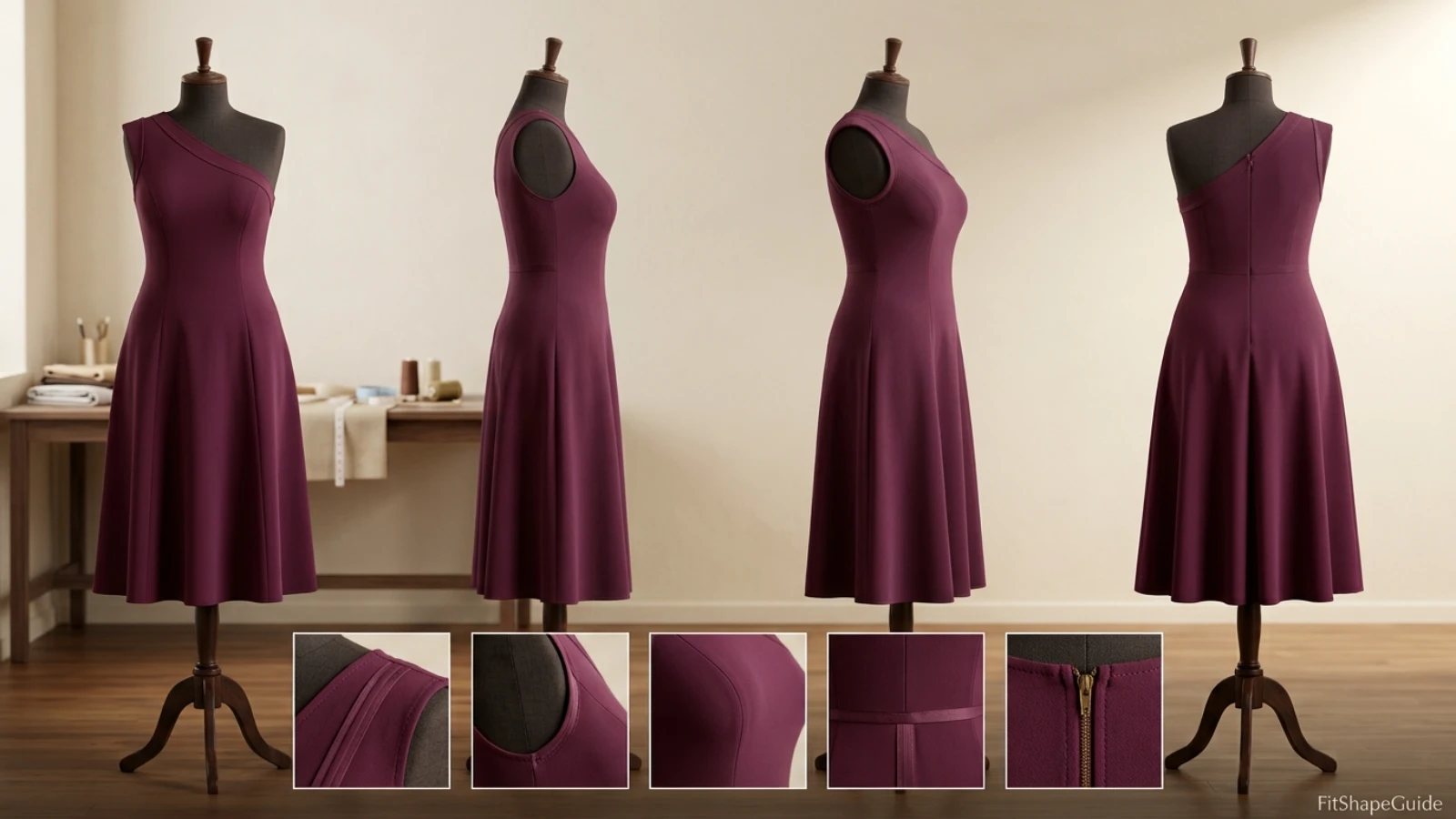
A one-shoulder neckline is a visual description, not evidence of support. Two similar dresses can behave differently: one uses a broad shoulder panel, shaped front, stable back and level waistband; another hangs a shallow diagonal tube from one narrow strap. The best one-shoulder dresses distribute tension around the torso, create space over the bust and ask the covered shoulder only to position the upper edge.
Wide-strap princess-seam A-line
Best for: weddings, dinners and cocktail events when you want a defined waist with balanced skirt volume. Look for a broad shoulder panel, princess seams that pass over the bust apex, a high bare-side edge, firm back closure and level waist seam. Trade-off: a fixed diagonal neckline must match both shoulder width and bust projection. If the front is shallow, the skirt may look balanced while the upper body twists.
Secured asymmetric wrap midi
Best for: shoppers who value adjustable waist placement and a softly opening neckline. Choose a faux wrap or a true wrap with deep overlap, an internal anchor and a separate waist tie. Trade-off: pulling the tie tighter does not create more bust depth. A loose upper overlap can gape when leaning, while a low bare-side edge can reveal a strapless bra wing.
Princess-seam one-shoulder sheath
Best for: polished cocktail, work-event and dinner dressing. Stable stretch crepe, a full lining, vertical shaping and a back vent can keep the silhouette clean. Trade-off: a narrow skirt gives the torso less freedom to rotate independently, so shallow fronts show quickly as diagonal drag lines. Confirm seated ease at bust, ribcage, waist and hip.
Draped or ruched jersey dress
Best for: softer occasions, travel and changing measurements when the knit is dense and resilient. Directional ruching can provide extra surface length over the bust and soften small asymmetries. Trade-off: gathers can disguise strain, and thin jersey may lengthen on the bare side, reveal bra edges or pull into the underarm. Stretch must recover after sitting and movement.
Structured one-sleeve formal gown
Best for: black-tie events when the bodice has genuine internal engineering. Look for multi-panel shaping, protected boning, firm lining, waist stay, strong zipper foundation and a sleeve joined without dragging the neckline. Trade-off: sleeve and skirt weight can pull in different directions, while beadwork makes alterations technical. Decorative corset seams alone do not equal support.
Supportive knit or smocked casual dress
Best for: daytime, resort and relaxed events. Dense interlock, ponte, rib or broad torso smocking can adapt through bust and waist while a flared skirt limits downward pull. Trade-off: narrow elastic at the bare edge can dig in, and loose smocking can let the neckline rotate. A heavy maxi skirt still needs a stable waist seam.
Across these options, the best one-shoulder dresses are defined by balanced construction rather than a dramatic diagonal line. The right category depends on event formality, intended bra, bust depth, shoulder comfort, skirt weight and how much alteration complexity you are willing to accept.
Shoulder anchoring, bare-side security and bust projection decide the fit
The best one-shoulder dresses work as an asymmetric load path. The covered shoulder positions one upper corner. The diagonal neckline transfers some tension across the front. Shaped bust panels and side seams contain projection. The back and waist resist rotation, while the skirt hangs from the waist instead of the shoulder. A wider strap can feel better, but it cannot rescue a loose torso or shallow bodice.
The covered shoulder should guide, not carry
A broad, flat shoulder panel generally distributes pressure better than a narrow strap. It should follow the shoulder without creeping toward the neck or falling toward the arm. Check the seam or fold at the highest point: puckering toward the neckline suggests diagonal tension, while a shoulder that lifts away may be too long or poorly angled. Sleeve versions also need enough bicep and upper-arm room so movement does not yank the neckline.
The bare-side edge is a structural boundary
The exposed side should sit high enough to cover the intended bra and remain close during breathing. A lightly stabilized edge, silicone grip or internal support may reduce small movement, but tight elastic is not automatically secure. If the edge cuts inward, creates overflow or leaves a deep pressure line, it is too short or too rigid. If it opens when you lean, inspect bust depth and the diagonal neckline before simply taking in the side.
Bust room requires width, depth and vertical length
Finished bust circumference is only one dimension. The front also needs enough length to travel from the neckline over the fullest point to the under-bust and waist. When that path is short, the front waist rises, the bare-side edge drops, the covered side pulls upward and the skirt rotates. Princess seams, darts, shaped lining panels or controlled stretch should create three-dimensional space without compressing the bust toward one side.
The back and waist prevent torque
A firm zip back, fitted mid-back panel, broad smocked torso, internal waist stay or accurately placed waistband resists the turning force created by the diagonal neckline. A very low back removes stability and often increases reliance on the shoulder and bra. This can still work for a light mini or midi, but it is a larger trade-off in a long or embellished gown. Compare the upper-body principles with the one-shoulder tops guide, then remember that a dress adds skirt weight below the waist.
| Construction point | Why it matters | Evidence to confirm | Main warning |
|---|---|---|---|
| Broad anchored shoulder | Spreads pressure and sets neckline position | Width, lining, seam angle and sleeve attachment | Panel creeps toward neck or arm |
| Diagonal neckline | Connects the two unequal sides | Stable edge, adequate length and smooth lie | Ripples or pulls toward one shoulder |
| High bare-side edge | Contains the bust and conceals support | Side height, light stabilization and recovery | Cuts in, rolls or opens when leaning |
| Shaped front panels | Create depth without sideways compression | Princess seams, darts, cups or mapped stretch | Seams miss the fullest point |
| Firm back closure | Resists rotation around the torso | Level zipper, high enough back and stable lining | Back climbs toward covered shoulder |
| Waist anchor | Carries the skirt and keeps seams level | Waistband, stay, seam or firm smocking | Front waist rises over the bust |
| Balanced sleeve and skirt | Controls uneven downward forces | Light sleeve, even hem and secure waist join | Dress rotates after several minutes |
The best one-shoulder dresses make each part’s job visible: the shoulder sets position, the front provides depth, the bare edge contains, the back controls rotation and the waist carries the skirt.
Fabric, lining, recovery and skirt weight
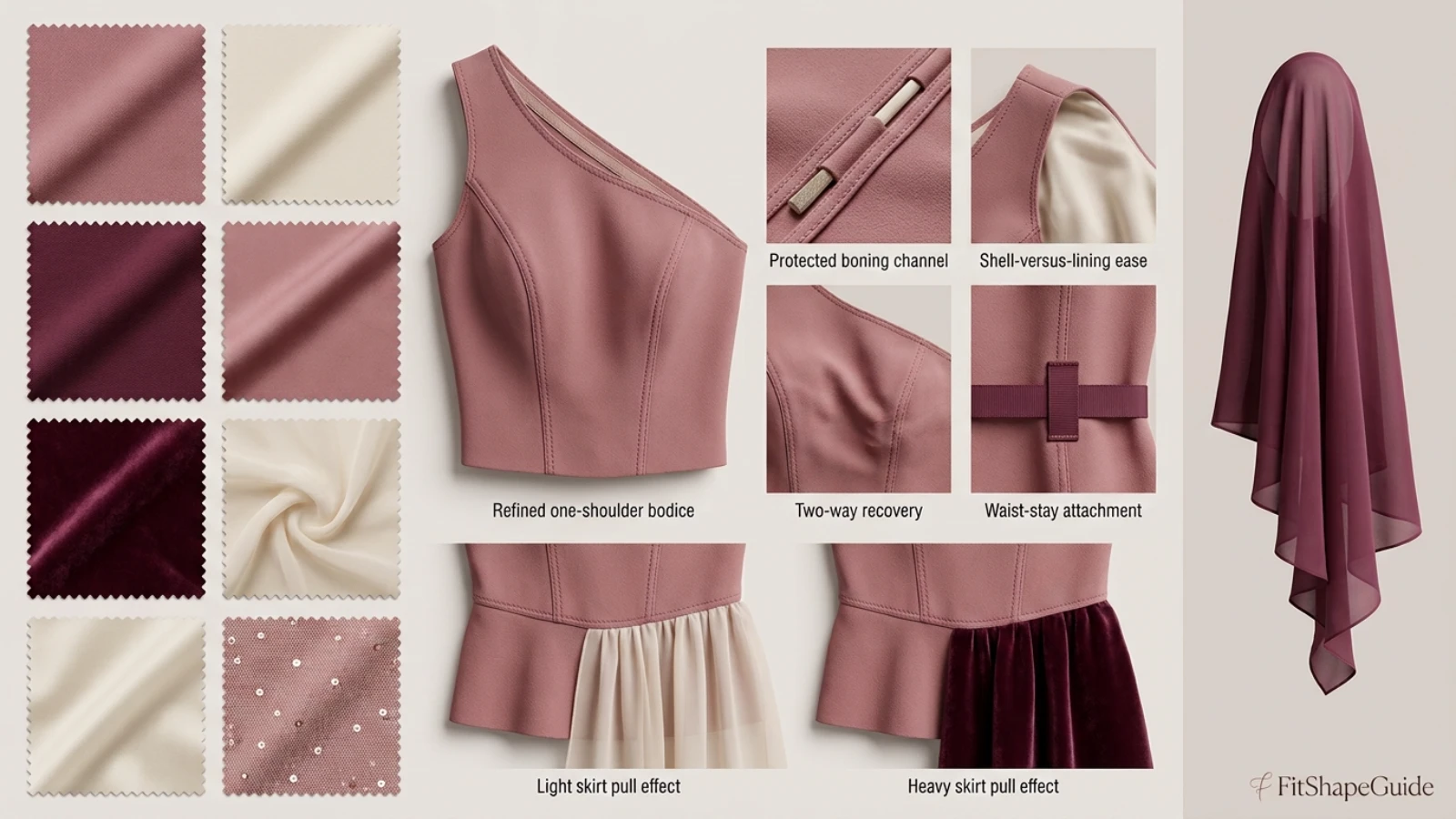
Fabric decides whether an asymmetric pattern keeps its shape after an hour. Stable woven crepe, faille, jacquard, satin-backed crepe and lined lace preserve a designed neckline but need accurate bust measurements. Ponte, interlock and substantial stretch crepe allow useful movement when they recover strongly. Thin jersey, loose rib, bias satin and soft chiffon can be beautiful, yet require more thoughtful lining and anchoring.
Stable wovens make fit evidence visible
In a woven sheath or A-line, darts and seams must supply the space that stretch cannot. This makes a good pattern predictable but less forgiving. Check that the shell and lining offer similar bust ease; a roomy shell over a tight lining is still a tight dress. Satin shows diagonal strain quickly, while brocade and jacquard can add bulk where seams cross the bust. Crepe often gives the cleanest balance of drape and control.
Controlled stretch must return to shape
A knit one-shoulder dress should stretch across the bust without lengthening permanently along the bare edge. Pull a fabric sample gently in both directions if shopping in person, then release it. It should return without ripples. Online, composition percentages help but do not reveal knit density or recovery, so customer photos after sitting and movement are valuable. Ruching can create useful surface area, but it should not be the only evidence of depth.
Lining can stabilize or secretly restrict
A full bodice lining reduces transparency, supports seams and protects skin from boning or embellishment. It must still match the outer shell’s shape. Short linings can drag the waist upward, while rigid linings under stretch shells can flatten the bust. In formal gowns, inspect whether cups, boning and waist stays are sewn into a firm foundation or merely attached as decorative components.
Sleeve and skirt weight create unequal pull
A one-sleeve design adds fabric on the same side as the shoulder anchor, while a cascade or drape may add weight across the opposite side. A long train, sequins or layered skirt increases downward force. The waistband or internal stay should carry that load. If lifting the skirt slightly immediately relaxes the shoulder, the lower half is pulling too much from above.
Season and event change the best choice
Dense crepe and ponte are versatile for transitional weather. Chiffon can work for a wedding party when the lining and front shaping are substantial; see the bridesmaid dress guide for group-order and alteration timing. Velvet and embellished satin suit evening events but add weight and may limit seam changes. For hot weather, a lined lightweight woven with a stable waist may outperform a heavy, clingy knit.
The best one-shoulder dresses pair the material with the structure: stable fabric needs precise shaping, stretch needs recovery, sheer layers need a supportive lining, and heavy skirts need independent waist anchoring.
How to buy the best one-shoulder dresses online
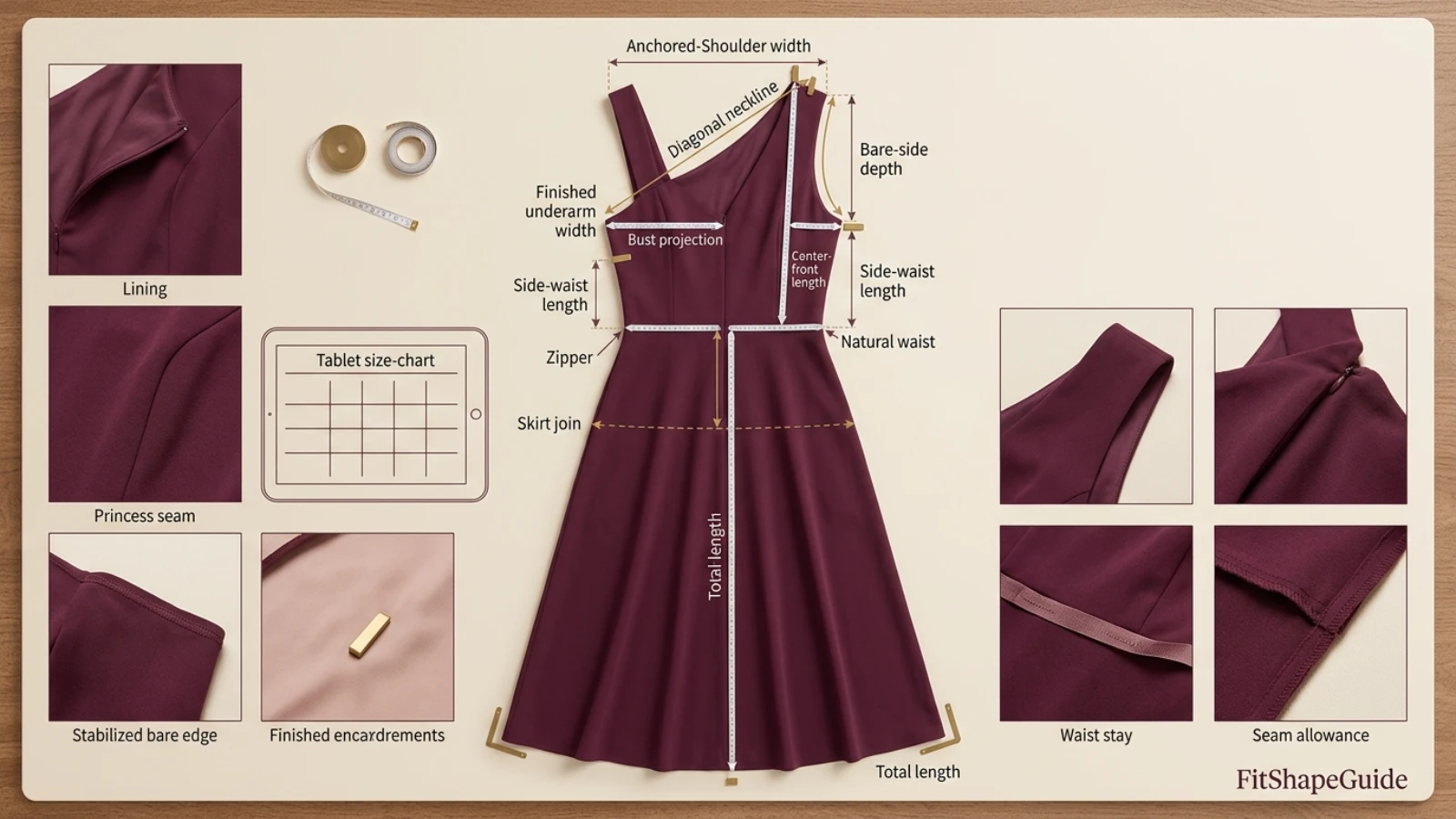
Measure over the exact bra or support setup planned for the dress. Record full bust, snug under-bust, natural waist, high and full hip, shoulder-to-bust apex, center-front neckline-to-waist length, both side-waist lengths and intended hem. For asymmetric clothing, add anchored-shoulder width, diagonal neckline path and bare-side edge height. Differences between the two sides are design information, not errors to average away.
| Listing evidence | Why it matters | Warning sign |
|---|---|---|
| Finished bust or underarm width | Shows usable horizontal room | Only a generic letter size |
| Center-front neckline-to-waist length | Protects projection and waist level | Only center-back length listed |
| Anchored-shoulder width and placement | Predicts pressure and neckline direction | Shoulder hidden by hair or pose |
| Diagonal neckline and bare-side height | Predicts coverage, grip and bra concealment | No straight front or bare-side photo |
| Back height, closure and waist | Shows resistance to rotation | Low back shown without foundation details |
| Sleeve or drape construction | Reveals extra weight and mobility limits | No raised-arm or back view |
| Shell, lining and stretch percentages | Predicts ease, opacity and recovery | “Stretchy” without composition |
| Skirt layers, embellishment and length | Signals downward load and alteration cost | Formal gown lacks lining or weight evidence |
Confirm what the size chart measures
A body chart describes the wearer the brand intends to fit; a garment chart describes the dress. Ask whether listed bust measurements represent the body range, finished circumference or a flat half-chest. If bust and waist indicate different sizes, prioritize adequate front room and length, then assess whether the waist or back can be refined. Sizing down to make the bare edge feel tighter usually increases compression and twisting.
Compare with a successful asymmetric garment
Measure a shaped dress you already wear comfortably. Compare underarm width, center-front length, waist, side height, back height and skirt attachment. If you own a successful one-shoulder top, record its anchored-shoulder width and neckline path, but remember that a dress adds weight below. Note the bra worn with the reference because different cup edges and band heights change coverage.
Read photos for vertical and rotational strain
A straight-on photo should show a level waist and vertical center line. Side views reveal cup exposure, underarm cutting and front-waist lift. The back should not climb toward the covered shoulder. Ignore poses that hide the bare edge with an arm or angle the torso. Useful customer images include seated, walking and rear views rather than only a static front pose.
Read reviews for symptoms, not verdicts
Useful reviews mention body and garment measurements, support setup, shoulder comfort, bare-edge security, zipper behavior, seated ease, dancing, lining and laundering. “Flattering” is encouraging but not diagnostic. “The waist rose two inches in front,” “the bare side opened when leaning” or “the sleeve pulled during reach” identifies the pattern feature that may matter to you.
Use adjacent sizes when returns permit
Trying two nearby sizes helps separate a size problem from a pattern mismatch. Use the same bra and run the same movement sequence. Keep the size that balances bust room, front length, bare-side security, waist stability and shoulder comfort. If one size compresses the front while the next rotates around the torso, neither size fixes the underlying geometry.
For that reason, the best one-shoulder dresses for a large bust are usually the listings that disclose asymmetric measurements and support details before asking you to trust a styled photograph.
Safe Amazon recommendation workflow
Before inserting a product module, verify the live title, seller, size chart, shoulder and sleeve construction, bare-side height, back and waist closure, shell and lining composition, care instructions, current return eligibility and useful customer-photo evidence. Use the affiliate tag bracalculator-20 only on a confirmed Amazon URL. Never publish a permanent price, rating, review count, coupon, stock or delivery claim.
The best one-shoulder dresses for a large bust earn inclusion only when the live listing supports a construction-led conclusion. If front length, side coverage or anchoring cannot be verified, state the missing evidence or omit the product.
Movement and security tests every one-shoulder dress should pass
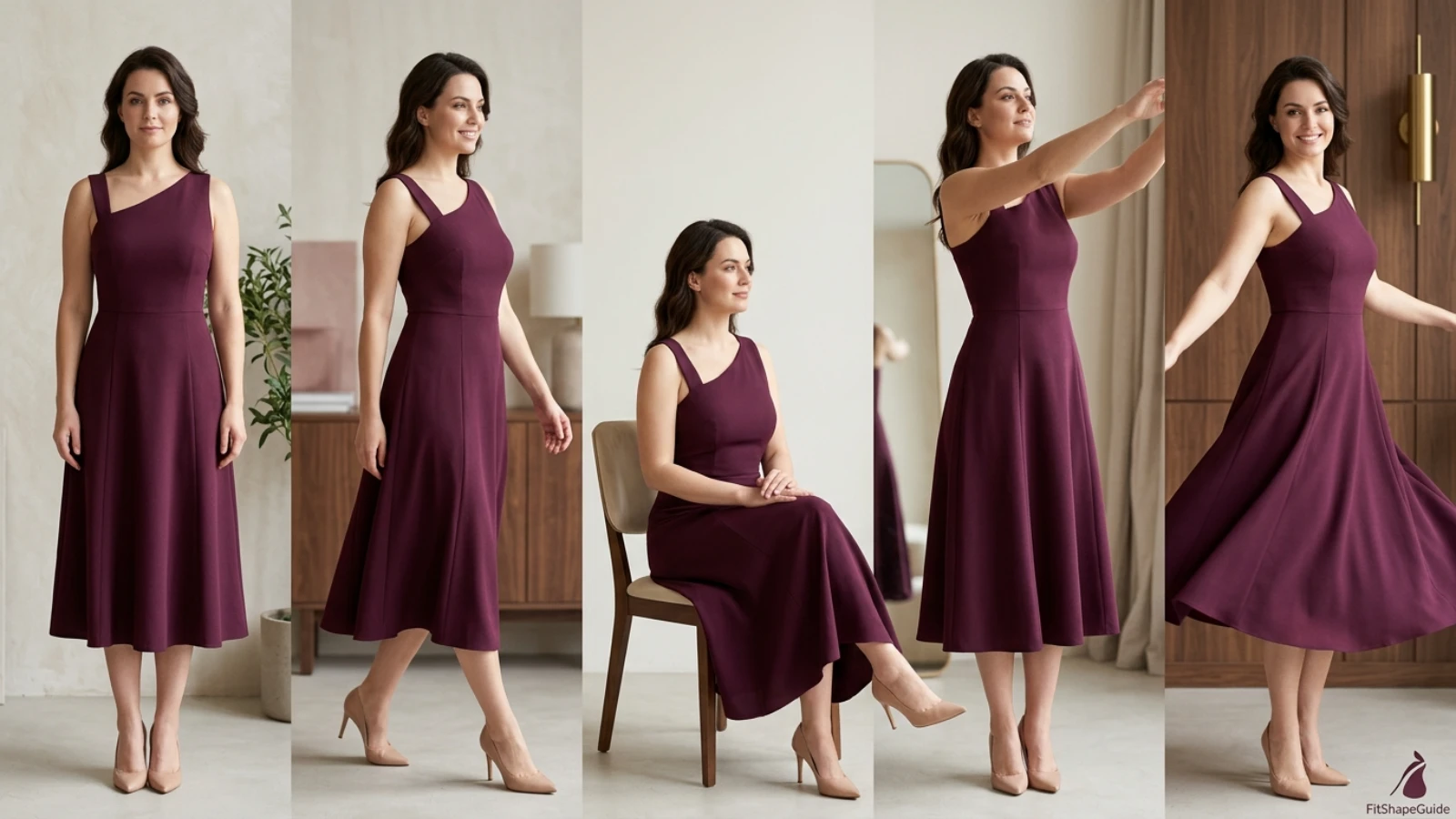
The best one-shoulder dresses for a large bust must remain balanced after the first attractive pose. Fasten the intended support garment, zipper and waist anchor, then let the dress settle for several minutes. Do not begin by tightening the shoulder or applying tape; you need to see what the construction does on its own.
Neutral stand and slow-walk baseline
Stand naturally without lifting one shoulder. Walk, turn and pause. The diagonal neckline should remain smooth, the bare edge close, the waist horizontal and both side seams vertical. If the dress rotates toward the covered side, inspect shoulder angle, missing front length, loose back and uneven skirt weight. If it drops on the bare side, check edge recovery and bodice depth.
Twenty-minute asymmetry test
Wear the dress for at least twenty minutes. Let both shoulders relax and notice whether you unconsciously raise the covered side. Pressure that develops slowly is more informative than instant softness. A deep mark, headache, tingling, numbness or persistent shoulder and neck pulling is a stop signal. The dress should not require posture correction to stay in place.
Seated dining and lean test
Sit upright, then lean toward a table and return. Check neckline gape, bare-side exposure, bust-panel position, waist pressure and zipper ripples. A structured bodice may feel close but should permit a full breath. If sitting pushes the bust upward and opens the bare edge, the front may be too short or the waist too rigid.
Unequal arm test
Raise the bare arm, then the covered arm, then both arms to shoulder height. The sleeve or shoulder panel should permit motion without dragging the neckline. Compare what happens on each side. A dress that stays stable on the bare side but climbs when the covered arm moves needs more sleeve, armhole or shoulder-panel mobility—not a tighter waist.
Reach, self-hug and bag test
Reach forward, hold a steering-wheel position and gently hug the shoulders. The back should not climb, the bare edge should not open and the side seams should resettle afterward. Add the intended clutch, shoulder bag or crossbody. A bag on the covered side may press the shoulder panel, while one on the bare side may disturb the neckline edge.
Dance, stairs and skirt-load test
Take several steps, climb a low stair if safe and complete a gentle turn. The skirt should hang from the waist instead of winding the bodice around the torso. Test any slit while sitting and walking. For a one-sleeve gown, observe whether sleeve weight combines with the skirt to pull the covered side downward during dancing.
The best one-shoulder dresses remain predictable across the full sequence; they do not convert every reach, turn or seated movement into a neckline adjustment.
Common one-shoulder dress fit problems and what they mean
Asymmetric symptoms show where tension begins. A rising front waist suggests missing center-front length. A dropping bare edge may mean weak recovery, but it can also occur when the bust pulls a shallow front outward. Rotation toward the covered side can come from shoulder angle, sleeve weight, loose back anchoring or an uneven skirt. Diagnose the complete dress before pinning one edge.
| Visible symptom | Likely cause | Best next step |
|---|---|---|
| Dress rotates toward covered shoulder | Short diagonal path, shoulder pull or weak waist/back anchor | Seek more front length and stronger torso stability |
| Bare-side edge drops or opens | Weak recovery, low edge or shallow bust panel | Choose higher shaped coverage before adding tape |
| Bare-side edge cuts inward | Edge is too short, rigid or under bust tension | Restore bust room and use a longer stable edge |
| Front waist rises over bust | Insufficient center-front bodice length | Seek longer front shaping rather than a larger waist |
| Covered shoulder creeps toward neck | Shoulder angle is too inward or neckline is pulling | Try broader outward placement and more front room |
| Sleeve restricts reach | Narrow bicep, high armhole or short sleeve cap | Choose more sleeve mobility, not a tighter neckline |
| Back climbs diagonally | Front pull and weak back resistance | Increase front depth and stabilize the back |
| Dress twists after walking | Poor recovery or uneven sleeve/skirt weight | Choose stable material and inspect waist attachment |
When sizing up works
Size up when the next size restores bust ease, center-front length, bare-side comfort and lining room while the waist and back remain controllable. It is less helpful when the larger size leaves a loose back and dropping bare edge while the front waist still rises. That combination points to a proportion mismatch.
When sizing down is the wrong fix
A smaller size may grip at the exposed edge, but it can flatten the bust, increase diagonal tension, pull the covered shoulder inward and raise the waist. Security created by compression is not stable construction. Compare a style with a higher bare edge, shaped front and firmer waist before accepting discomfort.
What a tailor can realistically improve
A tailor may shorten an accessible shoulder panel, refine a loose back or waist, stabilize an adequately sized bare edge, add bra-strap keepers, adjust a simple armhole or hem the skirt. Adding substantial bust depth, raising a very low exposed side, changing a one-sleeve armhole, moving boning or rebuilding integrated cups may require reconstruction. Fit the bust first and obtain an estimate before removing tags.
A discreet strip of fashion tape may reduce minor movement on clean, healthy skin when the dress already fits. It should not carry the bust, create missing depth or correct a rotating gown. The best one-shoulder dresses make diagnosis easier because their stable seams reveal where the pull begins.
Bra compatibility, occasions and styling
The best one-shoulder dresses for a large bust do not require the bust to look smaller; they require the dress and support system to occupy compatible space. Decide whether the neckline conceals a strapless or longline bra, works with a convertible one-shoulder strap, includes genuine bra-sized internal support or needs a deliberate visible layer. Test the exact setup before tailoring.
Strapless and longline bras
A well-fitted strapless bra is often the simplest option because it avoids a visible strap at the bare side. The dress must still have enough side and back height to cover cup edges and wings. A longline can distribute support lower on the torso but may conflict with a close waist seam or low back. Adhesive cups can add shaping or coverage for some wearers; they do not reproduce band-based support.
Convertible one-shoulder configurations
Some convertible bras allow both straps to connect on one side or one strap to travel diagonally. This may add security, but the bra strap should lie under the dress panel without creating a ridge or pulling the dress toward the neck. Confirm the anchor points are designed for that configuration. Do not improvise a path that distorts the cups or makes the band climb.
Internal support and corsetry
Built-in cups are useful only when their width, depth and placement match the wearer. Genuine internal structure may include multi-panel lining, cups, boning, under-bust tape and a waist stay. A foam pad sewn into a shallow front adds coverage, not necessarily lift. During fitting, check the internal layer separately from the shell and confirm that boning ends are protected.
Match construction to the occasion
For a wedding, a lined A-line or secured asymmetric wrap offers a practical ceremony-to-dance-floor starting point; the wedding guest dress guide covers dress codes and season. For black tie, a structured one-sleeve gown needs enough foundation to balance the skirt; the formal gown guide explains long-skirt load and technical alterations.
Use the asymmetric line intentionally
A one-shoulder neckline already creates a focal direction, so jewelry can stay simple. Earrings, a cuff or a ring may complement the open neck without competing with it. A wrap should sit below or around the shoulder panel rather than pulling across the diagonal edge. These are styling options, not rules for hiding the bust; fit balance comes from level waists and stable seams.
The best one-shoulder dresses remain comfortable after the complete outfit is assembled. Test outerwear, bag straps, hairstyle and jewelry against the covered shoulder, bare edge and any closure hardware.
Care, storage and final buying checklist
Asymmetric dresses can distort when stored from a single shoulder. Use both internal hanger loops if provided, support a heavy skirt across a padded hanger or store embellished gowns flat in a breathable garment bag. Follow the care label. Heat can damage elastic recovery, silicone grip, bonded edges and foam cups; twisting can stretch a bias neckline unevenly.
Recheck after cleaning
Before the next event, inspect the bare edge, shoulder seam, zipper base, waist join, boning channels and lining. Try the dress with the intended bra and repeat the lean and unequal-arm tests. A garment can look unchanged on a hanger while the lining or edge elastic has relaxed.
- Does the listing show the bare side, covered shoulder, back and waist clearly?
- Are bust, front length, fabric, lining and stretch details available?
- Can the intended bra remain concealed through movement?
- Does the waist or internal foundation carry the skirt?
- Are return and alteration deadlines practical for the event?
- Can the dress pass sitting, reaching and dancing tests without adjustment?
Use this checklist to separate the best one-shoulder dresses from look-alike listings that provide an attractive front photo but little evidence about bust depth, edge security or rotational stability.
The best one-shoulder dresses also make future care practical: their edges recover, their waist seams stay level and their structure can be inspected before the next event.
Final verdict
The most reliable starting point is a wide-strap princess-seam A-line with a high bare-side edge, firm back closure and stable natural waist. A secured asymmetric wrap offers adjustability; a lined stretch-crepe sheath offers polish; and a properly founded one-sleeve gown can work for black tie. The best one-shoulder dresses for a large bust create depth in the front and resist rotation through the torso. If the neckline stays in place only through compression, raised posture or tape, choose a better pattern.
Frequently asked questions
Can women with a large bust wear one-shoulder dresses?
Yes. Choose a one-shoulder dress with genuine bust projection, a broad anchored shoulder, a high secure bare-side edge and stable support through the back, under-bust or waist. The shoulder should position the neckline rather than carry the full weight of the bust and skirt.
What one-shoulder dress style is best for a large bust?
A wide-strap princess-seam A-line is a strong starting point, followed by a secured asymmetric wrap, lined stretch-crepe sheath or properly founded formal gown. The best choice depends on front length, bust shaping, bare-side height, back stability, bra compatibility and skirt weight.
What bra should I wear with a one-shoulder dress?
A well-fitted strapless or longline bra, a convertible bra configured for one-shoulder wear, or verified bra-sized internal support may work. Match the cup edge, wing, back band and strap path to the exact dress, then test both together while sitting, leaning and reaching.
How do I stop a one-shoulder dress from slipping?
Choose enough bust depth, a higher stable bare-side edge, a firm back and an anchored waist. Light edge stabilization or fashion tape may reduce minor movement when the dress already fits, but neither can replace missing front room or carry a heavy skirt.
Should I size up in a one-shoulder dress for a fuller bust?
Size up when it restores bust ease, center-front length, bare-side comfort and lining room while the waist and back remain stable. If the larger size rotates, exposes the bra or still rides up in front, choose a better-shaped construction instead.
How should the bare side of a one-shoulder dress fit?
The bare-side edge should cover the intended bra and remain close during breathing, leaning and arm movement without cutting in, rolling or creating overflow. Gape can come from a shallow front, so restore bust projection before automatically taking in the edge.
Can a one-shoulder dress be altered for a large bust?
A tailor may refine a loose back or waist, shorten an accessible shoulder panel, stabilize an adequately sized edge, add bra keepers or hem the skirt. Adding major bust depth, raising a very low side, changing a one-sleeve armhole or rebuilding cups is more complex.
Are one-shoulder dresses comfortable for weddings and formal events?
They can be comfortable when the bodice and waist carry the dress, the shoulder panel lies flat and the bare edge stays secure. Test at least twenty minutes of sitting, walking, leaning, unequal arm movement, reaching and gentle dancing in the intended bra and outer layer.
Related resources
How recommendations should be verified
FitShapeGuide may earn a commission when verified affiliate links are added, at no extra cost to the reader. Commercial relationships should be disclosed clearly and close to the recommendation, consistent with the FTC’s endorsement and review guidance and Disclosures 101 guidance. A commission must not change the construction evidence used to include or exclude a dress.
No Amazon product, ASIN, price, rating, review count, seller, stock, coupon or personal wear claim has been fabricated. Product slots remain deferred until the current listing can be checked. When details change or cannot be confirmed, update the module, state the limitation or remove the recommendation.