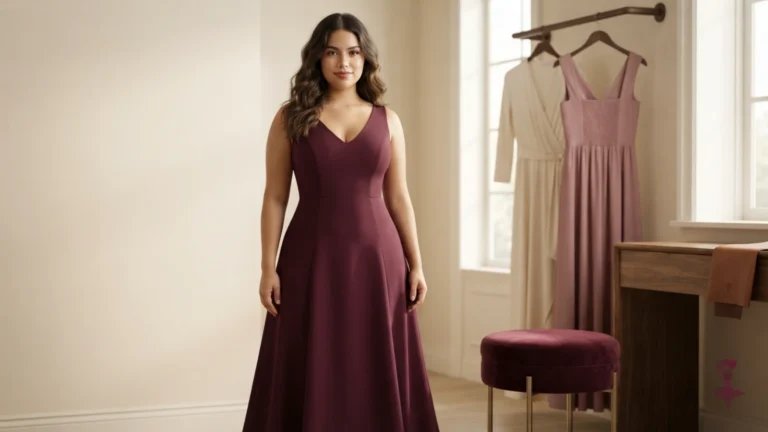
Best Silk Blouses for a Large Bust
A construction-first buyer’s guide to elegant silk without pulling, cling, or exposure: bust ease, shaping, neckline stability, weave, opacity, seam strength, front length, movement, and care.
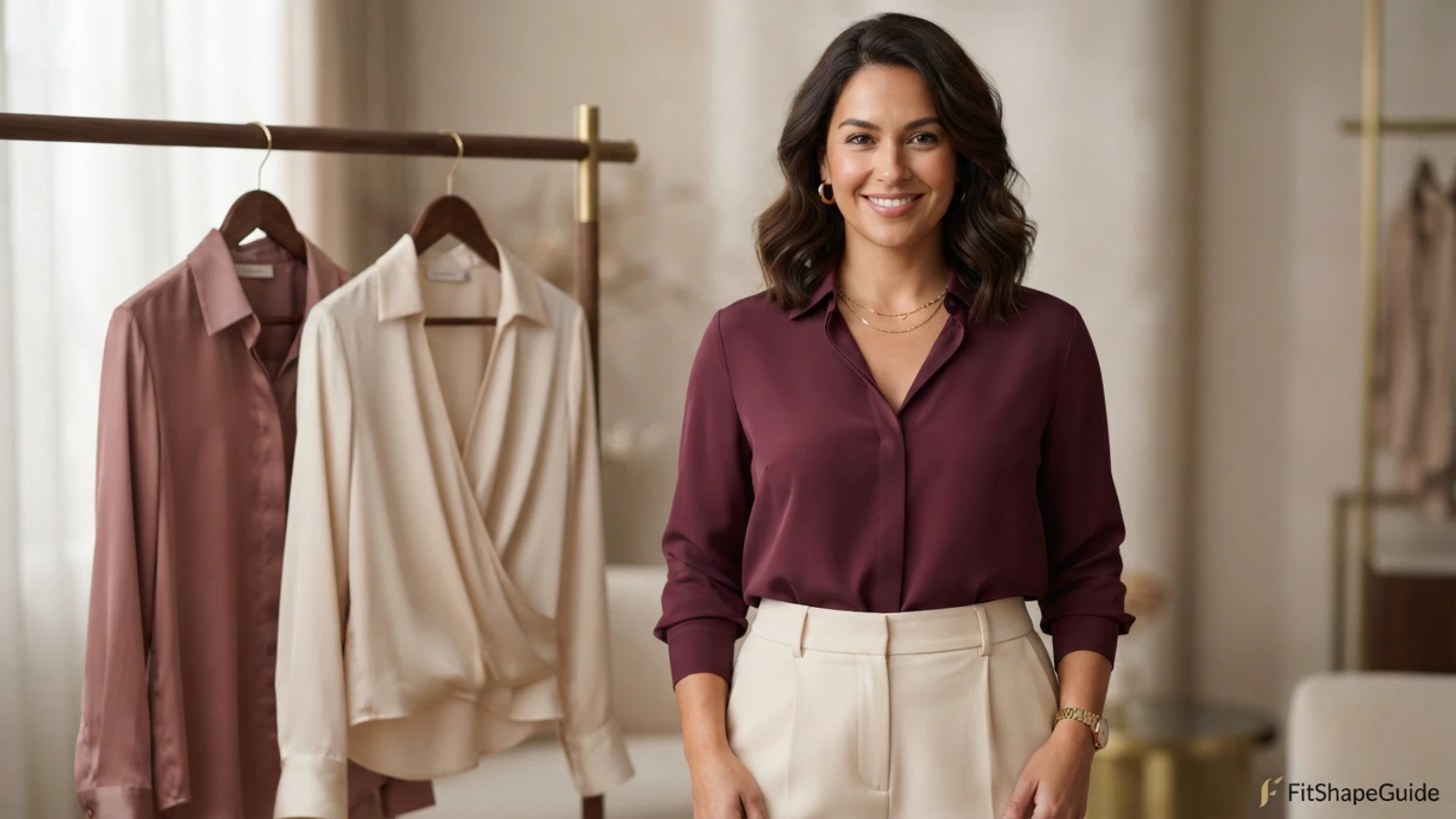
The best silk blouses for a large bust combine the fluidity people expect from silk with enough three-dimensional room to move over the chest without pulling forward, opening at the neckline, or catching on the bra. “Silk” identifies a fiber, not one fixed surface or behavior. Silk crepe de chine, charmeuse, twill, georgette, habotai, and stretch-silk blends differ in sheen, grip, weight, opacity, resilience, and drape. Satin is a weave and may be made from silk or other fibers, so a glossy product image does not prove fiber content. The pattern still matters most: if the front is too shallow, even luxurious cloth can produce diagonal drag lines, seam stress, a raised front hem, underarm cutting, or a neckline that slides outward. Sizing up may release the bust while making the shoulders, armholes, or waist too large. A better blouse places room through darts, shaped panels, controlled gathers, an adjustable wrap, a longer front, or a fuller-bust block. This guide compares those constructions, shows how to read fabric and garment evidence online, and separates minor fixable issues from failures that require a different pattern. Product modules remain private until live names, composition, measurements, care, returns, stock, imagery rights, affiliate links, and retailer details are verified.
The 60-second silk blouse check
- The shoulder seam sits near the shoulder edge unless a dropped shoulder is clearly intentional.
- The neckline stays against the body during a full breath and forward lean without revealing the bra.
- Darts point toward the fullest bust area and stop before it; curved panels follow the body without puckering.
- A placket lies flat, buttons remain vertical, and no interval opens at the fullest horizontal point.
- The cloth stays opaque and does not turn shiny, pale, or visibly strained when the arms move.
- Side seams remain vertical instead of rotating toward the front to provide missing room.
- The center-front hem has enough length to settle near the intended level rather than lifting sharply.
- After sitting and reaching, the neckline, sleeves, seams, and hem return without repeated adjustment.
Best silk blouses by construction
The best silk blouses do not depend on loose drape alone. Fluidity can soften an outline, but it cannot create missing front circumference, dart depth, neckline anchoring, or center-front length. Compare the architecture first, then check the exact silk fabric, support layer, activity, and care. The right choice depends on bust-to-waist difference, shoulder width, torso length, preferred neckline, bra coverage, and whether the blouse will be worn tucked, untucked, or under a jacket.
Darted silk crepe de chine blouse
Best for: polished work-to-evening wear. Crepe de chine usually presents a softer luster and a slightly grained surface rather than mirror-like shine. Side bust darts create depth without adding the same amount at the waist. Look for darts that aim correctly, a stabilized neckline, adequate sleeve and upper-back room, and a hem long enough to tuck. A dart can be present yet too shallow, so confirm that the front falls from the bust instead of pulling toward it.
Princess-seam or panelled silk blouse
Best for: a stronger difference between bust and waist. Curved seams distribute shaping over a longer line and can produce a closer, cleaner fit than a flat front. The curve should pass over the fullest area without puckering, collapsing above it, or twisting below it. Fine silk shows pressing and stitch quality clearly, so inspect seam smoothness. A mispositioned curve is harder to alter than a simple side dart.
Fuller-bust silk button-front blouse
Best for: preserving shoulder and neck fit while gaining front room. A useful fuller-bust block may add front width, dart intake, center-front length, closer button spacing, or an internal closure at the tension point. Look for finished garment measurements and an explanation of how the pattern differs from a standard cut. A “curve” label without front-specific construction evidence is not enough.
Secure faux-wrap silk blouse
Best for: adjustable-looking neckline balance without managing a loose full wrap. A sewn crossover, internal modesty panel, or hidden snap can hold the overlap while darts or gathers provide projection below it. The crossover must remain high enough during a forward lean and wide enough across the bust. A deep wrap forced closed by one snap may still strain at the side seam and lift at the front.
Shaped silk twill shirt
Best for: shoppers who prefer more body, coverage, and placket definition. A twill weave can provide a firmer hand than a very fluid charmeuse, although weight and finishing still vary. Seek bust darts or curved panels, a stable placket, close button spacing, balanced shoulders, and a smooth collar stand. Structure can skim rather than cling, but a rigid flat pattern can create pronounced tension.
Controlled-gather silk popover
Best for: fluid ease and fewer closure stress points. Gathers released from a shoulder yoke, neckline, or center front can provide room if they are deliberate and distributed. A half placket simplifies dressing while an uninterrupted lower front reduces gape risk. Check that fullness begins above the bust rather than accumulating only at the waist, and confirm that the neckline, armholes, and hem remain controlled.
| Construction | Best use | Evidence to seek | Main trade-off |
|---|---|---|---|
| Darted crepe de chine | Work, dinner, versatile dressing | Correct dart height, stable neckline, opaque body | Dart may be too shallow for stronger projection |
| Princess-seam silk | Defined waist and shaped fit | Curve at fullest point, smooth pressing, seam reserve | Wrong curve placement is difficult to correct |
| Fuller-bust button front | Classic shirt styling | Extra front room, longer front, close buttons | Specialty size data may be limited |
| Secure faux wrap | Open neckline with containment | Wide overlap, fixed anchor, modesty solution | Deep crossover can open during motion |
| Shaped silk twill | More structure and coverage | Darts, stable placket, balanced collar | Less forgiving if the front is undersized |
| Controlled-gather popover | Fluid casual or occasion wear | Useful gather release, stable neck, sufficient hem | Uncontrolled volume can hide the waist |
How the best silk blouses control necklines and closures
Among the best silk blouses for a large bust, neckline control is part of the pattern rather than an afterthought. Silk’s movement makes neckline and closure design especially visible. A blouse can have adequate circumference yet feel exposed because a bias-cut edge grows, a wrap overlap is too narrow, a facing rolls outward, or the garment is being pulled forward by bust projection. Conversely, a highly stabilized neckline can stand away when the front length is short. Stability comes from the whole pattern: shoulder position, back-neck width, front depth, facings, stays, closure placement, and the weight of the cloth.
V-necks need shape, not just depth
A V neckline can lengthen the visual line and create space above the bust, but depth is only one variable. The edge should remain flat against the upper chest, the point should sit where the intended bra remains covered, and the shoulder width must prevent outward drift. A narrow V may pull open sideways; a very wide V may expose straps. Staystitching, a stable facing, careful grain placement, or a discreet keeper can help, but none replaces adequate front room.
Wrap overlap must survive motion
Judge the overlap at neutral posture, full breath, forward lean, seated turn, and arm reach. A true wrap offers adjustment but may redistribute tension as the wearer moves. A faux wrap gives a fixed shape but cannot expand beyond its pattern. Look for a generous underlayer, an anchor below the bust or at the side seam, and enough fabric length to cross without dragging the opposite shoulder forward. A modesty snap is useful only when both edges naturally meet.
Button spacing should meet the load
For button-front silk, one closure should sit close to the fullest horizontal point, with another reasonably near above or below. Wide spacing places more force on each interval. Fine fabric can reveal scalloping, buttonhole distortion, and diagonal strain quickly. A narrow hidden placket or internal snap may stabilize a small gap, but if the two sides must be pulled together, the blouse needs more front room rather than stronger fastening.
Facings and bindings should lie quietly
Inspect the neckline edge in front, side, and three-quarter views. The best silk blouses keep this edge quiet without making it rigid. A facing should not roll out, ripple, or create a thick ledge. Fine bindings should not constrict the neckline or drag the shoulder. On very light silk, a heavy facing can dominate the cloth; on structured silk, insufficient support can collapse. The correct internal treatment matches the weight and intended movement of the outer fabric.
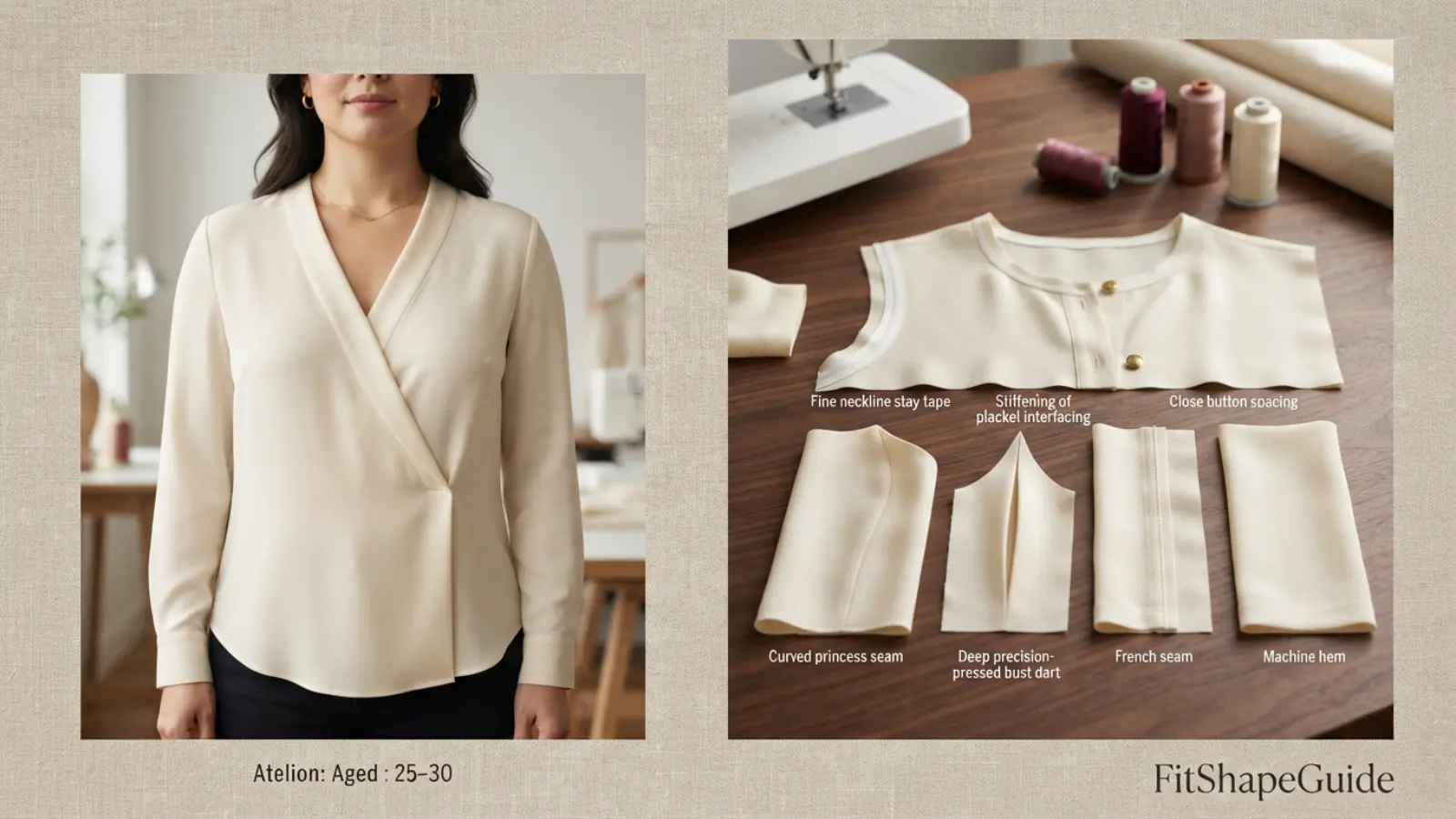
Silk fiber, satin weave, drape, opacity, static, and perspiration
The best silk blouses begin with correct identification. Silk is a fiber; satin is a weave that creates a smooth, lustrous face and can be made from silk, polyester, acetate, viscose, or blends. Charmeuse is a satin-type fabric with a lustrous face and duller back, while crepe de chine has a more subdued surface and textured hand. Silk twill shows a diagonal weave and often feels more substantial; georgette is crisper and commonly sheer; habotai is lightweight and smooth. These names describe useful tendencies, not guaranteed performance. The best silk blouses for a large bust treat weight, yarn, weave density, finishing, color, lining, cut, and care as separate evidence.
Crepe de chine: fluid with quieter shine
Crepe de chine is often a strong starting point for a blouse because its surface is less reflective than high-luster charmeuse and its slight texture can reduce obvious cling. It still requires sufficient ease, suitable opacity, and well-finished seams. Lightweight versions may show bra edges or turn translucent under tension. Look for darts, panels, or controlled gathers rather than assuming drape will solve a flat front.
Charmeuse and satin: reflection magnifies fit
A smooth lustrous face reflects light across every curve, fold, and strain line. That can look elegant when the blouse skims calmly, but an undersized front may create bright horizontal streaks, collapsed shadow lines, or a pulled neckline. Bias orientation can increase drape and movement but may also grow or cling differently. Confirm fiber content; “satin blouse” does not necessarily mean silk. A lined or double-front design may improve coverage but can alter breathability and drape.
Silk twill: more body, less collapse
Twill can support collars, cuffs, plackets, and shaped seams more decisively than very light silk. Prints may also reduce the visual prominence of minor creasing. However, structure does not create stretch. If bust depth or front length is missing, the tension may appear as a hard fold or lifted hem. Twill works best when the garment is patterned accurately and the weight suits the season and layer plan.
Georgette and chiffon: transparency changes the brief
Sheer silk blouses require a deliberate foundation. Evaluate whether a coordinating camisole is included, whether the intended bra remains visible, and whether double layers shift independently. A loose outer layer can still catch at the bust if the armhole, sleeve, or neckline is tight. Seams and hems are highly visible through sheer cloth, so clean finishing is part of both durability and appearance.
Stretch silk: useful recovery must be verified
Some silk fabrics include elastane or another fiber for stretch. Check the exact percentages and whether stretch runs across the body, lengthwise, or both. A small amount may improve recovery and movement, but the garment should not be selected at maximum extension across the bust. The best silk blouses use stretch as movement reserve rather than their only source of bust room. Continuous tension can increase shine, reveal underlayers, distort seams, and shorten useful life. Stretch is reserve, not a substitute for shape.
Opacity, static, and perspiration are separate tests
Opacity depends on weight, weave density, color, lighting, tension, and the contrast of the bra or base layer. Static depends on the full fiber system, finish, humidity, and adjacent layers; it should not be assumed from the word silk alone. Perspiration may temporarily darken some silks or interact with dyes and finishes. Review care instructions, choose a compatible base layer if useful, and test an inconspicuous damp area only when the manufacturer permits it. Marketing claims such as “sweat proof,” “static free,” or “washable silk” require product-specific evidence.
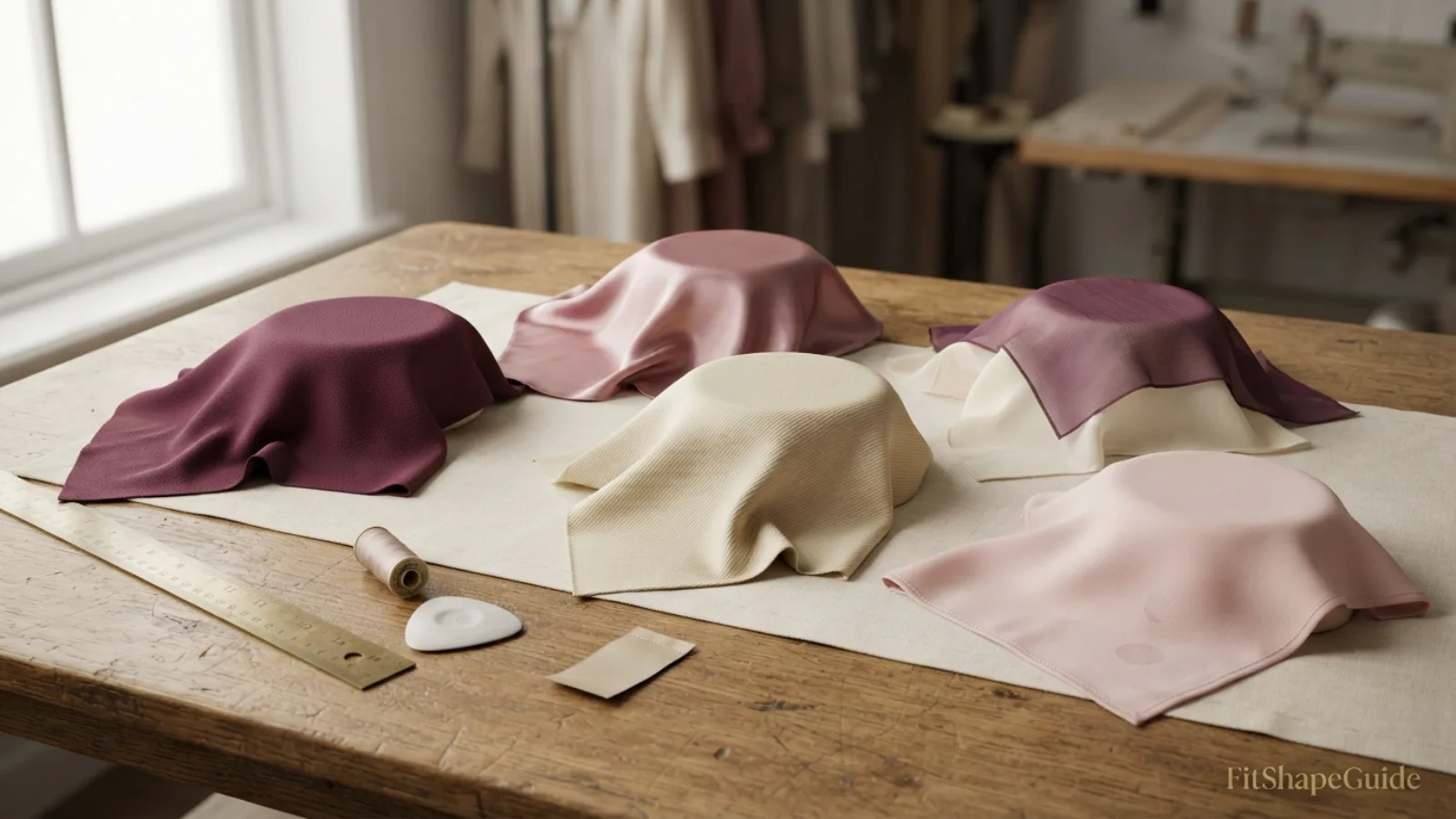
Bust ease, darts, gathers, shoulders, and front length
Bust ease is the difference between the garment’s available circumference and the body plus the intended foundation layer. The number is useful, but it does not reveal where the room is located. A relaxed blouse may have generous total width while pulling at the chest because the back holds most of that width, the front is short, or the armholes sit incorrectly. The best silk blouses place adequate width and length on the front while keeping the neck, shoulders, upper back, and sleeves balanced.
Start with a successful blouse
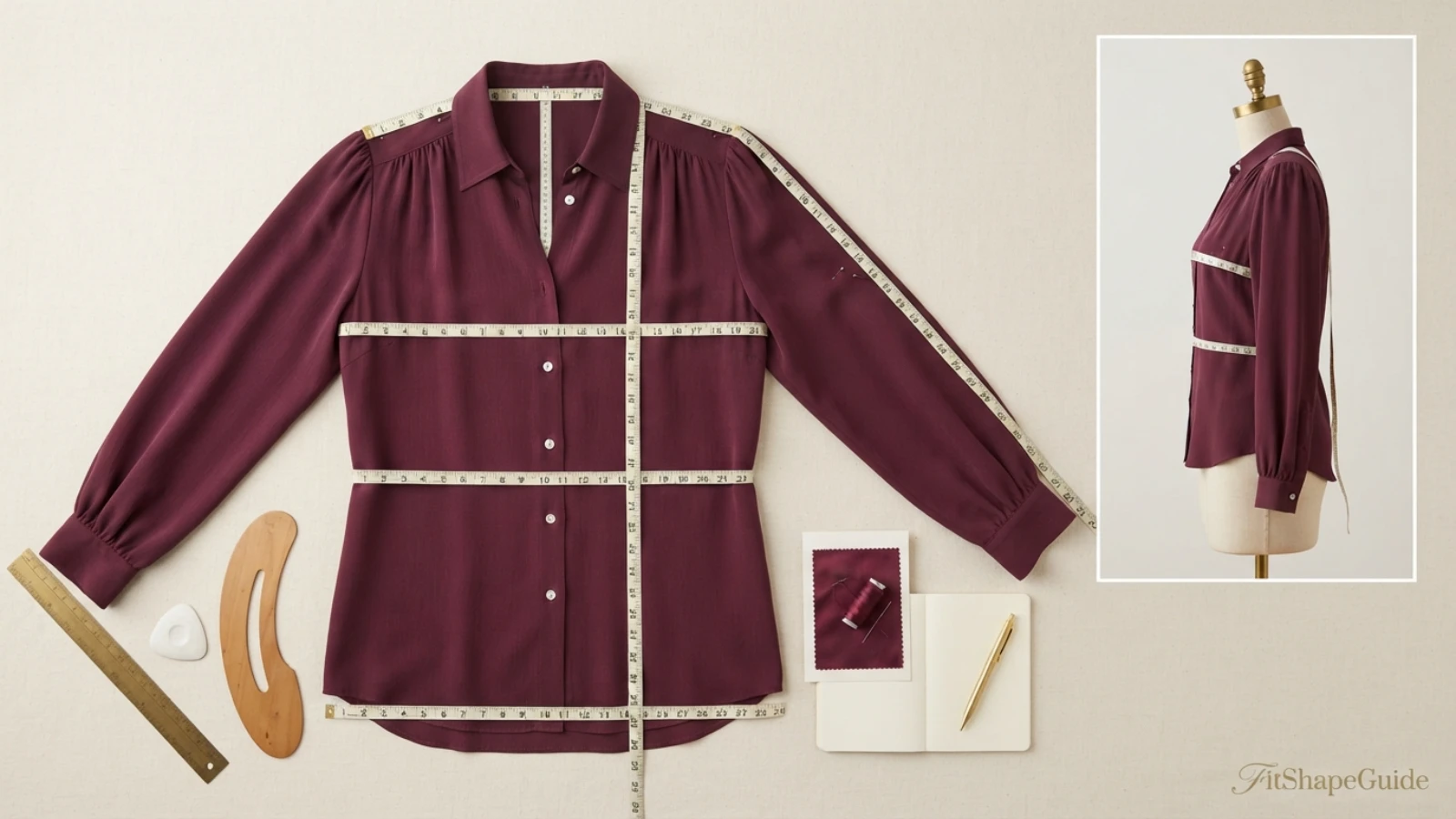
Button or close a blouse that fits, lay it flat without stretching, and measure straight across at the fullest bust level; double that figure for an approximate circumference. Also record shoulder width, front and back length, waist, hem, armhole depth, bicep, sleeve, cuff, and neckline depth. For wraps, note overlap width and tie position. Compare similar silhouettes: a fitted twill shirt, fluid crepe popover, and bias charmeuse shell require different ease.
Darts need correct height and sufficient intake
A side bust dart should point toward the fullest area and finish before it. If it ends too high, fabric may pool above while the lower front strains; if too low, the blouse can drag downward and hollow near the upper chest. The intake must create real depth. A token dart on a standard block may appear useful in a listing yet provide little projection. Side photography reveals whether the front travels over the bust and then falls instead of tipping outward.
Gathers must release where room is needed
Gathers at the shoulder, yoke, or neckline can distribute front width, but placement matters. If fullness releases above and around the bust, it can support fluid ease. If it begins below the fullest point, the upper front may still pull while volume accumulates at the waist. Fine gathers should hang vertically without being stretched flat. Elasticized gathers need recovery and a stable anchor so the neckline does not drift.
Shoulders limit how far sizing up can go
Size up when the larger size restores bust, upper-back, and front-length comfort while the neckline, shoulders, armholes, and sleeves remain intentional. Stop when shoulder seams fall down the arm, the neckline floats, the sleeve twists, or the armhole exposes the bra. A dropped shoulder can be a deliberate relaxed design; it should not be the accidental result of buying several sizes larger to close the bust.
Bust projection uses vertical length
The front must travel outward before falling downward, so a blouse can seem long on a hanger yet rise at center front in wear. Compare front and back lengths from comparable points. Darts, curved panels, a fuller-bust block, a shaped hem, or extra front length can restore balance. Judge tuck security while seated and reaching. Overall length added equally to front and back may not solve a front-specific shortage.
| Measurement | What it predicts | How to compare | Failure signal |
|---|---|---|---|
| Finished garment bust | Available circumference | Compare with a similar non-stretch blouse | Only a body-size range is supplied |
| Front versus back length | Hem balance and tuck security | Measure from matching high-shoulder points | Front rises sharply in side view |
| Shoulder and armhole | Neckline anchor and sleeve motion | Compare seam-to-seam and depth | Dropped seam, floating neck, exposed bra |
| Dart or panel height | Location of projection | Compare high shoulder to fullest curve | Point or curve sits above or below bust |
| Bicep and cuff | Reach and layer comfort | Measure actual intended sleeve position | Torso pulls when the arm bends |
| Wrap overlap | Neckline containment | Assess standing, leaning, sitting, reaching | Edge separates or snap carries tension |
How to find the best silk blouses for a large bust online
Online shopping becomes more reliable when a listing is read as technical evidence instead of a styling mood board. Begin with the exact fiber percentages and finished garment measurements. A brand body chart states whom the size is intended to fit; it does not reveal the blouse’s actual ease, shoulder width, front length, bicep room, neckline depth, or wrap overlap. If a “bust measurement” is listed, determine whether it describes the body, the garment laid flat, or a maximum stretched dimension.
Measurements worth requesting
Request full garment bust, shoulder width, front and back length, waist, hem, bicep, sleeve, cuff, and armhole depth. For a shaped design, ask for dart height or inspect its position relative to the model’s high shoulder point. For a wrap, ask about the fixed overlap, inside tie, snap, or modesty panel. Confirm whether measurements are taken with pleats or gathers relaxed, and whether a lining is measured separately.
Photos that reveal construction
Useful listings show front, three-quarter, side, and back views with the blouse closed; both tucked and untucked when relevant; and at least one frame with the arms moved. Zoom in on the neckline, placket, darts or curved seams, side seam, armhole, cuffs, and hem. Crossed arms, hair, a jacket, scarf, bag strap, or strong pose can conceal pulling. A video helps only when the front and side remain visible through actual motion.
Read fiber language literally
“Silky,” “silk touch,” and “satin” do not confirm silk fiber. Check the composition label for exact percentages of silk and any companion fibers. If the blouse is lined, identify the lining separately. Also review country of origin, care, and trim information where supplied. The FTC’s textile guidance explains that most covered products require fiber content, country of origin, and responsible business identification; a retailer’s marketing adjective is not a replacement for those disclosures.
Use reviews as location-specific evidence
A useful review says where the blouse succeeds or fails: neckline opened while seated, dart sat too high, placket separated between particular buttons, sleeve pulled the torso, fabric became transparent under tension, or front length was short when tucked. Reviews help identify the best silk blouses only when they describe a location and condition. “Runs small” is less useful without garment size, proportions, bra or base layer, and intended fit. Repeated comments about the same location carry more weight than a single overall rating.
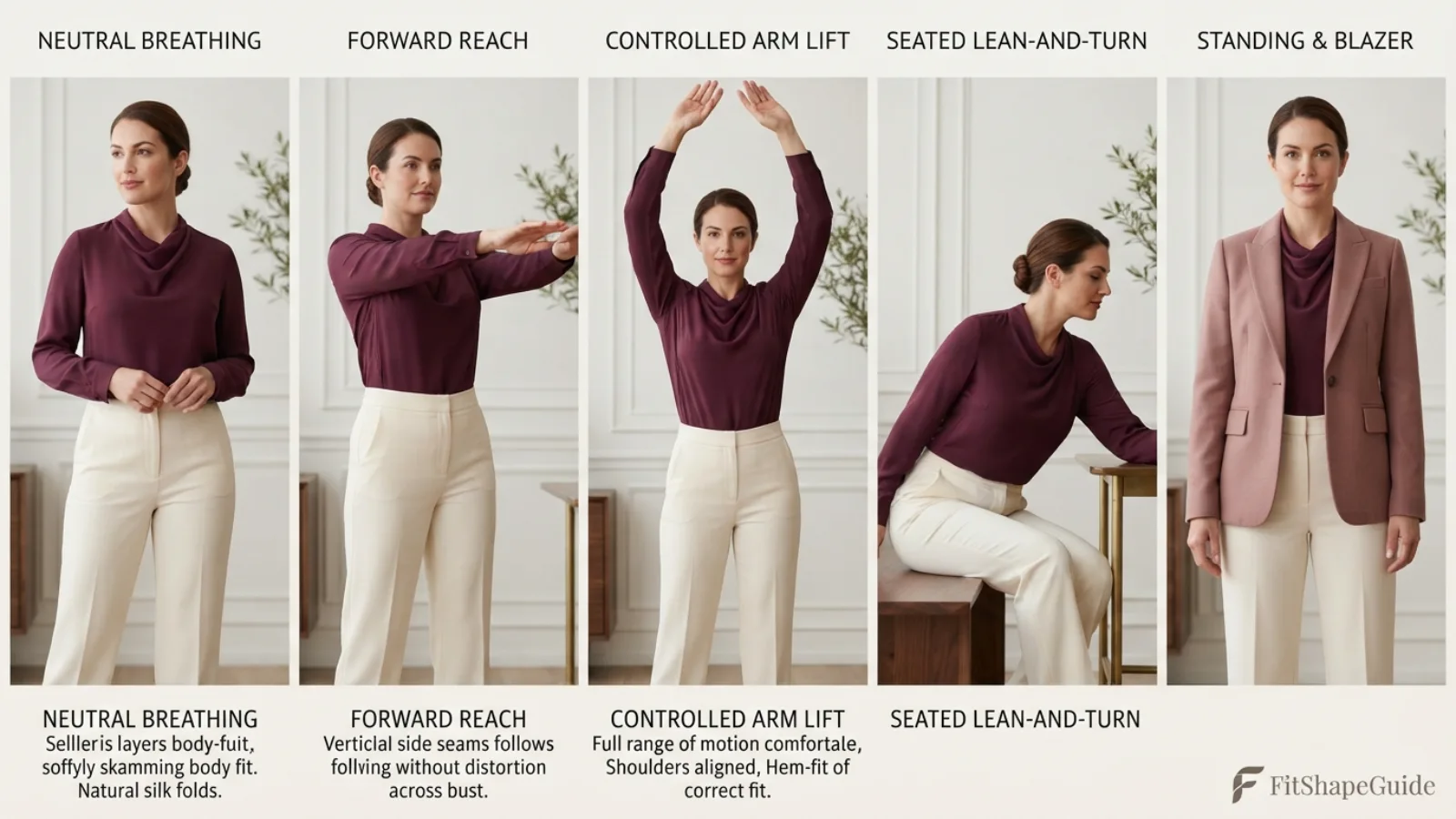
The five-position test for the best silk blouses
A mirror check at rest cannot reveal whether a fluid blouse is stable. Keep tags attached and follow the retailer’s return conditions. Wear the actual bra, camisole, trousers or skirt, and jacket planned for the blouse. Perform each position slowly; delicate fabric should never be yanked into a test. The aim is not unlimited athletic motion. It is ordinary breathing, desk work, dining, commuting, and layering without exposure or garment monitoring.
1. Neutral breath
Stand naturally, release the shoulders, and take a full comfortable breath. The neckline should stay in place, buttons should remain aligned, darts or seams should point correctly, and the fabric should not change color or shine from tension. Check the side seam and front hem. A blouse that fits only while the rib cage is held still has insufficient reserve.
2. Forward reach
Reach as if using a keyboard, steering wheel, or shelf. The upper back and sleeves should contribute movement without dragging the neckline backward or opening the front. A small shift is normal; persistent throat pressure, a placket gap, or side seams rotating forward indicates imbalance. Reaching can also reveal a narrow bicep or low armhole that pulls the whole blouse.
3. Controlled arm lift
Raise the arms to a practical height rather than forcing them overhead. Observe underarm coverage, sleeve comfort, neckline stability, and hem recovery. If the entire blouse climbs and remains high, the armhole, sleeve, or torso may be poorly balanced. If the bra shows through the armhole, sizing down may worsen the bust fit; a different cut is usually better.
4. Seated lean and turn
Sit, lean slightly forward, and turn toward each side. This increases demand on bust, upper back, neckline, waist, and front length simultaneously. The overlap should remain secure, the placket should stay closed, and the hem should cover the planned waistband. Check whether the fabric catches under the bust or pools sharply above a tuck.
5. Layer and recovery
Add the intended blazer, cardigan, or coat, then remove it. Sleeves should enter the layer without forcing the shoulder seams forward, and the silk should settle after the outer layer comes off. The best silk blouses recover their neckline, side seams, sleeves, and hem after the layer is removed. Excess static, twisting cuffs, rolled facings, and a neckline that requires resetting are practical wear issues. A small amount of smoothing is normal; repeated reconstruction of the outfit is not.
Fit failures that eliminate the best silk blouses
Silk’s reflectivity and fluid movement can make small imbalances obvious, but not every fold is a defect. Soft vertical or diagonal drape created by the design is normal. Repeated strain lines converging on one point, localized shine, an opening edge, a rotating seam, or a hem that does not recover are diagnostic. Look from front, side, and back before deciding whether the answer is a new size, a small alteration, a different bra or layer, or a different construction.
| Symptom | Likely cause | First response | Walk-away point |
|---|---|---|---|
| Diagonal lines toward bust | Insufficient front depth or wrong dart | Try more ease or stronger shaping | Shoulders fail before the bust releases |
| Neckline falls open | Narrow overlap, forward pull, unstable edge | Test correct size and secure construction | Coverage depends on constant pinning |
| Placket scallops or gaps | Missing room, wide buttons, weak support | Seek larger front, closer closures, darts | Edges must be forced together |
| Side seam rotates forward | Front borrowing width from back | Choose fuller front or shaped panel | Seam stays rotated after adjustment |
| Front hem rises sharply | Missing front length or projection | Seek longer front and shaping | Tuck fails when seated |
| Fabric turns shiny or sheer | Excess tension or low opacity | Try more ease, denser cloth, lining | Coverage fails in ordinary posture |
| Torso lifts with arm | Narrow bicep, low armhole, sleeve imbalance | Compare sleeve and armhole construction | Normal reach requires resetting blouse |
| Seam puckers or spreads | Construction stress or poor pressing | Inspect unworn garment and seam quality | Threads break or holes appear |
When sizing up works
Move up when the larger size restores relaxed breathing, opacity, neckline security, front length, and movement while the shoulders, armholes, sleeves, and waist remain useful. Excess waist can sometimes be refined. A larger size is not automatically less flattering; a silk blouse needs enough room to drape. The goal is controlled ease rather than a garment stretched smooth across the body.
When a different construction is smarter
Choose princess seams when bust and waist need different amounts of room. Choose a fuller-bust button front when standard sizing damages the shoulders. Choose a faux wrap when adjustable-looking neckline balance matters, twill when more body and opacity are useful, or a popover when a long placket remains the weak point. If silk care is incompatible with the planned routine, a well-cut large-bust blouse in another verified fabric may deliver better cost per wear.
Which silk blouse alterations are realistic?
The best silk blouses are bought to fit the bust, shoulders, neckline, and armholes before secondary refinement. Silk can show needle marks, pressing shine, puckering, and handling damage, so choose a tailor experienced with fine fabrics. Confirm seam allowance, lining, interfacings, edge finishes, and print placement before any work. Pin or baste the proposal, close the blouse, and repeat the movement test before permanent cutting.
Reasonable adjustments
A tailor may take in the waist or side seams, refine a hem, shorten a sleeve, reposition a button, add a discreet internal snap where the edges already meet, secure a wrap keeper, or improve a loose facing. Small dart refinements may be possible when the apex and fabric permit. These alterations should preserve the grain, drape, and original balance. Stitch length, needle, thread, pressing temperature, and stabilizer must suit the silk and lining.
Adjustments with trade-offs
Changing dart intake affects waist width and front length. Taking in side seams can reduce armhole or hip ease. Shortening a blouse may remove a shaped hem or reduce tuck security. Raising a neckline with an insert changes styling and can alter drape. Adding a snap can localize tension if room is marginal. Each proposal should be judged while breathing, sitting, reaching, and wearing the intended foundation.
High-risk reconstruction
Adding substantial bust width, moving an entire princess curve, rebuilding shoulders, changing armhole shape, creating front length, or converting a deep loose wrap into a secure neckline is usually pattern-level work. Matching silk may be difficult, and old stitch lines can remain visible. When the primary structure is wrong, returning the blouse and selecting a better block is generally more reliable than reconstructing expensive delicate fabric.
How to style the best silk blouses
Silk already supplies texture, movement, and light response. The best silk blouses need styling that supports the activity and preserves the garment’s intended line. There is no requirement to hide a large bust or avoid shine entirely. The practical questions are whether the neckline is secure, the foundation stays concealed, the fabric remains calm, the hem works with the waistband, and outer layers allow the sleeves and shoulders to move.
Workwear: crepe blouse with clean tailoring
Pair a darted crepe de chine blouse with high-rise tailored trousers or a column skirt. A stable V, soft band collar, or open crew neckline can sit cleanly beneath a blazer. Keep jacket armholes and sleeves large enough that they do not pull the blouse backward. A full tuck emphasizes waist definition; a blouse with extra front length may stay more secure through sitting. If the office layer comes off, complete the movement test without it.
Soft structure: silk twill with straight denim
A shaped twill shirt can balance the visual softness of silk with a more defined collar, placket, and cuff. Wear it tucked, half-tucked, or open over a base only when the front remains long enough over the bust. Straight or wide-leg denim creates a grounded texture contrast. The right button-down construction matters more than using styling tape to hold an undersized front.
Evening: secure wrap with a quiet base
A faux-wrap blouse can create an elegant open neckline when the overlap and anchor are stable. Use a smooth bra or compatible camisole for a large bust if the fabric is sheer or the neckline requires a base. Check the final outfit while seated, because a waistband can push blouse volume upward and change the overlap. Jewelry should not snag fine silk or weigh down the edge.
Layering: sleeveless silk under a jacket
A silk shell reduces sleeve bulk beneath tailoring, but armhole shape and side-bust coverage must remain secure when the jacket is removed. Compare with the dedicated sleeveless-top fit guide if bra concealment is central. A slightly matte fabric often layers quietly, while high-luster charmeuse can highlight pressure from a tight jacket. Test both layers together rather than buying them independently.
Relaxed dressing: popover with a defined hem decision
Controlled gathers and a popover opening can create fluid ease without a button line. Decide whether the blouse will be fully tucked, front tucked, or worn out before choosing length. A curved hem, side slit below coverage level, or slight high-low balance can help. If a deeper crossover is preferred, the wrap-top guide explains overlap, tie position, and movement in greater detail.
Care for the best silk blouses without distorting them
Follow the garment’s own care label because silk type, dye, print, lining, interfacing, buttons, trims, and finishing determine the safe method. The FTC’s textile-label guidance explains fiber-content disclosures, while its care-label guidance explains care-instruction responsibilities. “Washable silk” is product-specific; it is not permission to wash every silk blouse the same way.
Treat stains promptly according to the label and avoid rubbing one point aggressively. Perspiration, fragrance, deodorant, cosmetics, and water can interact with some colors or finishes, so test only where permitted. If hand or machine washing is approved, use the specified temperature and method, avoid twisting, and support the garment’s weight when wet. Reshape the neckline, placket, cuffs, seams, and hem gently. If dry cleaning is specified, identify stains and delicate trims to the cleaner.
Press or steam only at a setting suitable for the exact fabric and from the recommended side. Use a pressing cloth when appropriate, and avoid stretching bias edges or pulling a warm damp placket. Store clean and dry on a smooth hanger that supports the shoulders, or fold with tissue when the garment’s weight could distort it. Protect from snagging jewelry, rough bags, and crowded hardware. Repair a loose button or opening seam before stress enlarges the damage.
Value is cost per calm wear, not the lowest price, highest shine, or largest silk percentage in a headline. Count how many settings the blouse serves, which bras and layers it accepts, whether it works tucked and untucked, how demanding its care is, and whether the closures and seams can be maintained. The best silk blouses earn repeat wear because the neckline stays secure, the front remains balanced, the fabric does not require constant monitoring, and the wearer can move through a normal day confidently.
Final buyer checklist
- Exact shell and lining fiber percentages are disclosed; “silky” is not treated as silk.
- Finished garment bust, shoulder, front length, armhole, bicep, waist, and hem are usable.
- Darts, curved panels, gathers, or a fuller-bust block place room at the front.
- The neckline or placket stays closed during breathing, leaning, sitting, and reaching.
- Fabric remains acceptably opaque and free from concentrated tension shine.
- Side seams remain vertical and the center-front hem returns after movement.
- Seams, buttonholes, facings, hems, and lining show clean fine-fabric construction.
- Care method, return conditions, layer plan, and alteration limits suit real use.
Related large-bust guides
The best silk blouse creates shape before the fabric drapes
Begin with a darted silk crepe blouse if one versatile option is the goal. Choose princess seams for a stronger bust-to-waist difference, a fuller-bust button front to protect shoulder fit, a secure faux wrap for controlled neckline openness, silk twill for more body, or a gathered popover for fluid ease without a full placket. The decisive evidence is not shine or a luxury label: it is verified fiber content, usable front room, accurate shaping, a stable opening, suitable opacity, smooth seams, balanced length, understood care, and movement that ends without adjustment. That is what separates the best silk blouses for a large bust from a standard flat-front blouse relying on drape to hide strain.
Frequently asked questions
Is silk a good fabric for a large bust?
Yes, when the blouse provides enough bust depth, front length, neckline stability, shoulder balance, and movement. Silk can drape beautifully, but fluidity does not replace pattern room. Look for darts, curved panels, controlled gathers, a secure wrap, or a fuller-bust cut, then verify opacity, seam quality, fiber content, and care.
What are the best silk blouses for a large bust?
A darted silk crepe blouse is a versatile starting point. Princess-seam designs suit a larger bust-to-waist difference; a fuller-bust button front protects shoulder fit; a secure faux wrap controls neckline exposure; silk twill adds structure; and a gathered popover reduces closure stress. Choose by garment measurements and movement, not style name alone.
Is a satin blouse always made from silk?
No. Silk is a fiber, while satin is a weave and may be made from silk, polyester, acetate, viscose, or a blend. Check the exact fiber percentages for the shell and lining rather than relying on shine, the word satin, or “silky” marketing language.
How do I stop a silk blouse from gaping at the bust?
First confirm adequate finished garment bust room, front projection, upper-back ease, front length, and closure placement. A correctly fitted blouse may benefit from a hidden snap at one weak interval. If the edges must be pulled together, side seams rotate, or the front turns shiny under tension, a snap or tape will not replace missing pattern room.
Should I size up in a silk blouse for a fuller bust?
Size up when the larger size restores neckline security, opacity, front length, and movement while the shoulders, armholes, sleeves, and waist remain usable. If the neckline floats and shoulders drop before the bust fits, look for deeper darts, princess seams, a fuller-bust cut, controlled gathers, or extra front length.
Which silk weave is least likely to cling?
No weave guarantees a non-clinging result because fit, weight, finish, humidity, static, lining, and adjacent layers all matter. A matte crepe or more structured twill may appear less clingy than very light lustrous charmeuse, but each product still needs adequate ease, opacity, and a movement test.
Can a tailor alter a silk blouse that is too tight at the bust?
Only sometimes. A tailor may release side seams if enough allowance exists, refine darts, add a hidden snap where edges already meet, or take in the waist after buying for the bust. Adding substantial front width, moving a full princess curve, rebuilding shoulders, or creating front length is more complex and may leave visible needle marks.
What measurements should I check when buying a silk blouse online?
Check finished garment bust, shoulder width, front and back length, waist, hem, bicep, armhole depth, sleeve, cuff, and neckline depth. For shaped designs, compare dart or princess-seam height; for wraps, check overlap and anchoring. Confirm exact shell and lining fibers, opacity, closure, care, and return conditions.