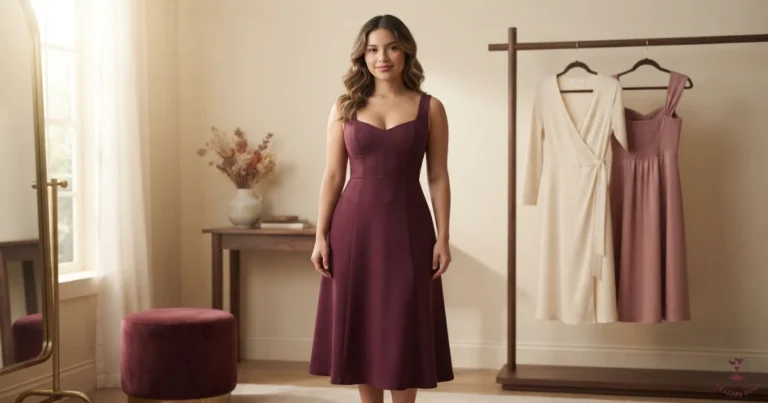
Best Swim Cover-Ups for a Large Bust
A construction-first guide to beach shirts, kaftans, tunics, cover-up dresses, sarongs and resort separates that provide enough front room over a fuller bust without turning every cover-up into an oversized tent.
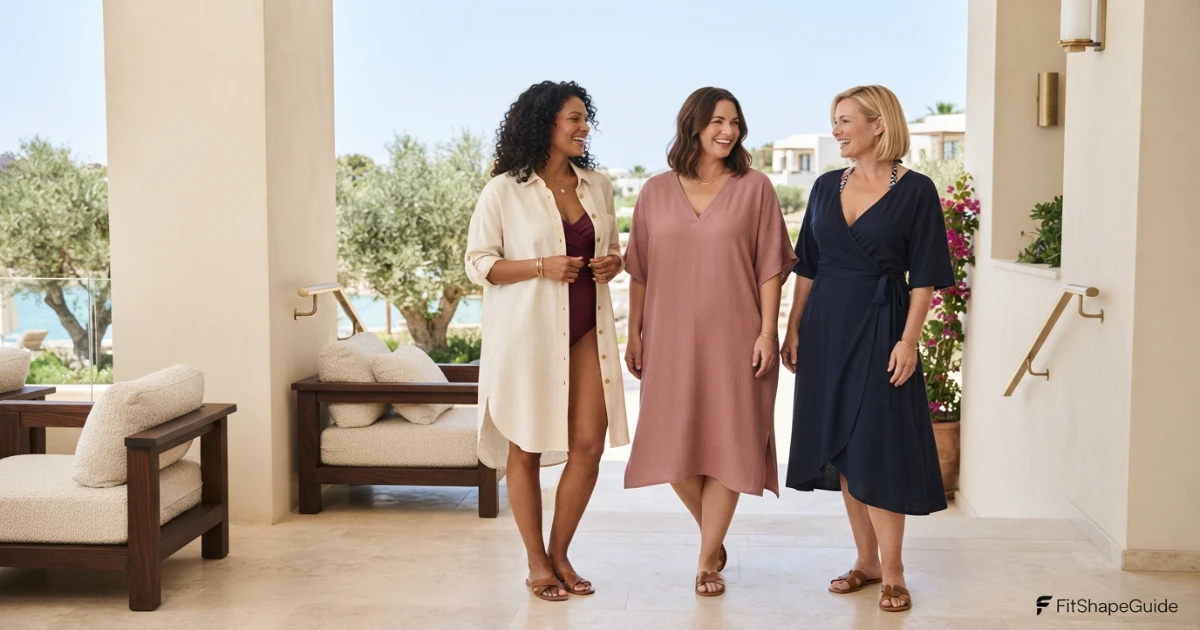
The 90-second swim cover-up test
- Put on the real swimsuit: cover-ups should be judged over the swimwear and straps you will actually wear.
- Button or close the fullest point: the front should remain flat without opening, pulling or creating a diagonal strain line.
- Raise both arms: sleeves and shoulders should move without dragging the entire front upward.
- Sit down: check whether the neckline opens excessively or the hem becomes restrictive.
- Walk while the swimsuit is damp: the cover-up should not cling or become unexpectedly transparent beyond your comfort preference.
- Use the pockets: a phone or room key should not distort the whole garment.
What makes a swim cover-up work for a large bust?
A swim cover-up is a layer, not a correction device. Its job may be sun coverage, moving between the pool and a restaurant, adding warmth, creating a resort outfit or simply giving you a layer you enjoy wearing. A fuller bust does not create a requirement for oversized or dark cover-ups.
The main construction challenge is front projection. A garment measured flat may appear wide enough around the bust but still lack the front length needed to travel over the fullest point and fall back toward the waist or hip.
When front length is inadequate, the center-front hem can lift, side seams may swing toward the front, button plackets can bow and the shoulder or neckline may be pulled forward.
The cleanest solution is enough room where it is needed—not simply a larger garment everywhere. Bust darts, side-front seams, dropped shoulders, open fronts, wrap construction, gathers from a yoke and fluid fabrics can all create usable front space.
| Cover-up style | Why it can work | Best use | Main trade-off |
|---|---|---|---|
| Button-front beach shirt | Can be worn open or closed | Pool, beach, lunch | Button spacing needs enough bust room |
| Shirt dress | More polished full-body layer | Beach-to-restaurant | Needs front length as well as circumference |
| V-neck kaftan | Generous front drape and airflow | Resort and relaxed beach days | Very wide cuts can overwhelm movement |
| Split-neck tunic | Easy neckline with controlled length | Pool and casual lunch | Front split needs secure depth |
| Wrap cover-up dress | Adjustable front and waist relationship | Resort, cruise, beach club | Overlap must stay secure |
| Open-front kimono | No bust closure required | Quick layering | Wind can move the open front |
| Sarong / pareo | Completely independent of bust fit | Hot weather and flexible coverage | Provides little upper-body coverage |
| Resort trousers + shirt | Separate sizing for upper and lower body | Beach-to-lunch outfit | Two pieces to manage |
Best swim cover-up styles for a large bust
Oversized beach shirt
A relaxed beach shirt is one of the easiest fuller-bust cover-ups because it does not need to fit like a tailored blouse. Wear it open when the swimsuit provides enough coverage or close selected buttons when more front coverage is wanted.
Trade-off: oversized should still look intentional. If shoulders, sleeve length and hem all become excessive just to close the bust, the garment is using scale instead of proper front room.
Shaped shirt dress
A shirt dress offers more structure for beach-to-lunch use. Bust darts, a back yoke, side slits and a softly curved hem can improve movement.
Trade-off: a straight shirt-dress pattern may gape even when a larger oversized shirt does not.
V-neck kaftan
A kaftan naturally provides more fabric through the front and works well when the V-neck opening remains controlled.
Trade-off: extremely wide sleeves and bodies can become cumbersome around food, pool chairs and windy beaches.
Split-neck tunic
A tunic gives the ease of a kaftan with more defined shoulders and sleeves. A split neckline reduces pressure at the upper chest.
Trade-off: the split can become lower than expected when seated or leaning if the front is too short.
Wrap cover-up dress
Wrap construction gives adjustable overlap through the bust and waist and can create a polished resort outfit without a rigid center-front closure.
Trade-off: true wraps need enough overlap to stay secure in wind and when sitting.
Open-front kimono cover-up
An open front removes bust-closure problems entirely. Choose the shoulder, sleeve and back width for movement and let the fronts drape naturally.
Trade-off: open fronts provide less protection in strong wind and may need a separate outfit underneath for restaurants.
Sarong or pareo
A sarong avoids upper-body fit entirely and can be tied as a skirt or wrapped higher according to personal preference.
Trade-off: it does not provide shoulder or arm coverage and knot placement can feel bulky while sitting.
Resort trousers with an open shirt
A loose resort trouser plus lightweight beach shirt creates a complete outfit and lets upper and lower body sizing remain independent.
Trade-off: full-length trousers need enough airflow and a hem practical for sand or wet pool decks.
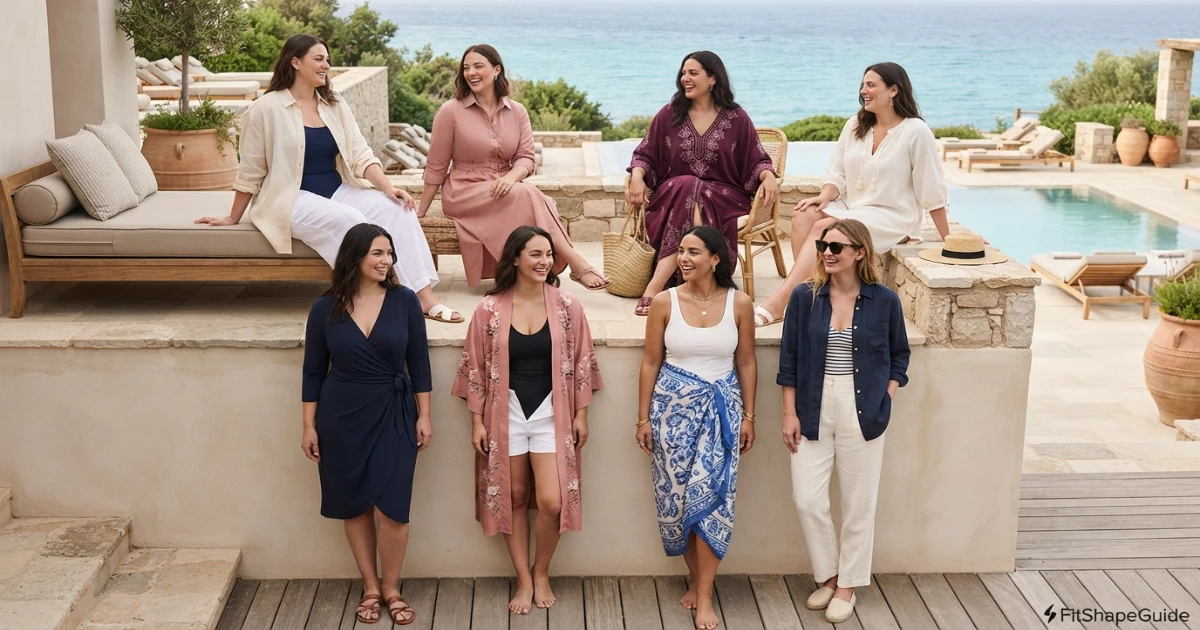
Button-front beach shirts and shirt dresses
Button-front cover-ups are versatile because they can function as a fully open layer, a partially closed shirt or a dress. That flexibility also means the front construction deserves careful inspection.
Button spacing
Look at where buttons fall across the fullest bust point. A large gap between two buttons can open even when total garment circumference looks sufficient.
The placket should remain relatively straight when the garment is closed. If it bends sharply around the bust or produces horizontal strain lines, more front room is needed.
Bust darts
A shirt dress with bust darts may fit more cleanly than a completely rectangular beach shirt. The dart should point toward the bust area but finish before the fullest point.
Back yoke and pleat
A back yoke with a center or box pleat can improve upper-back and shoulder movement. This is especially useful when the cover-up is worn over a swimsuit with substantial straps or a crossback.
Dropped shoulders
A moderate dropped shoulder makes the garment easier through the upper torso without needing precise armhole placement. Very low dropped seams can add unnecessary sleeve bulk.
Curved hem
A curved hem can make small front-to-back length differences less obvious. The center front should still have enough length to remain intentional rather than rising dramatically over the bust.
Side slits
Side slits improve stride length and help a longer beach shirt sit comfortably. They also prevent a narrow lower section from dragging the upper garment downward.
Kaftans and tunics for a fuller bust
Kaftans are naturally forgiving through the bust because the body is usually wide and fluid. The better question is whether the shoulder, neckline and length still look deliberate.
V-neck kaftans
A moderate V opening creates room at center front and avoids a high neckline being pulled forward by bust projection.
Check depth while sitting. A loose kaftan can drop lower at the neckline when the body changes position.
Split-neck tunics
A split neck creates vertical opening without requiring a full V. This works well with cotton gauze, linen blends and other light woven fabrics.
Shoulder width
Very wide kaftans may not have a conventional shoulder seam. If they do, inspect whether the seam sits intentionally rather than being pulled toward the front.
Sleeve opening
A generous sleeve can improve airflow and make dressing over damp skin easier. Make sure it does not expose more of the swimsuit side than you want when lifting the arms.
Waist shaping
Kaftans can be completely loose, internally drawstring-adjusted or belted. Waist definition is optional. Choose shaping because you prefer it, not because a large bust requires it.
Side slits
Long kaftans benefit from side slits for walking and sitting. Check slit height when seated, especially if the garment is being used beyond the pool deck.
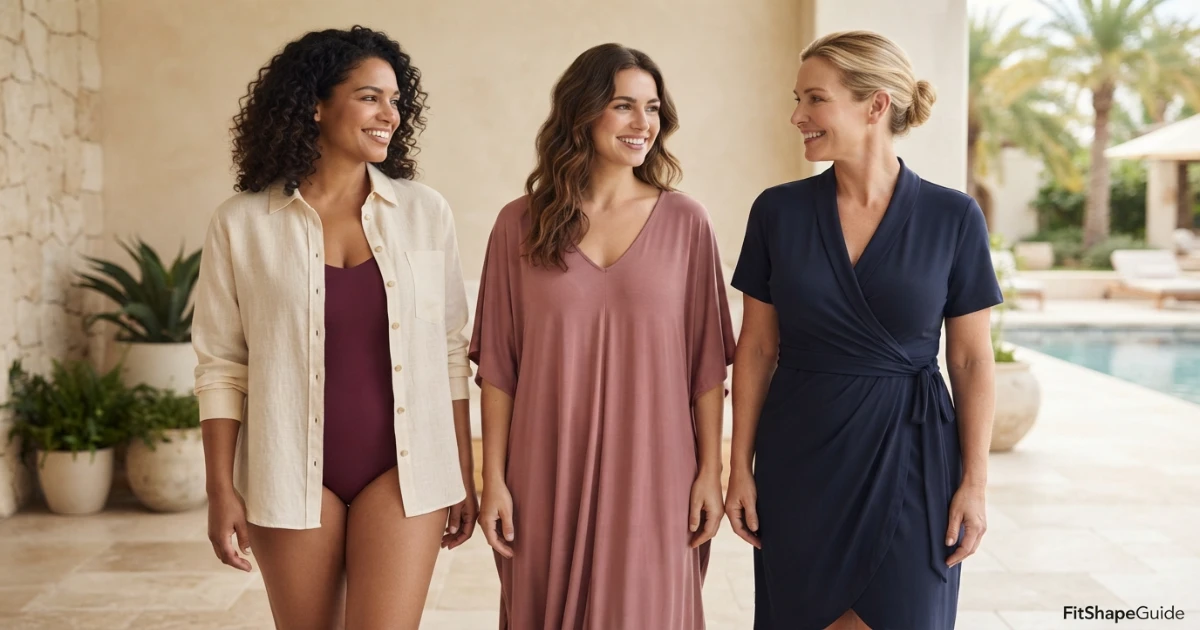
Wrap and tie-waist swim cover-ups
Wrap construction is useful because the front does not depend on a rigid button placket. The overlap can adjust to different bust and waist relationships within the limits of the pattern.
True wrap dresses
A true wrap has two separate front panels. Check that the inner panel reaches far enough across the body before the outer panel closes. Insufficient overlap can make the neckline and skirt less secure.
Fixed-wrap dresses
A fixed crossover creates the appearance and diagonal shaping of a wrap but reduces the risk of the front opening unexpectedly.
Internal ties
An internal tie can keep the under-panel anchored. It should lie comfortably against damp skin and not require excessive tension.
External waist ties
Tie placement should correspond to the garment’s intended waist or underbust position. A tie being pulled upward by a short front bodice is a fit warning.
Wrap tops with resort trousers
A short wrap-style cover-up top can work with loose linen-style trousers or swim shorts when full dress coverage is not needed.
Wind test
Wrap cover-ups are particularly worth testing outdoors. Walk or move the skirt panels with your hands to estimate how much overlap remains when wind or movement separates the fabric.
Sarongs, pareos, skirts and resort bottoms
Sarongs are one of the simplest ways to add coverage without introducing another upper-body fit problem. They can be tied at the waist, hip or higher on the torso depending on size and personal preference.
Short sarong
A shorter pareo is easy for pool movement and can be removed quickly. Confirm enough wrap overlap if it will also be worn into a casual restaurant or beach bar.
Long pareo
A longer wrap creates more leg coverage and can function almost like a skirt. Fabric weight matters because a saturated long pareo can become heavy.
Swim skirt
A pull-on cover-up skirt avoids tying and can be paired with any supportive swim top. Check waistband comfort over damp swimwear.
Resort trousers
Fluid wide-leg trousers create a complete pool-to-lunch outfit when worn with a swimsuit and open beach shirt. Look for a waistband that remains comfortable over wet fabric.
Shorts
Lightweight shorts are practical for walking, boating or active resort days. Avoid waistbands and linings that stay wet for much longer than the swimsuit.
If you prefer a trouser-based beach outfit, many of the waistband and drape principles in Wide-Leg Pants and a Large Bust also apply to resort trousers.
Best cover-up fabrics for pool and beach wear
Linen
Linen is breathable and works well for beach shirts, tunics and resort trousers. It wrinkles naturally and can become noticeably heavier when wet.
A linen shirt that is intentionally relaxed can be one of the most reusable cover-ups because it works over swimwear and later with ordinary resort outfits.
Linen blends
Blends can reduce some wrinkling or add drape and softness. Check exact care because not every blend behaves the same way.
Cotton gauze
Cotton gauze offers texture, airflow and an easy resort look. Light colors may become more transparent over wet swimwear, so test opacity according to your preference.
Rayon or viscose-style fabric
Fluid fabrics drape easily over bust projection and can work particularly well for kaftans and wrap dresses. Some become heavier or more delicate when wet, so care instructions matter.
Lightweight stretch jersey
A matte stretch jersey can be useful for pull-on cover-up dresses because it moves easily and resists rigid bust pulling. Choose enough fabric weight for opacity.
Mesh
Mesh dries quickly and provides visual coverage without blocking much airflow. It remains intentionally sheer, which may or may not suit the setting beyond the beach.
Crochet and open-knit fabrics
Open-knit cover-ups are decorative and breathable but can snag on pool furniture, jewelry and rough surfaces. Check whether the garment stretches downward when wet.
Wet-swimsuit friction
A cover-up that slides easily over dry skin may cling to damp swimwear. Test armholes, bust room and torso ease with the swimsuit slightly damp when practical.
Mini, mid-thigh, midi and maxi cover-up lengths
Hip length
A hip-length beach shirt provides upper-body coverage and works well with swim shorts, skirts or resort trousers. Check whether the hem catches on the fullest hip when buttoned.
Mid-thigh
Mid-thigh is one of the most versatile shirt and tunic lengths because it adds coverage without requiring a full dress hem.
Knee and midi length
A longer shirt dress, kaftan or cover-up dress works well when the garment is also intended for casual resort dining. Side slits improve walking.
Maxi length
A maxi kaftan or open cover-up creates dramatic resort styling but needs enough floor clearance for wet decks, sand and stairs.
Front-to-back balance
A fuller bust may make the front hem hang slightly differently from the back. Small differences can be part of natural garment drape. A dramatic front rise combined with pulling at the shoulder or side seam suggests insufficient front room.
High-low hems
A deliberately high-low design can add rear coverage while keeping the front easy for walking. Make sure the intended shape is visible on the garment itself rather than being created accidentally by bust tension.
Sitting, walking, reaching and wearing over wet swimwear
Chair test
Sit in a pool chair and then a normal upright chair. A long shirt or tunic should not pull sharply at the bust when the lower hem is trapped beneath the body.
Overhead reach
Reach for a towel or raise the arms as if tying up hair. The cover-up may move naturally, but it should settle again without dragging the neckline into an uncomfortable position.
Beach-bag test
Wear the shoulder bag you actually use. Check whether its strap causes an open cover-up to pull unevenly across the bust or makes a neckline sit differently.
Wind test
Open-front kimonos, wrap dresses and sarongs behave differently in wind. Secure closures according to the garment design rather than relying on constant hand adjustment.
Wet swimsuit test
Put the cover-up over damp swimwear and walk for several minutes. Check transparency, cling, drying behavior and whether damp swimsuit straps catch inside the cover-up.
Restaurant test
If you intend to wear the cover-up into a café or casual restaurant, sit down and confirm that the garment still provides the coverage and opacity you want.
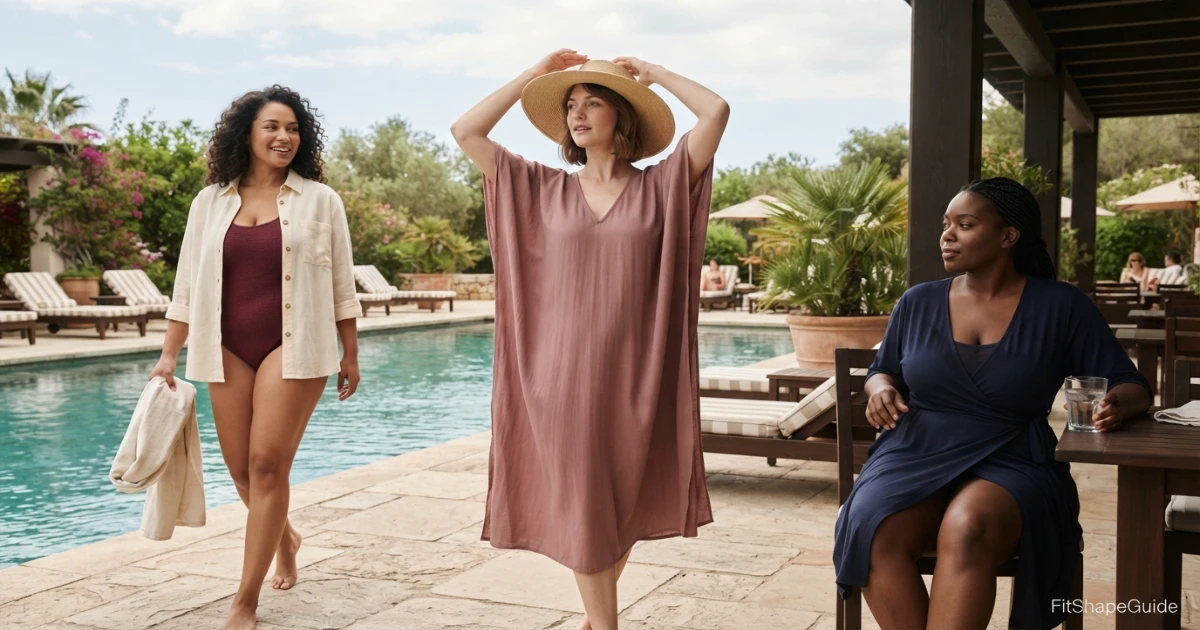
How to buy a swim cover-up for a large bust online
Cover-up sizing is unusually inconsistent because some designs are conventional garments while others are intentionally oversized or sold in broad size ranges. Product photography alone cannot tell you how much front room a cover-up provides.
- Check the full-bust measurement: compare it with your body measurement plus the amount of ease the style needs.
- Check garment length: note center-front and center-back length where both are available.
- Inspect shoulder construction: set-in, raglan and dropped shoulders fit differently.
- Check button spacing: especially if the shirt or shirt dress will be worn closed.
- Look for bust shaping: darts, gathers, pleats, wrap panels or curved seams.
- Check sleeve opening: a relaxed body can still have unexpectedly narrow sleeves.
- Inspect side slits: important for longer tunics, shirts and kaftans.
- Read fabric content: linen, cotton gauze, rayon-style fabric and jersey behave very differently when wet.
- Check opacity: especially for warm ivory, white and other pale fabrics.
- Review care: salt, chlorine, sunscreen and damp wear can make easy washing valuable.
Measure a cover-up you already like
Lay a shirt, tunic or dress flat and record pit-to-pit width, shoulder, front length, back length, upper-arm width and hem width. Use those garment measurements as a practical reference.
Do not rely on “one size” alone
A one-size kaftan or pareo may provide generous total fabric but still have a fixed neckline, shoulder opening or sleeve width. Check the actual dimensions when available.
Check whether it must close
If an open beach shirt is your intended styling, closure fit is less important. If the garment is supposed to become a lunch dress, full-button or wrap closure becomes essential.
Plan around your swimsuit neckline
A very high swimsuit neckline may show above a low cover-up; wide swim straps may sit under narrow shirt shoulders. Neither is a problem if you like the combination, but test the actual layers together.
Choose one hard-working cover-up first
A useful resort capsule can start with one lightweight beach shirt or tunic, one bottom-based option such as a sarong or trouser and the swimwear you already own. You do not need a separate cover-up for every swimsuit.
If your swimsuit itself needs more support, start with Best Plus-Size Swimsuits for a Large Bust, Best Underwire Tankinis for a Large Bust, or Best Swimsuits with Adjustable Straps for a Large Bust.
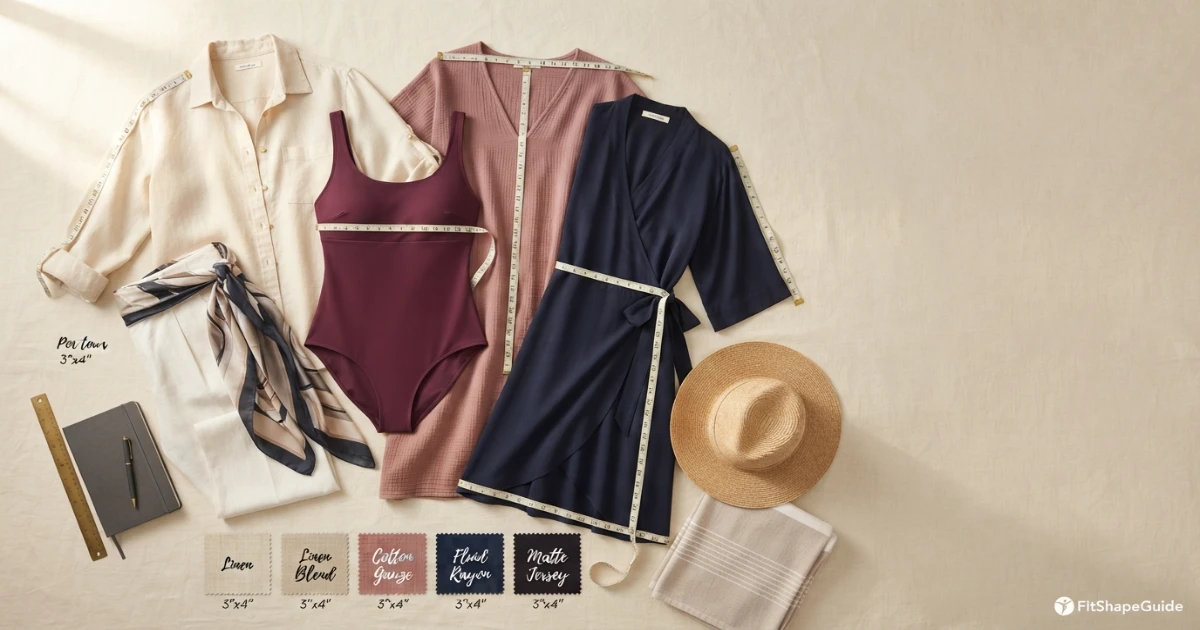
Common swim cover-up fit problems
| Problem | Likely cause | Better response | Avoid |
|---|---|---|---|
| Buttons gape across bust | Insufficient front circumference or poor button spacing | More front room, bust shaping or open styling | Sizing down for shoulder fit |
| Front hem becomes much shorter | Insufficient front garment length | Longer front or more bust projection | Assuming all high-low effect is intentional |
| Shoulder seams pull forward | Bust/front panel is borrowing fabric from shoulder area | More front room or relaxed construction | Pulling the shirt backward repeatedly |
| V-neck drops too low seated | Loose neckline plus insufficient front length | Higher/secured neckline or more front room | Relying on constant adjustment |
| Kaftan feels enormous everywhere | Size increased only for bust room | More shaped or open-front design | Assuming more fabric always improves fuller-bust fit |
| Sleeves feel tight | Upper-arm or armhole measurement too small | Wider sleeve or raglan/dropped shoulder | Judging size only by bust |
| Wrap opens in wind | Insufficient overlap or weak tie | More overlap or fixed-wrap construction | Depending on one loose knot |
| Fabric becomes transparent wet | Light fabric and low opacity | Choose more opaque fabric if preferred | Assuming dry opacity predicts wet opacity |
| Cover-up clings badly over swimsuit | Fabric surface or insufficient ease | More drape/ease or different fabric | Sizing down for a cleaner dry silhouette |
| Long cover-up restricts walking | Hem too narrow or no side slits | Wider hem, slit or shorter length | Pulling garment upward while walking |
The shirt fits the bust but looks too oversized at the shoulders
A different pattern may work better than another size. Try a shirt with bust darts, a more controlled dropped shoulder, curved side-front shaping or an open-front construction.
The cover-up fits dry but sticks to my swimsuit
Wet swimwear changes friction. Try a more fluid or slightly roomier cover-up, or dry off before putting on fabrics that cling when damp.
The kaftan neckline keeps moving
Check both neckline width and front length. A very wide garment can still have a neckline that is being pulled out of place by insufficient front projection.
The wrap dress looks secure standing but opens when sitting
Seated fit changes the relationship between bust, waist and skirt. More overlap or a fixed-wrap design may be a cleaner solution than tying the waist tighter.
Final verdict
The best swim cover-ups for a large bust provide front room without automatically adding excessive fabric everywhere else. Button-front beach shirts, shaped shirt dresses, V-neck kaftans, tunics, wrap dresses, open kimonos, sarongs and resort separates can all work.
Start with the way you will actually use the cover-up: open over a swimsuit, closed for lunch, tied as a dress or worn only from the pool to your room. Then check bust width, front length, shoulder and sleeve movement, closure security and wet-fabric behavior. A strong cover-up should feel easy enough that you stop arranging it once it is on.
Frequently asked questions
What swim cover-up is best for a large bust?
A relaxed button-front beach shirt, V-neck kaftan, split-neck tunic or secure wrap cover-up is a strong starting point because each can provide more front room without requiring a close rigid bust fit.
Are kaftans good for a large bust?
Yes. Kaftans naturally provide generous front ease, but check neckline stability, shoulder placement, sleeve width and garment length rather than relying only on total fabric volume.
Can I wear a button-down shirt as a swim cover-up?
Yes. Lightweight button-front shirts are versatile cover-ups. If you want to close the shirt, make sure the placket stays flat across the fullest bust point.
Are wrap cover-ups good for a fuller bust?
They can be excellent because the crossover adjusts around bust projection. Choose enough overlap and a waist tie or fixed construction that remains secure while sitting and walking.
Should a cover-up be oversized?
It can be relaxed or oversized if that is the intended style, but excessive overall size should not be required simply to obtain enough bust room.
What fabric is best for a beach cover-up?
Linen, linen blends, cotton gauze, fluid woven fabrics and lightweight jersey can all work. Choose according to airflow, opacity, drying behavior, drape and care requirements.
How long should a swim cover-up be?
Hip, mid-thigh, midi and maxi lengths can all work. Choose according to coverage preference and activity while checking that the front length does not rise dramatically over the bust.
How do I shop for a cover-up online with a large bust?
Compare full-bust or pit-to-pit width, shoulder width, front length, upper-arm width, closure style and fabric behavior instead of relying only on the labeled size.
Editorial and verification standards
This guide evaluates swim cover-ups through full-bust room, front garment length, shoulder placement, sleeve width, neckline security, closures, wrap overlap, side slits, hem width, fabric drape, opacity, damp-wear behavior and beach-to-resort practicality.
Cover-ups are evaluated as garments rather than tools for concealing a body. A fuller bust is not treated as a reason to require oversized silhouettes, waist compression, dark colors or maximum coverage.
Current resortwear construction includes relaxed button-front beach shirts, tunics, kaftans, adjustable-neckline cover-up dresses and fluid beach-to-lunch garments. These examples reinforce why closure, neckline, fabric and garment measurements matter more than the label “cover-up” alone.
Before publishing any commercial recommendation, FitShapeGuide should verify the exact live seller, cover-up, color, size range, garment bust measurement, shoulder, sleeve, front and back length, closure, neckline, wrap overlap, fabric composition, care, current availability and return conditions.
No ASIN, price, rating, review count, coupon, stock statement or delivery claim should be published unless directly verified. Affiliate disclosure should remain clearly visible close to commercial recommendations.
Best Swim Cover-Ups for a Large Bust
A construction-first guide to beach shirts, kaftans, tunics, cover-up dresses, sarongs and resort separates that provide enough front room over a fuller bust without turning every cover-up into an oversized tent.
The 90-second swim cover-up test
- Put on the real swimsuit: cover-ups should be judged over the swimwear and straps you will actually wear.
- Button or close the fullest point: the front should remain flat without opening, pulling or creating a diagonal strain line.
- Raise both arms: sleeves and shoulders should move without dragging the entire front upward.
- Sit down: check whether the neckline opens excessively or the hem becomes restrictive.
- Walk while the swimsuit is damp: the cover-up should not cling or become unexpectedly transparent beyond your comfort preference.
- Use the pockets: a phone or room key should not distort the whole garment.
What makes a swim cover-up work for a large bust?
A swim cover-up is a layer, not a correction device. Its job may be sun coverage, moving between the pool and a restaurant, adding warmth, creating a resort outfit or simply giving you a layer you enjoy wearing. A fuller bust does not create a requirement for oversized or dark cover-ups.
The main construction challenge is front projection. A garment measured flat may appear wide enough around the bust but still lack the front length needed to travel over the fullest point and fall back toward the waist or hip.
When front length is inadequate, the center-front hem can lift, side seams may swing toward the front, button plackets can bow and the shoulder or neckline may be pulled forward.
The cleanest solution is enough room where it is needed—not simply a larger garment everywhere. Bust darts, side-front seams, dropped shoulders, open fronts, wrap construction, gathers from a yoke and fluid fabrics can all create usable front space.
| Cover-up style | Why it can work | Best use | Main trade-off |
|---|---|---|---|
| Button-front beach shirt | Can be worn open or closed | Pool, beach, lunch | Button spacing needs enough bust room |
| Shirt dress | More polished full-body layer | Beach-to-restaurant | Needs front length as well as circumference |
| V-neck kaftan | Generous front drape and airflow | Resort and relaxed beach days | Very wide cuts can overwhelm movement |
| Split-neck tunic | Easy neckline with controlled length | Pool and casual lunch | Front split needs secure depth |
| Wrap cover-up dress | Adjustable front and waist relationship | Resort, cruise, beach club | Overlap must stay secure |
| Open-front kimono | No bust closure required | Quick layering | Wind can move the open front |
| Sarong / pareo | Completely independent of bust fit | Hot weather and flexible coverage | Provides little upper-body coverage |
| Resort trousers + shirt | Separate sizing for upper and lower body | Beach-to-lunch outfit | Two pieces to manage |
Best swim cover-up styles for a large bust
Oversized beach shirt
A relaxed beach shirt is one of the easiest fuller-bust cover-ups because it does not need to fit like a tailored blouse. Wear it open when the swimsuit provides enough coverage or close selected buttons when more front coverage is wanted.
Trade-off: oversized should still look intentional. If shoulders, sleeve length and hem all become excessive just to close the bust, the garment is using scale instead of proper front room.
Shaped shirt dress
A shirt dress offers more structure for beach-to-lunch use. Bust darts, a back yoke, side slits and a softly curved hem can improve movement.
Trade-off: a straight shirt-dress pattern may gape even when a larger oversized shirt does not.
V-neck kaftan
A kaftan naturally provides more fabric through the front and works well when the V-neck opening remains controlled.
Trade-off: extremely wide sleeves and bodies can become cumbersome around food, pool chairs and windy beaches.
Split-neck tunic
A tunic gives the ease of a kaftan with more defined shoulders and sleeves. A split neckline reduces pressure at the upper chest.
Trade-off: the split can become lower than expected when seated or leaning if the front is too short.
Wrap cover-up dress
Wrap construction gives adjustable overlap through the bust and waist and can create a polished resort outfit without a rigid center-front closure.
Trade-off: true wraps need enough overlap to stay secure in wind and when sitting.
Open-front kimono cover-up
An open front removes bust-closure problems entirely. Choose the shoulder, sleeve and back width for movement and let the fronts drape naturally.
Trade-off: open fronts provide less protection in strong wind and may need a separate outfit underneath for restaurants.
Sarong or pareo
A sarong avoids upper-body fit entirely and can be tied as a skirt or wrapped higher according to personal preference.
Trade-off: it does not provide shoulder or arm coverage and knot placement can feel bulky while sitting.
Resort trousers with an open shirt
A loose resort trouser plus lightweight beach shirt creates a complete outfit and lets upper and lower body sizing remain independent.
Trade-off: full-length trousers need enough airflow and a hem practical for sand or wet pool decks.
Button-front beach shirts and shirt dresses
Button-front cover-ups are versatile because they can function as a fully open layer, a partially closed shirt or a dress. That flexibility also means the front construction deserves careful inspection.
Button spacing
Look at where buttons fall across the fullest bust point. A large gap between two buttons can open even when total garment circumference looks sufficient.
The placket should remain relatively straight when the garment is closed. If it bends sharply around the bust or produces horizontal strain lines, more front room is needed.
Bust darts
A shirt dress with bust darts may fit more cleanly than a completely rectangular beach shirt. The dart should point toward the bust area but finish before the fullest point.
Back yoke and pleat
A back yoke with a center or box pleat can improve upper-back and shoulder movement. This is especially useful when the cover-up is worn over a swimsuit with substantial straps or a crossback.
Dropped shoulders
A moderate dropped shoulder makes the garment easier through the upper torso without needing precise armhole placement. Very low dropped seams can add unnecessary sleeve bulk.
Curved hem
A curved hem can make small front-to-back length differences less obvious. The center front should still have enough length to remain intentional rather than rising dramatically over the bust.
Side slits
Side slits improve stride length and help a longer beach shirt sit comfortably. They also prevent a narrow lower section from dragging the upper garment downward.
Kaftans and tunics for a fuller bust
Kaftans are naturally forgiving through the bust because the body is usually wide and fluid. The better question is whether the shoulder, neckline and length still look deliberate.
V-neck kaftans
A moderate V opening creates room at center front and avoids a high neckline being pulled forward by bust projection.
Check depth while sitting. A loose kaftan can drop lower at the neckline when the body changes position.
Split-neck tunics
A split neck creates vertical opening without requiring a full V. This works well with cotton gauze, linen blends and other light woven fabrics.
Shoulder width
Very wide kaftans may not have a conventional shoulder seam. If they do, inspect whether the seam sits intentionally rather than being pulled toward the front.
Sleeve opening
A generous sleeve can improve airflow and make dressing over damp skin easier. Make sure it does not expose more of the swimsuit side than you want when lifting the arms.
Waist shaping
Kaftans can be completely loose, internally drawstring-adjusted or belted. Waist definition is optional. Choose shaping because you prefer it, not because a large bust requires it.
Side slits
Long kaftans benefit from side slits for walking and sitting. Check slit height when seated, especially if the garment is being used beyond the pool deck.
Wrap and tie-waist swim cover-ups
Wrap construction is useful because the front does not depend on a rigid button placket. The overlap can adjust to different bust and waist relationships within the limits of the pattern.
True wrap dresses
A true wrap has two separate front panels. Check that the inner panel reaches far enough across the body before the outer panel closes. Insufficient overlap can make the neckline and skirt less secure.
Fixed-wrap dresses
A fixed crossover creates the appearance and diagonal shaping of a wrap but reduces the risk of the front opening unexpectedly.
Internal ties
An internal tie can keep the under-panel anchored. It should lie comfortably against damp skin and not require excessive tension.
External waist ties
Tie placement should correspond to the garment’s intended waist or underbust position. A tie being pulled upward by a short front bodice is a fit warning.
Wrap tops with resort trousers
A short wrap-style cover-up top can work with loose linen-style trousers or swim shorts when full dress coverage is not needed.
Wind test
Wrap cover-ups are particularly worth testing outdoors. Walk or move the skirt panels with your hands to estimate how much overlap remains when wind or movement separates the fabric.
Sarongs, pareos, skirts and resort bottoms
Sarongs are one of the simplest ways to add coverage without introducing another upper-body fit problem. They can be tied at the waist, hip or higher on the torso depending on size and personal preference.
Short sarong
A shorter pareo is easy for pool movement and can be removed quickly. Confirm enough wrap overlap if it will also be worn into a casual restaurant or beach bar.
Long pareo
A longer wrap creates more leg coverage and can function almost like a skirt. Fabric weight matters because a saturated long pareo can become heavy.
Swim skirt
A pull-on cover-up skirt avoids tying and can be paired with any supportive swim top. Check waistband comfort over damp swimwear.
Resort trousers
Fluid wide-leg trousers create a complete pool-to-lunch outfit when worn with a swimsuit and open beach shirt. Look for a waistband that remains comfortable over wet fabric.
Shorts
Lightweight shorts are practical for walking, boating or active resort days. Avoid waistbands and linings that stay wet for much longer than the swimsuit.
If you prefer a trouser-based beach outfit, many of the waistband and drape principles in Wide-Leg Pants and a Large Bust also apply to resort trousers.
Best cover-up fabrics for pool and beach wear
Linen
Linen is breathable and works well for beach shirts, tunics and resort trousers. It wrinkles naturally and can become noticeably heavier when wet.
A linen shirt that is intentionally relaxed can be one of the most reusable cover-ups because it works over swimwear and later with ordinary resort outfits.
Linen blends
Blends can reduce some wrinkling or add drape and softness. Check exact care because not every blend behaves the same way.
Cotton gauze
Cotton gauze offers texture, airflow and an easy resort look. Light colors may become more transparent over wet swimwear, so test opacity according to your preference.
Rayon or viscose-style fabric
Fluid fabrics drape easily over bust projection and can work particularly well for kaftans and wrap dresses. Some become heavier or more delicate when wet, so care instructions matter.
Lightweight stretch jersey
A matte stretch jersey can be useful for pull-on cover-up dresses because it moves easily and resists rigid bust pulling. Choose enough fabric weight for opacity.
Mesh
Mesh dries quickly and provides visual coverage without blocking much airflow. It remains intentionally sheer, which may or may not suit the setting beyond the beach.
Crochet and open-knit fabrics
Open-knit cover-ups are decorative and breathable but can snag on pool furniture, jewelry and rough surfaces. Check whether the garment stretches downward when wet.
Wet-swimsuit friction
A cover-up that slides easily over dry skin may cling to damp swimwear. Test armholes, bust room and torso ease with the swimsuit slightly damp when practical.
Mini, mid-thigh, midi and maxi cover-up lengths
Hip length
A hip-length beach shirt provides upper-body coverage and works well with swim shorts, skirts or resort trousers. Check whether the hem catches on the fullest hip when buttoned.
Mid-thigh
Mid-thigh is one of the most versatile shirt and tunic lengths because it adds coverage without requiring a full dress hem.
Knee and midi length
A longer shirt dress, kaftan or cover-up dress works well when the garment is also intended for casual resort dining. Side slits improve walking.
Maxi length
A maxi kaftan or open cover-up creates dramatic resort styling but needs enough floor clearance for wet decks, sand and stairs.
Front-to-back balance
A fuller bust may make the front hem hang slightly differently from the back. Small differences can be part of natural garment drape. A dramatic front rise combined with pulling at the shoulder or side seam suggests insufficient front room.
High-low hems
A deliberately high-low design can add rear coverage while keeping the front easy for walking. Make sure the intended shape is visible on the garment itself rather than being created accidentally by bust tension.
Sitting, walking, reaching and wearing over wet swimwear
Chair test
Sit in a pool chair and then a normal upright chair. A long shirt or tunic should not pull sharply at the bust when the lower hem is trapped beneath the body.
Overhead reach
Reach for a towel or raise the arms as if tying up hair. The cover-up may move naturally, but it should settle again without dragging the neckline into an uncomfortable position.
Beach-bag test
Wear the shoulder bag you actually use. Check whether its strap causes an open cover-up to pull unevenly across the bust or makes a neckline sit differently.
Wind test
Open-front kimonos, wrap dresses and sarongs behave differently in wind. Secure closures according to the garment design rather than relying on constant hand adjustment.
Wet swimsuit test
Put the cover-up over damp swimwear and walk for several minutes. Check transparency, cling, drying behavior and whether damp swimsuit straps catch inside the cover-up.
Restaurant test
If you intend to wear the cover-up into a café or casual restaurant, sit down and confirm that the garment still provides the coverage and opacity you want.
How to buy a swim cover-up for a large bust online
Cover-up sizing is unusually inconsistent because some designs are conventional garments while others are intentionally oversized or sold in broad size ranges. Product photography alone cannot tell you how much front room a cover-up provides.
- Check the full-bust measurement: compare it with your body measurement plus the amount of ease the style needs.
- Check garment length: note center-front and center-back length where both are available.
- Inspect shoulder construction: set-in, raglan and dropped shoulders fit differently.
- Check button spacing: especially if the shirt or shirt dress will be worn closed.
- Look for bust shaping: darts, gathers, pleats, wrap panels or curved seams.
- Check sleeve opening: a relaxed body can still have unexpectedly narrow sleeves.
- Inspect side slits: important for longer tunics, shirts and kaftans.
- Read fabric content: linen, cotton gauze, rayon-style fabric and jersey behave very differently when wet.
- Check opacity: especially for warm ivory, white and other pale fabrics.
- Review care: salt, chlorine, sunscreen and damp wear can make easy washing valuable.
Measure a cover-up you already like
Lay a shirt, tunic or dress flat and record pit-to-pit width, shoulder, front length, back length, upper-arm width and hem width. Use those garment measurements as a practical reference.
Do not rely on “one size” alone
A one-size kaftan or pareo may provide generous total fabric but still have a fixed neckline, shoulder opening or sleeve width. Check the actual dimensions when available.
Check whether it must close
If an open beach shirt is your intended styling, closure fit is less important. If the garment is supposed to become a lunch dress, full-button or wrap closure becomes essential.
Plan around your swimsuit neckline
A very high swimsuit neckline may show above a low cover-up; wide swim straps may sit under narrow shirt shoulders. Neither is a problem if you like the combination, but test the actual layers together.
Choose one hard-working cover-up first
A useful resort capsule can start with one lightweight beach shirt or tunic, one bottom-based option such as a sarong or trouser and the swimwear you already own. You do not need a separate cover-up for every swimsuit.
If your swimsuit itself needs more support, start with Best Plus-Size Swimsuits for a Large Bust, Best Underwire Tankinis for a Large Bust, or Best Swimsuits with Adjustable Straps for a Large Bust.
Common swim cover-up fit problems
| Problem | Likely cause | Better response | Avoid |
|---|---|---|---|
| Buttons gape across bust | Insufficient front circumference or poor button spacing | More front room, bust shaping or open styling | Sizing down for shoulder fit |
| Front hem becomes much shorter | Insufficient front garment length | Longer front or more bust projection | Assuming all high-low effect is intentional |
| Shoulder seams pull forward | Bust/front panel is borrowing fabric from shoulder area | More front room or relaxed construction | Pulling the shirt backward repeatedly |
| V-neck drops too low seated | Loose neckline plus insufficient front length | Higher/secured neckline or more front room | Relying on constant adjustment |
| Kaftan feels enormous everywhere | Size increased only for bust room | More shaped or open-front design | Assuming more fabric always improves fuller-bust fit |
| Sleeves feel tight | Upper-arm or armhole measurement too small | Wider sleeve or raglan/dropped shoulder | Judging size only by bust |
| Wrap opens in wind | Insufficient overlap or weak tie | More overlap or fixed-wrap construction | Depending on one loose knot |
| Fabric becomes transparent wet | Light fabric and low opacity | Choose more opaque fabric if preferred | Assuming dry opacity predicts wet opacity |
| Cover-up clings badly over swimsuit | Fabric surface or insufficient ease | More drape/ease or different fabric | Sizing down for a cleaner dry silhouette |
| Long cover-up restricts walking | Hem too narrow or no side slits | Wider hem, slit or shorter length | Pulling garment upward while walking |
The shirt fits the bust but looks too oversized at the shoulders
A different pattern may work better than another size. Try a shirt with bust darts, a more controlled dropped shoulder, curved side-front shaping or an open-front construction.
The cover-up fits dry but sticks to my swimsuit
Wet swimwear changes friction. Try a more fluid or slightly roomier cover-up, or dry off before putting on fabrics that cling when damp.
The kaftan neckline keeps moving
Check both neckline width and front length. A very wide garment can still have a neckline that is being pulled out of place by insufficient front projection.
The wrap dress looks secure standing but opens when sitting
Seated fit changes the relationship between bust, waist and skirt. More overlap or a fixed-wrap design may be a cleaner solution than tying the waist tighter.
Final verdict
The best swim cover-ups for a large bust provide front room without automatically adding excessive fabric everywhere else. Button-front beach shirts, shaped shirt dresses, V-neck kaftans, tunics, wrap dresses, open kimonos, sarongs and resort separates can all work.
Start with the way you will actually use the cover-up: open over a swimsuit, closed for lunch, tied as a dress or worn only from the pool to your room. Then check bust width, front length, shoulder and sleeve movement, closure security and wet-fabric behavior. A strong cover-up should feel easy enough that you stop arranging it once it is on.
Frequently asked questions
What swim cover-up is best for a large bust?
A relaxed button-front beach shirt, V-neck kaftan, split-neck tunic or secure wrap cover-up is a strong starting point because each can provide more front room without requiring a close rigid bust fit.
Are kaftans good for a large bust?
Yes. Kaftans naturally provide generous front ease, but check neckline stability, shoulder placement, sleeve width and garment length rather than relying only on total fabric volume.
Can I wear a button-down shirt as a swim cover-up?
Yes. Lightweight button-front shirts are versatile cover-ups. If you want to close the shirt, make sure the placket stays flat across the fullest bust point.
Are wrap cover-ups good for a fuller bust?
They can be excellent because the crossover adjusts around bust projection. Choose enough overlap and a waist tie or fixed construction that remains secure while sitting and walking.
Should a cover-up be oversized?
It can be relaxed or oversized if that is the intended style, but excessive overall size should not be required simply to obtain enough bust room.
What fabric is best for a beach cover-up?
Linen, linen blends, cotton gauze, fluid woven fabrics and lightweight jersey can all work. Choose according to airflow, opacity, drying behavior, drape and care requirements.
How long should a swim cover-up be?
Hip, mid-thigh, midi and maxi lengths can all work. Choose according to coverage preference and activity while checking that the front length does not rise dramatically over the bust.
How do I shop for a cover-up online with a large bust?
Compare full-bust or pit-to-pit width, shoulder width, front length, upper-arm width, closure style and fabric behavior instead of relying only on the labeled size.
Editorial and verification standards
This guide evaluates swim cover-ups through full-bust room, front garment length, shoulder placement, sleeve width, neckline security, closures, wrap overlap, side slits, hem width, fabric drape, opacity, damp-wear behavior and beach-to-resort practicality.
Cover-ups are evaluated as garments rather than tools for concealing a body. A fuller bust is not treated as a reason to require oversized silhouettes, waist compression, dark colors or maximum coverage.
Current resortwear construction includes relaxed button-front beach shirts, tunics, kaftans, adjustable-neckline cover-up dresses and fluid beach-to-lunch garments. These examples reinforce why closure, neckline, fabric and garment measurements matter more than the label “cover-up” alone.
Before publishing any commercial recommendation, FitShapeGuide should verify the exact live seller, cover-up, color, size range, garment bust measurement, shoulder, sleeve, front and back length, closure, neckline, wrap overlap, fabric composition, care, current availability and return conditions.
No ASIN, price, rating, review count, coupon, stock statement or delivery claim should be published unless directly verified. Affiliate disclosure should remain clearly visible close to commercial recommendations.