Best Turtleneck Alternatives for the Office
Eight polished, blazer-friendly neckline options for a fuller bust when a traditional roll neck feels tight, bulky, warm or difficult to fit through a full workday.
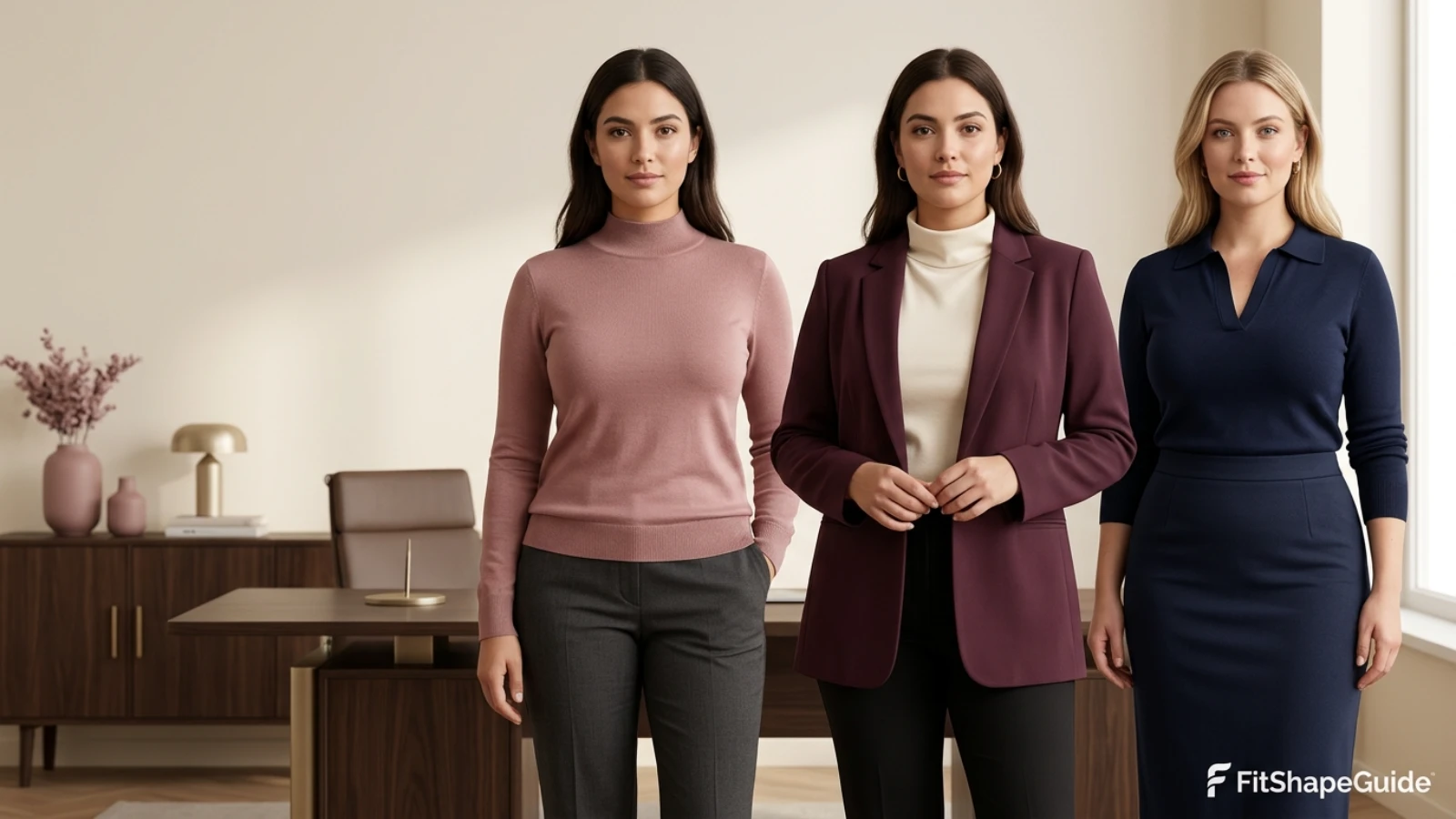
The 90-second office-neckline test
- Turn the head: the collar should not rub, twist or pull the front upward.
- Sit and breathe: the knit should not become sheer, tent forward or shorten dramatically over the bust.
- Reach to a keyboard: shoulder seams and armholes should return without moving the neckline.
- Add the blazer: collar fabric must lie inside or outside deliberately without bunching at the lapels.
- Check temperature: keep the outfit on for ten minutes in a heated room before judging comfort.
- Remove the layer: the top should still look composed enough for the desk or meeting room.
What should replace a turtleneck at work?
A turtleneck does several jobs at once: it creates a finished neckline, adds warmth, fills the space inside a blazer and often works without jewelry. An alternative does not need to copy every detail. Decide which function matters. If you want the vertical, minimalist effect, begin with a mock neck. If pressure and heat are the problem, use a funnel or split neck. If you need softness, consider a controlled cowl. If layering is the priority, choose a moderate crew or collared fine knit.
The traditional roll neck can be difficult on a fuller bust when its fabric is heavy, its body is cut straight or its front length is limited. The bust may use vertical length and circumference that the pattern did not provide, causing the collar to pull back, the hem to rise or the fabric to stretch unevenly. This is a garment-dimension issue, not evidence that high necklines are unsuitable for a body type.
| Alternative | Closest turtleneck benefit | Best office setting | Main trade-off |
|---|---|---|---|
| Fine-gauge mock neck | Clean high-neck line with less folded fabric | Most offices, meetings and presentations | A tight neck opening can still pull or feel restrictive |
| Soft funnel neck | High coverage with space around the neck | Cold offices and relaxed tailoring | Collar height can collide with blazer lapels |
| Controlled cowl neck | Warmth and visual finish through drape | Business casual and creative workplaces | Too much fabric can add bulk or shift |
| Collared knit or knit polo | Self-finished neckline and professional detail | Smart casual offices and hybrid days | Placket or collar may pull if bust room is limited |
| Split-neck or Johnny collar | Polish with more airflow and neck freedom | Warm offices and layered commutes | Opening depth must remain secure when seated |
| Substantial moderate crew | Minimal, layer-friendly base | Conservative offices and uniforms | Very thin fabric may cling or show seams |
| Soft boat or portrait neck | Refined collarbone line without neck contact | Desk days and creative offices | May expose bra straps or conflict with jacket shoulders |
| Tie-neck or scarf-collar blouse | Built-in neckline interest and meeting polish | Formal offices and presentations | Ties can add center-front bulk and require arranging |
Use the table as a starting point, not a universal ranking. Dress codes, sensory preferences, climate and jacket cut can change the answer. A mock neck may be perfect beneath a roomy blazer yet uncomfortable in a warm open-plan office. A split neck can feel effortless at a desk but may need a modesty panel for frequent bending or camera calls.
The best office alternatives, ranked by function
Fine-gauge mock neck
The collar rises only partway and normally does not fold. It creates the closest visual substitute while reducing layers at the throat. Choose a neck opening that passes comfortably over the head and settles without horizontal strain.
Best with: single-breasted blazers, straight trousers and simple jewelry. Watch: a straight, short body that climbs over the bust.
Soft funnel neck
A funnel stands or drapes away from the neck rather than gripping it. It preserves warmth and coverage while allowing air and movement. A softly structured collar looks intentional without repeated folding.
Best with: collarless jackets, long cardigans and cold offices. Watch: stiff collars that push into the jaw or collapse unevenly.
Controlled cowl neck
A shallow cowl adds soft drape without touching the throat closely. The most office-friendly version uses limited fabric, a stable shoulder and an anchored inner edge so it does not fall forward.
Best with: clean trousers and simple jackets. Watch: oversized folds that crowd lapels, swing open or require constant arranging.
Collared fine knit
A knit polo or neat collared sweater supplies the finished effect of a shirt with the movement of knit fabric. A V-shaped opening can relieve neck pressure while the collar keeps the outfit work-ready.
Best with: tailored pants and open blazers. Watch: gaping plackets, curling collar points and thin unsupported knit.
Split-neck or Johnny collar
This neckline opens vertically from a small collar or band. It gives airflow and directs the garment downward without a deep wrap or center buttons. The opening should remain stable through sitting and reaching.
Best with: warm offices, travel days and camera meetings. Watch: a cut that becomes too low when the bust fills the front.
Substantial moderate crew
A crew neck is simple, but fabric weight and shaping determine whether it reads as polished. Compact fine gauge, an opaque finish and a clean neck band make it an effective blazer base.
Best with: conservative offices and capsule wardrobes. Watch: tight high crews that repeat the neck pressure you are trying to avoid.
Soft boat or portrait neck
A restrained horizontal neckline can look elegant while leaving the throat free. Choose one that sits inside bra straps and blazer edges and has enough internal stability to resist sliding.
Best with: desk days and collarless layers. Watch: exposed straps, shoulder movement and wide jacket lapels competing with the line.
Tie-neck or scarf-collar blouse
A narrow tie or softly draped scarf collar gives a formal focal point without a fitted roll neck. Leave it in a loose knot, simple loop or restrained bow according to the workplace.
Best with: presentations and formal business wear. Watch: thick ties resting on the bust or becoming trapped under lapels.
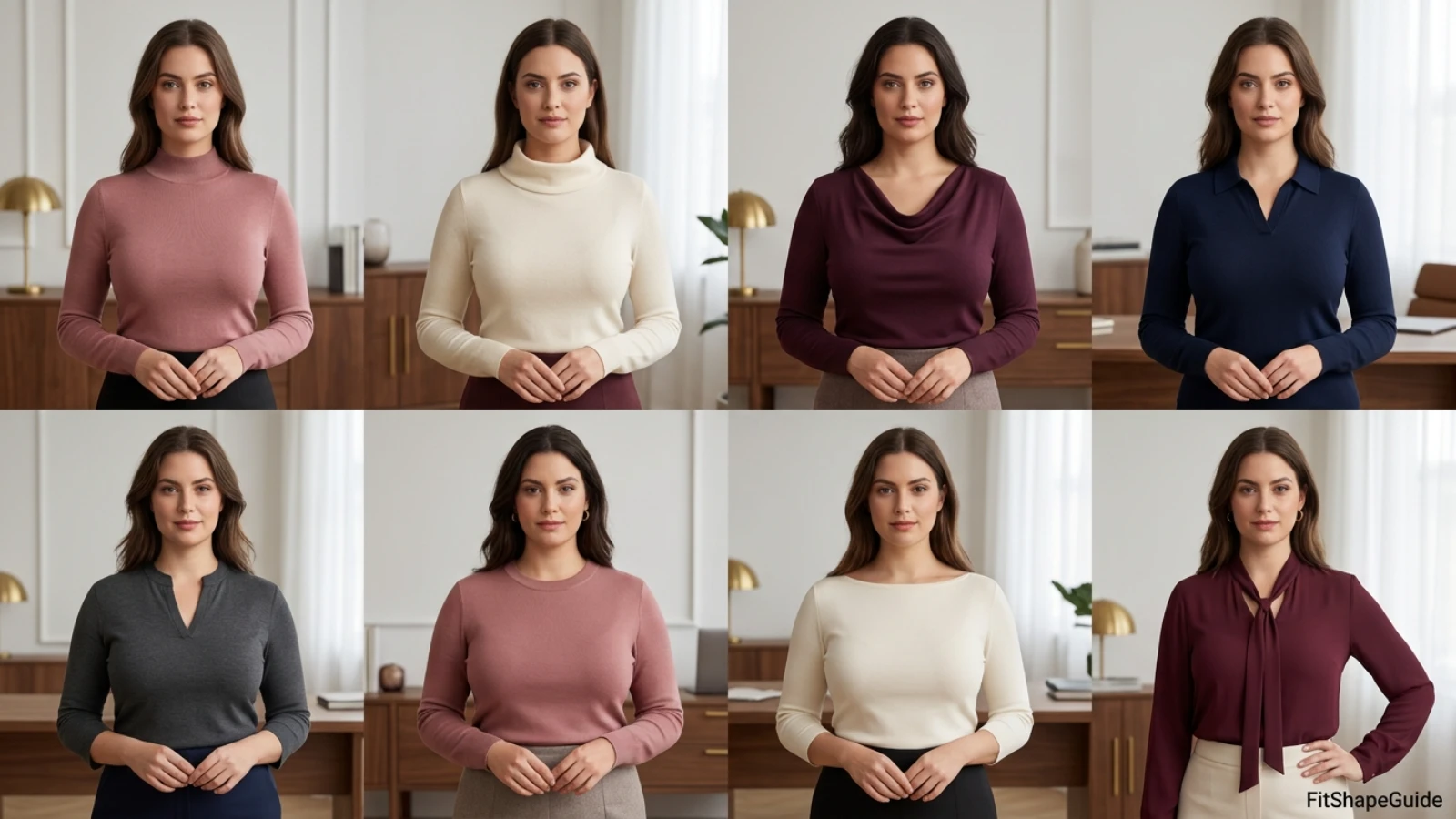
Mock, funnel and cowl necks compared
Mock, funnel and cowl necks all provide upper-chest coverage, yet their pattern behavior differs. A mock neck is a short, close collar attached to the neckline. A funnel collar is usually taller or more open and may stand away from the neck. A cowl adds deliberate fabric volume that falls into folds. Product names are not standardized, so rely on photos, measurements and construction descriptions instead of the label alone.
Choose a mock neck for clean tailoring
A mock neck is the easiest match for a conventional blazer because it creates a narrow vertical line above the lapels and has limited bulk. Fine gauge matters: a smooth, compact knit fits beneath a jacket more predictably than a chunky rib. The body needs enough bust room before stretch is counted. If the knit is already near its limit while standing, sitting and reaching can make it sheer, shorten the front or pull the collar backward.
Check the collar seam. It should sit flat without twisting or creating a tight horizontal ridge. The opening must stretch enough to pass over the head without cracking stitches, then recover. Makeup transfer is common with close openings; use a clean scarf over the face during try-on when permitted and follow the retailer’s instructions.
Choose a funnel neck for space and warmth
A funnel is useful when the visual height of a turtleneck is welcome but direct neck pressure is not. Softness alone is insufficient: the collar must have enough structure to stand or drape as intended. A very limp funnel can collapse into random folds, while a stiff one can push against the chin. Turn the head and look down before buying.
Funnel collars often work best with collarless jackets or open cardigans because they occupy space around the neck. Under a notched-lapel blazer, decide whether the funnel sits entirely inside the lapels or rises cleanly above them. Half-in, half-out placement tends to shift as the arms move.
Choose a cowl for controlled drape
A cowl can provide room over the bust because its front has additional fabric, but extra fabric is not the same as correct shaping. A shallow cowl should fall from the neckline and return after movement. If the folds begin too low, they may pool at the fullest point of the bust or open when leaning. Check the inside edge for a facing, weight or anchor that keeps it stable.
For formal offices, smaller is usually easier to style than an oversized statement cowl. Keep jewelry simple, and pair the drape with a clean trouser or skirt. When a blazer is required all day, test collar bulk at the lapels and behind the neck; a beautiful standalone top may be an inefficient layer.
Collared, crew and open-neck alternatives
If turtlenecks feel hot or restrictive, moving to another high collar may not solve the problem. A collared knit, split neck, substantial crew or restrained boat neck can keep an office outfit finished while leaving more space around the throat. These options are especially useful in heated buildings, warm climates and workplaces where jackets come on and off frequently.
Collared knits and knit polos
A collar frames the neckline and reads intentionally under a blazer. Knit construction adds movement, but the placket must be evaluated like a shirt. Buttons should lie flat; an open V should not spread wider when seated; and collar points should not curl. If the style has a zipper, check that the teeth and pull lie smoothly over the bust rather than forming a hard ridge.
Collared knits can bridge formal and business-casual days. A fine-gauge version with tailored trousers is quieter than a sporty contrast-stripe polo. The office context comes from the entire garment—fabric, trim, sleeve, hem and finish—not the collar name alone.
Split necks and Johnny collars
A vertical split gives the upper chest breathing room without requiring a deep neckline. The opening should be reinforced so it does not stretch longer over time. Sit, lean over a laptop and turn sideways to a mirror. If more coverage is needed, select a shorter split or add an opaque camisole rather than pinning the neckline under tension.
Moderate crew necks
A crew becomes office-ready when the neck band lies flat, the fabric is opaque and the body has deliberate shaping. A moderate opening is often more comfortable than a very tight crew. Fine rib can expand over the bust, but recovery matters; a neck or hem that remains stretched after wear will look tired quickly.
Boat and portrait necks
A soft horizontal neckline can look polished with a simple skirt or trouser, but it requires the most careful undergarment and blazer test. Raise both arms and rotate. The edge should remain inside bra straps, and the shoulder seams should not migrate. A collarless jacket normally preserves the neckline better than a wide notched lapel.
Tie necks and scarf collars
Choose a narrow, fluid tie that falls cleanly rather than a thick bow that sits on the bust. Verify that the blouse has enough front width and length before tying. A loose knot at the base of the neck can create formality with less pressure than a close bow. During a long presentation, the tie should stay placed without repeated adjustment.
Fuller-bust construction that prevents pulling
A neckline cannot work independently from the body of the top. The bust uses both horizontal circumference and vertical length. When a garment provides only width through stretch, the fabric may become thin while the hem rises. Better options provide room through shaping, cut, knit structure or a combination of these.
| Fit signal | Likely construction cause | Better response | Avoid |
|---|---|---|---|
| Collar pulls backward | Insufficient front length, tight bust or low armholes | More front length, bust shaping or different cut | Pulling the hem down all day |
| Horizontal lines across bust | Insufficient circumference or overstretched knit | More room, denser knit or fuller-bust pattern | Relying on a blazer to hide strain |
| Front hem sits higher than intended | Bust consumes length or top is cut short | Longer front, curved hem or bust darts | Sizing up without checking shoulders |
| Excess fabric tents below bust | Straight body without waist or under-bust shaping | Side seams, darts, rib recovery or strategic tuck | Compression to force fabric inward |
| Armholes drag top upward | Armhole, sleeve or shoulder mobility is limited | Better sleeve pitch, gusset, stretch or size | Assuming the neckline is responsible |
| Neckline becomes sheer | Fabric is overstretched or too lightweight | More ease, opacity, lining or denser gauge | Matching underlayers as the only fix |
| Blazer will not settle | Collar or sleeve creates internal bulk | Finer top, roomier jacket or collarless layer | Forcing a fitted jacket over thick knit |
| Side seams rotate forward | Front needs more width or projection | Different cut, size or fuller-bust shaping | Twisting the garment into position repeatedly |
Shoulder placement
The shoulder seam should sit close to the intended shoulder point unless the style is deliberately dropped. A shoulder that is too narrow can pull the sleeve and neckline upward. A very dropped shoulder adds fabric beneath a blazer and may make the armhole shift. Try the top alone, then under the actual layer.
Front length and hem strategy
Compare front and back hem position while standing naturally. A small difference can be part of the design or body geometry; the question is whether the intended tuck or untucked line remains stable. For a full tuck, sit and confirm that fabric does not pull the neckline downward. For an untucked top, the hem should clear trouser pockets and jacket buttons without bunching.
Darts, seams and knit shaping
Woven tie-neck blouses benefit from bust darts, princess seams or pattern shaping. Knits may use fully fashioned increases, side-seam contouring, rib changes or elastane-assisted recovery. None guarantees fit by itself. Inspect whether the shaping occurs where your body needs it and whether the fabric returns after gentle stretching.
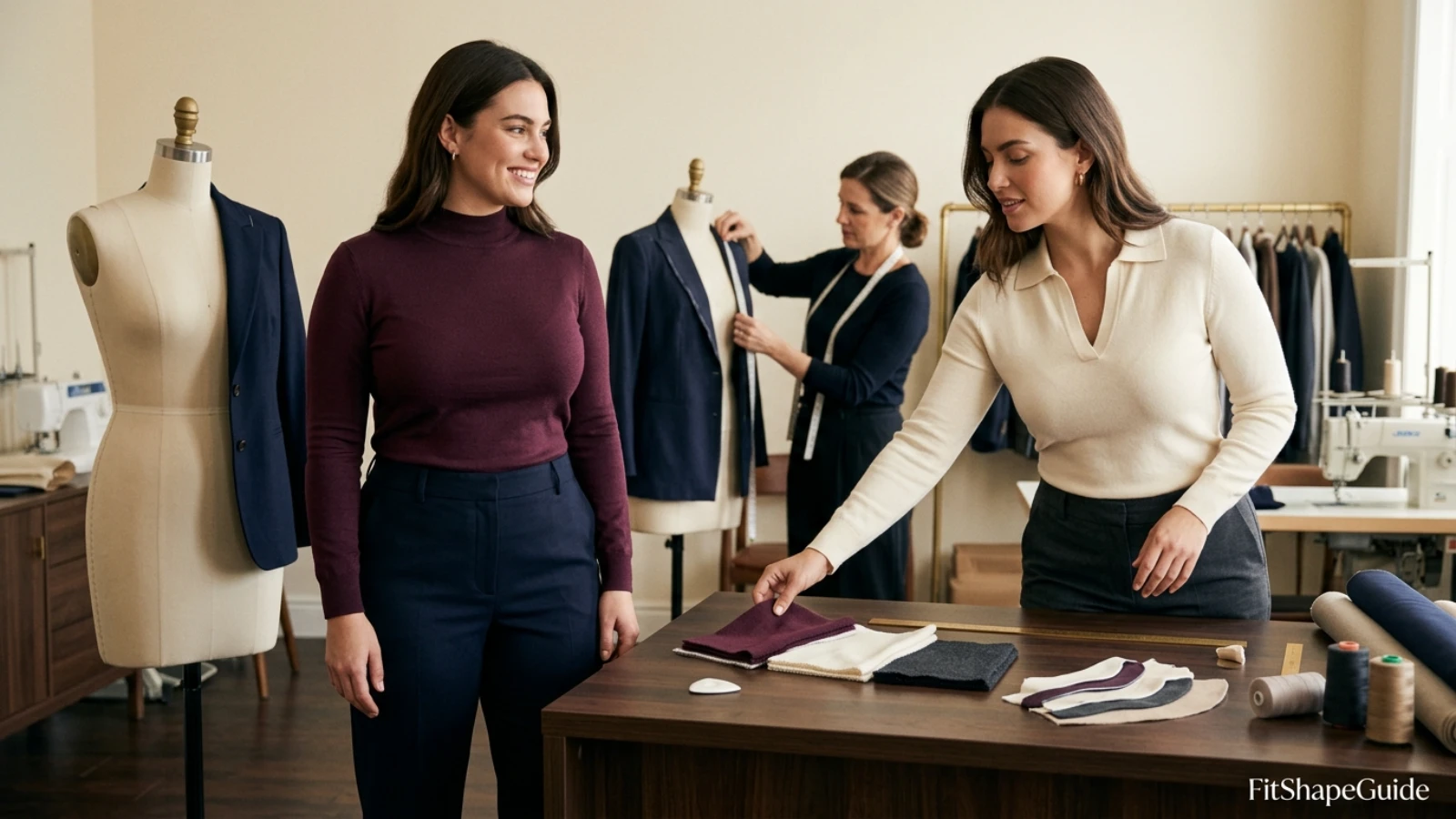
For a wider overview of necklines, seams and shaping, use the best tops for a large bust. If a classic high neck remains comfortable and fits correctly, the large-bust turtleneck guide explains the original option in more detail.
Fabric, warmth and recovery for office wear
Fiber content influences comfort and care, but knit construction, yarn, gauge, finish and garment thickness also matter. A thin wool knit and a heavy wool sweater behave differently. A cotton rib and compact cotton interlock can have different stretch and recovery. Read the full materials list, inspect the knit and test the actual garment rather than relying on a single fiber label.
Fine-gauge merino and wool blends
Fine-gauge merino can provide warmth with less thickness than chunky knit and may manage temperature across a commute and office. Skin sensitivity varies, so rub the collar against the neck for several minutes. Check care instructions before purchase. Some wool sweaters are machine washable on an appropriate cycle, while others require hand washing or different handling.
Cotton and cotton blends
Cotton knits can feel familiar and work well in heated offices. Rib constructions have significant widthwise stretch, but the garment still needs recovery. Added stretch yarn may help the knit return, yet performance depends on the complete construction. A soft cotton mock neck that bags at the elbows or collar will not stay polished merely because the fiber feels comfortable.
Viscose, modal and blended knits
Fluid cellulosic blends can create elegant cowls and smooth shells. Their drape may reduce stiffness, but weight can pull a neckline downward or lengthen a garment during wear. Check whether the fabric clings, becomes sheer under light or grows after hanging. Follow the specific care label; fiber family alone does not determine washing.
Synthetic and mixed-fiber options
Polyester, nylon and acrylic blends can add durability, shape or affordability, but heat, static and pilling experiences vary. Pilling is affected by fiber, yarn, fabric construction, finish and use, not simply by whether a garment is “natural” or “synthetic.” Rub a hidden area gently, inspect high-contact zones and read care and abrasion feedback cautiously.
Cold office
Start with fine-gauge merino, a wool blend or compact double knit. Pair it with a blazer that has enough collar and armhole room.
Warm office
Use a split-neck cotton blend, lightweight collared knit or moderate crew. Make sure opacity survives stretch and bright overhead lighting.
Variable commute
Choose a breathable fine layer and put warmth into a removable jacket or coat instead of a heavy collar that cannot be adjusted.
Long seated day
Prioritize recovery at elbows, bust and hem, plus a neckline that remains comfortable when posture and room temperature change.
Care is part of cost per wear
Before buying, decide whether the required washing, drying and storage fit your routine. Fold knits that may stretch on hangers, allow damp garments to dry as directed and keep direct heat away when the care label warns against it. Rotate frequently worn sweaters so fibers and elastic can recover. A lower purchase price does not create value if the garment’s care is impractical for weekly office use.
Blazer-friendly office outfit formulas
A successful alternative should work both with and without the outer layer. Start with the neckline that solves comfort, then select jacket structure and trouser volume. Keep one focal detail: a cowl, tie or strong collar needs a quieter lapel and minimal necklace, while a simple mock or crew can accept a more defined blazer.
Mock neck + single-breasted blazer
Use a fine-gauge mock beneath an open or comfortably buttoned blazer. The collar should rise cleanly between the lapels, and the top sleeves should not bunch inside the jacket. Straight or wide-leg trousers complete a dependable meeting uniform. Compare jacket construction in the work blazer guide.
Funnel neck + collarless jacket
A collarless jacket gives a soft funnel its own space. Keep the jacket neckline clean and verify that the funnel does not spill outward or push the front edges apart. This pairing is useful in a cold office because both pieces can provide coverage without overlapping lapels.
Split-neck knit + tailored trousers
A split neck provides airflow and vertical detail. Choose a reinforced opening and add a camisole only if needed for movement coverage. Tailored trousers and a simple belt can make the combination meeting-ready without a jacket. It also adapts easily to the business-casual outfit formulas.
Controlled cowl + clean longline layer
Let the cowl be the outfit’s soft element. Use a simple longline blazer or cardigan with enough front space, then add straight trousers or a column skirt. Avoid a scarf, heavy necklace or ruffled lapel competing at the same point.
Collared knit + wide-leg trousers
A compact collared knit creates clear upper structure while wide-leg pants provide movement. A partial or full tuck can work when the top has enough front length and the waistband remains comfortable when seated. Keep the collar neat and the placket calm.
Moderate crew + statement blazer
A substantial crew is the quietest base for texture, color or a stronger lapel. It should not be so tight that the neckline presses or pulls backward. Add a small pendant only if it remains above the fullest bust area and does not become trapped by the jacket.
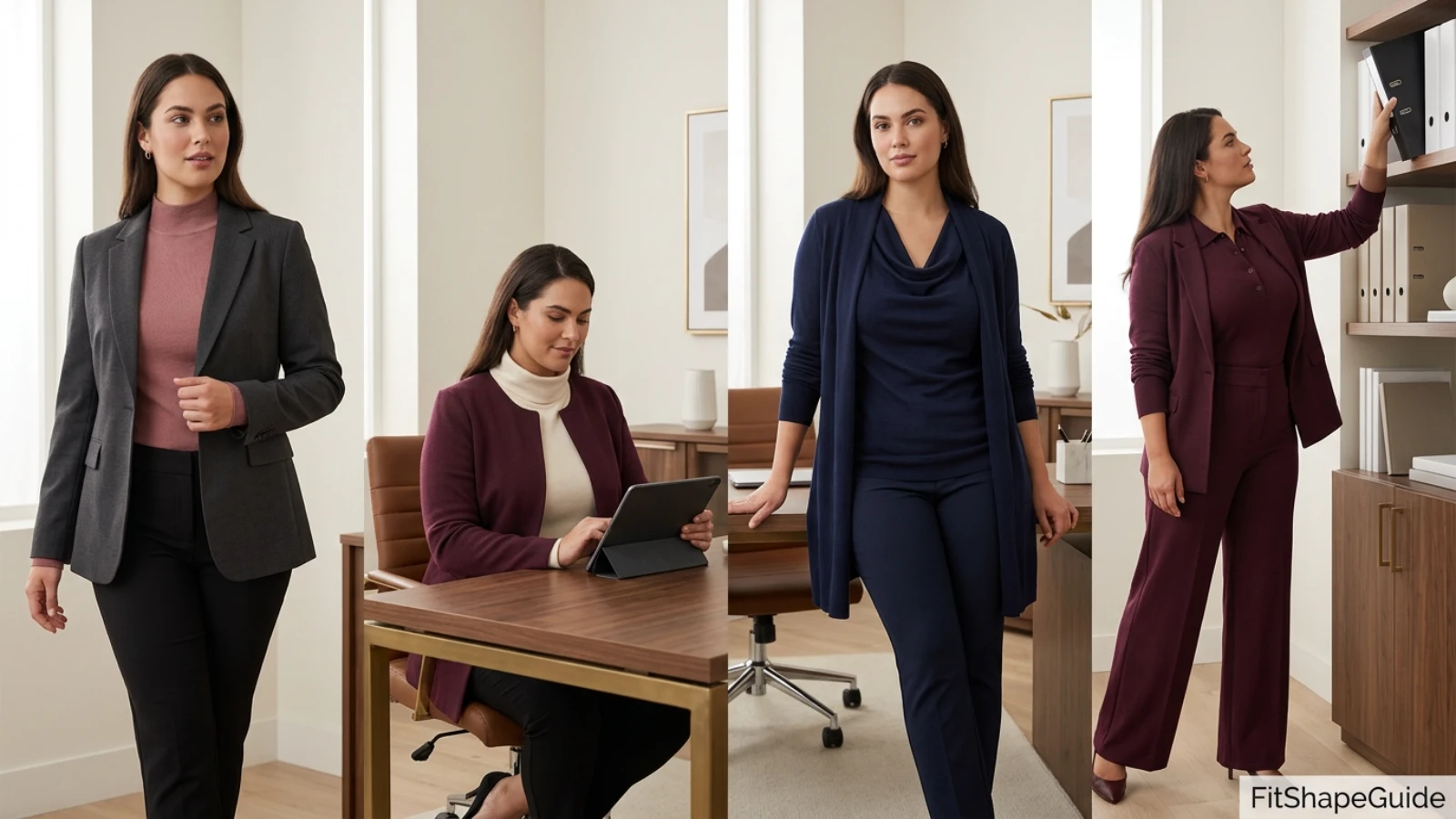
Use the complete office-dressing framework to adapt these formulas to dress code, meetings, commute and temperature. The goal is not to use clothing to “balance” the body; it is to assemble layers that cooperate in motion.
Online shopping, fitting-room tests and care
Start with an office top you already wear successfully. Record shoulder width, pit-to-pit width, front length, back length, sleeve length, hem width and neckline opening when measurable. Compare garment measurements, not only body-size charts. If the seller provides no top measurements, use reviews as secondary clues and confirm the return policy before trying an unfamiliar neckline.
- Identify the collar: verify height, fold, opening and whether it is close, standing or draped.
- Inspect every view: front, side and back images reveal tenting, collar collapse, shoulder drop and hem difference.
- Read the knit: check fiber content, gauge, rib or jersey construction, lining, opacity and claimed stretch.
- Confirm dimensions: bust room, front length and armhole mobility matter before a generous collar can help.
- Check care: note washing, drying, ironing, dry-cleaning and storage requirements.
- Review returns: confirm deadlines, final-sale exclusions, tag rules and responsibility for return shipping.
Fitting-room sequence
Wear the intended bra and trousers. Put the top on without forcing the neckline. Settle the shoulder seams, then let the hem fall without pulling it down. Look at front, side and back views. Sit for two minutes, reach forward, rotate, raise both arms and remove the blazer. The neckline should return, the front should remain opaque and the hem should not require arranging.
For tie necks, test two realistic arrangements rather than the most elaborate bow. For cowls, lean forward and see whether the inner edge remains covered. For mock and funnel necks, turn the head, look down and use a phone briefly. A collar that is tolerable only while standing still will not improve during a long workday.
Build a small capsule
Choose one high alternative and one open alternative. A mock or funnel covers colder formal days; a collared split neck or substantial crew handles warmth and easier layering. Add one blazer compatible with both. Two reliable tops that share trousers and a jacket usually create more repeatable value than several statement collars needing different layers.
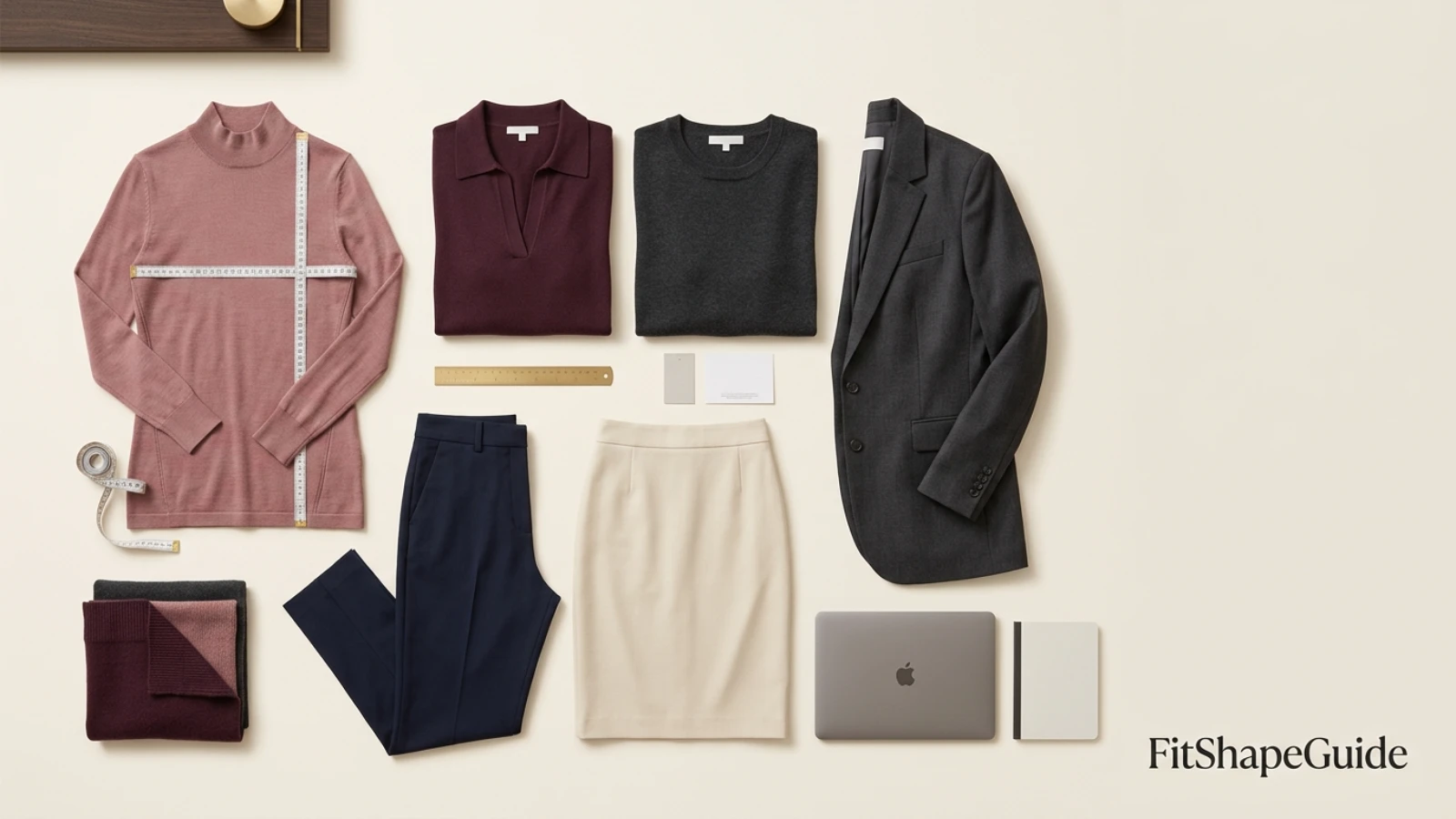
If the capsule needs more knit options, compare gauge, shaping and layer compatibility in the large-bust sweater guide. Do not add a style merely because it is fashionable; it should solve a temperature, neckline or layering job already present in the wardrobe.
Common problems with turtleneck alternatives
The mock neck still feels restrictive
A shorter collar does not guarantee a larger opening or softer pressure. Check neckline circumference, collar elastic and seam stiffness. Move to an open funnel, split neck or moderate crew rather than repeatedly stretching a collar that does not recover.
The funnel collapses into the blazer
The collar may be too soft for its height or the jacket may leave insufficient space. Try a collarless jacket, a lower funnel or a mock neck. Do not pin a knit collar where movement can pull the pin or fabric.
The cowl opens when leaning
Look for a shallower cowl, stable inner facing or higher base neckline. A camisole can add coverage, but it does not stop excessive fabric movement. Test at a desk before wearing the top to a meeting.
The collared knit placket gaps
The body may need more bust room, a deeper armhole shape or a different placket construction. Choose a pullover Johnny collar, a reinforced shorter opening or a fuller-bust cut. Do not depend on hidden safety pins under tension.
The crew neck looks too casual
Increase fabric substance and finishing rather than making the neck tighter. A compact knit, clean neck band, shaped body, pressed trouser and tailored blazer can create formality. Thin T-shirt jersey may need a different role.
The boat neck exposes bra straps
Select a narrower opening, use a compatible bra with secure strap placement or have discreet garment strap keepers sewn inside the shoulders. If the top still moves during reaching, it is not a dependable work layer.
The front hem rises under a blazer
More bust circumference or front length may be needed. Check whether the jacket armhole drags the top upward. A longer hem, curved front, bust darts or different jacket can solve the interaction more effectively than constant retucking.
The knit pills where the bag rubs
Pilling can result from fiber, yarn, fabric, finish and abrasion. Reduce repeated friction, rotate the garment and follow care instructions. Remove pills only with a method suitable for the fabric; aggressive shaving can damage fine knits.
The top works alone but overheats in meetings
Put insulation into removable layers. Use a lighter split neck or crew under the blazer and carry warmth in the coat or cardigan. Test the outfit in a heated room before a long day rather than relying on outdoor temperature.
Final verdict
The best turtleneck alternative for most offices is a fine-gauge mock neck with a comfortable opening, enough bust room and stable front length. Choose a soft funnel when neck space and warmth matter, a controlled cowl for gentle drape, or a collared split neck for more airflow. A substantial moderate crew is the simplest blazer base.
Judge the complete garment: collar, shoulder, bust shaping, armholes, hem, gauge and recovery must cooperate. Test it seated, reaching and under the intended jacket. The right alternative preserves office polish without neck pressure, bust strain, excess collar bulk or repeated adjustment.
Frequently asked questions
What is the best alternative to a turtleneck for the office?
A fine-gauge mock neck is the closest polished alternative, while a split-neck collared knit is better when neck pressure or overheating is the main problem.
Are mock necks appropriate for the office?
Yes. A smooth, opaque mock neck with stable shoulders, enough bust room and a clean hem works well with tailored trousers, skirts and blazers.
What neckline is better if turtlenecks feel tight?
Try a soft funnel neck that stands away from the throat, or move to a split neck, collared knit or moderate crew for less neck contact.
How should a mock neck fit a large bust?
The collar should remain comfortable while the bust area stays opaque, side seams remain vertical and the front hem does not rise or pull backward.
Are cowl necks professional enough for work?
A shallow, controlled cowl can be professional when it stays covered during leaning and does not create excessive bulk beneath the blazer lapels.
Can I wear a crew neck instead of a turtleneck?
Yes. Choose a substantial, opaque crew with a clean neck band and shaped body, then add tailored trousers or a blazer for office structure.
What fabric works best in a warm office?
A lightweight cotton blend, fine collared knit or breathable split-neck fabric can work well, provided it remains opaque and recovers after movement.
How do I test a turtleneck alternative under a blazer?
Button and unbutton the blazer, sit, reach, turn the head and remove the layer while checking collar bulk, shoulder movement, bust strain and hem position.
Editorial and verification standards
This guide ranks neckline types by office function, garment construction, fuller-bust fit, layer compatibility, temperature and movement rather than promising one universally flattering shape. Knit behavior was checked against CottonWorks knit basics, which explains how intermeshed loops allow knitted fabrics to stretch and conform, and its single- and double-knit reference, which details the widthwise extensibility of rib structures and the role of stretch yarn in recovery.
Fiber and care guidance was checked against Woolmark’s Merino workwear guidance for breathability and temperature response, plus its wool-sweater care instructions. Pilling is treated as a multi-factor performance issue, consistent with CottonWorks garment durability guidance, rather than blamed on one fiber name.
Before publishing a product module, verify the direct seller, exact style and variant, size range, garment measurements, neckline construction, bust shaping, front length, fiber content, gauge, care, returns and current availability. Affiliate relationships should be disclosed clearly and close to recommendations under the FTC endorsement guidance. No product ranking appears until those facts can be checked.
“Best” means suitable for an individual’s neck comfort, bust dimensions, office climate, dress code, layer, movement and care routine. It does not mean that a body needs to look smaller, longer or visually corrected.