Best Polo Shirts for a Large Bust
A construction-first buyer’s guide to polo shirts that sit smoothly through the bust, keep a balanced collar and placket, move without riding up, and recover after wear.
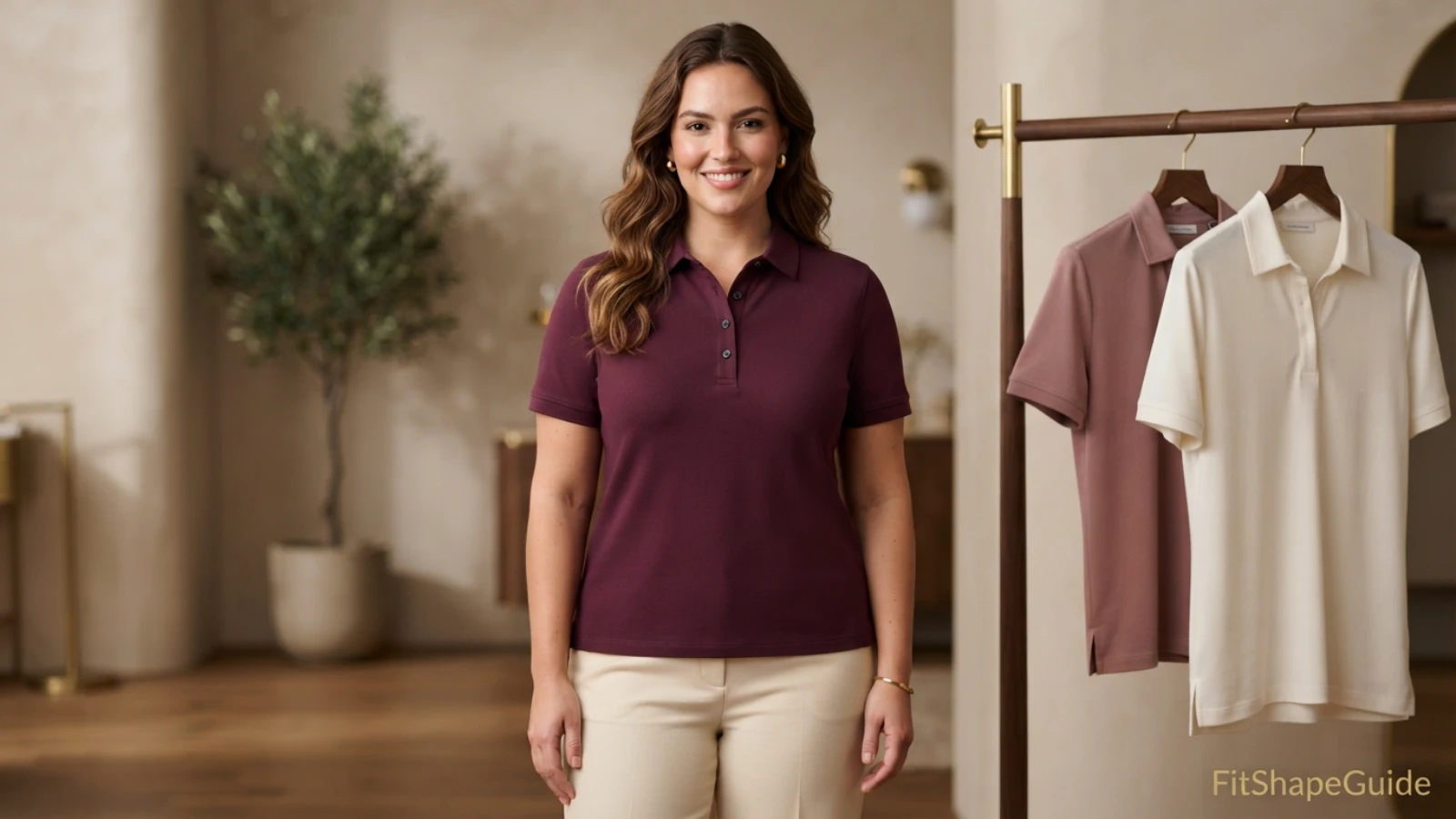
The best polo shirts for a large bust combine enough finished garment room with a placket that stays flat, a collar that does not spread or pull backward, balanced shoulders, comfortable sleeves, and extra center-front length for bust projection. A polo may look simple, but the collar, button band, knit structure, side seams, sleeve opening, and hem all react to tension. If the front is too shallow, the placket can form a V, buttons can pull sideways, the collar can widen, side seams can rotate forward, and the front hem can rise. Sizing up may release the chest but also lower the armholes, lengthen the shoulder, widen the neckline, and make the waist boxy. A better solution places room where it is needed through shaping, a fuller-bust block, a stable longer placket, useful front length, and fabric with appropriate recovery. This guide explains how to compare piqué, jersey, interlock, cotton-stretch, performance, and longline polos using measurable construction evidence rather than vague labels.
The 60-second polo shirt check
- Fasten the polo as you intend to wear it: the placket lies flat and does not split into a stretched V.
- The collar rests evenly instead of lifting at the back or spreading under bust tension.
- Shoulder seams remain near the shoulder edge unless the design is intentionally dropped.
- The sleeve opening is comfortable and does not pull the armhole or front panel upward.
- Side seams hang close to vertical and vents do not rotate toward the front.
- The front hem stays reasonably level with the back after breathing, reaching, and sitting.
- The knit returns toward its original shape instead of leaving a widened placket or persistent chest ripples.
- Opacity, bra coverage, and neckline depth remain suitable in daylight and movement.
Best polo shirts by construction
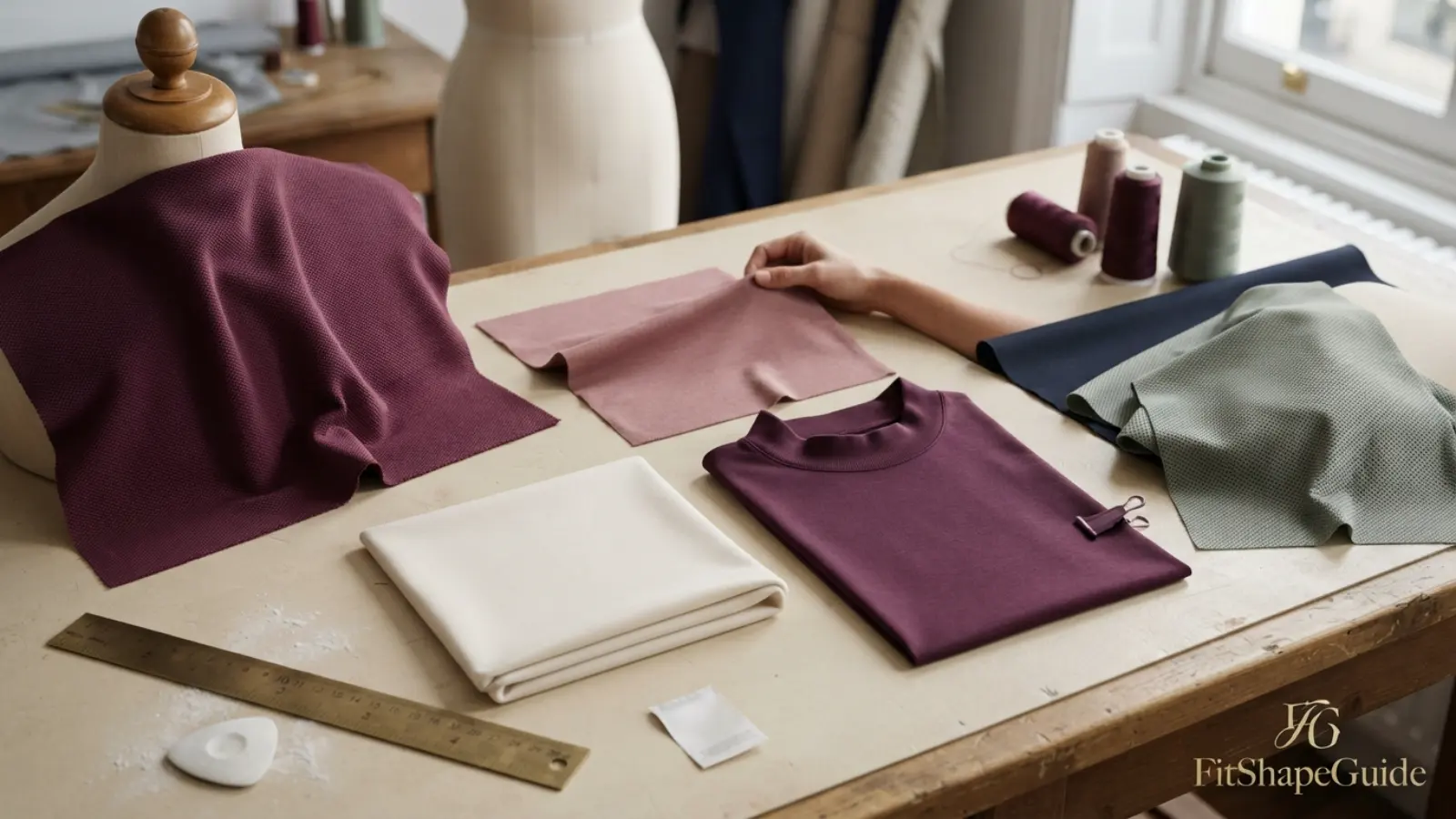
Construction should lead the buying decision. Two polos with the same cotton percentage may fit differently because their knit, placket, collar, shaping, sleeve, and length are different. The best polo shirts make those structural details verifiable instead of relying on a generic “relaxed” or “stretch” label. The six categories below are product types—not fabricated named recommendations. Verify current measurements, composition, care, returns, seller, and stock before adding any real affiliate product.
Shaped midweight piqué polo
Best overall: a polished polo worn tucked or untucked. Look for controlled front ease, a lightly shaped waist, stable collar, reinforced placket, side vents, and useful front length. Midweight piqué holds structure and can skim rather than cling, but a coarse or rigid version exposes missing projection quickly. The bust should fit before the knit is stretched.
Smooth interlock or jersey polo
Best budget-friendly route: simple everyday styling with less surface texture. Interlock is often smoother and more substantial than single jersey, while jersey may be lighter and more fluid. Either can be comfortable, but very soft cloth can outline bra edges or settle into the bust-to-waist fold. Seek opacity, recovery, a stabilized neckline, and a placket that does not curl.
Cotton-stretch polo
Best for active movement: commuting, golf, work, or long seated days. Elastane can improve give and recovery, but it cannot replace front room, appropriate length, or correct shoulder fit. Check whether the fabric snaps back after reaching and whether the placket and collar are separately stabilized. An undersized stretch polo may cling, shine, or grow around the bust.
Fuller-bust or seamed polo
Best for a projected or heavier bust: preserving a closer shoulder and waist fit. Bust darts, princess-inspired panels, curved side seams, or a cup-aware block can add three-dimensional room without enlarging every area equally. Confirm that shaping points toward the fullest bust level and that the front length remains balanced. “Curvy” is not evidence unless the pattern changes are explained.
Open-neck or zip-placket polo
Best for pressure-sensitive necklines: a clean sporty shape without multiple buttons across the upper chest. A notch, Johnny collar, open V, or short zip can reduce button-gap risk, but the opening must remain stable and provide the coverage you want. Look for facing, binding, or interfacing that keeps the neckline from stretching wider during wear.
Relaxed longline or performance polo
Best for plus-size range and coverage: easier lower-front room, side vents, and movement. A longer body can help with front hem lift, while moisture-management textiles may suit heat or sport. Verify bust, hip, bicep, opacity, and actual front length rather than trusting “relaxed.” Petite shoppers should check that the placket, sleeve, and hem are not scaled too long.
| Fit priority | Strong starting construction | Evidence to confirm | Main trade-off |
|---|---|---|---|
| Best overall | Shaped midweight piqué | Front ease, stable placket, side vents, balanced hem | Rigid piqué exposes missing projection |
| Budget | Smooth jersey or interlock | Opacity, neckline stabilization, recovery, return policy | Thin versions may cling or twist |
| Heavy or projected bust | Fuller-bust or seamed polo | Front-specific room, correctly placed shaping, longer front | Fewer options and more measurements to verify |
| Lower-set or sagging bust | Longer placket with adjustable opening | Button positions, neckline coverage, shaping height | A fixed short placket may end at the wrong level |
| Petite | Petite shaped polo or concise open-neck cut | High-shoulder-to-hem, placket, armhole, and sleeve length | Standard longline cuts can overwhelm the torso |
| Plus size | Relaxed longline or cup-aware polo | Full bust/waist/hip chart, bicep room, side vents, front length | “Oversized” may add width without projection |
How the best polo shirts control the placket, collar, and bust
The placket carries concentrated tension
A polo placket is a short reinforced opening joined to a flexible knit body. When the body lacks bust room, force concentrates at the placket base and buttonholes. The band can form a V, ripple, curl outward, or drag the collar points apart. The best polo shirts keep a stable placket flat before the buttons are used to pull the garment closed. Interfacing, a doubled knit, clean stitching, and a reinforced bottom box help, but reinforcement cannot compensate for an undersized front.
Button placement should work with your bust level
Button count alone is not enough. Note where each closure sits relative to the fullest horizontal bust line and where the placket ends. A longer three- or four-button placket offers more neckline control than a very short two-button style, but only when the intervals stay flat. On a lower-set bust, a short placket may end exactly where tension is greatest. An open-neck design can be easier if its neckline is properly faced and does not spread.
The collar must balance the neckline
A collar that is too heavy for the body can pull a soft knit downward. One that is too light can curl, collapse, or flare as the neckline widens. Rib collars recover differently from self-fabric collars, and collar stands are uncommon but more structured. Check that the back neck stays against the body, both collar points sit at similar heights, and the collar does not migrate backward after reaching. A clean collar frame creates visual balance without needing an exaggerated size.
Shaping converts circumference into projection
Extra width spread evenly around a flat front does not behave like three-dimensional bust room. Side darts, curved panels, princess-inspired seams, or front-specific pattern length allow fabric to travel outward and return toward the torso. A dart should aim toward the fullest area and stop before it. If it points far above or below, the polo can still crease. Very stretchy polos may omit darts, but the wearer should not have to stretch the fabric to create all necessary volume.
Sleeves and armholes can pull the chest indirectly
A tight rib cuff, narrow bicep, or high restrictive armhole can lift the side body and draw diagonal lines into the bust. Conversely, an oversized armhole may expose the bra or create folds that destabilize the front. Test the sleeve at rest and during a forward reach. The opening should remain comfortable without gripping, rolling, or dragging the shoulder seam downward.
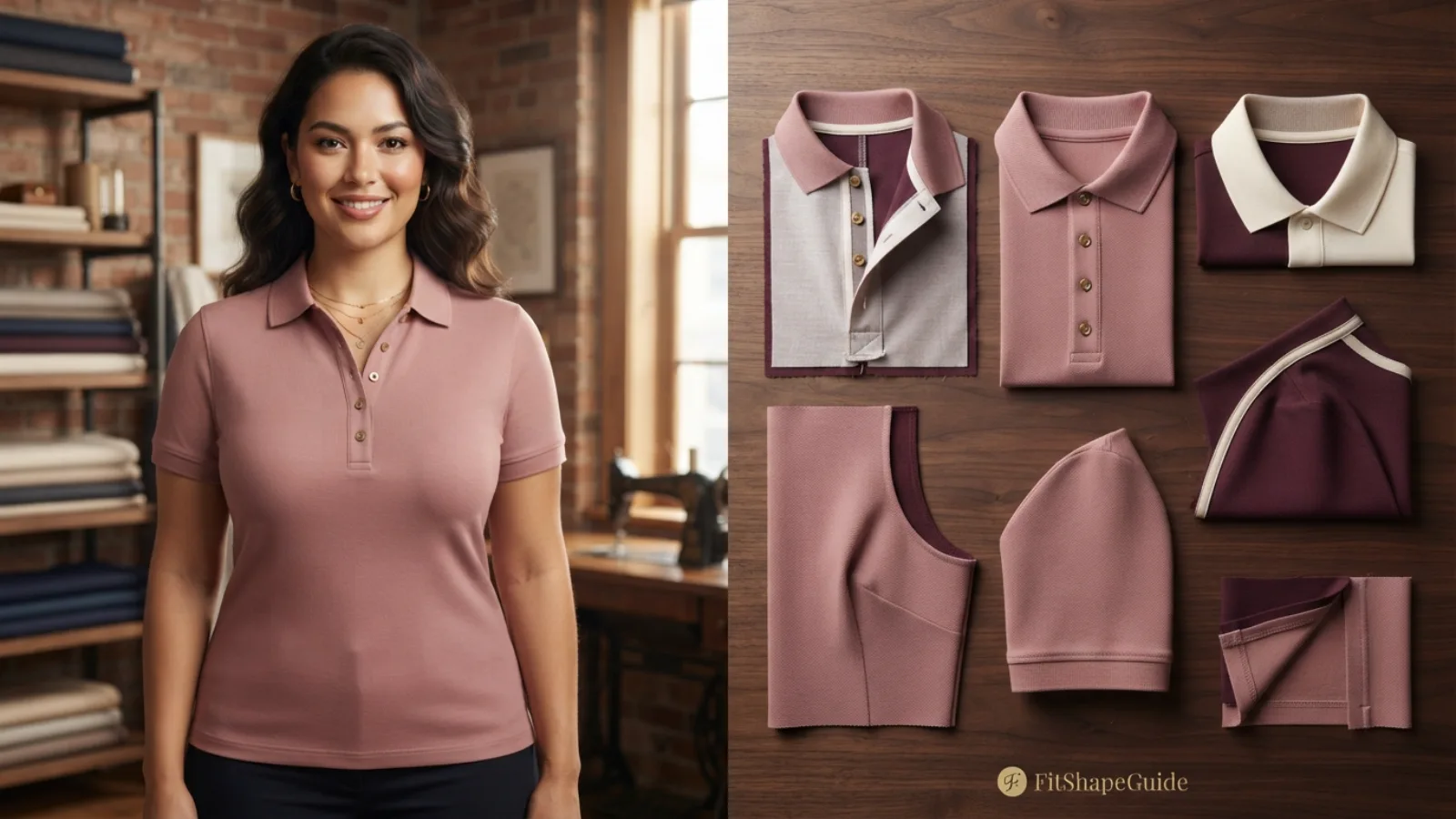
Fabric choices in the best polo shirts: piqué, jersey, interlock, and blends
Piqué: structured texture with limited forgiveness
Piqué commonly has a raised honeycomb, waffle, or corded surface. It can hold a collar, skim small texture, and create the classic polo appearance. Weight and finishing vary: one piqué may be soft and flexible while another feels dry and firm. A rigid piqué can bridge the body nicely when it has enough room, but it may also show horizontal tension or make a short front more obvious. Assess actual drape and recovery rather than assuming every piqué behaves alike.
Single jersey: soft drape with more cling risk
Jersey is usually smoother, lighter, and more fluid than classic piqué. Its face and back differ, and edge curling can matter in garment construction. A well-cut jersey polo can feel less bulky and tuck easily, yet thin jersey may reveal bra seams, stretch pale across the bust, or twist after laundering. Opacity, fabric weight, grain alignment, recovery, and stabilized openings are more useful clues than softness alone.
Interlock: smooth, often denser, and more stable
Interlock is a double-knit structure with a smoother appearance on both sides and often more body than comparable single jersey. It can create a polished polo with less surface texture than piqué. Extra density does not guarantee perfect recovery, and a heavy interlock can still pull at a short placket. Check whether it hangs cleanly without clinging and whether the collar weight is compatible with the body.
Cotton-elastane: mobility depends on the whole construction
A small elastane percentage may improve crosswise give and help the shirt return after reaching. The exact effect depends on yarn, knit, percentage, finishing, weight, and how the fabric is cut. Stretch is not free room: constant extension across the bust can distort buttonholes, widen the placket, and emphasize bra texture. The best polo shirts use stretch as comfort reserve after adequate pattern ease has been established.
Polyester-rich performance knit: light and quick-drying, with trade-offs
Performance polos may emphasize moisture movement, airflow, UV claims, or wrinkle resistance. Treat each claim as product-specific and verify the maker’s evidence. A light synthetic knit can dry quickly but may cling, retain odor differently, show shine under tension, or feel less breathable to a particular wearer. Mesh panels and perforations also change opacity. Inspect the exact color because pale and dark versions can reveal different levels of show-through.
Recovery and shrinkage are visible after use and care
Recovery is the knit’s ability to return toward its earlier shape after extension. During try-on, reach and sit, then stand neutrally without smoothing the shirt. Persistent chest ripples, a widened neckline, or a stretched placket are warning signs. Cotton-rich polos may change dimensions during laundering; “pre-shrunk” is not a promise of zero change. Follow the garment label and do not buy a tight size expecting a controlled amount of shrinkage or stretch.
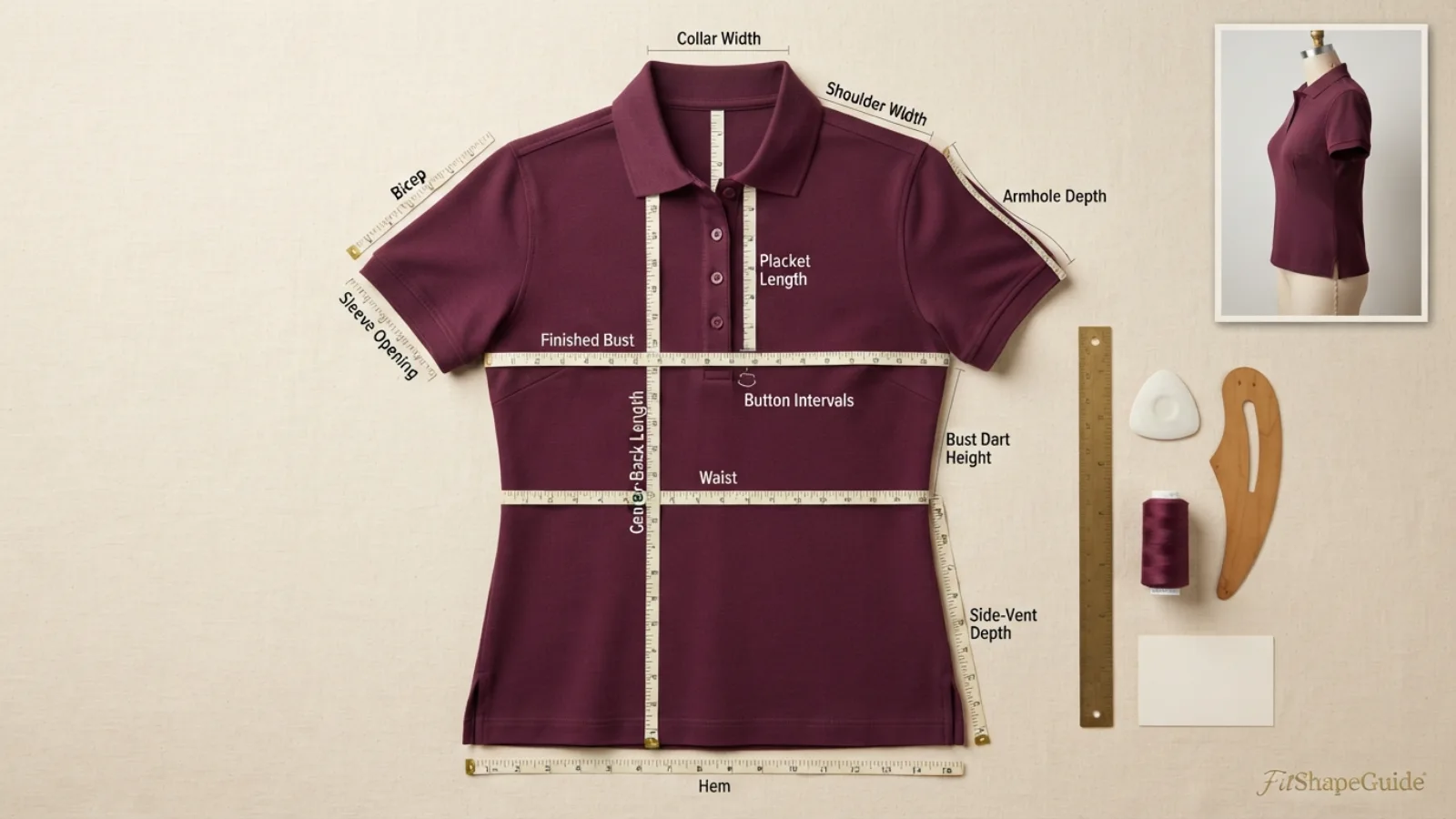
Measurements for the best polo shirts: bust ease, shoulders, sleeves, and length
Start with a successful knit top
Measure a top or polo that already fits the way you want. Lay it flat without pulling the knit, measure underarm to underarm, and double that number for an approximate finished circumference. Record shoulder width, waist, hem, high-shoulder-to-front-hem length, center-back length, armhole depth, bicep, sleeve opening, placket length, and vent depth. Use the same method for every garment. A stretched flat measurement is not comparable with an unstretched retailer measurement.
Body charts and garment charts answer different questions
A body-size chart suggests the body measurements a label intends to serve. A finished garment chart shows the actual polo dimensions and therefore lets you estimate built-in ease. If only body ranges appear, ask for garment bust, waist, hip or hem, shoulder, bicep, and length. Do not impose one universal ease target: a structured piqué polo, a close stretch golf shirt, and a relaxed longline polo are designed for different relationships.
Shoulders set a limit on sizing up
When the next size fixes the chest but pushes shoulder seams down the arm, enlarges the neck, or drops the armhole, the grading is adding room in the wrong places. A deliberate dropped shoulder can work on a relaxed polo, but it should still return after movement. Fuller-bust shaping is often more efficient because it protects the shoulder size while adding front width and length.
Sleeve opening and upper back affect the front
The upper back expands during a forward reach. A narrow back, restrictive armhole, tight bicep, or gripping sleeve band can pull the collar backward and lift the side body. Compare these areas with a successful top and test the exact intended activity. A golf or work polo that fits only while the arms hang straight does not have functional ease.
Bust projection consumes vertical length
The front travels outward over the bust before returning toward the waist or hem, so projection uses length as well as width. A polo may have enough circumference yet still ride up at center front, rotate its vents, or appear longer at the back. Compare front and back lengths and observe the side view. For a longline polo, verify the hip or hem measurement so added length does not create a new restriction lower down.
| Measurement | How to check | What it predicts | Common mistake |
|---|---|---|---|
| Finished bust | Flat underarm-to-underarm × 2, without stretching | Basic room when fastened | Comparing garment and body numbers as identical |
| Shoulder width | Across back between sleeve joins | Collar anchor and sleeve placement | Sizing up until shoulders collapse |
| Front and back length | Follow one consistent high-shoulder method | Hem balance over projection | Checking back length only |
| Waist and hem/hip | Measure flat at stated points | Tucking, sitting, and longline comfort | Assuming bust room guarantees lower-body room |
| Armhole, bicep, sleeve opening | Compare with a successful knit top | Reach and upper-arm comfort | Ignoring a rib cuff that grips |
| Placket length and intervals | Compare closures with fullest bust level | Neckline control and gap risk | Counting buttons without locating them |
| Dart or seam height | Compare with the fullest bust point | Whether shaping lands correctly | Assuming any seam equals bust-friendly shaping |
How to find the best polo shirts for a large bust online
Read the composition and knit description literally
Check every fiber percentage for the shell, collar, rib, mesh, and contrast panel where supplied. “Cotton feel,” “stretch,” “performance,” and “premium piqué” do not quantify behavior. The FTC’s textile-label guidance explains general requirements around fiber content and responsible company identification for covered products. Use composition to narrow expectations, then combine it with knit type, weight, product images, measurements, and care. Fiber names alone cannot guarantee softness, opacity, recovery, breathability, or shrinkage.
Inspect product images for tension evidence
Useful images show the polo fastened from front, side, and back; the collar and back neck; placket base; shoulder and sleeve; side seams and vents; and the full hem. Zoom across the fullest bust level. Look for a V-shaped opening, horizontal ripples, pale stretch, buttons leaning sideways, collar points spreading, diagonal lines to the armhole, rotated vents, or a raised center front. A tucked front or open placket can hide fit problems.
Translate reviews into location-specific clues
“Runs small” is vague. “Placket pulls between the second and third button,” “sleeve band tight,” “front rides up while seated,” “white color is sheer,” or “collar curled after label-directed washing” is useful evidence. Prioritize repeated comments for the same style, size, and color. Sellers may group several fabric variants in one listing, so confirm that a reviewer describes the exact polo you are considering.
Verify returns before comparing sizes
When measurements place you between sizes, ordering two sizes can reduce uncertainty only if return terms make it reasonable. Check final-sale status, shipping cost, return window, tag rules, and whether worn or washed items are excluded. Test indoors over the intended bra and base layer. Do not launder, alter, steam aggressively, or wear outside before deciding.
Keep affiliate placement separate from product proof
A polo should not be named “best” merely because an affiliate listing is convenient. The best polo shirts for a large bust earn their place through verified measurements, construction, movement, and care evidence. Verify the seller, live size range, exact garment chart, fiber line, construction photos, care, return terms, and current availability. Prices, ratings, review totals, and inventory change and should not be hard-coded without a live source and maintenance plan. Editorial fit evidence must remain stronger than the monetization slot.
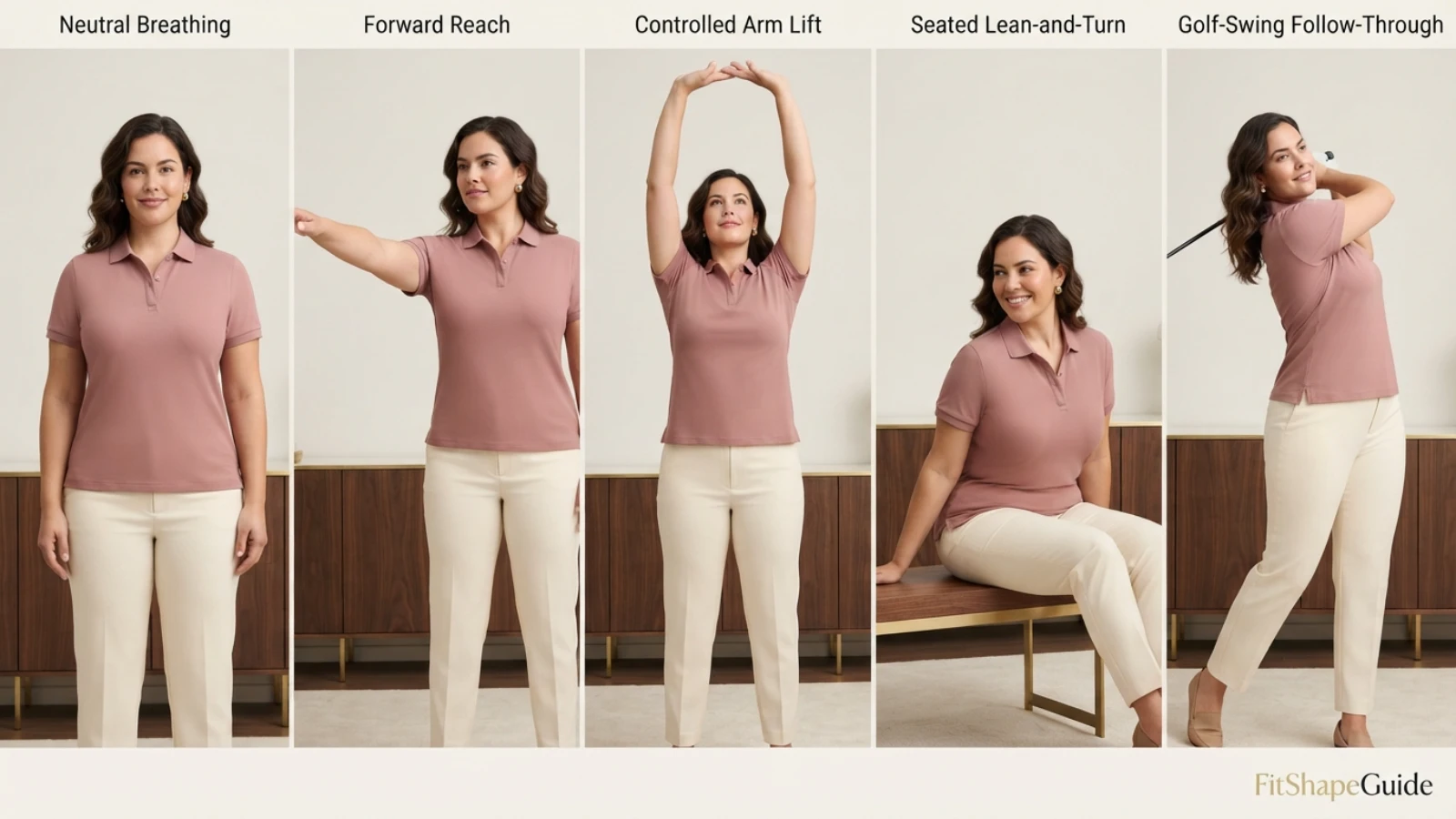
The five-position test for the best polo shirts
Wear the exact bra and base layer planned for the polo. Fasten the placket at the intended point and leave tags attached. Observe the collar, buttons, front hem, side seams, vents, sleeves, and recovery from front and side. A short phone video can reveal riding or twisting that a still mirror pose misses. Stop if a closure feels insecure or movement causes pain.
1. Neutral breath
Stand naturally, breathe comfortably, and let the arms rest. The placket should remain flat, collar points should sit evenly, and the fabric should not become shiny or pale from tension. Check side seams, shaping, sleeve bands, and front hem. A polo that begins strained has no functional reserve.
2. Forward reach
Reach as if typing, driving, serving, or holding a golf club. Watch the upper back, armholes, biceps, collar, and placket base. The polo may shift temporarily, but it should not choke, pull the collar sharply backward, open between buttons, or cut under the arms.
3. Controlled arm lift
Raise both arms to a comfortable working height. Note how far the hem travels, whether vents rotate, and whether the sleeve opening grips. Some lift is normal, but the movement should be usable and the polo should settle afterward instead of remaining trapped above the bust.
4. Seated lean and turn
Sit, breathe, lean forward slightly, and turn each direction. Check lower-front ease, waist and hip pressure, button intervals, and center-front length. A tucked polo should remain secure without painful bunching; an untucked polo should not climb and stay raised.
5. Activity and recovery
Repeat one motion specific to your use—golf swing, shelf reach, desk work, or carrying a bag—then return to neutral without smoothing the fabric. The best polo shirts recover with a centered placket, settled collar, near-vertical side seams, untwisted sleeves, and a hem close to its starting level.
Fit failures that eliminate the best polo shirts
A symptom can have several causes. A gaping placket may reflect missing bust room, short front length, tight upper back, poor button position, weak stabilization, or more than one issue. Diagnose the entire garment before sizing up or adding a closure.
| Visible symptom | Likely cause | Check next | Best first action |
|---|---|---|---|
| Placket forms a V or gaps | Missing front room or poorly placed closure | Finished bust, front length, upper back, button level | Try front-specific shaping; add a hidden closure only if edges meet easily |
| Collar spreads or lifts | Bust tension, weak neckline, or collar/body mismatch | Back neck, placket base, neckline recovery | Choose more room and better stabilization |
| Front hem rises | Insufficient center-front length | Front versus back length and side view | Seek extra front length; width alone may not solve it |
| Shoulders drop after sizing up | Standard grading adds room everywhere | Neck, shoulder, armhole, sleeve | Return to shoulder size and seek fuller-bust shaping |
| Sleeve band bites or rolls | Opening too narrow or rib too firm | Bicep and opening measurements during reach | Choose a plain hem, wider opening, or softer band |
| Side vents rotate forward | Front width/length shortage or tight hip | Side seams, waist, hem, longline hip | Change cut or add lower-front/hip room |
| Chest stays rippled after motion | Insufficient ease or weak recovery | Neutral fit, fabric return, placket distortion | Increase usable room or choose better recovery |
| White or pale polo becomes sheer | Low fabric density or excessive stretch | Daylight, bra contrast, fullest bust line | Choose denser fabric, more ease, or a suitable layer |
When sizing up works
Move up when the next size releases the bust, upper back, biceps, waist, and hip while the neckline, collar, shoulders, armholes, sleeves, placket, and overall length still suit the intended silhouette. This can work for a relaxed or sport polo and when your measurements are narrowly between sizes. Repeat the activity test because extra fabric can also twist or ride.
When a different construction is smarter
Change the pattern when your shoulder size fits but the front strains, the larger size collapses at the neckline, the placket ends at the fullest point, the center front is short, or the sleeve band becomes disproportionate. A fuller-bust block, curved panel, open neckline, longer placket, longline hem, or more stable knit changes the geometry instead of asking one larger flat size to solve every dimension.
Alterations for the best polo shirts: what is realistic?
Reasonable adjustments
A tailor may shorten a plain hem, reduce excess waist through side seams when vents and seam allowance permit, narrow a simple sleeve, adjust an existing dart, or secure one placket interval with a discreet internal fastener when the edges already meet without tension. Small button moves may help alignment, but the original hole and buttonhole positions limit the change. Wash the polo according to its label before a permanent length alteration if the tailor recommends it.
Possible adjustments with trade-offs
Shortening a vented hem requires rebuilding vent corners. Changing sleeve length may disturb a rib cuff. Reshaping the side body can alter stripes, logos, or color blocking. Replacing a collar or stabilizing a curling placket may cost more than the garment and can change its hand. A tailor should inspect knit stretch, seam type, available allowance, and machinery before promising a result.
High-risk reconstruction
Adding substantial bust width, creating missing center-front length, moving an entire armhole, lowering a fixed placket, or rebuilding a collar generally means pattern reconstruction. There may be little usable seam allowance in a knit polo, and needle marks can remain. Buy the bust, shoulder, bicep, placket, and front length correctly first; use tailoring for refinement rather than rescue.
How to style the best polo shirts
Polished: shaped polo with tailored trousers
A midweight piqué or interlock polo can replace a casual blouse when its placket lies flat and the hem tucks without bulk. Choose a rise that meets the polo comfortably rather than pulling it downward. A tonal belt, clean shoe, and small earring keep the collar as the deliberate frame. For dressier woven alternatives, compare the structure in the blouse fit guide.
Relaxed: open-neck polo with straight-leg denim
A Johnny collar or open placket can create neckline space without relying on unfastening a strained button. Keep the opening stable and at a comfortable depth. A straight or gently curved hem works untucked when the center front has adequate length. The goal is intentional ease, not a larger shirt slipping backward.
Layered: polo under a cardigan
Choose a smooth collar, moderate sleeve, and stable shoulder so the polo does not bunch beneath the layer. Test the cardigan over the bust and upper back with both arms forward. The cardigan guide explains front-edge balance and shoulder stability for open and fastened layers.
Sport and work: performance polo with functional ease
Match the fit test to the activity. A golf polo needs rotational room; a work uniform may need reaching, bending, and repeated sitting; a travel polo needs recovery after a bag strap. Tucking should not force the hem downward across the bust. If a close knit base is preferred, compare neckline and sleeve behavior with the T-shirt guide.
Button strategy is styling only after fit
Leaving the top button open can soften the neckline, but it should be a chosen look rather than emergency release. A half tuck can change visual proportion, but it should not hide a front hem pulled upward or vents rotated forward. The best styling begins after the polo passes the closed, seated, and movement checks.
Care for the best polo shirts without changing the fit
Follow the garment’s own care label because fiber blend, knit, dye, collar, placket interfacing, elastic content, mesh, embroidery, and trim determine the safe method. The FTC’s textile-label guidance explains general fiber-content labeling, while its care-label guidance covers care-instruction responsibilities. A generic online polo routine should not override the item’s label.
Fasten or unfasten the placket as directed, turn the garment inside out when allowed, and avoid high heat unless the label permits it. Heat and agitation can change cotton dimensions, fatigue elastane, curl collar edges, twist side seams, or distort the placket. Reshape the collar, button band, sleeves, vents, and hem during drying if instructed. Store the polo without stretching the neckline; folding may suit heavy knits better than a narrow hanger.
Value is cost per successful wear
A cheap polo is poor value when its placket gaps, collar curls, sleeves grip, pale color turns sheer, or front constantly rides up. A premium label is not evidence if it withholds useful measurements and composition. Value improves when the best polo shirts for a large bust perform in their intended setting, coordinate with existing layers, survive ordinary movement, and can be maintained according to the actual care label.
Final buyer checklist
- Exact shell, collar, rib, and stretch-fiber composition is understood where provided.
- Piqué, jersey, interlock, or performance knit suits the desired structure, drape, opacity, and activity.
- Finished bust, shoulders, front/back length, waist, hem/hip, bicep, and sleeve opening are known or comparable.
- The placket is reinforced, its closures sit usefully, and the collar remains balanced.
- Darts, curved panels, or a fuller-bust block provide front-specific room where needed.
- Side seams and vents remain near vertical; the center front does not climb sharply.
- The polo passes breathing, reaching, arm-lift, seated, turning, activity, and recovery checks.
- Opacity, care, likely dimensional change, returns, stock, and seller details are understood.
- Any alteration is small, feasible, and compatible with the knit, placket, collar, and vents.
- No recommendation relies on an unverified product, ASIN, price, rating, review count, or claim.
Related large-bust guides
The best polo balances its collar and placket before stretch is asked to help
Start with a shaped midweight piqué polo for versatile polish. Choose smooth interlock or jersey for less surface texture, cotton-stretch for activity, a fuller-bust or seamed block for front-specific projection, an open-neck design for adjustable neckline space, or a relaxed longline polo for coverage. The winning evidence is usable bust room, a flat reinforced placket, balanced collar, stable shoulders, comfortable sleeves, sufficient front length, vertical side seams, appropriate opacity, and recovery after movement. That combination separates the best polo shirts for a large bust from a standard flat-front knit that is simply stretched or sized larger.
Frequently asked questions
Are polo shirts flattering for a large bust?
They can be. A well-fitted polo creates a clean neckline and structured casual line when it has enough finished bust room, a flat reinforced placket, a balanced collar, suitable front length, and comfortable shoulders and sleeves. Flattery comes from garment proportion and fit, not from hiding the bust or following a universal neckline rule.
What are the best polo shirts for a large bust?
A shaped midweight piqué polo is the strongest all-round starting point. Smooth interlock or jersey reduces surface texture, cotton-stretch supports movement, fuller-bust seams add projection, open-neck or zip plackets reduce button pressure, and relaxed longline polos add coverage. Choose using finished garment measurements and a movement test.
Should I size up in a polo shirt for a fuller bust?
Size up when the larger size releases the bust, upper back, biceps, waist, and hip while the collar, neckline, shoulders, armholes, sleeves, placket, and length still fit. If the shoulders collapse or neckline widens before the placket lies flat, seek front-specific shaping or a different cut.
How do I stop a polo shirt placket from gaping?
First confirm enough finished bust room, upper-back ease, front length, and suitable button placement. A discreet internal closure may secure one interval only when the placket edges already meet without force. If buttons pull sideways, the collar spreads, or side seams rotate, a fastener cannot replace missing pattern room.
Is piqué or jersey better for a fuller bust?
Neither is universally better. Piqué often provides more texture and structure, while jersey is usually smoother and more fluid. Interlock can offer a polished middle ground. Choose based on weight, opacity, recovery, collar and placket stability, desired drape, and whether the garment has enough front room before stretching.
What polo neckline is best for a large bust?
A stable adjustable placket, Johnny collar, modest open V, or short zip can all work. The best option provides comfortable coverage and keeps its shape without spreading. Check where the opening ends relative to the fullest bust point and ensure the collar remains balanced after reaching and sitting.
Can a tailor alter a polo shirt that is tight at the bust?
Only in limited cases. A tailor may release usable side-seam allowance, adjust an existing dart, refine the waist, shorten a plain hem, or add a hidden closure where edges already meet. Adding major front width or length, lowering a fixed placket, rebuilding a collar, or moving armholes is complex and often uneconomical.
What measurements should I check when buying a polo shirt online?
Check finished garment bust, shoulder width, front and back length, waist, hem or hip, armhole depth, bicep, sleeve opening, collar width, placket length, and button spacing. For shaped polos, compare dart or seam height. Also verify fiber percentages, knit type, opacity clues, care, returns, and seller details.