How to Stop Bra Straps From Slipping
If you keep pushing your bra straps back onto your shoulders all day, shortening them is only the first thing to check. Repeated slipping can also come from straps that sit too far apart for your frame, an unstable back band, cup-fit problems, narrow or sloping shoulders, worn strap elastic or simply a bra whose rear geometry does not match your body.
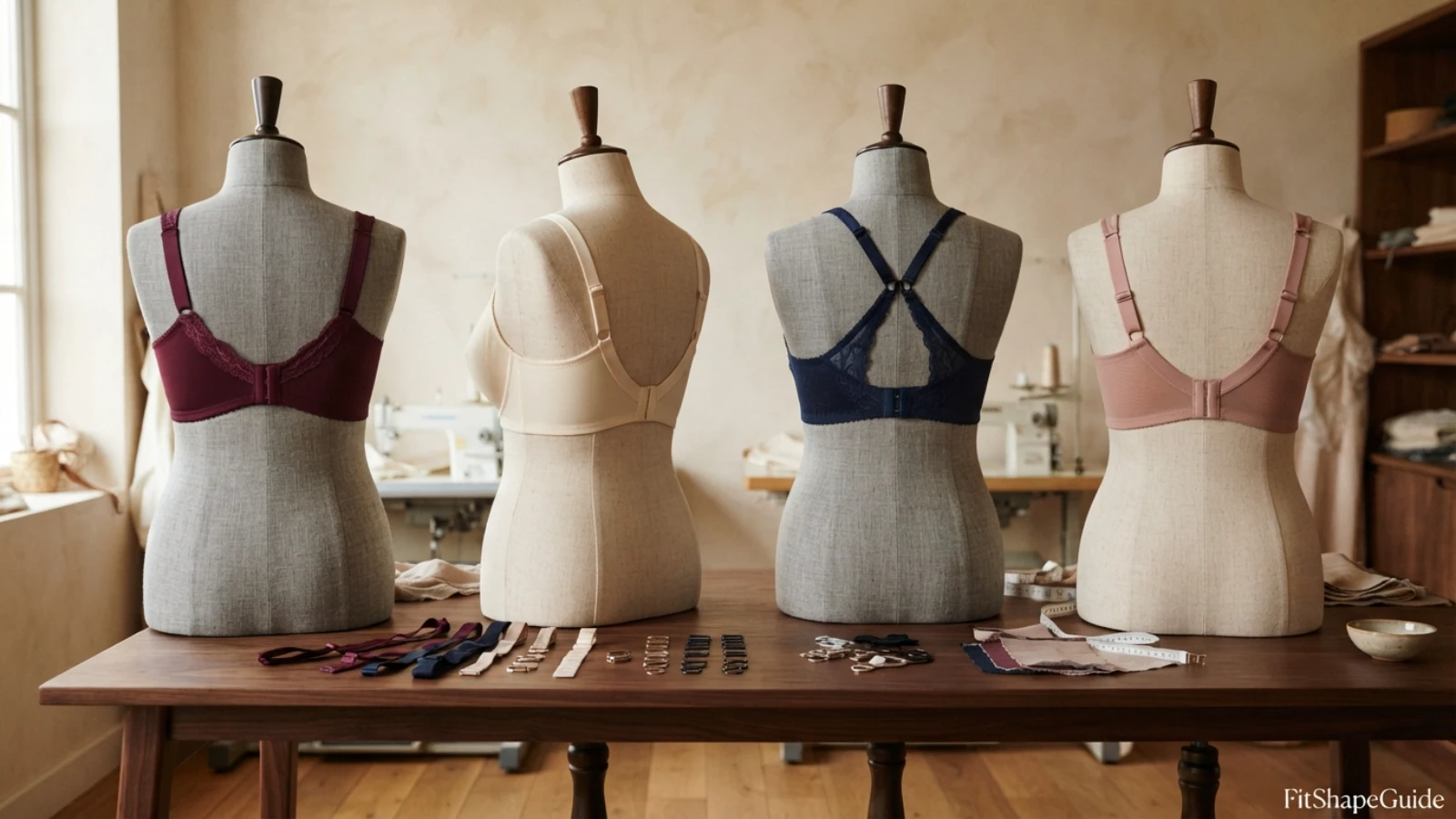
The 60-second slipping-strap diagnosis
- Adjust each strap separately rather than assuming both sides need identical settings.
- Slide a finger beneath the strap and check that it is secure without feeling painfully tight.
- Raise both arms and see whether the back band rides upward.
- Relax your shoulders naturally.
- Notice whether the strap sits near the outer shoulder edge before you even move.
- Reach forward as if typing or driving.
- Check whether one strap slips or both.
- Connect a J-hook or strap converter if the bra is designed for one and repeat the test.
- If the problem disappears when the straps move inward, strap spacing—not simple looseness—was likely a major part of the issue.
Why do bra straps keep falling down?
A slipping strap looks like a strap problem, but the cause can sit elsewhere in the bra.
Sometimes the slider is simply too loose. But if you shorten the strap and it falls again, look at the geometry of the whole frame.
The strap has too much slack or the slider gradually moves during wear.
The straps are attached farther apart than your shoulders comfortably support.
The band, cups or overall bra shape is shifting and taking the straps out of their intended position.
The straps are simply too loose
This is the easiest cause. New bras do not arrive pre-adjusted for your torso length, and straps can loosen gradually with repeated wear.
The straps are too widely spaced
A balconette or other wide-set design may place the strap near the outer shoulder edge. On a narrower or more sloping shoulder, gravity and arm movement can push it outward.
The band rides upward
When the rear band moves upward, the geometry between the band and shoulder straps changes. Tightening the straps to compensate may create a cycle of band migration and shoulder pressure.
The bra frame is too large or the wrong shape
A poorly matched cup or frame can leave the straps sitting farther outward than intended. Do not assess strap fit in isolation from the cups and band.
The strap elastic is worn
Older straps can lose recovery, and some sliders no longer hold their position as reliably after extensive wear.
Your shoulders and the bra simply disagree
Narrow, sloping or asymmetrical shoulders may work better with a bra designed with centered rear straps, a tow-back, U-back, racerback or convertible J-hook.
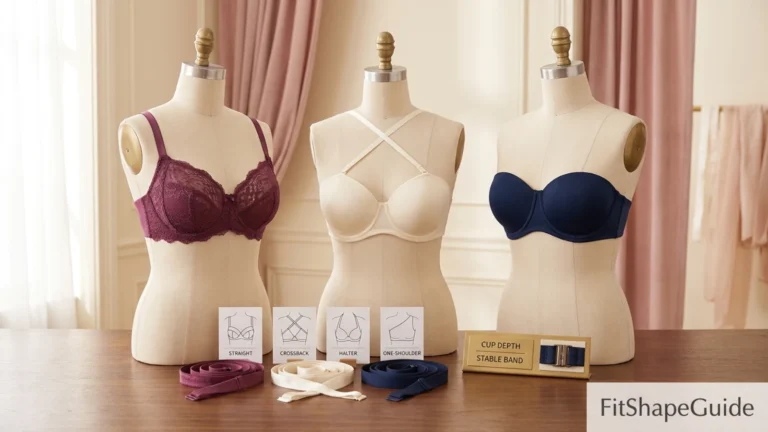
Best bra styles for straps that keep slipping
Full-cup bra with centered straps
Fuller-coverage frames often position the strap apex farther inward than very wide-set balcony styles.
Best for: everyday wear on narrower or sloping shoulders.
Tow-back bra
The rear strap attachments angle inward toward the center of the back, helping keep the straps away from the shoulder edge.
Best for: repeated slipping in standard straight straps.
Leotard or U-back bra
A curved rear wing can position the straps more centrally while creating a stable connection to the band.
Best for: everyday fuller-bust bras and T-shirt styles.
J-hook bra
An integrated hook joins the straps behind the upper back, converting them into an inward-running shape.
Best for: switching between straight and racerback positioning.
Fixed racerback bra
The straps converge toward the spine rather than running vertically near the outside of the shoulders.
Best for: persistent strap slippage and racerback clothing.
Convertible crossback bra
Detachable straps can be crossed behind the back when the bra’s approved configurations allow it.
Best for: flexible wardrobe use.
Fully adjustable strap bra
Long adjustment tracks are especially useful on shorter torsos or when left and right shoulder heights differ.
Best for: fine-tuning strap length.
Strap converter or retainer
A compatible clip can pull standard straps inward without replacing the entire bra.
Best for: testing whether more centered strap geometry solves the problem.

Adjust the straps correctly first
Adjust a new bra before judging it
Straps are not factory-set for your torso. Slide each adjuster until the strap is secure but not painfully tight.
Adjust each shoulder separately
Bodies are not perfectly symmetrical. One shoulder may sit lower or one breast may require a slightly different strap length.
Check again after washing and wear
Elastic settles over time. Periodically recheck strap length rather than assuming the original adjustment remains ideal forever.
Do not chase lift with the straps
If shortening the straps is the only way the breasts feel supported, check the band and cup fit. The shoulder straps should assist cup positioning rather than carry the entire load.
Watch the slider itself
If the strap keeps becoming longer during wear even after you set it correctly, the adjuster may not be gripping the elastic well anymore.
Check the bra band when straps keep slipping
The band and straps are physically connected. When the rear band moves, the strap attachment point moves with it.
The band should remain approximately level
Raise your arms and inspect the back. If the band climbs noticeably upward, the frame is not staying anchored.
Do not tighten the straps to pull the band down
That increases shoulder tension without fixing the underlying band issue.
Check band stretch
A once-reliable bra may start slipping at the shoulders after the band elastic has become worn and loose.
Band size is only part of the answer
Different bras use different materials and wing constructions. A stable fit comes from size plus elastic recovery and frame shape.
Reassess the entire bra if several things moved at once
If the band rides, cups shift and straps slip, this is not just an isolated strap problem.
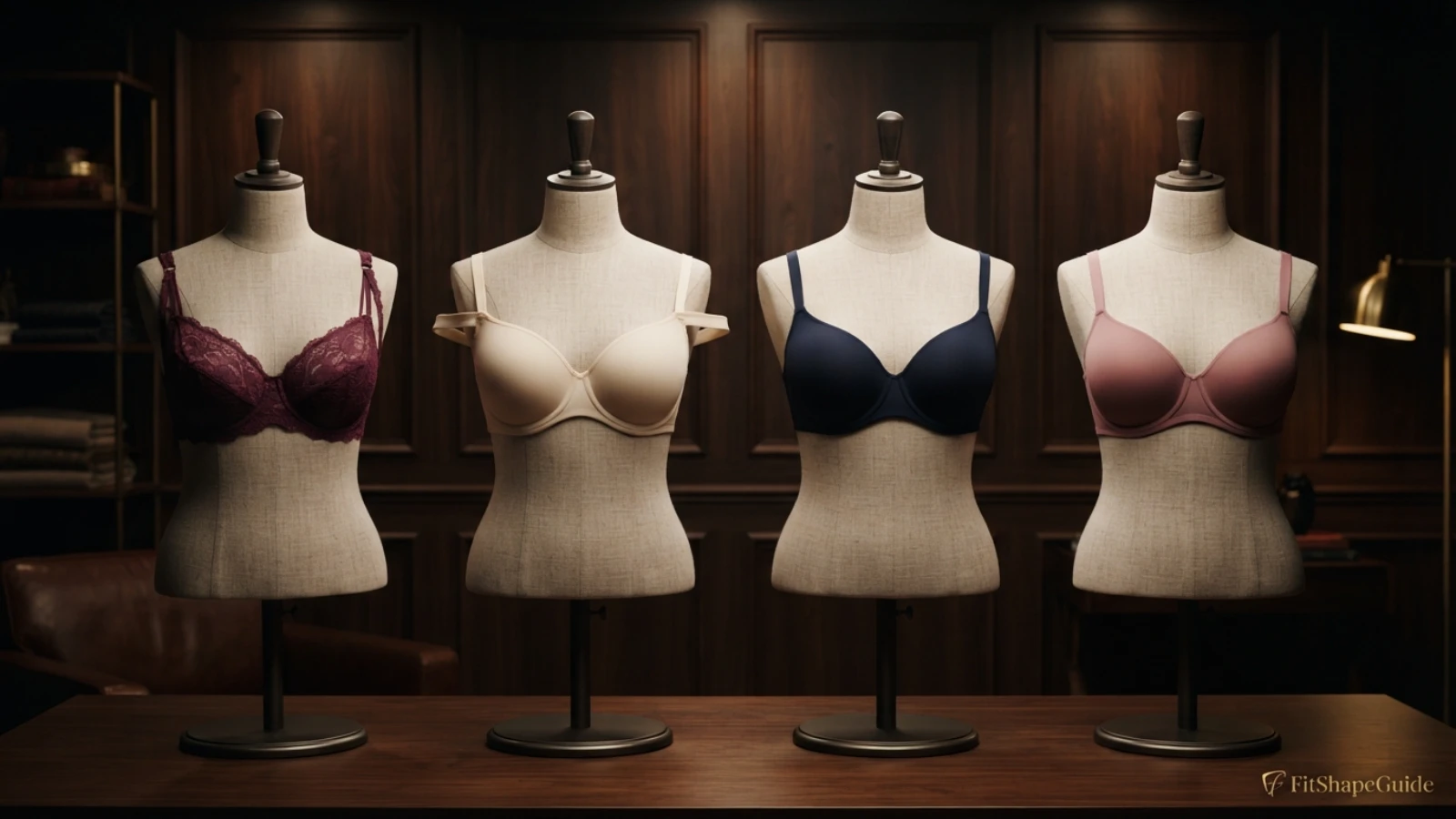
Wide-set straps vs centered straps
Bra straps attach to the cup at the front and the band at the back. Where those attachment points sit determines the path the strap takes across the shoulder.
Balcony styles can sit wider
Some balconette and demi shapes intentionally place the straps farther apart to create an open neckline. That can work beautifully on one frame and slip repeatedly on another.
Full-cup styles may be more centered
Many full-cup frames bring the upper cup and strap attachment inward, which can suit narrower shoulders.
Tow-backs angle inward
Tow-back designs deliberately pull the rear strap attachment toward the spine.
Angled rings can help
Some bras use angled strap rings at the back to direct the elastic inward instead of straight toward the shoulder edge.
Centered rear placement can matter more than strap width
A wide strap can still slide if it starts too far outside the shoulder line.
Best bra strap placement for narrow or sloping shoulders
If straps fall even in correctly fitted bras, your shoulder geometry may simply work better with more centered strap placement.
Narrow shoulders
The distance between the bra straps may be greater than the usable shoulder width, placing the elastic close to the outside edge.
Sloping shoulders
The shoulder provides less of a horizontal shelf for a conventional vertical strap to rest on.
Try a U-back or tow-back
Both designs can move the rear path inward while keeping a standard two-strap front.
Try a racerback or J-hook
Joining the straps behind the upper back creates an inward route that is much harder for the straps to slide outward from.
Do not force the shoulders backward
Your bra should fit your natural posture. Constantly retracting the shoulders to keep the straps on is not a useful garment solution.
J-hooks, racerbacks and crossed straps
J-hook bras
A J-hook connects the two straps behind the upper back. This can be particularly useful when you want straight straps most days and inward-routing only when needed.
Loosen before connecting
Changing from straight straps to racerback geometry makes the strap route longer and changes the direction of tension. Loosen the straps first, connect the hook and then readjust.
Fixed racerback
A fixed racerback permanently positions the straps closer toward the center of the back. This can be extremely secure, though it offers less wardrobe flexibility.
Crossback convertible straps
When the bra is designed for it, crossed detachable straps provide another secure inward route.
Watch neck and trapezius pressure
Pulling the straps strongly toward the center can create new pressure near the neck if they are left too short.
For a full guide, see Best Racerback Bras for a Large Bust and Best Convertible Bras for a Large Bust .
Bra strap clips, converters and retainers
If you already own a bra that fits well through the band and cups, a strap accessory can sometimes solve the slipping problem without replacing it.
Central strap converter
A small clip draws the two rear straps together to create a temporary racerback-style route.
Check available strap length
Pulling two straps inward increases the path between cup and back attachment. You may need to lengthen them first.
Check clothing clearance
A converter that sits high between the shoulder blades may show under a wide or low back neckline.
Do not overdraw the straps inward
A very tight conversion can create neck pressure or distort the cup frame.
Use accessories only with compatible straps
Very thick, decorative, fixed or unusual strap constructions may not fit safely into every generic clip.
Accessory failure can be diagnostic
If pulling the straps inward completely solves the issue, your next bra purchase should prioritize naturally centered straps or a built-in J-hook.

Check for worn straps, elastic and adjusters
Elastic loses recovery
Repeated stretching and wear can reduce the strap’s ability to return toward its original length.
Sliders can begin drifting
If you adjust a strap in the morning and the slider is visibly farther down by afternoon, the hardware or elastic may no longer hold reliably.
Look at the band too
A worn band can alter strap position even when the straps themselves still look fine.
Compare with a newer bra
If two bras have nearly identical geometry but only the older one slips, garment wear is a useful clue.
Follow care instructions
Heat, aggressive washing or drying can affect elastic and hardware. Follow the exact care label rather than one generic washing rule.
Know when to replace rather than repair
A strap slider can sometimes be repaired, but if the band, cups and straps have all lost structure, replacement may be more practical.
How to buy a bra when straps always slip
- Confirm band and cup fit first. Do not buy around a strap symptom while ignoring the main frame.
- Look at rear strap placement. Centered, tow-back and leotard-back straps often suit narrower shoulders better than very wide attachments.
- Check whether the straps are fully adjustable. This gives more control for shorter torsos and asymmetric shoulders.
- Look for angled rear rings. These can direct straps inward.
- Consider an integrated J-hook. Useful when you want optional racerback security.
- Check approved convertible modes. Do not assume every detachable strap can safely be crossed.
- Check strap elasticity. Very soft elastic can feel comfortable but may not provide the stability you prefer.
- Check strap width—but not in isolation. Width affects contact area, while placement determines whether the strap stays on your shoulder.
- Try reaching forward. This is one of the quickest ways to expose straps that sit too far outward.
- Check returns. Shoulder geometry is difficult to predict from product photos alone.
Do not automatically buy wider straps
Wide straps can still slip when they sit too far apart. For slipping, placement can matter more than width.
Do not overtighten a wide-set balconette
If the attachment point itself is too far outward for your shoulders, shortening the strap may only add pressure without changing its path.
Check the front strap position too
A very wide cup apex can keep pulling the strap outward even when the rear attachment is reasonably centered.
Consider one everyday centered-strap bra
If slipping is a persistent problem, keeping at least one full-cup or tow-back everyday bra can reduce constant adjustment.
Use a converter as a test
If a simple strap clip immediately stops the slipping and remains comfortable, you have strong evidence that future bras should route the straps farther inward.
Common bra-strap slipping problems
| Problem | Likely cause | Try first | Avoid |
|---|---|---|---|
| Both straps slip | Too loose / too wide / frame shifting | Adjust straps, then check band and spacing | Immediately tightening to maximum |
| Only one strap slips | Shoulder or breast asymmetry | Adjust that side independently | Changing both straps equally |
| Straps slip on narrow shoulders | Rear spacing too wide | Tow-back / centered / J-hook | Only buying wider straps |
| Straps slip from sloping shoulders | Outer strap path | Racerback or inward-routing straps | Forcing posture |
| Band rides and straps fall | Unstable band | Reassess band fit | Tightening straps |
| J-hook causes neck pressure | Straps too short after conversion | Lengthen and readjust | Leaving straight-mode tension |
| Clip solves slipping but hurts | Converter pulls straps too far inward | Different clip position or centered bra | Enduring pressure |
| Strap length changes during day | Slider/elastic wear | Inspect hardware or replace bra | Readjusting endlessly |
| Strap sits outside shoulder immediately | Bra geometry too wide | Different cup/strap placement | Buying same frame again |
| Straps stay only when painfully tight | Spacing or frame problem | Centered straps + band/cup check | Accepting shoulder digging |
My straps slip even when they are tight
That strongly suggests you should inspect strap spacing and the rest of the bra frame. A strap can be tight yet still sit too close to the outside edge of the shoulder.
Only my right strap falls down
Adjust the two straps independently. Small differences in shoulder height, breast volume or torso shape can make one side need a shorter setting.
My balconette straps always slip
The wide-set strap placement may simply be a poor match for your shoulders. Try a full-cup, tow-back, leotard-back or J-hook design.
A racerback fixes the slipping but hurts my neck
Lengthen the straps after changing the configuration. Racerback routing changes the strap path and should not reuse an overly short straight-strap setting.
The best way to stop bra straps from slipping
Start with the simplest fix: adjust the straps. If they still fall, confirm the band remains level. Then evaluate geometry. For narrow or sloping shoulders, choose centered straps, a tow-back or leotard back. For extra security, try an appropriately adjusted J-hook, racerback or crossback configuration.
If a simple converter fixes the problem, use that information when buying your next bra. You should not have to keep your straps painfully tight just to stop them falling off your shoulders.
Frequently asked questions
Why do my bra straps keep slipping off my shoulders?
Common reasons include straps that are too loose, straps positioned too widely for your shoulders, an unstable band, worn elastic or a bra frame that does not suit your shoulder width or slope.
How do I stop bra straps from slipping?
Adjust the straps first, then check that the band stays level. If slipping continues, try more centered rear straps, a tow-back, leotard back, J-hook, racerback or compatible strap converter.
Should I just tighten my bra straps?
Only if they are genuinely too loose. If tighter straps dig into your shoulders but still slide outward, strap placement or overall bra fit is likely the more important issue.
What bra is best for narrow shoulders?
Bras with close-set or centered rear straps, tow-backs, U-shaped backs, J-hooks or racerback options can work well because the straps sit farther from the outer shoulder edge.
Are racerback bras good for slipping straps?
Yes. Racerback geometry pulls the straps toward the center of the back, making outward slipping much less likely. The straps should be readjusted after changing configuration.
Can a loose bra band cause straps to slip?
It can contribute. If the band rides upward, the rear strap attachment points move and the entire bra frame becomes less stable.
Do wider straps stop bra straps from falling?
Not necessarily. Wider straps can improve shoulder contact comfort, but a wide strap can still slip if its attachment points are too far apart for your shoulders.
Do bra strap clips work?
A compatible strap converter can pull the straps inward and may work well when strap spacing is the main problem. Readjust the strap length and make sure the converted position remains comfortable.
How FitShapeGuide evaluates slipping bra straps
This guide evaluates slipping straps through strap length, strap elasticity, adjuster stability, front and rear strap spacing, shoulder width and slope, band stability, cup fit, rear wing geometry and convertible strap routing.
FitShapeGuide does not assume that a slipping strap should always be tightened. Strap tension is only one variable. A strap positioned too far toward the outside of the shoulder can continue to fall even when it is uncomfortably short.
Current specialist fitting guidance supports checking the entire bra frame. A stable band should remain level, straps should stay on the shoulders without excessive pressure, and the shoulder straps should not be used to compensate for inadequate band support.
Current fuller-bust designs also demonstrate several construction solutions to recurrent slippage: straps positioned closer toward the center of the back, tow-back frames with angled rear rings, U-shaped backs, integrated J-hooks and convertible racerback routing.
When using a J-hook, converter or crossback configuration, FitShapeGuide recommends re-adjusting strap length because changing the path alters tension and can otherwise create unnecessary pressure near the neck or shoulder.
Before publishing any commercial recommendation, FitShapeGuide should verify the exact live seller, product name, current size range, front strap placement, rear strap placement, tow-back design, U-back construction, J-hook, convertible modes, strap width, full or partial adjustability, ring-and-slider hardware, band construction, fabrics, care instructions, current availability and return eligibility.
No ASIN, size range, strap feature, accessory compatibility, material claim, price, rating, review count, stock statement, coupon or delivery promise should be published unless directly verified.